100 Films’ 100 Favourites #51
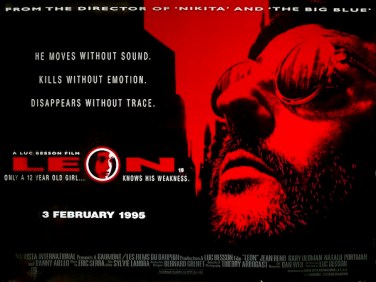
He moves without sound.
Kills without emotion.
Disappears without trace.

Also Known As: The Professional (USA) *shudder*
Country: France
Language: English
Runtime: 110 minutes | 132 minutes (version intégrale)
BBFC: 18 | 15 (version intégrale)
MPAA: R
Original Release: 14th September 1994 (France)
US Release: 18th November 1994
UK Release: 3rd February 1995
First Seen: VHS, c.1999
Stars
Jean Reno (Les visiteurs, Ronin)
Natalie Portman (Star Wars – Episode I: The Phantom Menace, Black Swan)
Gary Oldman (Bram Stoker’s Dracula, Tinker Tailor Soldier Spy)
Director
Luc Besson (Nikita, The Fifth Element)
Screenwriter
Luc Besson (The Transporter, Taken)
The Story
When her family are murdered by a corrupt police officer, 12-year-old Mathilda runs to hide with her quiet, reclusive neighbour, Léon. Turns out he’s a hitman, and she begins to train with him so she can exact her revenge…
Our Heroes
As the title character, Jean Reno’s child-like hired killer is likeable, sympathetic, and quite sweet — traits one wouldn’t typically associate with his profession. As his young ward, Mathilda, Natalie Portman is compelling, playing a hardened, emotionally bruised kid in desperate need of support and guidance, more so than she needs vengeance.
Our Villain
Gary Oldman brings pure entertainment value to the film in one of his most iconic performances: Stansfield, the crazy copper with a penchant for both drugs and quotable dialogue.
Best Supporting Character
There’s not much room for anyone else to stand out around the three lead performances, but Danny Aiello comes closest as Léon’s kindly mafioso handler, Tony.
Memorable Quote
Stansfield: “Bring me everyone.”
Benny: “What do you mean ‘everyone’?”
Stansfield: “EV-RY-ONE.”
Memorable Scene
As Mathilda returns home from buying groceries, she sees the door to her family’s apartment open and a man standing suspiciously outside. As she nears, she catches a glimpse inside — her father sprawled on the floor in a pool of blood. She keeps walking, pretending not to have seen, and approaches Léon’s door — where he’s been watching through his peephole. Trying to hold back tears, she rings his bell. Behind the door, Léon fidgets, not answering — he doesn’t want to get involved. She pleads under her breath. She rings again. The man at her door watches, suspicious. She rings again, desperate. Léon is torn… OK, you know all along what he’s going to do, but Besson’s direction and the performances from Portman and Reno ring every second of tension out of the sequence.
Letting the Side Down
Some people find the relationship between Léon and Mathilda problematic, and that gets in the way of their enjoyment of the movie. I’ve never seen it that way. Mathilda tries to inappropriately push herself on Léon, but he never takes her up on it. He’s a child himself in many ways and that side of life doesn’t seem to engage him at all, never mind in an unacceptable fashion.
Making of
The film’s second shot (still in the credits) is a tracking shot that travels along a New York road without stopping. It was only possible after studying the pattern of the traffic lights along the route to make sure the camera truck didn’t encounter any red lights.
Previously on…
The film was inspired by Jean Reno’s role in Besson’s previous film, Nikita (aka La Femme Nikita), in which he turns up in the third act as “Victor the Cleaner”, dressed in an outfit similar to Léon’s, to deal with Nikita’s botched mission.
Next time…
Besson wrote a script for a sequel focusing on a grown-up Mathilda. While they waited for Portman to age into the role, Besson left Gaumont to start his own studio, EuropaCorp. Unhappy at his departure, Gaumont have apparently refused to let him have the necessary rights. According to Olivier Megaton (the director of Besson projects like Transporter 3 and both Taken sequels) it will now likely never happen. Reportedly the script was recycled into Colombiana, which I am now 100% more interested in seeing.
Awards
7 César nominations (Film, Actor (Jean Reno), Director, Music, Cinematography, Editing, Sound)
What the Critics Said
“For Luc Besson, [Léon] is a poetic brute, a man without humanity who has lived so close to darkness for so long that he has lost all connection to the light. The universe around him, too, is a symbolic construction, an interweaving of opera, film noir and existentialism, where the larger-than-life forces of innocence and corruption explode in blood and violence. […] Reno plays it minimally; Oldman splatters his performance all over the screen. Oldman is the least inhibited actor of his generation, and as this deranged detective, he keeps absolutely nothing in reserve. When the camera gets close to him, you feel as if you want to back away. […] Stansfield’s signature is his passion for music. He thinks of everything, even his blood orgies, in terms of rhythm and color. You want Beethoven? he asks, picking up a shotgun. I’ll play you some Beethoven. Fortunately, Besson structures his film in much the same way. Not only does music play an important role in giving texture to his material, his scenes — especially the violent ones — are presented as arias, chamber pieces, symphonies.” — Hal Hinson, The Washington Post
Worst Spurious Connection in a Supposedly Professional Review
“A favorite of IMDb fanboys (who have absurdly — but predictably — ranked it the 27th best movie of all time!) and reportedly of pedophiles as well” — Matt Brunson, Creative Loafing (You’re right about one thing, though, Matt: 27th is ridiculous — Léon is top ten material.)
Counterpoint to Mr Brunson
“[It] would go on to become one of his most highly-regarded films among audiences. Sadly it was not thought of nearly as well by critics, merely receiving somewhat average reviews, giving us another sad oversight [and] proving that there are those times where the general audience can have more perception into a film than those that analyze them for a living.” — Jeff Beck, examiner.com
What the Public Say
“In spite of ranking on the top ten lists of many, many movie fans since its release, my love for [Léon] was not immediate. As a matter of fact I pretty much disliked it on the first and second outings because I couldn’t quite grasp what Luc Besson was going for with this film. It’s not an action movie, it’s more of a love story set to the tone of bloodshed and corruption, a subtle poetic masterpiece that relies on characterization and artistic strokes of pure raw emotion than some shoot em up gangster flick. […] I’ve come to truly appreciate what a pure piece of brilliant filmmaking this is and the loose allusions this has toward another Besson masterpiece La Femme Nikita. Everything about this film from the performances right down to the set pieces are like pieces of moving art, and Besson is the artist with the brush. […] Besson’s incomparable film is almost impossible to beat and there’s yet to be a director who could match his magnum opus. Even after almost twenty years, [Léon] stands as the superlative masterpiece of action filmmaking and has yet to be matched or toppled by any director in the business.” — Felix Vasquez, Cinema Crazed
Elsewhere on 100 Films…
I reviewed the extended “version intégrale” cut of the film in 2008, asserting that “I prefer this version. Not because there’s anything wrong with the original — far from it — but because this one has more. […] I love the film and the characters, I could happily take more of them, and I very much enjoyed all of the added material. […] Léon (in either cut) is unquestionably essential.”
Verdict
Léon delivers the kind of tense sequences of action you’d imagine of a dramatic action-thriller (i.e. not highly-choreographed punch-ups every five minutes, but the action scenes that do appear are suspenseful), but the film’s real joy lies in its characters, who are expertly performed and wonderful to spend time with (in a movie context — in real life, I wouldn’t be so sure…) As a whole, Besson brews the grittily realistic with something far more fantastical to create a film that is, perhaps, a little too unique for some to get a handle on (I’m thinking of the handful of low-rated critics reviews on Rotten Tomatoes, which fly in the face of the consensus opinion). For the majority, however, Léon is a gripping, characterful, rewatchable masterpiece.
#52 just can’t wait… to be king.

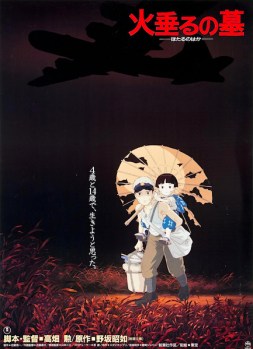 One of the most praised animated films of all time, this Studio Ghibli feature tackles grim subject matter: it’s the story of Seita and his little sister Setsuko, a pair of Japanese children who are orphaned and eventually left to fend for themselves in the closing months of World War 2. It begins with Seita dying of starvation and joining the spirit of his dead sister, so you know it’s not going to end well. A Disney movie this is not.
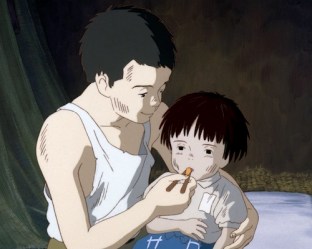 Another thing is that the film is often cited as a powerful anti-war movie, because it depicts the ravaging effects on innocents. However, director Isao Takahata insists it isn’t, saying it’s about “the brother and sister living a failed life due to isolation from society”. I’m inclined to believe him, because, from what we actually see on screen, these two kids are the only ones to be so badly affected! Okay, we do see people have died, and we’re told that food is running out… but there’s a gaggle of kids who seem to be having a fun day out when they stumble across the siblings’ makeshift shelter; or, right at the end, people who merrily arrive home and pop their music on. The film doesn’t try to claim that only these two kids suffered, but — aside from a few other destitutes at the start, and the bodies we see after the first bombing (later bombings don’t make any casualties explicit) — we don’t really see anyone else suffering. I’m not arguing that Takahata is saying no one else suffered, nor that these observations make it pro-war (I mean, any children dying, even if others are surviving, is not a good thing), but I didn’t get an anti-war message that was as powerful or as overwhelming as other viewers seem to have.
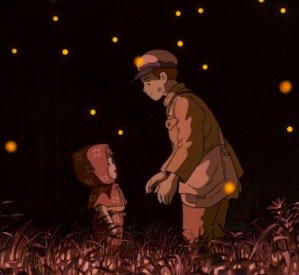 and, really, this story shouldn’t be “bearable”. That’s not to say you can’t feel an emotional connection to animated characters, but, as a medium, animation regularly deals in fantastical subjects, so with material this gruelling it does make it seem less real.
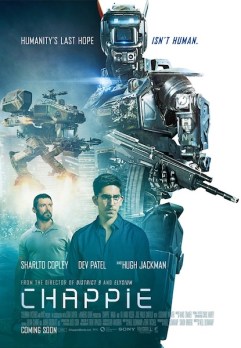 Neill Blomkamp seems to be on M. Night Shyamalan’s career path: a massively-praised Oscar-nominated breakthrough genre movie, followed by a series of increasingly maligned follow-ups.
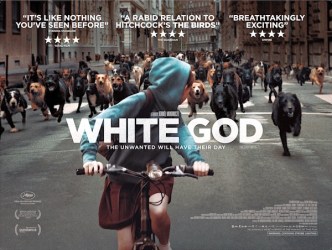 Thirteen-year-old Lili (Zsófia Psotta) and her dog Hagen are forced to temporarily live with her father, Dániel (Sándor Zsótér), because her mother is going on holiday with her new partner. Dániel doesn’t like Hagen anyway, but when the dog’s behaviour causes problems for him, he sets Hagen loose on the streets. Already angry with her father and his attitude, a devastated Lili sets out to find her beloved dog, who is busy discovering the darker side of mankind and our treatment of animals.
 For all the toughness of the journey, where it leads is triumphant; not entirely so, I must add, but enough. The film’s third act can pithily be described as Rise of the Planet of the Dogs: having seen the abuses of humans, an impounded Hagen leads a canine uprising that seeks to… well, they don’t speak (they’re dogs, remember, and this isn’t Disney), so who knows what their precise aims are? “Revenge” would be too cruel, but they definitely seeking some retribution. The film’s sadness doesn’t disappear (hence why not entirely triumphant), but some wrongs are righted.
 Some will find the middle of the film a slog, I suspect, both emotionally and with its occasionally lagging pace. However, the bookends seek to justify it. There’s catharsis in the finale, as described, but even better is the film’s opening. It has to be seen to be properly understood, but it’s operatically scored, shot, and edited, and involves hundreds (literally) of trained dogs en masse. It’s spectacular, unforgettable moviemaking; perhaps even one of the best openings to a film ever. And I don’t say that just as a “dog person”.
 Score:



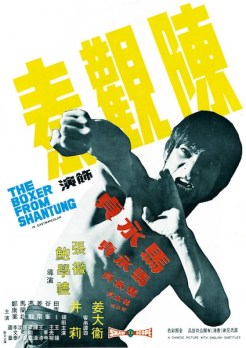 The problem with watching so many Shaw Brothers movies so close together, as I have this year, is they begin to blur into one. There’s definitely a house style to the stories, the photography, the sets — everything, really. Even the particularly good ones can fail to lodge in the memory as discrete units.
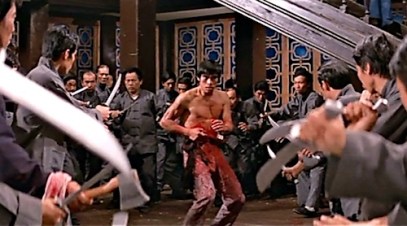 At the end of the day, tightly choreographed and expertly performed action sequences such as this are why we come to these movies; and, at the end of the day, The Boxer from Shantung doesn’t disappoint.
 Donnie Yen returns as the eponymous kung fu master, who’s most famous for training Bruce Lee, to complete a trilogy of biographically-dubious but broadly entertaining actioners.
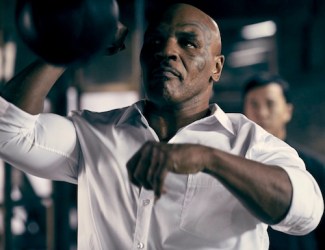 the less said about the film’s attitude to foreigners the better (though I guess Hong Kong’s British occupiers weren’t exactly above reproach).
 After an awkward first half, Ip Man 3 gradually transitions into a rewarding set of circumstances, on both the action and emotional fronts. The lack of consistency may mean it doesn’t satisfy fans as much as the first film did, but I’d say it’s a step up from the second, and definitely worth a look for fans of the old punching-and-kicking-and-hitting-each-other-with-poles-and-knives.
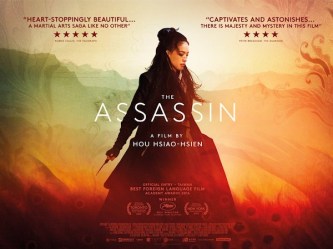 The Assassin is a martial arts drama about Nie Yinniang (Shu Qi), a woman trained since childhood to be a highly-skilled assassin. When her emotions lead her to renege on a mission, her master sets a difficult task for Yinniang to prove herself: she must return to her homeland and assassinate its leader, Tian Ji’an (Chang Chen) — her cousin, to whom she was once betrothed.
 So little happens at times that it’s very easy to become disconnected from it. At one point my mind wandered to other films it reminded me of.
 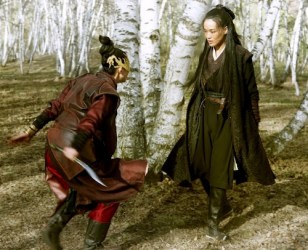 For all that, there is some action, but director Hou Hsiao-Hsien has said he’s more concerned about the before and after of a fight than the process itself — it’s about the mood, the tension, the ultimate outcome of winning or losing, rather than the choreography of the combat — so there’s a lot of build-up for very brief bursts of action. That’s certainly not an invalid way to handle it — it’s Leone-esque, in its way — but it does mean anyone looking for the detailed swordplay or fisticuffs you expect of a martial arts film will come away disappointed.
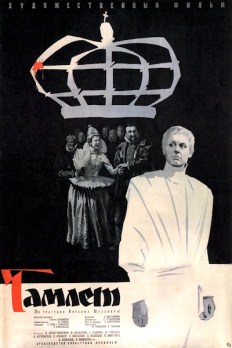 A black-and-white, two-and-a-half hour Shakespeare adaptation in subtitled Russian? No, wait, come back! Actually, don’t bother, because if you’re turned off by any or all of that description then, yeah, this isn’t for you. If you don’t object, however, then you’ll find a film that the likes of Sir Laurence Olivier, Sir John Gielgud, and Sir Kenneth Branagh have hailed as the greatest film adaptation of arguably the Bard’s most revered play.
 In the famously complex lead role, Innokenty Smoktunovsky gives a Hamlet who you really feel is more intelligent than everyone else around him — like a student fresh home from his studies, who has surpassed his parents and old acquaintances in sheer learning and attentiveness to philosophical topics, but doesn’t yet have a firm handle on his swirling thoughts. It’s possible he’s going genuinely mad with it, too, rather than the playfulness some choose to interpret in the part. Anastasiya Vertinskaya embodies sweet innocence as Ophelia, who Hamlet seems to genuinely care for, but has a poor way of showing it. Conversely, Mikhail Nazvanov makes for a somewhat neutered Claudius — he’s almost bumbling, outwitted by Hamlet but with enough innate power (he’s King, after all) to mask it. I suppose that emphasises the “student who’s outstripped his parents” point, but it doesn’t exactly make for a powerful villain. Still, different interpretations are always interesting.
 The visitation of Hamlet’s father’s ghost is another tour de force moment, the kind of visual impact that benefits not a jot from being described in text.
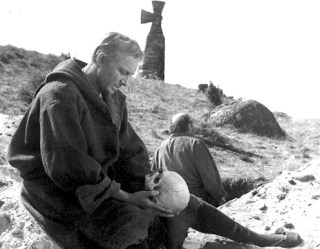 Even with the subtitle issue feeling like an obstacle to engagement, this was perhaps the most enjoyable Hamlet film I’ve seen. Maybe that’s because it has an advantage in that I’m now more familiar with the play (something which hindered Branagh’s version, as that was the first time I’d seen it), but it speaks to the film’s overall quality that it has more to offer than just Shakespeare’s words.


 I wasn’t as impressed as some were by
 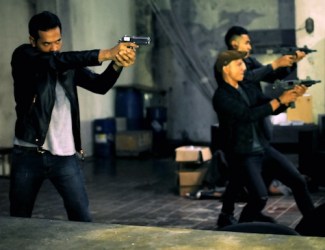 Where the first film was an efficient, simple thriller designed almost solely to link the startling action sequences, here writer-director Gareth Evans has created a sprawling crime epic. Anyone who’s seen the kind of gangster actioners Hong Kong cinema has produced since the ’80s or so will feel in familiar territory. That’s no bad thing, however, just a point of genre comparison. By expanding the world he’s created out in every direction, Evans has created a work that is not only bigger in a literal sense, but also deeper, more complex, and more interesting than the straightforward adrenaline rush of the movie that made his name.
 But as incredible as each of those are — and indeed they are — the highest of highlights is surely the car chase. There’s a chance you’ll have heard about this even if you’re not especially interested in the film: a bit of behind-the-scenes detail about how they achieved one particular shot went viral a couple of years ago. If you haven’t seen that, nor the film, then don’t seek it out — it actually kinda spoils it a little bit, knowing how it was done. (Without spoiling it, it was all done practically, whereas a Hollywood blockbuster would undoubtedly have done it with CGI — and spent as much on that one shot as Evans and co have on this entire movie.) The sequence is more than just one technically-impressive shot, however, but an exciting and innovative action scene all round, that definitely pushed the boundaries of the filmmakers’ capabilities (they had to get in a specialist outfit from overseas to help realise their ambitions).
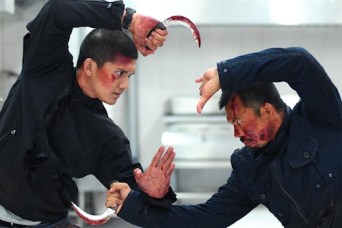 Most Hollywood blockbusters seem to push (or exceed) the two-and-a-half hour mark these days, and even when it fills that time, it feels like it’s partly because no one quite knew when to cut back. The Raid 2, however, feels suitably epic — just as you think a film that’s two-and-a-half hours long ought to feel, really.
 100Films.co.uk