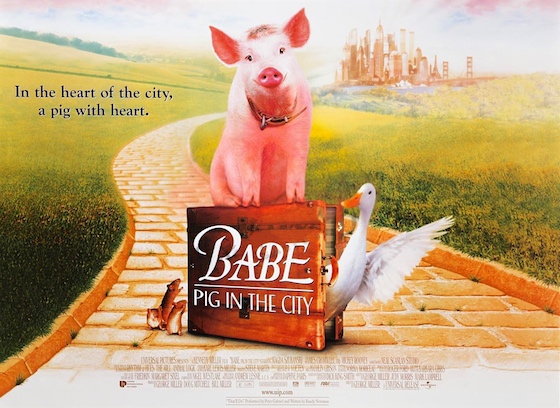
Babe: Pig in the City (1998)

2017 #42
George Miller | 92 mins | streaming (HD) | 1.85:1 | Australia / English | U / G

Babe: Pig in the City

Between making the first Mad Max trilogy and winning an Oscar with kids’ animation Happy Feet, George Miller produced beloved family flick Babe, which was such a success he took the directing reins for this follow-up. I remember it going down very poorly at the time — Rotten Tomatoes doesn’t quite support that, but a quick scan reveals many of the reviews to be retrospective. Some were wise to it from the off, however: Roger Ebert gave it full marks and his presenting partner Gene Siskel chose it as the best movie of the year! Not everyone’s got on that bandwagon (it still has a low rating on IMDb), but it’s definitely developed a cult following. Sign me up, because I too thought it was rather brilliant.

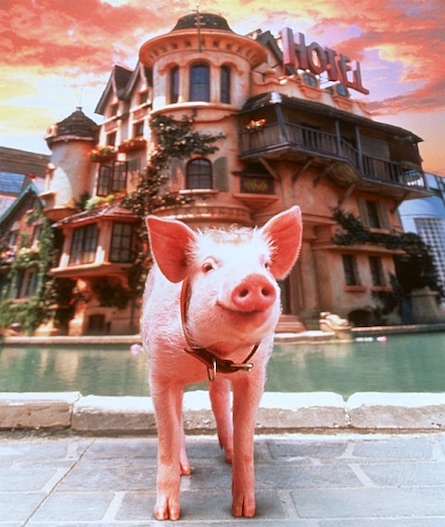
Set immediately after the events of the first film, it sees everyone’s favourite sheep-pig travelling to the big city to raise money to save his farm. There, he ends up staying at a kind of hotel for animals, and winds up in all kinds of hijinks. There’s no point trying to describing it — the movie is barking. Also oinking, and quacking, and… yeah, you get the joke.

In some ways it feels like a kids’ movie made for adults. Sure, it’s about cute talking animals, but a lot of the jokes are squarely aimed at knowing grown-ups, as is some of the emotional stuff, such as a scene where the Jack Russell is clearly running off to Heaven, which probably (hopefully, even) goes over younger children’s heads. As that may suggest, it’s also a very dark movie. Most of the darkness is eventually undercut, subverted, or rescued, but not always immediately — the situations are allowed to get bleak first.

Pig in a hotel

There’s an above-the-call-of-duty quality to the filmmaking, too. It’s lovelily designed, in a hyper-real cartoon-strip way, and beautifully shot, by Andrew “Lord of the Rings” Lesnie no less. Plus there’s a credits song written by Randy Newman and performed by, of all people, Peter Gabriel. And that’s not some kind of “they used a song by them” coincidence — its lyrics are based around the famous “that’ll do, Pig” catchphrase. Barmy.

Pig in the City made me really made me want to rewatch the original — I enjoyed it as a kid, but as an adult would I see all sorts of extra stuff that I missed before? Or was it the success of the “cute talking pig movie” original that gave Miller & co the freedom to cut loose in the sequel? Comments I’ve read suggest the latter. Well, even if Babe doesn’t merit revisiting as an adult, this sequel certainly does. I’m not sure I’ve ever seen anything else quite like it.

4 out of 5

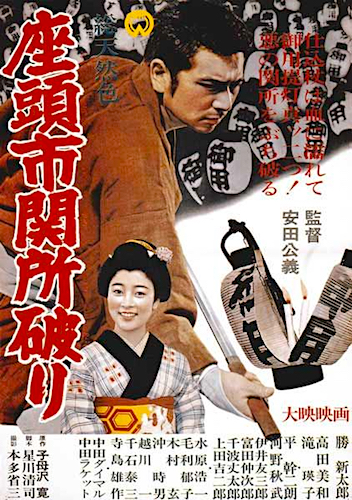
Adventures of Zatoichi (1964)

aka Zatôichi sekisho-yaburi

2018 #108
Kimiyoshi Yasuda | 86 mins | Blu-ray | 2.35:1 | Japan / Japanese

Adventures of Zatoichi

Another Zatoichi film (the ninth now), another super-generic title. Only in English, mind: best I can work out, the Japanese title translates as something like Zatoichi Breaks Through the Barrier or (considering what happens in the final act) possibly Zatoichi Guard Station Break-In. Even if you can’t translate it in a way that sounds reasonable in English, why not go for something like Zatoichi’s New Year? (That’s when the film’s set, and is referenced many times.) Okay, maybe it doesn’t sound super exciting, but at least it’s more distinctive than Adventures of Zatoichi, which could be literally any of the films.

Anyway, titling issues aside, the fourth and final Zatoichi film put out in 1964 (which I guess made the New Year thing even more appropriate on its original release) sees Ichi arrive in a village near Mount Myogi, where he intends to be for the first light of the new year. Lots of merchants have also gathered there for the festival, but the local yakuza are demanding an unreasonably high percentage of the takings as tax. Although this subplot facilitates some comic relief in the complaining of a pair of travelling performers, Ichi has other concerns on his mind: there are a couple of good-hearted young women who each need Ichi’s help defending them from the murderous stupidity of men. One, her brother has escaped prison and returned to town; the other, her father, a village elder, has gone missing and she’s looking for him. Both have something to do with the yakuza. In a slight twist on the usual formula, Ichi’s prodigious reputation means the gangsters are afraid of him (rather than assuming they can beat him), but he’s still got his work cut out getting to the bottom of a conspiracy between the gang’s boss and the local magistrate. That’s not to mention the intriguing connection Ichi finds with the village’s old drunkard…

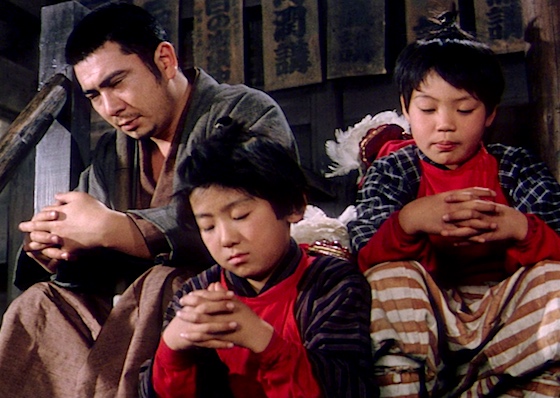
Z boys

Everyone else seems to rate Adventures of Zatoichi somewhat poorly. It’s ranked 20th out of 25 by Letterboxd users, the lowest of the series so far, and below some of the post-series Zatoichi films. The Digital Bits go even further, placing it in their bottom three (they haven’t ranked the films, but I checked all their ratings and they only gave three Cs). Other reviews include comments like “a workmanlike but satisfying episode” (Paghat the Ratgirl), “the quality level dips a notch after the outstanding original eight” (D. Trull), and “one of the more ordinary run-of-the-mill Zatoichi films” (Jacob Olsen). Not outright condemnation then, but definite damning with faint praise.

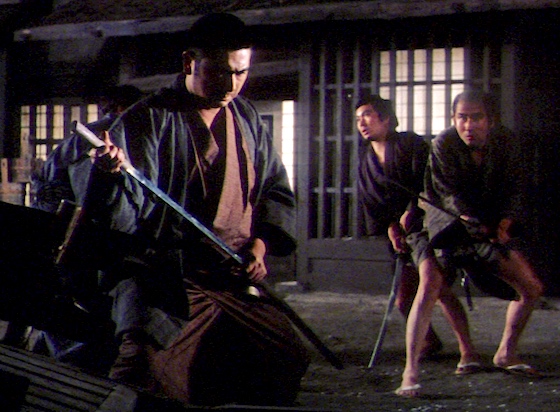
Conversely, I thought it was rather brilliant. It has a nice, clear, well-connected narrative (something I haven’t always found in previous instalments). There’s a great cast of supporting characters, lots of small roles who all make their mark. It creates almost an ensemble around Ichi, which is a nice change of pace — it really feels like it’s set in a bustling village, rather than a half-empty town where Ichi only encounters three or four people. Tonally the film displays an effective mix of humour, action, drama, and emotion, making for an all-round entertainment. It may not have a unique setup to mark it out like Fight, Zatoichi, Fight, or the flashy direction of Chest of Gold and Flashing Sword, but it’s an above-average example of “standard” Zatoichi. It even boasts another top-drawer climax, with a well-shot and precisely-performed one-on-one duel in gently falling first snow, followed by Ichi taking out a small army to get at the men responsible. Again, it’s not as exceptionally striking visually as some of the recent big finales, but it’s superbly done nonetheless.

Live by the sword, pretend to die by the sword

Also, the film contains one of my favourite moments of the series so far, which is both amusing and encapsulates the character of our hero. In it, Ichi slashes his way through four assailants, then pauses… a moment later, three of them drop dead. Seeing this, the fourth just… lies down beside them. Despite being blind, Ichi can tell the chap’s still alive; but rather than finish him off, Ichi simply motions for him to leave. It’s both funny and shows Ichi’s compassion: he kills because he has to, when people attack, not for the sake of it, or even for a grudge. Similar to this is his badass summation of what just happened near the end: “I only came here to worship the first light of the new year. I expected a quiet journey, with no need to draw the blade in this cane. You brought this all on yourselves.”

In fairness, the film is not without its problems. The early story about the merchants and the tax rate doesn’t really go anywhere. It establishes the magistrate and boss are bad folk, but then it disappears underneath the other storylines. Also, I didn’t get wholly invested in the conflict between Ichi and the gang’s yojimbo. These kinds of subplots always feel like a do-over of the first film to me, so maybe that’s why more time isn’t spent on it. It makes for a couple of impressive bursts of swordplay and one heart-to-heart chat, but no more than that.

Adventures of Zatoichi may not be the very best movie this series has to offer, but in revelling in its formula, and doing so much of it so well, it’s one of the films I’ve enjoyed the most. In fact, this would probably be a really good one to introduce people to the series: it’s got most of the key elements, all done really well. It doesn’t deserve to be as overlooked as it seems to be.

4 out of 5

Fight, Zatoichi, Fight (1964)

aka Zatôichi kesshô-tabi

2018 #76
Kenji Misumi | 88 mins | Blu-ray | 2.35:1 | Japan / Japanese

Fight, Zatoichi, Fight

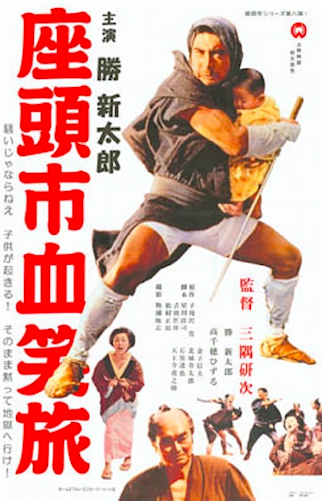
It’s a bit ironic that whoever chose the English-language titles* for the Zatoichi films decided to emphasise fighting in the name of this eighth instalment, because it’s perhaps the least concerned with Ichi’s sword skills so far. That’s not to say there aren’t a couple of nifty sequences of blade-clashing fun, but they’re not the film’s focus. You might think that’s antithetical to the series’ purpose, and yet Fight, Zatoichi, Fight is widely regarded as one of the series’ finest instalments, perhaps even the best of all.

It begins, as so many Zatoichi films do, with our hero on the run from some gangsters who want to kill him. Ichi accepts a ride from a pair of passing palanquin carriers, but his would-be assailants spot this and resolve to attack further down the road. Before they make their move, Ichi hears a woman struggling along with her baby, and insists she take the palanquin instead. The assassins don’t see the switch, however, and so attack nonetheless, killing the mother. Her papers reveal she was returning to her husband, the baby’s father, and Ichi, blaming himself for her death, insists he make the 65-mile journey to return the infant personally.

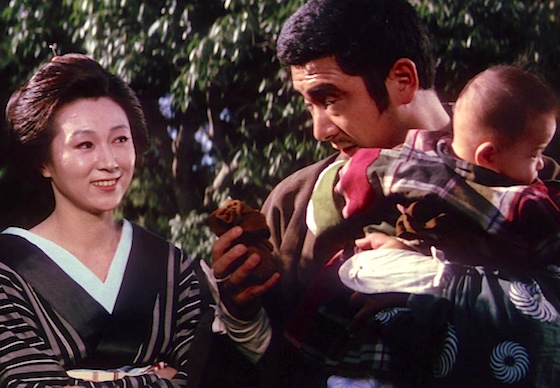
This is where Fight differs from the norm, because it’s at least as concerned with Ichi’s need to care for the child as it is with him fending off the assassins, who naturally pursue him on his way. The impromptu sidestep into de facto fatherhood leads to plenty of goofy comedy, much of it around bodily fluids, like when and where the baby pees, the stench of its used nappies, and also a scene where Ichi tries to get the kid to suckle on him while they wait for actual milk. Another amusing sequence sees Ichi hire a prostitute for the night, but only so she can look after the baby and he can get some sleep. But he keeps waking back up nonetheless, each time insisting on doing just one more thing for the child.

Family unit

You see, Ichi really cares for the kid, and this is where the other side of the equation comes in: as well as comedy, the situation also brings up a good deal of character-driven seriousness, as Ichi is forced to reflect on the lifestyle he has chosen for himself. No one is better than Shintaro Katsu at playing both sides, transitioning between warm humorousness and grim introspection in the blink of an eye.

But it’s not only internally that Ichi has cause to consider his lifestyle. Halfway along their journey, Ichi inadvertently saves the life of a female pickpocket, Ko, who he then employs to be the baby’s nanny — mainly so he can teach her better ways and reform her. But she’s a pretty young lady, so naturally she falls for blind old Ichi, and for the child too, and suddenly they’re a little family unit. Ko wants it to stay that way, for them to raise the baby together; and, despite his protestations to the contrary, Ichi has come to really like the child, and would probably like that life too. But, without spoiling anything, events transpire to make Ichi realise such an existence just isn’t possible for him, and he must do the right thing for the child’s sake. In the end, despite the laughter along the way, Fight, Zatoichi, Fight is a pretty emotional and sad film, with our hero ending up as he began, and as he always must: alone on the road.

Lest you think it’s too downbeat, let’s talk about the action! Despite being on babysitting duties, there are still some great fight scenes: there’s one where assailants keep bursting into a hut where Ichi’s trying to change the baby’s nappy (now that’s multitasking); and a gambling scene where he catches a cheating boss in the act, with an ensuing fight outside where Ichi keeps shh-ing his attackers because the baby’s asleep. Then the finale lives up to the series’ recent penchant for exciting visuals: the amassed villains surround Ichi with flaming torches in an effort to confuse his hearing, and as our hero slashes away at them even his clothing catches fire. Sure, we know he must prevail, but there’s real jeopardy in this one.

Fiery climax

So, in many respects, Fight, Zatoichi, Fight has it all. It’s even got a unity of story and structure that feels almost rare in the series — everything connects up, pays off, has relevance; unlike other films, which often seem to start with a bit of superfluous action or something. But what it has most of all is a storyline that is unique and emotional, and therefore memorable and affecting. It’s easy to see why the film is so often elevated as one of the series’ very best. It’s probably best appreciated as part of the series, rather than as a newcomer’s entry point, because part of its effectiveness lies in it being different from the norm. That said, it stands as an excellent film in its own right.

5 out of 5

(A quick caveat: although this is the first Zatoichi film I’ve given full marks, I would, with hindsight, award the same to the first movie as well.)

Fight, Zatoichi, Fight placed 20th on my list of The 26 Best Films I Saw For the First Time in 2018.

* I say “chose” because a literal translation would be something like Zatoichi’s Journey of Blood and Laughter. ^

Anon (2018)

2018 #95
Andrew Niccol | 100 mins | download (HD) | 2.39:1 + 1.78:1 | Germany / English | 15

Anon

Sky Cinema’s latest acquisition in their attempt to establish a “Netflix original”-style brand is, ironically, also a Netflix ‘original’… just not in the UK (in the US, it was released on Netflix last week). It’s also probably their most promising grab yet… although when its forerunners are Monster Family and The Hurricane Heist, that’s not saying much. But this is a new sci-fi/thriller from the writer-director of Gattaca, so that’s gotta be worth a look… even if he has spent most of the intervening two decades making some, shall we say, less-well-regarded movies.

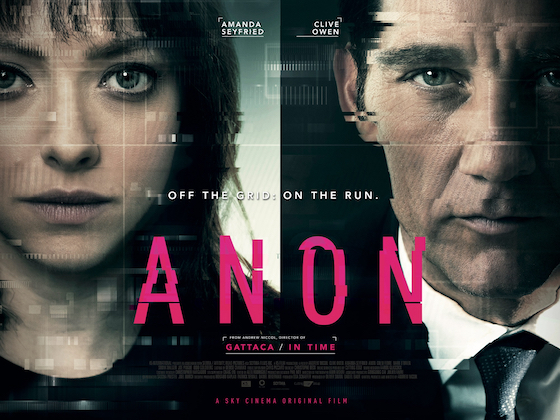
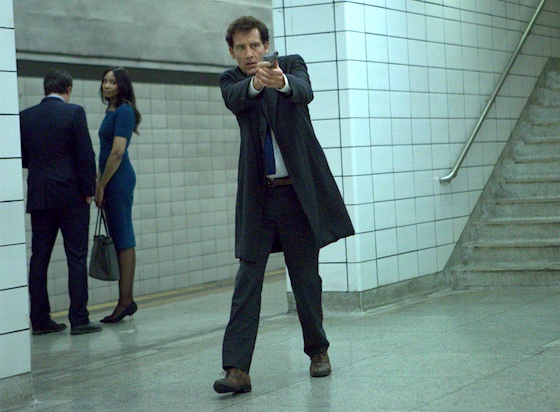
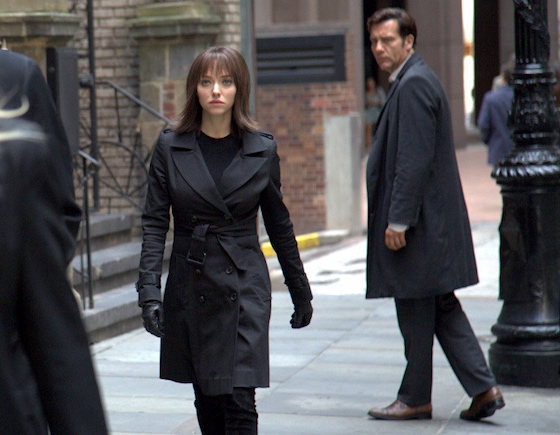
It’s set in a near future where everyone has ocular implants that feed a constant stream of data, like non-stop augmented reality, identifying people and places, putting digital adverts on the side of buildings, and so on. These devices are connected up to a central network that allows what everyone sees to be monitored and played back when needed — for example, if a crime is committed. It’s the ultimate eyewitness, literally. When someone’s murdered, the police can just play back the last few moments of the victim’s life to see the killer. But when bodies start turning up whose final moments have been tampered with, detective Sal Frieland (Clive Owen) finds himself on the trail of an off-the-grid hacker (Amanda Seyfried) with the ability to alter records — and when the entire system is based on the notion that what’s recorded is unequivocal truth, her skills are a massive potential threat.

Mad skillz

Many a lazy review has described Anon as “like a Black Mirror episode”, which is not wholly inaccurate but is getting to be a stale descriptor — Charlie Brooker didn’t invent high-concept dystopian sci-fi about the dangers of future technology, so why wheel out the comparison every time anyone else dares venture into the same ballpark nowadays? Nonetheless, that is the ballpark Anon is playing in, but mixing speculative sci-fi with an equal dose of hardboiled noir to keep things spicy.

That’s not my only problem with other reviews, though, many of which have put forth low scores and negative reactions. I saw some of them in advance of my viewing, so while watching I kept thinking, “it must go badly wrong later, because so far it’s great.” Well, that moment never came. I wouldn’t say the film is perfect — some parts, especially later on, are a tad hurried, meaning more clarity of motive would be nice — but, for me, the whole worked. There are some interesting sci-fi ideas (all the stuff about being able to trust what you see, including a standout extended sequence where the hacker messes with Sal’s head), plus it feeds some ever-relevant commentary on privacy and surveillance, with the added texture of a noir-shaped plot and atmosphere for good measure.

In fairness, there’s clichéd stuff too, though I’m not sure how much it should bother us. For one example, it’s not much of a spoiler to say that Sal has a “dead kid” backstory, something which is a bit overdone at this point, but your mileage will vary on how much that stuff bothers you — while some of us just think it’s a tired trope, for others it seems to completely ruin the film. Conversely, I read someone criticise it for using “noir clichés” and just thought “that’s called genre, kid”. I also saw a review which decided the film was worth 1-out-of-10 just because there was a scene where they were smoking indoors, so there’s no accounting for what different people will consider important in their assessment of artistic quality.

Gunning for other reviewers

In my opinion, Niccol and co have offered up a well-realised near-future world — not necessarily fully imagined (it’s never explained how we got to a point where everyone has these implants, seemingly enforced by law, but that doesn’t really matter), but the way the tech is depicted and how it affects everyday life is very believable. We’re thrown into the deep-end of this environment, with just enough exposition to keep up, before the film quickly moves onto the intriguing mystery that challenges the rules of this world — and considering we’ve only just learnt the rules, being able to get straight to how they’re being circumvented is impressively economical storytelling. It’s also a neat setup for having to go back to old-fashioned cloak-and-dagger-type detective work in a modern setting — this future is so high-tech, the only way to stop the criminal from detecting the operation against her is to put Sal undercover using no-tech communication.

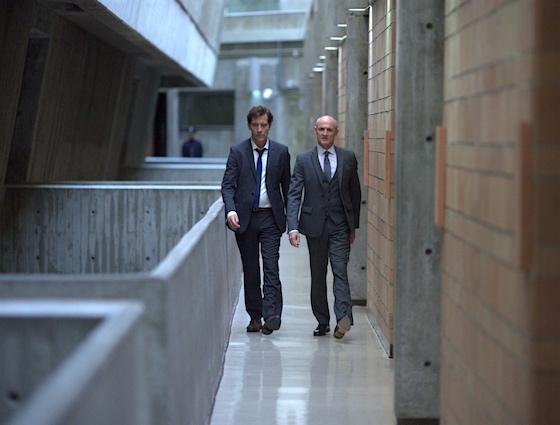
It’s a really well made film, too. The locations are suitably evocative — the police buildings are defined by huge brutalist concrete slabs — which have been attentively framed and shot, without show-off-y camerawork. Then there’s the on-screen graphics during the point-of-view shots, which are detailed and thorough in their content, design, and execution. Their plausibility lends an automatic verisimilitude to the whole situation. And the POV shots had another nice surprise in store…

Brutal

Regular readers may recall that I’m a fan of a good variable aspect ratio, so it was a pleasant surprise to find that Anon features that technique — it’s unusual to see it outside of huge-budget films that have been shot/formatted for IMAX, and even then there’s no guarantee the multi-ratio version will be widely available (cf. Marvel only including them on 3D Blu-rays; Brad Bird not allowing Ghost Protocol to be released with it at all). In Anon, the ‘drama’ scenes are presented in your movie-standard 2.35:1, but it expands to a screen-filling 16:9 every time we see through someone’s eyes. These changes are very effective. The film employs the technique early and then often, so it doesn’t have the “wow” factor that some IMAX films achieve even when viewed at home, but it’s suitably immersive. Indeed, this would probably play really well on a vision-filling IMAX screen. The fact I wouldn’t have a chance to see it even if it did get IMAX showings means I’m not too sad it’s a direct-to-streaming release.

That said, it’s kind of a shame Sky snapped it up over here. This is anecdotal evidence I know, but I know far more people with Netflix (like, pretty much everyone nowadays) than with Sky Cinema (I’m not sure I know anyone but me, actually, and I only subscribe occasionally), and I’d like to be able to recommend this to people, especially so as to go against the grain of the criticisms that I feel have been unwarrantedly negative. Well, obviously I can still recommend it, but how useful is that if people aren’t going to get the chance to see it on the basis of that recommendation?

Who's that girl?

Nonetheless, recommend it I shall. Perhaps Anon can’t equal other works at the top-tier of its genre, but I feel some have been unfair in writing it off. Any familiarities in the shape of its plot are in aid of creating that noir atmosphere, while the sci-fi concepts are reasonably considered and executed. For fans of the genres involved, it’s definitely worth a look.

4 out of 5

Anon is available on Sky Cinema from today.

The Cabinet of Dr. Caligari (1920)

aka Das Cabinet des Dr. Caligari

2017 #163
Robert Wiene | 77 mins | Blu-ray | 1.33:1 | Germany / silent (German) | U

The Cabinet of Dr. Caligari

The poster child for German Expressionist cinema, as well as featuring “cinema’s first true mad doctor” and “cinema’s first unreliable narrator” (at least according to David Cairns on the Masters of Cinema Blu-ray — I haven’t verified those statements for myself), The Cabinet of Dr. Caligari certainly has a lot to unpack for a film that’s barely an hour-and-a-quarter long. Or does it? Because one has to wonder if there’s an element of style over substance here.

“A mystery story told in the Poe manner,” according to the original Variety review, the titular Dr Caligari (Werner Krauss) is the host of a fairground attraction, and his eponymous cabinet contains Cesare (Conrad Veidt), a somnambulist who Caligari controls — at the fair, to answer questions from the audience; and at night, to do his evil bidding, including murder. Caligari’s activities come to the attention of young Franzis (Friedrich Feher), who attempts to uncover the truth about the doctor and expose him.

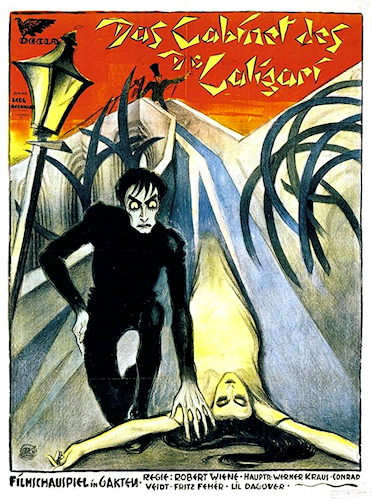
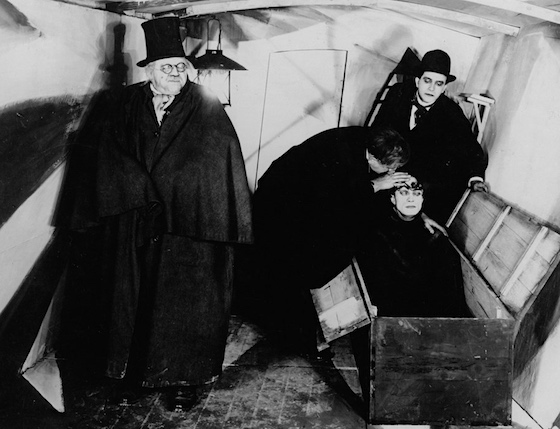
But the most famous thing about Caligari by far is not the storyline or the characters, but the visual style. Painted backdrops evoke a landscape straight out of a nightmare: jagged lines and stark monochromatic shapes (this isn’t just a film that happens to be filmed without colour, it feels black and white), they give the impression of the winding streets of a town and its locales without actually being one. The implied structures tower over the characters, leaning in above, creating an oppressive and unnerving atmosphere, while their total lack of reality evoke theatre more than the literalism we’re now used to from film. The make-up and performances are the same: heightened; dreamlike — or nightmarish.

Impractical architecture

Which may be entirely appropriate given the film’s framing narrative, which (spoilers!) introduce an ending that’s a little bit “and it was all a dream”. Or was it? Well, that depends how you interpret what happens. The bookends were apparently added to help sell the film to the public, framing its fantastical narrative in something more grounded. The screenwriters weren’t happy — as Lotte H. Eisner writes (in the MoC booklet), “the result of these modifications was to falsify the action and ultimately to reduce it to the ravings of a madman. The film’s [screenwriters], Carl Mayer and Hans Janowitz, had had the very different intention of unmasking the absurdity of asocial authority, represented by Dr. Caligari.” Well, the tacked-on ending doesn’t necessarily negate such an interpretation, you just need to fill in the blanks to get there yourself.

For example, there’s what Cairns calls his “Mulholland Drive theory”: that what we witness is all true, until the point that Franzis sees the asylum director is Caligari; from there until the reveal that Franzis is an asylum patient is a fantasy. Evidence in favour of this: everything goes implausibly swimmingly for our hero in that section, from easily recruiting the asylum staff to finding (as Cairns puts it) “Caligari’s second cabinet, in which he keeps his entire backstory.” It’s a fun reading, even though it’s clearly a case of projecting an interpretation onto the film that wasn’t intended by the makers.

One that fits better, perhaps, is that Franzis’ flashbacks aren’t merely “the ravings of a madman”, but he’s telling the truth, and that somehow between the end of his flashbacks (which see Caligari locked up in his own asylum) and where we join the framing narrative (with Franzis locked in the asylum and Caligari in charge), the evil doctor has reasserted his authority and captured his accuser. Of course, that requires a leap — how does Caligari regain control? Why don’t we see it happen? Well, we don’t see it happen because that wasn’t what the makers intended.

Suspicious activity

And so we come back to “it was all a dream”. Maybe that’s the best explanation — the writers may’ve hated it, but in some respects it saves them from themselves: Cairns’ visual essay highlights a bunch of plot holes, inconsistencies, and confusions, not to mention issues of character motivations and actions (“in a way it makes no sense to speak of character motivation in a mad man’s fantasy”), all of which you can hand-wave away if “it was all a dream”. This is why I wondered if it was style over substance. The sets, the make-up, the performances — all fantastically atmospheric. The story, the characters, their actions — not such great shakes.

But maybe that’s okay. After all, why not? Director Robert Wiene and his crew did a fantastic job of bringing a surreal nightmare to life, and nightmares seldom feature plausible storylines.

4 out of 5

The Cabinet of Dr. Caligari was viewed as part of my Blindspot 2017 project, which you can read more about here.

ManHunt (2017)

2018 #94
John Woo | 109 mins | streaming (HD) | 2.35:1 | China & Hong Kong / Japanese, English & Mandarin | 15

ManHunt

John Woo’s latest movie is now “A Netflix Film” in the UK, US, and presumably some other territories too. After almost 15 years spent making period dramas, it’s a return to the contemporary action-thriller genre that made his name. Whether it represents a return to his previous quality… well…

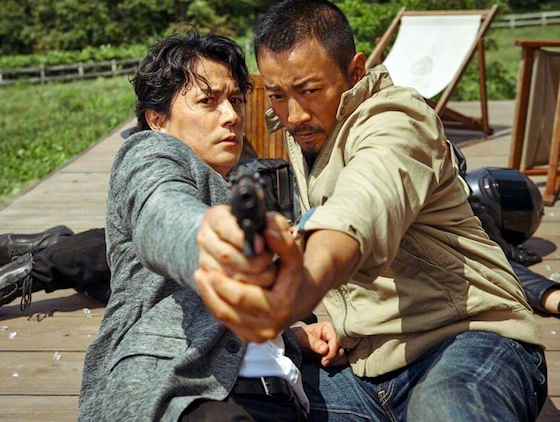
ManHunt introduces us to Du Qiu (Hanyu Zhang), a Chinese lawyer for a Japanese pharmaceutical firm, credited with saving the company when he won a court case three years ago. Now he’s leaving to head to America, but the company’s president tries to persuade him to stay by sending a sexy lady to wait at his house. Unfortunately for Du, when he wakes up the next morning she’s dead and he’s the prime suspect. Soon he’s on the run to clear his name, with hot-shot cop Yamura (Masaharu Fukuyama) on his tail, though he’s not convinced of his target’s guilt. That’s just the start of it — why would someone want to frame Du for murder? Well, it gets complicated…

For the first half of its running time, ManHunt is a baffling experience. Not so much because of the plot — though that sets so many wheels in motion that one must pay attention — but because of how it’s put together. One major problems is the way it casually mixes together multiple languages, leading to some flat translations (that’s being kind — maybe the screenplay, which comes courtesy of seven screenwriters, was unexciting to begin with) and clunky line delivery. But hey, this is an action movie, so we can forgive some iffy performances. A greater barrier to enjoyment comes in the form of Taro Iwashiro’s underpowered, plinky-plonky score. That might be fine during chatty scenes, but it continues into the early action sequences, robbing them of pace, dynamism, and excitement. It’s a thoroughly bizarre choice that undermines the film’s raison d’être.

Not chuffed to be cuffed

With its unoriginal innocent-man-on-the-run story and disengaging production quirks, it’s tempting to give up on ManHunt before the half-hour mark. However, director John Woo does begin to sneak in some of his trademark flair. One particularly good bit sees Yamura and his new partner visit the crime scene to go over what they think happened. Woo mixes together their reenactment with flashbacks in interesting, increasingly overlapping ways… until the sequence ends with the female officer getting hysterical, the old-fashioned-ness of which undercuts the sequence a little right at the end.

As the various plot strands kicked off at the start begin to come together, the film becomes increasingly worth watching. If you can make it through the first half, the second begins to revel in its own silliness. It stops mattering that everyone has to deliver dialogue in at least two languages but none of them can actually act in more than one. It stops mattering that the plot barely makes sense — in fact, it actually improves the crazier it gets. A framed man on the run? Yawn. A pharmaceutical company searching for a secret formula to perfect the currently-lethal super-soldier drug it’s testing on homeless people, which is in the possession of the widow of a former employee they killed for alleged corporate espionage, and using drug-enhanced hitwomen to do its dirty work while corrupt addict cops cover up the indiscretions of its president’s son? Awesome. And the action finally kicks into gear too, gradually shifting first into having some good moments, then into whole sequences that are worth your time. Is it all too little too late? Kinda. But at least it rewards those prepared to stick with it.

Sharing is caring

In many ways I should give ManHunt just 2 stars, but that would be to ignore the fact that I’m glad I watched it. But if a 3-star rating is any kind of recommendation, here it’s a very cautious one.

3 out of 5

ManHunt is available on Netflix now.

Zatoichi’s Flashing Sword (1964)

aka Zatôichi abare tako

2018 #50
Kazuo Ikehiro | 82 mins | Blu-ray | 2.35:1 | Japan / Japanese

Zatoichi's Flashing Sword

Zatoichi’s built up quite the reputation by the beginning of this seventh adventure: his previous escapades have left many gangs gunning for him — literally, as it turns out, because the story begins with Ichi getting shot by an opportunistic nobody. Fortunately for everyone’s favourite blind masseur-cum-swordsman, the guy’s clearly not a great shot, and a friendly passerby sees to it that Ichi gets the care he needs. Later Ichi sets about tracking down his mysterious benefactor, which puts him in the middle of a conflict between two gangs — what else is new? This time they’re arguing over a free fireworks display and the rights to provide a river crossing service. Sounds a bit less violently dramatic than normal, doesn’t it? But when gangsters don’t get what they want…

Flashing Sword offers a more straightforward story than some other instalments of the Zatoichi series: the opposing sides and their differences are thoroughly established, and one gang are even clearly the good guys! Makes a change from Ichi having to pick between the lesser of two evils and/or trying to wipe out both sides. Some other reviewers seem to find the story simplistic or lightweight. Conversely, I appreciated the clarity of approach, and thought the film found different ways to add complexity beyond pure plot gymnastics.

Did somebody mention gymnastics?

Playing out as more of a drama than some of the other films, the events here have something of an emotional impact on our roving hero. As the two sides argue in low-key fashion, Ichi’s involvement in the conflict is limited, and so he settles into the home he’s been welcomed to as a guest, to the point where he almost seems ready to settle there. Well, we know he never will, but that’s dramatic irony for you. It’s the same with the pretty young lady that Ichi once again finds himself involved with (all the ladies love a blind man, it would seem) — we know they’ll never end up together, but the characters have to find that out for themselves. This time, Ichi is robbed of his possible dreams in particularly cruel fashion, as the bad guys scheme to force the good boss’ hand. Ichi finds out the truth, but by then it’s too late — all that’s left is for him to take revenge.

And that brings us to one thing everyone can agree on: that the film’s climax is spectacular. First Ichi stalks around the enemy HQ, hidden in nighttime shadows, picking off the guards in small clumps. Then he faces the army of gangsters head-on, as the sound of fireworks explode outside; then he extinguishes the candles so that his adversaries must, like him, fight in the dark; and finally the combat moves outside, the fight unfolding in an elegant bird’s-eye tracking shot, lit by the multicoloured fireworks overhead. It’s another example of great direction by Kazuo Ikehiro, who also helmed the previous film. He seems to have been reined in here — the imagery isn’t quite as consistently striking this time — but there’s loads of great stuff nonetheless, and the finale is the best of it. Derek Hill of Images describes it as a “long, messy climax [that] rewards viewers’ patience with one of the most memorably over-the-top finales that the series has produced thus far.” Todd Doogan and Bill Hunt of The Digital Bits call it, simply, “a classic.”

Colourful action

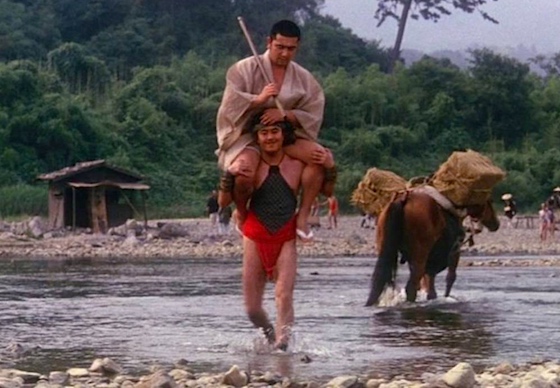
The earlier parts of Flashing Sword put Ichi in a comedic role (extended skits include a bit about him being too heavy to carry comfortably across the river, and another where he’s served spoiled rice that he proceeds to smear all over the room), but during the climax he becomes something else entirely — Walter Biggins of Quiet Bubble describes him as “a demonic avatar”; Paghat the Ratgirl reckons he “captures something of a Dark God in his physical presence and prowess.” Never is this sense clearer than when he finally comes face-to-face with the enemy boss, Yasugoro. Portrayed by Tatsuo Endo, he’s a very good villain: preening with confidence when he’s winning, a cowering coward when losing, always blighted by a stutter. As with all good villains, they bring out the truth of our hero: even as Yasugoro smashes tiles on Ichi’s head, making him bleed (gasp!), the blindswordman stays true to his word and doesn’t draw his sword… until Yasugoro draws first, and Ichi abruptly cuts him down.

As I mentioned earlier, a few of the other reviews I’ve read are a bit down on Zatoichi’s Flashing Sword, though Letterboxd users do rank it in the series’ top ten best instalments (just). I’m more aligned with the latter. Although it may seem more simplistic than some of the series’ other films so far, it puts that apparent plainness to meaningful use, and boasts arguably the series’ greatest action sequence to date as a capstone.

4 out of 5

Zatoichi and the Chest of Gold (1964)

aka Zatôichi senryô-kubi

2018 #24
Kazuo Ikehiro | 82 mins | Blu-ray | 2.35:1 | Japan / Japanese

Zatoichi and the Chest of Gold

The sixth film in the Zatoichi series (and the first of four released in 1964) begins with blind masseur Ichi (Shintaro Katsu) paying tribute at the grave of a man he killed (Ichi must spend most of his time pinballing from one such grave to another). Afterwards he stumbles upon a group of celebrating villagers — they’ve finally managed to scrape together enough money to pay the taxman the thousand ryo they owe. But when that money is stolen, Ichi happens to be in the wrong place at the wrong time and is accused of being involved in the theft. He sets out to clear his name — and, despite the abuse they hurl his way, also get the villagers their money back, because he’s that kind of fella.

What unfurls is one of the series’ typically fiddly plots, characterised by a shortage of explanation about who’s who, meaning it requires attention to work out what’s going on sometimes. I’m beginning to wonder if this is a cultural issue; by which I mean, would these stories be easier to follow for Japanese viewers? Or is it just a particular feature of the Zatoichi series’ plots? Mind you, other reviews note how straightforward the story is this time out. Perhaps the problem is just getting to grips with who’s who — these films don’t always lay that out neatly. Once you have a handle on that then, yes, Chest of Gold’s story is pretty linear. It does try to play something of a twist about who’s behind the theft of the money, but that revelation shouldn’t come as a great surprise.

Nighttime meeting

None of this is to say Chest of Gold is a poor film. Far from it. For one thing, it’s probably the most artfully directed Zatoichi film so far. Or if not artfully then certainly energetically — it’s full of more unusual angles and editing tricks than the previous films put together. But director Kazuo Ikehiro isn’t just a show-off, knowing when to not over-complicate matters: if a sequence calls for a simpler series of shots (in a dialogue scene, for example) then that’s what we get. The cinematography looks superb too, with a palpable richness. It was lensed by Kazuo Miyagawa, who also shot Rashomon and Yojimbo for Akira Kurosawa and Ugetsu Monogatari and Sansho Dayu for Kenji Mizoguchi, amongst other noteworthy work. When you hire the best, etc.

Their talents extend to filming the action scenes, which are some of the series’ best. They’re brief but furious, especially one where Ichi takes down a convoy of executioners, including a compliment of musketeers, filmed in a single take with a simple pan. Such understated filming lets Katsu’s combat choreography be front and centre. There’s an unexpected and quite vicious epilogue fight scene too, described by Chris D. in his Criterion notes as “one of the highlights of the series”. That’s against Jushiro, one of the series’ greatest villains, who’s just as menacing when comparing Ichi to a worm as he is when wielding his whip or sword. He’s played by Tomisaburo Wakayama, who previously appeared as the second film’s antagonist, but is a different character here.

Bathtime meeting

It’s quite a brutal and adult film all round, actually: there’s blood spurting all over the place in several of the fight scenes (a first for the series); a sequence where three of the villagers are cruelly tortured; and a somewhat risqué scene where our masseur hero gets a special kind of massage himself, from a very obliging woman who, to Ichi’s surprise, expects payment after… though when he gets a whiff of her hand…

Chest of Gold doesn’t deviate from the Zatoichi formula so much that it feels out of place, but it does have enough unique and memorable elements to mark it out. It’s the series’ best entry since the first, and, based on other reviews and rankings, seems likely to remain near the top of the list.

4 out of 5

The Villainess (2017)

aka Ak-Nyeo

2018 #35
Jung Byung-gil | 124 mins | streaming (HD) | 2.35:1 | South Korea / Korean | 18

The Villainess

After taking bloody revenge on the people who killed her father, skilled combatant Sook-hee (Kim Ok-vin) is arrested and then forcibly recruited into a secret government agency who want her murderous skills. In exchange for ten years of her life and abilities, she’ll get a new identity and her freedom. As Sook-hee adapts to her new situation, flashbacks fill us in on her past — and the role it still has to play in her future.

There are obvious similarities to Luc Besson’s Nikita in that setup, but, frankly, I haven’t seen that movie in a long time, so I’m afraid you’ll have to look elsewhere for a more in-depth comparison than “hey, this is a bit like that!” The Villainess isn’t selling itself on the freshness of its premise, anyway — to most potential viewers, the primary attraction is the freshness of its action sequences. On that, it delivers, and then some.

It starts as it means to go on, opening with an eight-minute tightly-choreographed (fake-)single-take mostly-first-person killing spree. It’s a giddy display of violence that’s sure to entertain those of us who are so inclined. Many more hyper-kinetic, just-as-awesome action sequences follow over the next couple of hours. A motorbike chase that is also a sword fight (!) was a particularly memorable one for me (as I mentioned in last month’s Arbies). That’s also done in a ‘single take’ — if there’s one thing director Jung Byung-gil loves, it’s a fake single-take action sequence. If there’s another, it’s spurting blood — apparently if you strike anyone anywhere you’ll hit an artery and the red stuff will be squirting all over the place.

A sword fight... on bikes!

While the action scenes will be the focus for many viewers, there’s also a surprisingly effective emotional story at the film’s core. It even stops being an action movie for a bit in the middle to become a kind of romantic drama, which sounds ridiculous, but it works. There are plenty of twists and revelations involved in the storyline, so no spoilers here, but I will say it’s ultimately a pretty bleak film — it goes places I don’t think many straight-up action movies would dare. Well, certainly not Hollywood ones, anyway.

And none of that is to say it betrays its action roots — this isn’t one of those films that’s trailed like an action movie but, actually, only has a couple of stunts and is mostly something else. No, this really, really pays off just as a two-hour adrenaline kick; but it’s also, simultaneously, something more complicated. Put both sides together and I think there’s a good chance this will, deservedly, become regarded as a genre classic.

4 out of 5

The Villainess is available on Netflix UK from today.

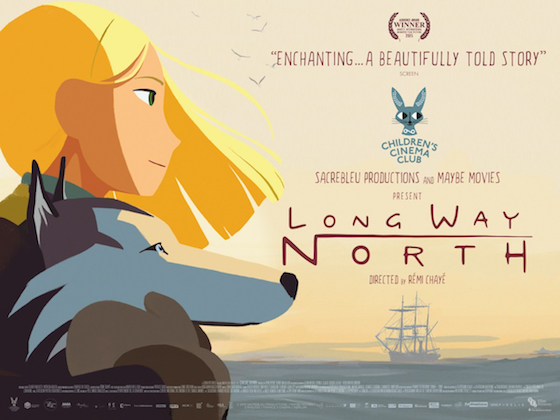
Long Way North (2015)

aka Tout en haut du monde

2017 #33
Rémi Chayé | 78 mins | streaming (HD) | 2.35:1 | France & Denmark / French | PG / PG

Long Way North

I can’t remember what brought this French-Danish animation to my attention, but I’m glad something did because it’s a beautiful little film that deserves to be better known. Set in the late 19th century, it’s about a young Russian girl, Sasha, who embarks on an adventure to the North Pole, following in the footsteps of her missing grandfather.

Regular readers may recall I ranked it among the top movies I saw last year, when I cited the “understated beauty in its deceptively simple visual style”. Indeed, the animation initially seems so plain that it feels like watching a draft animatic, but that conceals its ability to reveal subtleties when needed. In the end, the distinctive look is part of the film’s considerable charm.

I also mentioned its “equally subtle but strong feminist streak”, another positive aspect. Sasha is strong-willed and capable, but not without her faults, which makes her an engaging heroine. The film doesn’t overplay its “girls can too” side, which only makes it more successful, I think.

There’s none of the epic action sequences or broad humour that most English-language animation assumes kids need to keep them engaged, but instead Long Way North offers good characters on a proper old-fashioned exploration adventure. Highly recommended.

5 out of 5

Long Way North placed 13th on my list of The 17 Best Films I Saw For the First Time in 2017, which can be read in full here.