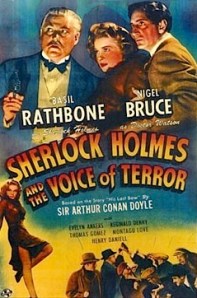
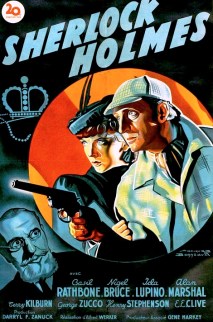
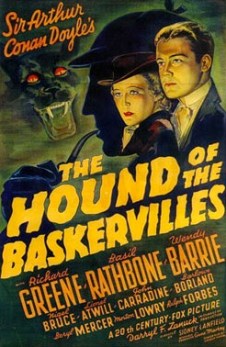
Sherlock Holmes in Washington (1943)

2009 #1
Roy William Neill | 68 mins | DVD | U
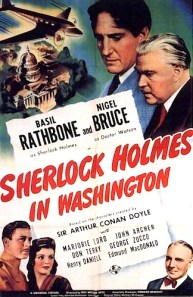
Sherlock Holmes in WashingtonThe last of three World War 2-concerned films in the Rathbone/Bruce series (the previous two being The Voice of Terror and The Secret Weapon), and once again more a spy thriller than a traditional detective tale. That’s not to say Holmes’ abilities as a detective aren’t present — in fact, he does a very reasonable amount — but if you switched him for a generic British Intelligence agent the plot would be unlikely to suffer and the dialogue probably wouldn’t need much work.

Certainly, the quality of Holmes’ detection is a bit of a mixed bag. Some scenes do demonstrate his brilliant reasoning, but others stretch credibility to the limit, for example when he manages to work out what’s been transported in a blanket. Another disappointing moment sees Holmes in awe of and “forget” about modern scientific methods, which seems rather at odds with the highly intelligent detective at the forefront of his field that we see in the original tales. It’s more than a little like the filmmakers have taken the character and methods from his 19th Century setting and dropped (rather than adapted) him into the present day. It’s these little inconsistencies that are arguably most bothersome when such a spy thriller claims to be a Holmes film.

Other deduction scenes do work, however, such as when Holmes enjoyably reasons the hiding place of the matchbook, the film’s MacGuffin. Unfortunately, this sequence suffers from a total lack of tension as we already know where it is. This leaves us watching Holmes play catch-up, and there’s no sense of a race-to-the-prize because we don’t see how the villains’ hunt is progressing. Said matchbook is put to good use in another sequence where it is unwittingly passed around at a party. This is perhaps the most simple and obvious thing to do with such a MacGuffin, but at the same time it’s an always-effective idea. On the other hand, when the matchbook ends up back where it started one has to conclude that this sequence is no more than padding.

One of the more striking elements of the film is it being Holmes’ first trip to the States (on screen in this series, at least). It’s highly praiseful of America, of course, and spends a good bit of time on a travelogue-style showcasing of sights, continuing with Watson remarking on US papers, trying out gum, and more. It makes a change of scene for the series, but also feels a bit self-congratulatory on the part of the American production team, which can be more sickening than the British patriotism of the previous two entries. While that may be national bias on my part, it seems a bit unlike Holmes too. There’s also the prerequisite patriotic closing quote, though at least this time it’s from a British character about US-UK relations. Still, intentional or not, Rathbone delivers it with an almost unwilling flatness.

Elsewhere, Watson’s bumbling comedy is occasionally unobtrusive, occasionally grating, but occasionally raises a smile. Best is the scene where Holmes has him play various characters in a reconstruction, although there’s more mileage in that than the film manages. In complete contrast to this, the film’s villains are a particularly brutal bunch, murdering for no real reason and torturing women.

By the time the film limps to a sudden conclusion at an antiques shop, the quality of the film has become reminiscent of the quality of Holmes’ detection: a mixed bag.

3 out of 5

This review was written over three months after seeing the film, based entirely on notes made at the time and my rather poor memory. Apologies if it is therefore a bit unfocussed or, God forbid, inaccurate in the odd minor fact.

Sherlock Holmes and the Secret Weapon (1943)

2008 #75
Roy William Neill | 66 mins | DVD | PG

The name’s Holmes, Sherlock Holmes, as Universal’s loose adaptations of Britain’s Greatest Detective deliver a low-key proto-Bond, 22 years before Goldfinger applied the same tricks to Britain’s Greatest Spy.

“How so?”, you might ask. Well, Holmes has been employed as a spy for His Majesty’s Government; it begins with an ‘end of the previous adventure’ almost-action sequence that would undoubtedly take place before the opening credits now; there’s a war-winning weapon at stake; a bit of globetrotting (albeit just from Switzerland to London); some double-crossing and side-switching; even a surprisingly nasty torture sequence; a nice race-against-time final act; and an equally-matched villain, with a secret lair, who has devised a clever death for our hero. So the lair is just a house with soundproofing and unbreakable glass, but that’s not a bad effort — I don’t think there are many volcanoes to hollow out in the London area. It may be Bond on a World War Two London scale, but the feeling is there.

I discussed the controversy (for a modern audience, at least) of this updated setting in my last Holmes review, and it’s even more abundant here — seeing Baker Street as a victim of the Blitz, and 221B surrounded by sandbags, is very odd indeed — but at least it employs several elements from a variety of Conan Doyle’s plots, and it’s not unreasonable to assume that, given his skills of deduction and disguise, Holmes would’ve been employed as a spy had he been ‘alive’ during the war. In fact, Holmes actually does some detecting this time, whereas in Voice of Terror he seemed to meander around a bit, and employs several disguises, even if some of them are about as much cop as one of those glasses-nose-and-moustache masks. Of course, it would help the mystery if its solution wasn’t revealed before Tobel (the inventor of the titular war-winning weapon) was even kidnapped, but you can’t have everything.

What lets the film down more is Lionel Atwill as a weak Moriarty, supposedly the film’s grand villain. It’s not all his fault — for one example of poor writing, Holmes deduces the final code after an accidental clue from Watson, while Moriarty gets it by clumsily spilling water over a copy, hardly displaying great powers of deduction — but he doesn’t compare to the scheming, cunning Moriarty we saw played by George Zucco in The Adventures of Sherlock Holmes. On the plus side, the ease with each Moriarty outwitted Holmes in that earlier outing made our hero look a bit ridiculous, whereas here Holmes gets to outwit his nemesis a couple of times, including a particularly nice denouement.

As with Voice of Terror, I enjoyed a lot of Secret Weapon in spite of its distinct un-Holmes-ness — it’s another pacey, exciting World War Two spy thriller. It’s better than its immediate predecessor on the whole, though a spot of miscasting nearly persuaded me to remove another star.

4 out of 5

Sherlock Holmes and the Voice of Terror (1942)

2008 #74
John Rawlins | 63 mins | DVD | U

Despite the success of their two Sherlock Holmes films (The Hound of the Baskervilles and The Adventures of Sherlock Holmes, both 1939), Fox decided the character was outdated and resolved not to make any more. Universal clearly disagreed, and the popular pairing of Basil Rathbone and Nigel Bruce reprised their roles three years later for this, the first of twelve Holmes films the studio would make with the duo in just five years.

There’s more change afoot than just the logo at the start, however, as Holmes and Watson are dragged from their typical Victorian setting to London in the midst of World War Two. For a modern audience, who definitively associate Holmes with the Victorian era, this move seems virtually incomprehensible and sacrilegious; but Conan Doyle’s original Holmes stories take him as far as the start of World War One, so bringing the character another 28 years forward is little worse than, say, relocating the 1980 novel The Bourne Identity to 2002. Nonetheless, the filmmakers were aware of the problem even at the time, choosing to open the film with a title card that asserts Holmes to be “immortal… ageless, invincible and unchanging” in the hope that audiences would accept a then-present-day setting.

Whether the setting bothers you or not, the story itself might. The basic concept is a nice idea for a war-set spy-thriller, but not really for a Sherlock Holmes mystery. There are plenty of audience-pleasing applications of his ‘impossible’ deduction skills, such as the moment when Holmes concludes someone dislikes him based on the depth of footprints left in a carpet (never mind that the character huffily ignored Holmes when he came in), but the main plot involves a minimal use of these abilities. It’s also loaded with implausible elements — why would the Nazis waste bombs on empty fields (to disguise one plane going a different route) when they could have used them on genuine targets? Why are recordings shipped to Germany and broadcast back, rather than just broadcast from England? Worst of all, what’s going on with Rathbone’s haircut? The final twist is either genius or ludicrous, I’m not sure which; and the misguided reference to Holmes’ deerstalker (he’s promised not to wear it — why?) is, well, misguided.

It’s not all bad. As mentioned, the basic storyline is a good one, providing decent entertainment once it gets going; Holmes gets plenty of amusing lines, which manage to provide more genuine laughs than Watson’s incompetence; and there’s some lovely shadow-drenched photography — though the film’s even more drenched in patriotism, to the point of propaganda at times.

The consensus seems to be against me, but by the end I was quite enjoying Voice of Terror. It may be a Sherlock Holmes film in name only, but taken instead as a cheap spy thriller it makes for passable entertainment.

3 out of 5

The Adventures of Sherlock Holmes (1939)

2008 #39
Alfred Werker | 79 mins | DVD | PG

The Adventures of Sherlock HolmesNever mind waiting two or three years for a sequel these days — after the 1939 Hound of the Baskervilles was a box office success, Fox had a sequel out just five months later! I reviewed that first Rathbone/Bruce film back in February, promising an irregular series reviewing the further thirteen pictures the pair starred in. Well, I’ve finally got round to watching the second, and while I was a tad harsh on the first I found myself enjoying this one more.
The Adventures of Sherlock Holmes pits the titular detective against his arch-nemesis, Moriarty, in what’s really speaking a relatively weak plot — most depressing of all is how easily Moriarty’s plan to distract Holmes almost succeeds. But never mind that! There’s rain-lashed, fog-drenched Victorian London streets! Brutal murders by foul foreigners! Dastardly plots against the crown! Galloping carriages! Romantic subplots! A smattering of comedy! A song-and-dance number! (No, really, there is.) And a final shoot out… in the Tower of London! You can’t escape the joyous feeling that this was designed as pure entertainment, literally including something for everyone.

Bruce’s Watson may bumble about too much for the purists (me included, more often than not), the murder plot lacks proper explanation (the production notes on Optimum’s DVD pleasingly expand on this), Rathbone’s characterisation of Holmes may be a touch too friendly… but by then I’m just nitpicking. This sequel is atmospherically, entertainingly and excitingly executed, and that’s plenty good enough for me.

4 out of 5

The Baskerville Curse (1983)

2008 #25
Eddy Graham | 67 mins | DVD | U / G

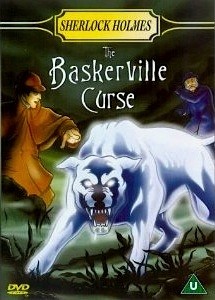
The Baskerville CursePeter O’Toole is Sherlock Holmes (well, his voice) once again in this animated Conan Doyle adaptation from the ’80s (see also my reviews of two others, The Sign of Four and A Study in Scarlet). Of course, this is an adaptation of that perennially popular Holmes story, The Hound of the Baskervilles, and as such O’Toole barely features. A shame, as he’s the only half decent thing in this mess.

As I’ve previously expressed, The Hound of the Baskervilles is not my favourite Holmes story, though it has its moments and there have been some enjoyable screen versions. Unfortunately, this pointlessly renamed offering retains all of the original’s faults but loses most of the best bits, despite wasting time on train journeys, telegram writing and pointless flashbacks to things we saw just minutes earlier. The animation is poor, even for a production of this level, with dire character design and a total lack of atmosphere (it opens with jolly music over views of primary-coloured countryside!) There are further flaws, but there’s no point wasting any more time going through them. I can only hope that the final entry in this series, The Valley of Fear, will be closer in quality to the other two instalments.

In retrospect, I’m certain I underrated the 1939 adaptation of The Hound of the Baskervilles. I’m equally certain that I shall have no such regrets over this lame attempt.

1 out of 5

The Baskerville Curse featured on my list of The Five Worst Films I Saw in 2008, which can be read in full here.

The Hound of the Baskervilles (1939)

2008 #9
Sidney Lanfield | 77 mins | DVD | PG

The Hound of the BaskervillesArguably the definitive screen interpretation of Sherlock Holmes and Dr Watson, played by Basil Rathbone and Nigel Bruce, appear for the very first time here, in what would become the first in a series of 14 pictures starring the pair. (Incidentally, this will be the first in an irregular set of reviews of that series. I have the rather lovely Optimum box set, you see, and so shall slowly work my way through it. Though as I’ve already owned it for several years and only just started watching it (as with so many DVDs), I have no idea how long it will be before I finish.)

I’ll start by laying my cards on the table: The Hound of the Baskervilles is a vastly overrated Holmes tale, and one that has been unduly adapted at least 15 other times (that from a quick search of IMDb). As far as I can tell its popularity is primarily due to the circumstances around its original publication (it was the first Holmes story in nearly a decade, following his death in The Final Problem). Holmes is absent for much of the story, which plods along fairly uneventfully (or, at least, inconsequentially) until a slightly dubious climax involving a centuries-old portrait. Naturally, all of these flaws carry over into any faithful adaptation, and this certainly is one.

One of the novel’s strong points is its occasional Gothic styling, and this is something the film version does very well. Dartmoor looks fantastic, like something Tim Burton would have created were he working in the ’30s. It’s clearly a set, but it’s dramatic and moody and completely effective. After the dull and poorly-designed interior scenes in London, it’s fantastic when the film finally moves down into Devon and things… well, don’t exactly get going, but at least there’s something to look at! As with the novel the plot meanders by, diverted by an escaped convict and an entirely pointless (in this version at least) seance, until that painting-based resolution. All is not lost, however, as a particularly vicious-seeming attack by the hound livens things up considerably.

Rathbone is underused as Holmes, which is a shame as he immediately makes the part his own. Bruce isn’t as bungling and comedic as he would later become, though the signs are already beginning to show. And the infamous final line — “Oh Watson, the needle!” — is actually a huge anticlimax if you haven’t seen it before, an entirely pointless, meaningless and misplaced addition.

I feel like I’ve come down a little harshly on Hound of the Baskervilles, mainly thanks to a general unfavourable opinion of the source material. There are many better Holmes stories, often ignored thanks to the fame of this particular one. The following 13 films may be even less faithful adaptations than this, but I’m looking forward to their fun and frivolity, which will hopefully top Baskervilles. The moor really is fantastic though.

3 out of 5

A Study in Scarlet (1983)

2007 #97
Ian Mackenzie & Alex Nicholas | 48 mins | DVD | U

A Study in ScarletPeter O’Toole is again the voice of the famous sleuth in this disappointing animated adaptation of the first Sherlock Holmes mystery.

The adaptation is faithful to the original novel’s structure (sadly, as it’s a somewhat bizarre one, and ripe for a more interesting interpretation), but loses any elements pertaining to Holmes and Watson’s first meeting. The animation seems more basic than the other entry in this particular series that I’ve seen, and O’Toole’s performance is flatter. The rest of the cast don’t fare any better. The story itself isn’t a bad one, but after being pleasantly surprised by The Sign of Four, I just found this to be disappointing.

2 out of 5

The Sign of Four (1983)

2007 #83
Ian Mackenzie & Alex Nicholas | 47 mins | DVD | U

The Sign of FourA slightly unusual one to review, this: it’s a 49-minute animated Sherlock Holmes adaptation from the ’80s, one of four in this particular series. But, as best I can tell from IMDb, it’s not specifically TV-based, and it does feature the voice of Peter O’Toole. Vocally he makes for a good Holmes, though the character design could be a little better. I can’t recall the original story well enough to comment on this as an adaptation, but it’s a decent mystery that’s well explained. The animation is not bad; certainly no worse than most kids’ TV animation from the ’80s and ’90s, and better than the flat Flash-animated stuff of today. A solid production.
3 out of 5

Basil the Great Mouse Detective (1986)

The Great Mouse Detective2007 #3
Ron Clements, Burny Mattinson, Dave Michener & John Musker | 71 mins | DVD | U / G

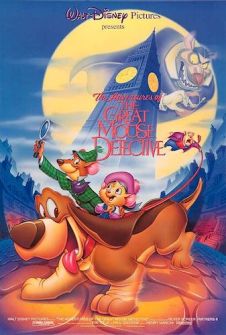
A seriously underrated Disney film, though it does appear to have a substantially large cult following based on it being seriously underrated.

If you like your Disneys musical this may be one to avoid, though the couple of songs present are quite decent, but if you’re a Sherlock Holmes fan you should definitely catch it.

4 out of 5