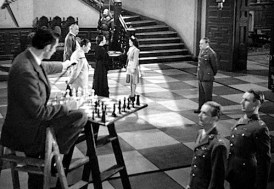
The Pearl of Death (1944)

2013 #15
Roy William Neill | 66 mins | DVD | 4:3 | USA / English | PG
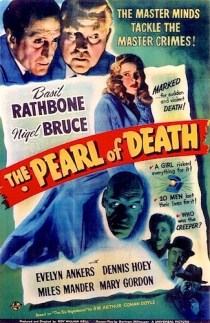
The Pearl of DeathThe Pearl of Death is one of the better-regarded films of the Basil Rathbone Sherlock Holmes canon, but somehow it didn’t quite click for me. That doesn’t meant there isn’t a lot to enjoy, however.

The story this time is adapted from Conan Doyle’s The Six Napoleons, and the main mystery seems to be pretty faithful. It’s a rather good one too, involving the hunt for a stolen item — the titular Borgia Pearl — that has been hidden in one of six china busts — the multiple Napoleons of Doyle’s title. It’s dressed up here with some nice touches: Holmes first rescues the priceless Borgia Pearl, but then quite spectacularly loses it. The notion of Holmes being doubted, of having to prove himself to reassert his reputation, is a good one — one recently borrowed by avowed Rathbone fans Moffat & Gatiss for their modern-day Sherlock, in fact. The film attempts to build up villain Giles Conover as a Moriarty-level nemesis, including borrowing some text from The Final Problem to describe him. Unfortunately, Miles Mander doesn’t quite convey the menace to pull it off, but Conover is a fair match for Holmes in places.

Evelyn Ankers and some other chapsElsewhere, Nigel Bruce gets to indulge in a slapsticky scene that, as ever, people who dislike this interpretation of Watson would be happy to do without. Also worth noting is the female lead, British actress Evelyn Ankers: she was a regular fixture of Universal’s horror features, terrorised in no less than The Wolf Man, The Ghost of Frankenstein, Son of Dracula, The Mad Ghoul, Captive Wild Woman, Jungle Woman, Weird Woman, The Invisible Man’s Revenge, and The Frozen Ghost! (Plus a previous Holmes film, Voice of Terror, to boot.)

The series’ regular director, Roy William Neill, manages his usual atmospheric and exciting touch in places, but others are a slight let down — both involving characters kept in shadow and their eventual reveal. The opening sequence features a disguised Holmes; supposedly disguised to the audience too, though I imagine many will guess it’s him. He’s mostly kept in shadow, on the edge of frame, or with his back to the camera — it’s quite effective, in fact. Sadly, there’s no commensurate whip-the-disguise-off reveal.

Later in the film, the monstrous Hoxton Creeper is shown in silhouette most of the time, with everyone talking about how disgusting ‘it’ is. Unfortunately, when it comes to finally revealing his hideous visage in the final moments… he just sort of turns around to listen to a moderately interesting conversation. Considering all the points when the Creeper could have been revealed to good effect, The Borgia Pearl... OF DEATHNeill somehow managed to pick one of the least dramatic. Neither of these reveal fudges are ruinous, of course, and are outweighed by the handling of sequences like Holmes setting off the museum’s alarm, the ensuing robbery, the villains stalking round a potential victim’s house, and so on. Still, I was surprised to find them so wanting.
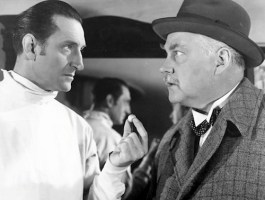
The Pearl of Death won’t find a place amongst my very favourites of the Rathbone Holmes series, but I feel I may have, for some reason, been expecting too much from it. Only niggles and incidental points let it down, rather than anything fundamental, and a future reappraisal may one day bump it up in my estimation. Nonetheless:

4 out of 5

The Scarlet Claw (1944)

2012 #46
Roy William Neill | 71 mins | DVD | 4:3 | USA / English | PG

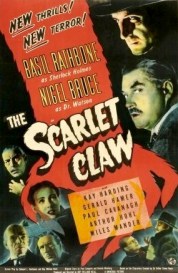
The Scarlet ClawAccording to Wikipedia, “David Stuart Davies notes on the film’s DVD audio commentary* that [The Scarlet Claw is] generally considered by critics and fans of the series to be the best of the twelve Holmes films made by Universal.” That’s always a bold kind of assertion to make (it’s never trouble-free to define an entire fandom’s favourite), but I can still believe it’s true: The Scarlet Claw is marvellous.

When looking it up before viewing I was surprised to find it had a spot on the Top 500 Horror Movies (voted by users of IMDb’s horror boards, apparently), where it had a place in the lower 300s. I was surprised — Holmes is a detective series, not one I’d think of nominating for such a list. But there is one arguable exception to that — The Hound of the Baskervilles, of course — and it’s clear that Scarlet Claw draws significant inspiration from that preeminent entry in the Holmes canon. Lists of similarities are available for them that wants them, because I think Scarlet Claw does enough to merit consideration in its own right.

And it really is a horror movie too. There’s not just the elements of occult in the myth of the Canadian town Holmes and Watson find themselves in almost by chance, which you always know will be debunked in a Sherlock Holmes plot, but also the way the production is staged. Indeed, the film’s scariest sequence occurs after it’s revealed that the killings are being committed by a mere human — The Black and White Mista properly chilling murder scene, quite out of step with the film’s age and PG certificate.
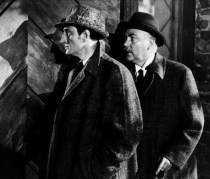
A lot of this is thanks to director Roy William Neill. On a previous review of mine, Ride the High Country’s Colin noted that Neill “turned out some quality low-budget stuff for Universal. He had a real knack for creating a spooky and mysterious atmosphere that’s evident in his horrors and thrillers.” This film demonstrates that fact more than any Holmes yet. His direction is incredibly atmospheric, from a wonderful mist-covered opening scene, replete with an incessantly tolling bell, to regular instances of shadow-drenched photography afterwards; not to mention various pleasing camera angles and moves.

The story — in which townsfolk believe a mythical beast has returned to murder its residents — presents a well-constructed mystery all round, though as it moves into the second half some of its twists become all too guessable. There simply aren’t enough supporting characters to provide any meaningful sense of having to ponder who the villain might be (because, as I noted, you know it’s not really a beast). Holmes and WatsonThere’s also a hefty dose of coincidence that everyone involved, both on screen and off, conveniently ignores.

If we’re looking at the flaws, there’s a return for the painful closing speech from Rathbone, this time a Churchill-quoted ode to the wonder of Canada. Ugh. Still, you half expect it from this series, and it’s very easy to ignore.

The other little niggles may stop the film from being perfect but, like the similarities to The Hound, while they’re certainly there, they’re easy to overlook in the name of a rollicking good horror-mystery-adventure.

4 out of 5

The Scarlet Claw merited an honourable mention on my list of The Best Films I Saw For the First Time in 2012, which can be read in full here.

* I could verify this for myself, but I haven’t, so… ^

Sherlock Holmes: A Game of Shadows (2011)

2012 #44
Guy Ritchie | 129 mins | Blu-ray | 2.40:1 | USA / English | 12 / PG-13

Sherlock Holmes A Game of ShadowsIf 2009’s Sherlock Holmes was Batman Begins — a re-introduction to a well-known hero and his entourage of secondary characters as they tackle a (second-string/unheard-of) menace in their home city — then A Game of Shadows is The Dark Knight: a globe-trotting epic against the famous, formidable nemesis attempting to drive the world to destruction. Unfortunately, the analogy doesn’t extend to the film’s extraordinary step-up in quality.

Before the first film’s release, accusations flew that Ritchie’s take on Holmes wasn’t faithful enough. Some of these persist, but as I noted in my original review I think they’re pish: yes, this series gives a blockbuster action/comedy spin on the character, but it remained a Sherlock Holmes tale. This is less true of the sequel. There’s still some detective work, but it comes in brief flashes here and there. The big denouement does pick up on scattered (deliberately-)easily-missed clues from throughout the film, but only to provide a standard Explain The Villain’s Grand Plan scene. A ballroom scene where Sherlock looks around the room, seeing “everything” through a series of quick-pan fast glimpses of stuff, highlights an inferiority to other current versions — where those certain others let us in on what Holmes is learning from his quick glances, here we just see some stuff. In short, it’s not Sherlocky enough.

Most of the other elements that made the first film a success are present and correct though. The banter between Robert Downey Jr.’s Holmes and Jude Law’s Watson zings as well as it did first time, A game of smokethough perhaps not always as memorably, and Ritchie crafts an array of interesting action sequences. Some still accuse it of being a sub-Matrix rip-off, which I personally think shows a lack of attention or imagination on the part of those viewers — there’s more to what’s going on here than that. There’s a wit The Matrix films never had, for one thing, and more twists on the format. The trick of having Holmes explain what he plans to do as we see it in slow-mo, before executing it at full blistering speed, is repeated but also subverted in multiple ways.

Plus the action is just finely staged full-stop — there’s a fun alleyway fight to open proceedings, a sprawling brawl around a London gentlemen’s club, a fun duel around a moving train (much seen in the trailers), and a stunningly unusual race through some woods away from a German munitions factory (coincidentally (I imagine) a bit like Captain America, but with better CGI; and also much seen in trailers). Those are the big numbers, but smaller-scale sequences come and go throughout. In many ways it pings from one action scene to another, a plot cropping up occasionally to provide a link between them.

A game of beardsYet for all that, that climax is a game of chess: Sherlock and Moriarty come face to face while in the room next door Watson and gypsy Simza try to spot an assassin. It’s one of a couple of scenes where Downey Jr.’s hero comes face to face with his nemesis, played by Jared Harris, and these scenes are definitely some of the film’s high points. Harris makes a perfect addition to the cast, the only disappointment being that we don’t get to see even more of him. Downey Jr.’s become such a Movie Star recently that it’s easy to forget he’s a multiple Oscar-nominee, and he and Harris give as good a hero-villain act-off as you’re likely to find in a blockbuster.

Other big-ticket cast additions include The Girl with the Dragon Tattoo herself, Noomi Rapace, seriously underused as the aforementioned gypsy fortune-teller Simza, who turns out to be central to the plot. The size and scope of her role actually fits the story, pretty much, and it wouldn’t have mattered if they’d cast a European ‘unknown’, but by making a fuss of casting That Acclaimed Actress From Those Acclaimed European Films and giving her third billing attention is drawn to how little she has to do.

A game of cameosBetter served is Stephen Fry as Mycroft, a role normally rendered as a brief cameo. And indeed it’s little more than that, but there’s more of him than I was expecting (certainly so in one (pointless aside of a) scene that I’m sure you’ve heard about), and Fry of course excels — it’s the kind of role he was made for. Meanwhile the award for best agent goes to Eddie Marsan’s: Lestrade appears late on for all of two shots, but Marsan is still billed high enough to be on the poster, above most of the cast.

A quick mention also for Hans Zimmer’s score. I enjoyed his work on the first film and he delivers again here. Zimmer’s one of those big Hollywood blockbuster composers whose work can all sound the same (I watched The Lion King just the other day and could definitely hear Piratical elements in there), but here he injects a bit more variety into his oeuvre. It’s not just the departure from his usual style that works, it’s that there’s a mixture of styles within the movie itself, each well suited to their own sequence while still blending as a whole.

A game of drinksA Game of Shadows comes out as a fun ride with several stand-out moments, but not as a particularly exceptional version of Sherlock Holmes. It’s very enjoyable as a comedy-action movie with amusing characters and entertainingly-staged action sequences, but while my affection for the first has grown to make it one of my favourite movies, this is just an entertaining follow-up.
4 out of 5

Sherlock Holmes: A Game of Shadows is out on DVD and Blu-ray in the UK from today, and in the US from June 12th. Ha-ha.

The Spider Woman (1944)

2011 #96
1944 | Roy William Neill | 60 mins | DVD | U

It’s the second season finale of the brilliant Sherlock tonight, so what better time to post a review of another Holmes adaptation that’s based in part on the infamous The Final Problem

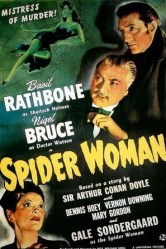
The Spider WomanThe seventh feature starring Basil Rathbone as Sherlock Holmes and Nigel Bruce as Dr John Watson is the first since Hound to drop Holmes’ name from the title and, at under an hour (59 minutes 33 seconds in PAL, to be precise), is the shortest yet.
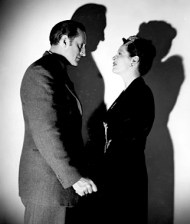
It’s previously been asserted (in this blog’s comments) that The Spider Woman is “one of the best of the series”, and it’s certainly a strong effort. Screenwriter Bertram Millhauser (who also wrote the previous two films, and would go on to pen two more) skillfully mixes elements from various Conan Doyle tales — while I spotted two or three, Wikipedia says the full list includes The Sign of Four, The Final Problem, The Adventure of the Empty House, The Adventure of the Devil’s Foot and The Adventure of the Speckled Band.

As they’re combined here, the story sees Holmes fake his own death to help tackle the Irene Adler-esque titular woman, apparently his intellectual match, who’s somehow causing a spree of suicides. Several of these borrowed elements — the faked death and The Woman — lead to some delicious scenes, such as when Holmes reveals he’s alive to Dr Watson, offering one of those occasions where Bruce’s comedic rendition of the role actually works; or when an incognito Holmes meets the woman, who is actually aware of his true identity. Indeed the woman, played by Sherlock Holmes vs the Spider WomanGale Sondergaard, is so good that they crafted a sequel around her, albeit Holmes-less. I’ve not seen it and don’t own it, so I’ve no idea what that does for its quality.

The mystery itself is solid enough, but that’s not necessarily the point of these Holmes adventures. They’re not play-along puzzles like an Agatha Christie adaptation, where there’s a set of definite clues and a finite number of suspects, but rather exciting tales that whip you along their incredible path — adventures indeed. You can certainly see the (deliberate) tonal link between these ’40s films and the modern-set Sherlock, or indeed the pair of Robert Downey Jr. films.

At the halfway point of the Rathbone-Bruce films (it’s only taken me four years to get this far), the series is still producing exciting, good-quality re-arrangements of Conan Doyle’s works. And I’m assured there’s more to come. Fantastic.

4 out of 5

A Study in Terror (1965)

2011 #66
James Hill | 91 mins | TV | 1.85:1 | UK / English | 15

A Study in Terror“Sherlock Holmes vs. Jack the Ripper” would be the easiest way to describe this pulpy ’60s effort. It’s far from the only example of this sub-sub-genre: Murder by Decree did it 14 years later, and goodness knows how many novels and short stories have attempted it. But I’ve not seen or read any of those, so I’m afraid I can’t compare.

Judged in its own right, then, it’s a decent Holmes movie, with an atmospheric rendering of Victorian London and a passably intriguing plot. However, the relatively light basis in the true story of Jack the Ripper may grate with some who approach it from that angle: there’s a Holmesian plot grafted onto a smattering of Ripper facts, as opposed to using Holmes to deduce one of the posited real solutions. As entertainment, though, that doesn’t hold it back.

That said, I didn’t feel it all quite made sense — someone sends Holmes a clue at the start of the story, with no explanation as to what it’s got to do with anything, Whore killin'and though by the end it’s explained who sent it, I was none the wiser what they’d been intending. And I watched the revelation scene twice too. Still, at least the important bit — who the murderer is ‘n’ all that — is quite neat.
Also watch out for Judi Dench in a small early role, and Barbara Windsor getting killed. Marvel, with hindsight, at which one’s got the bigger role and is higher billed.

3 out of 5

Valley of Fear (1983)

2011 #64
Warwick Gilbert, Alex Nicholas & Di Rudder | 48 mins | DVD | 4:3 | Australia / English | U

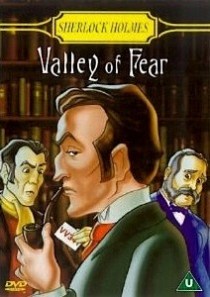
Valley of FearI don’t recall how exactly I came across these animated Sherlock Holmes adaptations starring the voice of Peter O’Toole as the eponymous detective, or how I came to decide to view all of them, but it’s been almost four years since I reviewed the first… and three years since I reviewed the third. Now, finally, I get to the final episode. Such is the erraticism of using LOVEFiLM. (At least I have an excuse for my dawdling here — my incredibly slow viewing of all the Rathbone/Bruce Holmses is entirely my own tardiness.)
This series started decently for me, with a moderately promising adaptation of The Sign of Four, but then slid gradually downhill to an atrocious version of The Hound of the Baskervilles. Valley of Fear isn’t as bad as that, but nor does it represent a massively significant increase in quality.

The negatives of the previous films still remain, primarily the weak ’80s TV animation. It’s not as badly designed as the bright-and-colourful version of Baskervilles, at least. O’Toole’s performance is nothing to write home about either. The story is perhaps the least-well-known of the four Holmes novels, and while it has its moments — mainly in clever deduction, often the best bit of any Holmes tale — this version is unlikely to change anyone’s mind on that fact.

Having quite liked the first of these adaptations that I saw, it’s a shame the other three haven’t lived up even to those expectations (it was only a three-star effort, after all). Ah well.

2 out of 5

Valley of Fear featured on my list of The Five Worst Films I Saw in 2011, which can be read in full here.

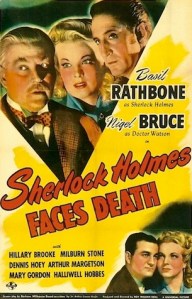
Sherlock Holmes Faces Death (1943)

2010 #79
Roy William Neill | 65 mins | DVD | U

After a shockingly long absence, I’m finally getting on with watching the Rathbone/Bruce Sherlock Holmeses. (I started this series over two-and-a-half years ago now — I think I’m watching them slower than they made them!)

Sherlock Holmes Faces DeathHe’s put down the hound of the Baskervilles; silenced the voice of terror; uncovered the secret weapon; had, um, some other adventures; and, uh, been to Washington… but now, Sherlock Holmes faces death!

Not a man in a black robe with a scythe, just, y’know, the threat. Of dying. Except there’s no threat, really. I suppose Sherlock Holmes Does Some Investigating With No Real Threat To Himself doesn’t sound quite as dramatic.

Nor, it would seem, does The Adventure of the Musgrave Ritual, the popular Conan Doyle story on which this film is loosely based. It’s not a tale I’m familiar with so can’t accurately comment on the faithfulness of screenwriter Bertram Millhauser’s adaptation, but it concerns the Musgrave family and their ancient ritual, so as the Rathbone/Bruce films go it’s practically word-for-word. It isn’t actually, of course, because the ritual at least has been changed significantly. Whatever the qualities of the original, the chess-based screen variant works marvellously.

Faces Death leaves behind the proto-Bond WW2 spying of the last three films (“it can almost be viewed as the starting point of a completely new Holmes series” asserts one review I’ve read) to involve Holmes in a genuine detective mystery (though still set during the war, it’s less front-and-centre). The story is packed with proper deduction, which is excellent, and to top it off Watson isn’t as bumbling as he could be, not that Bruce’s characterisation improves. Most of the humour comes, more appropriately, from a typically useless Lestrade, as well as frequently-drunk butler Brunton.

Relocated in the war years, the Musgrave manor is currently a home for convalescent soldiers, providing no end of potential suspects. Some may guess the culprit from the off, others will land upon them at other places throughout proceedings, but it seems to me there’s still enough going on to keep us guessing.

The film ends with another of Holmes’ speeches, this time less patriotic and more about the duties of man to his fellow men. It’s quite naively optimistic about mankind’s ability to care for others, though any analysis of humanity’s propensity or not for charity, and how that may have changed in the last 70 years, seems somewhat misplaced in discussion of a ’40s detective adventure.

The sixth film in the Rathbone/Bruce series is one of the best so far. And Rathbone finally has a sensible hairstyle to boot!

4 out of 5

Sherlock Holmes (2009)

2010 #49
Guy Ritchie | 128 mins | Blu-ray | 12 / PG-13

“Oh my God, what have they done to Sherlock Holmes?!” Etc etc. By this point you’re likely to have heard the arguments that Guy Ritchie’s blockbuster re-imagining of the Great Detective is actually based on all sorts of references and allusions in Sir Arthur Conan Doyle’s original works, so I won’t go over them again here. Indeed, I’m not even convinced they’re relevant in the first place.

You see, it’s true — Ritchie and co have turned grumpy old romance-free Holmes into a comedic action hero with a love interest. But he still has the brilliant mind, he still has a mystery to solve, and that love interest is Irene Adler, “the one that got away” from one of Conan Doyle’s earliest Holmes tales. Perhaps this isn’t such an unfaithful Holmes after all.

And actually, the mysteries Holmes solves make some of the film’s most interesting bits. Numerous murders and impossible escapes make up the narrative, slipping by almost unnoticed in the main plot; but, come the climax, in true detective story fashion Holmes has an explanation for how every one was done. There’s the equivalent of Poirot gathering all the suspects together to explain it to them, only in Ritchie’s blockbusterised version of a classic detective story this takes place atop a half-built Tower Bridge with the villain dangling precariously over his doom.

The way to this climax offers a good mix of detecting, action and humour. It’s not pure Holmes then, but it’s not pure blockbuster either. Downey Jr brings some of his Tony Stark magic, but his take on Holmes is still distinct, not just because of his faultless English accent. His madness, obsession and genius are all well portrayed, and Ritchie’s direction matches it beautifully.

Some of the early scenes make for the most perfect evocation of Holmes I’ve seen on screen, such as when he’s in a restaurant and the sheer volume of noise becomes too much, thankfully broken when his guests arrive; or the fight sequences, where we listen as he meticulously plans every last move in super-slow-mo — all shot for real in-camera, incidentally — before executing them in a matter of seconds. The Matrix-esque slow-mo punches and what have you may have looked derivative in the trailer, but in context they’re bang on.

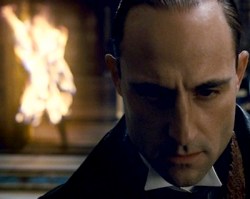
Though this is Downey Jr’s film, most of the cast are up to the task. Even Jude Law, who I’m no fan of, makes for a decent sidekick of a Watson, his shoot-first characterisation contrasting with Holmes’ thoughtful care better than the regular question-asking audience-cypher. Mark Strong’s villain is suitably chilling, aided by the film’s irreverence: if they can make Holmes into a quip-dealing action man, maybe there really is something supernatural at work? To reveal the truth would spoil that proper climax. The closest to a weak link is Rachel McAdams’ Irene Adler. I like McAdams well enough generally, and here too, but she may still be a little out of her depth — they’ve gone for a Pretty Young Thing when someone a little older may’ve suited better.
The closing moments set up a sequel in the most blatant way possible — if Batman Begins‘s Joker card is a brief, subtle indication, Sherlock Holmes‘s equivalent would be to have Batman and Gordon debating who this Joker feller might be and what he might want for a couple of minutes. It’s a bit too much, if you ask me, particularly as the Joker in question (oh, you all know who it is) isn’t actually seen — rumours of a famous cameo prove to be false.

And so what we find with this new Sherlock Holmes is an entertaining blockbuster, but with enough ‘proper Holmes’ laced underneath to make it feel different, unique even. Ritchie brings something special to the director’s chair too, believe it or not — you may think he’s sold out into blockbusterdom to revive his flagging and repetitive career, but the touches he brings suggest the mind of someone who has control of his material, his camera and his edit, and wants to use them all to try something a bit different, not just another hack-for-hire who could churn out any old template-hewn action/adventure flick.
Perhaps it’s a little long in places. That might be my only complaint. And yet, for that, I’m certainly looking forward to Sherlock Holmes 2.

4 out of 5

Steven Moffat and Mark Gatiss’ modern-day re-imagining of Sherlock Holmes, Sherlock, starts at 9pm tonight on BBC One.

Sherlock Holmes placed 8th on my list of The Ten Best Films I Saw For the First Time in 2010, which can be read in full here.

Sherlock Holmes (2010)

2010 #45
Rachel Lee Goldenberg | 89 mins | DVD | 12 / PG-13

Sherlock HolmesFrom the company that brought you such pinnacles of cinematic excellence as AVH: Alien vs. Hunter, Snakes on a Train and Mega Shark vs. Giant Octopus comes the latest in a long line of cheaply-produced blockbuster cash-ins, this time tied to… well, I think you know. (While I’m at it, I encourage you to look at their website — the sheer volume of these ‘mockbusters’ they’ve produced now is almost impressive.)
You wait decades for a new Sherlock Holmes film and then two come along at once. One is the Guy Ritchie-directed Robert Downey Jr-starring genuine blockbuster moneymaker. The other is thankfully not the rumoured Sacha Baron Cohen/Seth Rogen/Judd Apatow/other faintly irritating people (I forget who was involved) comedy vehicle, but instead a direct-to-DVD cash-in from mockbuster kings The Asylum. Yes, I’d rather this version, thanks.

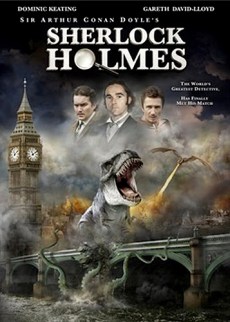
I’ve not seen an Asylum film before, but I hear this is one of their best. It’s not exactly “good” by any reasonable definition, but as “cable TV movie” quality goes I’d say it trumps the dull Case of Evil. And dull this certainly isn’t — sea monsters! dinosaurs! dragons! air battles! If you thought Ritchie’s Sherlock Holmes looked disrespectfully blockbusterised, it seems positively Brettian by comparison.

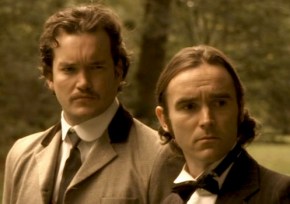
Watson and camp short-arse HolmesBut, in The Asylum’s favour, their Sherlock Holmes doesn’t hide what it is. Yes, it’s called simply Sherlock Holmes rather than Sherlock Holmes and the Implausible CGI Monsters, but at least said monsters are plastered all over the DVD cover (both US and UK). If you see that and still expect something faithful to Conan Doyle, more fool you. That said, at times it’s surprisingly faithful to Doyle’s spirit. There’s some decent-ish investigation and deduction, the story structured like a mystery rather than an action-adventure.

But you can’t escape the dinosaurs, sea monsters and dragons, or the various steampunk elements introduced towards the climax. And so your enjoyment probably depends on your expectations. Some of the acting’s poor — not least Ben Syder’s camp short-arse Holmes, sadly — and the CGI’s weak, looking like a ’90s syndicated TV series. The direction occasionally lacks competence and a couple of action sequences are pointlessly repetitive.

Sherlock Holmes and the Implausible CGI MonstersAnachronisms abound, the best being the first: the film opens in London, 1940, the middle of the Blitz, and the opening shot foregrounds the Millennium Bridge. I don’t think you have to be too familiar with London to know when that was built. Elsewhere we get intercoms on houses, incongruous light switches and period inaccurate telephones, just to mention a couple. It’s shoddy, yes, but almost part of the fun.

But, for all the faults, there are positives. It’s still not “good”, but it is often “quite fun”. Thoroughly daft, certainly, but — provided you don’t demand too much — quite entertaining because of it.

3 out of 5

Steven Moffat and Mark Gatiss’ modern-day re-imagining of Sherlock Holmes, Sherlock, starts at 9pm tomorrow on BBC One.

Tomorrow night, my review of the Guy Ritchie Sherlock Holmes.

Sherlock (2002)

aka Case of Evil / Sherlock: Case of Evil

2009 #46
Graham Theakston | 89 mins | TV | R

Case of EvilSherlock Holmes is a character so well known in the international psyche that he is open to seemingly endless reinterpretation — a wartime spy in the Rathbone era, his younger self in a Temple of Doom remake, or cryogenically frozen to reawaken in the 22nd Century (no, really). Indeed, this year alone we can expect to see him re-imagined as both a wisecracking martial artist in a period-set action/adventure film from Guy Ritchie, and as a detective in the present day in a new TV series from Steven Moffat and Mark Gatiss. All of which are considerably more exciting than this lame Young Sherlock effort from 2002.

Here, writer Piers Ashworth — who would go on to pen the new St Trinian’s and Goal! III (for which be sure to read the review at The Big Whatsit) — creates a kind of Holmes Begins, showing a young and unknown Sherlock break his first case against renowned criminal Professor Moriarty, gaining a bit of fame before he joins the investigation of a serial killer. Ashworth makes sure to complete the Begins format with introductions for various iconic elements, like the deerstalker (though only in the final scene), the pipe (though, only in the final scene), and even his drug addiction (though Holmes seems to have already been cured of it).

More fundamentally, however, Holmes is recast as a kind of Victorian James Bond, both in terms of his character and the plot structure. It begins with the end of the previous mission (which, GoldenEye-style, will become relevant later), before progressing through various familiar beats, like the villain helpfully explaining his plan and a climactic big shoot-out a la You Only Live Twice or The Spy Who Loved Me, except on a much, much, much smaller scale. To add to the effect, Dr Watson is revealed to be “a bit of an inventor” — a Q in the making? Even Holmes himself is not immune: young, dashing, and womanising. Yes, womanising. He even has a threesome, shot and scored like soft porn, though with a US TV-friendly complete lack of nudity. Or sex. It does feature an unintentionally hilarious striptease though.

The story itself moves at a decent lick early on, complete with some genuine detective work that even, occasionally, displays Holmes’ genius. Most of this (at least, most of it that’s actually relevant to the plot) occurs during a couple of autopsies, which choose not to stint on the gore. (Incidentally, this makes it even easier to believe it was created with US TV in mind. Nudity? Nooo. Gore and violence? Hurrah!) Unfortunately, the longer the film goes on the more it slows and begins to drag, and the mystery-solving is replaced with running around, backstory exposition, and semi-decent sword fights. The best of these is fortunately at the climax, which takes place (amusingly, like Basil the Great Mouse Detective) atop the Palace of Westminster clock tower — or, at least, a poor computer-generated version of it (also like Basil the Great Mouse Detective). To be fair, the interior is a decent-enough set… though quite how the clock faces function when no workings whatsoever are attached to them is a mystery worthy of Holmes. Sherlock was shot in Romania, so such dodgy effects work rears its head any time they wish to depict a London landmark. Thankfully this isn’t often, because every such shot is appallingly realised.

Much the same could be said of the performances. James D’Arcy initially seems miscast as Holmes, but… well, he is — it’s just that everyone else is even worse. Roger Morlidge’s Dr Watson feels like he’s being portrayed by Ricky Gervais — no, worse, like James Corden’s version of Gervais from Horne & Corden — while Vincent D’Onofrio’s accent wavers all over the place and takes his performance with it. In what amounts to a cameo as Mycroft Holmes, Richard E. Grant is dreadful too. I’ve never been much of a fan of his, but this is weak work even by his standards. About the only passable performance among the major characters comes from Nicholas Gecks as Lestrade. There’s nothing exemplary about his role, but by simply doing nothing wrong he fares better than the rest.

Sherlock probably sounds irredeemably awful, and for some it will be (Sherlock Holmes has a threesome for Chrissake!), but despite the numerous flaws it remains largely watchable and even has its moments, particularly for more forgiving non-Sherlockians.

2 out of 5

Sherlock featured on my list of The Five Worst Films I Saw in 2009, which can be read in full here.