
Quentin Tarantino | 153 mins | Blu-ray | 18 / R
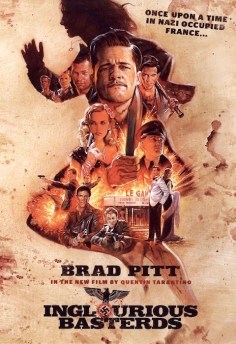 Watching almost any film a second time can affect your opinion of it. It could reveal deeper levels of character or theme; it could allow you to see how the writer(s) subtly foreshadowed events, or built up to the big twist; it could be you spot jokes you were too busy laughing during last time; it could let you look at the imagery now you don’t have to concentrate so hard on the subtitles. Or it could reveal shallowness, that there’s nothing to be gleaned that you didn’t get the first time; or highlight the holes in a plot that seemed so well constructed before; or jokes that were hilarious fall flat when heard more than once; or the action sequences aren’t exciting when robbed of their freshness. A second viewing can reveal that you were too young to get it the first time, or that you’re now too grown up to enjoy it; it can reveal a bad movie isn’t so bad, or that without the hype it’s actually quite good; it can raise a favourite even higher in your estimations, or it can tear it down. And even if a second viewing just reaffirms exactly what you felt the first time, well, when there’s such a chance for change and it doesn’t occur, that’s an effect in itself.
This is why I try to post all my reviews after only seeing a film once. There’s nothing wrong with appraising a film after many viewings — far from it — but that’s not the point of this particular blog, focusing as it does on films I’ve never previously seen. (Whether a newcomer’s perspective is still worth anything once a film is months, years, or decades old is another matter, perhaps for another time.) Unfortunately, though rarely, a film slips through the cracks. As you’ve likely guessed, Inglourious Basterds is such a film: though I named it my favourite film I saw in 2009, I didn’t make any notes or write a review promptly. And so here I find myself, over eight months since I first watched it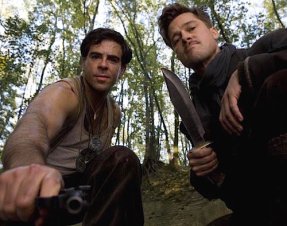 — and, today, a year since its UK release —, having watched it a second time to refresh my memory. But has it changed my opinion?
Inglourious Basterds is, in some respects, a law unto itself. That’s probably why it received such a mixed reaction at Cannes; one that, notably, settled down to generally praiseful by the time it was officially released a few months later. It wasn’t, as had been expected, the story of a group of American Jews dropped behind enemy lines to murder Nazis, thereby spreading terror through the enemy ranks. That’s part of the tale Tarantino eventually brought to the screen, but what you’d expect to make up the bulk of the movie — as Aldo Raine himself puts it, “killin’ Natzis” — is skipped over with a single cut. The film is divided up into five chapters; the second is the one most directly concerned with the Basterds, and it’s also the shortest.
And that’s not the only thing Tarantino does differently. The whole film is a grab-bag of filmmaking styles, techniques and modes, thrown together with a gleeful abandon. Tarantino uses what he wants when he wants it, sometimes for no reason at all, and with no eye to creating a stylistic whole. If he wants a character’s name to appear in huge letters over a freeze-frame of them, he will; that doesn’t mean he’ll use it for every character, or every major character, or for every other character on that one’s side — if he wants it just once, he’ll throw it in just once. It’s like that square Uma Thurman drew in Pulp Fiction, only instead of being one thing once he does it again and again, with any trick he fancies, throughout the film.
I’m tempted to list them, but that would remove some of the fun if you’re yet to see the film. My favourites, however, are the subtitles that don’t always translate things — e.g. when a French character says “oui”, so do the subtitles. It’s pointless really, but also kind of thought provoking too: if, as a non-French-speaker, we say “oui”, knowing what it means, then are we actually saying “yes” or are we saying “oui”? I’m certain, however, that Tarantino’s subtitling choices weren’t designed to elicit such thoughts and probably don’t stand up to the scrutiny they’d require (such as: if the rest of a Frenchman’s French is translated to English, why aren’t his “oui”s? (As it were.))
This is just one of the things that signals the truth of Inglourious Basterds: it’s not really about World War 2 — though you’d be forgiven for thinking it was, considering it’s all set during World War 2 and all the characters are soldiers, resistance fighters or politicians — but is in fact about film, or cinema, or the movies, or whichever name you want to use. It’s not just his mix and match of cinematic techniques that suggests this — though the much-heralded use of Spaghetti Western style on a World War 2 setting works as fabulously as you could hope — but it’s overt in the text too.
 The ending (and skip this paragraph if you haven’t seen the film) is the key to that, as I’m sure you either noticed or have read in other coverage. The power of cinema literally destroys the Nazis, changing the course of the war. Killing Hitler — and the rest — is one of those barmy notions that at first seems wrong, and then seems completely right. “If my characters had existed, this is what would have happened” is one of those genius notions that seems so inescapably obvious you wonder why no one’s done it sooner. Why do you necessarily need to obey history if the rest of your story is fiction anyway?
Back to other matters. It’s interesting just how long the scenes are, and in so few locations. Chapter One takes place solely in a small farmhouse (except for a few minutes outside it); Chapter Four is almost entirely in the La Louisiane bar; Chapter Five almost entirely in Shosanna’s cinema. And while the other two use more locations, their number isn’t great: Chapter Three features the aforementioned cinema, a cafe and a restaurant; Chapter Two a briefing ground, Hitler’s war room, some derelict location, and a prison. This isn’t a full list of locations and scenes, but it’s most of them. Tarantino hasn’t created some writerly exercise — “you are only allowed five locations, one long scene in each” — but he has nonetheless crafted most of his films in long scenes in few locations. I imagine this, along with “all that reading”  (I believe more of the film is subtitled than in English), did little to endear it to the complaining masses who thought they were getting “Kill Bill in WW2”.
The chapter-ified structure and constant introduction of new characters suggests a Pulp Fiction-ish ‘short story collection’ at first, but it becomes clear as the film moves on into its fourth and, certainly, fifth chapters that it actually all builds together as one whole story. The chapter headings serve their purpose, denoting the various stages of the tale and allowing Tarantino to jump around, rather than having to find a way to move more seamlessly from segment to segment or somehow intercut them all. Indeed, unlike the other Tarantino films the use of chapters evokes — i.e. Pulp Fiction and Kill Bill — Inglourious Basterds is quite solidly linear, at least as far as the progression through each chapter is concerned. (Chapter Two jumps about in time a bit, with a Nolan-esque stories-within-stories-within-stories structure, but even then does little to upset the linearity.)
 And for all those constantly-introduced characters, the acting is top notch. Christoph Waltz easily deserved the huge pile of awards he garnered, his quirky persona following in a long tradition of calm psychopaths in movies. You always know his pleasantries hide something far nastier; every scene he appears in is instantly tense. Mélanie Laurent is an instant one-to-watch as the film’s real central character, Shosanna, though she seems to have been sadly sidelined by all the praise heaped on Waltz. It doesn’t hurt that she’s the kind of woman you’d happily decorate a whole review with pictures of (though you’ll note I resisted). Michael Fassbender is the very definition of Englishness, without quite slipping into an irritating stereotype. It’s difficult to imagine the originally-cast Simon Pegg in the role, though I’m sure he would’ve brought something… shall we say, different… to it. Brad Pitt’s much-criticised heavily-accented performance is fine. While not as memorable as the others mentioned, I don’t see why some have had such a problem with it.
Between Tarantino’s writing and more excellent performances, we’re also treated to a host of minor but memorable characters: Denis Menochet’s farmer, managing to equal Waltz in the long opening scene; Til Schweiger’s vicious German basterd; Diane Kruger’s glamorous, calm actress-spy; Daniel Brühl’s apparently sweet accidental hero and movie star-to-be; Martin Wuttke’s raving loony Hitler; and others too. Perhaps the only duff note for me was Mike Myers as an English General. I liked the Wayne’s Worlds and Austin Powerses (and haven’t subjected myself to The Love Guru for this reason), and he’s not exactly bad here, but there’s a part of me that couldn’t escape wondering exactly why he was cast in such a small and uncomedic role. A real Brit would’ve been more appropriate, I feel. Perhaps Simon Pegg.
Myers was one of the things I noticed more on my second viewing. So was that “care-free deployment of an abundance of film-specific techniques” — while they’re undoubtedly there, when one expects them they don’t seem nearly so surprising or all-pervading as they did at first. Clearly it’s the shock value: in the same way a jump scare or joke dependent on a surprise twist might only work once, so Tarantino’s occasional and somewhat incongruous flourishes don’t stick out as firmly when you know they’re coming. But that’s not a bad thing. There’s no joyous discovery of something new and slightly different exploding across the screen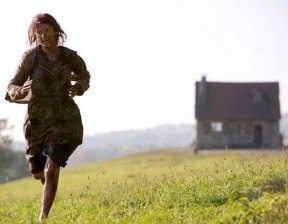 every once in a while, but it also proves they work, that he was right to employ them.
Some people hated Inglourious Basterds (though not enough to keep it out of the IMDb Top 100), be it for the unexpected nature of its story or for the long talky scenes with lots of reading. But that’s just another reason I love it — not to be awkward or Different, but because by being so much its Own Thing it can provoke such strong feelings, in either direction. It’s common for Hollywood to produce films so bland they evoke bags of apathy from those with enough brainpower to realise the film doesn’t have any, so it’s quite nice to have a film that has a brain — and, more importantly, a personality (several, even) — that it isn’t afraid to show off, and isn’t afraid for you to dislike if you want. Love it or hate it, it demands to be seen and judged on its own merits.
To be frank, I’m not sure I liked Inglourious Basterds as much my second time. I may well like it more again on my third, when there’s less personal hype involved. I’d still give it the same star rating though, so at least there’s no conflict there.
You might argue that Pulp Fiction or Reservoir Dogs are better films, but — with its long idiosyncratic speeches and scenes, relatively extreme violence, use and re-appropriation of generic convention, 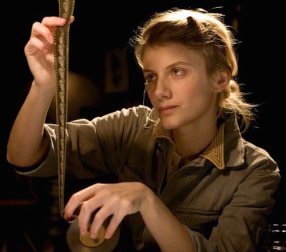 care-free deployment of an abundance of film-specific techniques, and, both through this and also directly in its narrative, its love of film as a medium — Inglourious Basterds isn’t just “a Quentin Tarantino film”, it is Quentin Tarantino. His choice of final line — “You know something, Ultivich? I think this just might be my masterpiece” — is clearly about more than Aldo Raine’s swastika-carving abilities.

Inglourious Basterds is on Film4 tonight, Friday 24th October 2014, at 9pm.
It placed 1st on my list of The Ten Best Films I Saw For the First Time in 2009, which can be read in full here.
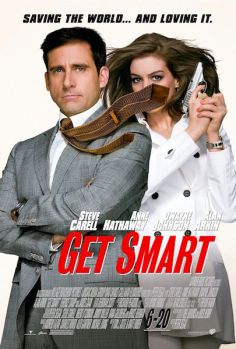 Get Smart, as you likely know, was a TV series in the ’60s, which makes one wonder how it’s taken so long to get to the big screen. I guess it didn’t have the same fanbase or perceived relaunchability that led to an endless array of big-screen versions of ’60s/’70s series in the last decade or two —
 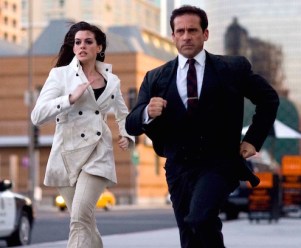 there’s a few action sequences that are surprisingly decent too, considering this is still primarily a comedy.
 to be the smarmy big shot who either ignores or specifically brings down a character like Carrell’s, but instead he’s one of his biggest supporters. (That he turns out to have been A Bad Guy All Along, Gasp! is beside the point.) The office bullies don’t actually have any power at all and are frequently brought down to size. It makes a nice change from the stock sitcom clumsy-hero-who-eventually-comes-good with irritating-and-condescending-higher-ups on the side, the pedestrian and unenjoyable fallback of too many comedy writers.
 but it’s asking a little too much from not necessarily sympathetic viewers.
 Readers may remember that I opened my
 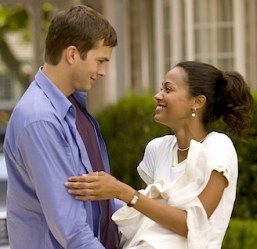 Mac and Kutcher play the roles they always play— No, actually, in fairness, I can’t say that: I think I’ve only seen Mac in the
  It’s as recognisable from TV sitcoms —
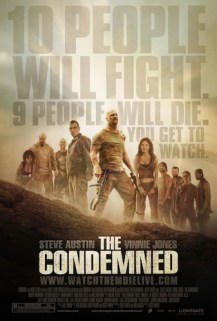 The Condemned is an old-fashioned-ish action movie, produced by WWE Films — i.e. the people behind all the wrestling claptrap. I should very much like to point out that I don’t care one jot about WWE or any other form of wrestling, real or faked. So why watch this? Because it’s got nothing to do with WWE itself aside from one (or more, I don’t know) former wrestlers acting in it.
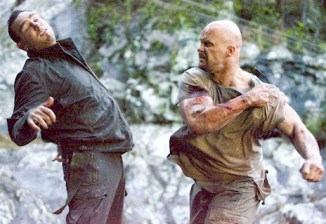 Indeed, in places it’s even satirical. Largely, though, the plot flatly commentates on society’s preoccupation with violent entertainment. Ironically, this is criticising not only organisations like WWE, who produced the film, but the genre of the film itself. It’s difficult to tell if director/co-writer Scott Wiper and his fellow filmmakers are aware of this irony/self-criticism, but if we give them the benefit of the doubt it becomes a nice layer.
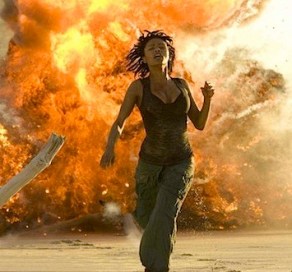 The same can be said of the action. With ten people, nine of whom will die, it could just be a series of fights where the designated Good One emerges victorious. And yes, there are a couple of fights of this nature, but as Things Go Wrong the realistically sick side of the ‘game’ is revealed: one female is cut up and presumably raped, all streamed live, while another is tortured before eventually being burned alive. It’s disgusting but, crucially, the film agrees that it is. That might sound obvious, but one suspects certain entries in the torture porn genre would disagree. That it draws you in to the brainless action movie mindset — fights! deaths! yay! — before twisting it with a dose of nasty reality suggests a greater degree of thought to both its structure and social message than one might expect. Maybe this is only a serendipitous side effect of the story path the writers chose, but even if it was an accident the success of it is still present.
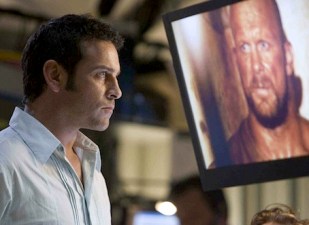 Something that amuses me is how many reviews call this “a brainless action movie” and make assertions like “the dialogue only serves to get from one action scene to the next”. Now, I’m not going to argue that The Condemned is actually some essayistic polemic on the evils of the media or modern violence-obsessed culture, but it has more to think about than the majority of action movies — meaning it’s neither brainless nor devoid of importance between action scenes. Perhaps you can enjoy this solely as a series of action scenes, but I have to wonder if those who do didn’t so much turn their brain off as have it removed (assuming there was one there in the first place) — the commentary on voyeurism and violence isn’t subtle and therefore certainly not accidental, so quite how it can be missed is beyond me.
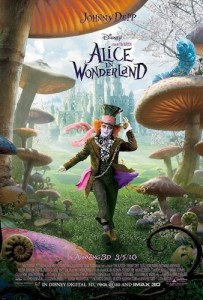 I believe Tim Burton coined the now-ubiquitous term “reimagine” when he remade — I mean, reimagined (sorry Tim!) —
 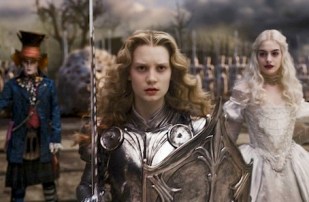 It’s a moderately interesting cycle to attach it to, one it seems has been missed by its pigeon-holing as “a Tim Burton film” and “another Alice adaptation”.
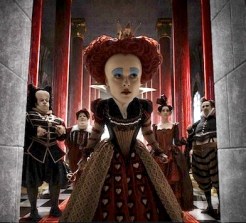 Among the rest of the cast, Helena Bonham Carter does a speech-impedimented Red Queen that feels as familiar was Burton and Depp’s work; Anne Hathaway’s White Queen is amusingly floaty, her hands permanently raised in a faux-delicate gesture; Crispin Glover is under-characterised and marred by some dodgy CGI (quite what’s been done to him I don’t know, but his movement is frequently jerky), but otherwise a decent enough henchman. In the all-Brit voice/mo-cap cast, Matt Lucas is best as Tweedles Dum and Dee — sadly, there’s not enough of him… um, them… — while Alan Rickman is Alan Rickman as the Caterpillar; Stephen Fry has little important to do as a less-scary-than-usual Cheshire Cat; and others — like Michael Sheen, Paul Whitehouse and Timothy Spall — blend into the background with competent but unremarkable work.
 The funny thing about Burton’s Alice is that — despite the ultimately needless 3D, the familiar fantasy-epic storyline grafted onto Carroll’s characters, and the apparent lack of inspiration from either the director or his cast — it’s still quite enjoyable. It’s not going to do much to engage your emotions or your brain, it won’t give you any hearty laughs or edge-of-your-seat thrills, and it may occasionally make you wish it would get a move on — all of which means that, by the end, it can feel a tad slight. Valid criticism abounds on the web, but… well, I enjoyed it. Maybe I’m just too forgiving.
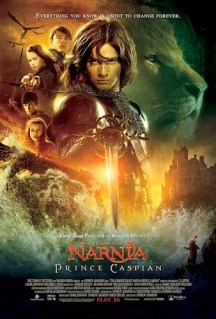 The Pevensie children return to Narnia, but hundreds of years later, in Disney’s last adaptation from C.S. Lewis’ series (don’t worry, Fox have taken it over). For those keeping track, this is both the second book and second film, but fourth chronicle chronologically. Which is fine for now, but I wonder what they’ll do come those earlier-set ones…
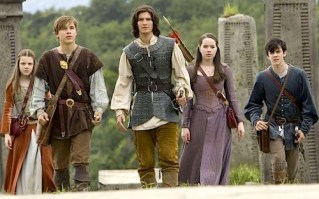 held the record for the longest closing credits at 10 minutes. I don’t really know what’s common these days but 12 minutes is nonetheless 8% of the film.
 or maybe it’s just counting on their memory a bit too much. With only limited characterisation and basic political complications, Prince Caspian really boils down to a series of fights and battles. Nicely done fights and battles, I’d argue, but still, no one’s coming away from this particularly enriched.
 Speed Racer feels like an unfair place to kick off
  Even some of the performances stand out, not something you’d expect from such a (for want of a better word) lightweight tale. Of particular note are Susan Sarandon as Mom and Christina Ricci’s Trixie, whose huge eyes help render her perhaps one of the most perfect live-action versions of an anime character ever seen. Yes, the characters mostly exist to service their place in the plot, but the odd scene or glance or line delivery adds some subtlety here and there.
 And, to specifically rubbish his opinions here, Phantom Menace is praised for being “made to be looked at more than listened to… filled with wonderful visuals” and condemns Speed Racer because “whatever information that passes from your retinas to your brain is conveyed through optical design and not so much through more traditional devices such as dialogue, narrative, performance or characterization… you could look at it with the sound off and it wouldn’t matter.” Not that Film’s unique factor (over novels or radio or what have you) is its visual sense, and a silent film that can be told through image alone, devoid of any intertitles, was once a lofty aim. I’m sure Ebert could readily explain why Phantom Menace’s visual splendour is a good thing and why Speed Racer’s is so terrible, but, on the other hand… pot, meet kettle.
 Back to Speed Racer. In every respect it’s like a living cartoon, and it’s the Wachowskis’ commitment to this aesthetic in every single respect that makes it work where others have floundered. It’s not perfect, I suppose. It may run a little long at two-and-a-quarter hours; but then, it so rarely lets up that I didn’t mind a jot. And the kid is often annoying; but then, as annoying little kids in films go, I’ve seen worse. At times I even liked him.
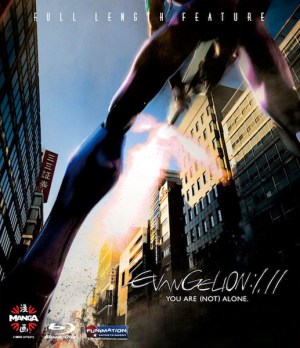 When I (first) reviewed
 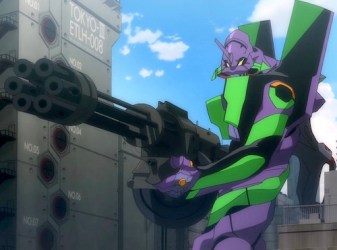 is a new addition I swear, while he also listens to a (digital, at least) cassette player rather than an iPod (other MP3 players are available, naturally). It’s not a major flaw — unlike, perhaps, the fact that the “covert” and top-secret Nerv organisation has great big signs plastered all over town and everyone seems to know about them — but, still, maybe a new bit of animation to replace the tape-playing close-ups would’ve been nice.
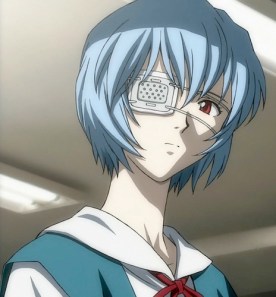 The pros and cons of the series remain. Shinji is alternately interesting, perhaps even complex, and a whiney little irritant. Here he has a character arc at least, suggesting he may be more sufferable next time out. His relationship with Major — sorry,
 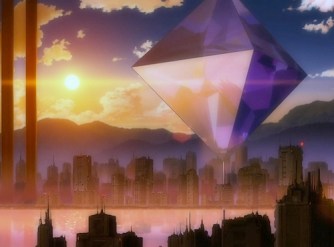 Another factor thrown up by the TV-series-to-feature conversion is the image quality. An HD big screen is a mixed blessing here. On one hand, it looks great on Blu-ray, with crisp lines and solid colours, the result of re-filming, colouring and CGI-ing the original animation elements rather than using the finished TV shots. On the other, such clarity sometimes shows up a lack of detail in the original animation — these elements were created for 4:3 mid-’90s TV, not a hi-def (home) cinema — and the solid colours and money-saving techniques (for example, showing something static rather than a lip-synched (ish) mouth during conversations) can remind the viewer of cheaper TV roots. Perhaps I’m being overly critical though, because much of it does look fabulous; at the very least, the thorough ground-up rebuild means it looks better than the TV series ever will, never mind has.
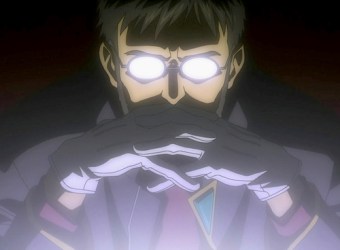 It’s enough to make one scurry back to the series for answers, though the three movies still to come promise whole new characters, plots and a — frankly, much-needed — brand-new ending. After two misfires (one in the series, one in
  His Girl Friday is an acknowledged classic — 19th on the
  It doesn’t seem like 18 months since the RSC brought Hamlet to the stage with British TV’s biggest star actor (probably) as the titular Dane, but it is (more or less). Thanks to sold-out performances and largely positive reviews (theatre critics seem even less keen to agree on anything than film ones), we’re now treated to this film adaptation, shown on BBC Two on Boxing Day and released on DVD (but not Blu-ray, boo
 100Films.co.uk