
Tomás Lunák | 81 mins | TV (HD) | 16:9 | Czech Republic & Germany / Czech | 15
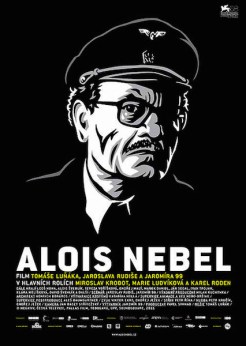 A Czech noir animation, set around Christmas 1989 to the backdrop of the country’s Velvet Revolution. Eponymous character Alois Nebel is a train station guard whose flashbacks to an event at the end of World War 2 see him sectioned, though possibly for other nefarious purposes. Having lost his job, he travels to head office in Prague to try to reclaim it, where he meets a ragtag gang of social misfits. Finally returning home, the mystery of what happened 44 years earlier may be resolved…
If that covers most of the film, it’s because Alois Nebel seems to very much occur in three distinct sequences, most probably the legacy of being adapted from a three-volume graphic novel. They’re linked by the mystery of what happened in World War 2… sort of. I mean, there is a mystery, but what that mystery is isn’t fully elucidated, it goes AWOL during the middle segment of the film, and it remains pretty easy to guess the outcome. Plus, the titular character seems entirely incidental to it — he only witnesses something in the past, and then is accidentally, unknowingly involved in its resolution four decades later. Perhaps that’s part of the point…
Although the events of the past may find a resolution, the film leaves us with many questions. How and why do Nebel’s colleagues get him locked up in the mental hospital? Ok, there’s an element of corruption in the ‘how’ — but how did they know about his flashbacks? And the ‘why’ is certainly never made clear. Then, what is all the Prague stuff about? It seems a complete aside in the middle of the narrative. Is it a “state of the nation at that time” piece, maybe? There’s a revolution playing out in the background afterall, but it’s very much an aside.
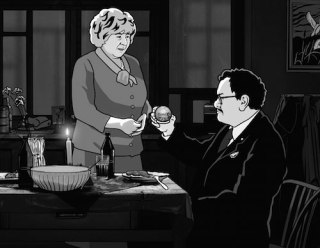 Perhaps the whole film is Deeply Thematic, then? It may be to do with the country moving on and making peace with its past, seen in a microcosm in the actions of Nebel (moving past the flashbacks, having new experiences, finding love, etc) and the people around him (finally getting revenge for something that happened nearly half a century ago). Maybe that’s all more clear if you know the Czech mindset, or the history of the Velvet Revolution. The second post in this thread on IMDb gives an idea of some of the stuff you need to know, and how some of the nuance is lost in English — for instance, there are actually multiple languages spoken in the film*, but it all comes out as English in the subtitles.
On the bright side, the language of visuals is universal, and some of the animation here is quite stunning. There are shots and camera moves you don’t typically see in 2D animation, and a greater variety of them too, presumably because it’s all been rotoscoped, so it’s all based on real-life filmed stuff rather than the one painted background someone did, etc. There’s always something moving in shot, too — trees blowing, rain streaming, snow drifting in… The landscape shots featuring that kind of thing are more beautiful than the character animation. The latter is always the oddest part of rotoscoping. Here, it sometimes lends a hyper-realistic style, with all the little shifts and tics you get from real people that you don’t from purely animated ones. The downside to that is you sometimes get a bit of an uncanny-valley effect, or parts of the body changing shape or floating around for no apparent reason.
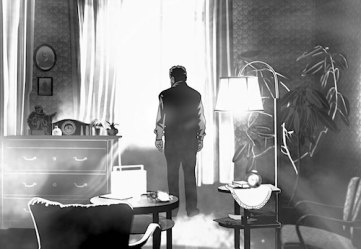 With some attractive black-and-white animation and a sporadically engaging mystery plot, Alois Nebel is far from meritless. However, its firm grounding in a wide spread of Czech history and attitudes suggests it may be best suited to those already well-versed in that country’s history and culture.

* I realise I’ve put Czech as the only language at the top. That’s what IMDb and Wikipedia say and I’ve not found anything that verifies exactly what else is spoken. ^
 Disney’s ’80s/’90s renaissance more-or-less came to an end with this adaptation of Edgar Rice Burrough’s jungle hero.
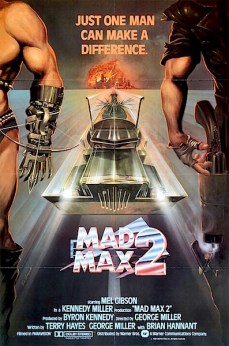 Roaming the outback of a gasoline-desperate post-apocalyptic Australia, “Mad” Max Rockatansky (Mel Gibson) comes across a commune-like oil refinery, whose inhabitants are under siege by a brutally violent gang. Max strikes a bargain: he’ll help them escape with their oil, in exchange for a tank full for himself.
 The most memorable part, however, is the climax. They escape the oil refinery, Max driving the tanker — fitted out with weaponry and defences — and the gang give chase. An almighty action sequence follows, a speeding battle through the outback. It feels wrong to just call it “an action sequence”, like that’s selling it short. You get the sense that this is why the movie exists; that co-writer/director George Miller’s goal with the entire rest of the film has been to get us to this point. It’s not just “the climax”, it’s “the third act”, and it’s stunning — the choreography of it, the editing, the stunts, as dozens of vehicles chase each other, people run around on top of them, jump between them… I don’t think it’s hyperbolic to say it must be one of the greatest action sequences ever committed to film. One of the reasons
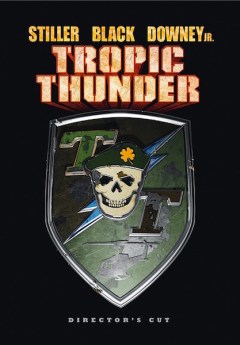 A bunch of obstreperous actors are too much to handle for the director of a Vietnam war movie, so he dumps them in the jungle to shoot it with hidden cameras. Things go awry; hilarity ensues.
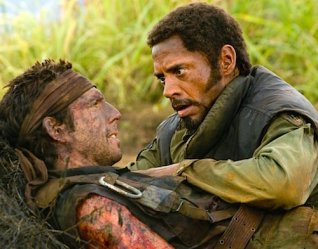 The film may run a little long in the middle, though I don’t think that’s the fault of this extended cut. It adds just over 17 minutes across many little changes and extensions
 As presidential nominee Barack Obama talks about the American Dream, in a run-down corner of the nation a trio of small-timers plot a robbery, landing them in hot water with some nasty people.
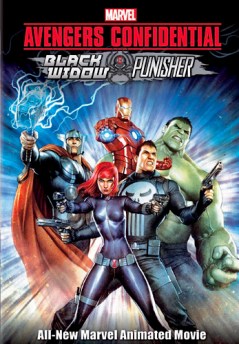 Anime take on Marvel properties. S.H.I.E.L.D. agent Black Widow teams up with vigilante Frank Castle, aka the Punisher, to investigate a threat to global security.
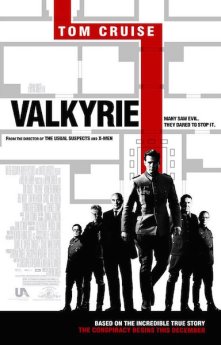 After abandoning the X-Men franchise for a
 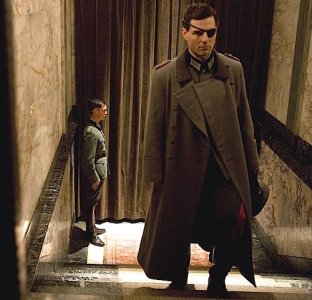 One of the stated aims of the conspiracy is to show the rest of the world that not everyone in Germany believed in what Hitler and his inner circle were doing. It may have taken us a long time to realise that, for fairly understandable reasons, but quality films like this help get the message out. Singer has crafted a proper thriller here, replete with scenes of edge-of-your-seat tension. Many a filmmaker can’t manage that with a fictional storyline, never mind one where we know exactly how it turns out.
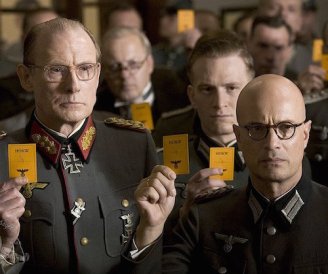 but nor is he in simplistic action hero mode.
 Steven Spielberg’s second feature (or “first” if you’re American) is based, loosely, on a true story. The fictionalised version sees Lou Jean (Goldie Hawn) breaking her husband (William Atherton) out of prison so they can travel cross state to liberate their baby from foster care. Everything goes smoothly until they accidentally kidnap a police officer (Michael Sacks), hundreds of police cars begin to follow them, and a multi-day slow-paced chase ensues.
 when filmmakers became contractually obliged to keep their compositions “TV safe”). The camerawork is frequently extraordinary, including at least one unbroken shot where the camera moves around inside and outside the car, like something out of
 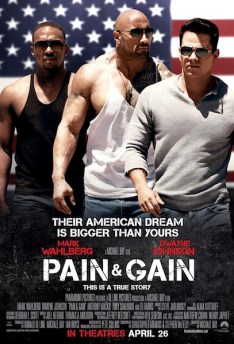 For his first non-sci-fi movie in a decade, divisive action director Michael Bay channels Tarantino (kinda) for this based-on-a-true-story crime comedy. Dwayne “The Rock” Johnson, Mark “Marky Mark” Wahlberg and Anthony “
 Bay is aided by leads who are surprisingly adept at comedy. Johnson is the best thing in it, consistently hilarious as his conscience battles former addictions and newfound religious convictions. I noted down some of his best lines to quote in the review, but they lose something without his delivery.
 After he’s become so sidetracked making the
 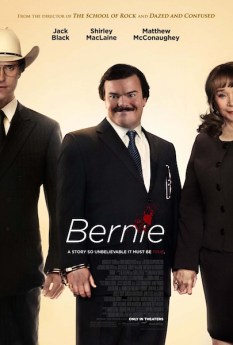 I seem to vaguely remember dismissing Bernie as just ‘Another Jack Black Comedy’ back whenever it came out (in the UK, that wasn’t until April 2013), and essentially forgot about it until earlier this month when it came up on
 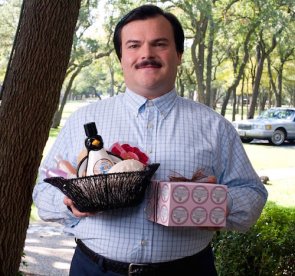 (If you’re observing similarities to Midnight in the Garden of Good and Evil there, you’re not the first: the magazine article that inspired Bernie, published around the same time as
 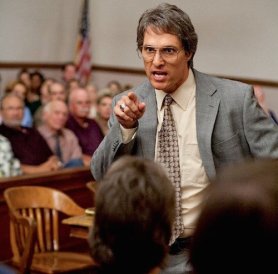 The local attorney seeking Bernie’s prosecution is played by man-of-the-moment Matthew McConaughey. I don’t know when we’re meant to deem the start of his “McConaissance”, but I’m not sure this really qualifies as part of it. Not that he’s bad, but it feels like the kind of played-straight comedy Southerner I’ve seen him do a few times now; indeed, it’s how he comes across in real life, from what I’ve seen. It fits the role like a glove, but doesn’t make for a remarkable performance.
 100Films.co.uk