2015 #107
Ang Lee | 127 mins | Blu-ray | 1.85:1 | USA, Taiwan, UK, Canada & France / English, Tamil, French, Japanese, Hindi & Chinese | PG / PG
 2013 Academy Awards
11 nominations — 4 wins
Winner: Best Director, Best Cinematography, Best Original Score, Best Visual Effects.
Nominated: Best Picture, Best Adapted Screenplay, Best Film Editing, Best Sound Mixing, Best Sound Editing, Best Original Song, Best Production Design.
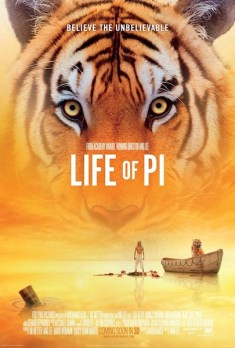 “Unfilmable” — now there’s an adjective you don’t hear tossed about so much these days. For a long time it seemed like it was all the rage to label novels “unfilmable”, but at this point too many ‘unfilmable’ novels have been filmed, and the wonders of CGI have put paid to anything ever again being unfilmable for practical or visual reasons. It may still be an apposite descriptor for works that feature very literary storytelling, though if you can render something like the subjective and unreliable narrator of Fight Club on screen — and in a movie that many regard as being superior to the novel, too — then there are few boundaries in that realm either. And someone even made On the Road, so just as soon as The Catcher in the Rye gets filmed we can probably put “unfilmable” to bed forever.
Yann Martel’s internationally-renowned Booker Prize-winner Life of Pi is one novel that used to have that adjective attached (of course it was — that would’ve been a pretty stupid introductory paragraph otherwise, wouldn’t it?) I’ve never read the novel, but I suspect it may’ve earnt the label for both of the above reasons, because it concerns, literally, the story of a boy stuck on a lifeboat with a tiger, and, figuratively, the very nature of storytelling itself — not to mention the purpose of religion and the existence of God. Never has “from the director of Hulk” seemed less pertinent.
Said director — Ang Lee, of course — did win one of this film’s four Oscars. Match that with two of its others — namely, for cinematography and visual effects — and you get an inkling of one of the film’s most praised facets. Whatever one thinks of the film’s story and themes (and I’ll come to those), it looks incredible. This is the kind of film that demands the increased resolution and colour palette of HD; it may even demand the 3D it was shot in, because watching in 2D it felt clear that wasn’t its native format — not because of the old cliché of things being thrust in the viewers’ collective face (well, only once or twice), 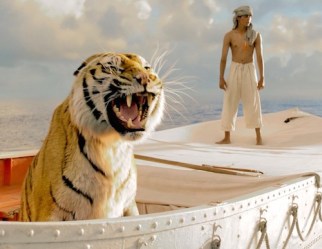 but because of almost-indefinable features of each shot’s crispness, its depth of field, even the compositions. It absolutely works in 2D, and it didn’t leave me longing for 3D in quite the same way as something like the swooping aerial sequences of How to Train Your Dragon, but, unlike with the majority of movies released in 3D, I did feel like I wasn’t seeing the director’s full vision.
Nonetheless, Claudio Miranda’s Oscar-winning cinematography proved controversial in some quarters. While the movie is indeed beautifully shot, swathes of it are also awash with CGI, so I think there’s some merit to the argument that it doesn’t count as photography. Conversely, I’d actually argue that the real-world bits look even more glorious than the digitally-rendered parts, on balance. Sure, you have the obvious spectacle of the psychedelic whale-jump, featured heavily in trailers and on the Blu-ray 3D cover, and the painterly skies and seas while in the lifeboat; but the early sequences in India, bursting with crisp, luscious colour in the zoo or at a nighttime light festival, are in some respects even more memorable.
To give with one hand and take with the other, however, I felt that the pair of aspect ratio shifts were utterly pointless and, worse, distracting. Firstly, I believe 2.35:1 was used for the flying fish scene to make the sequence feel more epic, and to allow the fish to jump further out of the screen. Well, in 2D the latter is lost entirely; and on TV (and possibly in the cinema, presuming the screen-space got thinner rather than wider), the movie suddenly feels constrained — the exact opposite effect to when films like The Dark Knight or Hunger Games 2 open out for their IMAX sequences, for instance. 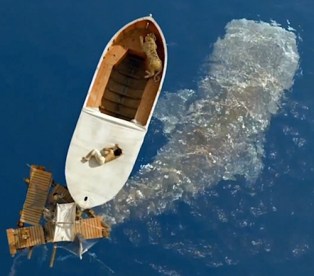 Later, the 4:3 “book cover” shot is just pure indulgence. There’s no reason not to just have empty sea to the left and right of frame, and the “it’s emulating the book cover!” reason/excuse doesn’t come close to passing muster simply because book covers aren’t 4:3. In both cases, then, what was intended to be striking or clever or innovative or in some way effective, I guess, comes across as pointless and distracting and pretentious.
And if we’re talking daft choices, don’t get me started on the meerkat-infested carnivorous island…! Maybe there’s some Deeper Meaning there — or, later, is the film deliberately lampshading the island’s total lack of meaning, when Pi tells the journalist that there doesn’t need to be meaning if it’s just what happened? Whatever — for me, it only served to make 110% sure we know (spoilers!) that Pi’s whole story is definitely BS. In that respect, the bizarre fancifulness was heavy-handed.
Ah, the story. To be honest, I liked it a little better a year later when it was called All is Lost; some people liked it better a decade earlier, when the tiger was a volleyball called Wilson. The striking imagery of a boy stranded on a boat with a tiger makes one assume that’s what the film’s About, but it’s not really About that at all. If you’re expecting a pure adventure on a life-raft, the long preamble where Pi describes his early experiences of religion must seem utterly pointless, but it all feeds back in at the end when we come to the point of Pi’s — well, Martel’s — tale.
I’m going to discuss the end while avoiding direct spoilers, but, honestly, any foreknowledge of the film’s (possible) message(s) is liable to colour your perception; so if you’ve not seen it, it may be best to skip the next paragraph until later.
 Reading around a little online, it seems that some people have interpreted the film’s message as being a defence of/justification for/persuasion towards religious faith, and hate it for that. This interests me, because I — coming, I suspect, from a similar perspective on religion — read it as a subtle condemnation of religious stories. Actually, not a condemnation, but a tacit acceptance of the fact that such stories are a nice fairytale, but not the truth. To put it another way, I took the message to be (more or less) that religion is an obvious fiction which people choose to believe because it’s a nicer story than the more plausible alternative, neither of which are provable. I think some focus on the point that the journalist hearing Pi’s story is told it will make him believe in God, and, at the end, the journalist seems to accept that it does. I don’t think that’s the film’s contention, though; I think the film is, in a way, explaining why people believe in God. Or maybe there are just no easy answers.
Seeking those answers, Rafe Spall is very good in what amounts to a tiny supporting role… but then, I have a fondness for him as an actor (his excellent, just-the-right-side-of-OTT turn as a gangster’s unhinged psychopathic son is the only real reason to watch The Shadow Line), so I may be biased. One must also single out Suraj Sharma, an unknown cast almost by accident when he accompanied his brother to the auditions, but who gives a good turn even when mostly performing opposite a CG tiger, a CG sea, CG fish, more CG…
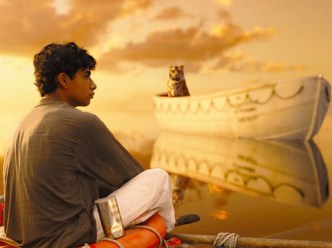 I found Life of Pi to be a little bit of a mixed bag, on the whole, where moments of transcendent wonder-of-cinema beauty rub up against instances of thumb-twiddling; where insightful or emotional revelations rub shoulders with pretentious longueurs. There is much to admire, but there are also parts to endure. The balance of reception lies in its favour, but while some love it unequivocally, a fair number seem to despise it with near-equal fervour. Either way, it’s definitely a film worth watching, and in the best possible quality you can manage, too. It also made me want to read the book, which for a movie I wasn’t even sure how much I liked is certainly an unusual, but positive, accomplishment.
The UK TV premiere of Life of Pi is on Channel 4 (and 4HD) tonight at 9pm.

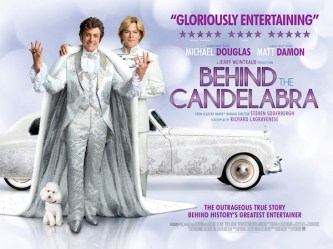 Steven Soderbergh’s supposed last-ever film (or, if you’re American, Steven Soderbergh’s first project after he supposedly quit film) is the story of Scott Thorson (Matt Damon), a young bisexual man in the ’70s who encounters famed flamboyant pianist Liberace (Michael Douglas) and ends up becoming his lover, which is just the start of a strange, tempestuous relationship.
 It looks great, too. The film, that is, not Rob Lowe’s face. The design teams have realised an excellent recreation of the period, which is then lensed with spot-on glossy cinematography by DP ‘Peter Andrews’. Occasionally the film moves outside that heightened, shiny world into places odder and grubbier, with one shot of Liberace peering over the door of a porn shop private video booth (really) that’s particularly striking.
 James Woods is the owner of a trash TV station who’ll do pretty much anything for ratings. His hunt for the next ‘big’ thing leads him to come across the signal for a channel that shows just one bizarre, disturbing programme. Obsessed with finding out the truth behind it, he gets suckered in to a conspiracy that blurs the line between reality and imagination.
 I guess for some people the “ew”-inducing effects are the primary delight of the film. These are the kind of people who complain about the UK version being cut. In truth, this is actually the originally-released R-rated version; the so-called Director’s Cut adds just over a minute. Having read about
 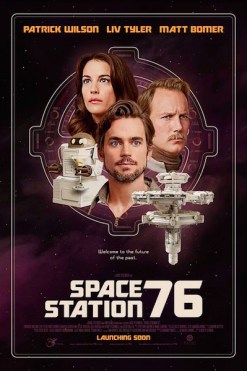 Liv Tyler is the new first officer on a space station commanded by Patrick Wilson in this retro-future-styled film, which is both a spoof of/riff on ’70s genre movies, and a character drama about people’s relationships. No, really.
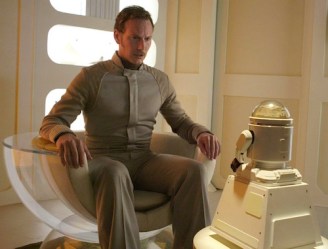 used to feed into the humour, that’s simply what makes it, a) a period movie (just a period movie set in the future), and b) a comedy-drama (as opposed to a drama). I think this is the real reason for its lowly regard on sites like IMDb: those expecting Anchorman in Space are going to be disappointed; but you can’t blame anyone for such expectations when that’s more-or-less how it’s trailed.
 The characters and their relations are well enough drawn to make it passably engrossing, even if not a stand-out contribution to any such genre, while the comedy pays off handsomely at times.
 From the sword and sorcery ‘boom’ of the ’80s, Red Sonja concerns a warrioress going after the evil queen who slaughtered her family and has now seized a magical MacGuffin that will destroy the world or somesuch.
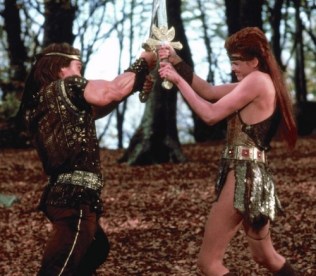 being a particular highlight. Veteran helmer Richard Fleischer’s direction seems to have come in for criticism from some quarters, but I found it adequately unremarkable. Damning with faint praise, I know, but it doesn’t merit slagging off either.
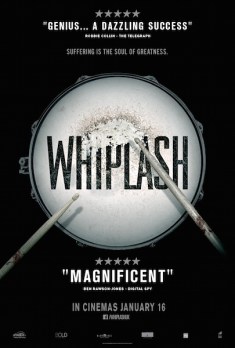 Mr Fantastic dates Supergirl and is taught the drums by J. Jonah Jameson in writer-director Damien Chazelle’s Oscar-winning music drama.
 Simmons’ Oscar is well earnt as the unpredictable Fletcher. If you’ve seen clips and trailers you might imagine it’s a fairly one-note turn, the Angry Teacher who possibly reveals a Heart Of Gold either just in time for the third act or at the very end. But no, there’s more to it than that, and Simmons negotiates every facet and nuance with the expertise of an experienced character actor. Commendations to both Chazelle and Simmons for wrong-footing me on what was actually going on with him more than once.
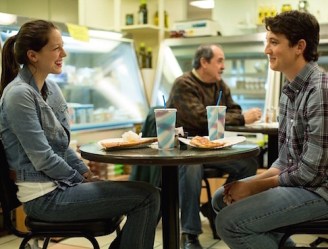 That thread could do with a boost in the middle, to give their relationship a little more weight when we reach the decisions Andrew must make about it later on. (Personally, I’d choose Melissa Benoist over J.K. Simmons any day, but I don’t think that’s the point…) The same could be said of Andrew’s relationship with his father (Paul Reiser), though that’s actually given more screen time and is consequently more impactful.
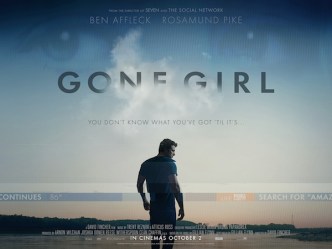 “Horrible people do horrible things to each other” is the Post-it Note summary of this dark drama-thriller from director David Fincher, adapted by screenwriter Gillian Flynn from her own novel, which is short on heroes and overloaded with villains. An alternative brief summation is, “modern society is shit.”
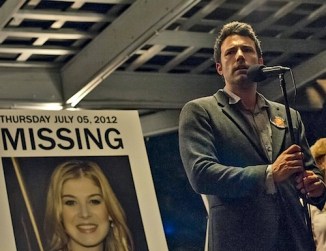 However, that opinion may stem from the same point as my view on the more praise-filled reactions: that Gone Girl is not a film as great as
 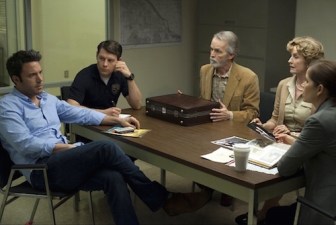 This is an argument for which I have a lot of time. The majority of Fincher’s filmography is made up of policiers and thrillers of one form or another, and even when he breaks out of that mould — in The Social Network, for instance — he often brings a similar perspective and toolset. Many of these films are borderline-rote, heavily-generic schedule-fillers at screenplay level, and would have been just that in the hands of a lesser director; in the hands of a master filmmaker, however, they become genre-transcending classics. I think that same sentence could be said about most (all?) of Hitchcock’s best films.
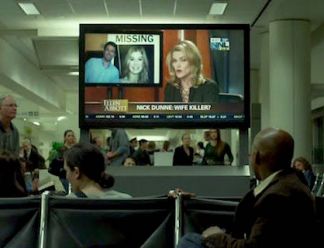 Is it for the masses, too? Maybe. In his
  a lesser actress could’ve given a performance with fewer notes and the film still would’ve functioned; or they would have struggled to contain the numerous sides to Amy’s personality in the form of a plausible human being. Pike does that, and more. She goes on my list of “people who were robbed of an Oscar because it was someone else’s ‘time’” (alongside Paul Greengrass’
  From the heart of Disney’s most recent poor period, Lilo & Stitch is possibly the only film that comes out of that era with any affection. Certainly, it spawned several sequels and a relatively-long-running TV series. By the standards of the films that surround it, it’s a good’un; in the grand scope of all Disney films, however, I didn’t care for it that much.
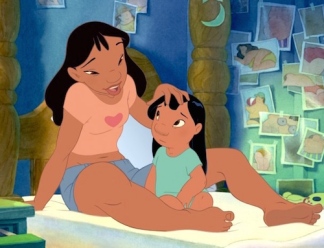 The story is something and nothing. Despite strong and relatively mature thematic notes, it doesn’t quite break free of the family-movie trappings to achieve the kind of insight or age-group transcendence that, say, Pixar movies routinely manage. For kids, though, especially ones who are feeling like misunderstood outsiders, there might be a lot to take from it. The zany antics of the heroes might also work for them in a way they didn’t for me — the ‘craziness’ comes across as a series of vignettes to bide time until the climax, and I didn’t find it massively engaging either. This is also the stage at which Disney had decided musicals were a Bad Idea, so there’s only a couple of non-diegetic songs to keep things ticking over, and… well, your mileage may vary.
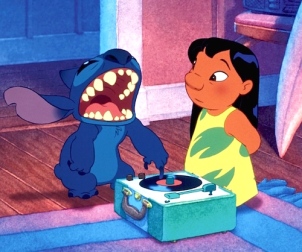 that might be missed by many a viewer, but it gives a subtly different feel. It’s a little more classical, which sits nicely against the very modern zany-aliens storyline.
 Directed by
 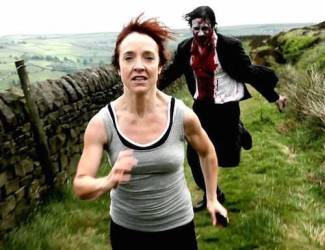 Amateurish production values often let the side down. I don’t think Brunt’s direction would be too bad were it not for the cheap camerawork, although the action scenes are overrun with ShakyCam. There are some very good bits late on: the developments that come as a result of a stranger’s arrival; a phone call with the kids; perhaps even the very end, which is a bold climax.
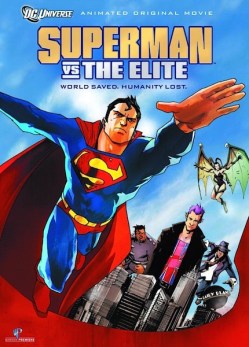 Adapted from acclaimed comic book story What’s So Funny About Truth, Justice & the American Way?, this DC animated movie sees the methods and morals of Superman (George Newbern) being questioned by the public and authorities alike when a super-villain escapes for the umpteenth time and kills more innocent bystanders. In the incident’s wake, a new super-powered team emerges — the titular Elite, led by Manchester Black (Robin Atkin Downes) — and their preparedness to execute criminals is met with great popularity around the world. How much humanity is humanity willing to sacrifice in the pursuit of conflict resolution? Are Superman’s high morals a thing of the past?
 I assumed they were being faithful to a comic that hails from the ’80s, but it was actually published in 2001. It’s like Brit Pop never happened.
 100Films.co.uk