2016 #128
Zack Snyder | 183 mins | Blu-ray | 2.40:1 | USA / English | 12 / R
 The Batman v Superman Ultimate Edition has been available via various means for a month or more now, but has only hit disc in the UK this past week (and I waited for it, because I’m a good boy). This extended cut adds half-an-hour of material, give or take (comparing the two Blu-rays tells me the difference is just under 31 minutes; Movie-Censorship.com says it’s just under 30 minutes) — material that is unlikely to completely transform anyone’s opinion of the movie, but at the same time definitely does improve it. That means two things: firstly, most of my original review still applies; but secondly, and crucially, some of it doesn’t.
If you hated the movie’s overall dark tone, or its depiction of either of its titular heroes, or the over-CGI’d climax, or the way it shoehorned in teases for DC’s future movies, this cut fixes none of that. I mean, of course it doesn’t — they didn’t remake the movie. If you thought the storyline wasn’t clearly explained, or that Superman’s half of the story needed more screen time, or that you’d really like to have to wait even longer before the title fight, then this is the cut for you.
As per Movie-Censorship.com, there are 99 changes. Yes, 99. That’s made up of 18 wholly new scenes and 60 extended ones, plus 19 scenes with alternate footage and two slight audio tweaks. The clearest effect of these additions is in filling out the events in Africa near the start of the film and Lois Lane’s subsequent investigation into them, as well as showing Clark actually investigating Batman, rather than just having Perry constantly tell him off for doing it. In the process, it massively clarifies who the overall villain is and what connects all the many disparate plot threads, so that it’s a logical reveal rather than an end-of-act-two declaration that some viewers completely missed. Let’s take each of those in turn.
 You may have read that the photographer with Lois in Africa is Jimmy Olsen, identified in the credits but not on screen in the theatrical cut. In this version he is named on screen, but that’s not the important part. More is done to establish why Lois is in Africa, what she’s hoping to achieve, and lay the seeds for why it’s all going to go wrong. This is achieved in such a short space of time that it seems ludicrous it was cut out, leaving theatrical viewers playing catch-up when a couple of extra moments would’ve explained it clearly. (Of course, there may be an element of re-viewing bias in this: I already know what’s happening so of course I cottoned on to everything sooner.) When things do go south, more material makes it explicit what happened — what the bad guys do to frame Superman, essentially. It’s possible some of this material was cut to achieve the PG-13 rating, but in doing so they left out bits and pieces that are referenced later, heightening the sense of confusion for theatrical viewers — how are we meant to know a woman testifying to a congressional hearing about “burned bodies” is a reference to events we just witnessed if we don’t see anyone burning any bodies?
This kind of increased clarity follows throughout the film. The fleshing out of Lois’ investigations is what leads to us understanding the overall scheme better when it comes to a head. It’s also where you’ll find Jena Malone’s character. There was much speculation about who Malone was playing, especially after she was cut and director Zack Snyder claimed it was because her character was of greater significance to the DC movie universe than this movie in particular. Turns out she’s… some lab tech. That’s it. Now, her role seems disproportionately small considering the level of actress cast, so maybe she has some secret identity that will be revealed in Justice League; but on the BvS level, she actually helps explain some of the plot, and therefore is much more relevant to BvS itself than that awful Flash cameo or the terribly clunky scene with the meta-human files. If Snyder really wanted to ring-fence the universe-building into the Ultimate Edition, those are the scenes he should’ve excised from the theatrical cut.
 Less vital to the overall plot, but which certainly contributes to the titular conflict, is that Clark’s investigation into the Batman is seriously beefed up. It makes Clark/Superman feel like more of a leading character in a film that was, at least as originally conceived, his sequel. In some respects this storyline is a more understandable excision, because Superman’s dislike for the Batman and his methods isn’t entirely unclear in the theatrical cut. Equally, it does flesh it out better and connect up some of the dots, like why he intervened when Batman was trying to steal the Kryptonite at the docks (essentially: a Bat-victim’s girlfriend said Batman needed stopping. Maybe not a great reason, but hey, it’s a reason). It’s a case in point of how this film simply has too much going on. To create a workable version it’s had to be three hours long — that’s the length of two movies, and it does feel like two movies’ worth of material. Not back-to-back movies — you couldn’t cut it in two at the middle and be left with two independent films — but two movies that occur concurrently; intercut. I mean, there are even two big action climaxes, back to back.
In my original review, I noted that there was an “almost-throwaway sliver of dialogue that indicates Lex put all of this together, [but] the way it’s presented in this cut makes it come a little out of nowhere.” I believe some viewers missed that reveal entirely. The primary achievement of the Ultimate Edition, then, is making this story clear. It’s still something of a reveal that Lex is behind everything, but we get there through investigations and deductions that the characters make, rather than arriving at the end and Lex simply declaring, “b-t-dubs, everything you’ve just seen? Totally planned it all.” Personally, I thought Lex’s plot was already fairly clear; not crystal, by any means, but you could get there. I mean, you had to pay attention — probably more attention than most people expect to have to pay in a Zack Snyder blockbuster — but it was there. So it’s tough for me to say exactly how much clearer the Ultimate Edition makes it. It does feel more streamlined, with obvious new bits that help clarify certain points. 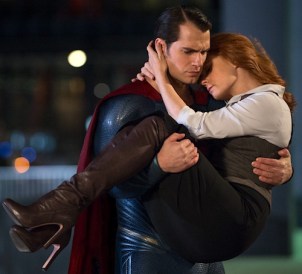 I don’t think it sinks to the level of spelling it all out slowly and carefully in case you missed it, but it does make it more explicit; and, as discussed, it does that by showing more of Lois’ investigation, so it feels like her role is more substantial too. She felt a little cursory in Man of Steel — “it’s a Superman movie, we have to put Lois Lane in” — whereas here she has a bigger role than her boyfriend… at least until the punchy-punchy climax, of course, when his superpowers win out.
Also in the Lex camp, his mystifying line to Batman about aliens coming (or something) is somewhat explained by a short scene (which was made available online after the theatrical release and is now cut into the film) where he’s shown in front of some kind of creature that disappears when troops turn up to arrest him. I say “somewhat explained” because that’s literally the extent of the scene — there’s not even the vaguest explanation of who the creature is, or what the creature is (another Kryptonian mutant? An alien entity? A man in a suit?), or how it got there, or why it got there, or what it’s doing with/to Lex… It’s just another vague tease, which non-fans must either shrug and ignore, or scurry online to find a forum thread or news article or tweet where knowledgeable fans can tell them what the hell they just witnessed and why it’ll be relevant next time.
That was one of the more sensible removals from the theatrical cut, then. Otherwise… well, I’m not the first to say this, but it’s really bizarre that Snyder seems to have consciously chosen to cut out scenes that actually explain the plot. As I’ve said, it was followable in the theatrical cut, so maybe he just got blinded by the fact he’d seen the movie a thousand times while editing and so it all still made sense to him? Nonetheless, watching the extended cut enhances the feeling (which is there in the theatrical if you know a longer version exists) that the methodology for shortening the movie by half-an-hour was to just select scenes at random and delete them. How else do you explain losing chunks of Lois’ and Clark’s respective investigations while that awkward scene of Perry wondering where Clark’s gone remains in both cuts?
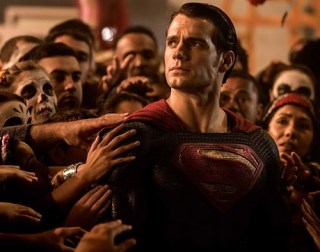 One thing that is pretty apparent about Snyder’s intentions is that he really wanted to make a Batman movie, and I suspect Man of Steel was his way in to getting to do that. Despite launching out of the events of Man of Steel, and engaging with issues of what it means to be Superman (therefore continuing MoS’s theme of “what would it be like if Superman was real?”), and having Lex Luthor as the main antagonist, BvS feels like a Batman-driven movie more often than it does a Superman one. Personally, I get it — I’m more of a Batman fan than a Superman fan too, so that approach warrants little complaint from me — but I can see why Supes’ fans would be miffed.
Another Snyder-related point comes to mind thanks to the numbering system I use for this blog. Most extended cuts of films I’ve already seen don’t merit a new number — i.e. this would be #127a — because they’re usually not significantly different to the existing versions, just adding some character beats, bonus action moments, or extra gags. They’re not fundamental enough to consider it a “new movie”. To be honest, because the extended BvS mostly serves to clarify the plot that was present in the theatrical version, I might’ve just gone with my usual numbering if it weren’t for, (a) everyone else saying how different it is, and (b) the fact a 30-minute extension amounts to 20% more film — no one can call that an insignificant addition. Interestingly, one of the few other extended cuts I gave a new number to was the Watchmen Director’s Cut. And I never bothered to watch the theatrical version of Sucker Punch, but from everything I read I’m sure the extended cut is substantially different and substantially improved. When Snyder does an extended cut, he means it. It’s not just “here are ten minutes of scenes I had to delete but rather liked”, it’s a revised version of the film — and it’s always a better version.
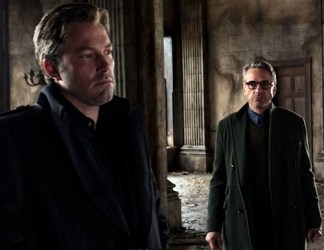 Other, more minor changes in this cut include increased violence, though personally I barely noticed it. Some people seem adamant this should’ve upped it to a 15 certificate, but I think you can justify saying it stops just short of that. Quite what the MPAA saw that merited an R, I’m not entirely sure. More interesting to my weirdly-obsessed mind is that the film actually includes the “Ultimate Edition” title on screen, both during the opening credits and at the end (where it’s technically titled “Batman v Superman: Dawn of Justice Ultimate Edition” without any additional punctuation). How many other extended cuts actually change their title card to reflect that fact? Off the top of my head, I can’t think of any.
As someone who genuinely enjoyed Batman v Superman’s theatrical cut, it’s hard to say how much better the Ultimate Edition is for viewers who were less convinced. However, I do think it’s a question of “how much better” rather than “is it better”, because this is certainly a superior version of the film — the fact it’s now over three hours long notwithstanding. The new cut won’t ‘fix’ the movie for viewers who object to the inherent tone and style of the piece, but if you’re open to that, this cut does improve the storytelling and character arcs for a smoother experience overall. I do understand some of the reasons people dislike this movie — the way it modifies characters from their traditional depictions; the overall serious and dark tone — but they’re not opinions I share. It’s certainly not a perfect movie, though: the climax descends into CGI-fuelled mayhem (though the reduced scale of a TV screen makes it more followable); the desire to counter accusations levelled at Man of Steel’s destructive climax gets old fast (the film is at pains to constantly tell us that such-and-such an area is deserted for this-and-that reason); the meta-human set-ups are clunky and distracting; and your mileage will vary on the revisionist versions of Superman and Lex Luthor (I didn’t love Eisenberg’s take on the character, but I don’t mind it either).

I gave the theatrical cut 4 stars, which doesn’t leave me much room for manoeuvre here. Is the Ultimate Edition a whole star better? Maybe it is. I enjoyed it enough that I’m almost kind of tempted to go for the full 5… but that would be pushing it. I’m not sure any movie is perfect, but even for someone who likes it Batman v Superman has enough niggles to discount it. Still, I think it’s an enjoyable, interesting movie, that provides a welcome tonal counterpoint to the efforts of the other superhero shared movie universe. Variety is the spice of life, after all.
Batman v Superman: Dawn of Justice – Ultimate Edition placed 10th on my list of The 20 Best Films I Saw For the First Time in 2016, which can be read in full here.
The next film in the DC Extended Universe, Suicide Squad, is in cinemas from today.

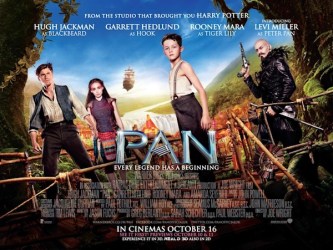 12-year-old Peter (Levi Miller) lives in an orphanage in World War 2 London… until the night pirates bungee in through the ceiling and kidnap a bunch of boys onto their flying galleon. Yes, really. From there it’s second star to the right and straight on ’til morning as the pirates take their new charges to Neverland, where they’re forced into the Mad Max-esque mining operator of Blackbeard (Hugh Jackman). When it turns out Peter can fly, a friendly chap by the name of Hook (Garrett Hedlund) helps him escape, and they head off to find Peter’s destiny, etc — he’s some kind of prophesied Chosen One, because of course he is.
 As said boy, Levi Miller manages to make Peter not intensely irritating, which is an achievement compared to other adaptations. Some of that is surely inherited from the writing and directing, but Miller gives a strong performance too. Hugh Jackman hams it up magnificently as Blackbeard, clearly having a riot. Rooney Mara may be miscast due to the colour of her skin (for all the complaints about whitewashing, her tribe is shown to be mixed race… which doesn’t necessarily excuse it), but her actual performance is very good. I felt like Garrett Hedlund was doing an impersonation of someone but I never quite got a handle on who (the character’s definitely written to be Han Solo, but the actor’s not copying Harrison Ford). Adele Akhtar brings comedy as Hook’s chum, Sam ‘Smee’ Smiegel, there are cameos of varying purpose from Amanda Seyfried and Kathy Burke, and Nonso Anozie is always a welcome presence, here playing Blackbeard’s henchman. Cara Delevingne doesn’t act so much as provide a human reference for the CGI.
 Having found Pan to be a very likeable fantasy adventure, I confess to being slightly confused by the response that saw it soundly trounced by most critics and viewers. The review on Blu-ray.com makes the assertion that “today’s movie audience has become so instinctively sophisticated when it comes to CGI-enhanced action sequences that no one can predict what they’ll like”, which I thought was pretty insightful — when does “amazing spectacle” tip over into “oh my God it’s just more CGI”? I think there’s a definite bias based on what people expect of a film. Indeed, a commenter on Letterboxd asserted that most of Pan “consists of the sort of spectacle-as-sleep-inducer set-pieces you find tacked onto the end of Marvel superhero movies”, which at least criticises the sainted Marvel movies for once, but I didn’t think it made up “most of the movie”, nor did I find it sleep-inducing. In fact, I thought Pan had some of the better CGI-driven-spectacle action sequences I’ve seen in our modern overloaded-with-CGI-driven-spectacle era. It is, however, one of those films that must have been genuinely made with its 3D release in mind — as is often the case with those, it’s not the stuff poking out at you that gives it away, but the in-focus backgrounds, which can be especially awkward to navigate in fast-moving action scenes. As Blu-ray.com’s review of the 3D disc notes, “the chaos of the final battle is easier to follow when the action occurs in recognizably separate planes in space.”
 or Disney’s, aside from my aforementioned aversion to the eponymous hero), so I was perhaps more open to this Epic Fantasy reimagining. (In that last respect, it definitely falls into the same bracket as Tim Burton’s Alice in Wonderland, which I wrote about in my review: classics of children’s fantasy adapted and reconfigured with a post-Potter/Rings mindset.)

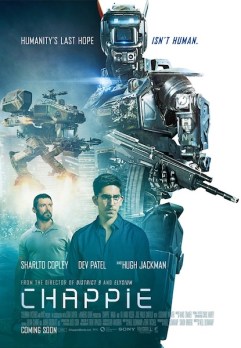 Neill Blomkamp seems to be on M. Night Shyamalan’s career path: a massively-praised Oscar-nominated breakthrough genre movie, followed by a series of increasingly maligned follow-ups.
 How the mighty have fallen. The great Michael Mann, who once helmed genre-defining crime movies with expertly-directed sequences, here delivers a movie that looks like an amateur cheapie by a film student who’s watched too many Paul Greengrass movies without learning anything meaningful from them.
 After years producing movies in the
  British Academy Film Awards 2016
 Adapted from Colm Tóibín’s award-winning 2009 novel by novelist-turned-screenwriter Nick Hornby and director John Crowley (
 Guiding us through this, the film’s heart in every respect, is Saoirse Ronan’s leading performance. I will watch Ronan in essentially anything at this point, both because she seems to choose good material and because, even when she doesn’t, she’s great in it. This is probably her first really mature performance, convincing as a somewhat shy young woman who makes her way out into the world, in the process realising all the confidence she should have in herself. It’s the kind of character and performance that works by accumulation; it’s about the journey, not heavy-handed emoting in a scene or two.
 John Crowley’s direction is largely unobtrusive, but that is a very different kettle of fish to lacking quality. The subtle changes in framing, lighting, and colour palette as the film moves through its locations and stages helps emphasise how Eilis is changing, and how the world changes in her perceptions, too. It makes the story’s times and places look beautiful without quite slipping into picture-postcard rose-tinted-memories territory.
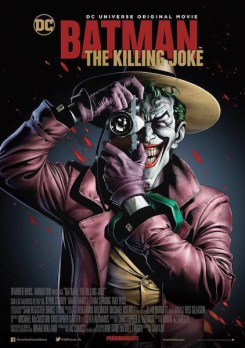 Alan Moore and Brian Bolland’s 1988 graphic novel The Killing Joke is one of the seminal works of superhero comic books’ move into seriousness in the ’80s, sitting just behind the likes of Watchmen, The Dark Knight Returns, and Batman: Year One in terms of significance. It’s also seen by many as the definitive story about Batman’s nemesis, the Joker, and has influenced the live-action interpretations of both Jack Nicholson & Tim Burton and Heath Ledger & Christopher Nolan. It is not without controversy, however, thanks in large part to its treatment of Barbara Gordon / Batgirl; and Moore has since semi-disowned it, saying it has no intrinsic value because it has nothing to say about real human beings, only commenting on the comic-book-y relationship between Batman and the Joker.
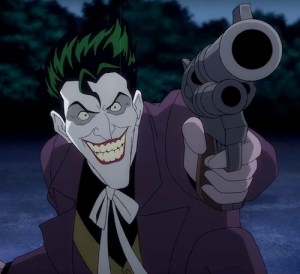 we get to the familiar meat of the story, where the Joker (Mark Hamill) decides to prove a point — in a violent and twisted fashion, naturally.
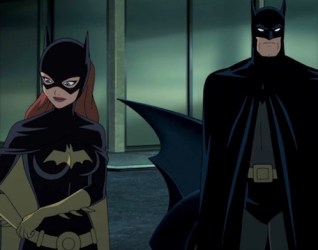 To say the least, this doesn’t seem like the best way to go about making her an independent, rounded human being — it comes off like fan service. No, worse: fan fiction. A scene earlier on where she explains her Bat-infatuation to her gay best friend is presumably meant to suggest a genuine motivation for the eventual sexy times, but it all comes across as a great big excuse.
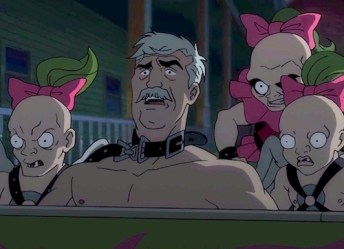 which brings its own problems to the story. But while he is a familiar figure in the Batman mythology, and so by extension to anyone who’s likely to watch this film, it’s also a standalone movie, not part of a series, and so it would be beneficial to establish his character somewhat before the Joker’s plan for him gets underway.
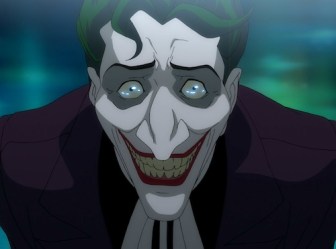 (It’s somewhat ironic, then, that (as ever) Alan Moore doesn’t receive an onscreen credit while Bolland does.) There are a handful of effective visuals here (the Joker’s gleeful face as he turns on the amusement park, its lights twinkling in his eyes), but they’re the exception to work which is adequate — good for what it is, even — but unremarkable.

 Score:



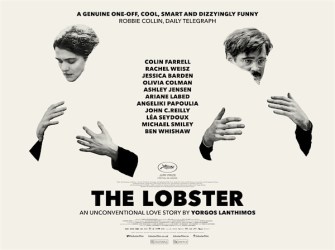 The first English language feature from Greek writer-director Yorgos Lanthimos (of
  Even if you accept these goals, Lanthimos’ film eventually goes off the rails. Without meaning to spoil too much, David eventually falls in with the loners, who have their own very specific social rules designed to inhibit partnering up. Revelation: the outsiders are fundamentally the same, just with different rules! That’s about the extent of what I got from this portion of the film; unfortunately, it goes on for a really, really long time. Among this group David meets ‘Short Sighted Woman’ (everyone aside from David is similarly named) and falls in love with her — I mean, of course he does, she’s played by Rachel Weisz. They develop a secret mode of communicating, but will be harshly punished if caught. This storyline is what the film uses to occupy its remaining time, but what it lacks in the offbeat humour of the time in The Hotel it makes up for with… nothing.
 100Films.co.uk