
There’s so much TV right now! And that’s before you consider all the old stuff to catch up on (and by “old” I mean “anything aired before the past month”).
Still, here’s a selection of what’s been gracing my eyeballs in the last 35 days…

Luke Cage (Season 1)
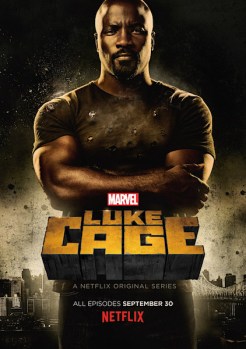 The third series in the Marvel/Netflix stable wins points for boldness, much as Jessica Jones did this time last year. Where Daredevil is a well-done but ‘standard’ superhero show, leading to it being somewhat demeaned by the Cool Kids of the critical world (but much higher-rated by us plebs on the likes of IMDb), Jessica pushed into dark psychological territory, and now Luke Cage brings black culture and life into the fold.
In truth, I still think Daredevil is the best produced of the three. Maybe that’s because it’s operating in more familiar territory, but it seems to know how to construct its storylines to fit the time given, and pace them to really kick off that “just one more episode” feeling that Netflix binge-watching is so famed for. Conversely, Jessica didn’t have enough story for 13 episodes, spinning its wheels and going in circles in the second half. Luke Cage doesn’t suffer from that exact problem, but it spends a lot of time finding excuses to keep its near-invulnerable hero out of the action.
But, for its plot-related flaws, it’s not a bad show. It has three strong villains — it’s just a shame it’s the fourth who becomes the focus for the back half of the season. Its use of music is unusual and brilliantly executed, though as it’s employing genres and styles, indeed a whole culture, that I’m not exactly au fait with, it’s like watching as a fascinated outside observer rather than someone fully embedded or engaged. That’s not necessarily a negative, just a different way of relating to it. And even with those storytelling faults I mentioned, there’s at least one huge and unexpected twist, which really livens up the show… for a bit. It also gives Rosario Dawson the biggest role she’s yet had in one of these Marvel series, and that’s no bad thing either.
Indeed, the best thing about Luke Cage is its characters. Mike Colter is an appealing leading man — when the character is allowed to do something, anyway — and the supporting characters on both sides are fantastic (with that one unfortunate exception I already mentioned). This bodes well for when they join up with everyone else in The Defenders next year, and also leaves season two with plenty of potential…
…if Netflix commission it, of course. Surely they can’t be intending to have 6+ Marvel shows on the go?!
Ripper Street (Season 5)
 It feels like only yesterday I was writing here about season four (it was, in fact, February and March). I think it was assumed this final season would be coming next year, but then Amazon announced it almost out of the blue just before the BBC’s run of season four ended, and made the unusual-for-them decision to dump the whole season at once, Netflix-style. It benefits this particular group of episodes because it really is one long story — when the show moved to Amazon for its third season it got more heavily serialised, but often with “case of the week” plots alongside that; the end of season four and all of season five throw that almost entirely aside for one long, developing storyline.
Nonetheless, they’ve done a good job of making a TV show rather than a really long movie in six parts. The third episode, in particular, sets our heroes aside almost entirely to spend an hour with a villain who’s barely done more than grunt so far, digging into his psyche and his hopes (if any) of redemption. It almost felt more like an arty drama film than an episode of a period police procedural and proves that, even after five years, a quality programme can still push at and explore its form.
The final episode, however, is a certified oddity. After wrapping up the season’s primary plots with relative haste, it moves on to an odd, somewhat lethargic non-story. It is, in its way, bold for what started as a police procedural to end with an episode that focuses on the drama of its characters’ lives, but it does so with an almost perverse fixation on setting up certain expectations only to dash them. It is tough to call the episode either satisfying or unsatisfying as a conclusion, though I imagine some will come to the latter opinion purely because it is so uncommon. It’s titled Occurrence Reports, and that seems apt, for it seems to merely report a series of occurrences; but they do at least, in their way, bring all of the series’ parts to their respective ends.
Leaving aside the finale’s forays into structural experimentation, this is a good final season, that has moments to count among the programme’s very best. I still reckon season three is the best individual run, however.
Black Mirror (Series 2)
 Well, it’s only taken me 3½ years to get round to this (seriously, where does time go?!) This bunch really represents the series’ highs and lows. On the one hand, Be Right Back — in which Hayley Atwell signs up for a company who create a virtual version of her deceased partner using his contributions to social media — is an exploration of broadly-plausible near-future-tech with a focus on its potential emotional effect. That’s what Black Mirror does best, I’d argue: look at stuff that may, perhaps, be in the pipeline, and how that would actually play out for us. On the other, there’s The Waldo Moment, which is also sickeningly plausible — as Charlie Brooker himself has said, it’s more or less come true, though with the likes of Boris Johnson and Donald Trump instead of a blue cartoon bear — but as an episode it doesn’t quite seem to know where to go with its concept or what it might ultimately signify. The episode just stops rather than ends, until a flash-forward coda that’s a bit silly in its extremity. Even Brooker, while doing press for the third season (released tomorrow), has said he’d go back and re-do that episode if he could. Still, full marks for effort.
Red Dwarf XI (Episodes 1-5)
 This latest series of Red Dwarf (which airs its fifth episode tonight, with the sixth available on demand from tomorrow) seems to have gone down rather well, with some reviews even hailing it as a “return to form” — that form being “the good old days” of Red Dwarf VI (or thereabouts), over 20 years ago. Personally, I didn’t dislike Red Dwarf VII or Back to Earth, and I even have a soft spot for Red Dwarf VIII, so what do I know? Nonetheless, I would concur that this Dwarf represents a fine vintage, hitting the series’ unique mix of accessible mainstream-ish comedy and proper science-fiction concepts. Red Dwarf XII is already in the can for 2017, and I wouldn’t be surprised to see Dave commission more episodes beyond that.
Star Trek The City on the Edge of Forever
Star Trek: The Animated Series Yesteryear
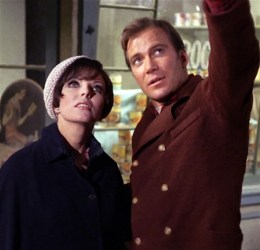 The entirety of TV Star Trek is available on Netflix, so I took the chance to watch the most acclaimed episodes of both The Original Series and The Animated Series — which happen to be connected, something I didn’t realise until afterwards. Er, I mean, which I totally planned. Both are pretty fine uses of science-fiction to explore relatable issues. Well, not many of us have to deal with disruptions to reality caused by time travel, or knowledge of the future creating dilemmas about what we do next, but they work the relatable stuff in around the surface plots. And they both still seem pretty bold for network TV episodes even today, almost half a century later, as (spoilers!) Kirk lets a good woman die to retain the correct timeline, and a kids’ cartoon deals with the subject of euthanasia.
Things to Catch Up On
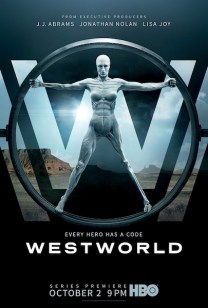 This month, I have mostly been missing loads of stuff. Probably the most talked about is HBO’s adaptation of Westworld, which has apparently pulled in even bigger ratings than Game of Thrones. Over here there’s the second series of The Missing, which if it’s half as good as the first will be a real must-see. Then there’s Woody Allen’s first (and last) TV series for Amazon, Crisis in Six Scenes. Reviews have been mixed to poor but I still intend to get round to it. And finally Hooten & the Lady, which may be the worst title for anything in the history of ever, but a globetrotting adventure series inspired by the likes of Indiana Jones and Romancing the Stone sounds right up my alley.
Next month… the latest Doctor Who spin-off comes to iPlayer; brand-new Black Mirror comes to Netflix; and I’ll finally watch Stranger Things, I promise.
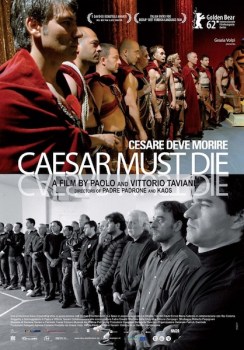 On the surface, this is a documentary about the inmates of Rome’s high-security Rebibbia prison — many of them with mafia connections — putting on a performance of Shakespeare’s Julius Caesar. However, it becomes clear fairly quickly that it’s all been staged, which is only more apparent when you learn some behind-the-scenes details (at least one prisoner had been released years earlier and returned to participate in this project).
 The director of minor horror
 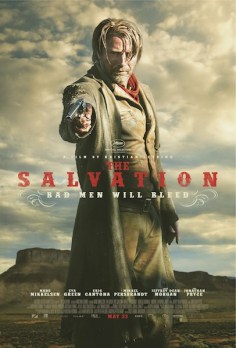 The spirit of the Spaghetti Western is kept alive in this Euro-minded South Africa-shot revenge Western.
 Score:



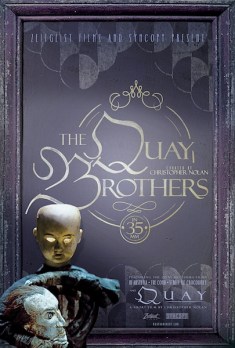 Christopher Nolan made a few headlines last year when his first post-
 For all that In Absentia initially feels like flailing in deep water without armbands, accompanied with “what have I got myself into?!” thoughts, in retrospect I found it to be the most accessible of the three animations. It’s abstract and confusing for most of its running time, but by the end you can decipher some meaning; you can understand the relevance of the feelings it aims to generate — and if you haven’t got there yourself, or if you’re unsure, there’s a dedication to point you in the right direction. I didn’t get that with the next two; not so easily, anyway, which is why I say they’re less accessible rather than less good per se.
 Michael Brooke notes that it is “setting out to wrong-foot the viewer at every turn, and the result wilfully defies verbal analysis.” What can be easily discerned is that it’s about a dream, and it probably shouldn’t be a surprise that there’s some dream-logic involved. As to what else is to be gleaned, your guess is as good as mine.
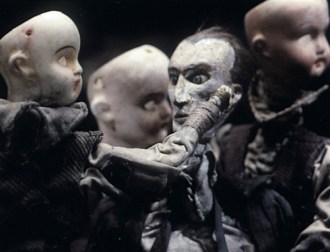 sometimes informative about the world the rest of us live in (In Absentia), sometimes a twisted analogy for it (Street of Crocodiles), and sometimes just fascinatingly unknowable (The Comb). All the films are teasingly oblique, and by all rights that should make them frustrating to the point of irritation, even abandonment… yet they’re kind of compelling nonetheless.
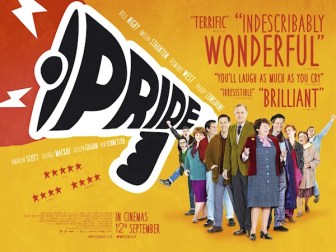 I don’t know if the true story behind Pride was big news back when it all actually happened in 1984, but I hadn’t heard of it until the film came along. For those who’ve still missed it, it’s about a group of gay activists deciding to form a group, LGSM, to support the striking Welsh miners — two groups who were poorly treated in one way or another by ’80s Britain.
 whose dancing display has to be seen to be believed. Bill Nighy and Paddy Considine are understated as quiet, hesitant characters who have inner steel, and Jessica Gunning makes a similar impact as a housewife who is completely emboldened by the activism.
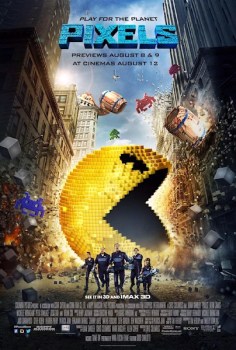 Adam Sandler, eh? He has his fans, though apparently not among people who can write because you rarely see a good word penned about him. The one exception is
 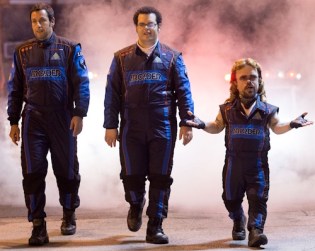 Pixels is the virtual definition of brain-off entertainment. The story has the plausibility of a kids’ daydream, the humour is frequently unimaginative, and the action sequences mostly coast on their basic concept rather than trying to elevate them. And Peter Dinklage is going to get a reputation for having terrible taste. I mean, I liked
 There are two stars in Mike Leigh’s biopic of famed British artist J.M.W. Turner: Timothy Spall, grunting his way through the title role with a deceptively layered realisation of an apparently simple but deeply complex man; and Dick Pope’s cinematography, which makes almost every frame look like a rich landscape painting, so that you feel you can almost see the brushstrokes.
 sometimes lack clear relevance (recognisable-off-the-telly actors turn up silently for what we’d call cameos if they were more famous). It creates a measured pace that is surely not to every taste, especially over the long running time, though personally I only found it sluggish towards the very end.
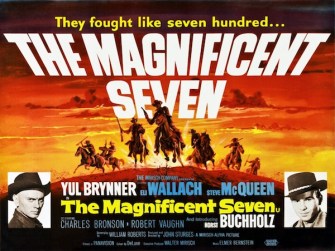 Described in the booklet accompanying the Ultimate Edition DVD release as “the last great American western before Sergio Leone reinvented the genre,” The Magnificent Seven doesn’t feel as dated as that might make it sound. Famously, it’s a remake of Akira Kurosawa’s
 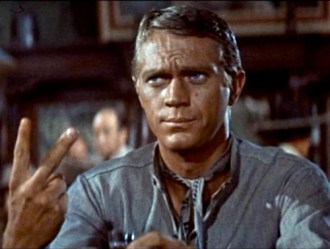 With even less screen time to go round than in Kurosawa’s original, the cast only get to provide thumbnail sketches of their characters. However, bearing that in mind, only Vaughn really feels shortchanged on time, while McQueen manages to steal every scene he’s in, even when he was supposed to just be in the background — much to Brynner’s annoyance. One reason this works is because the seven represent more or less the same things thematically, in some respects functioning as one hero character with seven parts. They are all unsettled drifters, good at killing but not at settling down; they have nothing to do but win and so be damned to go find another cause, or die trying. This is taken from Kurosawa’s film too, of course, but it fits just as well in its new setting, and the main scene where the seven discuss it is a definite highpoint of the movie.
 That’s not something that bothered me, but where I did find it suffering was in comparison to Kurosawa. While it has obviously been rejigged for its new setting, it’s not just borrowed the basic concept of seven violence-skilled loners defending a needy village, but rather retained all the bones of the samurai original. As with most remakes, it falters by not doing the same thing quite as well, for one reason or another. Still, if it is a faded copy then at least it’s of one of the greatest films ever made, which leaves it a mighty fine Western in its own right.
 100Films.co.uk