The Straight Story (1999)

2017 #133
David Lynch | 108 mins | TV (HD) | 2.35:1 | France, UK & USA / English | U / G

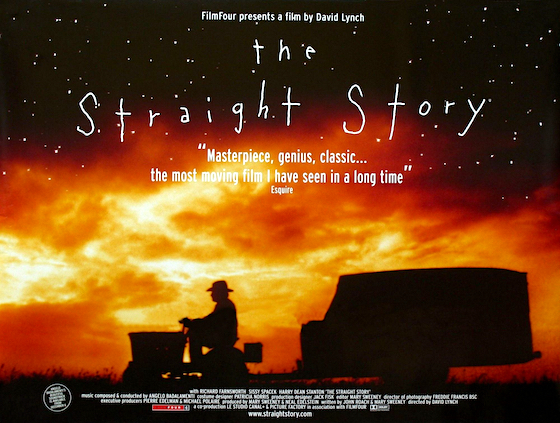
The Straight Story

“What would a G-rated Disney movie directed by David Lynch be like?” It sounds like a sketch show pitch, but in 1999, between Lost Highway and Mulholland Drive, it happened for real.*

And, talking of “happening for real”, this is a true story about an old fella, Alvin (Richard Farnsworth), who decides to visit his estranged brother after he suffers a stroke. Unable to get a driving licence, he sets off on his 30-year-old ride-on lawnmower, with a maximum speed of 5mph, to make the 240-mile trip. Yes, I said it’s a true story. Of course, it’s not just 100 minutes of Alvin riding a lawnmower along county roads — through the people he meets and the stories he tells, we learn he’s certainly lived a whole life.

Such a simple, straightforward, grounded (well, relatively grounded) narrative seems so very un-Lynch-like at first, but its tale of quirky Americana, peopled by a ragtag selection of endearing oddballs, isn’t so far outside his wheelhouse. There’s a definite Lynch touch detectable in how its made — the shot choices, editing patterns, and so on. There’s even a shot of a grain silo with a background hum that feels straight out of Twin Peaks. Then there are pretty scenery shots which are less obviously him.

Lawnmower man

Lynch has called The Straight Story his “most experimental movie”, which, considering the rest of his oeuvre, probably says more about what he considers experimental than it does about the film itself. What it does demonstrate is that the director, normally known for producing movies that befuddle the mind and chill the blood, is capable of producing something understatedly human and kind of heartwarming.

4 out of 5

* In the US, anyway — other distributors released it elsewhere, including Film4 here in the UK. ^

The Mummy (2017)

2017 #82
Alex Kurtzman | 110 mins | cinema | 2.39:1 | USA, Japan & China / English & Ancient Egyptian | 15 / PG-13

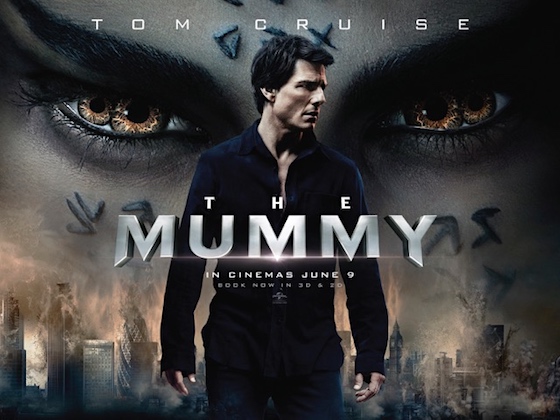
The Mummy

As studios scramble to emulate Marvel’s shared universe success, there are some very odd ideas being thrown around. One of the least odd, really, was Universal’s Dark Universe, which intended to mix together their various famous horror properties. At first blush that sounds as forced as most of these ideas are, but back in the day they made tonnes of “Dracula Meets Frankenstein” type movies, so why not do it again today? All of these movies were to be reboots, obviously, and they arguably played it safe by beginning with a reboot of one they rebooted before — a re-reboot, if you will. The Mummy 2017-style bears no resemblance to its popular ’90s forebear, but I doubt that was anything like the ’30s version anyway, so all’s fair in love and blockbuster moviemaking.

You’ll notice the repeated use of the past tense in my opening paragraph. That’s because The Mummy flopped, both critically and commercially, and the Dark Universe plans have been thrown into doubt. (Some say it’s been definitely cancelled, but I don’t think that’s been officially confirmed.) While I wouldn’t go so far as to call that a shame, I didn’t necessarily think The Mummy was that bad. On the other hand, it’s not great either…

Tom Cruise realises he's made a terrible mistake...

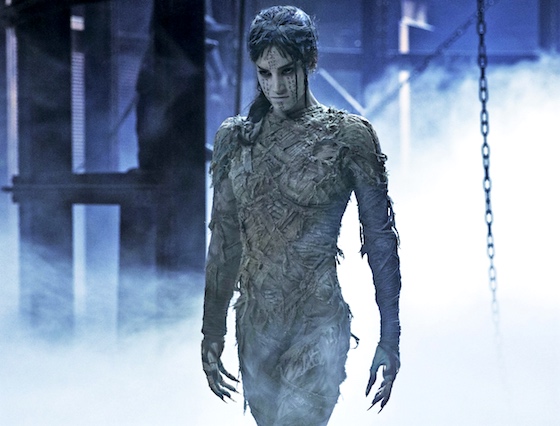
This iteration of the concept sets its scene in the present day war-torn Middle East, where Nick Morton (Tom Cruise) is a mercenary who stumbles upon a hidden tomb, inside which is the well-protected coffin of an Egyptian princess (Sofia Boutella). To cut to the chase, the dead lass wakes up, and brings all her supernatural powers to bear on destroying the world… or something. At the same time, Nick seems to have developed some kind of connection to her.

However, what sticks in your mind about The Mummy is not its eponymous villain, but all the time it spends trying to establish the aforementioned shared universe. Nick eventually comes into contact with a secretive organisation headed by Dr. Henry Jekyll — a name we all know, of course, so you begin to see the connections developing. You can’t help but feel more effort has been put into setting up this element than the movie that surrounds it, which therefore feels like little more than a delivery system for Dark Universe: Part 1.

But let’s try to judge it anyway. Primarily, it’s a tonal mishmash. It’s not exciting enough to satisfy as an action movie, but not scary enough to qualify as a horror. There’s humour, but it’s poorly integrated, feeling at odds with the dark tone. This is a PG-13 movie that kinda wants to be an R, but not so much that it’ll really commit to sitting on that PG-13/R line. Whole sequences and imagery seems to have been included just to look good in the trailer. For example, a bunch of business with a sandstorm in London — in the trailer it looked like it would be some sort of end-of-the-world climax, but it’s actually just a bit of a chase scene to get characters from one location to another.

“I’m here to talk to you about the Avenger Initiative.”

Cruise isn’t given room to display his usual charm, instead wandering through the plot being told stuff and always threatening to tip over into being the villain. This movie always seemed like an odd choice for him — getting stuck into a franchise-within-a-franchise at this stage in his career — and, yeah, it remains an odd choice. Russell Crowe phones in his Nick Fury turn as Jekyll, while sidekicks Annabelle Wallis and Jake Johnson fight against the material as they struggle to make their mark. Boutella’s part makes feints at complexity, but is ultimately no deeper than you’d expect the Mummy’s role to be in a Mummy movie.

And after all that it doesn’t even end properly. It’s not even that it’s blatantly set up for a sequel (it’s not, really), but it’s clearly aware that it’s part of a shared universe and they might want some of these characters back. Well, that’s what this is all about, don’t forget — Dark Universe: Part 1.

Despite all that, there are hints of a decent movie here: the first act is fairly good, and while the humorous moments may sit oddly with the pervading tone, they’re mostly fine in themselves. But it’s too concerned with establishing a universe when it should worry about being a good yarn in its own right, meaning it fails to do either adequately.

Mummy mia, here they go again

When I started this review I was going to end up giving it a generous 3 (that’s what it’s down as in my 2017 stats therefore), but my memories of whatever I liked enough to nudge it upwards have begun to fade. The Mummy — and the Dark Universe it was meant to kick off — could’ve been something, if not great, then at least worthwhile. Shame.

2 out of 5

Blindspot Sci-fi Roundup

With my 2018 Blindspot and “What Do You Mean You Haven’t Seen” selections now chosen, it’s about time I got on with reviewing those from the class of 2017 that are still in my “to do” pile. Here, then, are four more reviews of my 2017 must-sees, connected (as you may’ve guessed from the title) by all being works of science fiction.

In today’s roundup:

  • District 9 (2009)
  • Moon (2009)
  • Her (2013)
  • Forbidden Planet (1956)


    District 9
    (2009)

    2017 #88
    Neill Blomkamp | 112 mins | Blu-ray | 1.85:1 | South Africa, USA, New Zealand & Canada / English | 15 / R

    District 9

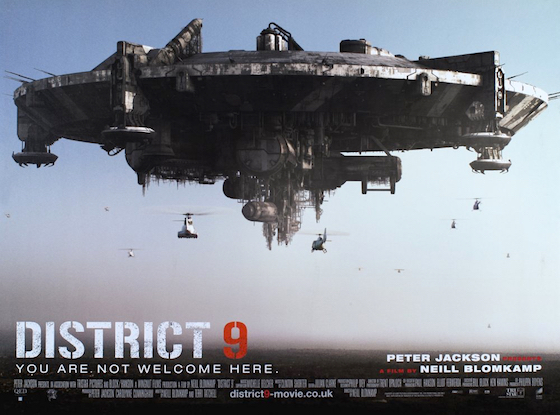
    We begin this roundup with two 2009 sci-fi thrillers that made the names of their respective directors. District 9 got the wider attention, being backed by Peter Jackson and receiving a Best Picture Oscar nomination (alongside three other nods), but I’d argue it’s ultimately the lesser of the two films.

    Although District 9 remains highly praised, co-writer/director Neill Blomkamp’s next two movies — Elysium and Chappie — haven’t gone down so well. Having seen both of those first, I feel like there are a lot of structural and tonal similarities between all three films, so it’s interesting to me how poorly the next two were received. Basically, they all start with some kind of societal sci-fi issue, explore that for a bit as the world of the story is established, then transition into being a shoot-em-up actioner.

    In District 9’s case, it starts out as a documentary about (effectively) alien refugees who live in a segregated community in South Africa. The obvious real-world parallels are, well, obvious. Then events transpire which make the idea of having to identify with those who are Other than us — of becoming affected by their culture — very literal. Then it turns into an achieve-the-MacGuffin shoot-em-up runaround. It’s done well for what it is, with some strikingly gruesome weaponry to give the well-staged shootouts a different edge, but that’s still what it is. Presumably it was all the rather-obvious allegory stuff that helped land the film a Best Picture nomination, and the fact the second half is a not-that-original humans-vs-aliens shooter was overlooked.

    Not so different. Okay, pretty different.

    For me, the clunkiest bit is the storytelling style it adopts. It’s a mockumentary… until it decides it doesn’t want to be so that it can tell its story more effectively… but then it sometimes slips back into mockumentary later on, most notably at the end. I found that distracting and formally inconsistent. I’d rather it had kept up the mockumentary act throughout or not used it at all; or, if you’re going to do both documentary and ‘reality’, have a point to it — show differing versions of the truth, that kind of thing, don’t just mix it together willy-nilly.

    All told, I found District 9 to be a mixed bag. The first half is excitingly original and interestingly ideas-driven, with allegory that is powerful if perhaps a little heavy-handed (I suppose that’s kind of unavoidable when you make a movie about segregation and set it in South Africa). The second half is just a shoot-em-up.

    4 out of 5

    Moon
    (2009)

    2017 #145
    Duncan Jones | 97 mins | Blu-ray | 2.40:1 | UK / English | 15 / R

    Moon

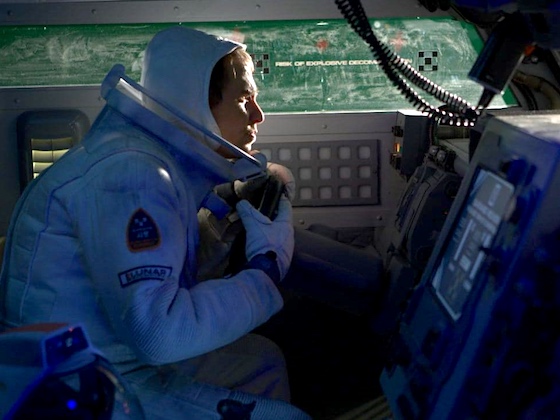
    The other 2009 sci-fi debut feature was that of director Duncan Jones. Although it received no Oscar love it did get a BAFTA, but seems to remain less seen: it has almost half as many user ratings on IMDb as District 9. Personally, I thought it was the superior film.

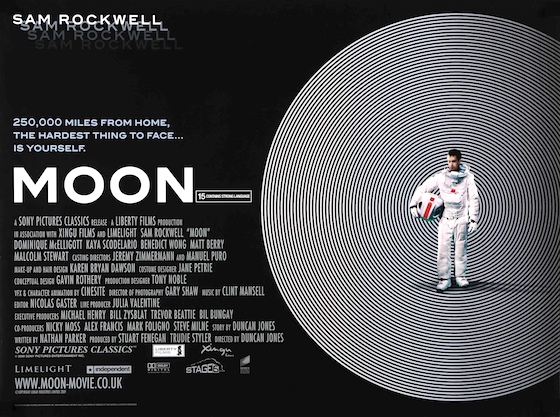
    It stars Sam Rockwell as the sole inhabitant of a mining facility on the Moon. As the end of his tour of duty approaches, his investigation in a malfunction unearths a startling secret. To say any more would spoil things, though Moon gets to its reveal pretty speedily. Also, you may’ve guessed it from the trailers (I more or less did). Also, it’s nine years old now and you’ve probably seen it — though, as those IMDb numbers show, maybe not.

    If you haven’t, it’s definitely worth seeking out. Like so much good sci-fi, it uses its imagined situation as impetus to explore the effect on its characters (or, in this case, character) and what the human reaction would be in such a situation. Maybe this is becoming a cliché already, but it’s quite like an episode of Black Mirror in that regard. (Isn’t all sci-fi that puts a high concept through the ringer of human experience “like Black Mirror”? Such stuff existed before that series. That said, maybe there wasn’t as much of it.)

    It's like looking in a mirror. A black mirror.

    Jones marked himself out as a director to watch with his attentiveness to character in the midst of his SF setting, but also by helming an excellently realised production on a tight budget — the moonbase set looks great and the model effects are perfect. A major reason I reckon it’s clearly better than District 9 is this consistency of style and tone. It’s a film that better knows what it wants to be and how to achieve its intended effect.

    As for Jones, he went on to make Source Code, a solid follow-up, but then seemed to throw a lot of talent away on the risible Warcraft. Hopefully his forthcoming Netflix Original, Mute, will restore the balance.

    5 out of 5

    Her
    (2013)

    2017 #165
    Spike Jonze | 126 mins | Blu-ray | 1.85:1 | USA / English | 15 / R

    Her

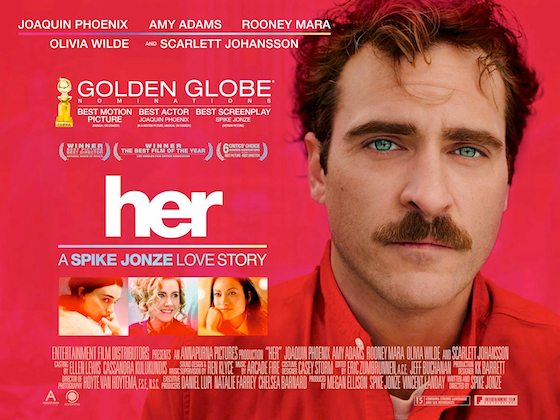
    If Moon is “a bit like an episode of Black Mirror”, Spike Jonze’s Her virtually is one. Set in a highly plausible near future — which has clearly been developed from our current obsession with our phones, iPads, digital assistants, etc — it stars Joaquin Phoenix as Theodore, a lonely chap who gets a new operating system based around a genuine AI, Samantha (voiced by Scarlett Johansson). As Samantha develops, she and Theodore soon become friends, and then more.

    People often refer to the template of Black Mirror as “what if technology but MORE”, and Her definitely fulfils that brief: “what if Siri was genuinely intelligent and someone fell in love with her?” Also like an episode of Black Mirror, it’s as much about what this reveals about humanity as it is about the crazy sci-fi concept. It’s primarily a romance about a lonely guy who was hurt in the past finding a new connection, with the fact he’s falling in love with a piece of technology almost secondary. Even within the world of the film, he’s not some kind of outcast: we hear about other people who’ve fallen for their AI, and his friends unquestioningly accept his relationship as genuine.

    Such acceptance doesn’t translate into our current world, it seems. Although Her is generally very well liked, some people struggle to engage with it at all, and from what I can tell that mostly stems from them not being able to relate to Theodore and his situation, i.e. the very concept of falling in love with an AI is too impossible for them to even imagine. I can’t help but feel that says more about those viewers (for good or ill) than it does the film, which executes the storyline with a great deal of believability and heart.

    5 out of 5

    Forbidden Planet
    (1956)

    2017 #172
    Fred McLeod Wilcox | 98 mins | Blu-ray | 2.40:1 | USA / English | U / G

    Forbidden Planet

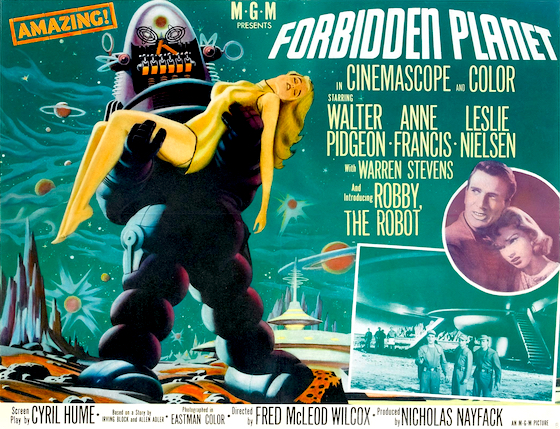
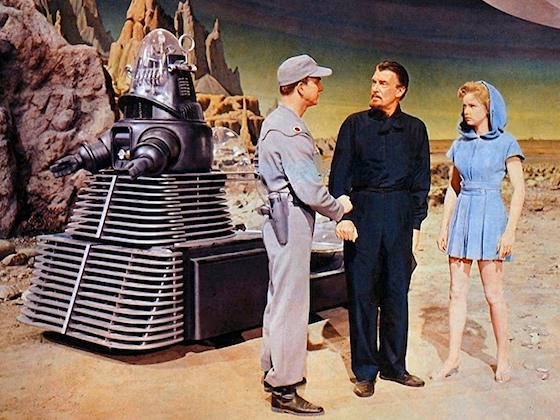
    This classic sci-fi adventure sees a spaceship crewed by blokes (led by Leslie Nielsen) land on the planet Altair IV to investigate what happened to a previous mission there. They find it inhabited only by Dr Morbius (Walter Pidgeon), his robot servant Robby, and his beautiful daughter Altaira (Anne Francis), who perpetually wears short skirts and has a fondness for skinny-dipping. Turns out the crew are a right bunch of horndogs (they spend most of their time lusting after Altaira, tricking her into kissing them and stuff like that), but there are bigger problems afoot when the planet starts trying to kill them.

    Once it gets past everyone’s lustfulness (it feels uncomfortably like watching the filmmakers play out some personal fantasies), there are proper big sci-fi ideas driving Forbidden Planet. There are also some gloriously pulpy action sequences, like a fight against an invisible monster. It’s backed up by great special effects. Obviously they’ve all dated in one way or another, but much of it still looks fantastic for its time — the set extensions, in particular, are magnificent.

    Nothing's forbidden on this planet, wink wink

    Something I wasn’t expecting (but I’m certainly not the first to note) is how blatantly the film was an influence on Star Trek. You can even map the similarities between characters pretty precisely. Switch out the spaceship models and original-flavour Star Trek is all but Forbidden Planet: The Series.

    Although its gender politics have aged even less well than its special effects, and its story occasionally gets bogged down by stretches of explanatory dialogue (it sometimes feels like you’re watching the writer invent and explain his ideas in real-time), Forbidden Planet remains a mostly enjoyable SF classic.

    4 out of 5

    District 9 and Forbidden Planet were viewed as part of my Blindspot 2017 project, which you can read more about here.

    Moon and Her were viewed as part of my What Do You Mean You Haven’t Seen…? 2017 project, which you can read more about here.

  • Another Blindspot Review Roundup

    Following on from the roundup of four of my Blindspot and “What Do You Mean You Haven’t Seen…?” reviews the other day, here’s another quartet.

    In today’s roundup:

  • Gran Torino (2008)
  • Planet of the Apes (1968)
  • Nashville (1975)
  • A Matter of Life and Death (1946)


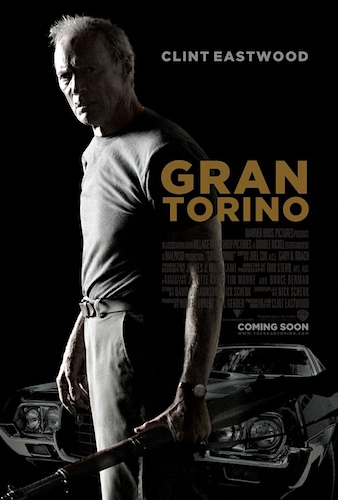
    Gran Torino
    (2008)

    2017 #78
    Clint Eastwood | 116 mins | download (HD) | 2.40:1 | USA & Germany / English & Hmong | 15 / R

    Gran Torino

    Clint Eastwood’s modern Western (thematically speaking), about a grumpy old loner who overcomes his inherent racism to bond with the immigrants who now dominate his neighbourhood and eventually come to their defence, is a well-liked film, generally regarded as a late career highlight for the director-star. I imagine it would play very nicely as a companion piece and/or counterpoint to his earlier Oscar-winner, Unforgiven — both are stories about old men in one final fight, essentially. Here, that comes with a subtext about the price that’s paid for standing up for yourself. It may be the right thing to do, and maybe it ends up with the right result, but the good guys really suffer to get to that point.

    While that aspect of the film is ultimately powerful, I was less won over by the actual filmmaking. It feels like it’s been jiggered around in the edit, with some odd bits where it just jumps into a new scene. Even before that, Nick Schenk’s screenplay occasionally features very heavy-handed dialogue, of the “explain what the character is feeling right now” variety. It’s especially bad when Eastwood just talks to himself in order to vocalise these points for the sake of the audience.

    Still, if you’re immune to such niggles then it remains a potent — and timely — tale of doing what’s right for the defenceless. Such themes never die, I suppose.

    4 out of 5

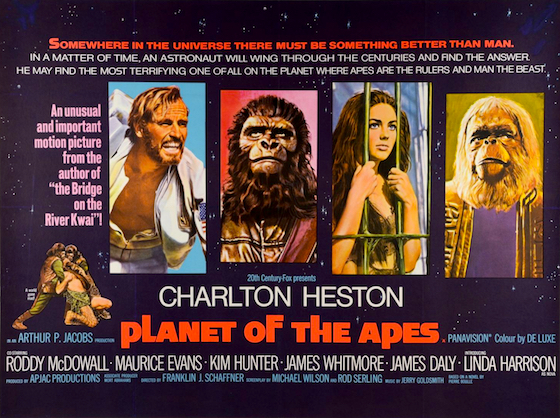
    Planet of the Apes
    (1968)

    2017 #96
    Franklin J. Schaffner | 112 mins | Blu-ray | 2.35:1 | USA / English | PG / G

    Planet of the Apes

    The original instalment in the long-running franchise (it’s up to nine films across three go-rounds now, plus a couple of TV series) sees astronaut Charlton Heston land on a mysterious planet where apes have evolved to have human-like intelligence, while men are mute wild creatures dominated by their simian betters. And eventually there’s a twist that everyone knows, which is a shame because I bet it was pretty darn surprising before that.

    Coming to Planet of the Apes for the first time almost 50 years after its release, there’s an unavoidable quaintness to some of it, mainly the monkey makeup. It was for a long time iconic, but it’s been abandoned in favour of hyper-realistic CGI in the new movies and therefore shows its age. That said, while the apes may not be as plausible as those produced by modern technology, the performances underlying them are still strong. It contributes to what is really a parable about dominance and oppression; colonialism inverted onto a white man, that kind of thing. All wrapped up in a sci-fi adventure narrative, of course.

    Honestly, it’s not just the effects that have improved — as a piece of speculative fiction, I think it’s now been outclassed by the recent trilogy. It’s still a cracking adventure, but a bit “of its time”.

    4 out of 5

    Nashville
    (1975)

    2017 #111
    Robert Altman | 160 mins | Blu-ray | 2.35:1 | USA / English | 15 / R

    Nashville

    Robert Altman’s low-key epic about 24 characters and how their stories interact, overlap, and collide across five days in the city of Nashville, Tennessee.

    The sheer scope of that makes it a tricky film to interpret. There’s a lot going on, much of it in snatched conversations and moments that leave it up to the audience to piece together what matters and why. Collision must be a theme: within the first hour there are three car crashes or near misses, and the climax is certainly a collision in its own way. I’ll be honest, this isn’t a fully-developed thought, so I’m not sure what the point of it might be. It’s a small element of the film, really — something like all the music being performed is much more obvious and therefore maybe more relevant.

    I guess I’m searching for meaning because the film in general is just casually observational of a bunch of characters meandering through a few days. Maybe there doesn’t need to be meaning — maybe that is the meaning. It’s certainly one way to interpret the finale. So, I kind of liked it — or, rather, admired it, perhaps — even if I didn’t necessarily ‘get it’.

    4 out of 5

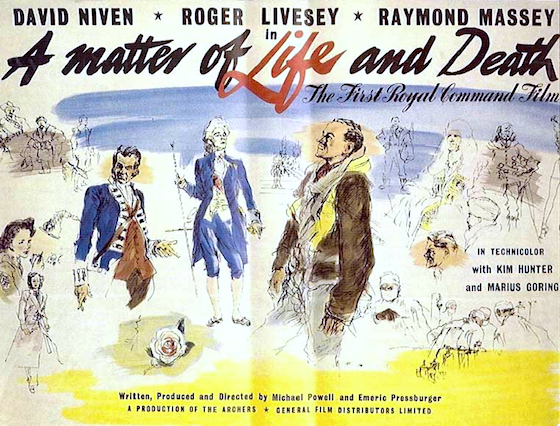
    A Matter of Life and Death
    (1946)

    2017 #74
    Michael Powell & Emeric Pressburger | 100 mins | DVD | 4:3 | UK / English | U / PG

    A Matter of Life and Death

    I finally get round to watching this on a ropey old DVD, and then they announce a new 4K restoration (which was released in UK cinemas earlier this month). Hopefully a Blu-ray will follow. It will be very welcome, because I imagine this film will look magnificent in properly restored HD.

    It begins with an incredible opening scene, in which an entire relationship is founded and ended over the radio in about five minutes. From there it’s the story of a World War Two pilot (David Niven) who avoids death by a fluke, then properly falls in love with the voice from the other end of that radio call (Kim Hunter) before the afterlife comes a-callin’ to take him where he was meant to be. Or maybe that’s all just a vision induced by the injury he sustained. Either way, he must argue his case to remain on Earth.

    It’s a grandly romantic film — it is all about the triumph of love over everything else, after all — but with a particular fantastical bent that I think remains unique. It has the wit to present a mildly irreverent stance on the afterlife, not taking the whole “life and death” thing too seriously. While the final result of the airman’s trial is never in doubt, the delight is in the journey there.

    5 out of 5

    Planet of the Apes, Nashville, and A Matter of Life and Death were viewed as part of my Blindspot 2017 project, which you can read more about here.

    Gran Torino was viewed as part of my What Do You Mean You Haven’t Seen…? 2017 project, which you can read more about here.

  • Blindspot Review Roundup

    Spoilers for my next monthly update: I’ve completed watching all 22 films on my 2017 Blindspot and “What Do You Mean You Haven’t Seen…?” lists. Hurrah!

    What I haven’t done is reviewed them all. Indeed, 17 still languish in my review backlog — that’s 77%. (In fact, I’ve only actually reviewed one Blindspot film — The Exorcist — with the other four being from WDYMYHS.)

    So, with the end of the year fast approaching — and, with the new year, a new batch of films to watch — I thought it high time I cracked on with those reviews. Here’s a quick roundup of a few, linked by all being adapted from novels, which may be the first of several such omnibus editions.

    In today’s roundup:

  • Dances with Wolves: Special Edition (1990/1991)
  • Jackie Brown (1997)
  • Silver Linings Playbook (2012)
  • The 39 Steps (1935)


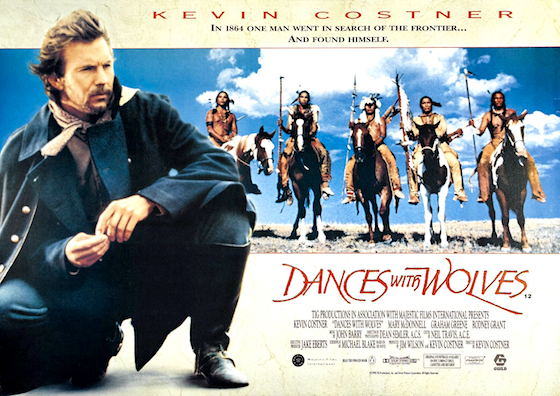
    Dances with Wolves
    Special Edition

    (1990/1991)

    2017 #26
    Kevin Costner | 227 mins | DVD | 2.35:1 | USA & UK / English, Lakota & Pawnee | 15 / PG-13

    Dances with Wolves

    Oscar statue1991 Academy Awards
    12 nominations — 7 wins

    Winner: Best Picture, Best Director, Best Adapted Screenplay, Best Cinematography, Best Sound, Best Film Editing, Best Original Score.
    Nominated: Best Actor (Kevin Costner), Best Supporting Actor (Graham Greene), Best Supporting Actress (Mary McDonnell), Best Art Direction-Set Decoration, Best Costume Design.


    The behind-the-scenes story of Dances with Wolves is almost as grand as the movie itself. An actor turned director whose inexperience led to production delays and budget overruns, leading to rumours the film was a pending disaster like Heaven’s Gate a decade before it (some nicknamed it “Kevin’s Gate”), and the studio who wanted a 140-minute cut having to settle for the 180-minute one that director delivered. The resulting film never even reached #1 at the box office… but still went on to be the highest grossing Western of all time, and became the first Western to win the Best Picture Oscar in almost 60 years. It was so popular that a 53-minute-longer extended cut was released a year later, which Costner later denied being involved with.

    Having not seen the theatrical cut I can’t offer an opinion on which is better, but the near-four-hour extended one certainly feels its length. That’s not necessarily a bad thing — this is an epic in the truest sense of the word, with a large story to tell on a grand canvass; although it’s concurrently a drama about just a couple of people from different cultures coming to interact. It’s almost too big to digest in a single go — I’m even not quite sure what I made of it. You can see why I’ve spent 10 months not writing about it.

    Anyway, I admired its scope and ambition. I wouldn’t say I loved it, but it merits revisiting someday.

    4 out of 5

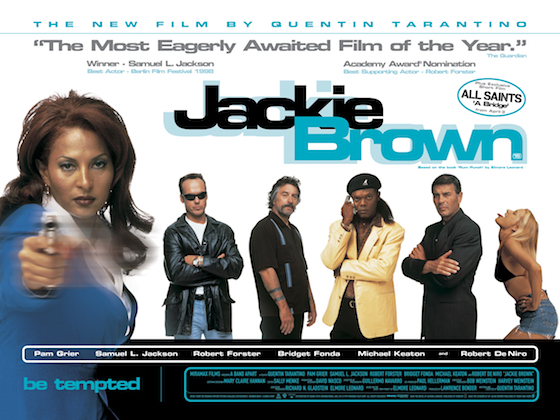
    Jackie Brown
    (1997)

    2017 #49
    Quentin Tarantino | 154 mins | Blu-ray | 1.85:1 | USA / English | 15 / R

    Jackie Brown

    Oscar statue1998 Academy Awards
    1 nomination

    Nominated: Best Supporting Actor (Robert Forster).


    Jackie Brown has long been my Tarantino blindspot. I caught up with Reservoir Dogs and Pulp Fiction after he was already established and they were regarded as modern classics, then was old enough to see the Kill Bills at the cinema and have followed his career from there. But, for some reason, his third feature has always eluded my attention. My tenth anniversary “heinous oversights” list seemed a good time to rectify that.

    Some people argue that Jackie Brown is secretly Tarantino’s best movie. I add “secretly” there because it gets a lot less attention than the aforementioned movies that came either side of it. That’s not a bandwagon I’m prepared to jump on. To me, it feels a little like QT was trying to emulate what worked about Pulp Fiction without just making a rip-off of his own movie, and therefore it’s a bit of an inferior copy. That’s not to say it’s a bad movie by any means. The eponymous character is particularly interesting, as you’re never quite sure what Jackie’s up to; what her plan is. She seems to be telling everybody everything, but she has to be screwing some — or all — of them, right?

    Possibly I was just approaching the film in the wrong way. Tarantino has called it “a hangout movie”, which he explained thus: “Jackie Brown is better the second time. And I think it’s even better the third. And the fourth time… Maybe even the first time we see it we go, ‘Why are we doing all this hanging out? Why can’t we get to more of the plot?’ But, now the second time you see it, and the third time you see it, you’re not thinking about the plot anymore. You’re waiting for the hangout scenes… It’s about hanging out with the characters.” Personally, I’m not in any desperate rush to hang out with these characters again. But who knows, maybe I’ll get it the second time. Or the third. Or the fourth…

    4 out of 5

    Silver Linings Playbook
    (2012)

    2017 #61
    David O. Russell | 115 mins | TV | 2.35:1 | USA / English | 15 / R

    Silver Linings Playbook

    Oscar statue2013 Academy Awards
    8 nominations — 1 win

    Winner: Best Actress (Jennifer Lawrence).
    Nominated: Best Picture, Best Director, Best Actor (Bradley Cooper), Best Supporting Actor (Robert De Niro), Best Supporting Actress (Jacki Weaver), Best Adapted Screenplay, Best Film Editing.


    Bradley Cooper’s performance — 3.5/5
    JLaw’s performance — 4/5
    JLaw’s dancing — 6/5
    Direction — 2/5
    Screenplay (first two acts) — 3/5
    Screenplay (bit where it suddenly gets plot-heavy and all exposition-y to set up the third act) — 1/5
    Screenplay (third act that seems to be from a completely different, much more conventional movie) — 2/5

    Average =

    3 out of 5

    The 39 Steps
    (1935)

    2017 #60
    Alfred Hitchcock | 83 mins | download (HD) | 4:3 | UK / English | U

    The 39 Steps

    This adaptation of John Buchan’s adventure novel is one of the best-known among director Alfred Hitchcock’s early works, and for good reason.

    Galloping briskly along with a running time under 90 minutes, it’s a film where mood, tone, and the wonderful execution of individual sequences are all allowed to trump plot, which is somewhere on the spectrum from unexplained to nonsensical. We follow the likeable wrong-man hero Richard Hannay (Robert Donat) as he runs away from a gang of villains who barely feature. That they have a nefarious plan is outlined early on to kickstart the action; what they were up to is explained in the final scene to give the story some resolution; and in between they’re pretty much just a force chasing our hero. It’s almost like the villains are the film’s MacGuffin: it doesn’t matter what or who they are, just that they want to catch Hannay and so he must escape them. It’s how he escapes and what happens during his escapades that matters to us; that provides our entertainment.

    It almost plays like a spoof in that regard — the plot is such stock spy-thriller fare that it doesn’t need to make sense in and of itself, we just get what it’s driving at. Of course, considering the age of the film, it’s more proto-spy-thriller than neo-spy-thriller. Whatever you class it as, over 80 years since its release it remains rollicking entertainment.

    5 out of 5

    Dances with Wolves, Jackie Brown, and The 39 Steps were viewed as part of my Blindspot 2017 project, which you can read more about here.

    Silver Linings Playbook was viewed as part of my What Do You Mean You Haven’t Seen…? 2017 project, which you can read more about here. Other WDYMYHS reviews already published include Hail, Caesar!, Into the Wild, Nightcrawler, and Room.

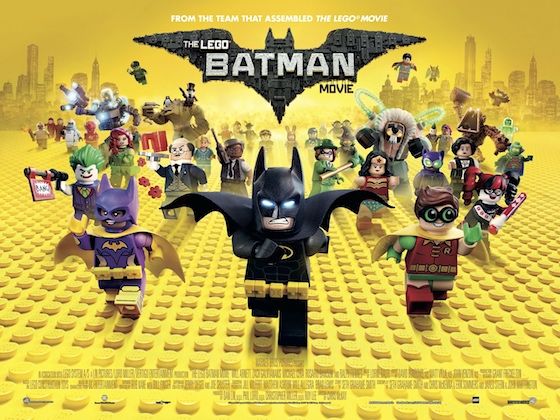
  • The LEGO Batman Movie (2017)

    2017 #84
    Chris McKay | 104 mins | Blu-ray (3D) | 2.35:1 | USA & Denmark / English | U / PG

    The LEGO Batman Movie

    Following the somewhat surprising success of The Lego Movie, we’re to be treated to a whole slew of movies related to those little Danish bricks. The first to hit the screen was this, I guess because the eponymous hero was a standout character in the aforementioned franchise initiator, and because Batman movies are always popular (well, almost always).

    The plot sees Batman (Will Arnett) have to tackle the latest nefarious scheme of the Joker (Zach Galifianakis), while also dealing with his personal issues about being a loner after he accidentally adopts teen Dick Grayson (Michael Cera). You might think the story is almost by the by, because the real point is the gags… and, fortunately, the movie is indeed consistently funny, with a Flash-like pace to keep things moving. It’s also a great one for Bat-fans, jam-packed with references to previous iterations of the hero — anyone wanting to catch them all in detail will require copious use of the pause button.

    But don’t disregard the narrative out of hand, because it also summons up surprisingly effective character arcs. Who expected that, right? Well, I say “arcs”, but it’s more “arc”: this is all about Batman. He seems to enjoy his awesome crimefighting life and doesn’t mind being lonely at home — but he is lonely, so why? Can he actually connect to other people? He’ll discover there are benefits to having a family… And so on. The LEGO Batman Movie may primarily be a comedy for kids based on a toy licence, but the emotional side works with surprising effectiveness. It’s not even just that it’s well built within the film itself: it illuminates Batman as a character. And I don’t mean LEGO Batman, but Batman of any incarnation.

    A car built for one

    The film also manages to deliver exciting action sequences, especially the big opener, that aren’t undermined by the freewheeling rebuild potential of the titular toy. These scenes look even better in 3D, the quality of which is great — the scale of the action, the depth to the locations, even elements of the characters, like the clear distance between Batman’s mask and his mouth. Does the extra visual dimension make it a better movie? Probably not… but I did watch some of the opening sequence in 2D afterwards and it felt less epic. That could just be me becoming more of a 3D convert, mind.

    Another aspect the movie applies well is the LEGO licence, making neat use of its scope to rope in villains from all sorts of other franchises. That said, Batman has a notably extensive rogues gallery of his own, so one wonders if they shouldn’t’ve chosen to foreground some of his own foes rather than… well, saying who else pops up might be spoilersome. And if we’re talking about flaws that I won’t go into detail about, I wasn’t too sold on the third act, with the finale in particular not really working for me. In fact, that’s about the only thing holding me back from giving it a full five stars. Maybe I’ll mind less on a rewatch.

    And there will be rewatches, because the rest is brilliant. It’s as fun as The Lego Movie, but mixed with being a surprisingly good version of Batman too. In a year overloaded with superhero movies, I’d wager this is one of the best.

    4 out of 5

    The LEGO Batman Movie is available on Sky Cinema from today.

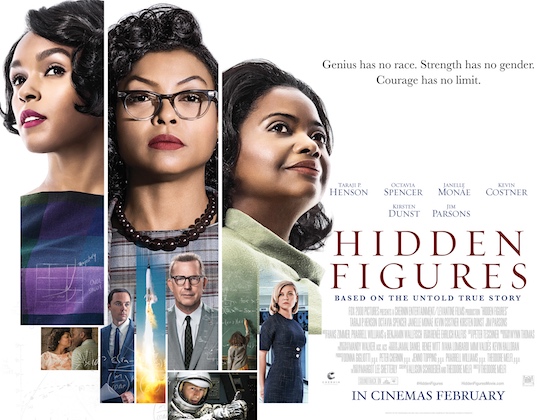
    Hidden Figures (2016)

    2017 #170
    Theodore Melfi | 127 mins | download (HD) | 2.39:1 | USA / English | PG / PG

    Hidden Figures

    Based on a true story, Hidden Figures is about three black women working at NASA in the early ’60s, a time when segregation was still in force in the US.

    It’s a double whammy of timely issues, then: they struggle to prove they’re clever and have scientific know-how because they’re women, and they struggle to prove they’re worth treating with respect because they’re black. How depressing that these things are still relevant over 50 years later. That said, any right-minded person watching it will still be suitably appalled that this kind of thing went on at all — even when you know about it, seeing it played out is something else.

    Of course, it comes with a positive message attached: these people overcome their societally-imposed disadvantages to be awesome nonetheless, fighting everyday sexism and racism left, right and centre to eventually prove their worth. Hurrah! It’s a strong message, even more powerful thanks to it being a true story, and no doubt goes a long way to explaining the film’s success. As a movie in its own right, it’s nothing particularly special. There are good performances from a high-calibre cast, but everything else is pretty standard for a biopic — well done, but there’s a reason the film’s Oscar nominations were for acting and screenwriting.

    4 out of 5

    Hidden Figures is available on Sky Cinema from today.

    The Past Month on TV #27

    A slightly earlier than normal TV review this month, to get ahead of all the Christmas telly — but there’s still plenty to discuss…

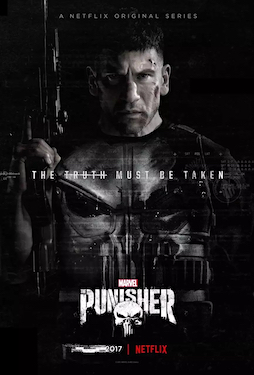
    The Punisher  Season 1
    The PunisherThe fourth live-action iteration of Frank Castle, Marvel’s murderous anti-hero (and people moan about Spider-Man reboots), debuted in Daredevil season two and was greeted so positively that now he’s got his own spin-off series. And “spin-off” is not an inaccurate descriptor, because this very much launches out of the events of Frank’s storyline in Daredevil — which makes it all the more annoying that Netflix care not for “previously on”s: Daredevil season two was over 18 months ago; a little refresher would be nice.
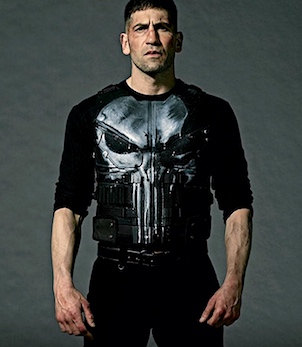
    You see, the plot revisits the Punisher’s origins: his family were killed in the crossfire of a gang shoot-out, leading him to kill the criminals responsible. He thinks that mission is complete, but the season begins (more or less) with him discovering new intel that suggests his family’s murder may not have been so random, and it links back to his actions when he was in the military. This also serves as a launchpad for the series to tackle other war-related issues, primarily the psychological wellbeing of veterans. With such serious themes it’s perhaps no surprise that there’s very little here that’s outright comic-book-y here — no superpowers, for sure; not even veiled references to the big names of the MCU movies, which we’ve had in every other Marvel Netflix show. In fact, if it weren’t for the fact the series is so obviously spun out of Daredevil and has the Marvel logo at the start, you could be forgiven for thinking it wasn’t a Marvel show at all.

    Some people think this removes the Punisher’s USP. In and of himself he’s just a violent man out for revenge — action cinema is stuffed to bursting with such anti-heroes. What makes Frank unique is he’s that kind of character but in a world where super-powered and super-moral people exist. So would The Punisher have been more interesting if, instead of a very grounded military conspiracy storyline, it had something to do with Frank clashing with superpowered people? I don’t know. It certainly would’ve been a different show. As it stands, this may be a show for people who don’t typically like Marvel shows. So was Jessica Jones before it, but this is for different people who don’t like Marvel shows — people like Jason Statham, maybe.

    Jon BernthalIn the title role, Jon Bernthal is fantastic. You can absolutely believe him as a revenge-driven psychopath capable of killing anyone and everyone, but also as a kind-of-charming strong-but-silent type with a heart and moral code who will definitely do the right thing. I’ve seen some critics and viewers opine that now is the wrong time for a series about a hero who just murders indiscriminately. I say those people definitely haven’t watched this Punisher. Although the plot is a conspiracy thriller, the series invests a lot of time in the emotional world of Frank Castle, making him human and moral rather than just a single-minded murder-machine. Bernthal makes what could be a very one-note role into a plausible human being; one who you believe might be able to find redemption and leave someday. And maybe that makes him even more tragic — he could find it; it’s possible… but likely? There’s the rub. As it’s also trying to engage with issues facing combat veterans once they return home, it makes for a clearly different, more serious flavour for an MCU production. How successfully it explores these weighty issues is more debatable.

    Many of these Marvel shows take their whole first season to fully complete the hero’s origin story, but The Punisher is stuck with the fact that Castle already became The Punisher during his Daredevil appearance. So do they just ignore that story shape? No, of course they don’t — they shift it on to the villain! Therefore any comic book fan who knows what one character will ultimately become (no spoilers here!) is constantly teased with possibilities throughout the season until, eventually, as we should’ve known from the start, the transformation occurs in the finale. Why not really surprise us: do the transformation earlier and then wrap a character up within one season, rather than leaving them dangling for a possible next time? Comic books have to leave things dangling — they will all run for ever and ever; there can be no permanent solutions — but these TV series will end — whether it’s after a single season, or two, or five, or ten, they are without exception finite. That means you’re allowed to wrap a character up and move on to others.

    So, The Punisher is not an unmitigated success, but it does lend another flavour to the Marvel-Netflix landscape. I certainly hope we get to see more of Bernthal’s take on the character in the future.

    Detectorists  Series 3 Episodes 2-6
    Detectorists series 3The third and final series of BBC Four’s sitcom about a couple of mates whose hobby is metal detecting was every bit the equal of the first two runs, which saw the show place on my list of 10 Favourite TV Series of the Last 10 Years back in February. Its brilliance lies in how perfectly weighted it is: the characters are quirky, but also normal; their problems are grounded and realistic, without being glum and unduly serious; it’s frequently hilarious, but without slipping into gurning ‘Comedy’ territory; it’s kind and gentle, but without being dull; and it’s all very lovely and kind-hearted, without being twee or saccharine. It’s also beautifully put together by writer-director (and star) Mackenzie Crook — the storyline across the series was precisely constructed, and the photography is often a gorgeous showcase for the English countryside. A real gem that will be missed, though at least it came to a perfect conclusion.
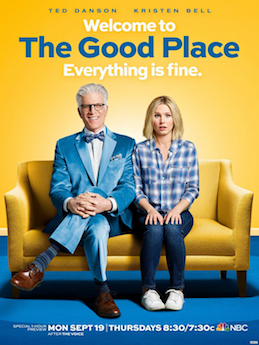
    The Good Place  Season 1 Episodes 3-13
    The Good PlaceI only heard about this after its Big Twist was much-discussed online, so starting it was an exercise in knowing there was a big reveal awaiting. Fortunately, that knowledge doesn’t overshadow everything that comes before it. For those who still aren’t aware of it (especially as it’s only on Netflix on this side of the pond), it’s about a woman (Kristen Bell) who dies and goes to Heaven only due to an admin error, so she tries to better herself so that she’s deserving of her place. Other complications emerge as the season goes on, but that’s the premise. There’s a lot of plot for a sitcom — although it’s not necessarily immediately obvious, it tells a 13-episode story; this makes Netflix quite a natural home for it, actually, as it’s not your typical “every episode is fundamentally standalone” sitcom. But it’s also very funny in amongst all that, mining not only the characters and their foibles, but also the uncommon situation they’ve found themselves in. The shocker in the finale is just the icing on the cake. I hear season two has gone off the boil somewhat, but I’ll find out for myself once it’s all wrapped up.

    Also watched…
  • Armchair Detectives Series 1 Episode 1 — Game show in which contestants watch a murder mystery scene by scene and attempt to guess the perpetrator. It’s a fun idea (who doesn’t ‘play along’ while watching a whodunnit?), but it’s hampered by the dirt-cheap quality of the drama. That’s to be expected on a daytime game show budget, but still…
  • Bounty Hunters Series 1 Episodes 3-6 — If you saw the James Corden comedy-thriller The Wrong Mans, this is tonally very similar to that — not quite as elegantly done perhaps, but still pretty decent. If you like comedy-thrillers and haven’t seen The Wrong Mans, watch that first.
  • The Flash Season 4 Episodes 3-6 — After complaints about it getting too grim and self-serious, they’ve endeavoured to return The Flash to the lighter tone of its first season, in the process practically turning it into a comedy. I often find these CW superhero shows kinda laughable anyway, so, a little to my surprise, that’s working for me.
  • The Musketeers Series 3 Episodes 9-10 — Sad to (finally) reach the end of this fun action drama. The third series wasn’t quite on a par with the first two (the result of new showrunners, undoubtedly) but it still had its moments. It leaves a swashbuckling void in the schedules that I doubt anyone will bother to fill.
  • Would I Lie to You? Series 11 Episodes 1-4 — Is this the best panel show on TV? Could well be. Its genius lies in the elegant simplicity of its concept, a game anyone can play (and we can play along with at home), plus the sharp and quick wits of regulars Rob Brydon, David Mitchell, and Lee Mack. Almost a dozen series in and there’s no sign of the hilarity waning.

    Things to Catch Up On
    Blue Planet IIThis month, I have been missing so much stuff. There’s been the fourth series of Peaky Blinders on BBC Two (which concludes this week, so we’ll whizz through it sometime in the new year); the second season of The Crown on Netflix (also waiting for the new year now); the same streamer’s first ever miniseries, Godless; the immensely acclaimed Blue Planet II (now available in UHD on iPlayer, too!); and I’m behind on Arrow and The Flash so haven’t reached the four-show Arrowverse crossover. And those are just the ones I can remember right now.


    Next month… is January, but sometime before that I’ll likely review some Christmas TV.

  • Your Name. (2016)

    aka Kimi no na wa.

    2017 #168
    Makoto Shinkai | 107 mins | Blu-ray | 1.78:1 | Japan / Japanese | 12 / PG

    Your Name

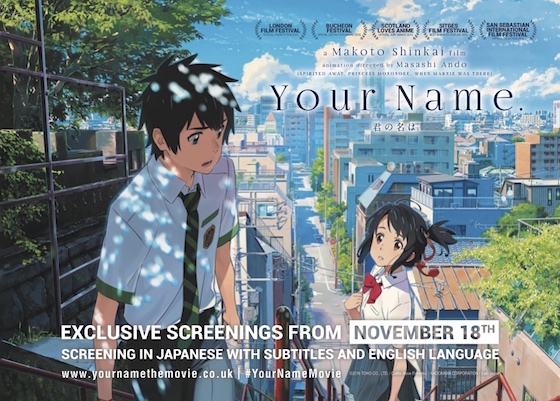
    If you’ve not heard about Your Name then… well, where have you been for the past year? It was a colossal hit in its native Japan during the back end of 2016, spending 12 weeks at #1 to become the fourth highest-grossing film of all time there (behind only Spirited Away, Titanic, and Frozen). It’s also the only anime not made by Studio Ghibli to gross over ¥10 billion at the Japanese box office. Critical acclaim has followed as it’s been released around the rest of the world too, hailing writer-director Makoto Shinkai as the new Miyazaki. It’s hard to imagine higher praise for an animator. The film reached UK cinemas last November, but then took a whole year to hit DVD and Blu-ray (I guess thanks to Japanese studios’ usual restrictive licensing agreements), and as of this week is available to stream for Amazon Prime members. So when I finally sat down to watch it this week it had a bit of weight on its shoulders — at this point it runs the risk of being a victim of its own hype.

    The film introduces us to Mitsuha, a teenage girl in a sleepy country town — more a village, really (it doesn’t even have a cafe!) — who wishes for a more exciting life in the big city. Her friends tell her she was acting weird the day before, but she can’t remember any of it. Then she wakes up in the body of Taki, a teenage boy living in Tokyo. Assuming it’s a dream — a very long, very realistic dream — she stumbles through his life for a day. To cut to the obvious, Mitsuha and Taki soon realise they’re actually swapping bodies, apparently at random but for a whole day each time. (The literal translation of the film’s Japanese title is What is your name, which kinda makes more sense.) They find ways to deal with it, but a big explanation for why it’s happening is looming…

    That feeling when you wake up and realise a boy's been inside you... er, as it were

    That comes in the form of a hefty twist about halfway through the movie. I’ve read some very different reactions to that development and what follows it — criticism of it for shifting the film into something generic after a more original first half; praise for it elevating the film into something more original after the generic first half. I guess your mileage will vary. For me, it kind of glossed over some of the body-swap stuff to get to a place where there was still time to deal with what happens next. Conversely, there are plenty of intersex body-swap movies — how much do we need to go over that again? But there are generic elements to the second half too.

    That said, the way it uses Japanese folklore to bring all the threads together is a bit different, at least for us Westerners. I don’t know if it’s based on genuine beliefs or if it’s a mythology imagined for the film, but it conveys some effective and affecting ideas. It builds to an emotional climax and, ultimately, a perfectly satisfying ending. Well, unless… At times you feel there were perhaps other, more unusual directions the film could have explored. Fair enough, that clearly wasn’t the story Shinkai wanted to tell; but some viewers may think those less well-trodden paths would’ve made for a better movie. Of course, that would’ve neutered its appeal to others; but then Mark Kermode compared it to Romeo and Juliet in terms of how it might appeal to teenagers, and that certainly doesn’t have a happy ending…

    Taki reaching for Mitsuha's boobs, probably. He loves feeling her boobs.

    I’m not just talking about the finale, though. For example: while in Taki’s body, Mitsuha displays his “feminine side”, which leads to a date with a girl he’s had a crush on for ages. On the day of the date, Taki is in his own body, which leaves Mitsuha upset because she’d wanted to go on the date. Surely you can see how this is possibly building in a direction where Mitsuha realises something about herself; something she might not have noticed living in a very traditional little town. But that’s not where Your Name is going — and, as I said, fair enough — but it’s not a bad idea for a movie (is it?)

    Nonetheless, at times the story is quite complicated, with overlapping dialogue, or a density of information conveyed in images, on-screen text, and dialogue simultaneously. I mention this because watching the English dub might make for a more manageable experience, at least on first viewing. (That said, there’s one gag which only works in Japanese, and the subtitles work at a rate of knots to explain the joke while it’s happening. I watched the English dubbed version of the scene afterwards and it kind of fudges the gag away, because there’s no way to translate it into English.) That said, other bits of the story are just straight up jumbly, but trust that there’s a reason for that — you may get confused about who’s in whose body when, but the film makes enough sense in the end.

    Pretty pictures

    One thing I have no problem praising unequivocally is the imagery. The film is visually ravishing; the animation thoroughly gorgeous. Its use of colour and light is beautiful; the detail in the art and its movement is almost photo-real, without the uncanny valley effect you often get from rotoscoping. Shinkai also seems to have a live-action-esque feel for shots and editing, particularly in his use of montage, which lends a very filmic feel. At other times it benefits from animation’s freedom to be less literal, particularly in one sequence apparently created with pencils and chalk.

    I do think the hype around Your Name ended up as a problem for me. I was expecting to be blown away by its amazingness, the expectation of which got in the way of just appreciating the film for what it is. That said, I definitely liked it a lot. Despite using some building blocks familiar from other movies, it mixes them together with some fresh perspectives to create a film that is thoroughly romantic, in multiple senses of the word.

    4 out of 5

    As I mentioned, Your Name is now available on Amazon Prime Video in the UK, in both subtitled and dubbed versions.

    Comedy Review Roundup

    Let’s have a laugh (or, perhaps, not) with…

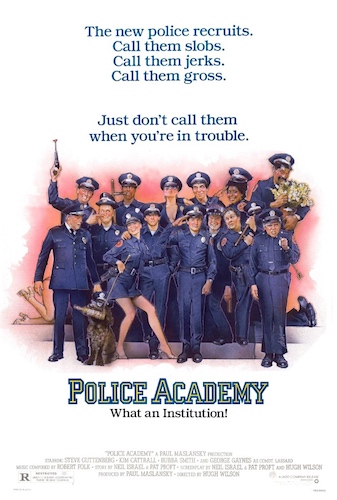
  • Police Academy (1984)
  • Black Dynamite (2009)
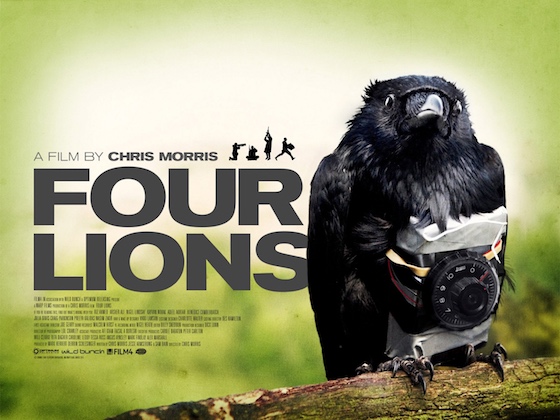
  • Four Lions (2010)
  • Ferris Bueller’s Day Off (1986)


    Police Academy
    (1984)

    2017 #27
    Hugh Wilson | 92 mins | streaming (HD) | 16:9 | USA / English | 15 / R

    Police Academy

    I watched some of the Police Academy movies when I was younger — yes, plural — but I never saw the first one. It never seemed to be on TV (though the second always was), and the fact it’s rated 15 (weren’t all the later ones, like, PG?) would surely mean my parents would never have let me rent it (I’m pretty sure I never saw any of the series after I hit double-digits age-wise). So there was an element of box ticking in finally seeing the original — a film that Roger Ebert gave zero stars.

    It doesn’t start well: the opening credits incompetently cover up the onscreen action. That’s not for the sake of a joke, like in, say, Austin Powers 2 — it’s not overt or thorough like a joke — it’s just poorly done. From there… it might be generous to say that things pick up, but they’re not so bad. In fact, I passingly enjoyed it. It’s not aged particularly well, but there are some funny bits. Remember the sound effects guy? I used to love him when I was a kid. There’s surprisingly little of him here, though. I guess he got amped up for the sequels.

    Police Academy isn’t some masterpiece that’s been buried under the weight of its increasingly shite sequels, but it isn’t that bad as an hour-and-a-half of mindless comedy.

    3 out of 5

    Black Dynamite
    (2009)

    2017 #47
    Scott Sanders | 81 mins | streaming (HD) | 16:9 | USA / English | 15 / R

    Black Dynamite

    A spoof of cheap blaxploitation movies, Black Dynamite hits every nail on the head. I’ve not actually seen many films from the genre (the original Shaft may be the extent of it, unless Live and Let Die counts), but you only need a passing awareness of the ludicrousies of low-budget ’70s genre cinema (the third act sidesteps into a spoof of kung fu movies) to get the overall joke. Plus there are plenty of generally funny riffs and sequences for the layperson to laugh at, the highlight being a deduction scene that makes no sense whatsoever. At a brisk 80 minutes, it’s hard to go wrong.

    4 out of 5

    Four Lions
    (2010)

    2017 #65
    Chris Morris | 97 mins | streaming (HD) | 1.85:1 | UK & France / English, Urdu & Arabic | 15 / R

    Four Lions

    A comedy about Muslim suicide bombers? You don’t need me to tell you all the different minefields that idea is tiptoeing into. But it’s by the guy behind Brass Eye, so it less tiptoes more bounds, and barely puts a foot wrong either.

    The most important point, of course, is that it is very, very funny. There’s a stream of good one-liners and exchanges. But it also winds up making you feel for some of these guys, which, considering their goal, is a feat unto itself. At the same time, the attempted emotional pull in the third act doesn’t quite come off — asking us to care for “the stupid one”, who’s merely been the butt of jokes until that point, comes a little out of left-field. I mean, if we’re suddenly meant to be concerned about his (mis)treatment, why have you been making us laugh at him all along?

    Anyway, if you just ignore that unwarranted about-turn, Four Lions is absolutely hilarious.

    4 out of 5

    Ferris Bueller’s Day Off
    (1986)

    2017 #50
    John Hughes | 103 mins | streaming (HD) | 2.35:1 | USA / English | 15* / PG-13

    Ferris Bueller's Day Off

    Is this or The Breakfast Club the archetypal John Hughes movie? Argue amongst yourselves — I’ve never seen The Breakfast Club. I hadn’t seen Ferris Bueller until this year either (I mean, obviously — it wouldn’t be here otherwise), though I’m not sure why. Despite it being quite well-known and referenced, it just didn’t seem to come up that often. (Incidentally, are references to it on the increase? Both Deadpool and Spider-Man: Homecoming had significant riffs on it within the past couple of years.)

    Anyway, for those as in the dark as I was, it’s the story of cool kid Ferris Bueller (Matthew Broderick) who has an elaborate plan to bunk off school for the day, which involves persuading his best mate Cameron (Alan Ruck) to ‘borrow’ his dad’s Ferrari and head off into Chicago with Ferris’ girlfriend (Mia Sara). Meanwhile, the school’s suspicious principal (Jeffrey Jones) tries to catch Ferris out.

    Going back to what I was saying a moment ago, part of why I didn’t watch it before was that I felt like I’d find it annoying. Turns out, not so much. Ferris is indeed a bit of a dick, but I’m not sure the film doesn’t know he is. Because he talks to camera and makes the viewer his confidante, the assumption might be we’re meant to admire him, but there’s an almost “unreliable narrator” aspect to him. Or maybe I’m projecting that because I didn’t like him but did enjoy his antics, who knows.

    5 out of 5

    * The film was reclassified as 12A for a 2013 theatrical re-release, but I watched it at home, where it’s still technically a 15. Ah, the oddities of the BBFC. ^