
Kenji Misumi | 88 mins | Blu-ray | 2.35:1 | Japan / Japanese
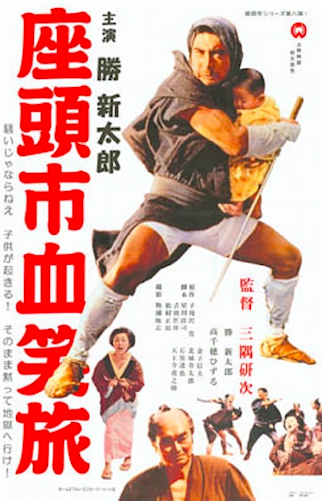
It’s a bit ironic that whoever chose the English-language titles* for the Zatoichi films decided to emphasise fighting in the name of this eighth instalment, because it’s perhaps the least concerned with Ichi’s sword skills so far. That’s not to say there aren’t a couple of nifty sequences of blade-clashing fun, but they’re not the film’s focus. You might think that’s antithetical to the series’ purpose, and yet Fight, Zatoichi, Fight is widely regarded as one of the series’ finest instalments, perhaps even the best of all.
It begins, as so many Zatoichi films do, with our hero on the run from some gangsters who want to kill him. Ichi accepts a ride from a pair of passing palanquin carriers, but his would-be assailants spot this and resolve to attack further down the road. Before they make their move, Ichi hears a woman struggling along with her baby, and insists she take the palanquin instead. The assassins don’t see the switch, however, and so attack nonetheless, killing the mother. Her papers reveal she was returning to her husband, the baby’s father, and Ichi, blaming himself for her death, insists he make the 65-mile journey to return the infant personally.
This is where Fight differs from the norm, because it’s at least as concerned with Ichi’s need to care for the child as it is with him fending off the assassins, who naturally pursue him on his way. The impromptu sidestep into de facto fatherhood leads to plenty of goofy comedy, much of it around bodily fluids, like when and where the baby pees, the stench of its used nappies, and also a scene where Ichi tries to get the kid to suckle on him while they wait for actual milk. Another amusing sequence sees Ichi hire a prostitute for the night, but only so she can look after the baby and he can get some sleep. But he keeps waking back up nonetheless, each time insisting on doing just one more thing for the child.
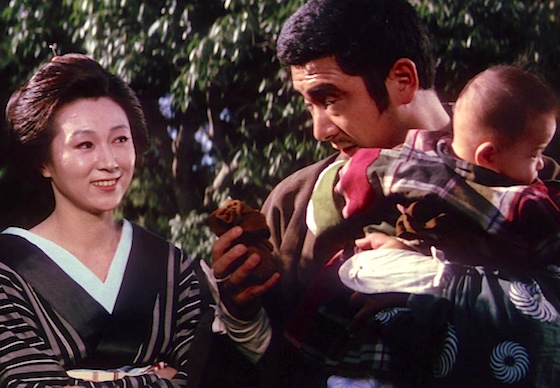
You see, Ichi really cares for the kid, and this is where the other side of the equation comes in: as well as comedy, the situation also brings up a good deal of character-driven seriousness, as Ichi is forced to reflect on the lifestyle he has chosen for himself. No one is better than Shintaro Katsu at playing both sides, transitioning between warm humorousness and grim introspection in the blink of an eye.
But it’s not only internally that Ichi has cause to consider his lifestyle. Halfway along their journey, Ichi inadvertently saves the life of a female pickpocket, Ko, who he then employs to be the baby’s nanny — mainly so he can teach her better ways and reform her. But she’s a pretty young lady, so naturally she falls for blind old Ichi, and for the child too, and suddenly they’re a little family unit. Ko wants it to stay that way, for them to raise the baby together; and, despite his protestations to the contrary, Ichi has come to really like the child, and would probably like that life too. But, without spoiling anything, events transpire to make Ichi realise such an existence just isn’t possible for him, and he must do the right thing for the child’s sake. In the end, despite the laughter along the way, Fight, Zatoichi, Fight is a pretty emotional and sad film, with our hero ending up as he began, and as he always must: alone on the road.
Lest you think it’s too downbeat, let’s talk about the action! Despite being on babysitting duties, there are still some great fight scenes: there’s one where assailants keep bursting into a hut where Ichi’s trying to change the baby’s nappy (now that’s multitasking); and a gambling scene where he catches a cheating boss in the act, with an ensuing fight outside where Ichi keeps shh-ing his attackers because the baby’s asleep. Then the finale lives up to the series’ recent penchant for exciting visuals: the amassed villains surround Ichi with flaming torches in an effort to confuse his hearing, and as our hero slashes away at them even his clothing catches fire. Sure, we know he must prevail, but there’s real jeopardy in this one.

So, in many respects, Fight, Zatoichi, Fight has it all. It’s even got a unity of story and structure that feels almost rare in the series — everything connects up, pays off, has relevance; unlike other films, which often seem to start with a bit of superfluous action or something. But what it has most of all is a storyline that is unique and emotional, and therefore memorable and affecting. It’s easy to see why the film is so often elevated as one of the series’ very best. It’s probably best appreciated as part of the series, rather than as a newcomer’s entry point, because part of its effectiveness lies in it being different from the norm. That said, it stands as an excellent film in its own right.

(A quick caveat: although this is the first Zatoichi film I’ve given full marks, I would, with hindsight, award the same to the first movie as well.)
Fight, Zatoichi, Fight placed 20th on my list of The 26 Best Films I Saw For the First Time in 2018.
* I say “chose” because a literal translation would be something like Zatoichi’s Journey of Blood and Laughter. ^




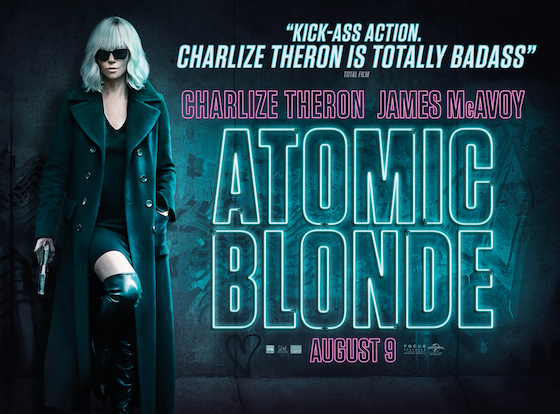


 The first screen adaptation of a novel by acclaimed British sci-fi/fantasy author China Miéville, The City & the City is a police procedural set in the unique location of twin cities Besźel and Ul Qoma, which occupy the same geographical space but inhabitants (and visitors) are forbidden from seeing the city they’re not in. When I first heard the pitch I assumed it was a Doctor Who-y sci-fi thing — that the cities were slightly out of step in time or something, and literally existed in the exact same space. Instead, they’re side by side, sometimes overlapping — there are places where the left-hand side of a road is in Besźel, the right-hand side in Ul Qoma. Residents are trained from birth not to see the other city. Apparently it’s partly an analogy for how we mentally block out unsavoury things in our own cities, but that doesn’t really come across in the screen adaptation, which is more focused on the murder mystery and its implications — it’s connected to a mythical third city, Orciny. In this respect it reminded me of Thomas Pynchon’s The Crying of Lot 49: our hero ends up investigating a very-secret, potentially dangerous organisation that may or may not exist, and whether or not they find it… well…
 The BBC’s latest Agatha Christie adaptation finally reached our screens after a delay for extensive reshoots (to remove a cast member accused of sexual misconduct, not on this production). It’s a grim tale of abuse and, of course, murder, but classy work by director Sandra Goldbacher kept it more in the tone of the Beeb’s excellent
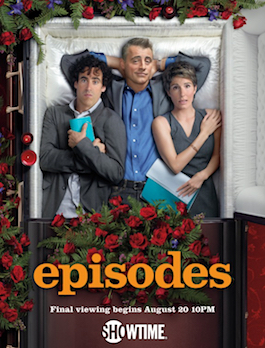 A whole seven months after its US airing (and nearly three years since we saw the last series), the final run of this UK-made UK/US-coproduced sitcom finally reached British screens (a far cry from the days when that took less than 24 hours). Originally about a pair of UK sitcom writers struggling to remake their successful British series for the US market, Episodes is fairly removed from that format at this point — it’s just about the characters now, and mainly their trials and tribulations with each other rather than the whims of the US network TV system.
 There was drama to spare at this year’s Eurovision. Firstly, China were banned from showing it due to messing around with the semi-final broadcast (they censored tattoos, homosexual dancing, and Pride flags); then, on the big night itself, the jury voting was neck-and-neck right to the final country… before being completely upended when the public votes were added.
 Cancellation season has been and, I think, gone in the US, and this year was a particularly bloody one. The big news as far as Twitter was concerned was Brooklyn Nine-Nine, which caused such a ruckus that multiple other networks were interested and it found a new home within 24 hours. Lucifer also caused a bit of a stir, though there’s no sign of hope for that yet. Similarly afflicted were Designated Survivor (which was decently addictive enough that I binged through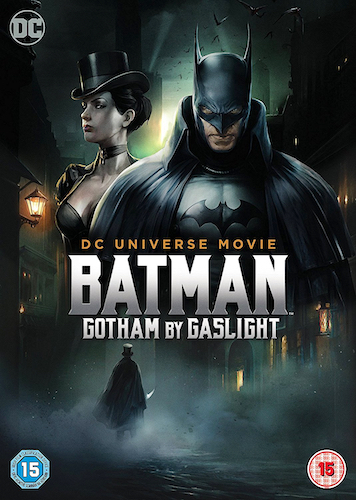





 100Films.co.uk