Red Sparrow (2018)

2018 #149
Francis Lawrence | 140 mins | download (UHD) | 2.40:1 | USA / English | 15 / R

Red Sparrow

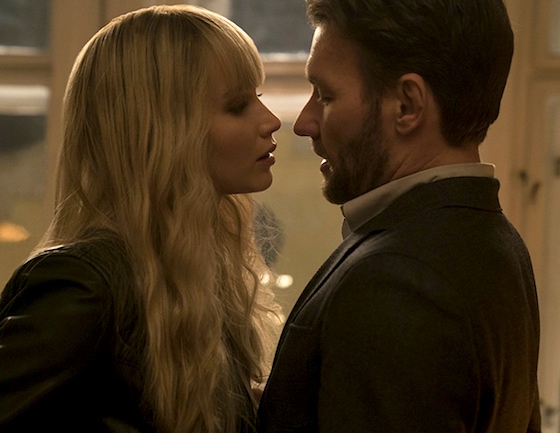
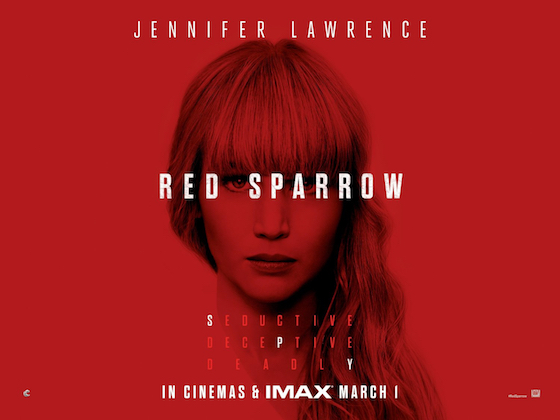
Jennifer Lawrence stars as Dominika, a Russian ballerina whose career-ending injury leads her down a path to becoming a “sparrow” — a highly-trained undercover operative for the Russian secret service. Used and abused throughout her training, when she’s sent after a CIA agent (Joel Edgerton) in order to find a mole within Russian intelligence, a series of double- and triple-crosses leave everyone in doubt about whose side she’s really on… including, er, us viewers.

Red Sparrow is set today. I think. It’s easy to forget. I had to check on a couple of occasions, including one final double-check before writing this review. The thing is, the politics of it all is very Cold War. Of course, given the current state of geopolitics, a neo-Cold War between Russian and the West is probably at its most believable since the ’80s, it’s just that this film’s handling of it doesn’t feel timely and modern, but like a Cold War story that someone decided should be set today. Partly that’s because a lot of the technology and tradecraft feels like it comes from a previous era too. I mean, one major sequence revolves around floppy disks. Floppy disks! I can’t even remember the last time I saw a floppy disk. Either that bit is based on something real-world (like, there’s a reason why someone stealing secrets would still be using floppies) — and, if it is, the film doesn’t bother to lay out why — or it’s the single most unrealistic thing in a movie that’s about a former ballerina being trained to be a Russian spy skilled in psychological influence and sexual manipulation in just three months — i.e. this is a pretty unrealistic movie all round.

Lady spy in red

Even if we ignore the inconsistencies of its temporal setting, it struggles with what else it has going for it. In its attempts to provide a twisty-turny plot, it’s not as clever as it thinks it is. As it flips and flops around about which side Dominika is supposed to be on really, clearly intending for us to feel wrong-footed every half-hour or so, the gears of how it’s setting up an inevitable final “reveal” begin to show through. Either that or I’m a genius for working it out ahead of time, whichever. One great well-disguised twist is better than endless back-and-forthing, but none of the filmmakers here seem to realise that, or don’t have the confidence to rely solely on that final reveal. Another side effect of this is it becomes hard to root for any particular character. Maybe this is the legacy of it being a US production: it can’t quite bring itself to ask us to fully invest in Dominika, a Russian spy, even as it tries to keep her the heroine. Plus the supposed twists wouldn’t work if we were actually let in on what she was plotting.

And away from the plot, the whole movie is sort of… seedy, but without owning it. It wants to be about sex and to somehow be honest about that, while also trying not to titillate in any way. It wants to be realistically violent, while merely being nasty in just one or two scenes. Conversely, it also wants to be a grown-up, labyrinthine Le Carré-esque thriller, but it’s so busy trying to repeatedly fool you that it forgets to properly engage you. It certainly doesn’t succeed in being plausible, with the elaborate plan Dominika supposedly concocted relying rather too much on crossed-fingers-type logic — or, I’m sure the filmmakers would say, her unparalleled ability to read people.

Sexy spy shenanigans

I’d rather it had picked a side: either go all out schlock — more violence, more tits — or go full intelligent thriller — rein in the seediness, rein in the superhuman foresight. As it is, Red Sparrow is not trashy enough to be titillating, certainly not clever enough to challenge Le Carré as the go-to example of intelligent spy thrills, and not stylish enough to get away with it either. It kind of sits in an awkward middle ground between all those things. I didn’t actually dislike it, but it didn’t thrill me either.

3 out of 5

Red Sparrow is released on DVD, Blu-ray, and UHD Blu-ray in the UK today.

The Header-Image-Forthcoming Monthly Update for June 2018

I’ve been an unexpectedly busy bee today, so I’ve only just finished putting together June’s monthly progress report this evening, without yet embarking on the header image — which take a surprisingly long time to create, so I’ll do that tomorrow.

[Edit: That lasted for five hours (during which the front page looked like this, fact fans) before I finished the usual style of header image. Much prettier.]

Anyway, here’s all the exciting lists and facts and stuff:


#125 The Post (2017)
#126 Power Rangers (2017)
#127 Three Billboards Outside Ebbing, Missouri (2017)
#128 Superman II (1980)
#129 A Monster Calls (2016)
#130 Nausicaä of the Valley of the Wind (1984), aka Kaze no tani no Naushika
#131 Rocky II (1979)
#132 Shrek Forever After (2010)
#133 Doubt (2008)
#134 Gaslight (1944)
#135 Zatoichi’s Revenge (1965), aka Zatôichi nidan-giri
#136 The Florida Project (2017)
#137 A Thousand and One Nights (1969), aka Senya ichiya monogatari
#138 Rocky III (1982)
#139 Sanjuro (1962), aka Tsubaki Sanjûrô
#140 National Lampoon’s Vacation (1983)
#141 Swingers (1996)
#142 Amadeus: Director’s Cut (1984/2002)
#143 If You Meet Sartana… Pray for Your Death (1968), aka Se incontri Sartana prega per la tua morte
#144 Becoming Bond (2017)
#145 Dudes & Dragons (2015), aka Dragon Warriors
Three Billboards Outside Ebbing, Missouri

A Monster Calls

Sanjuro

.


  • I watched 21 new films this month. A step down from the last couple, but by any other measure a very good month indeed — that puts it in the top 10% of all months in 100 Films history. Some of those other measures follow…
  • For starters, it’s the best June ever, easily passing 2015’s 16 to become the first June with 20+ films. Only July, November, and December now haven’t had a 20+ month.
  • That’s the fifth month in a row with 20+ films, a new record. The previous best was four (obviously) from January to April 2016.
  • It also more than doubles the June average of 9.5, pulling it up to 10.5. That leaves just July and August with all-time averages below 10.
  • It passes the rolling average of the last 12 months too (previously 18.5, now 19.1), but not the average for 2018 to date (previously 24.8, now 24.2).
  • Plus, as mentioned last month, I watched a film on June 29th, leaving just half-a-dozen dates on which I’ve ‘never’ watched a film.
  • This month’s Blindspot film: Hayao Miyazaki’s environmentalist sci-fi Nausicaä of the Valley of the Wind, which I liked, but not as much as the thematically-similar Princess Mononoke.
  • This month’s WDYMYHS film: epic music biopic Amadeus, which, again, I liked, but not as much as everyone else seems to.
  • This month I finally achieved my first Platinum Award on iCheckMovies — that’s the level you get when you complete a list. The list in question was IMDb’s Sci-Fi one, which I finished off by watching Stalker last month and Nausicaa this month. That means I have now seen the 50 greatest sci-fi movies of all time… according to IMDb voters.
  • Because I don’t already have enough film series on the go, this month I added a couple more — namely, the Animerama trilogy and the Sartana series of spaghetti Westerns. Both came out on Blu-ray this month and I thought for once I ought to make an effort to actually watch stuff I was buying.


The 37th Monthly Arbitrary Awards

Favourite Film of the Month
Plenty of strong films this month, including multiple Best Picture nominees and winners, but my personal favourite was a sequel. Kneel before… no, not Zod (I’m afraid to say I found Superman II a disappointment), but Sanjuro, Akira Kurosawa’s entertaining follow-up to Yojimbo. (And if you want my pick of all those Best Pics, Three Billboards is a close runner-up for this category.)

Least Favourite Film of the Month
I’ve never been a fan of the Power Rangers franchise, but the reboot had some degree of promise with its Chronicle-esque setup. It doesn’t deliver, though: it takes too long for the superheroic-type stuff to turn up, and when it does it’s a cheesy cheap-CGI mess.

Most Initially Irritating But Then Surprisingly Addictive Song of the Month
This month’s comical earworms have included Rock Me Amadeus (sadly not included on Amadeus’s soundtrack) and Fanfare Ciocarlia’s version of the James Bond theme (which plays over Becoming Bond’s end credits). But the song I keep coming back to is Holiday Road by Lindsey Buckingham of Fleetwood Mac fame. It’s only two minutes long, which felt like forever when it played during Vacation’s opening credits, but now I can’t stop listening to it.

Best Title of the Month
I’ll come clean with you, dear reader: half the reason I bought Arrow’s Sartana box set was because the film’s titles are so good. If You Meet Sartana… Pray for Your Death is, literally, just the start.

The Audience Award for Most-Viewed New Post of the Month
I guess I haven’t been the most interesting blogger this month: the hit count for June was my lowest since November, and some 23% less than the average for the rest of 2018. Ah well. However, one post that wasn’t so afflicted was this month’s winner, whose view count within the month is second only to Avengers: Infinity War’s straight-into-my-all-time-top-ten tally from April. Said winner was my 34th TV review, which covered The Americans season 6, a few midseason episodes of Westworld, a bit of Archer, and the Car Share finale. (In a very, very, very distant second place was The Snowman.)


This month: a superhero movie that’s a bit like James Bond, a spy actioner that wishes it was James Bond, and a James Bond that’s a bit like James Bond but many people wish was proper James Bond.

#21 Black Panther 3D (2018)
#22 Mission: Impossible – Ghost Protocol (2011)
#23 What We Did on Our Holiday (2014)
#24 On Her Majesty’s Secret Service (1969)

I enjoyed Black Panther just as much on a rewatch. The 3D is quite mild, with only occasional moments or scenes that pop, but it was worth it for the scenes in the IMAX ratio, which often come with the appropriate grandeur. When they enter Wakanda for the first time and the image smoothly enlarges from 2.39:1 to 1.90:1… gorgeous.

Ghost Protocol remains a great action blockbuster. Previously I’d always thought the “different directors bring a different style” ethos of the M:I movies went out the window from M:i:III onwards, but, rewatching them all, I’m getting a much better feel for the stylistic differences between Abrams, Bird, and McQuarrie’s contributions. And talking of IMAX ratios on Blu-ray, I’m still cross at Bird for not including them here. The forthcoming Fallout will also have scenes with an expanded aspect ratio for IMAX screenings, and McQuarrie recently stated on Twitter that he intends for those to be retained on the Blu-ray. Fingers crossed.

Finally, On Her Majesty’s Secret Service is the first Bond film I’ve watched since seeing Spectre at the cinema, almost three years ago now! And the last one before that was a rewatch of Skyfall in February 2013, almost five-and-a-half years ago. Wow. Seems it’s long overdue that I reengage with a franchise that I love — and a Blu-ray boxset that’s 68% unwatched. In that respect, you could argue OHMSS resumes a chronological rewatch that I started in October 2012 and left off in January 2013, but I’m not sure five-and-a-half years counts as “a pause”, really.


“Your mission, should you choose to accept it — I wonder, did you ever choose not to?”

Call Me by Your Name (2017)

2018 #80
Luca Guadagnino | 132 mins | streaming (HD) | 1.85:1 | Italy, France, Brazil & USA / English, Italian, French, German & Hebrew | 15 / R

Call Me by Your Name

Call Me by Your Name was the lowest grossing film among 2017’s Oscar Best Picture nominees, but it felt like it was one of the most talked about films on the ballot — though, being part of a list that also includes Get Out and “the fish sex movie”, obviously there’s stiff competition.

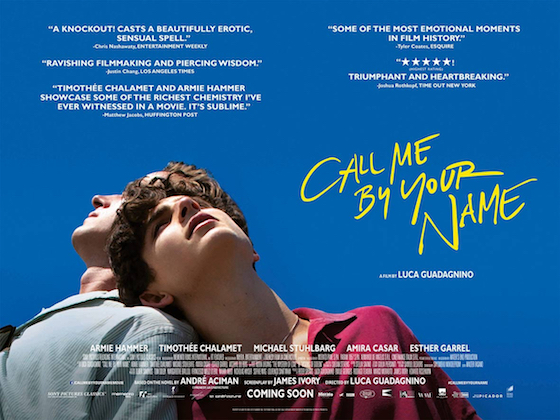
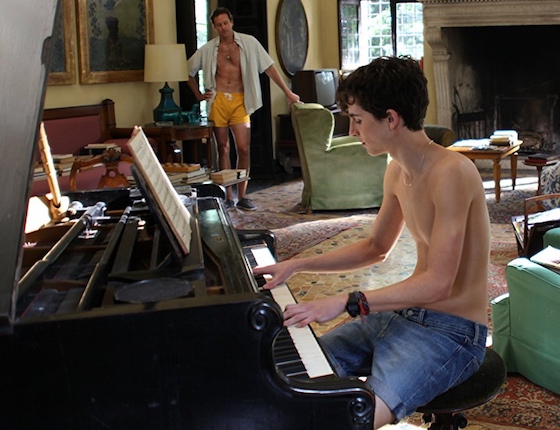
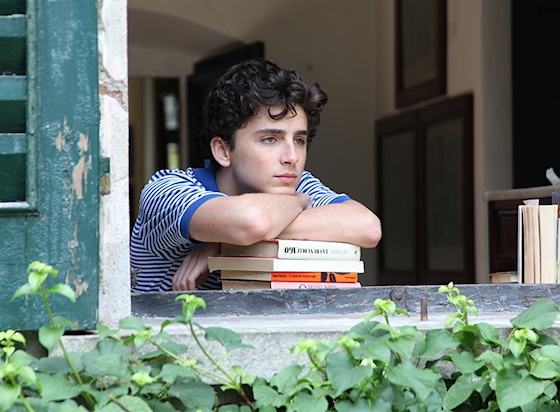
Set in Italy during the summer of 1983, it centres around 17-year-old Elio (Timothée Chalamet), the son of a pair of well-to-do intellectuals (Michael Stuhlbarg and Amira Casar) who spends his days lazing around their countryside villa — reading books, noodling about on the piano, and flirting with the local girls — and his evenings chasing skirt. He’s smart and talented, but still young and developing. Into his life comes Oliver (Armie Hammer), an American grad student who’s to be his professor father’s annual research assistant. Initially Elio is standoffish around the free-spirited Oliver, and yet seems fascinated by him. As they begin to spend more time together, a mutual attraction tentatively develops into a passionate love affair, a new experience for them both.

Sorry to rush you through the plot like that, but the gay romance between Elio and Oliver is what the film’s, y’know, about. It’s an effective and truthful depiction of young love — falteringly, unassured, but driven by powerful emotions and burning lust. Although Oliver initially seems hyper-confident, as he opens up to Elio it becomes clear that this is new for him too, and of course Elio’s only young, inexperienced even with girls at the film’s start, so of course love is a new thing to him. So, in some respects it doesn’t matter that the film’s about a gay relationship — the feeling it conjures of young love is universal. Of course, there are many reasons why it matters immensely that it’s about a gay relationship, but those concerns are largely external to the film itself. They intrude only in the sense that Elio and Oliver keep their affair a secret, though given Elio’s bohemian-ish family, he eventually finds more support than he might’ve expected.

Flesh

It’s not all sweetness and uncertainty, mind. I used the word “lust” for a reason: there’s some fairly sexually explicit stuff, so be warned if you’re of a sensitive disposition, or are particularly fond of peaches. Well, I say that — if you’re really fond of peaches, this will be your new favourite film. It’s not Stranger by the Lake graphic, despite what screenwriter James Ivory had in mind (i.e. there’s no explicit male nudity; Elio’s girlfriend gets her kit off though, which could spark a whole other debate about gender equality), but there’s still no doubting what the young couple get up to.

Talking of which, there was apparently some controversy about Elio and Oliver’s ages in regards to their relationship — Elio, as I said, is 17, and Oliver is 24. Some Americans seem to have a monomaniacal obsession with the age of consent being 18, which they then apply universally. I mean, it’s not even close to universal in the US (it’s 16 in 31 states and 18 in only 11), never mind worldwide. So, some people apparently have a major problem with that age difference between Elio and Oliver, whereas others won’t even think about it. For what it’s worth, the age of consent in Italy is 14 — imagine the reaction if they’d made Elio that young! For another perspective, in the UK in 1983 the age of consent for heterosexual couples was 16, but for gay people it was 21 — so, what, if this was set in the UK and Elio was female it would be okay, but because he’s male we’d have to be appalled? I guess my point is: think this shit through, and stop being “outraged” that people under the legal age of consent have romantic and sexual feelings.

Pining

But I guess there are fans of the film who’d know all about that, considering pretty young Timothée Chalamet has apparently become a favourite of the Tumblr crowd (who I’m basically assuming are all kids, which I’m sure is unfair). He’s not just young and beautiful though, but an extraordinarily competent actor too, all unearned confidence undercut by youthful vulnerability. His Oscar nomination was deserved. Armie Hammer went overlooked, but he gives a more nuanced performance than you might expect. From the supporting cast, the reliably excellent Michael Stuhlbarg stands out. Initially just an amiable dad, the film gradually peels back the layers to reveal what a fantastic father he is, including one heart-to-heart scene that alone (and even more than Hammer) should’ve seen him scooping awards.

The film was also overlooked in the cinematography category, which is a shame too. Shot on 35mm with a single lens by DP Sayombhu Mukdeeprom, it ably recreates the hazy feel of a long-ago summer. That sensation extends across Guadagnino’s direction, the gentle pacing reminiscent of a time when six weeks was forever, when the world was full of possibilities and there was time enough to explore them all and still have some left over.

Call Me by Your Name manages to resolve a striking array of contrasts — it’s both universal and specific, nostalgic and timely, powerful and gentle. The sum is a beautiful film in most every respect.

5 out of 5

Call Me by Your Name is available on Sky Cinema from midnight tonight.

It placed 18th on my list of The 26 Best Films I Saw For the First Time in 2018.

The Past Month on TV #35

In this month’s TV review: wah gwaan in Luke Cage season two, and “what’s going on?!” in Westworld’s finale.

Luke Cage  Season 2
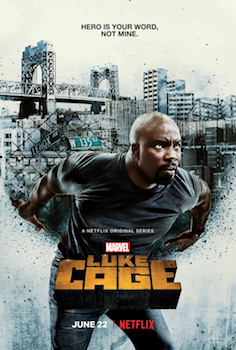
Luke Cage season 2The ninth season of the MCU on Netflix takes us back to Harlem for the continuing adventures of the eponymous bulletproof black man. It’s hard to imagine a more timely superhero for America (maybe if he was an immigrant too), not that the series’ is actually all that concerned with such issues, aside from passing nods and references. Instead, it’s more of a gangster crime drama: the still-standing season one villains, underworld power couple Mariah and Shades, intend to go legit by selling their illegal gun business, using the profits to invest in social projects for Mariah’s beloved Harlem. Standing in their way is Bushmaster, a superpowered patois-speaking Jamaican gang leader, who has a long-held grudge against Mariah’s family — and he’s come for retribution.

This focus on the conflicts between the villains has led some critics to reckon that Luke Cage has been sidelined in his own show. That’s true to an extent: because we’re privy to Mariah, Shades, and Bushmaster cooking up and executing their separate schemes, Luke is left to kind of wander around, trying to figure out stuff we already know. At the very least, the series is as interested in its villains as in its heroes — I reckon if you totted it up, Luke and Marian’s screentime would be pretty comparable. On the bright side, this is a very character-driven season — it’s as concerned with who these people are and how they’re changed by events, rather than just the mechanics of the plot — and Luke is certainly no exception. For one, his estranged father is in town — a superbly nuanced turn from the late Reg E. Carney (who the season is dedicated to, appropriately), which lends a different perspective again.

Plus, picking up and running with a theme from the first season, Luke is now famous as “Harlem’s hero”, but this is going to his head a bit, negatively affecting his relationship with Claire. The series does a good job of reflecting the celebrity status of superheroes, something the other Marvel films and series haven’t really touched on. If these events were even vaguely real, there’s no way Luke Cage could hang out in Harlem without being noticed. So now there’s an app to track his whereabouts, merchandise, sponsorship offers, his actions make headlines, and wealthy fans are willing to pay for him to make personal appearances. Luke espouses an ambivalent relationship to all this: he’d rather it wasn’t happening, but it does have its uses — and those prove seductive.
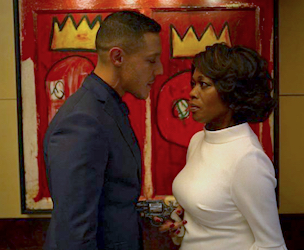
Rulers of HarlemMike Colter remains a likeable lead, but, again, it’s a villain who steals the show: as Mariah, the brilliant Alfre Woodard is perhaps the best thing about the whole series. Her performance is consistently fantastic, selling every twist and turn of character the writers throw at her. The season is as much about what events do to her as it is about Luke. She isn’t entirely alone, though: there are plenty of great performances, and scenes to showcase them, throughout the season. Occasionally there are some really bloody terrible ones though, like the time detective Misty Knight and her captain argue loudly about a shared secret while they’re in a room full of other cops. Is that bad writing, bad acting, bad direction, or all of the above?

And sometimes the good stuff is spread a bit thin. There are points, especially midseason, where it feels so goddamn slow. Or maybe not slow, but long. Episodes seem to just keep going. One is called On and On, like some kind of joke at our expense. This is the case with so many of these streaming shows, though — most of them need more plot and/or tighter storytelling. I guess part of the problem is the 13-episode diktat, which presumably the showrunners have no say over. It’d be better if they could make the season the length it needed to be, rather than spin wheels to make it last as long as it has to. That said, most Luke Cage episodes use the full hour “time slot”, and a couple run over it, so if maybe they’ve kind of reclaimed the padding…

Talking of other shows, the last time we saw Luke Cage in Luke Cage he was headed off to jail, but he starts this season free as a bird. Oh, and another major character is missing an arm. MCU fans will know that, since the last season, The Defenders happened, in which we saw these major changes to these characters’ status quo. There are vague nods at explaining some of that for anyone who skipped the team-up miniseries, but, really, it assumes you’ve watched it; and that ‘issue’ crops up again later in the season, with a couple of guest appearances by characters from Iron Fist. If you’re not interested in any of the other Marvel/Netflix series and don’t want to invest eight hours to find out a couple of linking story points (because The Defenders’ main plot has nothing to do with Luke Cage’s storylines), then maybe you need to read a plot summary on Wikipedia or something.

Heroes for hireThe flip side to all that is that this interconnectedness will perhaps be comic book fans’ favourite thing about the show — the way it casually references other series, or suddenly brings their characters in for a guest spot, is just like how comic books operate. It’s pretty constant too: barely an episode goes by without a significant reference to or cameo appearance by someone from another Marvel/Netflix show; and these aren’t all mere Easter eggs, but sometimes quite important or vital pieces of plot or character development.

For all its variability, Luke Cage finds its groove as the season goes on, and the final few episodes feel like an improvement (though I’d still contend they’re longer than they need to be). It all builds to a finale that feels almost low-key — I mean, there’s war on the streets and a lot of minor characters die, but that’s almost incidental, because it’s all about the characters, their relationships to each other, and how those find (or fail to find) closure. No spoilers, but it ends in a really intriguing place for season three. That’s not been officially commissioned yet, but surely it’s inevitable. It’ll be interesting to see where they take things next.

Westworld  Season 2 Episodes 8-10

Riding into the sunset (metaphorically)And so Westworld’s sophomore run rides into the sunset, and I think it’s left behind more questions than answers.

When the show’s first season finally came to expose its secrets, there was a lot of oohing and ahhing — the twists and reveals, whether you’d guessed them or not, retroactively made a lot of sense, and suggested a good deal of cleverness on the part of the writers. Season two’s finale, on the other hand, seems to have been met with a collective “…huh?” Even plenty of people who enjoyed it confess to not understanding everything that was going on, while others have just given up at this point.

Personally, I’m somewhere in between. There’s a lot to like and admire about the closing hours of season two, not least the production values: the show looks fantastic, and the acting is top notch. But I won’t dismiss the argument that the writers have disappeared up their collective arse, because there’s a lot of tricksiness and jiggery-pokery going on here that is sometimes hard to unravel — a stark contrast to the end of season one, I think, which managed to make the games it had been playing clear. Perhaps in their bid to outwit Reddit users, Westworld’s second season seems to have been jumping through hoops merely to be cleverer than its viewers, and I’m not sure that’s paid off.

Dark DoloresExhibit A is the “Hale was Dolores all along” revelation. It’s a neat twist, almost up to season one levels, were it not undermined by the season’s own structure: Hale hasn’t been Dolores all along, and the muddled timelines make it hard to recall how many scenes we’ve had with “Halelores” (as the writers apparently dubbed her). In fact, one of the ways they hid her in plain sight was to limit her screen time: apparently she only popped up in episodes three and seven. Those scenes are littered with subtle clues to her identity, however, though I guess the Redditors missed them — probably because they couldn’t keep track of which timeline we were in either.

There’s so much else going on here that I don’t even know which bits to pick out. I guess that’s part of the problem: with so many conclusions saved up until the finale and then all stuffed in at once, there’s just too much to digest and process in one almighty hit. One of my long-held suspicions has definitely been confirmed though: despite the plot of the series’ movie inspiration, co-creator Jonathan Nolan isn’t really interested in making a thriller about a robot rebellion at a technologically-advanced theme park, but instead has set out to make Person of Interest 2.0, for good or ill. That’s only going to become more apparent next season, I think, which is set to leave the titular park behind entirely. It’ll be interesting to see how many viewers it takes along with it…

Things to Catch Up On
Preacher season 3This month, I have mostly been missing Preacher’s third season, which started this week. Well, I only watched the first two episodes of season two in the end, so I’m very far behind. There’s also another Marvel TV series, Cloak & Dagger (which is passingly referenced in Luke Cage, apparently). That’s releasing new episodes weekly (on Amazon Prime this side of the pond). So many of these weekly shows I now wait to be complete before I binge them, but then I don’t get round to it (cf. Star Trek: Discovery, Black Lightning, etc). Finally, I happened to spot there had been a French sci-fi series called Missions on BBC Four, just before it disappeared from iPlayer, so now I’ve got all of that downloaded too.

Next month… you know, I have no idea. I know it’s the summer, but there must be something coming up? Maybe I’ll finally take the chance to dig into my massive backlog.

The Snowman (2017)

2018 #84
Tomas Alfredson | 119 mins | streaming (UHD) | 1.85:1 | UK, USA & Sweden / English | 15 / R

The Snowman

I read a comment somewhere that said Tommy Wiseau’s notorious film The Room is like a movie made by someone who’s never seen one but has had the concept thoroughly explained. The Snowman is like that but with crime thrillers.

Michael Fassbender stars as Norwegian detective Harry Hole — I presume there’s been some kind of fault of culture or translation there because, in English, that’s pretty much the worst name for a detective ever conceived without deliberately trying to be awful. He’s kind of washed up, with a terrible private life, but he’s also an unassailably brilliant detective — oh yeah, the originality keeps on coming. Anyway, after a woman disappears, an ominous snowman built near the crime sets Hole and a younger cop (Rebecca Ferguson) on the trail of a serial killer who’s been active for decades.

All of which should make for at least a solid crime thriller, but it just doesn’t quite work. It’s like the whole thing has been almost-correctly-but-not-quite translated from another language. I’m not just talking about the dialogue (though that’s sometimes that way too), but the very essence of the movie — the character arcs, the storylines, even the construction of individual scenes. Like many a Google Translate offering, you can kinda tell what it’s meant to be, but it doesn’t actually make sense in itself. According to the director, around 15% of the screenplay was never even filmed due to a rushed production schedule, which perhaps explains some of these problems.

Mr and Ms Police

Said director is Tomas Alfredson, the man who gave us Let the Right One In and Tinker Tailor Soldier Spy, so you’d expect a lot better of him. Even the technical elements are mixed: there’s some stunning photography and scenery, contrasted with occasional bad green screen; and all of Val Kilmer’s lines had to be dubbed (due to his tongue being swollen from cancer, apparently), but it sounds like it. His performance on the whole is weird, just one more part of the film that doesn’t sit right. It all builds to a massively stupid, unremittingly nonsensical finale. It’s during the final act where things finally goes overboard from “not very good” to “irredeemably bad”.

Indeed, some of the The Snowman is so shockingly awful that I considered if it merited my rare one-star rating. It’s close, but a lot of the film is fine — it actually toddles along at a reasonable three-star level most of the time, before falling apart entirely towards the end. “It could be worse” may be the faintest of praise, but it certainly doesn’t deserve any more.

2 out of 5

The Snowman is available on Sky Cinema from midnight tonight.

Journey to the Center of the Earth 3D (2008)

2017 #139
Eric Brevig | 93 mins | download (HD) | 1.78:1 | USA / English | PG / PG

Journey to the Center of the Earth 3D

Journey to the Center of the Earth 3D (as it’s actually titled on screen, a rarity for 3D movies) is a very loose (very, very loose) adaptation of Jules Verne’s classic fantasy novel — indeed, you could say it’s more of a sequel, as the characters’ adventure is inspired by the belief that Verne’s novel is actually an account of real events. It turns out they’re right, of course, because otherwise this would just be a movie about a man and his nephew trekking up a mountain to find nothing — which sounds like a film someone would make, but not an effects-driven summer blockbuster.

I remember Journey 3D (as the title card indecisively morphs into before finally moving on) going down quite poorly on its release a decade ago, but, looking up sources to cite for that now, I’m not wholly correct: it has 61% on Rotten Tomatoes, which isn’t great but is still considered ‘fresh’, and grossed a respectable $242 million (off a budget of just $60 million). Nonetheless, I expected little of it (I watched it mainly because it’s on my 50 Unseen from 2008, a notoriously under-completed list) but wound up pleasantly surprised… in some respects, anyway.

They're all right

The key to my enjoyment was watching it in 3D, in which it plays more like a theme park attraction than a movie: from the very beginning it has loads of those “sticking stuff out into the audience” hijinks that no one bothers with anymore (indeed, after watching a dozen other 3D movies on my TV, I don’t think I’ve seen anything poke out before). Gimmicky and in your face (literally) though it may be, the effect works, it’s uncomplicatedly fun, and it makes the movie better just because it’s trying. Relatedly, this was the first film released in 4DX, the South Korean-developed theatrical format which features “tilting seats to convey motion, wind, sprays of water and sharp air, probe lights to mimic lightning, fog, scents, and other theatrical special effects”. I imagine all that palaver suits the film really well — as I said, it’s more like a theme park attraction than a regular movie anyhow.

However, that’s just one of the reasons why I imagine it would be nearly unwatchable in 2D. All the stuff that’s kinda fun in 3D would seem pointless in 2D, and the at-the-camera things would be horrendously blatant (I mean, they are in 3D, of course, but at least their purpose is retained). And as for the rest of the movie, the direction feels very TV-ish; or, again, like a theme park attraction — it’s a bit basic, basically. Some moments push towards achieving wonder. I’m not sure they quite get there, but I’ve seen worse. (Director Eric Brevig is a visual effects guy by trade, with credits ranging from The Abyss and Total Recall up through Men in Black and The Day After Tomorrow to John Carter and The Maze Runner, and many more besides. His second film as director was the Yogi Bear movie (you know, the one with that poster), which is probably why he’s not directed anything since.)

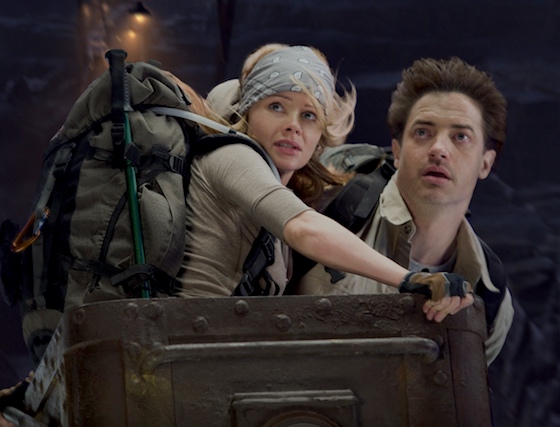
Remember when Hollywood thought Brendan Fraser was Harrison Ford?

Let’s not just reserve our criticism for the direction, though: the dialogue is terrible too, including what may be the single worst (or best — it’s so bad it’s good) exchange in the entire history of movies:

Trevor: Max was right. He was right! [shouting] Max! Was! Right! Ha ha! [to Sean] Your dad was right. He was right.
Sean: Hannah, your dad was right too.
Trevor: They both believed in something that everyone told them was impossible. He was right! [echoing:] He was right!

But hey, at least it makes an effort to do that screenwriting thing of eventually paying off every single thing we learnt about earlier… except for a yo-yo, the thing with the most “this is setup for later” introduction. Maybe the scene where they needed to do some hunting got cut… There’s added incidental amusement watching it a decade on thanks to the surprisingly old-fashioned technology on display: computer monitors are still CRTs; cool kids’ mobiles are still flip phones; being able to Google while on a plane is a wonder… It’s like the film is self consciously showing off how much technology has changed in the last decade — which it isn’t, obviously, because it couldn’t’ve known. And hey, if you don’t laugh at it you’ll cry because it’ll make you feel old.

Really, Journey 3D is cheesy, tacky, and kinda terrible… but I also enjoyed myself. Yes, a big part of that was the 3D. I’d never claim it was a good film, and I don’t think that I’d even recommend it, but I wouldn’t write off watching it again someday.

2 out of 5

Perfect Sense (2011)

2017 #131
David Mackenzie | 89 mins | streaming | 2.35:1 | UK, Sweden, Denmark & Ireland / English | 15 / R

Perfect Sense

It’s funny, sometimes, the journeys we take to watch a movie. I distinctly remember Ewan McGregor appearing on a chat show to promote this back in 2011. I thought it sounded like a good setup for a story, so the film’s existence lodged itself somewhere in the back of my memory. Clearly the film itself didn’t have much impact, and so, with no one talking about it, and no releases or TV screenings or whatever that were high-profile enough for me to notice, it went on the back burner. Until last year, when I noticed it was available to rent on Amazon Video.*

Anyway, the aforementioned setup is a global epidemic that causes people to have an intense emotional outburst followed by losing one of their senses — for example, the first stage is an uncontrollable bout of crying followed by losing the ability to smell. Over a short period everyone experiences the same thing, then the world learns to adapt… until it happens again, losing another sense. While this is going on, we follow the relationship of Michael (McGregor), a chef, and Susan (Eva Green), a member of a team trying to find a cure for the disease. Obviously, this provides our human connection to events, with the grand world-changing stuff providing more of a backdrop.

Life goes on...

It’s ironic, then — or at least counterintuitive — that there’s more emotional power in the montages about senses and what was being lost — the ideas-y stuff — than there is in the character- and relationship-based bits. Those are actually surprisingly clunky at first, with even McGregor and Green — both actors I like a good deal — struggling to make them work. Things do smooth out in that regard, but the romance plot proceeds to conform to a pretty standard shape. Was the sci-fi crisis meant to reflect the relationship, or is the relationship a down-to-earth framework on which to hang a big sci-fi story? I suspect the latter, because it’s the end-of-the-world theatrics that prove more interesting.

Those are kept grounded and plausible: despite the ever-worsening situation, people keep getting used to the new status quo and going on as normal — until the sensory deprivation goes too far to ignore, of course. There are lots of neatly observed and imagined little bits in how this unfolds, like how after taste is lost the rituals of going out to restaurants remains, with focus moved to the sounds and physical sensations of the environment and the food; and newspaper critics still review places for this, naturally. This “life goes on” thing feels very much like how we as a society genuinely react to big changes or threats.

...until it doesn't.

So, it’s not a perfect film, but Jesus, the negative reviews I sampled (chosen at ‘random’, where “random” means “the top results on Google”) were shitty pieces of criticism. Their points include things like it’s preposterous (well, the plot is propelled by an unexplained virus — it’s less preposterous than, say, Spider-Man), or the characters fall in love while the world falls apart (because no one ever seeks comfort in others during times of stress or tragedy), or the screenwriter has kind of a funny name (seriously — a supposedly professional review dedicated some of its limited word count to basically going, “lol, foreigner’s got name that looks funny!”) It annoys me that some people get paid to write bollocks like that.

As I said at the start, no one ever really talks about Perfect Sense, even after its director has gone on to bigger things (Starred Up attracted a lot of praise and Hell or High Water earnt Oscar nominations), but it’s worth a look for anyone interested in broadly-plausible end-of-the-world dramas.

4 out of 5

* Having rented it, I was surprised to see it begin with a BBC Films logo, because most BBC Films productions end up on BBC Two within a year or two. So I checked, and it turned out it had been on TV, just once, in November 2012. (You’d think they’d’ve shown it more than that in the five-and-a-half years since — I mean, they’ve shown The Ides of March six times in four years.) Worse than that, though, was when I checked my iPlayer downloads and found I had actually downloaded it, so paying for the rental was a waste of money. Well, at least it was only £1.99, and I paid with vouchers anyway. But the colour grading of the two was completely different, which was just odd. Anyway, back to the review: ^

Victoria & Abdul (2017)

2018 #52
Stephen Frears | 112 mins | streaming (HD) | 2.35:1 | UK & USA / English, Urdu & Hindi | 12 / PG-13

Victoria & Abdul

Returning to the role that earnt her first Oscar nomination, Dame Judi Dench stars as an even older Queen Victoria, who once again gets involved in a friendship with a foreign servant to the exasperation of those around her. If it wasn’t based on a true story, the similarities to Mrs Brown would make Victoria & Abdul look like a slipshod copycat sequel. Okay, this isn’t technically a sequel, but the similarities can’t be ignored.

Where the earlier film aimed for dramatic weight as a portrait of a grieving and isolated monarch finding human connection again, here the goal seems to be more comedic. Perhaps. I mean, if often shoots for funny, but it’s not funny enough to be an outright comedy. At other times it’s more straightforwardly dramatic, especially as it gets towards the end, but there’s a nagging sensation that the facts have been bent to fit the expected shape of the narrative. The film begins with a card that says it’s “based on real events… mostly”, which feels a little too comical for a heritage drama such as this, and was perhaps more intended it as a “get out of jail free” card for its historical accuracy. (I don’t know what the facts are, mind, so I can’t vouch for or condemn the film’s faithfulness to them.)

Turns out we are very much amused

Dench is very good, as you’d expect. The rest of the cast don’t get to deliver as much range, but they’re a quality bunch of performers and so are easily up to what they’re given. It’s also as pretty a production as you’d expect, with Oscar-nominated makeup and costumes, plus opulent production design and grand location choices, all shown off by Danny Cohen’s pleasant cinematography.

I read someone else assess that it’s not as good as its individual parts, and I think that’s fair. Most of the scenes, moments, and performances are strong — there are notably funny bits, dramatic bits, emotional bits; even unexpected complications in how it handles some of the characters — but when it’s all put together, it doesn’t quite coalesce. If you think you’re the kind of person who’d enjoy this movie, there’s every chance it will please you no end. Otherwise, while it does have definite qualities, it doesn’t do quite enough to transcend its trappings.

3 out of 5

Victoria & Abdul is available on Sky Cinema from today.

The Death of Stalin (2017)

2018 #85
Armando Iannucci | 107 mins | streaming (HD) | 1.85:1 | France, UK & Belgium / English | 15 / R

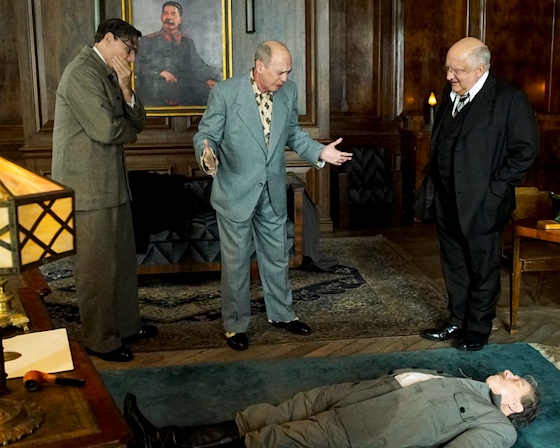
The Death of Stalin

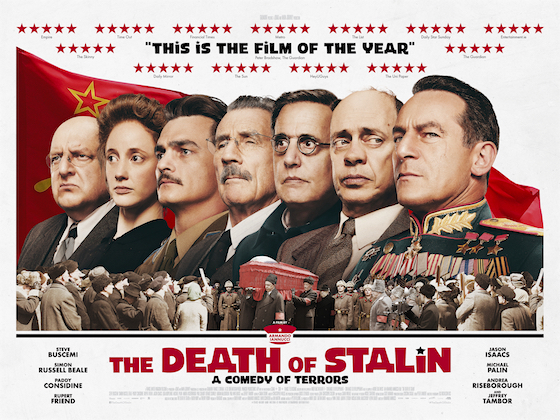
Armando Iannucci, the writer-director-creator behind political comedies like Veep, The Thick of It, and the latter’s Oscar-nominated movie spin-off, In the Loop, here turns his attention away from fictional present-day politics to real-life historical ones — as the title suggests, the death of Soviet dictator Josef Stalin and the power struggle that followed. Sounds like a laugh riot, don’t it? Dark comedies don’t get much darker than this!

It plays a bit like Horrible Histories for grown-ups, teaching you the facts of an interesting period of history, containing very serious events, while also sending up the objective ludicrousness of what went on. The flip side to that is one has to wonder about its accuracy. It’s officially adapted from some French comic books, rather than, say, an academic work, and various historians have commented on its veracity with regards to historical fact — some have said it’s littered with minor errors that can be excused as cinematic licence, others that it misses the mark entirely. For his part, Iannucci claims he actually “chose to tone down the real-life absurdity” because audience’s wouldn’t’ve found it believable.

Over Stalin's dead body!

The Death of Stalin probably isn’t the best text to cite in a history essay, then, nor a valuable piece of work for anyone interested in a proper understanding of what went on. As a comedy about the ridiculousness of dark times, however, it functions in a similar way to Iannucci’s other work. Functionally it’s very like The Thick of It, in that it’s about a group of semi-confident politicians trying to scheme against each other. Of course, the results of their machinations are a bit more serious and murderous than any of the problems Malcolm Tucker ever faced.

I’m sure some viewers must find the irreverence with which the film treats such matters to be a turn-off. Personally, I think its perspective is more profound: these are silly men playing silly power games, but the end results are often unthinkable and horrific. You only have to look at the recent news headlines — in which the gibbering orange blob who is the supposed “leader of the free world” has enacted a Hitlerian policy of tearing small children away from their parents and locking them up in cages at concentration camps, only to serve his own futile political ends — to see similar situations playing out to this day.

Perhaps, in this climate, The Death of Stalin is a reminder that we need to laugh at the preposterousness of monsters in power. It’s not quite as laugh-out-loud funny as the best of The Thick of It or In the Loop for me, but that point is, unfortunately, as relevant as ever.

4 out of 5

The Death of Stalin is available on Prime Video UK as of yesterday.

Yojimbo (1961)

aka Yôjinbô

2017 #126
Akira Kurosawa | 111 mins | DVD | 2.35:1 | Japan / Japanese | PG

Yojimbo

Best known to many viewers as the film Sergio Leone ripped off to make A Fistful of Dollars, Akira Kurosawa’s Yojimbo is itself already a Western in all but setting: it stars Toshiro Mifune as Sanjuro, a ronin who wanders into a village where two gangs are at loggerheads, a conflict from which the regular folk cower in fear. Where Kurosawa deviates from the Western, at least as they had been made to that point, is that Sanjuro isn’t a clean-cut hero who’ll side with the good guys and get this mess sorted — he’s a mercenary, primarily out for his own interests; and besides, there are no good guys to join: both gangs are equally bad.

In his essay that accompanies Criterion’s release of the film, Alexander Sesonske argues that Kurosawa is actually combining “two typically American genres”. So we have “a classic Western setting, with dust and leaves blowing across the wide, empty street that runs the length of a village, a lone stranger passes as frightened faces peer from behind shutters”, mixed with the morals (or lack thereof) of a gangster movie, with everyone a crook hoping to merely outgun the others. That all comes wrapped in the milieu of a samurai movie, meaning instead of pistol duels or scattershot machine-gun fire we get flashing blades. Indeed, Yojimbo was the first film to have a sound effect for a sword slashing human flesh — they had to experiment to get it right, because it had never been done. Considering the film also features severed limbs and squirting blood, the BBFC’s PG seems awfully lenient…

Observing the conflict

Given all that, it seems like this is an almost mercilessly nihilistic film. It’s set in a town that’s been fucked up by the never-ending gang warfare, and over the course of the story nearly everyone dies, many of them in brutally violent fashion. Even the hero seems remorseless, killing freely and plotting to get the two gangs to massacre each other because he sees a way to profit. Sesonske asserts that “Yojimbo lacks the intellectual challenge of Rashomon, the moral resonance of Ikiru, or the sweep and grandeur of Seven Samurai”, which may all be true to an extent, but we shouldn’t disregard what the film does offer: a bleak worldview that chimes with the careless brutality of the world as we know it.

Even in such hopelessness there is beauty, and here, at least, that comes from Kazuo Miyagawa’s gorgeous black-and-white cinematography. With many incredibly blocked and framed shots, it’s no wonder Kurosawa has been so copied — his visuals are always amazing. His exacting desires may’ve created various production issues (the specially-built set, made with extreme period accuracy, was unprecedentedly expensive; to create the windswept effect they used all of the studio’s wind machines, which was so powerful actors couldn’t open their eyes and camera cranes couldn’t complete moves; and he used all of the studio’s big lights for night scenes, but the way they pulsated meant lens filters had to be used to compensate), but it doesn’t half look good in the end.

5 out of 5

Yojimbo was viewed as part of my Blindspot 2017 project, which you can read more about here.