Film Noir Review Roundup

I’ve made a conscious effort to watch more film noirs this year, and today’s roundup contains a few results of that:

  • The Narrow Margin (1952)
  • Accomplice (1946)
  • Shockproof (1949)


    The Narrow Margin
    (1952)

    2018 #2
    Richard Fleischer | 68 mins | TV | 4:3 | USA / English | PG

    The Narrow Margin

    Recognised as a classic noir, The Narrow Margin follows a detective (Charles McGraw) who must protect a mob boss’ widow (Marie Windsor) as she travels by train from Chicago to LA to give vital evidence. As the ‘tec finds himself getting involved with an attractive fellow passenger (Jacqueline White), the assassins on his trail mistake her for their actual target…

    What unfurls is an exciting plot with some solid twists and some great dialogue (enough that it earnt a Best Writing Oscar nomination, in fact), all told in a snappy running time that ensures the film powers forward like, well, a locomotive. Director Richard Fleischer makes very effective use of handheld camerawork and the train setting to create a confined, claustrophobic atmosphere that emphasises the tension and peril of the characters. It all blends into a very fine thriller.

    4 out of 5

    Accomplice
    (1946)

    2018 #16
    Walter Colmes | 66 mins | streaming | 4:3 | USA / English

    Accomplice

    Described by Paul Duncan’s Pocket Essential Film Noir as “hardboiled fun”, and by the few other people online who’ve seen it with phrases like “one of the worst assembled detective movies I’ve had the occasion to watch in a long time”, Accomplice graces my eyeballs before many no doubt finer examples of film noir by virtue of the fact it was available to stream on Amazon Prime and I thought I’d catch it while it was there.

    Adapted by Frank Gruber from his novel Simon Lash, Private Detective, it sees private detective Simon Lash (Richard Arlen) being hired to track down a missing bank executive by his concerned wife (Veda Ann Borg), but the bank insists he’s merely on vacation. As Lash digs deeper, he begins to suspect the wife may have other motives — as does, well, everyone else.

    Running little more than an hour, Accomplice’s plot races past, giving you no time to stop and consider it. Maybe that’s for the best. Conversely, it makes it feel like it doesn’t hang together, even if it actually does. But it rushes along at a scene level, too: Lash seems to figure things out as quickly as it takes the actors to say their lines. It’d be Sherlockian, if you actually believed he had the necessary information and wherewithal to make the deductions.

    There is some fun to be had in a speedy car chase and the film’s occasionally kooky location choices, like the climax being set at a castle in the middle of the desert that’s pitching itself as some kind of hotel for mid-getaway crooks (I think that was the owner’s business plan, anyway). There are other surprising flashes of entertainment, though some of them were likely unintentional, but Accomplice is not really a good film.

    2 out of 5

    Shockproof
    (1949)

    2018 #68
    Douglas Sirk | 76 mins | TV | 4:3 | USA / English | PG

    Shockproof

    When you hear “film noir” you don’t immediately think of director Douglas Sirk (nor vice versa), better known for his colourful ’50s melodramas. Well, according to They Shoot Pictures, Don’t They’s list of most-cited noir films, he helmed three, of which this is the second. The plot has plenty of noir elements, but the film actually feels more like a romantic melodrama. It’s quite an effective mix.

    So, the noir: it’s about a female murder parolee (Patricia Knight) and her parole officer (Cornel Wilde), who begins to fall in love with her. But is she still attached to the crook she took the fall for (John Baragrey)? Is she just pulling the wool over the eyes of the parole officer? That’s kind of a love triangle, hence we’re back in melodrama territory. But the advantage of it being billed as a noir rather than a romantic drama is you’re not sure where it will go. Will she fall for the good honest parole officer with his sweet younger brother and blind mother? Or will she be tempted back to the criminal love of her life? Or will it have a more tragic ending altogether?

    Well, no spoilers, but it definitely takes a turn I wasn’t expecting — the third act spins off in a whole different direction. To be honest, I didn’t really like it, but at least it was unusual, a big departure from the earlier part of the film, and it kind of worked because of that. Again, no explicit spoilers, but it comes to a neatly ironic conclusion… before there’s one extra scene, which feels tacked-on and undermines where the film had got to tonally. And that’s exactly what happened: co-producer Helen Deutsch rewrote Samuel Fuller’s screenplay and added a cop-out ending that Sirk felt ruined the film.

    Fatal femme

    At least until that point there’s stuff to enjoy. Knight’s performance is the real star: although her true nature seems to have been revealed at the start (she’s a parolee, i.e. a no-good criminal), the film adds more nuances to her than that — primarily, you can’t be sure if what she’s doing is genuine, or if she’s playing the parole officer for her own ends. There’s also an interesting turn from Baragrey: I couldn’t be sure if his acting was a bit flat, or if he was deliberately being cool, cold, calculated, thinking he’s always in control, the smartest guy in the deal. Well, even if it’s the former, it functions well as the latter.

    So, Shockproof (a title that has no relevance whatsoever, incidentally) isn’t a total disaster, with some surprising turns that are to be commended even when they don’t work. It was clearly a compromised production, but an interesting one.

    3 out of 5

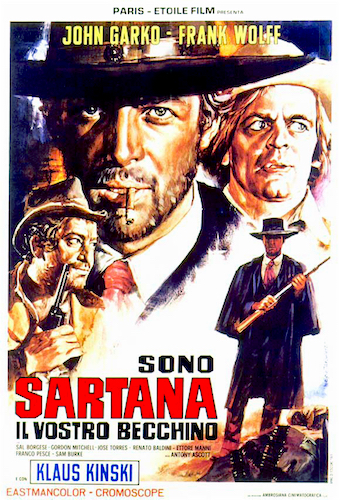
  • I Am Sartana, Your Angel of Death (1969)

    aka Sono Sartana, il vostro becchino / Sartana the Gravedigger

    2018 #169
    Giuliano Carnimeo* | 103 mins | Blu-ray | 2.35:1 | Italy / English | 15

    I Am Sartana, Your Angel of Death

    The second official movie to star Western antihero Sartana is, according to the blurb on Arrow’s Blu-ray release, “a more playful film than its predecessor, possessing an inventive visual style and developing its central character into a more creative and resourceful figure.” That’s bang on — and it’s a better film for it.

    It starts with a bang, too: a bank robbery that turns into an action-packed shoot-out. The leader of the gang is posing as Sartana, which puts a price on our hero’s head. He sets about trying to prove his innocence and get his revenge, while three fellow bounty hunters set about trying to kill him.

    Your Angel of Death is a lot slower paced than the non-stop action-fest of the first film, but that has its benefits: the plot is a lot clearer, and there’s more time invested in characters and non-violent set pieces (like Sartana’s card tricks), which I thought made for a more enjoyable watch overall. The storyline gives the film a “whodunnit” element, as the guy who framed Sartana is as much a mystery to us as it is to him. The film develops Sartana into a more interesting character, too, because his resourcefulness really comes out here. He doesn’t just shoot fast — he plans his strategy, uses objects as weapons in cunning ways, sometimes coming up with such things on the fly.

    Sartana takes aim

    Of the three men after Sartana, only the one played by Klaus Kinski gets any serious screen time. Kinski was a bankable actor in these kind of movies at the time, and so after his cameo-sized appearance in the first film he’s back here with a bigger role, as a somewhat camp bounty hunter. There’s a sort of running gag where he’s terrible at cards, and knows it, but can’t help playing anyway, which is quite fun. As for the other two hunters, one is used for a decent shootout-cum-chase sequence early on, but the third is introduced alongside the other two only to disappear entirely until the final duel, which makes the finale somewhat anticlimactic. One nice touch, though: Sartana clearly has a longstanding professional relationship with all three men — comrades in the bounty hunter game, or something like that — which adds an extra dimension to their encounters.

    The other standout in the supporting cast is Frank Wolff as Buddy Ben. Sartana initially thinks Ben might’ve set him up, but he was in prison at the time. From there he takes on the role of Sartana’s sidekick, kinda — we’re still not quite sure if he’s to be trusted, which is a nice dynamic.

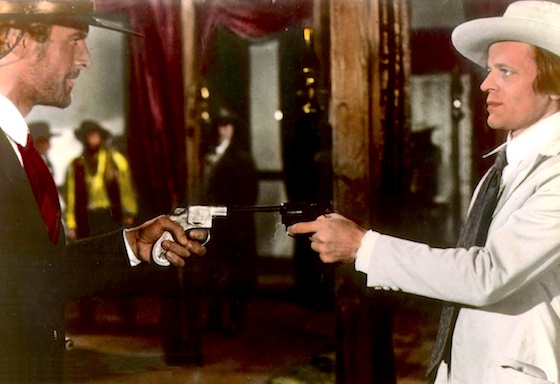
    Barrel to barrel

    Giuliano Carnimeo’s direction is less remarkable than Gianfranco Parolini’s work on the first film… or so I’m told: every review seems to mention it, as does Arrow’s booklet. There are some nice flourishes, however, with the most obvious being that almost anytime someone is shot the camera dramatically tips over sideways, mimicking their death. Apparently the film’s more humorous and ironic tone is in keeping with Carnimeo’s style, in contrast to the more straightforward action of Parolini, and that’s a positive in my book.

    Your Angel of Death was a more enjoyable experience than the previous film, which was very welcome because (as I mentioned in my previous review) I’d been slightly concerned that taking a punt on this box set would turn out to be a mistake. (Well, there are still three more films to go, so we’ll see!) That said, although there’s a lot of inventiveness and fun, it’s to the film’s detriment that it often feels a little slow. My score errs on the harsh side, then, but to go the other way would be generous.

    3 out of 5

    * Credited as Anthony Ascott. ^

    Jack Reacher: Never Go Back (2016)

    2018 #38
    Edward Zwick | 113 mins | streaming (HD) | 2.35:1 | USA & China / English | 12 / PG-13

    Jack Reacher: Never Go Back

    It’d take a braver man than me to name a sequel Never Go Back; doubly so a sequel to a film that garnered an at-best mixed reception; triply so a sequel to an adaptation whose star was vocally and unrelentingly regarded as being terribly miscast by the book’s own fans. But Jack Reacher star — and, more importantly, producer — Tom Cruise is the kind of man who jumps out of planes all day every day for weeks on end merely to capture one relatively minor sequence in a film, so I think we can safely say he’s a much braver man than me.

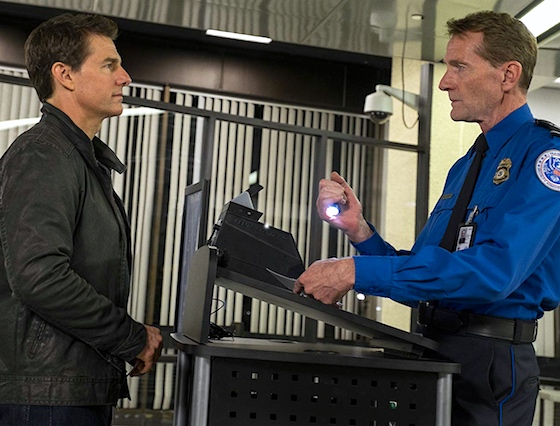
    For those unfamiliar with the character, Jack Reacher (Tom Cruise) is a former military police officer turned drifter — why he quit and why he hasn’t settled down like a normal person is probably explained somewhere, but I can’t remember. Naturally, as he drifts around the US he keeps finding himself involved in escapades — there wouldn’t be stories worth telling otherwise, would there? In this one, one of Reacher’s friends, Major Susan Turner (Cobie Smulders), is arrested for espionage. Reacher is certain she’s being framed, and his investigations lead to him being set up too. As the pair go on the run to uncover a conspiracy and clear their names, there’s the added complication of having to protect teenager Samantha Dutton (Danika Yarosh), who may be Reacher’s daughter.

    What plays out is a solid plot, smattered with decent action sequences. Frankly, it’s nothing incredible, and you’d have reason to expect more distinctive work from a director of the calibre of Edward Zwick (helmer of well-regarded films like Glory, The Last Samurai, and Blood Diamond), but it’s still a good action-thriller.

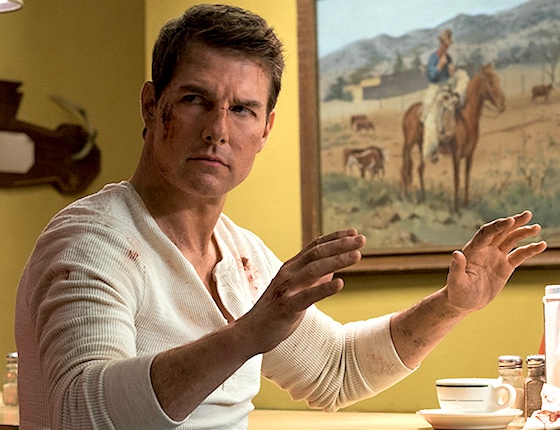
    Cruise in for a bruisin'

    In the title role, Cruise is good. It’s different to his usual routine — the familiar grinning charm is dialled way down, in order to facilitate Reacher’s trademark stoicism — but he’s got a charismatic enough presence that he remains an engaging lead even without it. Smulders and Yarosh also acquit themselves well. Together, the trio make for a neat de facto family. Once they’ve been brought together, the way they move through the narrative as a unit gives the film a different vibe from the “lone hero” thing you’d expect. Unfortunately, the bad guys are as bland as anything. It lacks even one really good villain, which is an especially noticeable problem after the first film had Werner bleedin’ Herzog to chew up the scenery.

    The title Never Go Back became a truism for some observers, because the film was not a success, either with critics (38% on Rotten Tomatoes) or at the box office (just $58.7 million in the US, though it drummed up a solid $162 million worldwide). Part of that is Reacher fans’ enduring dislike for Cruise’s casting. When they were bemoaning it before the first film’s release, I thought it was probably a storm in a teacup; that they’d get used to him over time. I mean, their sole objection seemed to be that he was too short, and how important was that, really? Incredibly important, apparently, because six years and two films later they still really, really hate him in the role. (Personally, I think him being a bit of a short-arse suits the characterisation better. Reacher seems to be a guy who gets underestimated; you don’t underestimate someone who walks in with the bulk of, say, Arnie. But then I’ve never read the books, so I may be wrong about this somehow.)

    A woman's place is in the kitchen

    Fans are one thing, but what put wider audiences off? Maybe it was just the poor reviews. Producer Christopher McQuarrie (who directed the first one, but was too busy on Mission: Impossible to return for the sequel) thinks one problem was they adapted the wrong book. I believe I saw him talk about this on Twitter, which means his comments can’t be referenced (because his tweets self-destruct), but if I remember correctly he didn’t say it was a bad novel, just that it didn’t work when placed as the second in the series. He speculated that more films were needed to establish Reacher’s character and world before they told this particular story. I tend to agree. For one thing, the film has to resort to an early montage to show Reacher and Turner’s friendship growing, which could’ve been more naturally handled by spreading it over a film or two. I think the possibility of Reacher having a kid would also carry greater weight if we were more familiar with the character from multiple adventures.

    Well, it’s all academic now, given the film series is most likely over: just this week, creator Lee Child announced he intends to take the rights to TV, primarily to cast a more faithful actor after those continuing complaints about Cruise. It’ll be interesting to see if it really does make a difference having a taller actor in the role. Somehow, I suspect not. Child also said he’s aiming for the mooted series to adapt one book per 10-12 episode season. Considering he’s written 22 books already, I wonder if he believes they’ll ever get through them all…

    “Sorry son, you just don't measure up.”

    Hopefully whatever they do works, because I’ve enjoyed these Reacher films so far. Never Go Back may not be all it could be, but it’s not so poor as to merit abandoning the film series entirely — it’s above average rather than exceptional (my score errs on the harsh side, in part to differentiate it from the superior first movie). It’d be a shame to see the films tossed aside for something lesser.

    3 out of 5

    The UK TV premiere of Jack Reacher: Never Go Back is on Channel 4 tonight at 9pm. It’s also available on Netflix UK as of yesterday.

    The Hunt for Red October (1990)

    The 100 Films Guide to…

    The Hunt for Red October

    The hunt is on.

    Country: USA
    Language: English & Russian
    Runtime: 135 minutes
    BBFC: PG
    MPAA: PG

    Original Release: 2nd March 1990 (USA)
    UK Release: 20th April 1990
    Budget: $30 million
    Worldwide Gross: $200.5 million

    Stars
    Sean Connery (Goldfinger, The Rock)
    Alec Baldwin (Beetlejuice, The Shadow)
    Scott Glenn (The Right Stuff, The Bourne Ultimatum)
    Sam Neill (Omen III: The Final Conflict, Jurassic Park)
    James Earl Jones (Star Wars, The Lion King)

    Director
    John McTiernan (Die Hard, The Thomas Crown Affair)

    Screenwriters
    Larry Ferguson (Highlander, Alien³)
    Donald Stewart (Missing, Patriot Games)

    Based on
    The Hunt for Red October, a novel by Tom Clancy, the first to star Jack Ryan.


    The Story
    After the USSR launches a new type of submarine with an almost undetectable engine, its veteran captain, Marko Ramius, ignores his orders and heads for the US. As the Russians hunt for him and the Americans try to intercept him, one question is on both sides’ minds: is Ramius intending to defect or start a war?

    Our Hero
    CIA analyst Jack Ryan is something of an expert on Ramius, and the main voice insisting the Russian intends to defect. With just days to prove his theory, the normally desk-bound Ryan must venture out into the field — the “field” in this case being the stormy waters of the Atlantic Ocean.

    Our Villain
    Submarine captain Marko Ramius, a hero in the USSR who trained most of their fleet, has been entrusted with their latest top-secret vessel, the Red October… but what is he intending to do with it? If Ryan’s right, he’s not such a villain after all.

    Best Supporting Character
    Commander Bart Mancuso is the captain of the US submarine USS Dallas, the first to encounter the Red October and, thanks to its genius sonar technician, the only one able to track it. Scott Glenn’s performance was based on a real sub captain the cast spent time with, Thomas B. Fargo, whose friendly but authoritative manner and relationship with his crew inspired Glenn.

    Memorable Quote
    “‘Ryan, some things in here don’t react well to bullets.’ Yeah, like me. I don’t react well to bullets.” — Jack Ryan

    Memorable Scene
    As the Red October navigates an underwater pass only traversable thanks to detailed maps and precise timings, the silent engine fails, forcing them to engage the regular motors — which attracts the attention of the Soviets hunting them. With a torpedo on their trail, Ramius takes the precarious navigation into his own hands…

    Technical Wizardry
    With much of the action taking place in the cramped confines of various submarines (the Red October, the USS Dallas, and another Soviet sub, the V.K. Konovalov), cinematographer Jan de Bont realised they would need a way for viewers to quickly determine which submarine they were on, especially when cutting between action on multiple vessels. He decide to subtly vary the colour of the lighting on each sub — blue for Red October, red for the Dallas, and green for the Konovalov — so that they would be distinguishable without belabouring the point. It works: while watching the film, it’s never confusing which sub we’re supposed to be on.

    Truly Special Effect
    Apparently director John McTiernan wanted to realise the underwater action with CGI, until ILM pointed out it was nowhere near that advanced yet. Instead, most of the underwater shots are models — and not shot underwater, but in a smoke-filled warehouse. They look fantastic, with small CG additions (like plankton or the wake of propellers) helping to sell the visuals. On the downside, some of the pre-digital compositing is now really showing its age — Alec Baldwin’s hair is see-through in the final shot!

    Next time…
    With the film a huge success, naturally more Jack Ryan adaptations followed. Technically the first two, Patriot Games and Clear and Present Danger, are sequels to Red October, but with Alec Baldwin busy the lead role was recast with Harrison Ford, so it feels more like the series starts over. For no apparent reason a fourth film in the series didn’t materialise, and so the series genuinely started over a decade later, with Ben Affleck playing a younger Ryan in The Sum of All Fears. That wasn’t a success, leading them to try again another decade later, with Chris Pine playing an even fresher Ryan in Jack Ryan: Shadow Recruit. That wasn’t a success either, which has led them down the path of adapting the character for television, with John Krasinski playing another young Ryan in Amazon’s Jack Ryan.

    Awards
    1 Oscar (Sound Effects Editing)
    2 Oscar nominations (Sound, Editing)
    3 BAFTA nominations (Actor (Sean Connery), Production Design, Sound)

    Verdict

    Everything ages: Tom Clancy’s debut novel was credited with helping start the techno-thriller genre in the ’80s, which I guess made this film adaptation cutting-edge when it followed shortly afterwards. Now, it’s the best part of 30 years old and, even if it’s not exactly looking dated, it certainly doesn’t look current — they don’t make big-budget spy thrillers like this anymore. But maybe they should, because Red October’s qualities stand the test of time: its story is driven by well-drawn, interesting characters (the committed everyman hero; the moral enemy submarine commander; and so on) and an overall sense of suspense (who will find the sub first? And how soon? And what will they do then?), rather than elaborate stunts or computer-generated effects. I like the latter too, but there’s room for variety in the cinematic landscape. Well, at least we’ll always have minor classics like this to watch again and again.

    The latest screen iteration of Tom Clancy’s hero can be seen in the TV series Jack Ryan, available to stream on Amazon Prime from today.

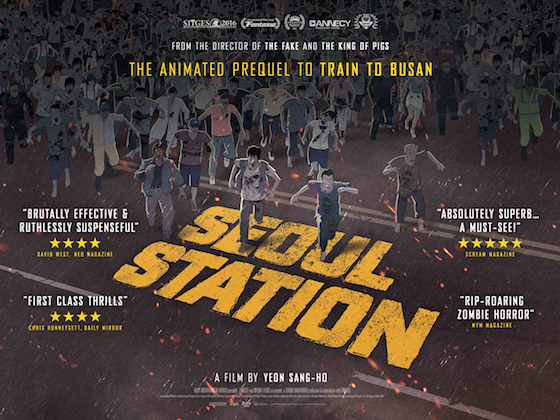
    Seoul Station (2016)

    aka Seoulyeok

    2018 #184
    Yeon Sang-ho | 92 mins | streaming (HD) | 1.85:1 | South Korea / Korean | 15

    Seoul Station

    Before he made zombie masterpiece Train to Busan, director Yeon Sang-ho was an animation director with several features to his name. So perhaps it’s not surprising that, to accompany his aforementioned live-action debut, he also helmed this animated prequel.

    Apparently set one day before the events of Busan (there’s no obvious indication on screen of how the films’ timelines line up), Seoul Station depicts events as the zombie outbreak expands at the titular transportation hub. Through this we follow Hye-sun (Shim Eun-kyung), a young runaway struggling to make ends meet living with her good-for-nothing boyfriend, Ki-woong (Lee Joon). Hye-sun’s father, Suk-gyu (Ryu Seung-ryong), has finally tracked her down, but arrives just after his daughter and Ki-woong have an argument and she runs off — and then the zombie thing happens. As Hye-sun struggles to escape the undead hordes, Ki-woong and Suk-gyu team up to search for her.

    Like Train to Busan, then, Seoul Station revolves around a struggling father-daughter relationship — though this one’s of a very different sort. That’s apparent from the off, but to say too much more would be a last-act spoiler. Suffice to say, it all comes to a very dark, grim ending, with none of the redemption or hopefulness of the main film. It also continues the live-actioner’s theme of other humans being the real villains, with the actions of selfish cowards being as much a threat to survival as the flesh-eating monsters. It feels like Yeon is being critical of Korean culture, taking potshots at the treatment of the homeless, the uselessness of the police, and more. Most of that stuff plays universally, mind, but the film hardly connects with it in a meaningful way. For example, we see one homeless guy struggle to get help for his injured and dying brother, as person after person either refuses help or begrudgingly does the least they can. “They should do more,” the film implies. But if they had, what would change? In this scenario, nothing — the guy’s been infected by zombie-disease; they’d all wind up undead too and it would spread faster.

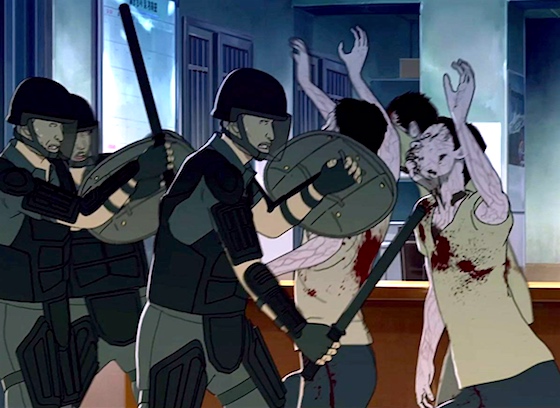
    Police brutality

    Half-assed social commentary aside, there are some really neat, original ideas in here, like a scene where Hye-sun must hold her nerve as she precariously tightrope-walks across the empty shell of a building, while behind her the mindless zombies throw themselves off the building onto the structure, their lack of dexterity leading most of them to plummet straight through it… but not all of them. Plus, as alluded above, there’s at least one solid twist. On the down side, it’s a bit slow — it takes 20 minutes for the zombie outbreak to start, for no particularly good reason; and though it mostly picks up after that, it occasionally loses focus again. The animation is of variable quality, too: some of it is very good, but at other times it feels kind of floaty, and there’s a very bizarre motion-blur effect applied to character movement.

    Unlike Train to Busan, Seoul Station can’t quite coalesce its good ideas into anything more meaningful than a zombie thriller. Plus, the ultimate grimness of the finale feels almost mean-spirited and cruel rather than pointed. It’s not a bad zombie flick by any means, but there’s an even better movie waiting to be refined out of its best ideas, and so it’s not as transcendentally great as its live-action forebear.

    3 out of 5

    The UK TV premiere of Seoul Station is on Film4 tonight at 11:15pm.

    Kidnapped (1917)

    2018 #159
    Alan Crosland | 64 mins | DVD | 4:3 | USA / silent (English)

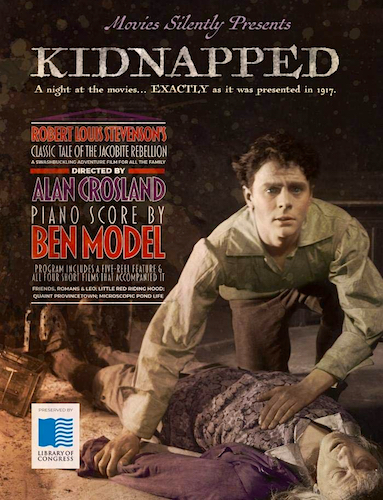
    Kidnapped DVD

    The first screen adaptation of Robert Louis Stevenson’s famous adventure yarn, the 1917 film of Kidnapped was believed by some to be lost. It was nothing of the sort, having been held in the Library of Congress’ collection since the ’40s. That’s not readily available to most of us, of course, but thankfully there are individuals like Movies Silently’s Fritzi Kramer who have the dedication to not only unearth these things, but to then spend the time and effort required to put together a DVD release. Such enterprises aren’t achieved through hard work alone, however, hence a Kickstarter campaign that was thankfully successful. And for those who missed out on that, the finished DVD is now available to purchase from Amazon.com. (For the benefit of UK readers, the cost of importing it currently comes to £26.12, though if you’re lucky it might slip through customs unnoticed and Amazon will one day reimburse you £4.35. Or you could wait for the exchange rate to improve, but, given Brexit, hahaha, good luck with that.)

    Anyway, what of the film itself? Running just over an hour, it’s a brisk dash through Stevenson’s story. I’ll cop to not being familiar with the original tale, but apparently this version sacrifices no more than an average adaptation, despite that comparatively speedy running time. For the benefit of those as unacquainted with the text as I: it’s the story of David Balfour (Ray McKee), a young man who should inherit the Scottish castle inhabited by his uncle Ebenezer (Joseph Burke), but the latter has no intention of giving it up, instead arranging for David to be kidnapped (hence the title) and carted off to The Colonies.

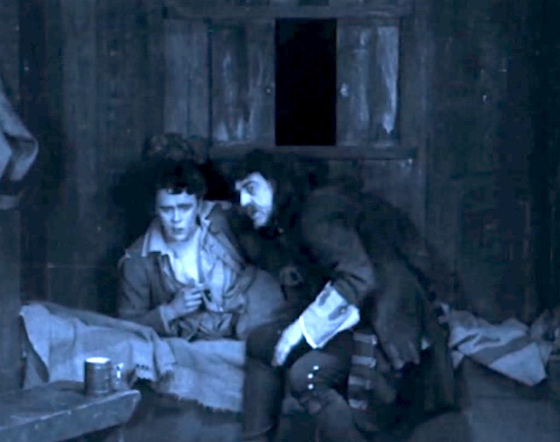
    “Yep, kid — you've been napped!”

    Chance sees David moved up from being cargo to serving as the ship’s cabin boy (what to do when the cabin boy brings you a dirty cup? Accidentally murder him, then in his place promote the young lord you’ve kidnapped to sell as a slave, of course), which allows him to run into adventurer Alan Breck (Robert Cain), who’s found his way aboard the same vessel (Breck’s introduction: “I’m vexed, sir. Ye’ve sunk my boat, and drowned my man. Be so kind as to land me at once!”) The ship’s dastardly crew plot to off Breck, but he and David team up, escape, and embark on a journey to reclaim the young Balfour’s inheritance. Along the way there’s swashing of buckles and encountering of real-life historical events, albeit bent slightly to suit the plot, and bent again to suit the moral mores of the film adaptation, which was advertised as being “for all the family” and “guaranteed censor proof!”

    While some bits may look silly with today’s eyes (or maybe they did at the time too, I don’t know — did a sailor dying instantly from being shot in the arm ever play well?), there’s plenty of adventurous fun to be had, and the production values are good. Mostly. I mean, at one point our heroes are taken to meet a Highland chieftain who lives in a cave with a window and dresses like a lumberjack in a skirt, but what’re you gonna do? Caves-with-windows aside, most of the sets aren’t half bad, and the location work is really good — it must’ve been shot somewhere in the US, but with bare trees, snow, and a genuine castle, it looks Scottish enough. While the action sequences obviously aren’t going to challenge a modern blockbuster for their creative choreography, there’s some effective swashbuckling when David and Breck escape the ship, and a decent chase through the snow thereafter. Cain definitely looks the party of a dandyish adventurer, and acquits himself well where it counts too — by which I mean, he seems pretty handy with a sword.

    Swashes being buckled

    Kidnapped may not be an unheralded classic begging for rediscovery, but it’s a fun jaunt nonetheless. Proof, if it were needed, that there’s often worth to be discovered by digging into the more forgotten and esoteric corners of film history.

    4 out of 5

    Kidnapped was the feature presentation of Conquest Program No.9, which you can read more about here. It is now available on DVD from Amazon.com.

    Conquest Program No.9

    2018 #158a-d
    30 mins | DVD | 4:3 | USA / silent (English)

    Conquest Program No.9 advertisement

    We all know the cinema experience of today: 20 minutes of TV adverts that we’d fast-forward at home but have no say in on the big screen, followed by 10 minutes of movie trailers that we’ve already watched on YouTube, and, finally, the film we’ve paid to see. But back in the day the theatrical programme was less unedifying, with short films of various stripes preceding the headline film (hence the term “feature film”, obv.)

    For her DVD release of the 1917 feature Kidnapped (more about that in my review here), Fritzi Kramer of Movies Silently was able to source the four short films that were bundled with it as part of “Conquest Program No.9”. The Conquest Programs were the idea of distributor George Kleine and created by Thomas Edison’s film company. Eleven were created in all, each one bundling together a feature film and a mix of shorts to create a complete bill of wholesome entertainment. By specifically recreating Program No.9, the Kidnapped DVD doesn’t just offer an approximation of what a night at the movies in 1917 might’ve been a bit like, but rather a genuine was-definitely-shown-in-theatres programme from the time.

    Friends, Romans and Leo

    The programme opens with a twelve-minute comedy short, Friends, Romans and Leo, directed by Alan Crosland, who also helmed Kidnapped, and featuring several of the feature’s leading players too. It’s a bit of Roman farcing about, concerning an “emperor” who’s so in debt he lets the moneylender marry his daughter rather than call in the mortgage on his garage. I’m sure that’s exactly how Roman politics worked. Then, an unwanted and useless servant is cast into the gladiatorial ring to face the hulking Brutal Brutus, and also Leo, a man in a lion costume… er, I mean: Leo, a lion. This bit, at least, has some amusing pratfalling. It’s not big (it’s a short film, after all), it’s not clever (characters speak in a mix of Olde Worlde English (“thou hast been good to me”) and modern slang (“that’s a twenty-karat rock, girlie!”)), and it’s not particularly amusing to today’s eyes either, although the second half is at least diverting enough. Certainly, a grown man titting about in a lion suit has its own kind of charm.

    Up next is a seven-minute “fairy tale in silhouette”, Little Red Riding Hood. I’d assumed it was going to be some kind of puppet animation job, but no, it’s live-action shot in silhouette, presumably for a kind of stylistic, picture-book-ish look. This means we’re treated to another man in an animal costume — the wolf, of course — but this outfit is less good than Leo’s, something even the silhouetted visuals can’t hide. The short rattles through the traditional story with no significant variations, which feels a little quaint viewed from the vantage point of over a century later. That said, it does include this immortal line: “It must be grandmama for it is her cap, but how very strange this bad cold makes her look!” Because people can always be identified by their caps, and colds make you look like a wolf.

    Little Red Riding Hood

    Talking of quaint, that clearly wasn’t a concept alien to 1917 audiences, as the third short implies. Titled Quaint Provincetown, it’s a seven-minute travelogue about a quiet little seaside town and its almost throwback way of life (even for 1917!) A series of lifestyle scenes rather than a narrative documentary, it’s a fascinating window into the past, which arguably makes it the most interesting of these films for the modern viewer. That said, how much of it was captured actuality and how much was staged, who knows — for example, at one point we watch a couple of boys have a fight in the street while their friends egg them on, which you feel the filmmakers can’t’ve just happened upon. Still, kids, eh? I guess some things never change.

    Finally, Microscopic Pond Life is a four-minute look at… well, what it says on the tin. This is, broadly speaking, stuff we’re nowadays familiar with from a young age thanks to science lessons and whatnot, but I imagine it must’ve been quite incredible to see these minuscule organisms in action for the first time. You’re not going to learn a lot of detailed scientific information from a 100-year-old short like this, but it remains a fascinating glimpse of the tiniest of lifeforms.

    Microscopic Pond Life

    Viewed today, this selection of short films is, at worst, an insight into a time long gone — one of the nearest experiences we’re likely to get to time travel. At best, the films themselves retain some inherent interest and entertainment value. As Fritzi puts it in her booklet accompanying the DVD, “the ninth Conquest program is not filled with hidden masterpieces, just good solid programmers that would have entertained the average American audience in 1917.” Very true, and fair enough.

    3 out of 5

    Read my review of Conquest Program No.9’s feature film, Kidnapped, here.
    The DVD is now available to purchase from Amazon.com.

    Christopher Robin (2018)

    2018 #180
    Marc Forster | 104 mins | cinema | 2.39:1 | USA / English | PG / PG

    Christopher Robin

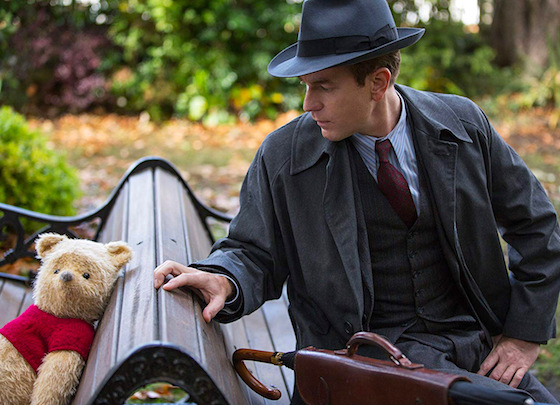
    Disney appear to have found a rich seam to mine for box office gold when it comes to live-action remakes of their most popular animated properties. Some have been variations different enough to almost stand on their own two feet; others have been straight-up remakes, because why mess with success. Christopher Robin is, perhaps, the most original so far. There have been many Winnie the Pooh adaptations down the years, as well as original movies and TV series featuring the same characters, so rather than remake any of those, here Disney have set about telling another brand-new story (although it begins with an adaptation of one of A.A. Milne’s very best Pooh stories, which is nice). This new tale justifies its live-action form by moving beyond the confines of the Hundred Acre Wood; and it also, smartly, trades on our own childhood nostalgia for the silly old bear.

    We all remember Christopher Robin as a small boy, but small boys grow up, and now Christopher (Ewan McGregor) is an adult in post-war London with a wife (Hayley Atwell) and young daughter, Madeline (Bronte Carmichael). He works for a luggage company that is facing the prospect of firing most of Christopher’s team, unless he can find 20% of cuts; so instead of going away with his family for a nice weekend in the country, he must stay and work — again. With both his personal and professional lives on the brink of collapse, Christopher is very stressed.

    Pooh in the park

    Meanwhile, in his childhood playground of the Hundred Acre Wood, Winnie the Pooh (a convincingly cuddly CGI creation, given voice by Pooh’s regular performer, Jim Cummings) awakens one morning to find all his friends are missing. Deeply concerned, he wanders through the door through which Christopher Robin used to appear, and finds himself in London, where who should he bump into but his old childhood friend — now all grown up and serious. But Pooh is still a childlike innocent, of course (don’t worry, they haven’t given him a Ted-style makeover), and maybe that attitude is just what Christopher needs.

    Having said they haven’t made Pooh into Ted (thank goodness — I like Ted, but that really isn’t the spirit of this franchise), there’s more than a little whiff of Paddington here. It’s not the exact same plot, but the overall theme — of a naïve but good-hearted bear arriving to help humans overcome their problems with kindness — is certainly similar. Indeed, many beats of the story that unfolds are familiar — the climax is somewhat borrowed from Mary Poppins, for example; and you’ll know how every subplot will end as soon as it’s introduced. For some viewers, this will render the film pointless and clichéd. For others… well, it’s not really the point.

    The joy of Christopher Robin is it takes those recycled elements and filters them through the prism of Pooh. If you too loved Pooh as a child, or an adult, then Christopher’s journey to rediscover that connection is relatable and supportable. And it’s simply a delight to spend time with the characters, as Pooh casually (and accidentally) dispenses heartfelt wisdom that both delights and, occasionally, may even cause you to think.

    Tigger on the loose

    The other denizens of the Hundred Acre Wood do pop up too: miserable old Eeyore (Brad Garrett) stole the show for the audience I watched with; Tigger (also Cummings, after test audiences objected to Chris O’Dowd’s English-accented take on the character!) is as exuberant as ever; and Piglet (Nick Mohammed) remains the voice of caution and cowardice, and as sweet as ever. As “the main ones”, those four get the most to do in the story, but there are also appearances from Rabbit (Peter Capaldi), Owl (Toby Jones), Kanga (Sophie Okonedo), and Roo (Sara Sheen) to complete the set; and with actors that good providing the voices, they make their mark.

    But, really, this is all about Pooh. Well, Pooh and Christopher Robin — the title’s not inaccurate. For those who don’t feel a connection to the bear of very little brain, I guess the familiarity of the narrative he’s part of in this film will drag down enjoyment — this, I presume, is why the reviews have been somewhat mixed. But, in my opinion, a little Pooh goes a long way — as Christopher says, he may be a bear of very little brain, but he’s also a bear of very big heart. The combination makes for a film that is amusing, sweet, and thoroughly delightful.

    4 out of 5

    Christopher Robin is in UK cinemas now.

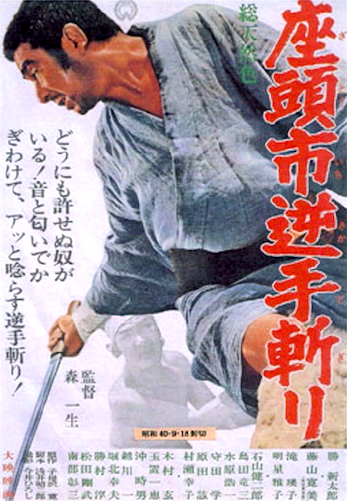
    Zatoichi and the Doomed Man (1965)

    aka Zatôichi sakate-giri

    2018 #157
    Kazuo Mori | 78 mins | Blu-ray | 2.35:1 | Japan / Japanese

    Zatoichi and the Doomed Man

    The eleventh film in the Zatoichi series is perhaps the first one that could legitimately be described as bad. It’s not outright terrible, but the plot doesn’t hold together very well, and there are only a couple of redeeming scenes.

    The first of these is at the very start, when the film opens on the striking image of Ichi receiving lashes as punishment for an initially-unspecified crime. They seem almost a minor inconvenience to our hero, however, who is more concerned with questions he has for his punisher about this cellmate of the previous night. It turns out he was the eponymous “doomed man”: a fellow who’s been incarcerated on a murder charge, but claims he’s innocent, and urges Ichi to track down the gang bosses who can vouch for him. Uncharacteristically, Ichi resolves not to help, but fate has other plans…

    That reliance on fate to marshal Ichi around led me to dub this Zatoichi and the Coincidental Coincidences of Coincidence. He’s constantly stumbling back onto the film’s plot even when he tries to avoid it, or bumping into the people he needs to find, or bumping into people who happen to be connected to other people he happens to know. It’s easily the most poorly-constructed story of the series so far. That’s not limited to its dependence on coincidence, either: half the stuff it sets up doesn’t even pay off or come together in a reasonable fashion. Although the initial “wrong man” setup is enticing, rather than do anything interesting or different with that, it just turns out to be the series’ usual: some bosses have betrayed the chap as part of a scheme to control the area. And to rub salt in the wound, we learn about this in a scene where one conspirator explains what they’ve already done to his co-conspirator. Oh dear.

    Shenanigans

    It’s a very slight story — not even enough to sustain the brief sub-80-minute running time, it would seem, as we’re ‘treated’ to an array of unrelated shenanigans. The primary one is a young man who starts following Ichi around, then later impersonates the famed blind masseur for financial gain — and, supposedly, for comic effect. He’s played by Kanbi Fujiyama, who (according to Chris D. in his notes accompanying Criterion’s release) “was a noted funnyman in mid-to-late-sixties Japan, appearing in sidekick roles in many of Toei studios’ ninkyo (chivalrous) yakuza films.” Reading other reviews, a lot of people seem to find his schtick hilarious, but I thought he was the most irritating comic relief character the series has yet foisted upon us — and he’s basically the co-lead of this instalment, so we get to see far too much of him. He eventually turns out to have a connection to the main plot too, which is emblematic of the whole movie: the connection is a complete coincidence, dumped on us via random exposition late in the game, and then not paid off in any way. It’s entirely pointless. At one point he disappears from the film entirely. Due to how it was handled, I began to wonder if we were meant to infer he’d died off screen. But then he turns up again in the epilogue, as it merely to confirm that wasn’t the case.

    That stands in opposition to the film’s main plot — you know, the titular one about the “doomed man” — which is resolved offscreen while Ichi’s already going on his merry way. It’s just one aspect that feels rushed (despite the short running time and ‘comedy’ distractions), or as if scenes were deleted. This is particularly noticeable as it pertains to the female interest, Oyone (Eiko Taki). Ichi rescues her thanks to a little trick she pulls, but then she seems ungratefully indifferent to him… until she’s suddenly hanging around near the end, hoping (as the women in these films always do) that he won’t run off while her back’s turned. Which is exactly what he does, of course.

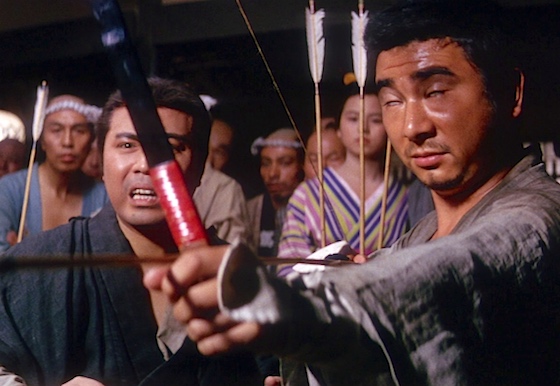
    Zatoichi with the doomed man

    You may remember I said there were some good bits. One is the pre-titles, which I already partly discussed. They’re effective thanks to some strong photography from Hiroshi Imai and the way they flip around with our expectations to create mystery (even if the reason Ichi’s receiving those lashings is completely irrelevant to the rest of the film). The other is the finale. As usual, the movie climaxes with Ichi having to take on an army of goons single-handed, but this one adds some spice with a seaside location, strewn with fishing nets (which get brought into the action) and covered with an early morning sea mist. It’s also beautifully shot, and there’s nicely choreographed combat. It’s easily the highlight of the film.

    Other reviewers are not so harsh on The Doomed Man, going so far as to call it a “fine entry” in the series, or “thoughtful [and] hilarious”. And yet, those reviews can’t seem to help spotting the flaws in spite of themselves. Walter Biggins’ review at Quiet Bubble is a series of questions about why the film is so poor, with the last query being the most baffling of all: “why, despite all this opacity all my questions, did I end up liking this movie so much?” I’ve no idea, mate. Several other reviews make comments along the lines of, “Ichi behaves uncharacteristically here, but there must be a good reason for that” — or it’s just crappy, inconsistent writing. At least Letterboxd users agree with me: it’s ranked 24th out of the main series’ 25 films (the only one lower is the 23rd film, Zatoichi at Large — which, incidentally, is by the same director).

    “Here's the end of the plot — go give it to someone and get this over with!”

    For me, The Doomed Man is by a clear margin the weakest Zatoichi film so far. As nowadays I very much look forward to my regular appointments with Ichi, being so underwhelmed left me feeling disappointed: it wasn’t worth the wait since the last film, nor was it really enough to tide me over until the next one. For those reasons I considered giving it a lowly two stars, but that felt a bit harsh: it certainly isn’t without merit (the climactic fight is a stunner), and it’s always nice to spend time in Ichi’s company, even if he is being inconsistently written. Nonetheless, it only earns that third star by the skin of its teeth. This is a “for completists only” instalment.

    3 out of 5

    Train to Busan (2016)

    aka Busanhaeng

    2017 #140
    Yeon Sang-ho | 118 mins | streaming (HD) | 1.85:1 | South Korea / Korean | 15

    Train to Busan

    Zombie movies have really risen to prominence this decade, for whatever reason (the success of The Walking Dead is an obvious culprit, though it would seem to have begun slightly before that, with Zombieland coming out in 2009, for example). You’d think that would result in the subgenre feeling played out, and there are certainly plenty of lesser efforts churned out, but films like the exceptional Train to Busan show there’s still quality to be found.

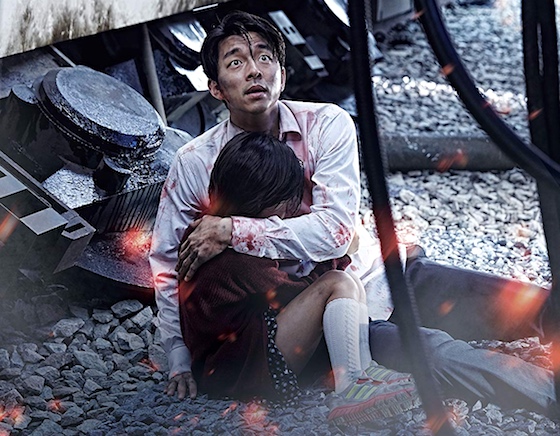
    The film centres on Seok-woo (Gong Yoo), a fund manager living in Seoul with his young daughter, Soo-an (Kim Su-an). Seok-woo’s work-focused attitude has left his relationship with his daughter strained and distant, so he acquiesces when she requests to visit her mother in Busan. As they board the train — alongside other passengers that represent a cross-section of society, natch — a zombie apocalypse breaks out. Initially safe in their carriage, the passengers must hope they can make it to safety.

    The family that fights zombies together...

    As you might expect, the mismatched group of passengers fall prey as much to their own infighting and prejudices as they do to the zombie hordes, and the situation works wonders for the father-daughter relationship of the lead characters. Despite that apparent predictability, co-writer/director Sang-ho Yeon and his cast earn our sympathies and create an attachment to these characters, such that we’re along for the journey with them. Whether or not you guess the letter of the plot is beside the point if you feel it along with the characters — when you’re on edge to see if they can make it, upset by their failures, and cheered by their victories. This also contributes to some effective suspense sequences, and the film is also peppered with intense, pulse-racing action scenes that have been impressively mounted. World War Z may’ve seemed to corner the market for “zombie movie as action epic”, but there are sequences here that give it a run for its money.

    Train to Busan shunts aside any tiredness you may feel about zombie flicks to demonstrate that, however overdone a genre may seem, there’s almost always room for fresh voices and creativity to produce remarkable work.

    5 out of 5

    Train to Busan placed 14th on my list of The 17 Best Films I Saw For the First Time in 2017, which can be read in full here.

    And that completes the reviews of my 2017 viewing (at last!)