Quentin Tarantino’s Swinging Sixties Movie Marathon Review Roundup

To promote his new movie, Once Upon a Time in Hollywood, writer-director Quentin Tarantino has curated a selection of movies from the Columbia vault (because Columbia is owned by Sony, and Sony are releasing OUaTiH) that are in various ways connected to said new movie. Some are influences on its style; some are the kinds of movies that the film’s characters would’ve appeared in; some speak to the societal concerns of the era. Along with film writer Kim Morgan, QT has hosted a “movie marathon” of his ten picks on TV, broadcast in the run-up to OUaTiH’s release in various territories (it’s on Sony-owned channels in 60 countries, and has been sold to other broadcasters in 20 more — “check local listings for details” and all that).

It’s been on this past week in the UK, airing nightly at 11:30pm on Sony Movie Channel, finishing with a double-bill tonight. If you’ve missed it, Movies4Men are repeating the lot next week from 6:30pm. I’m away from home this weekend so will have to catch some of those repeats, but I did watch the films on earlier in the week, and here are some thoughts on the first two…

  • Model Shop (1969)
  • Getting Straight (1970)
  • (If you watched this series elsewhere and are thinking “but those weren’t the first two films,” you’re right: for no apparent reason they’ve juggled the order in the UK.)


    Model Shop
    (1969)

    2019 #106
    Jacques Demy | 97 mins | TV | 16:9 | USA & France / English
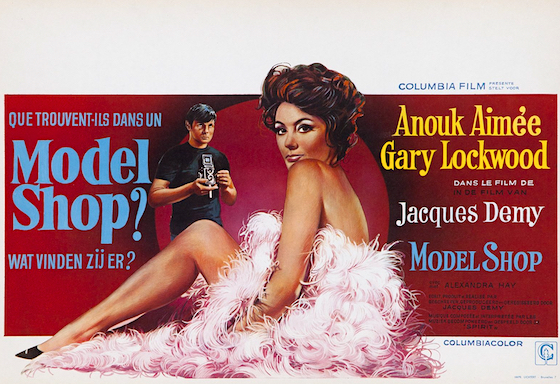
    Model Shop

    The English-language debut of French writer-director Jacques Demy, Model Shop shows us a day in the life of George (2001’s Gary Lockwood), a 26-year-old whose disillusionment is ruining his life. He’s quit his job at an architect’s because it was too low-level — he wants to design the big stuff, but isn’t interested in putting in the work to get to that tier. Consequently his girlfriend is getting fed up with him, he’s in debt, and his beloved car is about to be repossessed. George manages to talk the repo man into giving him until the end of the day to find the $100 he owes, and so he sets off on a drive around L.A. to find a friend to borrow it from. That’s when he spots a mysterious glamorous woman (Anouk Aimée) and begins to follow her.

    That perhaps makes the film sound more focused than it seems in viewing. There’s a definite European sensibility in play here — a laid-back, wandering feel, as George drifts around L.A. in his car, meeting up with different friends in different situations. The possibility of the draft hangs over their heads, informing their actions. As Morgan and Tarantino discuss in their introduction, some people might view the conversations and speeches in the film as being unnecessarily ‘heavy’, but it’s more than mere existentialism when there’s a genuine life-or-death experience just an unwanted call-up away.

    The atmosphere all that creates can make the film feel aimless, but, as Tarantino puts it, “the more you talk about Model Shop, the more you realise there is more to talk about.” Even while it feels like nothing is happening, stuff is happening. It’s the kind of film where we’re accumulating knowledge about the character and his world, and sometimes it’s only with hindsight we realise its signficance. At first it may not even seem like there’s much of a story — what could pass for the inciting incident (needing to acquire $100) is actually solved relatively quickly — but there is definitely a story, even if it’s a relatively small, somewhat undramatic one. This combination is I think why Tarantino describes the film as “deceptively simple and deceptively complicated.” I suppose it depends how much you want to see; how much you want to engage.
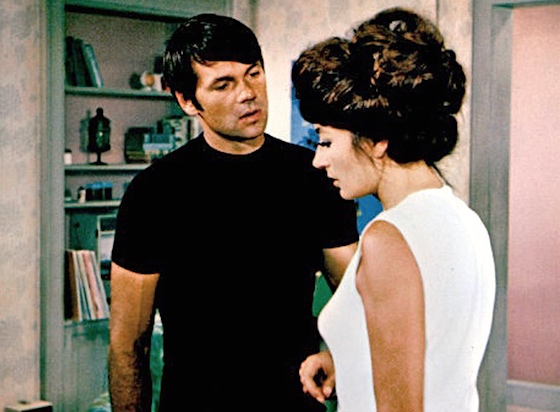
    “Open the pod bay doors, Lola.”

    Personally, I found George to be an immensely, almost painfully relatable character. The way he doesn’t quite know what he wants to do, just what he doesn’t; the way he doesn’t want to put in the long slog, just jump to the more interesting stuff at the end; the way he drifts and kills time rather than doing anything useful; and his big speech after he’s made to consider his own death “for the first time in [his] life”: he’s not a coward, but he doesn’t want to lose his life, because what’s better than life? Only, perhaps, art that reflects it. I’m not saying I am George, exactly, but boy, there were reflections.

    I was less engaged by Anouk Aimée’s character, Lola, who, once she’s properly introduced, takes over somewhat. Turns out she’s a character from Demy’s debut feature, Lola, making this a sort of sequel — only “sort of” because, while Model Shop does continue her story, she’s not at all the focus. Apparently a lot of Demy’s films feature crossover characters and connections in this way, which I guess was also an inspiration to Tarantino.

    I’d not heard of Model Shop before it cropped up in Tarantino’s selection, and it’s not been classified by the BBFC since its original release, so I presume it’s never had a video / DVD / etc release in the UK. While I would hardly say it’s some kind of ‘lost’ masterpiece, it does evoke a place and a time and the kind of lives that may’ve lived there — which is precisely why QT showed it to his Once Upon a Time crew, for the way it depicted L.A. in 1969 (he reckons it’s possibly the best movie ever for showing Los Angeles). Some of it is interesting, but at other times it retains that sense of aimlessness. It’s far from meritless, but I can also see why it’s the kind of film that’s been half forgotten.

    3 out of 5

    Getting Straight
    (1970)

    2019 #107
    Richard Rush | 120 mins | TV | 16:9 | USA / English | 15 / R
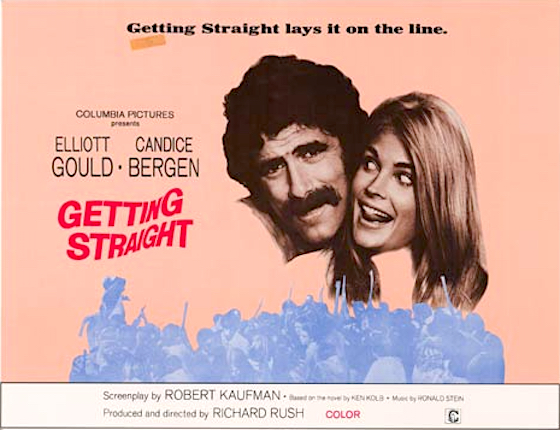
    Getting Straight

    According to Quentin Tarantino (I suppose I could try to independently verify this, but I haven’t), Getting Straight is one of four “campus radical” movies that were all released in 1970 (the other three are Zabriskie Point, R.P.M., and The Strawberry Statement). It stars Elliot Gould as Harry Bailey, a post-grad student at an unnamed Californian university, where he intends to qualify as a teacher, but where he’s also revered by the other students for his history of activism — even as he’s basically trying to join the establishment, they’re trying to lure him back to his old radical ways, beliefs he hasn’t left behind but doesn’t seem to wholly stand by anymore… or does he?

    So Harry is, on the surface, a potentially interesting main character: someone caught between the revolutionary youth and the establishment; who tells the youth why they’re dreaming and deluded, and tells the old men why they need to listen and buck up their ideas; but who is, therefore, conflicted about his own place in it all. But while putting someone in the middle might seem like a fair why to argue for both sides, it’s a bit obvious; allowing the film to have its cake and eat it, to an extent. And while it might seem objectively true that Harry is conflicted, evidenced by his flip-flopping from side to side, he seems pretty sure of himself for most of the film. There’s little done to explore his fence-sitting; to question his status as someone who proclaims to believe certain things yet seems to still find himself sat in the middle. Is he a hypocrite? If he is, I’m not sure the film bothers to interrogate that. So, if he isn’t, is that just because the film doesn’t want to show him as one? Perhaps we’re meant to buy that he’s the only sane person in a mad world, which seems a bit of a cliché.

    At the end Harry does ultimately pick one side, dramatically rejecting the establishment to go join rioting students. Why? He’s goaded into snapping by a professor’s smug, self-satisfied interpretation of The Great Gatsby, but if we’re meant to know why this bugs him so then I missed it. Does he reject the reading? Is it the tone of it, which is like being lectured down to? Maybe it’s just the straw that broke the camel’s back, but I didn’t really follow that as an arc. Earlier in the film Harry talks about finding a student riot sexy, a turn on, and then the movie ends with him and his girlfriend stripping off to shag literally in the middle of a riot, which does make you wonder if he was just thinking with his dick. I mean, he was for half of the rest of the film.
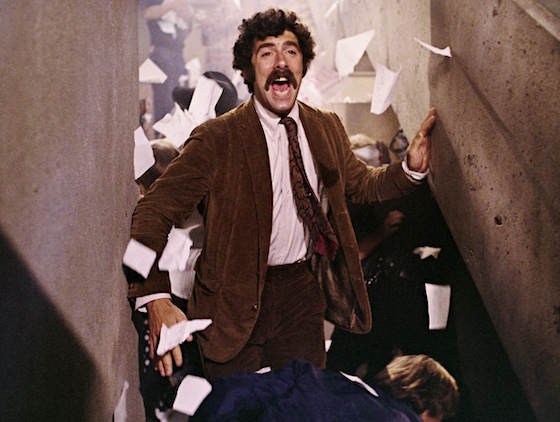
    Ranting and rioting

    With its focus on Harry, Getting Straight is something of a character study, and if this is anyone’s film it’s Gould’s. At times he gets a chance to expose different sides of this divided person, but he also certainly does a lot of shouting, lecturing, and ranting in the role. So maybe instead it’s about the times, with Harry basically a cipher to explore pertinent issues and different sides. It’s based on a 1967 novel, so was a relatively prompt adaptation, though to remain timely it would’ve had to be. Then again, Leonard Maltin’s movie guide apparently describes it as a “period piece”, and there’s a point there: the film is so much about that specific point in time that it couldn’t be set anytime else. Along with the slightly detached view of its main character, it doesn’t seem to be in or of the moment, like you might expect from a countercultural film made during the actual counterculture. It’s reflecting on it, like a period movie.

    Getting Straight is “one of [Quentin Tarantino’s] favourite movies ever,” or so he says, which unfortunately is a sentiment I can’t get on board with. I’m not even sure I can stretch to giving it a passing grade, because it was a bit too freewheeling and, by the end, in spite of the climactic ranting and rioting, kinda boring.

    2 out of 5

    Once Upon a Time in Hollywood is in UK cinemas from Wednesday, 14th August.
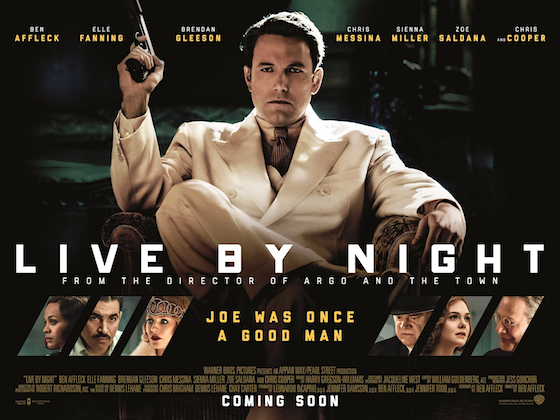
    Live by Night (2016)

    2018 #113
    Ben Affleck | 124 mins | streaming (HD) | 2.35:1 | USA / English | 15 / R

    Live by Night

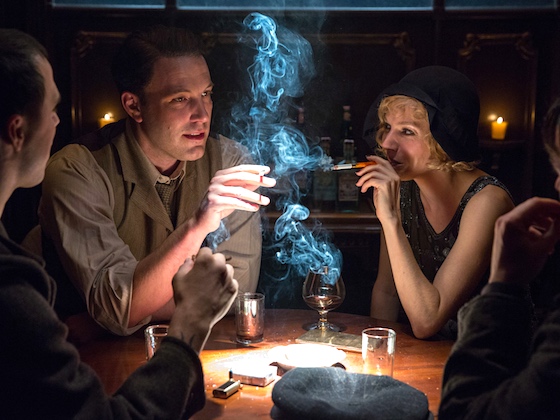
    Ben Affleck, once a bit of a laughing stock as an actor thanks to appearing in the likes of Pearl Harbor and Gigli, managed to reinvent himself somewhat as an acclaimed director, first with Gone Baby Gone and The Town, and then cementing that reputation by winning the Best Picture Oscar with Argo. This was what he chose as his next project — another adaptation of a Dennis Lehane novel (like Gone Baby Gone), another story of a Bostonian career criminal (like The Town), another period drama (like Argo… although a wholly different period, so maybe I’m stretching the comparison now). Rather, with its Prohibition-era setting, this was a gangster drama more likely to evoke classics such as The Godfather and Road to Perdition. There was, understandably, awards buzz. Then people saw it… and, it seems, just as quickly forgot it.

    I’ve mentioned a lot of other films in that opening paragraph, and you could make endless further gangster-movie comparisons, I think — and that’s a significant part of Live by Night’s problem. Almost everything about it reminds you of something you’ve seen before, often more than once. As a work in itself, it’s not remarkable enough to outshine the familiarities. Some of the plot is quite neat, with an emphasis on cause-and-effect that sees every solution turn into a new problem, and there are some very good individual scenes, though perhaps that’s easy when you’re working with quality actors Chris Cooper.

    Equally, some parts are underdeveloped. For example, Affleck gets into a relationship with Zoe Saldana that just seems like a vague sex-based aside, until he’s suddenly declaring that he’s put aside his plans for revenge, his primary motivation, because now everything is about his life with her. I need some more more joins between those dots, please. But at least it sometimes looks very pretty, though if you just want to see that then most of the visual splendour is in the trailer. There’s a surprisingly good car chase, though.

    They appear to be living, and it looks like it's nighttime. So that all checks out, then.

    Affleck is a decent director, and, actually, a quite like him as an actor too… in the right kind of roles. I’m not sure he’s got the range necessary for this part, however. His character is a conflicted, contradictory man — he genuinely has a good heart, but he’s often prepared to put it aside to do bad things; but, at other times, that moral compass gets the better of him. It’s a tricky line to tread and make believable, and Affleck’s performance is too monotone to convincingly portray it. That leaves the centre of the movie feeling empty, which is a problem however solid the stuff around him is. Apparently the film’s original cut was closer to three hours long and heavier on character stuff, so maybe the nuance disappeared in the editing — or maybe it didn’t. We’ll likely never know.

    Live by Night received an exceptionally negative response (just 35% on Rotten Tomatoes), but I can’t see why people hated it so much. It’s not fantastic, floundering somewhat in the shadow of the other gangster movies of which it’s so often reminiscent, but it’s not a bad attempt at the genre. Though, as a significant portion of the storyline takes place in “the sunshine state”, I’m not sure how good that title is. I mean, I live more of my life by night than these gangsters do. I just spend most of that time watching and writing about movies, though — maybe I should be launching a criminal empire?

    3 out of 5

    Zatoichi Meets the One-Armed Swordsman (1971)

    aka Shin Zatôichi: Yabure! Tôjinken

    2019 #99
    Kimiyoshi Yasuda | 95 mins | Blu-ray | 2.35:1 | Japan & Hong Kong / Japanese & Mandarin | 15

    Zatoichi Meets the One-Armed Swordsman

    Crossovers are an enduring device in comic books — what better way to boost sales (or, if we’re being less cynical, mix things up) than have a guest appearance by another popular character? And the past decade has seen Marvel Studios turn the same principle into a massive movie money-spinner. Of course, they’re far from the first to attempt an on-screen crossover — and what could sound more comic-book-y than a blind swordsman meeting a one-armed swordsman?

    This is the second such meet-up movie in the Zatoichi series. The first saw our hero face off against Akira Kurosawa’s Yojimbo… or someone with the same name played by the same actor, at any rate. That bait-and-switch was just one of many let-downs in what turned out to be the most disappointing film in the long-running series. With that in mind, perhaps it was foolhardy of me to look forward to this film. Certainly, it’s not the best-regarded Zatoichi adventure. But I really enjoyed the two original One-Armed Swordsman films (especially the first), so bringing that character into the beloved Zatoichi series had the potential to be a match made in martial arts heaven.

    After the prerequisite Bondian pre-titles scene that reminds us of Ichi’s skill with a sword, we’re introduced to Wang Kang (Jimmy Wang Yu), the eponymous one-armed swordsman from China, who’s travelling across Japan to meet an acquaintance at a monastery. Falling in with a family of Chinese performers, they come across a procession by a local lord, but the family’s young son gets in the way and is threatened with violence, so Wang Kang steps in to defend him. Offended, the samurai attack, killing all witnesses, including the boy’s parents. Wang Kang escapes and the slaughter is blamed on him, leading to a manhunt for the supposed fugitive. Ichi, wandering as always, encounters the boy and Wang Kang, and tries to help despite the language barrier.

    Creating a new one-armed swordsman

    An array of other characters come into the mix, as you’d expect from a Zatoichi film, including Oyone (Michie Terada) and her kindhearted parents, who take the fugitives in; Osen (Yūko Hama), a prostitute who falls for Ichi (don’t they all?); Kakuzen (Kōji Nanbara), Wang Kang’s friend at the monastery, who has plans of his own; and a trio of drunken gamblers who provide comic relief, including a risible fart gag. But that aside, the film has a dark, brooding tone. I mean, it starts with a massacre of innocents that’s blamed on the wrong man — hardly cheery — and that’s just the first of many tragic injustices visited upon these characters. And when the bad guys aren’t being menacing, Ichi is; like when he casually takes a guy’s ear off to get him to talk, or the moment when he closes in for the kill on the villainous boss, blowing the blindman’s whistle that said boss had earlier goaded him about… It’s triumphant, but also kinda chilling. Put yourself in the shoes of the men Ichi gets pitted against and you can see him as a kind of nigh-indestructible bogeyman.

    The tragedy extends as far as the ending, which is both frustrating and poignant. “If we’d understood each other’s words, we wouldn’t have had to fight,” says each of the men… except, er, they did have a way to understand each other, thanks to the bilingual boy. Have a sword fight first, ask questions later, I guess. But anyway, it’s frustrating because they didn’t need to fight (they were both good guys!), but it’s poignant because their basic natures, compounded by misunderstandings, meant they did fight — and because they fought, one of them had to die. It’s a damn good fight, mind; in fact, this is an excellent instalment for combat all round, thanks in part to there being another exceptional swordsman in town. The Chinese swordsman brings his own style, too, meaning there’s an array of stunts and tricks more familiar from Hong Kong action movies than Japanese ones. Indeed, Wang Kang is well served by the film all round. Sure, it’s still Zatoichi’s movie overall, but the guest star gets a couple of scenes to himself to show off, as well as his own honourable storyline.

    The real one-armed swordsman

    Nonetheless, rumours abound of an alternate cut, released in Chinese markets, that placed even more emphasis on Wang Kang. There doesn’t seem to be any firm evidence of its existence, but some people swear to have seen it, many years ago. Reports vary on just how different it is, ranging from merely the last 30 seconds being modified so that a different combatant wins the final duel, to there being additional Wang Kang fight sequences scattered throughout the movie. Considering this was a Japanese-Chinese co-production, it makes sense each market would prefer a version where their hero wins… although, of course, they could’ve come up with a storyline that saw the eponymous swordsman fight earlier, come to a draw, and then team up for the climax, seeing as they’re both heroes ‘n’ all. Ah well.

    The version we do get to see is as much a Zatoichi film as any other. It keeps in play many of the series’ familiar elements — not just exciting action scenes, but also emotional drama, a gambling scene with a difference, and humorous interludes that are actually moderately amusing — but adds some HK-style martial arts to the mix for a different flavour. The result may not be wholly perfect, but Zatoichi Meets the One-Armed Swordsman is a much better example of how to team-up two icons than the series’ previous attempt.

    4 out of 5

    FernGully: The Last Rainforest (1992)

    2018 #99
    Bill Kroyer | 73 mins | streaming (HD) | 1.85:1 | USA & Australia / English | U / G

    FernGully: The Last Rainforest

    I remember ignoring FernGully when it came out (probably when it hit rental video rather than at the cinema) because it looked a bit rubbish. I mean, it was an animated movie but it wasn’t made by Disney — “could such things even exist?”, wondered little me (probably). As the years went by, I kinda assumed everyone else had ignored or forgotten it, leaving it as some curio I vaguely remembered from video shop walls. But fastforward to 2009 and suddenly everyone was talking about it, because it had been remade as a big-budget 3D sci-fi epic by James Cameron. Okay, Avatar wasn’t actually a FernGully remake, but the disparaging comparison came up a lot. Fastforward another decade to now (a time when Cameron’s fourfilm remake of FernGully 2: The Magical Rescue (yes FernGully got a sequel) is still over two years away (provided they don’t push it back again)), and on a whim I finally watched FernGully to see this supposed likeness for myself.

    So, what’s FernGully actually about? Well, not blue creatures on an alien moon, although it’s equally as fantastical. It’s set in the Australian rainforest, where fairies live in isolation, believing humans to have gone extinct… that is until loggers turn up to destroy their home. Fairy Crysta (Samantha Mathis) shrinks human Zak (Jonathan Ward) down to her size to save him from a falling tree, at which point he learns about their way of life — oh, right, Avatar here we are. Anyway, many years ago an evil entity called Hexxus (Tim Curry) was trapped inside a tree, which the loggers cut down, and suddenly everyone’s at threat.

    If it’s not obvious already, FernGully is pretty heavy on the environmental messaging (it’s even dedicated to “our children and our children’s children”, and there’s a note at the end of the credits about donating proceeds to the Smithsonian for environmental work). I seem to remember this was all viewed as being kinda-loony eco stuff back when the film came out. Now, of course, acceptance of those views is much wider, and what the film has to say seems a little obvious. Though we’re still destroying the planet, so I guess we’ve not learned that much in the three decades since.

    Batty, indeed

    Even more of-its-time are the musical numbers. They’re very 1992, and not in a good way. That said, although it’s a terrible song, If I’m Gonna Eat Somebody (It Might As Well Be You) is one of the best titles ever.

    One of the people lumbered with an awful tune is Robin Williams, playing a mentally-deranged rapping bat. Nonetheless, he’s definitely one of the best things in the film — not as much as his Genie was in Aladdin, but he does occasionally bring a similar irreverence. It’s needed when the rest of the film is being a bit po-faced about the magic of nature. The other vocal standout is Tim Curry, who always gives good villain. He’s supported by nice design and animation, with Hexxus visualised as a dripping oil-creature, plus a couple of other forms as the film goes on, all of which look pretty effective. Like the rest of the movie, his characterisation and motivation are very underdeveloped, and Curry’s given little to do after his initial birth/song sequence, but the character looks good.

    All in, FernGully is a decent little animated adventure — a tad earnest perhaps, but not too bad — but it’s held back by weak music and a thin plot.

    3 out of 5

    Review Roundup

    Even though my film viewing has slowed to barely a trickle recently (more about that on Thursday), my review backlog is still humongnormous (so I big I had to invent that new world to describe it).

    So, here’s another exceptionally random selection of quick reviews to help clear out a tiny fraction of it. They’re connected merely by being films I watched over a year ago. Three of them score 3 stars, one of them scores 4, and I suspect you won’t guess which that is…

    In today’s roundup:

  • American Assassin (2017)
  • Captain Underpants: The First Epic Movie (2017)
  • Wild Strawberries (1957)
  • Yes Man (2008)


    American Assassin
    (2017)

    2018 #79
    Michael Cuesta | 112 mins | streaming (HD) | 2.35:1 | USA & Hong Kong / English, Arabic, Italian, Polish, Turkish & Persian | 18 / R

    American Assassin

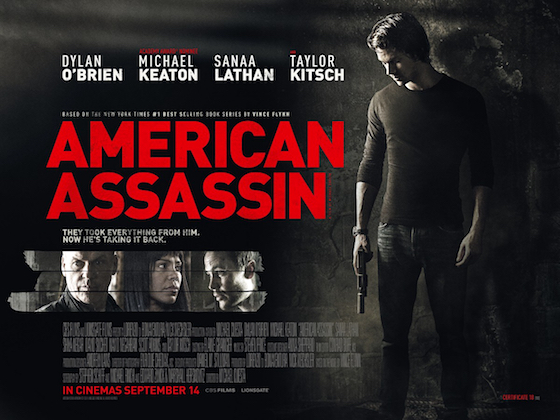
    Based on the Mitch Rapp series of novels by Vince Flynn (and, since Flynn’s death, Kyle Mills), American Assassin is an action-thriller about a CIA operative that’ll feel very familiar to anyone who’s ever seen a film starring Jason Bourne, Jack Ryan, or anything else along those lines. Indeed, it particularly reminded me of the last-but-one Jack Ryan reboot, crossed with something altogether murderier — you’ll notice this has an uncommonly high 18 certificate. I guess that was for some torture that goes on; although it also features a very intense opening scene, depicting an attack by terrorist gunmen on tourists at a beach resort. Considering this is no more than a dumb action-thriller, one might consider it a bit much to include such a viscerally-real-feeling sequence, inspired by relatively recent real-life attack(s), just to kickstart the hero’s journey…

    The film was made for just $33 million, which is chump change in modern Hollywood, and they’ve not done badly off it. The shooting locations do seem a little limited (the main sequence in Istanbul looks more like it was shot in a London shopping precinct (which, as I found out when I checked after, it was), and the bit in Poland is moderately familiar as London too (it’s Somerset House, recognisable to UK cinephiles as where Film4 host their outdoor summer screenings); but I’ve seen worse CGI in bigger-budgeted films, and the fisticuffs are decently staged.

    Altogether, it makes for quite an entertaining action thriller, with some decent scenes, but the story is wholly familiar — Mitch Rapp: Sum of All Shadow Recruits, if you will. Fans of the genre will likely get a kick out of it, especially if they’ve not seen some of the other films it feels so similar to (though if you’re a fan of the genre I don’t see how you wouldn’t’ve), but others need not apply.

    3 out of 5

    Captain Underpants:
    The First Epic Movie

    (2017)

    2018 #91
    David Soren | 85 mins | streaming (HD) | 1.85:1 | USA, Canada, France, UK & India / English | U / PG

    Captain Underpants: The First Epic Movie

    Somehow I was vaguely aware of the existence of a series of books called Captain Underpants, but I’d paid them no heed because they’re for young kids, and also because they looked stupid. I thought the same thing of this movie adaptation, but then I started hearing good things about it and, well, here we are.

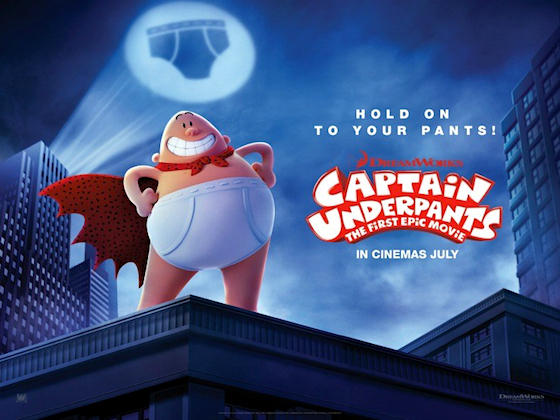
    It’s about two young boys who love nothing more than pranking teachers and creating superheroes. When their headteacher separates them because of the former, they manage to hypnotise him and convince him he’s the latter — the eponymous Captain Underpants. Initially that just makes their school life more fun, but then a supervillain turns up, so he’s handy for that too.

    Obviously it’s all thoroughly daft and primarily aimed at younger children — there are Messages without it being preachy, and it’s suitably irreverent and base at times. It’s the movie equivalent of mixing veg into, like, a burger, or something (I dunno, I’m not a parent. What food do you hide veg in?) But it also contains some good gags for the adults (satire!) and some clever bits of animation and stuff as well — it’s more inventive than you might expect in that regard.

    Indeed, I feel like it’s all-round better than you’d expect, given the title and overall style (the kiddie design and tone; the toilet humour)… but not so much better that it warrants 4 stars, so…

    3 out of 5

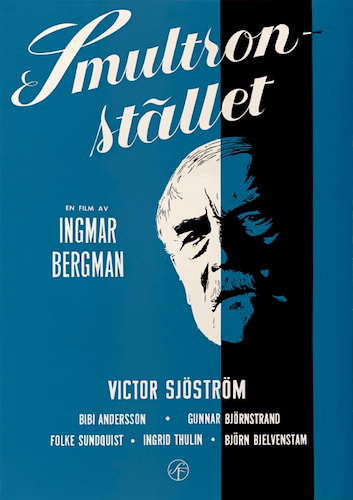
    Wild Strawberries
    (1957)

    aka Smultronstället

    2018 #90
    Ingmar Bergman | 87 mins | DVD | 4:3 | Sweden / Swedish | PG

    Wild Strawberries

    “Wondrously warm, one of Bergman’s very finest achievements, and a landmark in the history of cinema,” says Geoff Andrew in the notes that accompany the UK DVD release of Wild Strawberries, one of Ingmar Bergman’s most acclaimed movies from a career filled with them. However, speaking for myself, I’m still struggle to get a handle on the director’s output.

    It’s about a grumpy old professor (Victor Sjöström) who sets out on a road trip to collect an honorary doctorate. Along the way he has various encounters with other travellers, which prompt daydreams and memories that cause him to reassess his life and its worth.

    Put like that, what it’s “about” seems obvious, though in my notes I wrote “I’m not sure I have any idea what it was about. Something to do with old age and looking back and maybe death,” so how effectively its themes come across on a first viewing is, perhaps, debatable. That said, I’m fully prepared to accept I was looking in all the wrong places, maybe focusing too much on the literal road-trip storyline and not the figurative exploration-of-self the trip was provoking.

    On the bright side, there’s some effective imagery in the dream sequences, and I found it less crushingly dull or obtuse than Persona, which is something. Maybe Bergman’s just not for me? Or not for me yet? Well, I didn’t dislike it, but at the same time I didn’t get much out of it. Maybe some day I will.

    3 out of 5

    Wild Strawberries was viewed as part of my Blindspot 2018 project.

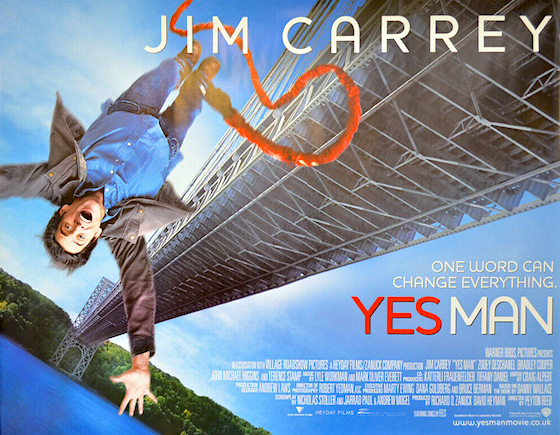
    Yes Man
    (2008)

    2018 #86
    Peyton Reed | 100 mins | streaming (HD) | 16:9 | USA & UK / English & Korean | 12 / PG-13

    Yes Man

    Loosely based on Danny Wallace’s memoir of the same name, Yes Man stars Jim Carrey as a negative chap who attends a motivational seminar that encourages him to start saying “yes” to every opportunity that comes his way.

    On the first night, he says yes to a homeless guy who wants a lift across town, then yes to letting the guy use his phone, then yes to giving him all his cash. But it turns out the drive used all his fuel, the call used all his battery, so he can’t phone for help, and he has to trek miles in the dark to buy fuel… not that he has any cash. So much for saying “yes” to everything. But at the petrol station he meets Zooey Deschanel and they hit it off. So, yeah, point made with perhaps the most outsized karmic reward ever.

    I suppose everything about Yes Man is broadly familiar — the romcom story arc; the kooky supporting characters; Jim Carrey’s schtick (it feels very much in same vein as the high-concept ’90s comedies that made his name; although there’s no fantastic element this time, and the worst excesses of his ‘act’ are thankfully limited to one or two scenes) — but it carries it off with reasonable charm. I mean, if you have no time for Carrey’s comedies, and aren’t attracted to Deschanel being a MPDG again, then there’s nothing here that’s going to win you round. For fans of such shenanigans, however, this is a perfectly enjoyable experience. It’s a 3.5-out-of-5-er, but I had a nice time with it, so my score leans on the side of generosity.

    4 out of 5

  • The Girl in the Spider’s Web (2018)

    2019 #90
    Fede Alvarez | 115 mins | streaming (HD) | 2.39:1 | USA, Germany & Sweden / English | 15 / R

    The Girl in the Spider's Web

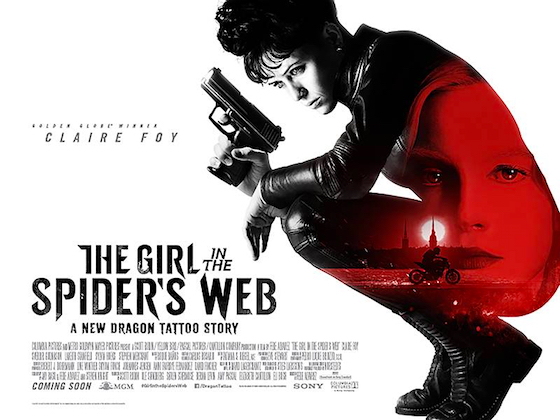
    I love a bit of context to frame a review, but crikey, I can’t be arsed to recap the turbulent history of this particular franchise. Heck, it doesn’t even have a proper name! Officially it was the Millennium Trilogy, but that didn’t seem to stick (especially when it went past three books). The original Swedish films have been bundled as “The Girl” trilogy, owing to the formula of their English language titles. For this latest incarnation, they chose to label it “A New Dragon Tattoo Story”, I guess reasoning that “Dragon Tattoo” was a more unique identifier than “The Girl” (not wrongly).

    The status of this film itself is equally confused. Is it a reboot? A sequel? If so, to what? I mean, it’s adapted from the fourth book, but only the first has been filmed in English (as is this movie), so is this now meant to be the second story? But as there doesn’t seem to be a Swedish language adaptation forthcoming, maybe this is intended to be a fourth one after all? Frankly, I suspect the filmmakers would rather we didn’t ask. The film makes little or no acknowledgement of any specific predecessors (aside from the fact that the recurring characters already know each other), instead diving headlong into a new, standalone story. Well, standalone-ish, because a lot of what occurs comes out of the past of Lisbeth Salander, the titular girl; and the events of her past were a key feature of some of the other stories as well, so…! Well, that you can’t escape your past, however much you might try, is sort of a theme here, I guess, so maybe we can kindly say it’s only appropriate.

    Whichever films or books you take in before this one, I don’t think Spider’s Web is a good jumping-on point. It assumes we have familiarity with the lead characters — hacker Lisbeth Salander (now played by Claire Foy) and investigative journalist Mikael Blomkvist (now played by Sverrir Gudnason), and their relationship, or lack thereof — which is a barrier to it being newcomer friendly. Anyway, the actual storyline sees Lisbeth being hired to steal a dangerous computer program from the CIA, which leads to all sorts of trouble with crime gangs and spies and whatnot.

    l33t h4x0r skillz

    Where the first three Millennium / Girl / Dragon Tattoo stories were all fundamentally crime thrillers, Spider’s Web opens up the storytelling world into much more fanciful realms. It’s a bit like they’ve tried to make Salander a kind of freelance female James Bond, using her l33t h4x0r skillz to stop evil cyber-terrorists. It also helps that she’s pretty handy on a motorbike and with a gun. How? Just because. Unfortunately, an element of ‘just because’ powers too much of the film, with fundamental flaws in even its basic setup: the computer program she has to steal is uncopyable, hence the reason she has to steal it, but that’s (apparently) not even possible. I guess the writers just thought “eh, it sounds plausible”, but, well, it didn’t sound plausible to me, and apparently it is indeed not possible to create a program that can’t be copied, so there we go.

    And yet, if you can suspend your disbelief, Spider’s Web is mostly enjoyable while it’s on. There are plenty of twists and turns in the plot — few, if any, are genuinely surprising, but it keeps it ticking over; as do the running about and shooting at things. It’s nothing special as action-thrillers go, but I’ve seen a lot worse. They’ve plumped for an R rating, in keeping with the darker adult themes the series is known for, but it’s a funny one: some of it feels tamed down as if they were aiming for a PG-13 (it’s scrupulous about never showing Lisbeth naked, even when she is), but there are some swears and the odd burst of violence that would never have got past at the lower certificate. Arguably that kind of half-heartedness extends to the whole experience.

    Yas Queen!

    Consequently, I feel kinda bad for Claire Foy in the lead role. After her acclaim in The Crown I can see she must’ve had big opportunities calling, but I imagine was also keen to show her range after becoming famous for such a particular kind of role. Lisbeth Salander is about as big a 180 from Queen Elizabeth II as you can get, right? However, she has big shoes to fill. Lisbeth is a potentially complex role, much desired by actresses keen for some meaty material (well, there was tough competition when they were casting the US remake of Dragon Tattoo, anyway), but both Noomi Rapace and Rooney Mara have put a firm stamp on it already (the latter even secured an Oscar nomination). I’d wager Foy is up to the task, although the screenplay doesn’t give her a whole lot to work with. Giving Lisbeth some (more) familial conflicts sounds potentially weighty, but the actual material doesn’t dig into it a whole lot.

    As for the rest of the cast, the fact they’ve cast someone you’ve probably never heard of as Blomkvist, the role previously played by a hot-off-Bond Daniel Craig, shows how he has a downgraded part to play here. The rest of the supporting cast includes a few somewhat more familiar faces, like Stephen Merchant, LaKeith Stanfield, and Sylvia Hoeks, all of whom are fine with what they’re given, but, as I say, it’s not exactly something to write home about.

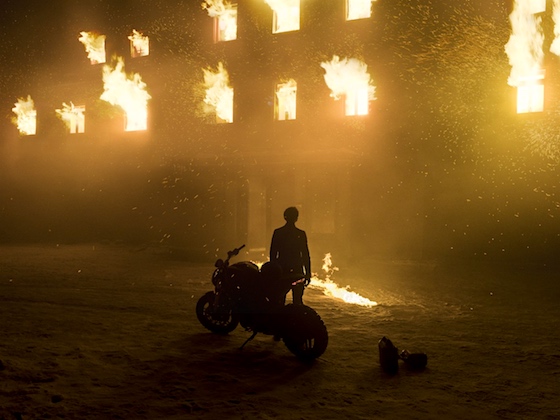
    Burning down the franchise

    Once upon a time Dragon Tattoo was a darling of the pop culture world, the books attracting a tonne of attention, the Swedish films going down very well, and the star-studded US remake suitably hyped up. Its shine has waned since then (possibly as a result of said US remake underperforming at the box office, which is a whole other can of worms), and now Spider’s Web is probably too little too late to revive it — certainly, it fared poorly with both critics (40% on Rotten Tomatoes) and audiences (a paltry $35 million worldwide). To say it deserved better might be overselling it, but there is value here, at least for any undemanding fans of the action-thriller genre.

    3 out of 5

    The Girl in the Spider’s Web is available on Sky Cinema from today.

    The Karate Kid (2010)

    2018 #72
    Harald Zwart | 134 mins | streaming (HD) | 2.35:1 | USA & China / English & Mandarin | PG / PG

    The Karate Kid

    For some, The Karate Kid is one of the defining films of the ’80s, with a legacy so strong that, 34 years after the original film, YouTube launched a sequel/spin-off series — and it did well enough to get recommissioned twice (so far), so I guess they were right. I’m pretty sure I rented the original film on video when I was a kid, but my memories of it are incredibly vague, and I’ve no idea if I ever saw the sequels. Anyway, my point is that I don’t have a nostalgic attachment to the original, which seems to have coloured some people’s response to this remake (which is itself rapidly approaching being a decade old!) Maybe that’s for the best, because it seems to be a pretty thorough reimagining — heck, the kid doesn’t even learn karate!

    This version stars Jaden Smith (son of Will) as the eponymous child, Dre, who’s forced to move from Detroit to Beijing when his single mother (Taraji P. Henson) gets a job transfer. Struggling to find his place in a foreign country, Dre gets bullied by his schoolmates, including a young kung fu prodigy (Zhenwei Wang). During one particularly vicious beating, Dre is saved by his building’s unassuming maintenance man, Mr Han (Jackie Chan), who it turns out is a kung fu master himself. When the bullies refuse to apologise because they’re taught poor values by their master (Yu Rongguang), Han agrees to teach Dre so that he might enter a kung fu tournament and face them fairly.

    So, having a quick read through a plot summary of the original film, the actual story isn’t that different — set in China instead of the US, with different character names, and with kung fu instead of karate (apparently Sony considered changing the title to The Kung Fu Kid but producer Jerry Weintraub refused), but otherwise fundamentally the same narrative. Well, it is a remake — what do you expect?

    Everybody was kung fu fighting. I mean, it was a kung fu tournament; that's kinda the point.

    From reading other viewer reviews, I get the impression a lot of people dislike it just because they’re nostalgic for the original or because they’re annoyed by Jaden Smith’s parents trying to make him a movie star. But if you remove those external contexts, the film offers a decent storyline and some strong performances — it’s Jackie Chan, c’mon!

    Speaking of which, there’s an alternate ending which features Chan fighting the other teacher (something that doesn’t occur in the film as released, obviously). I can see why they wanted to get more of Jackie fighting into the movie, because his is a supporting role otherwise, but it would’ve kinda diluted what the film is really about right at its climax. That said, some versions of the film are perhaps already structurally comprised: apparently the Chinese release was re-edited to make it seem like the American kid started all the fights against those good Chinese boys. I can see why Chinese censors would force that on the film, but I don’t see how it quite chimes with an ending where Dre comes out victorious.

    As for the cut the rest of us get to see, I can’t speak for how it compares to the 1984 original, but it holds up pretty well as an enjoyable film in its own right.

    4 out of 5

    Zatoichi Goes to the Fire Festival (1970)

    aka Zatôichi abare himatsuri

    2019 #80
    Kenji Misumi | 96 mins | Blu-ray | 2.35:1 | Japan / Japanese | 15

    Zatoichi Goes to the Fire Festival

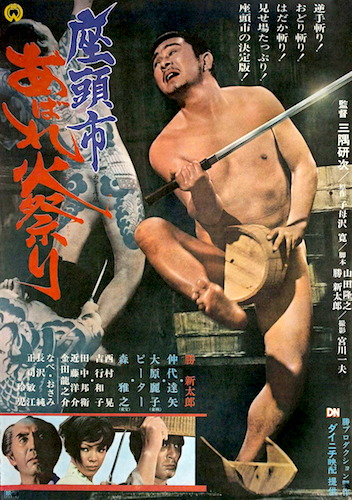
    No, this isn’t a film about a samurai at a ‘luxury’ music festival (and that’s the extent of Fyre references you’ll get here, because I’ve not watched either documentary and don’t really know much about it). Rather, this 21st entry in the long-running Zatoichi series (once released on UK DVD as Zatoichi at the Fire Festival, and also known by sundry other variations of those words) sees the eponymous blind masseur-cum-swordsman clash with evil underworld boss Yamikubo (Masayuki Mori). This boss is as blind as Ichi, which he initially uses to claim a kinship with the masseur, but then Yamikubo engages in a series of schemes to kill our hero. Meanwhile, a nameless ronin (Tatsuya Nakadai) stalks Ichi too, intending to kill him for an imagined slight.

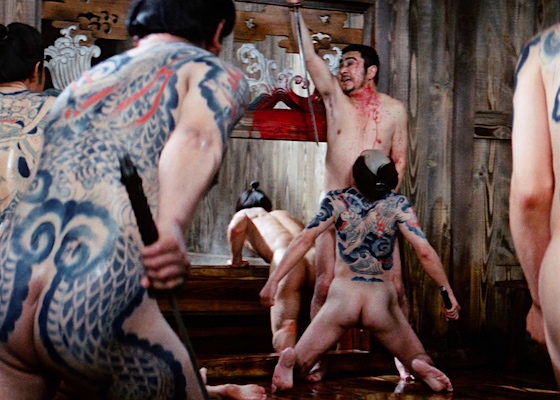
    More or less business as usual for a Zatoichi adventure, then. The blindness of the villain should really add an extra frisson of something — it’s a clear parallel with Ichi, after all — but I’m not sure it does, in actuality. More striking is that Fire Festival is pretty sex obsessed. Sex has been a factor of Zatoichi films before, but I’m not sure any other is as consumed by it as this one. It starts with a mistress auction and teases of nudity; the mystery ronin’s quest is to kill everyone who slept with his wife, which he thinks includes Ichi; the major set-piece is a fight in a bathhouse between Ichi and an army of assassins, all of whom are stark naked; Ichi spends an evening with five prostitutes; the villains decide the best way to kill our hero is with a honey trap (who winds up genuinely falling for Ichi, of course); there’s the roadhouse owners we randomly come across, who are casually perverse… and that’s all before the one-hour mark. Though if you’re expecting to see flashes of flesh, the nude scenes feature almost Austin Powers-level endeavours to make sure nothing explicit is shown.

    A sweet transvestite?

    There’s also an androgynous fellow called Umeji, who’s played be Peter, aka Pītā, aka Shinnosuke Ikehata — to quote his Wikipedia page, “one of Japan’s most famous gay entertainers, Peter’s androgynous appearance has enabled him to often play transvestite characters and he often appears on stage in women’s clothing.” He first gained attention the year before, as the lead in Funeral Parade of Roses, and later would have a supporting role in Akira Kurosawa’s Ran. Here he’s the pimp of those aforementioned five prostitutes, part of an attempt to prove he’s a “real man”. That doesn’t really work out, so his next attempt is to try seducing Ichi. It’s a startling, unexpected sequence in a genre film of this era, especially as he seems to get quite far — I mean, they end up under a bedsheet where we can’t see exactly what’s going on… until a knife slips out, anyway, with which Umeji was trying to kill Ichi. Naturally Ichi’s not impressed by that murder attempt, although he has nothing to say about the apparent homosexuality.

    Peter isn’t the only noteworthy face here. Easily missed by Western audiences are Utae and Reiji Shoji as that roadhouse couple I mentioned — apparently they came from family of famous comedians, which perhaps explains all the screen time they’re given. More recognisable is Nakadai, who would also later star in Ran, and also appeared in Yojimbo and The Human Condition trilogy, amongst many more. One of those others is another samurai movie, The Sword of Doom, in which he reportedly plays a very similar character to his role here — I’ve not seen it so can’t vouch for that myself, but many other reviews cite the comparison. Depending which of those you listen to, he’s either “comically bad” (DVD Talk) or “puts in a stellar performance” (Lard Biscuit Enterprises). His character is a bit of an odd one — his motivation is thin and decisions border on nonsensical — but Nakadai brings immense presence to the role nonetheless.

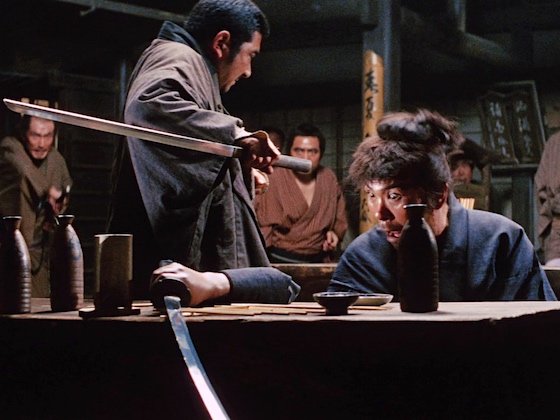
    Is that a katana or are you just happy to see me?

    Mind, most of the rest of the film’s plot is similarly confounding. It starts with a title sequence in which Ichi tries to run away from a little barking dog, ends with an out-of-nowhere scene where Ichi turns down a horse ride, and in between is almost as odd and randomly constructed as those two extremes. And yet it does tick most of the regular Zatoichi boxes, especially in terms of the action scenes. They’re as slickly choreographed and staged as ever, continuing to come up with fresh ideas even after all these movies. The nude bathhouse fight is the obvious standout, but there’s also a finale where Ichi faces down an army and a cunning foe with a hostage, but has a trick up his sleeve… literally! (Ho ho ho.)

    If you’re wondering where the titular festival has got to in all this, well, it never really turns up. The climax does begin with Ichi stranded in the middle of a lake that’s then set alight, but that’s not really a “fire festival”, is it? But it is a visually arresting sequence, just one of several throughout the film. This is the last contribution to the Zatoichi films from director Kenji Misumi, who directed the first and would end up tied for the title of the series’ most prolific director; and also for cinematographer Kazuo Miyagawa, who shot six of the films for various directors; and they both go out on a visual high with their work here. (I don’t like to over-clutter my reviews with pictures, so here are just a few additional memorable shots I grabbed. And this is really in a class of its own for images that evoke a sense of smell. Don’t say I didn’t warn you.)

    The film’s story, as I said, is less commendable. Altogether, it makes for a movie that I wouldn’t rank among the Zatoichi series’ finest achievements, but nonetheless has its share of entertainment value for fans.

    4 out of 5

    Stalker (1979)

    aka Сталкер

    2018 #100
    Andrei Tarkovsky | 162 mins | Blu-ray | 1.37:1 | Soviet Union / Russian | PG

    Stalker

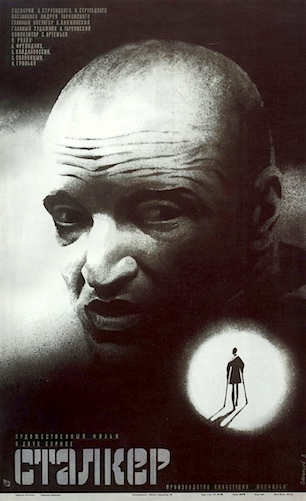
    Described by the blurb on its Criterion Collection Blu-ray release as “a metaphysical journey through an enigmatic post-apocalyptic landscape”, Stalker is… probably that… I guess…?

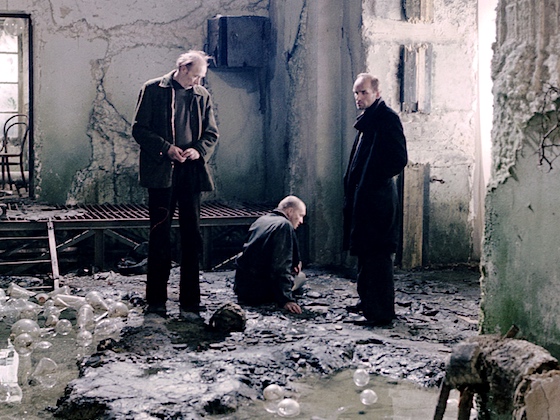
    Adapted from the novel Roadside Picnic by Arkady and Boris Strugatsky (which, according to critic Mark Le Fanu in Criterion’s booklet, is more hardboiled pulp than artistic thinkpiece), it follows a professional ‘Stalker’ (Alexander Kaidanovsky) — someone who can enter and navigate a mysterious restricted area known only as the Zone — as he guides two latest clients, a depressed writer (Anatoly Solonitsyn) and an inquisitive professor (Nikolai Grinko), into the Zone and to the attraction at its heart: the Room, a place which is rumoured to grant a person’s innermost desires.

    That’s the plot, anyway. Considering it’s over two-and-a-half hours long and I just summarised most of the story, you know it’s About more than that. But suffice to say I didn’t get it. It’s just some blokes wandering around, being depressed, occasionally philosophising about bugger all; then the ‘stalker’ chap is depressed even more by his clients’ attitude at the end, for some reason; and then we see his kid has telepathic powers because… um… People think director Andrei Tarkovsky’s previous sci-fi film Solaris is slow and obtuse, but it’s pacy and its meaning is crystal-clear compared to Stalker. Indeed, watching this just made me want to watch Solaris again — that was a slow Soviet sci-fi I actually found thought-provoking and interesting. One inspired thought I will credit it with is the notion of what “innermost desire” actually means. We might think we know, but do we? If the Room grants, not what we choose to ask it for, but our true innermost desire, then it reveals the truth of our self to us… and we might not like what we find.

    Some blokes being depressed

    The film “resists definitive interpretation” says Geoff Dyer in a featurette on Criterion’s Blu-ray. It’s “a religious allegory, a reflection of contemporaneous political anxieties, a meditation on film itself […it] envelops the viewer by opening up a multitude of possible meanings,” adds the blurb. Oy. So is it profound or just pretentious? I think the lack of clarity — the lack of definitive interpretation — can be used as evidence for both sides. Its acclaim would suggest most think it profound, so I’m the one missing something. That’s always possible. Also, I’m always wary of calling something “pretentious” — that’s become too much of a catch-all criticism for people who don’t understand an artwork and want to blame the work itself rather than their own intellectual capabilities. So we’ll have to settle on me just not understanding it.

    Some of it does look good, at least… which is handy when long stretches of it are just staring at things in unbroken takes (there’s something like 142 shots, which is about one cut every 88 seconds). Whatever the film is or isn’t trying to say, I feel fairly certain it didn’t need to take so much time to say it.

    Equal parts Annihilation but without the exciting stuff, privileged white male angst, and flicking through a photo album of deserted urban environments at someone else’s too-slow pace — with strange dashes of The Spy Who Came in from the Cold and X-Men Origins: Jean Grey for good measure — Stalker is… definitely something.

    2 out of 5

    Stalker was viewed as part of my What Do You Mean You Haven’t Seen…? 2018 project.

    True Romance (1993)

    2018 #150
    Tony Scott | 121 mins | Blu-ray | 2.40:1 | USA & France / English & Italian | 18

    True Romance

    Directed by Tony Scott from Quentin Tarantino’s first screenplay,* True Romance is pretty much everything you’d expect from an early Quentin Tarantino screenplay directed by Tony Scott. It stars Christian Slater and Patricia Arquette as a pair of Bonnie and Clyde-ish lovers, who accidentally steal a load of cocaine from her pimp and end up on the run from the mob.

    At first blush, I’d say this feels much more like a Tarantino movie than a Scott one. It’s all there in the dialogue, the subject matter, the characters — it’s everything you’d expect from early QT: verbose, funny, littered with pop culture references, violent. It’s well paced, too; not exactly whip-crack fast, but also never slow or draggy. It is shot more like a Scott flick than a QT one, but only somewhat — it lacks both the slick flashiness we associate with Scott’s early work (Top Gun, Beverly Hills Cop II) and the grungy hyper-editing of his later stuff (Man on Fire, Domino). That said, some scenes (like one between Arquette and James Gandolfini’s underboss in a motel room, for example) are shot like Tony Scott to the nines, reiterating my opening point.

    Other observations: There’s one helluva supporting cast — it’s just littered with famous names in roles that only last a scene or two. (I could list them, but that might spoil the fun.) The sweet plinky-plonky score by Hans Zimmer is so unlike either his normal stuff or this genre of movie, which is no bad thing. On its original release the film was cut by about two minutes to get an R rating, with the original cut eventually released “unrated” on home formats, sometimes labelled the “director’s cut”. All the differences are relatively short trims to do with violence (full details here). The “director’s cut” is the only one that’s ever been released on DVD or Blu-ray anywhere, thus making the distinction between “theatrical” or “director’s cut” pretty much moot at this point… or at any point in the last 20 years, frankly.

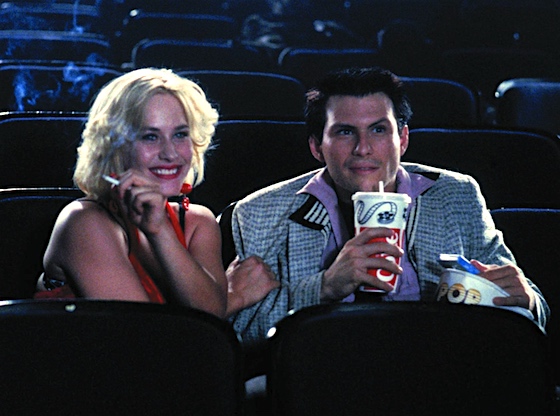
    Clarence and Alabama go to the movies

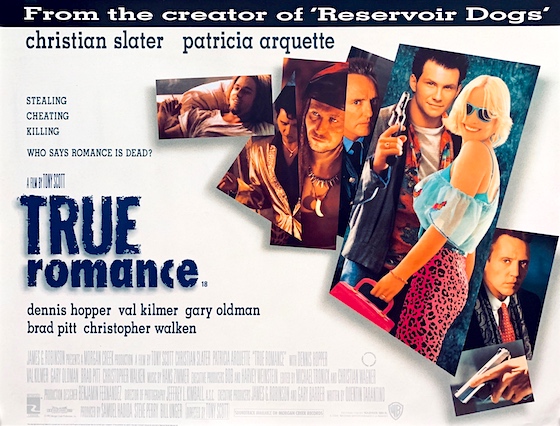
    It’s got a funny old trailer, too: it’s centred around a bunch of made-up numbers that have no basis in the film (“60 cops, 40 agents, 30 mobsters”), it mostly features the film’s climax, and it doesn’t once mention Quentin Tarantino — I guess “from the writer of Reservoir Dogs” wasn’t considered a selling point just the year after it came out. (Though obviously it was in the UK — just see the poster atop this review.)

    Of course, nowadays it’s often regarded as “a Tarantino movie” — the copy I own is part of the Tarantino XX Blu-ray set, for instance. I wonder if that ‘divided authorship’ is why, while the film does have its fans, it’s not widely talked about as much as some of either man’s other work: it’s not wholly a Tony Scott film, but, without QT actually behind the camera, it’s not really a Tarantino one either. Personally, I’m a fan of both men’s work, so of course it was up my alley. I don’t think it’s the best from either of them, but mixing together the distinct styles of two such trend-setting iconoclasts does produce a unique blend.

    4 out of 5

    True Romance was viewed as part of my Blindspot 2018 project.

    * True Romance came out between Reservoir Dogs and Natural Born Killers, but apparently QT wrote this first, then when he failed to get funding for it he wrote NBK, then when he also failed to sell that he wrote Reservoir Dogs. Another version says True Romance and NBK started out as one huge movie, written in Tarantino’s familiar chapter-based non-chronological style, until QT and his friend Roger Avery realised just how long it was and decided to divide it in two. ^