Sumurun (1920)

aka One Arabian Night

2010 #7
Ernst Lubitsch | 104 mins | DVD | PG

SumurunSumurun seems completely different to any film yet seen in the Berlin box set, yet this is more in line with the style of film that would ultimately lead Lubitsch to Hollywood.

As the alternate title would suggest, this is primarily an Arabian Nights-style drama… but, while on the surface this looks entirely at odds with Lubitsch’s previous comedy work, it actually concerns itself with the same topic: romance, and the various entanglements and complications that lead to it. What’s different here is that instead of being wholly comic it’s often deadly serious (literally, as it turns out), and instead of one simple girl-meets-boy trajectory (as in the preceding three films) there’s two girls and four boys between them, in various combinations. It’s a many-stranded, relatively complex narrative: there’s a group of travelling minstrels, an old sheikh, a young sheikh, a cloth merchant, a bevy of harem girls — all of whom are connected and interact in varying ways with varying objectives, though most are related to love — or lust.

The change in style is no bad thing. Lubitsch was clearly versatile, turning his hand well to this type of storytelling. His comedies are all based around romance, one way or another, and so treating the subject with a little more seriousness seems no great leap. He keeps control of the plot, despite the numerous strands and complexities, and his comedy background allows the tropes of farce to be employed in furthering the story. His previous use of fantastical realms, like the dolls’ world of Die Puppe, aids a succinct establishment of Lubitsch’s version of Arabia and its specific rules. Indeed, with its fantastical setting and shortage of character names (only Sumurun, Nur al Din and his two slaves — Muffti and Puffti — are known by more than their title, job description or physical impairment), Sumurun may be as much of a parable as some of the comedies.

And still, comedy creeps in round the edges. Lubitsch is arguably showing restraint by not letting every sequence descend into it, but there is a fair amount of wit and humour lurking throughout. It’s mostly applied wisely though, furthering character, story or both: the ugly hunchback who smiles at a child only to make him cry; the harem girls giving their eunuch guardians the runaround (multiple times); the two wannabe-thieves accidentally stealing a pretend-dead body and desperately trying to hide or dispose of it — the last a subplot which ultimately plays a key part in the climax.

What’s a little unclear is why it should be called Sumurun. Perhaps it’s no more than a vestige from the source, because while the titular harem girl is quite significant, she’s no more so than several other characters. Pola Negri’s namless dancer in particular seems more central to the narrative — indeed, she connects most of the disparate groups and plot strands; certainly more of them (and more significantly) than anyone else. But then, Sumurun survives to the end, and — along with her man, Nur al Din the cloth merchant — is the purest, most righteous, most deserving of all the main characters. Conversely, all the ‘bad’ (and, as noted, nameless) characters meet their end: the sheikhs are both fickle, and the old sheikh clearly a nasty piece of work; the dancer is flirty and adulterous; the hunchback, however, is devoted to her, and his tragedy effectively balances the “and they all lived happily ever after” of the freed harem girls and Sumurun and Nur al Din finally getting each other. If this is a parable, there’s quite a clear message about fidelity.

Sumurun may lack the straightforward fun of Lubitsch’s comedies, but by creating a complex and engrossing Arabian epic he entertainingly demonstrates that there was more to him than just the talented comedian.

4 out of 5

Read more reviews from Lubitsch in Berlin here.

Die Austernprinzessin (1919)

aka The Oyster Princess / My Lady Margarine

2010 #6
Ernst Lubitsch | 61 mins | DVD | PG

Die AusternprinzessinDie Austernprinzessin seems to be one of, if not the, most respected and/or beloved of Lubitsch’s early films. It makes They Shoot Pictures, Don’t They?’s Doubling the Canon list, something no other film in this box set has managed (nor, I should clarify, are any on the main list); it’s the only one to make IMDb’s top films of the 1910s; and it has some Proper critical backing too (more on that later). But personally, it’s my least favourite Lubitsch so far.

Which isn’t to say it’s bad — far from it. Set in America, it’s packed with displays of ostentatious wealth: the titular ‘princess’ (played by Lubitsch muse Ossi Oswalda), actually the daughter of an oyster-selling businessman, lives in a huge palace of a home; the family has hundreds of servants to do everything, to a ridiculous degree; and there’s a pervasive “must have more” culture splashed across it. This isn’t praised though, as you might expect from a contemporaneous US film (or most US films, really), but is instead a satire/pisstake. It must have been particularly effective/galling in a Germany heading into severe post-war Depression.

To support his theme, Lubitsch stages numerous epic set pieces on gigantic sets: Ossi’s bath, where a stream of maids carry her to and fro, wash and dry her; a huge cast of choreographed waiters, kitchen staff and guests at the wedding dinner; a mad foxtrot sequence that follows it; or the ladies’ boxing match, where for the third time in as many films Lubitsch shows a gaggle of women fighting over a man. The foxtrot sequence seems the most praised of these, though I wasn’t sold — other sequences here are better staged with greater comic impact. The supple, enthusiastic band leader was quite entertaining though.

Occasionally, however, one feels the size of these sequences may have distracted the director from the task of making his film funny. Not that it isn’t or that these aren’t — Lubitsch still exploits almost every chance for a gag — but there’s sometimes the suspicion that the logistics of staging such big sequences, and so many of them, have derailed him from the primary goal. By extension, the story often feels like a series of sketches (even more so than the previous two films), with several — Ossi’s instruction in how to bathe a baby, for example — seeming wholly extraneous and not always hitting home as well as one might’ve liked.

Similarly (though, it may just be my imagination), Oswalda’s skill gets a little lost among all the hullabaloo. She rarely has a chance to display the comedic and romantic charm she showed so beautifully in Ich möchte kein Mann sein and Die Puppe, although a couple of scenes allow her to let loose. She’s part of the ensemble much of the time, little more than a prop at others (the bath sequence, for example). Obviously, the film doesn’t have to focus on her, and the rest of the cast entertain — in particular a heavily made-up Victor Janson as the consistently bored oyster entrepreneur — but having seen her abilities so well displayed in the preceding films, they feel slightly underused here.

But, as I say, maybe I imagined it; and perhaps I’m holding Die Austernprinzessin to unfeasibly high standards, buoyed by the success of the previous films and the aforementioned critical standing? I haven’t even mentioned all the plus-points, like some excellent individual gags — a drive-in wedding! — and a great score on this edition (sadly uncredited, as far as I can see).

Speaking of this particular release, Ignatiy Vishnevetsky again pens the essay that accompanies the film, ending it with quite a nice analogy about food and restaurants and stuff — I won’t spoil it for those yet to read it. In fact, the main reason I even mention it is to cite that Sight & Sound review I mentioned, which asserts that Vishnevetsky’s essays “seem designed merely to show off his range — very pseud’s corner”. Not a point I’d necessarily disagree with, but it does feel a little rich coming from Sight & Sound, the magazine that (for one handy example culled from the same issue) can produce a list of the 30 “most significant” films of the last decade in which I’ve not even heard of half the selections.

And the reviewer also calls Die Austernprinzessin Lubitsch’s “earliest masterpiece”, which obviously I’m going to disagree with. I’ll stick to playing with dolls, thanks.

4 out of 5

Read more reviews from Lubitsch in Berlin here.

Silent Week – #1: Lubitsch in Berlin

The idea behind Silent Week is simple: the films are silent, the blog is anything but.

Oh, that sounds like a cheesy marketing line that ITV would use (not that ITV would ever go anywhere near a silent film). Sorry. But still, the idea runs more or less thusly: I watch a silent film one day, I post a review of it the next (well, that was the idea…) That doesn’t necessarily mean seven films, but enough to justify it being a Week rather than, I dunno, a Weekend. However, as it’s turned out (at least for this inaugural entry), I watched (almost) all the films last week and intend to post all the reviews this week.

Why silent films? Because I’ve noticed I own quite a few that I haven’t seen. I could probably do the same thing with anime, or film noir, or Asian action movies, or any number of other such genres/categories, but silents attracted my attention for now.

The initial idea (that again…) had been to start with a random selection of the silents I own, but then I got the new Masters of Cinema Lubitsch in Berlin set a week in advance of its release (which, incidentally, is tomorrow) — I always love it when that happens, especially as it inspires me to actually watch stuff right away. And this set has seven films — what could be more perfect for a Silent Week? (OK, one film immediately breaks the rules by not being silent, but as it’s a documentary about silents I rule it eligible.)

As if to cement this more themed approach, as I listed the silents I own they began to fall into categories — Hitchcock, Chaplin, Murnau & Lang, plus the Feuillade serials Fantômas and Les Vampires. I could muddle these up into more random weeks, or go chronologically across them all, but why bother? As I’ve got through Lubitsch in Berlin OK (well, almost) I’ll try again sometime soon with another of these themes, and continue that way… until I run out and have a grab bag of remaining titles (currently: 4½).

I hasten to point out (he says, in paragraph six) that I’m no expert on silent cinema — these are all first-views, as per the rest of the blog, and informed by little more than that (the exception being DVDs with booklets, where there may be a bit more info at my disposal). Despite the lack of any specialism, it’s thanks primarily to a series of era-spanning degree modules with a filmic bent that I’ve found myself with enough of an interest in the silent era to accumulate a variety of films over the past few years… I just haven’t watched most of them, clearly.

But let’s bring things back on point: six films directed by Ernst Lubitsch, and one documentary about them. I begin today with reviews of the first two featured in the set:

2010 #4
Ich möchte kein Mann sein
aka I Wouldn’t Like to Be a Man
1918 | Ernst Lubitsch | 45 mins | DVD | PG

“Ossi Oswalda is obviously a skilled comedic actress, convincing as both a petulant tomboy and a boyish gent, capable of both drunken stumbling and coy giggling, by turns delightfully rebellious, sweetly put-upon and succinctly joyous. She’s even believable as a man (albeit a boyish one).”

4 out of 5

2010 #5
Die Puppe
aka The Doll
1919 | Ernst Lubitsch | 64 mins | DVD | PG

“It’s a constant array of delights, and nothing outstays its welcome; every sequence is mined for its full comic potential, but Lubitsch wisely moves on before it can become repetitive or stale.”

5 out of 5


Coming up: Die Austernprinzessin (aka The Oyster Princess), Sumurun (aka One Arabian Night), Anna Boleyn (aka Deception), Die Bergkatze (aka The Wildcat), and Ernst Lubitsch in Berlin: From Schönhauser Allee to Hollywood.

Die Puppe (1919)

aka The Doll

2010 #5
Ernst Lubitsch | 64 mins | DVD | PG

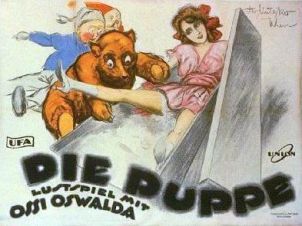
Die PuppeFrom the very start, Die Puppe sets out its stall (literally) as being something a bit special. The first sequence sees director Ernst Lubitsch himself unpack and assemble a doll’s house set and two dolls, which then become life-size and the dolls — now humans — the first characters we meet. It’s a neat framing device, a joke in itself, and some kind of early commentary on the role of a director.

From this point on, Die Puppe is a riot. Yes, some of it is distinctly old fashioned — an early chase scene, for example, sees Lancelot pursued by 40 desperate women, his mother, his uncle and the latter’s servant, back and forth and round in circles in a cartoonish fashion — and yet, even leaving aside allowances for it being 91 years old, there’s something wholly amiable about even these now-familiar proceedings.

And that’s just some of it, because Lubitsch doesn’t pass up any chance for a gag. Take the scene where Hilarius, the doll’s inventor, returns to his workshop to fetch the doll, who at that moment is actually his daughter in disguise. The point of the scene is conveyed — Hilarius accepts the deception. Except he also decides she needs more paint on her lips, which he dutifully applies. Or the pantomime horses that pull a carriage… but rather than ignore them, Lubitsch has the driver have to re-apply one’s tail. And so on. This constant expression of humour, working at every level from intellectual wit down to slapstick tomfoolery, means that even if one element has been done to death in the past near-century, there’ll be several other moments or scenes to compensate.

Even more so than in Ich möchte kein Mann sein, one could easily fill a whole review listing the great bits. Like when Lancelot is initially presented with an array of dolls, like a bizarre early-20th-century brothel with Autons for whores. Or the vulturous relatives, dividing up items while the Baron lies on his deathbed, and having the gall to accuse him of bad planning when they can’t decide who should have a vase that’s promptly broken. Or the broadly satirical monks with their ‘meagre’ meals, unwillingness to share, and incessant greed. And, in the vein of things-you-might-not-expect-from-this-era, there’s a great gag about an instruction manual. It’s a constant array of delights, and, also as in Ich möchte…, nothing outstays its welcome — every sequence is mined for its full comic potential, but Lubitsch wisely moves on before it can become repetitive or stale.

Lubitsch’s playfulness extends to the medium itself. He uses camera masks and wipes to focus on specific areas, breaking free of the 4:3 box to create different compositions, revealing parts of the frame on a delay, illustrating dream sequences, and more. There are ‘special effects’ that one could only achieve with a camera, like Hilarius’ hair changing colour, the balloon-flying sequence, a ghostly dream, and so on. And the irrepressibly cheeky young apprentice, played brilliantly by Gerhard Ritterband, routinely breaks the fourth wall to air his grievances to the audience.

And I haven’t even mentioned Ossi Oswalda, who gives another good comic turn as both the titular doll and her real-life inspiration. In his essay accompanying the Masters of Cinema edition, Ignatiy Vishnevetsky summarises her appeal (some of it, at any rate) so well that I may as well just quote from it: “Her comedy isn’t just funny to watch — it’s inviting, like a friend who cracks a joke and then asks you to tell one too. She begs a like-minded idiocy from the audience.” It is, I think, a point that’s even more applicable to Ich möchte kein Mann sein, but it stands well enough here.

Talking of this specific edition, I understand that Bernard Wrigley’s new score has come under fire from some sources (namely, Sight & Sound, though I’ve yet to read that review myself). Maybe their reviewer has a genuine complaint, but I thought that Wrigley’s score was for the most part perfectly lovely. It’s only flaw is that it often falls silent for a few uncomfortable seconds, reminding the viewer that ‘silent films’ should be anything but. Still, this is as minor a complaint as it sounds.

The Lubitsch in Berlin box set was a complete blind buy for me (as this series of reviews will attest), but these first two films alone easily justify it. Die Puppe, in particular, is simply outstanding.

5 out of 5

Read more reviews from Lubitsch in Berlin here.

Ich möchte kein Mann sein (1918)

aka I Wouldn’t Like to Be a Man

2010 #4
Ernst Lubitsch | 45 mins | DVD | PG

Die PuppeIch möchte kein Mann sein is the kind of silent film that might surprise some among a wider film-viewing audience, both in terms of the attitudes prevalent in what is occasionally assumed to be a highly prim era, and, even accepting that it really wasn’t, the things people were prepared to put on film then — the latter due to, I think, the perception of older films as wilfully innocent (a view no doubt influenced by the effect the Hays Code would later have on American movies).

But it’s anything but innocent: young ladies drinking, gambling and smoking, thinly veiled sex references, and multiple passionate — albeit drunken — kisses between two chaps. OK, so one of them’s a women in disguise, but when the truth is revealed at the end and the boy and girl (or, rather, man and girl) get together, one wonders if it’s such a perfect match after all… That it’s all played for laughs may be the key to making it permissible, and it is relentlessly comic. In a brisk 45-minute running time, Lubitsch allows nothing to outstay its welcome. Each little sketch within the narrative moves by as fast as it might today — in all likelihood faster, as the modern penchant seems to be to drag sketches out as long as possible, or at least until it’s stopped being funny. Twice over. This brevity may also be surprising to the uninitiated, refuting the assumption that overacting and labouring the point for an audience less accustomed to the shorthand of film were the order of the day.

Many memorable moments are produced throughout: the hypocritical early criticisms by Ossi’s uncle and governess; the men outside her window, rubbing their stomachs with ‘hunger’ in a shot framed from the waist down, not to mention the way they wave their canes around; similarly, the tailors stretching their tape measures as long as possible to impress our heroine; being squished on the train; the marauding horde of single women; the ‘gay’ kisses… Rarer is the sequence that doesn’t impress or linger in the memory.

Much of this is thanks to the film’s star, Ossi Oswalda. She’s obviously a skilled comedic actress, convincing as both a petulant tomboy and a boyish gent, capable of both drunken stumbling and coy giggling, by turns delightfully rebellious, sweetly put-upon and succinctly joyous. She’s even believable as a man (albeit a boyish one). It’s the kind of performance that’s infectious and makes you want to seek out more of her films (luckily, Lubitsch in Berlin contains two further examples). The rest of the cast fare well around her, particularly Margarete Kupfer as Ossi’s alternately stern and swooning governess.

Unfortunately, I can’t even attempt to put this in the context of the rest of Lubitsch’s work — shamefully, I’d barely heard of him prior to Masters of Cinema’s new set, never mind seen any of his films. MoC’s brand-new essays prove invaluable for me in this respect — immediately, this film’s, provided by Criterion’s Anna Thorngate, provides context of what the perception of Lubitsch’s Berlin work (vs his Hollywood work) is, and how Ich möchte kein Mann sein (amongst others) show this perception to be false — there is, in fact, a direct stylistic line between this and his better-known American films. Maybe when I see them I’ll spot it.

But, really, such knowledge and comparisons are entirely ancillary to one’s enjoyment of Ich möchte kein Mann sein. It’s all round a lot of fun, as well as no doubt offering some points of satire/debate about the differences between the sexes for those interested. Perhaps more pertinently, I can also see it serving as a good introduction to silent film: short, fast and funny, it has the potential to create converts.

4 out of 5

Read more reviews from Lubitsch in Berlin here.

Slumdog Millionaire (2008)

2010 #1
Danny Boyle | 120 mins | Blu-ray | 15 / R

Slumdog MillionaireAs we head in to this year’s awards season, I’ve finally got round to seeing last year’s big winner. It’s the Little British Film That Could, and I do feel like I’m the last person in the country to see it.

With its brightly coloured posters and home ent covers, cute child actors wheeled out at awards dos, and widespread popularity, it’s not hard to believe the pullquote someone at Fox’s marketing chose for the DVD cover: “the feel-good film of the decade”. An uplifting tale of a young no-hoper appearing on the world’s biggest game show and winning millions of rupees thanks to a generous helping of luck that means his multifarious life experiences have provided him with the exact answers to all 15 of Who Wants to Be a Millionaire’s genius-stumping questions, surely?

No.

Everything that claims it’s a “feel-good film” is being slightly disingenuous. It has a happy ending (I don’t think that counts as a spoiler for something that’s billed as “feel-good”), but until those closing moments it’s unrelentingly grim. Realistic, I’m certain, and depressingly so, but it seems designed for anything but making you feel good. The author of that chosen quotation, News of the World’s Robbie Collin, claims that he means the film is cathartic (not that I got that from his review, to be honest) — the happy and justice-bringing endings unleash goodness in the wake of the dire events that lead to them. It’s a sound theory, one that has often worked elsewhere, but not for me with Slumdog.

The problem is the ending. Director Danny Boyle’s recent films have all made a relatively poor show of their conclusion and Slumdog is no exception. True, it’s not close to the mess of Sunshine, but it doesn’t hold up in the way it ought to either. I don’t have a problem with it being reliant on guesswork — coincidence and luck form the backbone of the plot, making it permissible that our hero should win by chance rather than knowledge — but that some of its resolutions are too little too late to make one feel good about what’s already occurred, and the way it seems to bend the concept of Millionaire to fit its story somehow grates for me. I mean, is the name of the third Musketeer really a £1 million question?

But I don’t want to berate it too much because, in spite of the unconvincing finale, Slumdog Millionaire is a rather brilliant film. It’s peppered with convenience and flaws that go beyond the extent allowed in a plot based on coincidence (how come the questions come in the order the answers happened in his life? What about answers to all the questions we don’t see asked?), but these can be allowed to slide as a structural gimmick that facilitates something of an exposé of life for slum kids in India. Whether it has a documentary level of realism or not, and whether it under-sells or over-states the influence of gangsters and ease of mutilation and murder, the film’s unabashed grimness is surely closer to reality than most would dare. No wonder it nearly went straight to DVD.

The real revelation — once you get over the shock of it being, well, shocking — are the child actors. Here is where Boyle earns his Best Director awards, coaxing flawless lead performances out of a very young cast. Dev Patel may have been the focus point for plaudits, and while this isn’t undeserved, it’s the younger kids who play the same characters that arguably give the most memorable turns. They’re put through the ringer in almost every way imaginable and are never less than convincing, a feat for such young actors — so young that, as mentioned, the skill of Boyle (and, one imagines, “Indian co-director” Loveleen Tandan) is what’s really on display.

If there’s one good thing about Slumdog being billed as feel-good it’s that more people will have seen it, whereas promotion based on it being a gritty account of poverty, misery and abuse would surely have turned audiences away. And perhaps for most viewers the catharsis of a happy ending works, though the only person I’ve spoken to who felt that way is the aforementioned Mr Collin (and by “spoken to” in this instance I mean “tweeted”). The journey there certainly works though, and if by the end Slumdog is trying to both have its cake and eat it… well, I like cake.

Now there’s a quote for the DVD cover.

5 out of 5

Channel 4 and 4HD kick off their Indian Winter season with the TV premiere of Slumdog Millionaire tonight at 9pm.

Culloden (1964)

2009 #48
Peter Watkins | 69 mins | TV | 12

CullodenCulloden tells the story of the 1746 battle — famously, the last fought on British soil — and the events that followed it, as if it were covered by a modern TV news report (albeit a feature-length one).
This adopted style — a first — makes for an effective presentation. As a form it obviously foreshadows the docudrama, a method of presenting history which is so popular today, though not quite in this way. Writer/director Peter Watkins gratifyingly refuses to break from his premise: the whole film is very much like an extended news piece, featuring interviews, facts, and the famous BBC objectivity — at no point does the narration inform us who is good and bad, right and wrong, yet leaves us with little doubt about Watkins’ opinions (which are pretty low of just about everyone).

In fact, the film is fuelled by much youthful righteous indignation from Watkins, in his late 20s when Culloden was made. That said, his (perhaps unrealistic) idealism is still in evidence in every interview I’ve seen with him from decades later (though in those cases applied to what TV is and should be). But he allows it to dominate proceedings here, too often focusing on the awful conditions of the poor or the wrongs committed against them by Nasty Rich Folk. Should we be cross about this? It is 1746 after all — of course life was awful for common folk and the upper classes were rich twits who rode roughshod over them. That’s how things were in The Past, for thousands of years before it and hundreds of years after. With our modern developed sense of morality it all looks Nasty and Wrong, but we can’t go back and change it so why get so upset about it? Surely such vitriol is better directed at places where this is still the case?

While Watkins’ righteousness is clearly present before and during the battle, it’s really let loose in the aftermath, as English soldiers commit all sorts of atrocities to the Highlanders. Perhaps this was genuinely shocking and deserved in ’64, and it’s still true that the actions taken were unforgivably horrid, but it’s no longer shocking — not because we’re desensitized to violence at this point, but because we’re now very aware that we have done horrendous things throughout our history even while painting ourselves as the good guys (as we still do today, of course). Early on he describes the workings of the clan system, ostensibly factually but with a clear undercurrent of its unfairness; yet at the end bemoans its destruction by the English. Maybe this is why Watkins struggles to find anyone likeable in the film: they’re all as bad as each other.

Even if his overly moral stance falters, Watkins’ filmmaking techniques rarely do. The use of ordinary people as actors works fine most of the time, though occasional performances or scenes show off the cast’s unprofessional roots. Watkins’ theories about how TV should be run and the involvement of the public in the way he did here may be romanticised and impractical, but it’s hard to deny that his application of them worked wonders. Performances frequently aid the documentary effect by seeming just like those in genuine interviews or news footage, whereas even the best professional actors trying to emulate such reality are usually mannered enough for the viewer to realise they’re acting.

Best of all, however, is the titular battle. These scenes are extraordinary, creating a believability even the largest Hollywood budget has often failed to challenge. It’s epic but also involving, disorientating but clearly told, brutal without needing expensive prosthetic effects or an 18 certificate. It’s a brilliant example of camerawork, sound design and editing combining under inspired direction to create a flawless extended sequence.

Culloden was a bold experiment in filmmaking — indeed, the notion of a distant historical event being presented as if covered by news cameras still sounds innovative — and Watkins mostly pulls it off, with stunning battle sequences, effective performances and a high concept that is never betrayed. A few minor weak points aside, the only serious flaw is that Watkins lets his overdeveloped morality run unchecked. His application of a modern outrage to what seems a typical historical situation grates quite quickly but never abates, ultimately reclaiming a star from what is nonetheless an exemplary effort.

4 out of 5

Culloden placed 8th on my list of The Ten Best Films I Saw For the First Time in 2009, which can be read in full here.

Son of Rambow (2007)

2009 #35
Garth Jennings | 92 mins | DVD | 12 / PG-13

Of late I’ve posted several reviews resorting to taking my notes and turning them into sentences — this is why I probably should’ve stuck to my old post-them-all-in-order method. It’s now about nine months since I watched Son of Rambow, and the chances of being able to construct a worthwhile assessment from a combination of notes and memory has long since passed. So, for hopefully the last time, I offer up a paragraphified version of my brief initial notes.

Son of Rambow is beautifully written and directed, both roles fulfilled by Garth Jennings, who was previously responsible for directing the surprisingly-good (to my eyes) Hitchhiker’s Guide to the Galaxy movie. In contrast to that effects-ridden intergalactic comedy, Son of Rambow initially seems like a relatively straightforward, perfectly pleasant little movie about two boys and their video camera. It’s partly this, but it also brings in subplots of what it means to be a family — on various levels — and the evils of over-zealous religious orders (always a favourite topic for me).

Every significant character is given at least one twist that adds an extra level to them, even those who seem to just serve a specific plot function, and most of the minor ones — right down to Will’s silent grandmother — are given their small moment to shine. Nice little touches in Jenning’s work abound, from the comic asides with Didier to Will’s fertile imagination realised through animation, or the post-credits snippet of dialogue.

The two pre-pubescent boys have to carry the film, but thankfully are up to the task (even if their names being Bill nd Will and one of the characters being called Will (the one that’s played by Bill) make remembering them outside of the film a bit of a minefield). They are never less than utterly believable in both writing and performance. Will Poulter (as Lee Carter, the more rebellious of the two) is exceptional, talented in a way that’s reminiscent of River Phoenix in Stand By Me. It’s no surprise that both have gone on to greater things. And by “greater” I really mean “other”. There are wonderful performances all round in fact — aside from the lads, Jessica Hynes is especially worthy of note, creating a powerful character in just a handful of scenes.

The shape of the story may be familiar (unlikely pair start off wary of each other but become best friends, eventually fall out when one exceeds himself, but realise the error of their ways to come back together in the nick of time) and the lessons learnt are hardly new (true friendship can conquer all), but it’s all put together with immense joy and skill, built around a charming concept, that it becomes far more than the sum of its parts.
Hilarious and touching in equal measure, you’d need a heart of stone to remain unmoved. A triumph.

5 out of 5

Son of Rambow placed 4th on my list of The Ten Best Films I Saw For the First Time in 2009, which can be read in full here.

Originally posted on 14th March 2010.

No Country for Old Men (2007)

2009 #5
Joel & Ethan Coen | 117 mins | DVD | 15 / R

This review contains major spoilers.

When I saw No Country for Old Men, a new round of films were vying for the Best Picture Oscar. Now, as I finally post my review, a whole new load have been nominated, voted on, and await the final result. Sometimes I feel decidedly behind the times.

The first time I watched No Country for Old Men was in a screenwriting seminar. On R2 DVD (the format for said seminar) it runs one hour 57 minutes, but in the two-hour seminar we got through the whole film with plenty of pauses for discussion (of its narrative structure, with particular emphasis on the application of fate/chance/coincidence, if you’re interested). Obviously this entailed skipping chunks of the film to get to the end within the time. I was rather annoyed that our tutor hadn’t bothered to forewarn us this would be the subject of the seminar in such a way, because it meant I had no chance to see the film properly beforehand. Now, watching the film in full, I can clearly see the odd bit we skipped over, yet I don’t feel I missed anything terribly significant.

Cut short or no, it has an excellent use of no music — the Coens still create massive amounts of tension, numerous shocks, etc. It’s highly skilled direction and editing. There are a number of very good scenes along the way (even if the best remains somewhat dulled from constant repetition in the run up to the 2008 Oscars). And it all looks mighty pretty too, especially on Blu-ray (my re-watch format of choice here). The cinematography was probably my favourite part of the film.

As noted, it’s really about Fate, randomness, chance. Some clearly think this brilliant; I remain unconvinced. It lacks satisfaction. Maybe that’s real life — no, that is real life: random and lacking closure and satisfaction. But this isn’t real life, it’s a movie; and a movie with a near-fantasy (or, more accurately, horror) aspect too, in its unstoppable villain; so I think I want my proper tied-together plot, thank you very much, not a de facto hero who’s shot almost at random by a gang who have little to do with the story and a frequently irritating villain who exits the film fundamentally unscathed.

I’ve read one critic assert No Country for Old Men is the only worthy Best Picture winner of the past decade. I’ve seen another argue There Will Be Blood is the only genuine classic produced in the noughties. Any number of them have no doubt espoused similar such views. Critics, eh — always contradictory.

Anyway, No Country for Old Men: thoroughly unsatisfying,

4 out of 5

Originally posted on 5th March 2010.

There Will Be Blood (2007)

2009 #7
Paul Thomas Anderson | 152 mins | DVD | 15 / R

There Will Be BloodI used to consider myself a fan of Paul Thomas Anderson; however, I’ve come to the conclusion that I’m merely a fan of the film Magnolia. As I explained when I covered Boogie Nights, I love Magnolia, thoroughly dislike Punch-Drunk Love, and was ultimately uncertain about Boogie Nights. There Will Be Blood’s significant Oscar nominations and wins seem to have cemented it as Anderson’s most acclaimed work, but I wouldn’t consider myself a fan of this either.

That’s not to say it’s a bad film, but it is at times a baffling one. It makes minimal concessions to its audience from the very start, beginning with an extended montage that covers relatively vast tracts of time with virtually no dialogue, before segueing into a story that introduces and discards characters and events with little hint of their relevance, and eventually makes a huge leap forward for an equally impenetrable ending, all the while under- (or perhaps over-) scored with Jonny Greenwood’s disquieting music, sounding like the THX logo writ large. I can’t help but wonder if I missed something crucial along the way because, even after two and a half hours, I had no real idea what the film was about.

Leaving that aside, the film is technically excellent in just about every field. Daniel Day-Lewis easily deserved his Best Actor wins for his role as oil magnate Daniel Plainview, a performance so subtle that there initially seems little to it but which slowly peels away the layers to uncover much more. Anderson’s screenplay helps him along with an array of scenes written to textbook levels of perfection (almost literally: in a screenwriting class we studied in depth the scene where Plainview negotiates a land purchase from the Sunday family). Little Miss Sunshine’s Paul Dano delivers a superb supporting turn too, even if his casting as brothers Paul and Eli Sunday adds a level of confusion where there isn’t meant to be one (considering there was originally a different actor cast as Eli). Dillon Freasier also offers good, understated work as H.W., Plainview’s 11-year-old son.

Individual scenes are certainly well handled. The opening may offer little in the way of explanation, but with minimal dialogue, well-chosen images and events it expertly conveys Plainview’s rise to prominence and establishes his position without ever doing more than is necessary. The sequence with the burning oil derrick is visually stunning and, for me, the first point at which the discomforting score really worked (though it must be worth noting that Greenwood actually composed that cue for a different film). As already mentioned, many of the dialogue scenes are also exemplary, among them the much-quoted bowling alley finale. Anderson is capable of crafting moments of immense power, even if their cumulative effect is perhaps unclear.

It’s difficult to judge a film I have such conflicted feelings about, especially when its high critical consensus leaves me with a nagging feeling that, somewhere along the way, I missed something of vital importance. I’m not really a fan, and I’ll no longer call myself a fan of Paul Thomas Anderson, but his work is certainly interesting and definitely merits revisiting.

4 out of 5

Originally posted on 5th March 2010.