aka The Conqueror Worm
2010 #104
Michael Reeves | 83 mins | TV | 18
 Notorious for having numerous cuts forced upon it by censors, over 40 years after its initial release Witchfinder General — now uncut — seems almost tame. But gore and sadistic violence certainly aren’t the main attractions — there’s a lot more to the film than that.
Though I’m sure it was quite horrific in its day, there’s nothing here to rival the gore or gruesomeness of today’s horror movies; or, indeed, of horror movies being produced in other countries around the same period. Not that I’m advocating censorship, but one advantage to the previous cutting of the film is that it’s been restored from vastly inferior sources (it looks about VHS quality to me), making it possible to note what the censors felt needed removing. It’s interesting that, with only one brief exception, all the cuts are of violence to women, while similar violence towards men remains intact. Very moral.
(There are two ‘complete’ versions available now, often labelled the Director’s Cut and the Export Cut. As usual, Movie-Censorship.com has more details, but there seems to be no difference in violence (despite what IMDb may claim) — the latter merely uses some alternate takes, 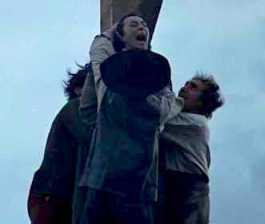 shot against Reeves’ wishes, featuring needlessly topless wenches. This is the cut shown by the BBC.)
If the violence isn’t disgustingly gory, what’s truly horrific is how real it is. I have no idea if the torture and execution methods are historically accurate (the lead characters were real people but the plot is far from historically accurate), but the opening hanging is nasty due to the woman’s distress, the later burning tortuous because we know that, at some point in history, for whatever reason, this kind of death penalty was dolled out… If it’s horrific or scary it’s down to the threat of violence, or the cynical sadism with which people are tortured, rather than gory special effects (indeed, the blood on display is marvellously fake) or supernatural goings-on (of which there are resolutely none).
In fact, if we’re discussing genre, it’s more like an historical action-adventure, with soldiers dashing around the countryside, horseback chases, bar brawls, ambushes, and the occasional sword fight. If you changed the villain from a witchhunter who tortures and murders in Very Nasty Ways for money, to a dastardly chap who just stabbed people for money, the film would still function and the controversy would instantly evaporate. I’m not saying they should have, because that’s not the point; just that, in structure and (in many places) tone,  Witchfinder General is more action-adventure than horror.
Tom Baker (not that one) and director Reeves’ screenplay (adapted from Ronald Bassett’s novel and nothing to do with the inspiration for its US title, Edgar Allan Poe’s poem The Conqueror Worm) adds a surprising amount of depth for either genre. It largely eschews the politics of the era — both the good and bad characters are on the side of Cromwell, the civil war only cropping up to provide period detail or motivation for characters’ movements — instead developing character and thematic interest.
Take hero Richard Marshall’s relationship with his beloved Sara’s guardian uncle, John Lowes. Lowes dislikes both Richard’s cause and his prospects, but is prepared to condone their marriage so Sara can escape the witchfinder’s path. Or the myriad minor characters who are well prepared to do as they’re told, or report people as witches just to get rid of them, often in silent agreement with the witchfinder and/or magistrate that everyone knows these people aren’t guilty of any real crime, but are still prepared to say or do whatever because someone wants rid of them. Thematically, one can read points about the corruption power can bring, in particular abuse of political situations.
 Best of all is the witchfinder himself, excellently portrayed by horror stalwart Vincent Price. Indeed, all the credit may lay with him, because it’s his line deliveries and uncertain looks that make the character conflicted early on, a man who may believe he is genuinely doing good for Christian values, but is seduced down darker paths by money, power, lust, and the prospect of revenge. When he allows himself to be lured to Sara’s bedroom as payment for leniency on her uncle, we’re uncertain if he’ll take what’s intended or use her loose ways as proof of witchery. That it’s the former quickly indicates how seriously he takes his espoused Christianity.
In the rest of the cast, Ian Ogilvy makes for a suitably dashing, morally centred hero as Richard, while Robert Russell is equally suited to the part of brutish, loutish, but insightful torturer Stearne.
The picture is nicely shot, with a suitable realism to the locations. Though one of the most horrific things about the whole movie is some of the most dire day-for-night footage I’ve ever seen — it seems to consist of leaving the sky rather bright while everything else is darkened  to near-silhouette levels of blackness. It’s even less convincing than that fake blood. I enjoyed the score too. A completely new one was written for the US release, but I presume this was the original because it was slightly calmer and more haunting than one might expect from an action-adventure-horror movie (which I presume was the reasoning for the replacement).
Despite the controversy, Witchfinder General will no longer please the gore-seeking brigade of certain horror fans — no bad thing. While it’s undeniably sadistic in places, it’s appropriate for the dark, realistic theme of the story. It may not be factually accurate, but it conveys well the sense of a dangerous, violent, morally bankrupt era. Its place as a British horror classic is well earnt.
Witchfinder General is on BBC Four tonight at 10:10pm.
Witchfinder General is on BBC Two tonight, Friday 31st October 2014, at 12:05am.

 Force of Evil comes well recommended, with places on several 1,000 Best Movies lists and inclusion both on They Shoot Pictures…’s 250 Quintessential Noir Films and in the US National Film Registry, not to mention a full 5/5 in Paul Duncan’s consistently handy Pocket Essential Film Noir. But it didn’t work for me.
 Duncan’s analysis (Force of Evil is one of seven noirs treated to an extended segment in his book) suggests a more complex reading of the film than I took from it, explaining much as symbolic or metaphorical. Considering I didn’t engage with the film, I’m tempted to see Duncan’s reading as a way of rationalising things that either aren’t there or were flawed, but the film’s wider critical acceptance suggests he may well be right.
 Living Free is, in many ways, a tale of obsession. I’m certain that wasn’t Joy Adamson’s intention in writing the book, and I don’t think it’s the filmmakers’ intention either, but the facts can still play that way. The Adamsons devote months of their time, give up a promising career, spend all their savings, drive themselves into debt, and are nearly killed several times, all in a frequently-extreme effort to save three delinquent lion cubs who would be put down were it not for their sentimental attachment.
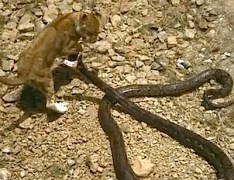 The rest of the story moves into What Happened Next territory: Elsa dies, the Adamsons’ obsession with finding and saving her cubs begins. The film skips the book Living Free, adapting threequel Forever Free instead, presumably for dramatic reasons — I imagine Elsa and cubs just living isn’t as much of a Story as her death and subsequent events.
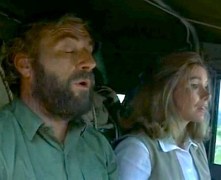 Living Free isn’t as endearing as Born Free. By the very nature of trying to keep the cubs wild, they’re less relatable than Elsa and consequently we become less attached to them. As you may’ve guessed, I found it more interesting to look on the film as a story of obsession, one that threatens to ruin the Adamsons’ lives, though ultimately it has an upbeat ending.
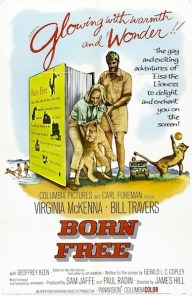 Born Free tells the true story of Joy and George Adamson, a Senior Game Warden in 1950s Kenya, who adopted three lion cubs after mistakenly killing their mother. Though they give two away to a zoo, Joy can’t bear to part with one, Elsa, and so they raise her — until circumstances force them to part with her. Despite Elsa’s age, Joy insists they try to release her into the wild rather than send her to a zoo.
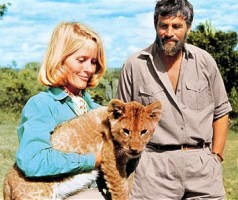 Then there are the other animals, including elephants (always wonderful) and the Adamsons’ adorable pet… rodent… (look, I’m no expert.) Best of all is a head-butting warthog, who has instantly become my favourite film animal. The entire film was worth that sequence.
 This is one of those films I always feel horrendously under-qualified to bother offering any kind of thought on. It’s the kind of film you suspect benefits most not just from repeated viewings and a desire to dig deep into its themes, but also a wider understanding of the director’s work and thematic concerns. This is only compounded in the case of Ozu by the fact I watched
  (which bolsters my belief that his most renowned work is indeed worth a second shot). One issue, I suspect, is that I knew nothing of Ozu before my first experience; having read up on him (if only a little), his idiosyncratic squared-off shots and straight-on close-ups feel less blatant and frequent here, and being aware of their deliberateness perhaps makes them less intrusive. That said, I remain unconvinced by it as a guiding notion — I’m sure there’s a reason beyond the proliferation of American cinema that the visual style we’re used to seeing in most film and TV is, well, the visual style we’re used to seeing.
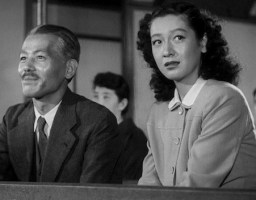 when the prospect of marriage and leaving her father seriously raises its head. (And I’m afraid that’s the closest to analysis you’ll find here.)
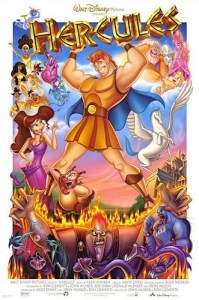 Hercules is the first post-me Disney; the point where, for whatever reason, I stopped watching their output. But, of course, Disneys — good Disneys, at any rate — are suited to every age group.
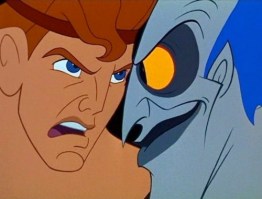 animal-sidekicks-with-no-dialogue-who-can-still-convey-their-thoughts-and-feelings-perfectly (I feel this tradition needs a snappier name.) Love interest Meg, meanwhile, starts out intensely irritating but is gradually redeemed. Good work, I say to the film’s
 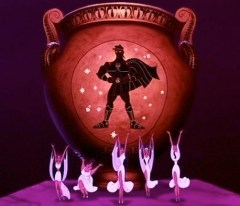 (though even mentioning it in the same sentence as that number makes it sound better than it is). Only love interest Meg gets a passable song, not that I could remember it within hours of watching the film. Maybe it’s not all that bad really, but when early-’90s Disneys could produce several unforgettable tunes per film, it feels like a weak album from a band you usually enjoy.
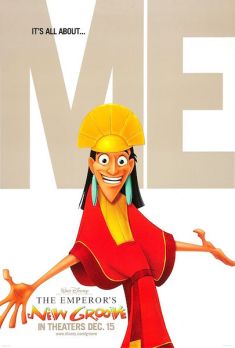 Disney’s 40th (canonical) animated film had a very troubled production, which, from what I can tell, turned it from a derivative riff on The Prince and the Pauper into this load of tosh.
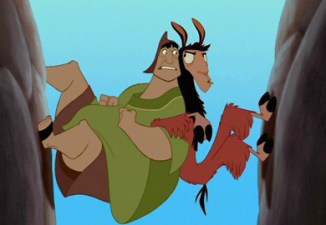 In reality it doesn’t suffer from that too much, and again looked nice and crisp in HD. I usually ignore image quality when it comes to reviews — not that I don’t care, but in these reviews I’m aiming to look at the content of the film rather than the particular copy I watched — but HD has such noticeable benefits for animation (when done well).
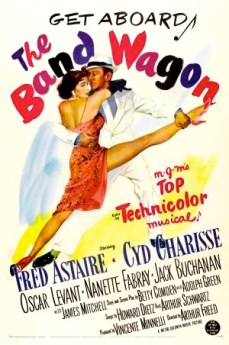 In this behind-the-scenes musical, Fred Astaire plays Tony Hunter, a slightly washed-up star of stage and screen. One can’t help but wonder if his performance has an autobiographical edge. It’s of no concern to the viewer though, because he’s as wonderful as ever.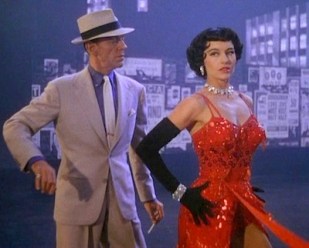
 Gigi is a film about largely horrid people doing morally dubious things. But of course it’s a musical from the ’50s, so it all has a veneer of loveliness and respectability.
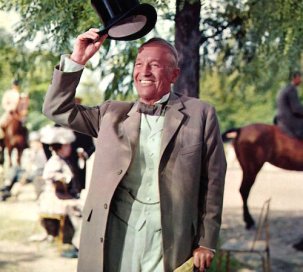 eventually Gaston realises he loves Gigi and her training is stepped up so she can become his latest conquest. I won’t go into the details of the ending, but their part of the story ends well.
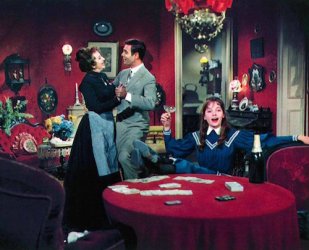 I’m Glad I’m Not Young Anymore is also a nice change of pace, celebrating old age for a change.
 100Films.co.uk