
Daniel Barber | 103 mins | Blu-ray | 18 / R
 Michael Caine killing hoodies. How great does that sound? As a film premise, that’s awesome. If it doesn’t get you excited about seeing this movie, then what kind of film fan are you, eh?
A mentally mature one, probably. But hush, don’t spoil our fun — those of us who may occasionally hanker for a morally simple form of voyeuristic vigilante justice want to see Sir Michael shooting yobs who definitely Have It Coming. Harry Brown delivers this wonderfully.
Politically and morally, in a real-world sense, Harry’s actions are as questionable as those in any vigilante movie. And yet, for that, it’s hard to avoid the sense that he’s bloody well right. Even as someone against capital punishment, against unnecessarily arming the police, and so on, there’s still satisfaction in witnessing Harry carry out his revenge; justice. When police raids kick off a violent riot at the climax, there’s the thought that Harry was dealing with this more effectively; that cutting the yobs down in a swathe of machine-gun fire might be the best solution for the future of humanity.  Which in some ways is quite a chilling way to feel. I’ll be buying the Daily Mail and watching Sky News next.
Barber’s film tries to dress itself up as plausible social drama, mind. Of course it’s more revenge fantasy wish-fulfilment, but perhaps the veneer of believability makes what happens even more satisfying. The bright side of that is the film manages to be a bit more than just a celebration of violence. It takes the moral question head on… sort of. “Where does it stop?” asks one character, once Harry’s dispatched with all but one of the main bastards who need dispatching. There’s a twist, which is neatly built up and I didn’t see coming so I won’t spoil, and it does make you briefly question, “where does it stop?” And that’s why vigilantism, or revenge in any way, is an ineffective solution in the real world. But this is a film and there comes a solution, so that’s OK. As with the rest, it is deserved, and it’s difficult not to think, “well, Harry was right, actually”.
Caine gives a stunning performance as the titular pensioner. The film bothers to invest you in the character: a man shattered by the death of his wife, the murder of his only friend, the past loss of a daughter, and buried experiences serving as a Marine in Northern Ireland. The evolution from quiet, downtrodden everyman to skilled vigilante is plausibly created — or, at least, plausibly enough. It’s to the credit of screenwriter Gary Young that he doesn’t dive to the vengeance action as soon as possible; to the credit of Barber that he’s not afraid to let the early scenes play out slowly, often with lots of silence, conveying the reality of the lonely pensioner. 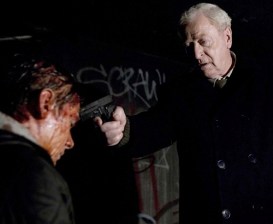 Whatever you may think of the revenge thriller it turns into, I think it’s hard to deny these early scenes have a realism and power. It is, of course, to the credit of Caine that he performs all this flawlessly. Oh yes, he’s (to quote another review) “the king of cool” when blowing away the scum that surround him, but before that he’s an affecting old gent, abandoned by the world.
Comparisons with Death Wish should probably be made, because yes, they do have much in common. Harry Brown is more skilled, though: Caine out-acts Charles Bronson at every turn, and Barber clearly is a director of not inconsiderable talent, something Michael Winner patently is not. The structure is the same, really — motivation from a brutal attack on the closest person to our lead character; spurred by his general feeling of useless ineffectiveness in the face of the modern, violent world; a long, steady slide downhill before our hero turns to vigilantism; his struggle to pull off the attacks — he’s no superman, they don’t go perfectly. But Harry Brown feels superior. Perhaps because it’s more vital to our times — this is a situation occurring in our country right now, not a somewhat abstract rape and murder. Not that those aren’t foul crimes, but Harry Brown has more of a relevant social conscious.  The counter to that would be that a murder spree may be viscerally satisfying but isn’t a real-world solution, so this is just as useless at relevancy as Death Wish.
One might also argue that Harry Brown loses Death Wish’s strongest aspect: Bronson never gets the men who attacked his family, only able to exact vengeance on criminals he happens across; Caine, on the other hand, gets to attack those responsible… and a couple of others who are peripherally connected and at least as deserving of his bullets. It’s more narratively satisfying to get revenge on the actual perpetrators, but not always as realistic. While that is a strength in Death Wish, it doesn’t make Harry Brown a lesser film for not following the same path. This is a different story, despite the similarities — it’s set in a more confined area, with more specific problems, and the murder is the catalyst for Caine’s character to take action against the people who are perpetrating all the crime, not just the particular one that galvanises him.
This is the kind of movie that can polarise an audience. For one thing there’s lurid and extreme language and violence, and lots of it — this well earns its 18 — but it is, largely, justified by the context. Beyond that, there are a lot of political and moral implications raised by the film’s realist tone. 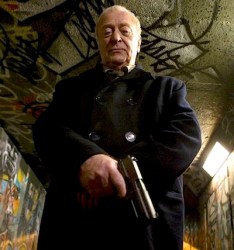 Some will think it tackles these, others that it’s just a facile revenge movie; some will think it’s cool, others despicable; some will think it plausible, others anything but. Or maybe, rather like me, you’ll think it’s all of those things, however mutually exclusive they may seem.
Harry Brown is satisfying when you know it probably shouldn’t be, and because of that it’s also thought-provoking, and because of those things it’s five stars from me.

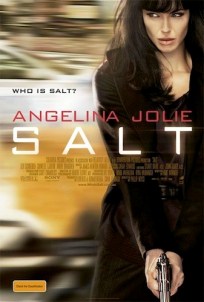 Angelina Jolie takes on a role originally earmarked for Tom Cruise in this Bourne-ish spy thriller from screenwriter Kurt Wimmer (
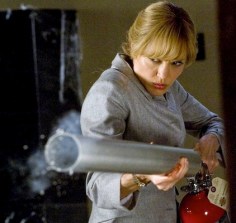 This is Salt’s mystery, and this is one of its strong points. The plot developments are well-paced throughout, developing and shifting our expectations rather than stretching it all for a glut of final act reveals. In this regard it goes places you might not expect from a mainstream Hollywood thriller. For starters, you expect the funeral-set assassination to eventually be the film’s climax, no doubt revealing our heroine isn’t a Russian spy as she unmasks the real killer. But that occurs at the halfway point, spinning the film off in new directions. To say more would spoil one of the film’s strongest elements: that, as I said, it has twists and follows storylines you wouldn’t expect in a Hollywood summer blockbuster.
 The three cuts, then, are: Theatrical (100 minutes — this was trimmed for the UK to make 12A, but is apparently uncut on disc); Director’s Cut (the one I viewed, this is 4 minutes 5 seconds longer); and an Extended Cut (1 minute 5 seconds longer than the Theatrical). The latter is based on the Director’s Cut and I’ll come to it in a minute. The differences between the Theatrical and Director’s cuts are numerous, but mainly amount to some extra character beats (including more flashbacks to Salt’s childhood) and violence — more blood; seeing people get hit rather than just seeing Salt firing; the President is killed rather than just knocked out; plus a very different death for Salt’s husband (again, more on this in a moment). Plus there’s a voiceover ending too, which in my opinion sets up the sequel even more than the Theatrical version does, with a blatant cliffhanger and suggested plot direction. My regular comparison site
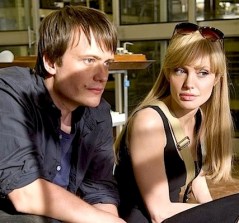 She has to control her emotions so as not to give herself away. In the other versions, however, she’s presented with him in a chamber and given a choice to save him — except trying to save him would give her away, so she’s forced to watch, blank-faced, as he slowly drowns. Salt sacrifices him for the greater good; he dies seeing her cold emotionless face. Ouch. By comparison, the theatrical cut’s blunt gunshot is much softer.
 if the filmmakers considered another option, now we can see it, and in cases like this choose our preference. Though it seems clear, by its inclusion in both the theatrical and director’s cuts, that Noyce preferred the instant-revenge option.
 Just over a year since the
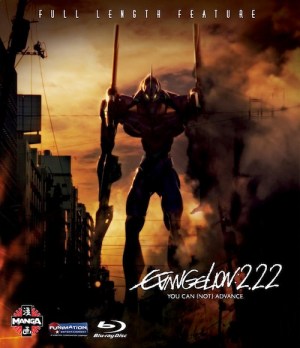
  For my money, the first 40 minutes or so of the film are (by and large) the best bits. It opens with a barnstorming action sequence, a great scene for newbies and fans alike as we’re introduced to Eva pilot Mari, who didn’t appear in the TV series. That she then disappears for most of the film, only to make a thoroughly mysterious return later, is one of those explanation-lacking flaws. I’m sure it won’t look so bad once the next two films provide us with answers. Well, I hope not.
 Then the gang take a trip to a scientific installation which is trying to preserve the oceans and their wildlife. It feels like animation shouldn’t be as effective for such a sequence as, say, the footage in a David Attenborough documentary, but nonetheless it feels extraordinary, in its own way. It also marks itself out with the interaction of the characters on a fun day out rather than their usual high-pressure monster-fighting world. And then it’s back to that world for another impressive three-on-one Angel attack.
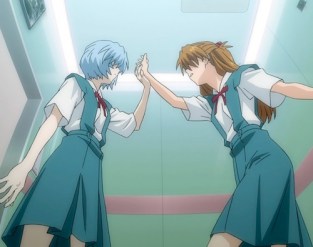 But it’s all building somewhere. For one, there’s another of the film’s best sequences — certainly, its most shocking, which readily earns the 15 certificate. I don’t want to spoil it for anyone yet to see the film, because it’s one of the plot points that differs from the TV series, but it involves the death of a main character in a brutal, deranged way. I say “death” — they pop up in the third film trailer that runs after the end credits, so there’s more to this yet…
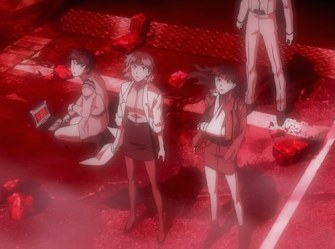 And then, after the end credits, there’s a brief scene that throws another spanner in the works! Double-cliffhanger-tastic… one might say…
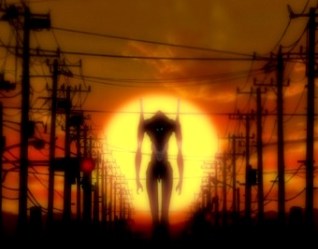 In short, if you’ve always liked Evangelion then you won’t be waiting for me to tell you this is a must-see reimagining; if
 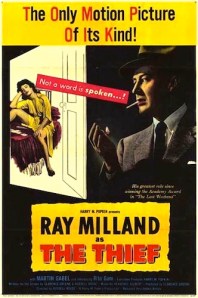 Ray Milland stars as Dr. Allan Fields, a nuclear physicist working at the United States Atomic Energy Commission, who is photographing secret files and passing them to The Other Side, until something goes wrong and the authorities are on his tail. But that’s almost beside the point, because if The Thief is known for anything it’s for its dialogue — as the poster proclaims, “not a word is spoken…!”
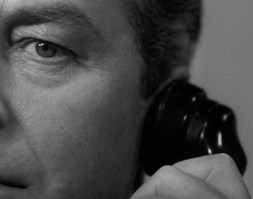 Obviously we can look back to the silent cinema for that kind of thing, but while that era could probably still teach many filmmakers something about visual storytelling, it’s hard to deny that the advent of synchronised sound adds a helluva lot to the ability of film — if it didn’t, it wouldn’t have taken over so fast and remained virtually 100% dominant for the last 80+ years.
 Perhaps this is why the villains are never explicitly named. But they’re definitely not American! Tsk tsk. More crucially, it’s a bit slow at times — it seems to take longer to explain things when stuck doing them through visuals alone. That said, it could probably have survived a speedier approach even doing what it does — perhaps, then, Rouse is playing for time: the film only runs 87 minutes in spite of its pace.
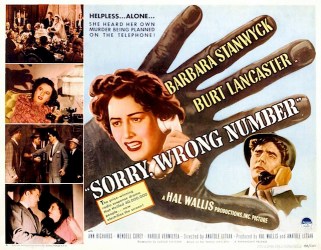 A film noir screenwritten by Lucille Fletcher, “based on her famous radio play” — I love how old movies have credits like that. It sounds like pure hyperbole, but in this case seems to be justified: the original play was broadcast in May 1943 but was so popular they chose to re-stage it with the same lead, Agnes Moorehead, a total of seven times up to 1960. Seven!
 As if keeping us guessing wasn’t enough, our feelings are shifting in this respect too. Arguably it unravels a little late on — when Evans is explaining his part to her, it’s getting a bit implausible — but it’s all redeemed by the finale.
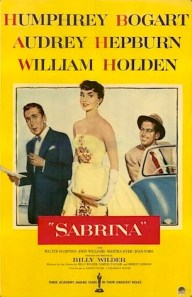 Audrey Hepburn’s next leading role after her star-making turn in
  But it actually feels very mean-spirited — Sabrina is likeable enough that we dislike his machinations. Which means that, for me anyway, there’s no truly supportable lead character. And then at the end he genuinely falls for her, which I found an equally implausible development — as well as seeming totally out of character, it did nothing to redeem what had come before. And he’s old enough to be her dad.
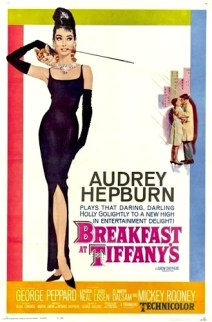 Breakfast at Tiffany’s is a stonkingly famous film — it’s the one most of the famous images in the cult of Audrey Hepburn come from — this despite the fact that, as
 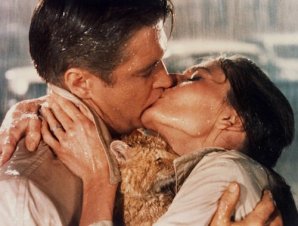 but it works here, especially when sung plainly by Hepburn.
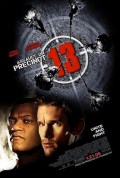
 John Carpenter’s rough-and-ready ’70s exploitation B-movie is remade as a slick ’00s action B-movie dressed up as an A-movie by director Jean-François Richet (who would go on to find far greater critical acclaim with his two-part French crime epic
 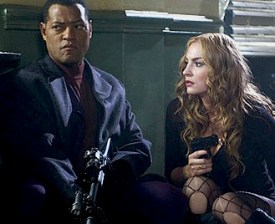 I don’t have hard timings to back this up, but I think the siege starts earlier and lasts longer here. It certainly felt that way, in part because the character of the father (whose act of revenge leads the gang to the precinct in the original) is gone. Of course, the film is about the titular assault on the titular station, so I think this refocussing is more than fair enough. It, naturally, emphasises the siege element of a film about a siege, something the original almost reneged on with its lengthy setup.
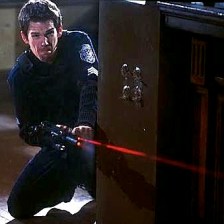 The only reason the prologue is necessary is if you want to begin your movie with an action sequence… so that’s why it there then. It’s also set in a sun-drenched summery atmosphere, totally at odds with the well-evoked wintery New Year that pervades post-titlecard. Consequently, looking back on the prologue, it feels even more out of place. I think it’s also designed to set a Gritty tone, with its rundown apartment and drugs deal and all that palaver; probably because the rest of the film is too far-fetched, if you were hoping viewers were going to be in mind of
  criminals inside the precinct are black or (in one case) hispanic. Ouch. You could try to argue we’ve developed past the need to force anti-stereotyping in casting; or you could argue this is a mainstream studio remake that felt the need to fall back on the familiar. It might not be a noticeable point were it not for it being so markedly different to the original.
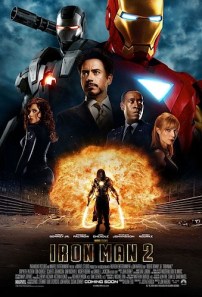 I’ve always contended that the first
  For starters, it relies on the story rather than the action. There are certainly some good sequences of the latter (more about those later), but there’s also a lot of story in between them — it’s not wall-to-wall explosions and punch-ups. Neither was the first, if you remember, and so it fits in that respect. It’s helped along by the ending of the first film, in which Tony Stark revealed he was Iron Man. That’s not something you do in superhero movies, which immediately lends this one a few new plot devices to play around with. Considering the burgeoning critical assessment that all superhero movies ever only tell the same two or three stories (an argument I think has a lot of validity), it’s nice to see anything to challenge the norm.
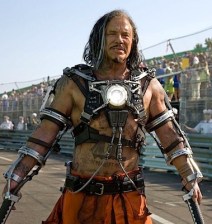 it’s the Penguin and whover-Christopher-Walken’s-character-was rather than Mr Freeze and Poison Ivy, if you will. They play to different sides of the hero: one is fighting Stark, one Iron Man (though there is naturally crossover); though they’re both intelligent, one functions as the brains and the other as the brawn. Mickey Rourke may go slightly underused, but it’s also part of the character, a quiet, thoughtful, intelligent hulk partnered with Sam Rockwell’s jabbering wannabe-Stark.
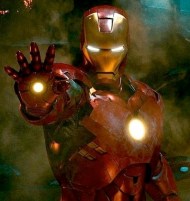 watched again later on Blu-ray, I enjoyed it a lot more. With Iron Man 2 I’m obviously distanced from trailers by a good year or so, and though one of their best moments is missing from the final cut, and the suitcase-suit is unavoidably spoilt by being so thoroughly screened during the promotion, watching now doesn’t have all the trailer-generated expectation to live up to. That famous Onion spoof about the first film’s trailer is, perhaps, even more applicable to the sequel.
 Aside from one unnecessary scene featuring Captain America’s shield and Agent Coulson leaving for New Mexico, and the fact that the film assumes everyone will know who Nick Fury is despite him being introduced fleetingly after the credits of the last film, the whole S.H.I.E.L.D./Avengers Initiative thing is worked into the plot well. If we didn’t know it was the beginning of the build-up to The Avengers, I think it would have sat much better with viewers. Even if it does end up blatantly laying the foundation for further stories, that’s hardly uncommon in franchise films of all kinds these days — at least we know this series will definitely pay it off, unlike so many franchise-wannabes that don’t make it past their first film. Plus, the film’s primary plot has its own villains and comes complete with a resolution; Fury, S.H.I.E.L.D. and co are a subplot that feed other subplots.
