
John Lasseter | 112 mins | DVD | 2.39:1 | USA / English | PG / G
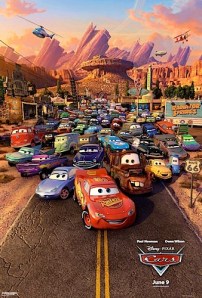 Since the creation of the Oscar for Best Animated Feature, only two Pixar features have failed to win: Monsters, Inc., which lost to Shrek — surely a key computer-animated film in anyone’s book — and this, which lost to Happy Feet, which was… well, it was quite good…* Obviously this does nothing to help dismiss Cars‘ reputation as Pixar’s worst film. But then, that reputation doesn’t warrant dismissing.
Much has been criticised by others, but my biggest problem is that it’s a bit predictable, kinda like Pixar/any kids’ movie by numbers. Pixar are usually better than that. There may be one or two slight surprises along the way — mostly in aid of a Good Strong Moral Message for the kiddies — but at times it’s a bit thumb-twiddly as you wait for characters to reach the point they’re inevitably headed for. It goes about these in such a long-winded fashion that it drags in the middle.
In a special feature on the DVD, Lasseter talks about how it was a very personal film, with a story inspired by his own family and past, as well as the Pixar crew’s road trip along Route 66, with events from that directly inspiring elements of the final story. I think this shows on screen, but not in a good way. It’s another reason the film is allowed to be occasionally long-winded and indulgent. No doubt it led to some of the best bits — the sequence where The Girl Car (I forget her name) tells The Main Car (McQueen! I remember that one)  how the building of the interstate killed off so many small towns is both historically accurate (more or less) and emotional — but I imagine it also explains why the film can feel so long.
This could be alleviated by the characters, but they’re not all that. Every one is lifted from a book of stereotypes, with such unfailing tedium that I can’t be bothered to list them. Some are moderately likable and occasionally they’re nice to spend time with, but it’s not a patch on any other set of Pixar characters — it can’t reach Ratatouille, never mind the Toy Storys.
The races — read: action sequences — are exciting and fluid. But then, would you expect anything less from Pixar? But then, with the film’s other failings, it’s good to see they haven’t lost all the magic.
I’ve often heard people criticise the world of the movie for not making sense but never understood why, because it doesn’t necessarily matter. But it does play on your mind while watching, and because it shouldn’t matter I think it’s indicative of faults elsewhere: if the characters and story were keeping your attention, if the film was consistently funny or exciting or engrossing, you wouldn’t be wondering who built these cars, or where their builders went, or how they reproduce… It’s like a child’s game writ into film: you can imagine a young boy playing with little toy cars,  having them talk to each other and giving them personalities, and it doesn’t need to make sense because his age isn’t even close to double digits and he’s just playing. But does that make it a viable idea for a film?
Aside from being Pixar’s Bad Film, Cars has become best known for the marketing machine it turned into, in particular the masses of high-selling model cars that have been churned out on the back of it. I don’t know how intentional this was — not as intentional as it seemed to be for the sequel, I suspect — but once you know where this ends up it’s reflected back into the film. McQueen sports at least three different paint jobs, for instance — that’s a handful of model cars right there, and if you make them in different sizes… Disney accountants must have been rubbing their hands in glee when these things started selling. It’s disappointing that this seems to have been the motivation for Pixar creating their second franchise, but hey, if the money brought in by a Cars movie’s merchandise every five years allows them to keep pushing (albeit gently) at the boundaries of mass-(Western)-market animation with the likes of WALL-E and Up, then I guess we shouldn’t complain too much.
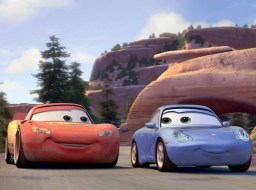 Cars is undoubtedly a below-par Pixar movie. It’s not a bad film — it has funny bits, exciting bits, a good moral message, some nice cameos and references and that kind of thing — but it doesn’t stand comparison to even a regular Pixar outing, never mind the best of their output. But hey, if you can produce 10 features that manage a 90%+ score on Rotten Tomatoes, I think you’re allowed a 74% slip-up.**

Cars is on BBC Three today at 9pm, and again on Sunday at 7pm.
* Based on its reception, Cars 2 may well be added to this list. Potentially beaten by Happy Feet Two. That’d be kinda funny. ^
** Other review comparison and aggregate websites are available. Does not include Cars 2, which scored 38%. (Ouch.)
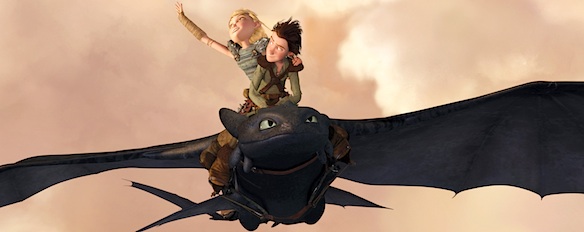
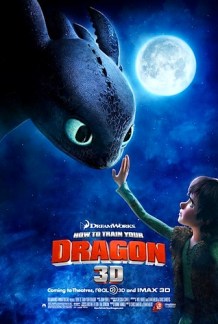 I saw a trailer for How to Train Your Dragon at the cinema a few months before its release. Having never heard anything of it, I thought it looked to have basic animation and a too daft tone. I wrote it off, expecting the kind of animated movie that would be slagged off as a Pixar-wannabe… and probably still land an Oscar nomination because there never seem to be many contenders for the animated feature award. Imagine my surprise, then, when it garnered endless positive reviews and a huge box office. What?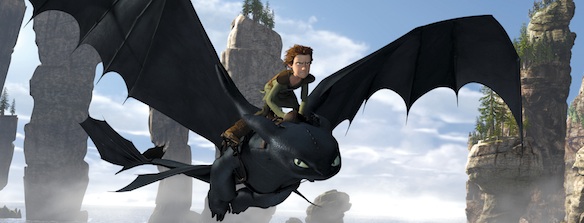

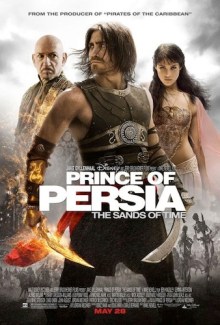 Disney’s attempt to launch a second franchise in the mould of
  There are some good action beats, but there’s also plenty of disorientatingly-edited, CGI-enhanced sequences, as per usual for the genre these days. For the former, see for instance Dastan’s climb up the wall into Alamut (or whatever it was called), or the knife-thrower-on-knife-thrower battle near the end. For explosions of CGI, see the massive logic-shattering ‘sand surfing’ sequence in the climax. Visually they’re clearly trying to evoke
 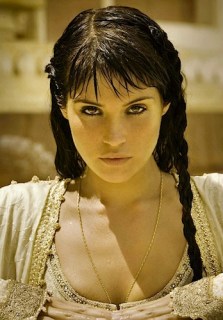 has the role Keira Knightley would’ve played five years ago. I think she’s meant to be a Strong Independent Princess but, much like Dastan, we’re told we should be inferring it rather than seeing any evidence of it.
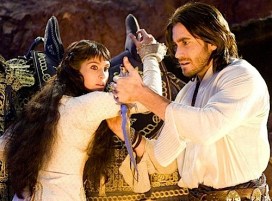 Plus, the sword-and-sandals milieu makes a bit of a change. I know we’ve had plenty of swords-and-sandals-flavoured movies in the wake of
  Holiday stars Cary Grant as an everyday chap who falls in love with a girl who, it turns out, is a wealthy heiress type… but who it also turns out may not share his views on the future. Her kooky sister, played by Katharine Hepburn, on the other hand…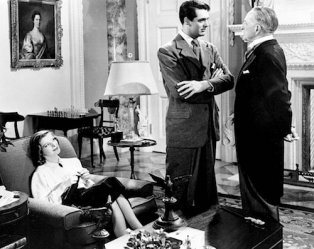

 The thoroughly blockbusterised remake of
 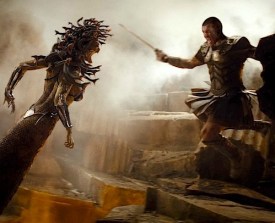 What the film is built to do is provide action sequences, though these are passable and rarely more. They’re fine while they’re happening, but pretty much forgotten after — none of it shows a great deal of inspiration. The history of film is littered with far worse examples, but that’s about the best I can say. I can see why it would be painful in 3D too: quite aside from the use of always-criticised post-conversion, and the apparent rush job on that, Letterier favours the modern action style of handheld jiggly shots and fast cuts, neither of which lend themselves to the 3D experience. Heck, even Michael Bay acquiesced to adapt his similar style when shooting
 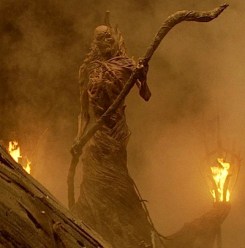 Design is probably the film’s strong point, particularly sequences that feature the three witches and the ferryman. Clearly these dark, borderline-horror-film settings are the design team’s strongpoint. Elsewhere, the gods have an appealingly retro lens-flared-silver-armour look about them — I don’t remember the ’80s original very well, but one could imagine this iteration of the gods being dropped in without anyone noticing.
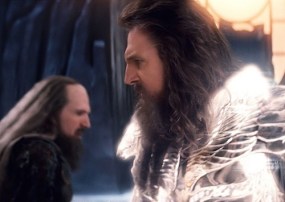 some plot elements could do with greater clarity, most of the characters could do with some depth.
 David Mitchell and Robert Webb move from the small screen to the big one in this comedy from the writers of their sitcom
  while Webb is adept at dancing sillily and, increasingly, hosting / voice-overing quickly-made cheap rubbish for various channels. These are all skills in their own way, but they don’t necessarily demonstrate brilliant acting. But, hey, they’re fine here.
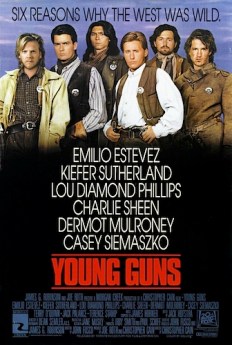 Way back in March, the ever-excellent Colin at
 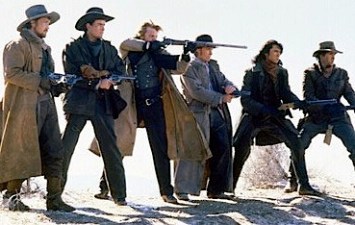 Though if someone was planning to use Young Guns to research the real-life facts of these events, more fool them in the first place. Wikipedia says (without citation) that “historian Dr. Paul Hutton has called Young Guns the most historically accurate of all prior Billy the Kid films”. We’ll leave it at that for now.
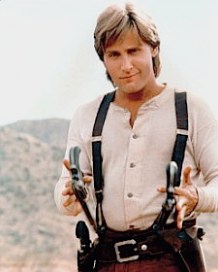 And that’s without mentioning the overuse of dated slow-motion that descends upon its eventual climax.
 Young Guns is not a particularly likeable film, managing to miss both its potential target audiences: it’s not serious-minded enough for Western enthusiasts, let down by the Brat Pack cast and (it seems) historical accuracy; but it’s surely not fun or modernised enough to appeal to a younger (or younger-minded) crowd. Though clearly it did well enough as it spawned a sequel two years later. I didn’t hate it, I just didn’t particularly like it.
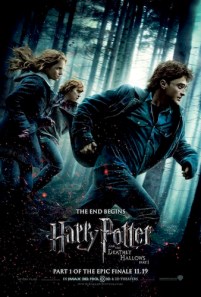 While the final Harry Potter film continues to obliterate records at box offices around the world, I finally caught up on the penultimate instalment in the phenomenal fantasy series. It’s Part 1 of
  of having seven books each covering a school year, but hush, let’s overlook that (everyone else seems to).
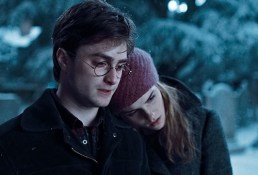 Talking of exceptional sequences, the animated one can’t go unmentioned. It’s wonderfully done, inspired by old silhouette animations, though achieved in 3D animation here, which is a pity. It’s still beautiful to look at, and it’s very fluid, but I can’t help but feel it would’ve been even more effective if they’d gone all out and done it in 2D.
 Themes of Nazi/Stalinist-style oppression are played up in the story (trials of those whose “blood status” is in doubt; listening to the radio for news of loved ones; Bellatrix’s torture of Hermione) and production design (the muggle-crushing new statue in the Ministry; the art style of anti-mudblood propaganda leaflets; the uniforms of the Ministry guards), but it’s subtle enough that it doesn’t batter you around the head.
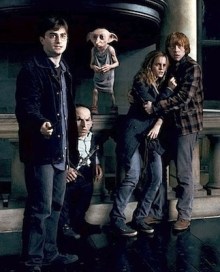 And so, the ending — which isn’t, because we’re in the middle of the book. So how well does it work as, y’know, an ending? Quite well, as it turns out — indeed, one might even compare it to something like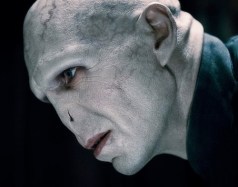
 Having been remade to Oscar-nominating effect by American Cinematic Gods the Coen brothers, the first adaptation of Charles Portis’ Western novel True Grit was around plenty (on TV, Blu-ray, etc) back in… February, I guess. The story in all three versions (which might sound obvious, but is never guaranteed when it comes to adaptations) concerns a 14-year-old girl, Mattie Ross (here, Kim Darby), whose father is murdered by his hired hand, so she sets out for murderous revenge, recruiting Marshal Rooster Cogburn (John Wayne) to help because she’s heard he has the titular attribute.
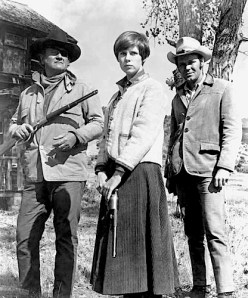 14-year-old but as a 14-year-old who’s wise beyond her years. Hailee Steinfeld’s performance in the remake has been much praised, but it has a lot to live up to from this.
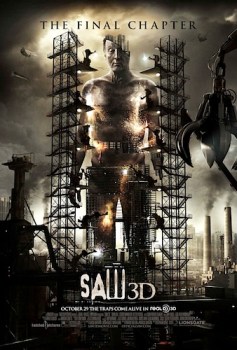 What’s this, the
  With so many characters killed off in the preceding films we’re not left with anyone to really care about — certainly not the new gang of coppers we’re introduced to. Actually, to say we’re “introduced to” them is a kindness — they just turn up and begin to lead that part of the plot.
 a lot more regularly than they were in previous films, and bits of them swing in the direction of the camera, but that’s in keeping with the style of the series and doesn’t jar massively — if you didn’t know it was shot for 3D, you wouldn’t notice most of it.
 The worst side effect of 3D, however, is that the colour looks ridiculous in 2D. I’m glad they’ve shot it with 3D properly in mind — everyone knows the glasses make 3D films darker, but not every filmmaker seems to be compensating appropriately (see, for example, the criticism of
  100Films.co.uk