
Wilson Yip | 106 mins | TV (HD) | 2.35:1 | Hong Kong & China / Cantonese, Mandarin & Japanese | 15 / R
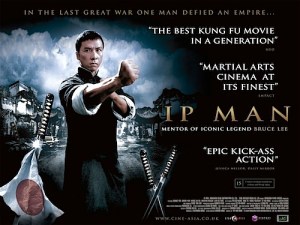 I liked Ip Man, but as we know from experience there are times when I find myself with little to say about a film, or I fail to make any notes, and this was an example of both. So I’ve decided to try something a little different.
I’ve read several different reviews of the film, found by various means, and have compiled a selection of quotes from them below. These are all segments of those reviews that I agree with or found to be an interesting point — I’m not trying to accurately represent each reviewer’s opinion, but instead using their words to enlighten my own. Each quote is, of course, credited and linked, so if you want to know their full opinion you can click through.
They’re arranged in an order that I think makes sense, too — by which I mean, rather than just bundle a selection of quotes in any old order, I’ve sorted them so that if you read them through as presented they should form a structured (more or less) piece.
And so:
Biographical martial arts drama starring Donnie Yen. China in the 1930s: Ip Man’s reputation as a martial arts master has brought fame and fortune to the city of Foshan. But hard times are ahead, as the Japanese invasion brings the once prosperous city to its knees.
Donnie Yen plays the eponymous Wing Chun master, who stove off hunger, poverty and half the Japanese army during China’s WW2 occupation – by kicking ass!
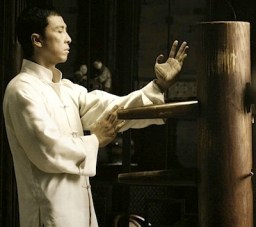 Though that’s an amusing thought, the film’s not quite that simplistic:
As he rallies his people to stand up for themselves, Ip Man becomes about how war pushes a peaceful man into action, but also how he tries to maintain his faith in what it means to be civilized.
Ip’s transformation from diffident bourgeois to symbolic man of the people is rendered as compelling period melodrama
There’s a pleasing playfulness about the opening scenes, which contrast… with the downbeat mood that follows during the occupation.
Not everyone was so impressed:
In transforming a humble real-life martial artist into the type of the reluctant hero (and nationalist icon), screenwriter Edmond Wong has turned his subject not only into something that he was not, but also into an overfamiliar kung fu movie cliche. This is an impression not helped by the film’s desaturated period look (yet another cliche), and a drift in the second, war-set half towards melodrama
a shameless hagiography that only bears a passing resemblance to history.
To elucidate:
The presence of young Zhun [Ip Man’s son] suggests an eyewitness veracity to the events as portrayed on-screen — after all, Zhun himself, now a much older man and a wing chun master in his own right, served as a consultant on Ip Man. The film, however, does not hesitate to sacrifice the truth to the demands of dramatic entertainment.
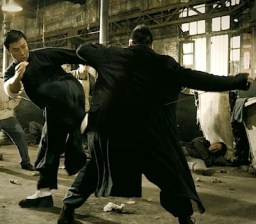
almost none of what you see in Ip Man actually happened, and in some sense that’s too bad, because the real Ip sounds like a fascinating figure. He was a pre-revolutionary police officer, a reported opium addict, and a refugee who fled the Communist takeover in 1949 for a new life in British Hong Kong. But all those factors make him undesirable as the hero of a work of rousing nationalist agitprop. So instead we get Yen’s remarkable performance as a man of prodigious Buddhist-Confucian composure and tranquility, who goes from wealth to poverty to near-slave status, and finally must fight a public gladiatorial match against a sinister Japanese general
disappointingly simplistic. Yip, Wong, and Yen never develop any real tension between Ip’s true story and the exaggerated myth-making of a martial-arts movie. But as an exaggerated, myth-making martial-arts movie, Ip Man is often thrilling.
True-to-life or not, action star Donnie Yen largely shines in the lead role:
Donnie Yen delivers a charismatic portrayal of Ip Man, the martial arts master of the title.
Man is the role Yen was made to play: a stoic tough guy that everybody in the community knows is the best
Yen’s performance is also a bit one-dimensional as the modest wing chun expert, but at least he gives a good account of himself in the finely composed and inventive close-combat scenes — an impressive highlight being when he wipes the floor with ten soldiers with methodical precision.
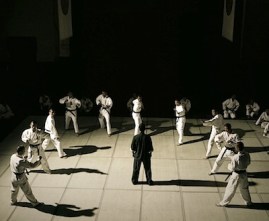 Indeed, fighting is still what the film does best:
As a showcase for the distinctive moves of Wing Chun, or more generally for some formalised (if largely wire-free) chopsocky, Ip Man is exemplary, thanks to the action choreography of cult Hong Kong star Sammo Hung.
Hung’s fight choreography is clever and exciting, with sequences that have Ip felling a sword-wielding rival with a feather-duster, or holding off two men with a 10-foot pole.
That final conflict between evil General Sanpo and Man — who of course still has to fight the biggest bad guy since the locals are too incompetent to even fight a group of disorganized bandits — is also curiously ruthless. Sanpo is likened to Man’s coat rack-like training apparatus, making the flurry of blows Man rains down on Sanpo’s head a vicious attack on a dehumanized piece of furniture. It’s a fittingly abstract and totally brutal finale.
There are definitely better kung-fu flicks in terms of pure action spectacle, but Ip Man delivers as tremendous entertainment even if you don’t much care about martial arts.
It’s not all rosy:
The film was a box office hit in China… That may have had less to do with the excellent fight sequences, directed by Sammo Hung with the help of one of Mr. Ip’s sons, than with the appeals to nationalism and, particularly, the heavy-handed depiction of the occupying Japanese as giggling sadists or implacable killing machines.
The Japanese themselves couldn’t be more stereotyped in their presentation, with the honourable-but-brutal general and his cackling, sadistic henchman
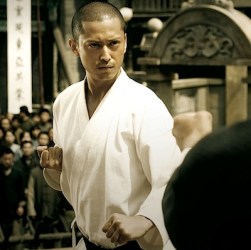 On the other hand, as that “sinister Japanese general”:
Hiroyuki Ikeuchi… imbues what could have been a cardboard villain role with dignity and grace
To revisit Film4’s point about the “desaturated period look (yet another cliche)”:
Yip’s aesthetics are more muted and traditional than those of well-known florid imports Hero and Crouching Tiger, Hidden Dragon. Yet such modesty is in tune with his soft-spoken protagonist, and also provides clean, sharp views of Yen’s awe-inspiring skills
But in conclusion:
a throwback to those chopsocky Hong Kong films of the 1970s – a period piece filmed on obvious but eye-pleasing studio sets with wall-to-wall kung fu and a simplistic, philosophical message.
I’m not qualified to judge whether [Ip Man] belongs among the top martial-arts films ever made, an opinion that’s been gaining credence as the movie bounced around the world… But there can be no doubt that director Wilson Yip has crafted a gripping, rousing, beautifully structured yarn, built around a calm but charismatic star performance by Donnie Yen and magnificent action sequences choreographed by the legendary Sammo Hung.

Consulted sources (including some unquoted)
- Abrams, Simon ‘Ip Man’ ushers in the return of the tough guys (New York Press)
- Adams, Derek Ip Man (2008) (Time Out)
- Cook, Simon IP Man 2 (Empire)
- Ebert, Roger Ip Man 2 (rogerebert.com)
- Film4 Ip Man Review
- Glasby, Matt Ip Man (Total Film)
- Hale, Mike Mastering Martial Arts (The New York Times)
- Healy, Jamie Ip Man (Radio Times)
- Johnson, G. Allen Review: ‘Ip Man’ is a fun kung-fu throwback movie (SFGate / San Francisco Chronicle)
- Jolin, Dan Ip Man (Empire)
- Murray, Noel Ip Man (A.V. Club)
- O’Hehir, Andrew “Ip Man”: A dazzling martial-arts epic (Salon.com)
- Schager, Nick Bruce Lee Mentor Ip Man Gets His Own Kickass Movie (The Village Voice)
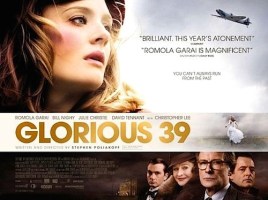 “This year’s
  I, however, thought it was rather good. I can see what turned some people off though. It’s a thriller, but it moves leisurely, especially early on. It’s also quite elliptical at times, not so much requiring you to pay attention as put the pieces together yourself. Plus it lacks a grand finale in which the hero triumphs, or at least loses in dramatic style — it’s quieter than that. Yet I liked the ending, finding it triumphant in a whole other way. But I won’t go spoiling that here.
 What’s better in a thriller than not actually knowing what will come? There should be twists in this genre — genuine twists when possible, not a stock array of “small character played by famous actor turns out to be vitally important” or ” good guy is actually bad guy” or what have you — and Glorious 39, with its balanced uncertainty, pulls some of those off.
 Part coincidence (in that I happened to notice it), part forced appropriateness (in that I then chose to post it now), 2000 AD was originally released in Hong Kong 12 years ago yesterday, tying in to Chinese New Year the last time it was (as it is now) the year of the Dragon.
 All that’s established in these parts could be done much more economically, which would result in far less viewer thumb-twiddling.
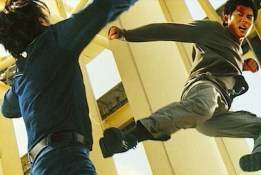 That might be being picky. The action feels slight at the time because it’s a good while coming, but in retrospect, considered on their own merits, there’s a lot of good stuff. There’s a good car chase, a couple of shoot-outs that err towards realism rather than balleticism (both have their merits, but something that feels realistically punchy is rarer), and a couple of solid punch-ups that play fairly nicely on the idea that our hero isn’t a martial arts expert. That concept isn’t mentioned in the film as much as it is in the DVD extras, but his style has a sort of scrambly feel that’s less honed than your usual kung fu bout; plus, as director Gordon Chan explains in the commentary, his apparent competency is how all kids fight in Hong Kong, because they’ve copied it from the movies!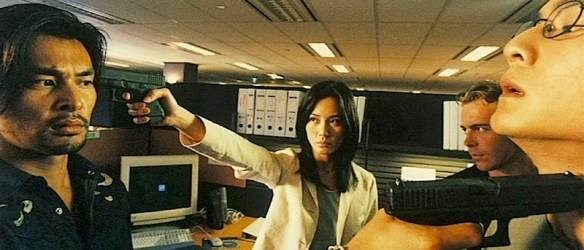
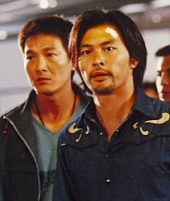 Talking of the action — it’s an 18? I know the BBFC used to be harsher, and particularly so on things featuring martial arts and whatnot, but I still don’t see how this makes an 18. A bit of swearing, a bit of blood — it’s a 15 surely? I watched this just days after
  As with any film heavily based in the realm of technology, certain things have dated. Two things work in its favour: one, as noted, it’s not actually got much to do with technology anyway; and two, it comes from the slightly later time when home computers were more commonplace, so it’s not as bad as those ’90s tech thrillers where computers could do pretty much anything a writer dreamed up. But there’s floppy discs, flight sims with flat graphics, and Magical Hacking Software that can Destroy Everything. An opening spiel about the future of warfare being cyber-attacks doesn’t feel like its quite come to pass (yet?), but then the film doesn’t wholly build on that. The computer software they’re chasing is as MacGuffiny a MacGuffin as they come — it may as well be a bomb or a file of information for all that would change the story.
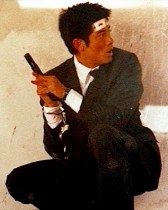 In the DVD’s special features, Chan notes that 2000 AD was an attempt to make an American-style action movie, to show there’s more to Hong Kong cinema than kung fu. Maybe that’s why it’s compromised at times — it’s an emulation of something else. It’s successful in places, but certainly not entirely. My score was awarded almost immediately after watching the film, but after looking back on it through the DVD extras I find I may have liked it a bit more. Am I being too harsh? Perhaps. But still, perhaps not.
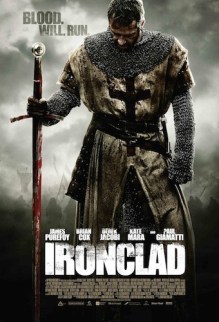 In medieval times, a group of filmmakers set out to prove you can make a Hollywood-quality historical action epic with independent funding in Britain, while in the present day a ragtag group of seven samurai— sorry, gunslingers— sorry, warriors, defend a small town— sorry, castle, from evil bandits— sorry, an evil king.
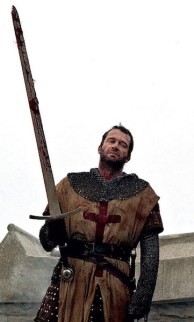 Anyway, it seems to me its use of facts are probably strong enough to support it as an entertainment. So some of the story structure may be reminiscent of
  I’ve seen some complain about the level of graphic detail in this regard, but this is medieval times, they didn’t just bump each other about a bit; and you don’t think a giant axe swung down on someone’s shoulder with all a man’s weight is going to just leave a scratch, do you? Director Jonathan English doesn’t linger on detail as if this were a horror movie. There’s cleaved bodies, severed limbs, squirts of blood and more, and it all feels gruesomely realistic, but individually each moment passes quickly.
 I imagine it also makes some of those fight scenes even more disorientating, which is a pity. Nothing will help the sometimes-too-obvious use of digital video though, which looks as nasty as ever.
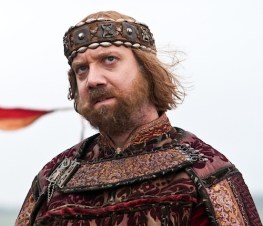 The unfamiliar true story also gives it the added edge of not knowing who lives or dies, or whether our heroes even succeed. If the ultimate end feels guessable, I think it’s only in retrospect. Of course, that doesn’t mean any of it’s historically accurate anyway.
 Half a decade ago I would surely have hated this film. I had no love for animals in general, certainly not pets. But in the past few years I’ve become a certified canine convert, and watching it now I loved it.
 but to be honest I could’ve done without some of the meagre scenes we did get, never mind more of them. Supposedly character building stuff like the teeny party to get to know future classmates — bleurgh. Luckily, such things are brief. And someone wanted more of Lisa Kudrow and Kevin Dillon’s failed-rocker foster parent characters? I’d rather have had less, thanks.
 a scruffy white terrier with an exceptional ability to sniff out food (featured in every picture, because… aww, just look at him!), but then he reminded me so much of my own dog that I may well be biased. There’s all sorts of mutts here for pretty much every kind of dog lover.
 Judged as simply a movie, on its story and its characters and all that regular palaver, I can see why Hotel for Dogs attracts so many poor scores (it has an exceptionally low
 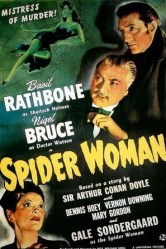 The seventh feature starring Basil Rathbone as Sherlock Holmes and Nigel Bruce as Dr John Watson is the first since
  Gale Sondergaard, is so good that they crafted a sequel around her, albeit Holmes-less. I’ve not seen it and don’t own it, so I’ve no idea what that does for its quality.
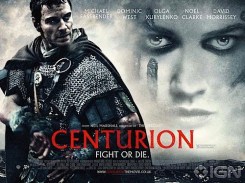 The fourth feature from writer/director Neil Marshall (despite owning his first three on DVD, this BD rental is the first I’ve actually watched — story of my life) is a bit of a departure: where the first three were horror (or at least horror-leaning) flicks, Centurion is an action-adventure crossed with something a little more artsy. Only a little, mind. Think
  Regular readers may know that I have an ever-growing dislike for films that begin at or near the end for no good reason (and most of those that do have no good reason to do so). Centurion’s opening line notes that “this is neither the beginning nor the end” of the lead character’s story. Oh dear, thought I; though perhaps “nor the end” signifies we might reach this point suitably distant from the credits, maybe. Not meaning to spoil it, but we’re there just 10 minutes later. Nice work Mr Marshall.
 The cast is packed with people who, even if you don’t know their names, there’s a fair chance you’ll know the faces (assuming you watch your share of British drama): in addition to Fassbender and Morrissey there’s Dominic West, JJ Field, Lee Ross, Paul Freeman, Liam Cunningham, Noel Clarke, Riz Ahmed, Imogen Poots, Rachael Stirling, Peter Guinness… not to mention Film Star Olga Kurylenko. Recognisability doesn’t guarantee quality, of course, but that’s a pretty good list.
 I really enjoyed Centurion, appreciating its mix between brutally real action and stunning scenery, with a slightly more thoughtful side emerging in the final act. It’s also always pleasant to see a film that runs the length it wants to at a reasonable speed, rather than padding itself to reach two or even two-and-a-half hours. Splendid.
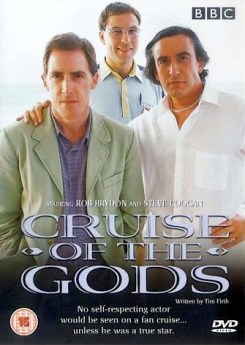 I’ve
I’ve 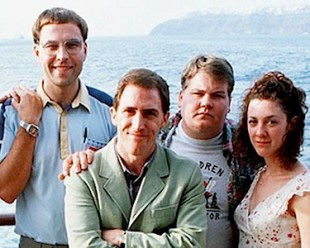 Though the film pokes fun (fairly good-naturedly) at sci-fi obsessives, the underlying story here is about a man overshadowed by his past. In this Brydon gives a strong performance — I think he’s a better actor than he’s normally given credit for — and he’s ably supported by Corden in particular, though to say what gives his role such quality might spoil a twist. He’s another one who’s actually a very good actor, but it gets hidden beneath a public persona that led to such dross as that sketch show with Mathew Horne.
 without ever realising all those disparate things were penned by the same human being. Poor writers.) Lowney, meanwhile, has stuck to TV, with episodes of
 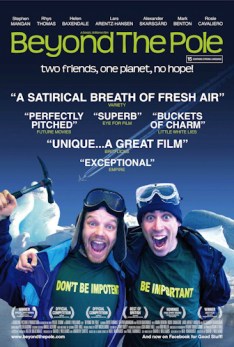 Adapted from a cult Radio 4 series, Beyond the Pole is a British mockumentary about “the first carbon neutral, vegetarian and organic expedition ever to attempt the North Pole”, starring Stephen Mangan Off
 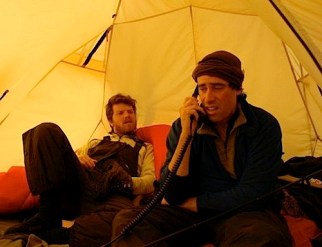 It’s also impressively realised. Its apparent low budget led me to assume we’d, a) see very little of the actual trip, and b) what we did see would be all inside-a-tent and green-screened. But no, it was really shot on floating sea ice off the coast of Greenland, and it makes for a highly effective polar landscape. Good work, filmmakers.

 100Films.co.uk