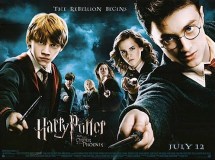
Harry Potter and the
Order of the Phoenix
2013 #45a
Original review
here.
.
Harry Potter and the
Half-Blood Prince
2013 #47a
Original review
here.

.
Harry Potter and the
Deathly Hallows: Part 1
2013 #48a
Original review
here.

.
Harry Potter and the
Deathly Hallows: Part 2
2013 #52a
Original review
here.
2007-2011 | 568 mins | Blu-ray | 2.40:1 | UK & USA / English | 12 / PG-13
When David Yates joined the Harry Potter series halfway through, as the director of its fifth instalment, his main prior experience was in TV — quite a change from the series’ track record, which had included acclaimed or successful movie directors. But he seemed a wise choice nonetheless: one of his stand-out works on TV was State of Play, a complex conspiracy series that suggested he’d be the right man to handle Order of the Phoenix for two reasons. Firstly, the novel includes a significant ‘resistance thriller’ aspect, similar to the edgy underground-investigation style of State of Play. Secondly, the lengthy novel was to be condensed into a single reasonable-length film, necessitating an ability to tell a story clearly and concisely. State of Play may not have been concise (it’s a six-hour story, after all), but it was complicated and it was clear.
The resulting film is, arguably, one of the series’ strongest because it is so different to the others. If the much-discussed ‘darkening’ of the films really kicked in with Goblet of Fire and the death of Cedric Diggory, Phoenix only cements this tone. Our heroes are persecuted throughout — and not just the lead kids, but Dumbledore and the rest of the Hogwarts establishment too, as a Ministry of Magic in denial about the return of Voldemort seeks to crush the dissenting voices of Harry and his headmaster.
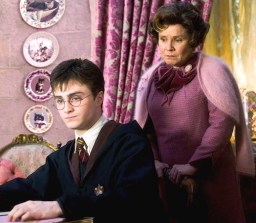 Their main weapon is Dolores Umbridge, perhaps the series’ most despicable villain, because she is so horrendously plausible. She seems to be all sweetness and light, but it masks a dangerous streak that sees her eliminate any fun from the school and, in one of the most sadistic sequences in either the novels or the films, she has Harry write lines with a magic quill that cuts each one into the skin of his left hand. The Potter series actually has its share of nuanced villains, but Umbridge is thoroughly unlikeable. Though she’s defeated and carted off at the end of Phoenix, she resurfaces in Deathly Hallows. I don’t recall if her final fate is expounded upon, on page or screen, but I’d quite like to see her ripped to shreds.
In one of the numerous special features on the Harry Potter Blu-rays, producer David Heyman notes that most directors finish a film of Potter’s scope and want a rest, or at least a change of pace. It’s why Alfonso Cuarón and Mike Newell only have one each to their name; it’s why the Bond films haven’t had two back-to-back entries from the same director since the ’80s; and so on. Not so Yates, however, who ended Phoenix hungry for more. Or hungry to establish a film career, take your pick. And so he also took on the next film, Half-Blood Prince.
It’s easy to accuse Half-Blood Prince of being all prelude to the climactic events of Deathly Hallows; it certainly feels that way first time through. There’s considerably more to it than that, even if the titular mystery is barely a subplot — especially in the film version where, once again, the sheer length of the novel necessitates massive cuts to the source text. But perhaps the most remarkable thing is how funny the film is. Between the return of Voldemort, the suspicion cast on Harry, and a devastating final battle, Phoenix is an incredibly gloomy film; as things roll towards the climax, packed with more deaths and villain victories, Deathly Hallows is too; and sandwiched in between, with one of the saga’s most gut-wrenching finales, you’d think Half-Blood Prince would be more of the same.
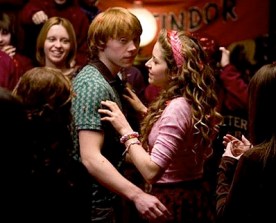 But not so. Yates approached his follow-up with a stated aim of introducing more comedy, believing the three leads to be talented in that area but not having had a chance to show it in his dour first film. So here we get a whole subplot given over to Ron’s attempts to join the Quidditch team, as well as much focus on the trio’s romantic entanglements — teenage love always being a good topic for humour. The film is not without its dark side, but peppered liberally throughout are those comedic subplots and scenes that are liable to see the viewer laugh perhaps more than in any other Potter film. It’s easy to miss this element — the main plot is, as always, getting darker and more serious — but once it’s been highlighted (as the makers do in the film’s special features) I think it becomes very noticeable.
Perhaps the other most notable aspect of Half-Blood Prince is the cinematography. Like most of cinema throughout the ’00s, the Harry Potter series shows a gradual shift from a very filmic look, to digital intermediates, to (in some cases) a wholly digital output. This is where it becomes most notable, I feel, with many sequences (especially those involving extensive CGI, like the Quidditch) graded and smoothed to the point where they look almost like a concept art painting rather than a real-life sequence. This is especially obvious if you watch any clip-laden series-spanning documentary, where Half-Blood Prince clips rub shoulders with any previous film and stand out like a sore thumb; but even in the movie itself, without that outside context, it’s sometimes highly noticeable.
The other thing it is is dark — not the story, but the visuals. This reaches its nadir in Deathly Hallows (both parts), which include some shots so dark it looks like some light-black shapes may, perhaps, if you squint and strain, be moving over some dark-black shapes. It’s ridiculous. I have no idea if it functioned OK in the cinema, but on a TV at home it most definitely does not. This seems to be a growing trend in films, though the Potter finale contains some of the worst examples I’ve yet seen. I don’t know the reason, but I presume it’s a tech thing — cameras that can function better in low light; 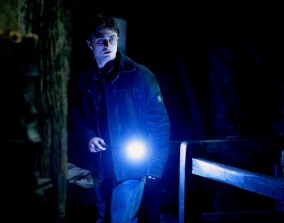 grading the film in perfectly-calibrated conditions so they can really push it to extremes, not considering how most end-users will view it; and, much like fast-cut action scenes, an over-familiarity with the material that means the director/editor/grader can see what’s going on because they’ve watched it dozens (or hundreds) of times, which doesn’t work for a first-time viewer in the middle of the film. As you may be able to guess, I’m not a fan.
By the time of these final two films, it seems Yates has moved from being a TV director skilled in complex plotting, to one very much at home with big effects-driven set pieces. The Battle of Hogwarts, which consumes around 90 minutes of the final film, is an epic and often jaw-dropping affair, though still laced through with the final plot developments and the completion of various character arcs. That said, it’s far from perfect, undermined by a pair of apparently opposing sets of decisions: on the one hand, to flesh out fan-favourite moments to give them too much emphasis (Mrs Weasley’s duel with Bellatrix is over-played; Harry and Voldemort’s final confrontation is amped up to the point it loses the book’s emotion); on the other, slavish faithfulness leaving some moments without enough emphasis.
The biggest crime of the latter is the very end: the battle over, Harry, Ron and Hermione stand outside Hogwarts, survey some of the damage, have a little chat… and then it abruptly cuts to a couple of decades later for the epilogue. For me, it doesn’t feel as if there’s enough space there, enough time to breathe, to consider the impact on the series’ supporting cast — many of them favourite characters, as vitally important to the viewer as they are to the lead trio. How will the Weasleys cope with their losses? What about those others who have lost almost everyone they hold dear? Where have the Malfoys gone? There are nods to this in a montage around the Great Hall / makeshift mortuary, but it feels underplayed; like we need a scene of life-goes-on normality set a few weeks or months later, 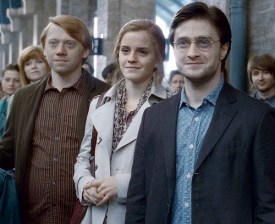 not a sudden smash-cut to a few decades on where we see how some characters’ lives have developed. I know some people complain about Lord of the Rings’ multitudinous endings but, one, they’re wrong, and two, Potter only has one and an epilogue — sure, the first completes the drive of the storyline and the second is a neat coda, but in between I feel we need more of a character-based resolution.
But hey-ho, it is what it is.
In the end, the TV director hired for a very specific filmmaking skill wound up in charge of exactly half the Harry Potter series. If there was a half to have a single voice in charge of, it’s this one, with one long narrative permeating the films in a way it doesn’t the first four. And yet, for that, each has a distinctive style and voice — well, apart from the two parts of Deathly Hallows, which are really one long film split into halves. Was it the right move, for the series? It clearly produced popular movies, but, thanks to the storyline, it’s already easy to regard the Potter series as four or five stories rather than seven, the last three books merging into one epic tale in three acts — a trilogy, if you will — rather than discrete stories, like the first four. By putting the same man behind the camera for them all, the films just emphasise this point. But maybe that doesn’t matter.
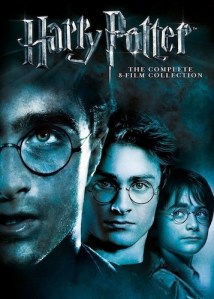 It’s hard to offer a final summary of the Harry Potter series. Some people see them as mediocre and overblown; for others, they are their life. Personally, I think they develop from sometimes-uncertain roots in the early films, to a flourishing series of epic fantasy movies. There are often niggles of one kind or another, be it acting (I forgot to discuss Emma Watson’s eyebrows!), or cartoonish designs, or too-faithful adaptation, or abbreviated adaptation, or what have you — but none of these are ever-present. More importantly, every film offers something to enjoy, and the growing maturity — of not only the cast, but also the filmmaking — means their impact only increases when viewed as an entire eight-film saga.
One for the ages? Movie and genre fans of a certain age might say, “don’t be so daft”; but I wouldn’t be so certain.

 Remember the Dungeons & Dragons film from 2000? To say it went down badly is an understatement. Nonetheless, they made a sequel with some returning cast (which I’ve not seen), which I doubt fared any better and maybe went straight to DVD. This one is again low-budget, and possibly was made for TV, but it’s all-new; and though form hardly suggests it will be any good, I was on a bit of a fantasy binge and it was on TV, so…
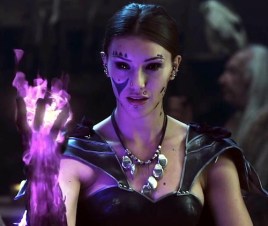 Director Gerry Lively helmed the preceding D&D movie and some stuff you’ve never heard of, as well as serving as DoP on such auspicious-sounding films as Son of Darkness: To Die For II, Waxwork II: Lost in Time, Hellraiser III: Hell on Earth, Return of the Living Dead III, and Children of the Corn III: Urban Harvest. Clearly cheap-sequels-no-one-wanted are his stomping ground. His direction is never more than television-y, although that’s an increasingly unfair description as more and more TV programmes become more and more movie-like; but as that’s still the high-end ones, I guess the derogatoriness holds for now. It’s not helped by editing that is occasionally bizarrely jumpy, as if someone thought it would be OK to skip a second or two just to speed things up.
 September 1881: after admiring their leader for years through cheap magazine stories, 19-year-old Robert Ford manages to hook up with the James Gang. Little does he suspect that, just seven months later, he will be responsible for the murder of his idol, Jesse James. (That’s not a spoiler, it’s in the title.)
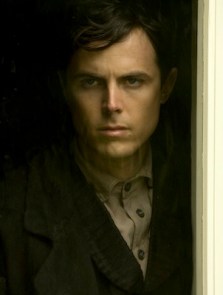 Let’s be clear, though: this is not a film for everyone. This is not an action movie set in the Wild West, which might be what’s expected from a Hollywood studio movie starring Brad Pitt. Apparently director Andrew Dominik intended to make a film with a Terence Malick vibe, so I read after viewing, which chimed with me because “Malick-esque” was one of my foremost thoughts during viewing. This is a slowly-paced two-hours-and-forty-minutes, with more shots of crops blowing gently in the breeze or riders approaching gradually over distant hills as there are flashes of violence. Despite what the studio wanted, this is not a fast-paced action Western, it’s a considered, sometimes meditative, exploration of character and theme.
 Jesse’s mood swings are more obvious than Ford’s, but Pitt makes them no less unlikely. At times charming and a clear leader, at others he is a genuinely tense, frightening presence, without ever needing to resort to the grandstanding horror-movie grotesques offered by (Oscar winners) Daniel Day-Lewis and Javier Bardem in There Will Be Blood and No Country respectively.
 This must also be thanks in part to director Andrew Dominik. Every last shot feels precisely chosen and paced. Of course, every shot in every film has been chosen and placed where it is, but the amount of thought that’s gone into that might vary. Jesse James somehow carries extra weight in this department, with no frame in its not-inconsiderable running time wasted on an unnecessary angle or take that’s allowed to run even a second too long. Somewhat famously, there was a lot of wrangling over the film’s final cut (delaying its release by a year or more), with the aforementioned debate between something faster and something even slower: a four-hour version screened at the Venice Film Festival, to a strong reception. Sadly, the intervening years haven’t seen that cut, or any of its parts, resurface (to my knowledge). That’s an hour and twenty minutes of material and I’d love to know what’s in them.
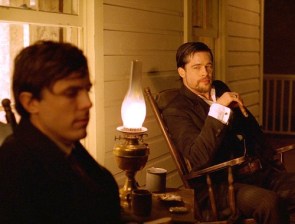 because he’s obsessed with the notoriety of Jesse. Later, once the titular deed is done, he becomes an actor (not without talent, as the narration informs us) and re-performs the act that made him famous hundreds of times. It’s his legacy, however, to not be as well-remembered as his victim; to not be as well-liked, even; not even close. There’s something there about the pursuit of fame for its own sake, if nothing else.
 The first Monty Python theatrical release (four more would follow; five if you count last year’s
  For my money, it becomes a bit tiring watching sketches for so long, even with the attempts made to link them together — it doesn’t form a narrative, so much as a series of casual crossovers that would make re-arrangement in an edit impossible. In and of themselves, however, many of the skits hit their mark.
 Reportedly the Pythons didn’t consider the film a success, hampered by interfering higher-ups and a ludicrously low budget (
 Directed by the inestimable Billy Wilder, winner of the Grand Prix (forerunner to the Palme d’Or) at the first Cannes, winner of the Best Picture Oscar in 1946, and also Best Actor, Director, and Screenplay, it’s a wonder that The Lost Weekend isn’t better known. I don’t think I’d even heard of it until Masters of Cinema announced their Blu-ray release
 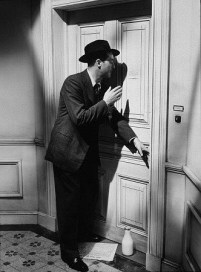 all of them thwarted at the last possible moment, when victory seems assured. The film isn’t preachy, but if it does teach us a lesson then this is how it does it.
 Milland is astounding. The film rides on him and he really carries it. It’s easy to play a comic drunk, but Milland doesn’t sink to that. Indeed he doesn’t do one type of drunk at all, swaying back and forth across various levels of inebriation as required. I often find films of this era contain performances we assess as great, but if you put them in a film today no one would buy it; they’d find it stagey and fake. Milland’s transcends that — it fits the era, but I wouldn’t be surprised to find it would play just as potently today. I think it’s fair to say that Milland is not widely known today, but with every film of his I become more convinced that history has been unkind.
 There’s also able support from Howard Da Silva as barman Nat and Doris Dowling as Gloria (is she a whore of some kind? Just an escort? A bar-crawler? Did I miss something?), whose slang is oddly infectious. No offence to Jane Wyman, but her lovelorn-but-strong girlfriend character only seems to really come alive in the closing minutes, when she considers abandoning Birnam to his fate.
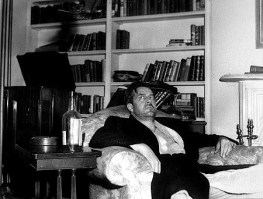 but from what I do know of other conditions of addiction and mental health, this feels as if it’s still thoroughly relevant.
 After
After 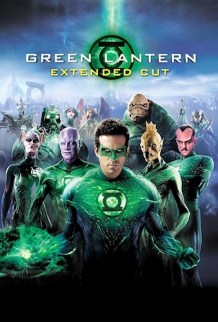 “Hype” has to be one of the biggest factors in how we view films these days. Technically it’s defined as “extravagant or intensive publicity”, I suppose thereby meaning something to “positive expectation”, but I think it also works the other way: if you’ve heard nothing but awful things about a film, its weakness has been ‘hyped’. It’s this latter point that applies to Green Lantern, which has an almost insurmountable degree of negative expectation attached. To summarise the headline points, it’s got a woeful rating of
 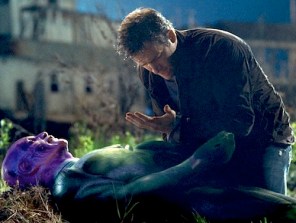 But I digress. Cocky jocky Hal is whisked off to the other side of the galaxy to learn how to be a Hero and use his ‘magic’ ring, which can conjure stuff up, then returns to Earth to save it from some menace(s). As superhero origin stories go, at least it’s got a couple of differences.
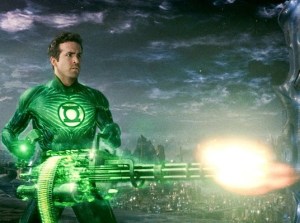 There are positives. The action sequences are good, which is a definite plus in this kind of film. The inventiveness with what the ring can do is fun. There’s a lack of relation to the sketchily-drawn characters that stands in the way of us truly engaging with them, and there’s a certain brevity and lack of scale that undersells the alleged threat to Earth (it’s a giant evil space-cloud that can barely cover a few city blocks, let alone the entire planet) — but, that aside, they’re entertaining enough. That said, much as the film pulls its punches with characterisation and threat, so it does with awe and spectacle. The Lanterns’ planet Oa doesn’t have the same impact as Asgard in
 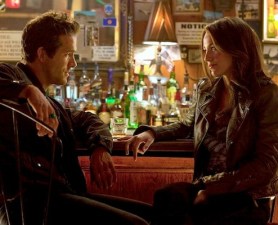 Indeed, I’d say the Extended Cut doesn’t go far enough, with some of the disc’s deleted scenes meriting inclusion. However, the main one occurs on Oa, meaning an effects-heavy scene that hasn’t had CG work done or all the voices recorded, so couldn’t just be dropped back into the finished film as-is. I imagine that’s why it wasn’t. That said, even if they’d done such work, those scenes are minor points, not game-changers.
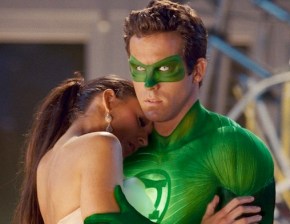 Still, I think there’s a better film lurking in Green Lantern, and it’s a shame it didn’t get the screenwriter(s) or director(s) required to bring it out. It’s even more of a shame that worse films than this have received a kinder critical consensus or huge box office. That leaves some suit feeling vindicated and churning out the same rubbish again, whereas with a bit more effort Green Lantern 2 could’ve been worthwhile.
 The fourth Harry Potter film is the pivot around which the series revolves, in oh so many ways. Most obviously, it’s book 4 of 7 — the halfway point. It’s also where the books switch from short ‘children’s novel’ lengths to the huge tomes they eventually became. More importantly, it’s the instalment on which the overarching plot of the entire series hangs. Although each previous entry in the Potter canon contributed something to the mythology (even if sometimes its significance wouldn’t become apparent until much later), they’re still viewable as discrete adventures. So too is Goblet of Fire, for the most part — the exception being its final act, which kicks off the story that will consume the rest of the series.
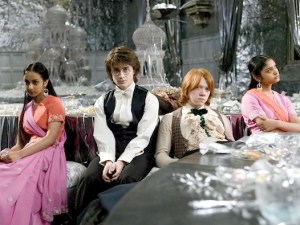 It makes sense: at this point the series was moving beyond your stock franchise length of “trilogy” and into less frequently charted waters, amid speculation that the leads would be recast. With Goblet of Fire being the last point you could reasonably pull that off, I imagine it paid to emphasise that these were the same kids — that we see a cast age in more-or-less real time throughout their childhood, including many small supporting roles as well as the leads, is one of the Potter films’ more unique highlights.
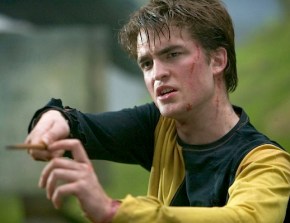 I can’t remember if Diggory’s meant to be a nice guy or an irritating jock, but here he’s played by Robert Pattinson, proving it’s not only his involvement with
 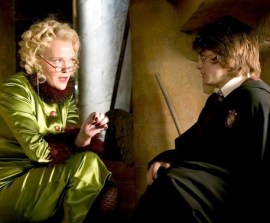 but her Quick-Quotes Quill — which, essentially, just makes stuff up — is present and correct. The next tale,
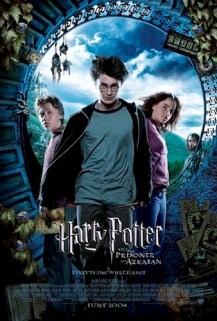 Prisoner of Azkaban marks a significant turning point for the Harry Potter film series. Viewed now, it’s easy to see it as just Episode 3 of 8; a saga still getting underway. At the time, coming off the back of two incredibly successful films, it felt like a grand shake-up of an established formula.
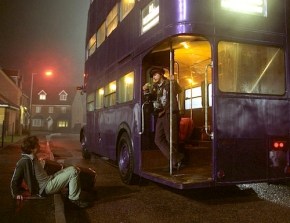 Cuarón and screenwriter Steve Kloves (who would pen every Potter film bar
 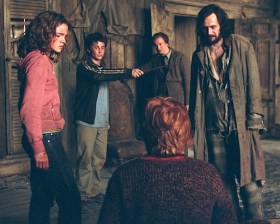 The film series doesn’t treat either of them particularly well compared to the books, but then supporting characters and subplots are the first things to go (quite rightly).
  100Films.co.uk