aka Iron Man Three
2013 #74
Shane Black | 131 mins | Blu-ray | 2.40:1 | USA & China / English | 12 / PG-13
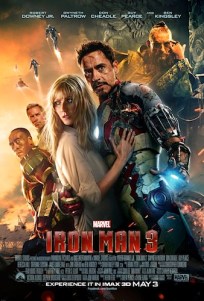 Some have described Iron Man 3 (or, as the onscreen title would have it, Iron Man Three) as “the best Iron Man yet”, even better than the exalted first movie. Others have described it as “at least better than Iron Man 2”, the derided first sequel. I thought the first one was a tad overrated and the second notably underrated, so where does this trilogy-forming instalment fall on my personal scale? Well, that depends what you want from an Iron Man film…
Following on from the events of Iron Man 2 and The Avengers, Tony Stark is a man with little purpose. The American government have a rebranded War Machine to do their bidding; Pepper is now running Stark Industries; who knows where S.H.I.E.L.D. are (dealing with the plot of Captain America 2, probably). Tony, meanwhile, is creating endless iterations of the Iron Man armour and suffering panic attacks from memories of when the suit failed him during the Battle of New York. For all his usual wisecracking, he’s a man who’s had his confidence undermined — and if there’s one thing Stark’s known for, it’s his self-confidence.
It’s not long before some events happen that push Stark, and his Iron Man alter ego (or is it an alter ego? But I’m getting ahead of myself), back into action. But those panic attacks remain, as does his overwhelming desire to protect his first stable relationship with Pepper. Here, then, is perhaps the film’s strongest element: the development of Tony Stark as a character. It’s not as if the first two films don’t have some degree of character development, but it wasn’t so fundamental. Tony starts Film 1 as a wisecracking show-off partying womanising arms manufacturer,  and ends it as… a wisecracking show-off partying womanising superhero. Film 2 and even The Avengers don’t take him a great deal further, arguably, but here he’s pushed. He still behaves recklessly, because that’s what he’s used to doing, but then the consequences of that recklessness — when he has something he cares about — are brought home. Literally.
Despite outward appearances, the Iron Man movies have always been as much — or more — about the characters and the humour as they have been about action sequences. When you’ve got Robert Downey Jr being hilarious, you want to see more of that than a robot-like superhero punching things. With Shane Black on co-writing and directing duties here (a great choice that pays off), you want to see that as much as ever, and the film keeps it up. So while Stark struggles with the responsibilities of a relationship and with how he’s going to overcome his anxiety problems, he continues to be as snarky and fun to be around as ever. And the film continues to not feature that much in-suit action.
Indeed, for much of the film the suit is out of commission: after the all-out assault on the house you surely saw in the trailer and that I alluded to above, Tony is in hiding, relying more on his own wits and detective skills to piece together just what’s going on. I imagine some people found this to be slow and dull, wanting the punchy-punchy boomy-explodey stuff of every other action movie. But after the sheer scale of The Avengers, Marvel and co are right to find a different tack. You can’t out-do what The Avengers did, and if you try to it would become implausible as to why S.H.I.E.L.D. and the super-friends aren’t sticking their noses in, so instead we have a problem on a grand scale, yes, but one for Stark/Iron Man to tackle on his lonesome.
That said, for the sake of the trailer and the adrenaline junkies, it just means the film is rear-loaded with action scenes — three climax-worthy sequences back to back, in fact. It’s a bit of a shame they’re so closely placed, because while each is well-executed individually, they’re also almost immediately overshadowed by what follows. You don’t have time to digest the Air Force One skydiving rescue before it’s off to the oil-rig for the Big Battle. The film takes a break from action by establishing where some characters are and shuffling pieces, sure, but it’s so much set up for the next sequence there’s no time to catch your breath. For me it’s a minor issue, one that will surely be less apparent on future viewings.
And future viewings are merited, because despite all the things that could be ever so depressing, the film has even more to commend it as entertainment. There’s Tony’s relationship with the small-town kid who helps him, for instance, which is suitably irreverent (“dads leave, no need to be a pussy about it”); there’s grace notes like the reluctant henchman (I’m not quoting his one line, it shouldn’t be spoiled); there’s the ’70s action series-style end credits (they brought a huge smile to my face, anyway); and there’s the film’s treatment of the Mandarin…
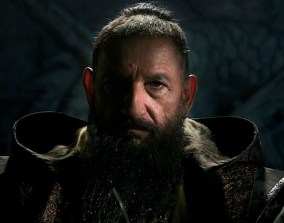 Ah, the Mandarin. He’s Iron Man’s big bad; the guy fans have been asking about since before the first film. I don’t know much about him, but I believe in the comics he’s some kind of magician — doesn’t sit well with the film series’ more sci-fi leanings, even after we’ve seen Iron Man meet the likes of Thor. Here, the Mandarin is reconfigured as a terrorist; a very powerful one, spreading his message by taking over US airwaves… and blowing things up as well, naturally. But there’s a twist to him, which I won’t discuss here; beyond to say that, even though I saw it coming (helped, I admit, by everyone saying “there’s a twist to the Mandarin!”), I thought it was quite brilliantly done. Ben Kingsley is magnificent.
It’ll also surprise no one when Stark’s business rival, Aldrich Killian, turns out to be a villain too. Bit of a rehash of the second film there, maybe, but — even though I liked that film — Iron Man 3 handles it better. Sam Rockwell’s Justin Hammer was perhaps a more memorable character, but Guy Pearce’s Killian fits the plot and themes nicely, and is more of a force to be reckoned with overall. My only disappointment came near the end (slight spoilers for the rest of the paragraph), when it’s revealed in a small aside of a scene that he can breathe fire. Come the big all-action climax and… he doesn’t do it again. Is it a little silly he can breathe fire? Maybe. But it does kinda work with the rest of the things we’ve learnt, and I presume it was a conscious reference to another Iron Man enemy, the giant dragon Fin Fang Foom, who Killian has tattooed on his chest. Even without that tattoo, they’ve established he has a special power, so why doesn’t he use it in the final battle? Surely that’s what it’s made for? Personally, I’d’ve deleted the earlier reference if I wasn’t going to use it at the climax.
 In the grand scheme of things, I still think that’s a minor complaint. Indeed, any issues I have with the film are minor complaints, including the slightly elongated first act and the Iron Man-less second one. I think it works for the style the film is aiming at — more of a military-ish spy-ish thriller than a bombastic beat-em-up superhero flick — and that works for me. And, not a complaint, but a minor point: the Actor’s Agent of the Week award goes to whoever represents Stephanie Szostak. I’ve never heard of her and her character’s only really in one sequence, but she’s billed right below the big-name lead cast and above henchman and 24 season three star James Badge Dale, amongst other recognisable names and faces. A Christmas bonus for that representative.
So, is Iron Man 3 the finest Iron Man film? Well, as ever, that’s a matter of perspective. I do think it completes the character’s personal arc, which has flown through not only the first two films but also The Avengers. I’m not the first to note the finalising tone of the film’s final minutes, and I believe the Bondian “Tony Stark will return” at the end is to reassure us he’ll be back in the Avengers sequel rather than imply we should look for an Iron Man 4. Despite marking out release dates through Summer 2017, Marvel have said they won’t be confirming any films of their 2016 or 2017 releases for at least another year. When the time comes, I don’t think an Iron Man sequel will be among them, keeping that particular big gun — and that particular big-name actor — for special occasions. I’m alright with that, because I think we’ve had three highly entertaining movies out of him, and even without an adaptation of the (in)famous Demon in a Bottle arc,  I don’t think there’s much left to do with the character right now. Plus, ending the film with the latest twist on the first movie’s renowned closing declaration is a nice way to round off a series… at least until the inevitable recasting one day.
So back to my question: is it the best Iron Man film? Well, that’s a matter of… oh, wait. Anyway, I refuse to commit. But it might be. It might well be.
Iron Man 3 is out on DVD & Blu-ray in the UK today, and in the US on September 24th. Ha-ha.



 A year after the end of
 Included on the Blu-ray releases of both The Avengers and (unlike Joss Whedon’s commentary or the tip of Loki’s spear)
  This is exactly the kind of tale I presume the imminent TV series
 The director of
  which is what you should expect from the director of all those films I listed above but quite blatantly doesn’t sit right. And it’s over two hours long too, so it keeps going… and going…
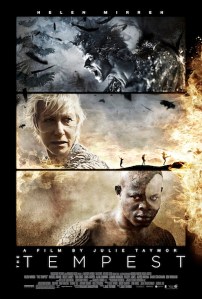 Film and theatre director Julie Taymor (infamous now for Spider-Man: Turn Off the Dark) here brings us a radical-seeming interpretation of Shakespeare’s final play. The main character’s changed gender! There’s CGI being tossed about everywhere! It’s got Russell Brand in it! If that sounds superficial, it is. Taymor’s film is still set in the Elizabethan period, in Elizabethan dress (broadly speaking), with a cast of mostly classical actors, enacted on an island that is admittedly a stunning setting but is nonetheless where the original play is set. If it’s a “modern retelling of William Shakespeare” (per the blurb), it perhaps missed what Baz Luhrmann
  It goes on in the middle, a mess of scenes of characters traipsing about the island for no apparent reason. (This reminded me of
 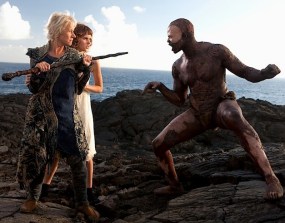 Another key role sees Djimon Hounsou as the slave Caliban, immediately suggesting a colonialist reading that isn’t exactly a huge reach anyway. And Russell Brand makes Shakespeare sound like Russell Brand talking, which at some points I’m not convinced he isn’t (I’ve no idea if Taymor allowed him to stray from the text or not). Love interest is provided by Reeve Carney. I’ve never heard of him, but he’s young and quite pretty and has a music video on the Blu-ray, so I guess he’s from that kind of arena. He speaks with an English accent, but so does everyone else (bar Caliban and the boatswain), so he may still be sourced from the other side of the pond’s teenybopper scene.
 Ariel as a truly spiritual spirit, half invisible and jetting off into the sky on a regular basis. I found his realisation a mixed bag: it’s nice to take advantage of the medium to render the spirit in a way that’s impossible on stage, but sometimes it goes a bit far and looks a bit cheap. They’ve also tried to make him androgynous, but done it a bit weirdly: he’s always naked, occasionally making it clear he has no penis, sometimes has small breasts, but always has a moderately deep, clearly manly voice. Show it to a class of teenagers studying the play and you may illicit some confused feelings… That aside, the make-up effects are brilliant. Caliban’s patchwork skin is the best piece of work, but Ariel’s rendering as a giant crow is a fearsome sight as well. For all I know the latter may count as costume design, which is what earnt the film an Oscar nomination. But, hey, the clothes are nice too.
 It would be nice to say the magic and fantasy could convert new fans to Shakespeare, much as Leo DiCaprio and swishy editing did for teens nearly two decades ago, but there’s nothing beyond that trailer-friendly neat-looking stuff to convince them it was worth their time. Meanwhile, Shakespeare traditionalists may find it all a bit much. If that leaves it stranded on an ill-located isle of terrible beauty, then at least it’s an apt fate.
 Co-written by geek god Joss Whedon and former
  #63 Bicycle Thieves, aka Ladri di biciclette (1948)
 The flip side is that, for me, the summer movie season is about to begin! That should help with the aforementioned final tally. Thanks to studios’ (wannabe-)piracy-beating speed when it comes to getting films onto disc these days,
  In researching this list I was surprised to discover a few films I didn’t know were adaptations. That might be a good list for another time, though that list, and this one, could be almost entirely filled by a single franchise: Die Hard. While the first film is based on
  As evocative as the title of
  Just as prone to retitling as Dick is Stephen King. Oh sure, there’s Carrie and The Shining and, y’know,
  Aww, a nice
 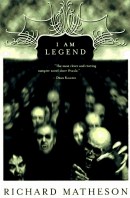 “But there is
 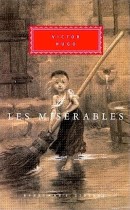 Despite having one of the most glaringly French titles ever committed to paper or celluloid,
  The first film I watched as part of my new-this-year
  Much of the film’s emotional impact comes courtesy of Cherrill, who gives a suitably pretty and sweet performance. Chaplin wasn’t impressed with her as an actress and attempted re-casting (the film has a
 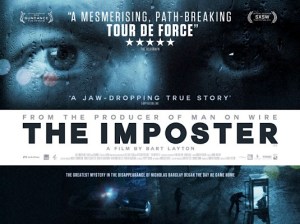 Some films benefit from knowing as little as possible going in; some are at their best when you know nothing at all. But that’s pretty much impossible — unless you go purely on someone’s “you’ll like this, trust me” recommendation about a film you’ve never even heard of, you’ll be aware of something. Normally this comes from a review or blurb, and you just have to trust that the reviewer or copywriter was kind enough to keep it spoiler-free.
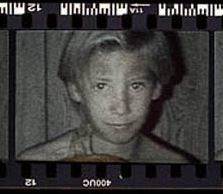 So here’s what the film lets you in on in the opening moments: in 1993, 13-year-old Nicholas Barclay went missing in Texas. In 1997, a boy claiming to be him surfaced… in Spain. He had Nicholas’ tattoos, but he had a French accent and the wrong colour eyes. And yet the first relative to see him, Nicholas’ older sister, gave a positive ID, and upon returning to America he was accepted into the family. Why did they take in such an obvious fraud?
 but, nonetheless, it makes the documentary itself feel untrustworthy, just like its participants. Is that an intended effect? Arguably the film’s main theme is lies — the lies we tell ourselves, the truths we want to believe; confirmation bias, perhaps, though that term is never mentioned — but the documentary itself never lies to us… I don’t think. It just feels like it might be.
 as the poster prominently tells us, this is “from the producer of
  100Films.co.uk