
George A. Romero | 97 mins | Blu-ray | 2.35:1 | USA, Canada & France / English | 15
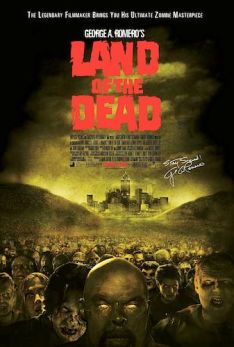 While the first three ‘Dead’ films (or “the original trilogy”, to put it in Star Wars-y terms) now all look and feel like ‘classic movies’ (read: “old movies”), the next three bring things bang up to date: Land of the Dead was only released eight years ago.
Set in a world where the zombie epidemic has been running for years, perhaps decades — but with a title card that lets us know this is “Today” — Land of the Dead focuses on a city of haves and have-nots: a massive tower block, Fiddler’s Green, houses those both rich enough to buy a place there and deemed suitable for entry by its board of directors; in the wreckage of a city around them, regular folk live in slums. Raiding parties go out to surrounding small towns to raid what’s left of canned goods and so forth, where the zombies live a dumb show of their former lives — until one of them realises that they could be something more…
A quick glance at the internet suggests Land is significantly less well regarded than Romero’s original trilogy, which I think is distinctly unfair. The reasons for this seem to be twofold: viewers coming to it as a modern zombie movie, apparently unaware of Romero’s legacy — or so I presume, from their complaints about sentient/sympathetic zombies; and fans of old who see it as too slick and modern, a sell-out to mainstream action/horror films. I don’t really agree with either.
Firstly, the zombies. They’re a development of the ideas we saw emerging through Bub in Day of the Dead. The ‘head zombie’ here is a hulking ex-mechanic-type, who witnesses a raid on his town where the humans needlessly ‘kill’ some of his fellow undead on their way out of town. He is outraged. This is a zombie not only sporting intelligence, but also emotion; a desire to protect, as he attempts to save some of his comrades’ ‘lives’; 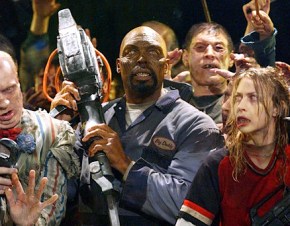 and then a desire for revenge, when he sees the glittering lights of the city in the distance. Lead he does, corralling the other zombies into a slow march towards their target.
Romero has said that he read Richard Matheson’s novel I Am Legend, the inspiration for Night of the Living Dead, as an analogy for revolution. Matheson’s vampire/zombie creatures are the successful revolutionaries, the hero the last remnant of someone resisting the change. Romero didn’t see him as the hero, but the old guard who ought to give in. I don’t know how fully Night adopts that theme (the revolution seems to have been crushed — though, in a ’60s America where protest seemed to have little impact, I can well believe that was Romero’s point), but it’s certainly present in Land: the oppressed zombie silent-majority rising up against their self-decreed masters.
Each of Romero’s films has had a significant, sympathetic black male hero. That wasn’t a deliberate choice in Night, but it seems to be a theme continued throughout the series: Night’s Ben is the intelligent, resourceful, thoughtful leader; Dawn’s Peter is the most level-headed and well-prepared of that film’s men; Day’s John wisely stays out of the soldier-vs-scientist bickering, and it’s ultimately his plan of escape to a deserted island that they follow. Land has an heroic black character too — but he’s the leader of the zombies. As if you were in any doubt that we were meant to be on their side, even if just a little bit.
 In the world of the humans, meanwhile, we also have an oppressed majority: the slum dwellers. Attempts at revolution there are soundly ignored, with the rich quietly taking the opposition out as ‘trash’ whenever able (which, I guess, is whenever they want). The people are controlled by drink, drugs, gambling, prostitution, and any other cheap entertainment you can imagine, all secretly managed from on-high to keep the general populace docile. And those entertainments are getting increasingly extreme, too: the zombie-on-zombie cage fights previously used cat or dog meat as motivation, but now they throw in Asia Argento. Again, Romero is holding a mirror up to present-day America, where the illusion of a ‘free society’ with easy social mobility is supported by the mega-rich in order to keep the poor down. It takes the zombie invasion for anything to change, which may be a case of Romero “following the story” rather than reflecting a political reality — who’s going to invade the US?
This is where I diverge from the aforementioned “old fans”, because Land is clearly bursting with Romero’s usual socio-political analogies and commentary. There’s the rich/poor divide (which, in real life, is actually shockingly extreme in the US) and the abundance of entertainment, as previously discussed; there’s certainly some post-9/11 thoughts (quoth Dennis Hopper, “we do not negotiate with terrorists”), and perhaps post-Katrina too; perhaps the zombies represent foreign nationals, either breaking in (for a nation founded on immigration, the US are certainly very cautious about it, especially when it comes to Mexicans) or kicking off a revolution (a ‘prediction’ of the Arab Spring?); and there are freedom fighters within too, who are incarcerated and apparently tortured without trial (Guantanamo); or, if you want to see Romero as a genuine prophet, they could be foreshadowing Occupy Wall Street and its ilk. But hey, it’s also got some action scenes, right?  Those commenters that do acknowledge these facets claim Romero’s just not as subtle as he used to be, which is also poppycock: Dawn’s criticism of consumerism is as blatant as anything listed here — perhaps even more so, because you can just watch Land as a near-future science-fiction humans-vs-humans-vs-zombies action flick, whereas I think Dawn’s ‘subtext’ is unmissable.
Indeed, while lots of reviews and articles merrily analyse these films’ commentary on their respective eras’ socio-political concerns, what’s less often (or “never”, as far as I’ve seen) noticed is how they reflect the filmmaking styles of their times as well. Night is a stark black-and-white chiller, contemporaneous with the likes of Psycho; Dawn is an auteur-driven socially-conscious ’70s drama mixed with a genre movie, just like the film school brats were getting into at the same time; Day is every inch the ’80s cult movie, ready to be quoted and replayed endlessly on VHS for its slick special effects; and now, Land is a ’00s action blockbuster. Romero’s directorial hand is evident at times, but in terms of the pace, action:story ratio, cinematography, CGI splatter, and more, this is easily interchangeable with any other mid-budget mid-’00s genre movie. Apart from that socio-political commentary, that is.
Talking of CG splatter, oh my does that not go down well with some. I like physical effects as much as the next well-adjusted film fan born before the millennium, but surely CGI is just a tool available now, isn’t it? So there’s some CG blood, or some CG-aided zombies — it’s not as if they were using real blood or real zombies before. It allows Romero and his special effects wizards to pull off some things that they haven’t done before, some of which are very effective. And there’s still tonnes of practical effects too!  If you want to see people getting ripped apart by zombies with their guts spilling out everywhere, in traditional Romero style, then… seriously, what’s wrong with you people?! But, erm, you should be satiated.
I will unbegrudgingly concede that Land of the Dead is not the pinnacle of Romero’s work, but I do believe it plays in the same league as its predecessors. Just because he’s now working in a ’00s action-adventure framework doesn’t mean Romero has stopped making points about society — how it is, and how it should be — in a way other genre filmmakers aren’t even bright enough to dream of, never mind actually imbue in their work. If more Hollywood cinema could deliver on thematic intent as well as over-expensive effects and explosions, we’d have a far richer mainstream cinema. Hey, how about someone lets Romero direct a superhero movie?

Part of Week of the Living Dead for Halloween 2013.
 Helmed by acclaimed director Nicholas Ray (
 On the plus side, Bernard Herrmann’s score is unequivocally excellent, particularly the pulsating opening theme and the insistent action climax.
 1956: global superstar Marilyn Monroe (Michelle Williams) comes to England to star opposite Laurence Olivier (Kenneth Branagh) in his latest directorial effort,
  The supporting cast is a veritable who’s who of recognisable British faces, stars of screens both big and small. Barely a speaking part goes by without an actor you’re certain to recognise. I’d list them but, honestly, there are far, far too many. Despite Marilyn coming with a hefty entourage, Williams is the only American in the cast, meaning American accents are lumbered (to varying degrees of success) upon Zoe Wanamaker, Toby Jones, Dougray Scott, and Dominic Cooper. Hey, of course Dominic Cooper’s in it — is it even legal to make a mid-budget British movie without him now?
 If you don’t know that name then you must be a young whippersnapper, because otherwise Ray Harryhausen needs no introduction.
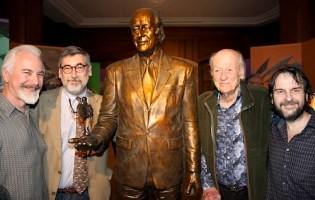 Sometimes they’re a bit jerky, maybe, and the inevitable issues of scale show they’re models fighting or interacting with actors on set… but for all that they’re still not significantly less realistic than so many modern computer-based techniques, and they carry a charm and obvious level of skill that said renderings usually lack.
 One thing I always wonder about ‘specialist’ documentaries is, do they have crossover appeal? Will someone with no interest in Harryhausen, or even in Cinema, get something out of this? Probably not, I guess. But that’s not a bad thing per se, because this is an informative overview of a man’s influential body of work that deserves all the appreciation it can muster. Even if, like me, you’re not that familiar with said work, this is a film that will show you why you should be.
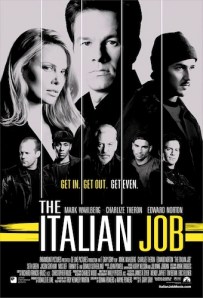 This came in for quite a bit of stick on release — how dare they re-make a British classic, etc etc. It didn’t help matters that one of the stars, Edward Norton, was apparently forced to appear against his will as part of his contract with the studio.
 and while Edward Norton’s performance is hardly remarkable, it doesn’t smack too much of being phoned in.
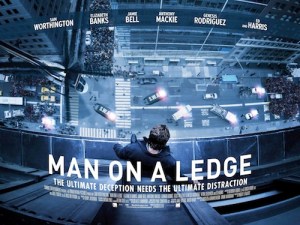 A man books into a swish hotel, has a nice meal, then climbs out the window. Onlookers and police gather. Will he jump? Or is he just a distraction?
 The island town of Swallow Falls exists for one purpose: sardines; the fishing, packing, and distribution thereof. But when the world suddenly realises that sardines are gross, the town’s economy is left in tatters and the only foodstuff the islanders have is sardines. (While we’re on the glum bit, the location of Swallow Falls is identical to the real-world location of Bermuda, except in this reality almost every inhabitant is Caucasian and the island is indisputably part of the US. This is why you don’t scrutinise the geopolitics of kids’ movies, especially American ones.)
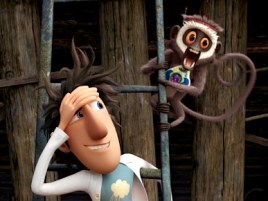 not an unworthy aim, and something Cloudy also achieves, but not a main consideration in my personal assessment of things. The main selling point is that it’s very funny. Of course there’s the slapstick cartoon humour, which is well done, but there’s also a lot of great one-liners, random asides, and the like. Not ‘adult jokes’ by any means, but I think it makes the film fun for grown-ups too.
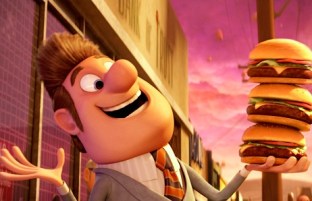 He’s a very funny character, but that’s in the writing, directing and animation — the voice work is spectacularly minimal. Apparently Harris was offered the lead but turned it down for the “more interesting” part of Steve. Nothing against Hader, but if I were the directors I’d have tried to persuade him to do both.
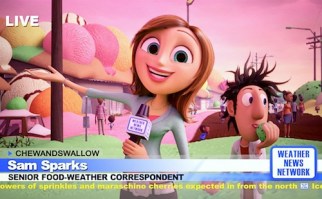 I should probably learn to stop writing off non-Pixar animated movies so readily (and, based on what I’ve heard and seen of their last few efforts, maybe slacken off on the Pixar love. I say that as if it’s news — plenty of people already have; and I’ve never been wholly on that bandwagon anyway. But I digress…) Big, bold, colourful, funny and exciting, Cloudy with a Chance of Meatballs is the kind of film I imagine a lot of kids love and watch on loop. In the process they may even be learning some Important Moral Lessons, which, crucially, aren’t too heavy-handed. Many of these aspects work for adults too. I don’t know if you’d want to watch it on loop, but you may certainly want to watch it again.
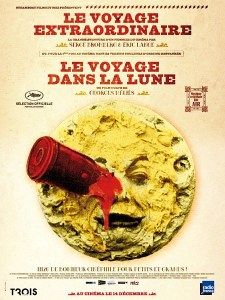 Documentary about the life and work of Georges Méliès, with particular attention to
 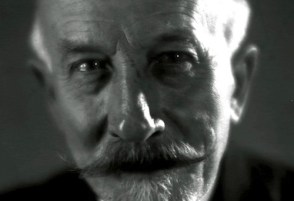 The Extraordinary Voyage accompanies A Trip to the Moon on DVD (or, if you fancy spending a small fortune, Blu-ray), but arguments that it goes beyond a mere ‘special feature’ are worth hearing. It’s a worthy biography/tribute to a cinematic force whose influence is still felt today, coupled with the extraordinary story of how his supremacy is being preserved.
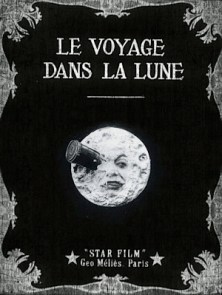 Of all the defining images of cinema — certainly of the silent era — the face on the Moon with a rocket in its eye must be one of the most recognised, though you have to wonder how many have actually seen Méliès’ full vision. More than it could have been, though, because A Trip to the Moon was so popular that, in the copyright-lax world of early cinema, it was widely copied and ripped-off; the kind of thing that destroyed Méliès’ career and, along with it, much of his work.
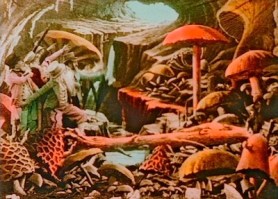 But Méliès wasn’t making a documentary, he was making an entertainment. Indeed, the analogy to a blockbuster is a good one, because this is essentially the turn-of-the-century equivalent. The fantastical sets, costumes and story are all designed to wow the viewer — and remember, we’re only a few years on from people diving out of the way of film of a train arriving in a station.
 Whatever it is, it’s certainly not period-authentic.
 “Old fogies go to India” is the setup of this frothy comedy-drama that clearly courts the so-called ‘grey pound’ — i.e. older viewers still prepared to pay to go to the cinema. But when said fogies are played by Judi Dench, Maggie Smith, Tom Wilkinson, Bill Nighy, Ronald Pickup, Celia Imrie and Penelope Wilton, it will surprise no one to learn there’s something here for us all.
 100Films.co.uk