2015 #13
Ben Affleck | 130 mins | Blu-ray | 2.40:1 | USA / English & Persian | 15 / R
 2013 Academy Awards
7 nominations — 3 wins
2013 Academy Awards
7 nominations — 3 wins
Winner: Best Picture, Best Adapted Screenplay, Best Film Editing.
Nominated: Best Supporting Actor, Best Original Score, Best Sound Mixing, Best Sound Editing.
 Argo is probably the most traditionally entertaining from 2012’s crop of Best Picture nominees. I know a lot of people awarded that honour to American Hustle, but David O. Russell’s film left me largely cold, and, even with OTT performances and funny lines, I think it is actually a very awards-y kind of film.
Argo, on the other hand, is a straight-up espionage thriller. Based on a true story that you’d dismiss as too ridiculous if someone had made it up, it tells the tale of CIA extraction expert Tony Mendez (Ben Affleck), charged with rescuing six US officials who escaped the 1980 attack on the US embassy in Iran and are hiding at the Canadian ambassador’s residence. Tony’s plan is to fake the production of a Star Wars-style movie, fly in to Iran on the pretence of location scouting, and simply fly the officials out posing as his crew. To make the story look genuine, he enlists Hollywood makeup artist John Chambers (John Goodman) and producer Lester Siegel (Alan Arkin) to all but set up the movie for real. Then all Tony has to do is pop over to a country where Americans are despised and fly their six most-wanted fugitives out on a commercial airline flight.
I think Argo is a winner — with audiences, that is — because of its deft mixing of humour and tension. It begins with the latter, showing the siege in Iran in accurate detail (the end credits contrast photos of the actual event with the film’s recreation, lest you were in any doubt). The US public are concerned about the dozens of embassy employees held hostage — there’s wall-to-wall news coverage, plenty of gung-ho vox pops, etc. The US government, meanwhile, flounder about what to do about the escapees — in very-need-to-know secret, of course, because if news gets out… well… With no good plans, this is when Tony cooks up his Hollywood idea, and he jets off to California to set it up and prove it can work.
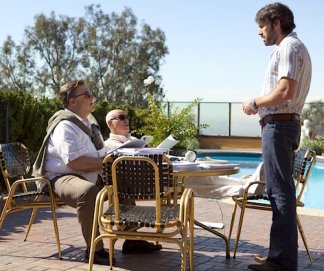 This is where we get the humour, mainly directed at the movie industry. Some say this is why it won the big awards: Hollywood loves a look at itself, and here it’s both satirical (“So you want to come to Hollywood, act like a big shot, without actually doing anything? You’ll fit right in!”) and congratulatory — after all, the plan goes ahead and so (spoilers) Hollywood saves the day. The film creates just the right balance between taking the mick out of Hollywood and bigging-up its role in saving some lives, while also not spending too long on this section that we forget the perilous situation on the other side of the world. After all, once all the fun and games in Tinseltown are over, it’s back to the serious business in Iran.
When we return there, lives are very much at stake, under genuine threat from the Iranian militia if the six are discovered. The latter sequences where Tony sets about actually extracting them are loaded with unease, particularly when, to maintain their cover, they actually have to go on a location scout, complete with government guide. These six embassy employees — secretaries, effectively — are of course not trained spies, but nonetheless must know and be convincing within their cover stories. They have overnight to learn complete identities in case they are quizzed, knowing that even the slightest mistake could spell their capture, and their capture would inevitably lead to their death.
As director, Affleck’s one arguable misstep during all this is the OTT climax. (Spoilers follow, naturally.) In some respects it’s an awkward case: in reality, Tony and the rescuees boarded their flight home with no problems — their tickets were pre-booked and the flight left at 5:30am, so there weren’t even any guards on duty. That would make a bit of an anti-climactic ending to a Hollywood thriller, though, so of course it needs to be jazzed up. 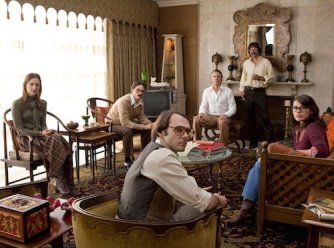 That’s just artistic licence, really — it’s not as if these people were safe, they just had a damn good plan; and, as I said, you need a dramatic ending for a thriller. However, all the “chasing them down the runaway” stuff is a bit full-on and action-movie-ish. It’s not even accurate to how it would go in real life, if it had happened, because the militia’s cars would need to be travelling phenomenally fast to keep up with the plane, and they aren’t seen to be affected by its jets either. For me, the rest of the climax — the guards checking the ‘crew’ out, phoning the LA office, later running up to the control tower, etc — all works; assuming you accept the film is still a Hollywood thriller, not a fact-bound documentary, and so needs a suitably dramatic climax. It’s a shame they didn’t leave it at that, but not a deal breaker either.
This extended version adds about nine minutes of material, primarily in the form of a subplot with Tony’s wife and kid, which from what I can tell was all but excised entirely from the theatrical cut. It’s a humanising subplot rather than an essential part of the narrative, but I also didn’t feel it got in the way of what else was going on, and was surprised to learn it had been removed so thoroughly. There are also a variety of little moments reinserted, plus some alternate shots and takes used, often for little apparent reason. For the interested, it’s detailed in all its infinite intricacies here.
Argo is perhaps an unusual Best Picture winner in the current era. It’s the kind of film that would have been a mainstream hit back in the ’70s or ’80s, back when adults still went to see adult movies rather than solely committing themselves to comic book effects extravaganzas. (A fact I stumbled across the other day: Kramer vs. Kramer earnt over $100 million at the US box office. 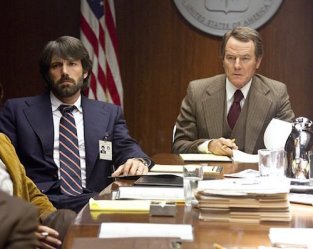 That was in the ’70s — adjusted for inflation, it comes to over $350 million. For a drama about a couple divorcing and arguing over custody of their kid! Today, it’d be lucky to earn a tenth of that, even if it was up for Oscars. But I digress.) It’s a surprising Oscar pick these days because it’s a genuinely enjoyable watch, rather than a gruelling look at something-or-other serious.
Occasional slips aside, it’s a well-made, highly-entertaining, real-world spy thriller. Was it the best picture of 2012? Maybe not. The best movie? Maybe.

 Possibly-crazy people offer definitely-crazy theories on the subtextual meaning of
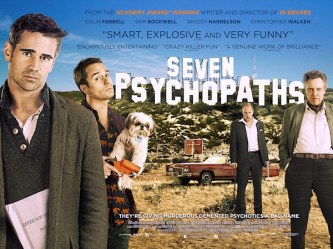 The writer-director and star of
  mainly via references to Farrell’s endeavours to pen a movie called, you guessed it, Seven Psychopaths. One wonders if there’s a hefty dose of autobiography in the writer’s struggle…
 A bunch of obstreperous actors are too much to handle for the director of a Vietnam war movie, so he dumps them in the jungle to shoot it with hidden cameras. Things go awry; hilarity ensues.
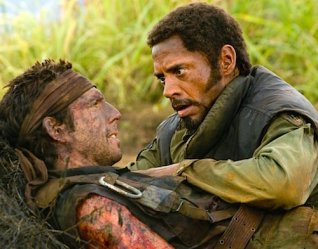 The film may run a little long in the middle, though I don’t think that’s the fault of this extended cut. It adds just over 17 minutes across many little changes and extensions
 Jack Palance is an actor wanting out of his studio contract in this stagey film noir.
 Partially driven by a seeming twist that’s obvious from the outset (which, in fairness, the film reveals only 40 minutes in), the story never quite comes alive. Palance and Corey make parts worth watching, but at other times it’s a bit of a slog, not helped by an awful score that chimes in now and then, loudly. Expansive cinematography (so much headroom — was it shot to be cropped for widescreen? Perhaps it was) combats any feeling of claustrophobia the single location and oppressive moral situation might have leant it.
 The first film to be advertised in space (
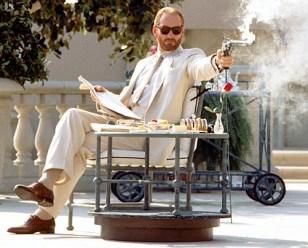 That said, it’s probably a good thing this isn’t a whole movie of “fictional characters in the real world” — you can imagine how that would play out; all the predictable “fish out of water” hijinks. However, at just over two hours, this isn’t a short film, and cutting out some of the middle wouldn’t have hurt.
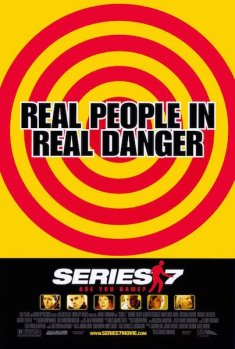 The debut of director Daniel Minahan — who’s since helmed episodes of over a dozen TV shows, including HBO hits
  You know the kind of people who wait ages and ages for something and really want it and pre-order it or whatever and then when it finally arrives they… add it to a pile and don’t get round to watching/reading/listening to it for even longer than the ‘forever’ they were waiting in the first place? If you don’t, you do now — that’s me.
 To be precise, Panahi’s ban is from filmmaking, writing screenplays, leaving the country, or giving interviews, so they conclude that reading aloud an existing screenplay while someone else films him doesn’t contravene any of those rules. Nonetheless, the edited (not-a-)film was smuggled out of Iran on a USB stick hidden in a cake in time for its Cannes premiere.
 In fact, despite the singular input and focus put into this ‘project’, it could be used quite successfully as part of an argument against auteur theory. But that isn’t what it sets out to do either.
 questions that are always worth asking about purported documentaries.
 A behind-the-scenes making-of with a difference, American Movie: The Making of Northwestern (to give its full title) is a documentary about wannabe-filmmaker Mark Borchardt attempting to produce a horror feature film with little more than some mates and good intentions, battling against a lack of money, interest, and dedication. It descends, quickly, into the kind of farcicality that leads some to assume it’s a
  Whatever you take away from it, American Movie feels like a must-see for certain sections of film fandom, particularly anyone who wants to make a movie themselves. Its appeal is broader than that though, an everyday story of adversity that isn’t so much overcome as temporarily averted. It’s not bleak or sad, but it is melancholic. And, whatever the morals of it, often laugh-out-loud funny.
 100Films.co.uk