Cinderella (2015)

2016 #43
Kenneth Branagh | 101 mins | streaming (HD) | 2.35:1 | USA & UK / English | U / PG

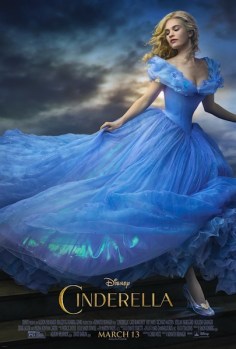
Disney’s animated classic is re-imagined in live-action, losing the songs but expanding the story. The latter serves to find a little more realism in the setup (how Cinders became a servant to her stepmother, etc), as well as in the characters’ motivations and actions.

Cate Blanchett excels (as ever) as the evil stepmother, and Lily James sells Ella’s perfectness as delightful rather than irritating. It’s kinda odd to see Game of Thrones’ Richard Madden as a clean-cut Prince, though.

Branagh brings requisite class and gloss for a remake that, while not a classic like the original, is a worthy revisioning.

4 out of 5

The Lion King (1994)

100 Films’ 100 Favourites #52
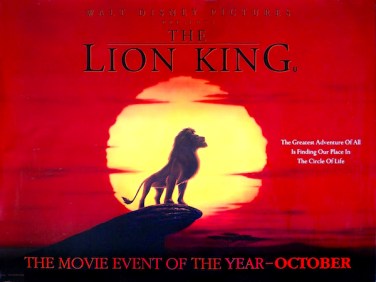
The greatest adventure of all is
finding our place in the circle of life.

Country: USA
Language: English
Runtime: 88 minutes
BBFC: U
MPAA: G

Original Release: 15th June 1994
UK Release: 7th October 1994
First Seen: VHS, c.1995

Stars
Matthew Broderick (Ferris Bueller’s Day Off, Election)
James Earl Jones (Star Wars, Conan the Barbarian)
Jeremy Irons (The French Lieutenant’s Woman, Die Hard with a Vengeance)
Rowan Atkinson (Bean, Johnny English)

Directors
Roger Allers (Open Season, The Prophet)
Rob Minkoff (Stuart Little, Mr. Peabody & Sherman)

Screenwriters
Irene Mecchi (Brave, Strange Magic)
Jonathan Roberts (James and the Giant Peach, Jack Frost)
Linda Woolverton (Beauty and the Beast, Alice Through the Looking Glass)

Story by
Deep breath… Burny Mattinson, Barry Johnson, Lorna Cook, Thom Enriquez, Andy Gaskill, Gary Trousdale, Jim Capobianco, Kevin Harkey, Jorgen Klubien, Chris Sanders, Tom Sito, Larry Leker, Joe Ranft, Rick Maki, Ed Gombert, Francis Glebas & Mark Kausler; with additional story by J.T. Allen, George Scribner, Miguel Tejada-Flores, Jenny Tripp, Bob Tzudiker, Chris Vogler, Kirk Wise & Noni White; and the story supervisor was Brenda Chapman.

Sort of based on
Hamlet, a play by William Shakespeare.

Songs by
Elton John (The Muse, Gnomeo & Juliet)
Tim Rice (Jesus Christ Superstar, Aladdin)

The Story
The savannahs of Africa are ruled by the lion Mufasa, a kindly king who is struggling to instil some sense of life’s importance in his reckless young son and heir, Simba. But Mufasa’s brother, Scar, lusts for power, and manipulates Mufasa and Simba to gain it…

Our Hero
Lion cub Simba is heir to his father’s throne as ruler of the Pride Lands, and a naughty, unruly prince who just can’t wait to be king. All that changes when he winds up outcast, and has to learn to grow up before returning to save his kingdom.

Our Villain
King Mufasa’s jealous brother, Scar, who also just can’t wait to be king. Obviously that’s not going to happen under the regular rules of succession, but Scar is a cunning and conniving sort. Well, he is the villain.

Best Supporting Characters
After running away, Simba falls in with meerkat Timon (voiced by Nathan Lane) and warthog Pumbaa (voiced by Ernie Sabella), who have a laid-back attitude to life, and raise the lion cub to have the same. So successful they had their own spin-off series and were the stars of a sequel, too.

Memorable Quote
Mufasa: “Everything you see exists together in a delicate balance. As king, you need to understand that balance and respect all the creatures, from the crawling ant to the leaping antelope.”
Simba: “But, Dad, don’t we eat the antelope?”
Mufasa: “Yes, Simba, but let me explain. When we die, our bodies become the grass, and the antelope eat the grass, and so we are all connected in the great circle of life.”

Quote Most Likely To Be Used in Everyday Conversation
“Hakuna matata” — a wonderful phrase, it means no worries for the rest of your days.

Memorable Scene
The opening sequence, in which all the animals gather to celebrate the birth of Simba, scored to Circle of Life, is a majestic sequence — so impressive, in fact, that Disney used it, uncut and unadorned, as the film’s trailer.

Best Song
Big romantic number Can You Feel the Love Tonight won the Oscar, and there were nominations for epic opener Circle of Life and quotable comedy hit Hakuna Matata, and you shouldn’t overlook the fun and impressive choreography of I Just Can’t Wait to Be King, but for me the best number is Scar’s Be Prepared. I do love a good villain’s song.

Technical Wizardry
The Lion King continues Disney’s integration of CGI into their animated features, this time using it to create the pivotal wildebeest stampede. A new program had to be written for the sequence, which allowed hundreds of computer generated animals to run without colliding into each other. It took the CG department three years to animate the scene.

Making of
Voice actor Frank Welker (who has over 760 credits to his name on IMDb, including originating Fred in Scooby-Doo and voicing Megatron in the Transformers animated series) provided all of the film’s lion roars. No recordings of actual lions were used.

Next time…
As one of the biggest successes of the Disney Renaissance, The Lion King has naturally had more than its share of follow-ups. The headline has to be the stage musical adaptation of the film, which opened in 1997. It’s the third longest-running show in Broadway history, and is “the highest-earning entertainment property in history in any medium”. In 1998, direct-to-video sequel The Lion King II: Simba’s Pride was released. Apparently its plot is influenced by Romeo and Juliet. A second direct-to-DVD sequel, The Lion King 1½ (known as The Lion King 3 in some countries, including the UK), was released in 2004. It’s based on Rosencrantz and Guildenstern are Dead, re-telling the first movie from Timon and Pumbaa’s perspective. I watched it years ago and really enjoyed it, an opinion supported by its strong 76% on Rotten Tomatoes. On television, spin-off series The Lion King’s Timon & Pumbaa ran for three seasons from 1995, and just last year TV ‘movie’ (it’s only 45 minutes) The Lion Guard: Return of the Roar heralded the start of a new series, The Lion Guard. It’s been renewed for a second season.

Awards
2 Oscars (Song (Can You Feel the Love Tonight), Score)
2 Oscar nominations (Song (both Circle of Life and Hakuna Matata))
2 BAFTA nominations (Music, Sound)
3 Annie Awards (Film, Voice Acting (Jeremy Irons), Individual Achievement for Story Contribution)
3 Annie nominations (Individual Achievement for Artistic Excellence (x3))
2 Saturn nominations (Fantasy Film, Performance by a Younger Actor (Jonathan Taylor Thomas))

What the Critics Said
“Even the inescapable hype cannot diminish the fact that this is one great film. Consider that this movie delivers strong characters, a sophisticated story, good music, captivating visuals and loads of emotion — all within the confines of a G-rated cartoon. […] The most exhilarating part of The Lion King is that it’s not just great animation, but superior filmmaking. Outstanding character animation is a given at Disney, which handles the nuances of movement better than anyone. But the last few animated features show an increasing mastery of cinematography techniques. In The Lion King, the eye of the camera ranges from point of view to overhead to moving with the scene. The opening sequence where the plains animals trek to see the newborn cub and the wildebeest stampede scene are breathtaking.” — Bill Wedo, Philadelphia Daily News

Score: 92%

What the Public Say
“Timone and Pumba [sic] are two of the more interesting comic relief characters in Disney films. I’d argue that they’re one of the most wonderful depictions of a same-sex parenting couple that I have ever seen. I don’t want to get drawn into a debate over their sexuality, but the pair are partners in the truest sense of the word, sharing a life. They sleep together, for crying out loud. I don’t care about their sexuality or anything like that, because we’ll never get an answer on that and it’s immaterial. All that matters is that they complete one another, and it’s sweet. […] Even when Simba arrives, it’s very clear that the dynamic is different – Simba isn’t an equal partner in the relationship like Timone and Pumba. They’re a family, but Timone and Pumba are more of a couple.” — Darren Mooney, the m0vie blog

Verdict

My third Disney pick is consecutive to my previous two (Aladdin and Beauty and the Beast) in Disney’s history of animated classics, which goes to show how successful their ’90s Renaissance was. (Also, when my childhood was.) The Lion King succeeds by combining a selection of memorable, hummable songs with an epic tale of royal politicking — but, y’know, in a Disney way. Unafraid to include plot twists that place it alongside Bambi in the company’s canon, but with some well-performed comedy characters to lighten the mood, it manages to be one of Disney’s most entertaining but also most philosophical (in its way) films.

#53 has… my sword, and my bow, and my axe.

The Incredibles (2004)

100 Films’ 100 Favourites #44

Expect the incredible.

Country: USA
Language: English
Runtime: 115 minutes
BBFC: U
MPAA: PG

Original Release: 5th November 2004 (USA)
UK Release: 26th November 2004
First Seen: DVD, 2005

Stars
Craig T. Nelson (Poltergeist, Action Jackson)
Holly Hunter (Raising Arizona, The Piano)
Samuel L. Jackson (Pulp Fiction, Snakes on a Plane)
Jason Lee (Mallrats, Alvin and the Chipmunks)

Director
Brad Bird (The Iron Giant, Mission: Impossible – Ghost Protocol)

Screenwriter
Brad Bird (*batteries not included, Ratatouille)
(I bet you could count on one hand the number of Western animated movies written by one person.)

The Story
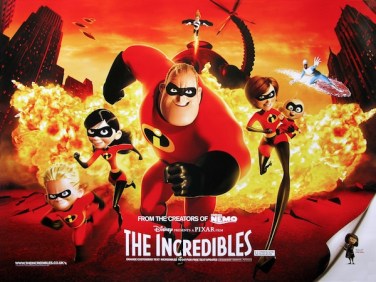
After public opinion forced superheroes into a civilian relocation programme, Bob and Helen Parr — formerly Mr Incredible and Elastigirl — live a quiet domestic life with their three children. Bob is dissatisfied, however, and easily tempted back to heroic ways by a call to defeat an evil robot. When it emerges this is part of a plan to kill retired superheroes and give powers to everyone in the world, Bob’s wife and superpowered kids must enter the fray to save the world.

Our Heroes
The fantastic four titular heroes: Bob Parr, aka Mr Incredible, who has super strength and limited invulnerability; his wife Helen, aka Elastigirl, who can stretch her body like rubber; their daughter Violet, who can become invisible and generate a force shield; and her younger brother Dash, who has super-speed (name/power coincidencetastic!) There’s also their chum Lucius Best, aka Frozone, who can form ice from the air. He’s very cool, hence casting Samuel L. Jackson.

Our Villain
Disillusioned superhero fanboy Buddy Pine, who grew up and used technology to give himself powers, dubbing himself Syndrome. Wants to give everyone in the world powers, because when everyone’s super, no one will be.

Best Supporting Character
Fashion designer Edna Mode, who makes the superheroes’ costumes. Inspired by Hollywood costume designer Edith Head, Bird wanted Lily Tomlin to voice her, and provided an example of how she should sound. Tomlin thought it was perfect, so she instead persuaded Bird to play the role himself.

Memorable Quote
“No matter how many times you save the world, it always manages to get back in jeopardy again. Sometimes I just want it to stay saved! You know, for a little bit? I feel like the maid — ‘I just cleaned up this mess! Can we keep it clean for ten minutes?!’” — Mr. Incredible

Memorable Scene
After tearing his old costume, Bob visits Edna for a new one. He wants a cape. Cue montage of why capes are a bad idea.

Technical Wizardry
The film presented a whole host of new technical challenges for Pixar, not least fully animating a whole cast of humans for the first time — they had to develop new technology to animate detailed anatomy, clothing, skin, and hair. The latter was a particular challenge. On Monsters, Inc., the animators persuaded director Pete Docter to give Boo pigtails to make her hair easier to animate, but Brad Bird accepted no such compromises, particularly as Violet’s long, face-covering hair was integral to her character — and it had to be depicted underwater and blowing in the wind, too. Ultimately, Violet’s hair was only successfully animated toward the end of production.

Next time…
One of the few Pixar sequels people actually wanted, The Incredibles 2 is in development for a 2019 release. That’s only a 15-year wait.

Awards
2 Oscars (Animated Film, Sound Editing)
2 Oscar nominations (Original Screenplay, Sound Mixing)
1 BAFTA Children’s Award (Best Film)
10 Annie Awards (Feature, Directing, Writing, Voice Acting (Brad Bird), Music, Production Design, Animated Effects, Character Animation, Character Design, Storyboarding)
6 Annie nominations (Voice Acting (Samuel L. Jackson), Character Animation (again, x3), Character Design (again), Storyboarding (again))
1 Saturn Award (Animated Film)
2 Saturn nominations (Writer, Music)
Won the Hugo for Best Dramatic Presentation Long Form

What the Critics Said
“what really makes The Incredibles work is the wit of Bird [though] much of it will be over the heads of very young viewers who account for so much repeat business. Bird’s satiric take on suburbia, conformity and forced notions of equality is surprisingly sophisticated and biting for an animated feature, matched by a visual panache that is often breathtaking.” — Kevin Lally, Film Journal International

Score: 97%

What the Public Say
“Most Disney films are about people meeting and falling in love. Incredibles is one of the only ones I can think of about how important marriage is. It shows a couple fighting, getting along, and working together.” — Rachel Wagner, Reviewing All 54 Disney Animated Films and More!

Verdict

Even before the present glut of big-screen super-heroics, Pixar were in on the game with this affectionate genre entry. Writer-director Brad Bird mixes together classical superhero antics with elements of 1960s spy-fi to create a retro world of optimistic heroics and larger-than-life villainy — at odds with the dark-and-serious tone of so many superhero movies of the past 17+ years, but all the more memorable for it. It’s also great at the kinds of things Pixar is known for. The combination means it transcends both the kids’ animation and superhero subgenres.

#45 will be… keeping up with the Joneses.

Maleficent (2014)

2016 #84
Robert Stromberg | 93 mins | streaming (HD) | 2.35:1 | USA & UK / English | PG / PG

Disney seem to be embarking on a project to remake all of their most beloved animated movies in live action,* with Cinderella being one of the highest grossing movies of last year, The Jungle Book currently doing gangbusters at the box office worldwide, an all-star Beauty and the Beast hotly anticipated for next year, and others in the pipeline that include Mulan, Pinocchio, The Sword in the Stone, both Peter Pan and Tinkerbell, another 101 Dalmatians, an Aladdin prequel, Winnie the Pooh, and Tim Burton’s Dumbo. (No, I did not make those last two up.)
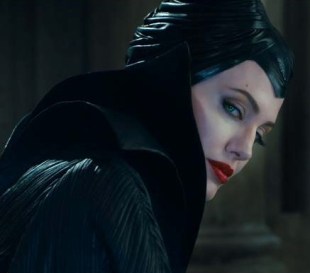
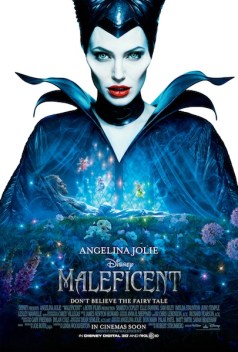
But it all started… back in 2010, when Tim Burton’s Alice in Wonderland was an unexpectedly ginormous hit. But then there were a couple of years off, so you could argue the current wave started here: a revisionist re-telling of Sleeping Beauty from the point of view of its villainess. In this version, we meet Maleficent as a child, protector of some fairy kingdom that borders the human kingdom. One day she meets a trespassing human boy, Stefan; they fall in love; eventually, he stops visiting, set on making his fortune in the king’s castle. After Maleficent has grown up to be Angelina Jolie doing an English accent and Stefan has grown up to be Sharlto Copley doing a Scottish accent (goodness knows why), the human king decides to invade the fairy land. Maleficent repels his forces, and the dying king vows whoever can defeat her will be named heir. So power-hungry Stefan does something terrible, and we’re on the road to the story we know… more or less.

It’s an interesting idea to take an archetypal villain who’s evil for evil’s sake and try to give her motivation, to understand why she did terrible things. Maleficent makes a fair fist of this, beginning long before the familiar tale to establish a run of events that tip the titular character to the dark side. What Stefan does to her to win power is pretty dark, and a clear analogy to a real-world crime that you wouldn’t expect from a PG-rated Disney movie. Our sympathies, at this point, lie with Maleficent. Of course, then she goes and condemns an innocent child to eternal slumber, so that’s less nice.

However, this is a Disney movie — you don’t get to turn a villain into the central character and have her be evil throughout. This is where the film gets really revisionist, because Maleficent keeps an eye on cursed Princess Aurora (Elle Fanning) as she grows, doing more to keep her alive than the trio of fairies she’s supposedly in the care of, and her heart is gradually warmed to the girl. Unfortunately, Maleficent was too good at the cursing malarkey: unable to lift her own spell, it plays out regardless, and the film serves us new renditions of the impassable thorns, giant dragon, and true love’s first kiss. It’s in the last where Maleficent is thematically revisionist rather than just a massive rewrite. Your mileage may vary on whether this version is obvious and cheesy, or actually more meaningful and (for the primary audience of little kiddies) more thought-provoking than the original’s — I’d go with the latter.
So in some respects, Maleficent is a success. In others, it’s a bit of a mess. For all the additional character development given to Maleficent herself, the rest of the characters are two-dimensional at best. It’s ironic that, in a movie all about fleshing out and understanding the villain, the new villain (i.e. Stefan) is so flat. Other elements are just pointless or nonsensical, like the corridor of iron spikes Maleficent & co briefly have to squeeze along. It’s not a bad idea per se — it’s been established that iron hurts fairies (goodness knows why, but there you go), so it’s a reasonable concept for a physical obstacle — but it’s really poorly integrated into the story, and it’s bested by… walking through it carefully. Thrilling.

Parts of the film test-screened poorly — mainly the first act, with audiences wondering why it took so long for Jolie to turn up. Consequently, the whole thing was thrown out and reshot; in the process, Peter Capaldi and Miranda Richardson were deleted (and after they’d had to endure hours of transformative prosthetics for their roles, too), and Maleficent was given a new backstory. How far this extended into the rest of the movie, I’m not sure, but at times it feels like stuff has been cut or rearranged. Certainly the story flies past — if it wasn’t trimmed down in the edit, it needed expanding back at the screenplay stage.

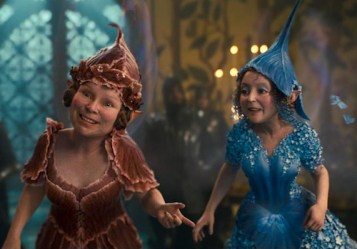
Then there’s the uncanny-valley-tastic rendition of the three fairies, with mini plasticky-CGI versions of Imelda Staunton, Juno Temple and Lesley Manville floating around until they jarringly turn into live action; the unintentional hilarity of the Prince Charming-type apparently being from the kingdom of Ofsted (it’s actually Ulfstead, but still); and the original film’s famous song, Once Upon a Dream, being slowly murdered by Lana Del Rey. Perhaps surprisingly, the work of production-designer-turned-director Robert Stromberg is pretty decent, though over-fond of crash zooms during action sequences, and an overall visual style that’s reminiscent of the likes of Burton’s Alice in Wonderland and Sam Raimi’s Oz the Great and Powerful — both of which Stromberg designed, funnily enough.

For all its faults, Maleficent was still the fourth highest grossing movie of 2014 — though the top grosser was Transformers: Age of Extinction and second was The Hobbit: The Battle of the Five Armies, so that shows what quality matters to the box office. Nonetheless, it’s no wonder Disney have kicked into gear with the live-action remakes, and even a Maleficent sequel is in development. (No idea how that’ll work — Sleepier Beauty?) On the bright side, there is something more interesting going on here than just an animated film being re-done with real people (and copious CGI). Certainly, anyone interested in fairytales being deconstructed and/or reconstructed should be sure to check it out.

3 out of 5

Maleficent is available on Netflix UK as of this week.

* At least they’re not trying to tie them together as another shared universe! ^

Home on the Range (2004)

2016 #32
Will Finn & John Sanford | 73 mins | streaming (HD) | 1.78:1 | USA / English | U / PG

I have many goals within my film viewing, quite apart from trying to watch 100 films every year. Some I’ve completed (the Rathbone Holmes series), others are almost done (every Spielberg film), others not so much (every Hitchcock film), and others I’ve barely begun (the Zatoichi series). One of these goals is to watch every Disney Animated Classic, their canon of feature animations that currently sits at 55 titles (with another scheduled for later this year, in the US at least). I did a pretty good job on the real classics while growing up, and have since filled the gaps of the modern classics, so I’m left ploughing through their lesser periods: the content they pumped out in the war-affected ’40s, and the post-Renaissance pre-Lasseter clusterfrack that was their ’00s produce. My best hope is to uncover a hidden gem while I mop up this dross.
Home on the Range is not a hidden gem.

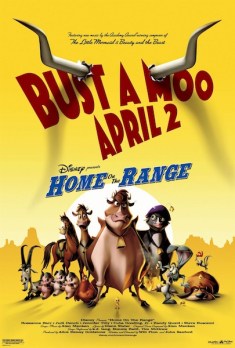
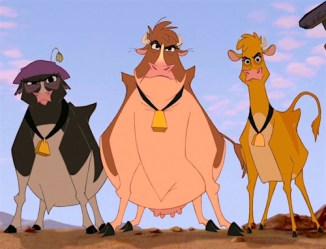
The plot, such as it is, locates us in the Old West, where a trio of singing cows hunt for an outlaw in order to save the farm they live on. The early ’00s box office was not a great place for musicals, Westerns, or traditional animations, so one does have to wonder what inspired Disney to make their 45th Animated Classic a traditionally-animated musical Western.

Still, box office failure does not equate to a lack of quality. No, the film achieves that all by itself. There’s a plodding, familiar, poorly-structured story, with dull characters, who spout flat dialogue, which does nothing to help their unoriginal relationships. The voice acting is irritating, with the exception of one or two over-qualified performers (Dame Judi Dench?!) The songs are weedy, repetitious, and unmemorable. The villain’s number is the best of a bad bunch, but only because it has a moderately amusing reveal in the middle of it. The animation is unremarkable, besides some terrible CG intrusions. It seems to be under the impression that “hog” is a word for “cow”, based on the number of puns. A couple of gags do land — I even laughed out loud once, though I’ve forgotten why — but the majority is resolutely uninspired.

It’s actually not the worst of Disney’s canon (as I mentioned, there’s the odd flash of enjoyment, which is more than can be said for Chicken Little), but it’s still one for aficionados — or completists — only.

2 out of 5

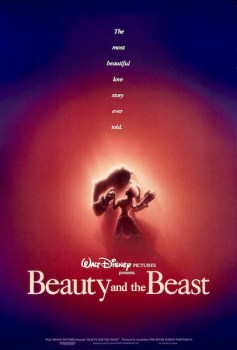
Beauty and the Beast (1991)

100 Films’ 100 Favourites #10

The most beautiful love story ever told.

Country: USA
Language: English
Runtime: 84 minutes | 92 minutes (special edition)
BBFC: U
MPAA: G

Original Release: 15th November 1991 (USA)
UK Release: 9th October 1992
First Seen: VHS, c.1993

Stars
Paige O’Hara (Beauty and the Beast: The Enchanted Christmas, Enchanted)
Robby Benson (Ice Castles, Dragonheart: A New Beginning)
Angela Lansbury (The Manchurian Candidate, Bedknobs and Broomsticks)

Directors
Gary Trousdale (The Hunchback of Notre Dame, Atlantis: The Lost Empire)
Kirk Wise (The Hunchback of Notre Dame, Atlantis: The Lost Empire)

Screenwriter
Linda Woolverton (Alice in Wonderland, Maleficent)

Story by
Deep breath… Roger Allers, Brenda Chapman, Burny Mattinson, Brian Pimental, Joe Ranft, Kelly Asbury, Christopher Sanders, Kevin Harkey, Bruce Woodside & Robert Lence.

Based on
La Belle et la Bête, a French fairy tale originally by Gabrielle-Suzanne Barbot de Villeneuve, but in this case (and most others) adapted from the retelling by Jeanne-Marie Leprince de Beaumont.

Music
Alan Menken (Aladdin, Hercules)

Lyrics
Howard Ashman (Little Shop of Horrors, Aladdin)

The Story
An arrogant prince is transformed into a beast, with one hope of redemption: someone must fall in love with him before his 21st birthday; if not, the curse’s effects become permanent. When elderly inventor Maurice is imprisoned by this Beast, his bookworm daughter Belle offers to take his place. Spying a chance to alleviate the curse, the Beast agrees. With only a short time until his 21st birthday, could a girl ever learn to love a beast?

Our Hero
A girl who’s strange but special — a most peculiar mademoiselle. With a dreamy far-off look, and her nose stuck in a book, she really is a funny girl, a beauty but a funny girl, that Belle.

Our Villain?
The Beast’s got fangs, razor sharp ones; massive paws, killer claws, for the feast. He was mean and he was coarse and unrefined, but now he’s dear and so unsure. Perhaps there’s something there that wasn’t there before…

Our Villain!
No one’s slick as Gaston, no one’s quick as Gaston, no one’s got a swell cleft in his chin like Gaston. Uses antlers in all of his decorating, my what a guy, that Gaston.

Best Supporting Character
The comedy double act of French candlestick Lumiere and English clock Cogsworth, voiced (respectively) by Law & Order’s Jerry Orbach and M*A*S*H’s David Ogden Stiers. Funny old business, acting.

Memorable Quote
“Try the grey stuff, it’s delicious / Don’t believe me? Ask the dishes / They can sing, they can dance / After all, miss, this is France / And a dinner here is never second best.” — Be Our Guest

Quote Most Likely To Be Used in Everyday Conversation
“It’s not right for a woman to read. Soon she starts getting ideas, and thinking…” — Gaston. (I didn’t say it should be used.)

Memorable Scene
The film’s prologue tells the story of how the Prince became the Beast through the medium of stained glass windows. It’s a beautifully realised fairy tale within a fairy tale.

Best Song
Titular Beauty and the Beast may’ve won the Oscar (“Tale as old as time, song as old as rhyme” — that one), but the actual best song is clearly Be Our Guest. A toe-tapping tune married with fun lyrics, fantastic choreography and superb animation combine to make it, for me, one of the greatest numbers in any musical, animated or otherwise.

Making of
Be Our Guest was originally to be sung to Belle’s father, Maurice, when he’s trapped in the castle. It was writer Bruce Woodside who pointed out that it was in the wrong place because such a key song shouldn’t be performed to a secondary character, so it was moved later to be sung to Belle. This is why you should always listen to writers.

Previously on…
Beauty and the Beast is Disney’s 30th Animated Classic, their official canon of animated movies. It’s the third film in the “Disney Renaissance”, the decade-long period (starting with The Little Mermaid and ending with Tarzan) when the studio enjoyed revived creative and financial success. In terms of this particular retelling of the tale, it owes a clear debt to Jean Cocteau’s La Belle et la Bête.

Next time…
Two direct-to-video animated sequels and a spin-off educational live-action TV series. In 1994, it was the first Disney animated film to become a Broadway musical. In 2002, it was extended with a new song, and in 2012 was re-released in 3D. An all-star live-action remake is out next year.

Awards
2 Oscars (Original Song (Beauty and the Beast), Original Score)
4 Oscar nominations (Picture, Sound, Original Song (both Belle and Be Our Guest))
2 BAFTA nominations (Original Score, Special Effects)
2 Saturn nominations (Fantasy Film, Music)
2 Annie Awards (Animated Feature, Individual Achievement in the Field of Animation)
Nominated for the Hugo for Best Dramatic Presentation.

What the Critics Said
“A lovely film that ranks with the best of Disney’s animated classics, Beauty and the Beast is a tale freshly retold. Darker-hued than the usual animated feature, with a predominant brownish-gray color scheme balanced by Belle’s blue dress and radiant features, Beauty engages the emotions with an unabashed sincerity.” — Variety

Score: 93%

What the Public Say
“The voice cast are perfectly suited to their roles and imbue them with dexterity and flair. Paige O’Hara splendidly combines strength and touching bravery as Belle. Her singing voice is a marvel as well, singing with clarity and loving kindness. Robby Benson’s deep but engaging voice is ideally suited to the Beast, and gives him depth and mournful sorrow that subsides into happiness as he develops feelings for Belle.” — vinnieh

Elsewhere on 100 Films
Back in 2010 I reviewed The Special Edition of Beauty and the Beast (to give its full on-screen title), describing it as “impossible to fault in any significant way. The design and animation are beautiful, the voice acting spot-on, the score exquisite, the story fast-paced and enthralling […] It’s hilariously funny, remarkably exciting, surprisingly scary, relentlessly romantic […] Every [song] bursts with memorable tunes, witty rhymes, genuine emotion — even the Soppy Girly Song is a good one!” Beat that, verdict section…

Verdict

Beauty and the Beast was, famously, the first (and, for a long time, only) animated movie to be nominated for Best Picture at the Oscars, and you could hardly think of a more deserving candidate. Every element of it displays artistry, from the the witty dialogue and lyrics, to the likeable and engaging characters, to the fluid and detailed animation, to the songs which help the film to run the gamut of emotions. In the field of Broadway-style Disney musicals, Beauty and the Beast is animation perfection.

#11 will be… a long nap.

The Lone Ranger (2013)

2015 #177
Gore Verbinski | 149 mins | streaming (HD) | 2.35:1 | USA / English | 12 / PG-13

Hated by Americans and loved (well, ok, “liked”) by everyone else (well, ok, “by lots, but by no means all, of people who reside outside America”), Disney’s attempt to pull a Pirates of the Caribbean on Western adventure IP The Lone Ranger is by no means as successful as the first instalment in their piratical franchise, but is at least the equal of its sequels — and, in some cases, their better.

The convoluted plot sees us arrive with John Reid (Armie Hammer) in the frontier town where he grew up, where his brother Dan (James Badge Dale) is now sheriff. Construction of the railroad is running by the town, spearheaded by Latham Cole (Tom Wilkinson), who letches after Dan’s wife (Ruth Wilson); but work is plagued by a band of outlaws led by Butch Cavendish (William Fichtner). Receiving information on his whereabouts, Dan rounds up a posse and heads out to tackle him, with John insisting on tagging along. Unfortunately it’s an ambush and they’re all slaughtered (oh dear)… except John just about survives, and is found and nursed back to life by a Native American, Tonto (Johnny Depp). He has his own grievances, and together they set out on a mission of revenge.

And if you’re wondering where Helena Bonham Carter is in all that: despite her prominence on many of the posters, her role is really just a cameo. That’s marketing, folks.

I know some people complain about simplistic stories that are used to just string action sequences together, and that’s a perfectly valid thing to get annoyed about, but The Lone Ranger swings to the other extreme and uses an over-complicated story to string together its action sequences. All it actually needs is a little streamlining, because the film is allowed to swing off into too many sideplots. This makes the middle of the film a slog, and you feel every minute of its excessive two-and-a-half-hour running time.
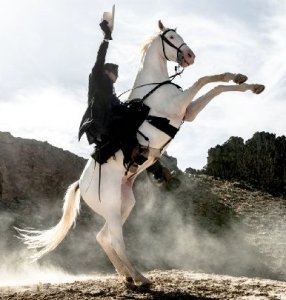
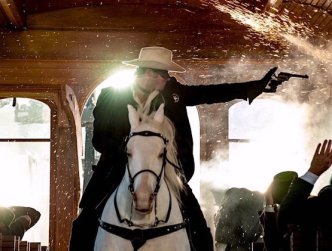
That slog is made worthwhile by what comes before and after said middle: a pair of train-based action sequences that are each truly fantastic. The second, in particular, is arguably amongst the grandest climaxes ever put on screen (providing you don’t feel it’s tipped too far into being overblown, of course). It’s inventively choreographed, fluidly shot, and perfectly scored with just an extended barnstorming version of the Lone Ranger’s theme music (aka the William Tell Overture). It’s an adrenaline-pumping action sequence that single-handedly justifies the entire film’s existence, if you’re into that kind of thing.

With multiple trains, horses, actors, guns, stunts, and copious CGI to tie it together, that sequence must’ve cost a bomb. Notoriously, the whole film was deemed too expensive and Disney insisted the budget be slashed, resulting in delays… and it still cost a fortune. That, quite apart from the negative critical response in the US, is a big part of why it flopped at the box office — a recurring problem for Disney at the minute. To be frank, I’m not convinced anyone made a truly concerted effort to stem the overspend. When a gaggle of CG rabbits hopped on screen, all I could think was, “who allowed this?!” You’ve got a massively over-budgeted film that the studio want cut back, and one reason for that is CG bunnies that have almost no bearing on anything whatsoever! The amount of time and effort that must’ve gone into creating those fairly-realistic rabbits for such a short amount of screen time… it cost millions, surely. Millions that could’ve been saved with a simple snip during the writing stage if only someone had said, “well, those bunnies don’t add anything and they’ll be bloody expensive, so let’s lose them.”
So criticism is not unfounded, but the film doesn’t deserve the level of vitriolic scorn poured on it by the US press and, consequently, public. Discussing this, the “critical response” section on the film’s Wikipedia page is interesting, and this part pretty much nails it:

Mark Hughes of Forbes, analyzing what he felt was a “flop-hungry” press desiring to “control the narrative and render the outcome they insisted was unavoidable” for a highly expensive movie with much-publicized production troubles, found the film “about a hundred times better than you think it is … [a] well-written, well-acted, superbly directed adventure story.”

I’m not quite as effusive as Hughes, but The Lone Ranger is worth the time of anyone who enjoys an action-adventure blockbuster. It’s a three-star adventure-comedy bookended by a pair of five-star railroad action sequences, which make the trudge through the film’s middle hour-or-so feel worthwhile. There was a better movie to be made here — one that was half-an-hour shorter, more focused, and probably several tens of millions of dollars cheaper to make — but that doesn’t mean the one we got is meritless.
4 out of 5

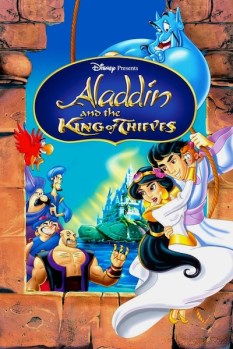
Aladdin and the King of Thieves (1996)

2015 #196
Tad Stones | 82 mins | streaming (HD) | 16:9* | USA / English | U

For most of the ’90s and ’00s, Disney churned out direct-to-video sequels to many of their most beloved animated classics. They have a reputation for being unremittingly awful, hence why Pixar’s John Lasseter put a stop to their production after he became Disney’s Chief Creative Officer in 2006. Despite that reputation, however, there are those who say one or two are actually quite good. One of those (and the only one I’ve previously seen) is The Lion King 1½ (released as The Lion King 3 in the UK), which is a sort of a Rosencrantz and Guildenstern Are Dead to the original film’s Hamlet, re-telling the story from the perspective of Timon and Pumbaa. I saw it years ago but would vouch for its relative quality — when I first re-watched The Lion King after, I briefly thought some scenes were missing, which I guess is testament to how well it fits.

Another such-praised sequel is this follow-up to Disney’s 1992 Animated Classic. It’s actually the second sequel (the first was also the first of those Disney DTV sequels) and also follows an 86-episode TV series. Fortunately, the makers dropped an early idea to use one of the series’ main villains as the film’s antagonist, and so it functions perfectly as a direct sequel to the original movie. Which is nice, because that first sequel isn’t meant to be very good and I imagine the TV series is hard to come by nowadays. Plus, neither of those can claim an ever-so-important distinction that this can: it features the return of Robin Williams as the Genie.

The film begins on the wedding day of Aladdin (Scott Weinger) and Jasmine (Linda Larkin), which is interrupted by the mysterious Cassim, the King of Thieves (John Rhys-Davies), and his gang of forty thieves seeking to steal an oracle from among the wedding gifts. Although they fail, the oracle informs Aladdin that the answers he seeks about his long-departed father are to be found with the forty thieves… I expect you can guess where that’s going. Fortunately the film gets there pretty quickly, then transitions into a story about the possible redemption (or not) of Cassim alongside the quest for the Hand of Midas, capable of turning whatever it touches into gold (natch).
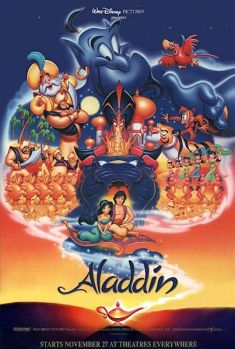
The King of Thieves has a few things in its favour. It’ll come as no surprise that the biggest and best is Williams reprising his iconic performance, and consequently being responsible for most of the film’s humour. There are a couple of fun nods to some of Williams’ other best-remembered roles, and plenty to other Disney films too. The rest of the film offers a fast-paced, action-packed narrative, with a few musical numbers to boot. The songs are certainly not as memorable as those found in proper Disney movies, but most are decent while they last. Jasmine gets somewhat short shrift, but this is really a story about father and son.

Those who dislike Disney’s Aladdin won’t find anything to enjoy here, but for fans of the original, Aladdin and the King of Thieves is a solid, fun follow-up.

4 out of 5

* The film was made for release on VHS, so it’s no surprise that the OAR is 1.33:1. The HD version is cropped for 16:9. It’s mostly alright, though anyone with an eye for composition will find it obvious at times. ^

Aladdin (1992)

100 Films’ 100 Favourites #1

Imagine if you had three wishes,
three hopes, three dreams
and they all could come true.

Country: USA
Language: English
Runtime: 90 minutes
BBFC: U
MPAA: G

Original Release: 25th November 1992 (USA)
UK Release: 18th November 1993
First Seen: VHS, c.1993

Stars
Scott Weinger (Aladdin and the King of Thieves, Shredder)
Robin Williams (Good Will Hunting, Insomnia)
Linda Larkin (The Return of Jafar, Joshua)
Jonathan Freeman (The Return of Jafar, The Ice Storm)

Directors
Ron Clements (Basil the Great Mouse Detective, Hercules)
John Musker (The Little Mermaid, The Princess and the Frog)

Screenwriters
Ron Clements (The Little Mermaid, The Princess and the Frog)
John Musker (Basil the Great Mouse Detective, Hercules)
Ted Elliott (The Mask of Zorro, Pirates of the Caribbean: The Curse of the Black Pearl)
Terry Rossio (Shrek, Pirates of the Caribbean: At World’s End)

Story by
Deep breath… Burny Mattinson and Roger Allers, Daan Jippes, Kevin Harkey, Sue Nichols, Francis Glebas, Darrell Rooney, Larry Leker, James Fujii, Kirk Hanson, Kevin Lima, Rebecca Rees, David S. Smith, Chris Sanders, Brian Pimental & Patrick A. Ventura.

Based on
The folktale of Aladdin and the magic lamp from One Thousand and One Nights, aka The Arabian Nights.

Music
Alan Menken (Little Shop of Horrors, Tangled)

Lyrics
Howard Ashman (Little Shop of Horrors, Beauty and the Beast)
Tim Rice (The Lion King, Evita)

The Story
Street urchin Aladdin falls for bored Princess Jasmine when she sneaks out of her palace one day, leading him to the clutches of evil vizier Jafar, who needs Aladdin to retrieve a magic lamp as part of his scheme to rule the land. When Aladdin accidentally discovers the lamp’s inhabitant, a wish-granting Genie, he uses his wishes to set about wooing the princess. Jafar, of course, has other ideas…

Our Hero
One jump ahead of the bread line, one swing ahead of the sword, steals only what he can’t afford (that’s everything). Riffraff, street rat, scoundrel. It’s Aladdin, of course.

Our Villain
Grand Vizier Jafar, a plotting underling — the kind of role that has strong precedent in fiction, I’m sure, though Conrad Veidt as villainous Grand Vizier Jaffar in The Thief of Bagdad is rather clearly the direct inspiration.

Best Supporting Character
Oh, I don’t know, maybe… the Genie! Fantastically voiced by a heavily-improvising Robin Williams, praise is also deserved for Eric Goldberg’s character animation, which matches him every step of the way. In fact, it was an animation Goldberg created using one of Williams’ stand-up routines that convinced the comic to take the part.

Memorable Quote
Aladdin: “You’re a prisoner?”
Genie: “It’s all part and parcel, the whole genie gig. Phenomenal cosmic powers! Itty bitty living space.”

Memorable Scene
Trapped in a desert cave, Aladdin accidentally rubs a lamp and unleashes the Genie — and with it, Robin Williams’ all-time-great hilarious performance.

Best Song
For me, it’s Prince Ali, the huge Genie-led number as a disguised Aladdin arrives back in town in grandiose style. The Genie’s big solo number, Friend Like Me, is an incredibly close second. Soppy A Whole New World won all the awards, because of course it did.

Truly Special Effect
Only the second time Disney used CGI with 2D character animation. In Beauty and the Beast, it built a room for the characters to dance in; here, there’s a character (the entrance to the cave) and a whole action sequence (the flying carpet escape from said cave). It earnt the team a BAFTA nomination. There’s no shame in what they lost to: Jurassic Park.

Making of
Robin Williams ad-libbed so much of his role as the Genie — generating almost 16 hours worth of material, in fact — that the film was rejected for a Best Adapted Screenplay Oscar nomination.

Previously on…
Aladdin is Disney’s 31st Animated Classic, their official canon of animated movies. It’s the fourth film in the “Disney Renaissance”, the decade-long period (starting with The Little Mermaid and ending with Tarzan) when they had a run of films that were critically and financially successful (unlike those before and after said period).

Next time…
Two direct-to-video sequels, the second of which is quite good; in between those, a TV series ran for 86 episodes(!); a Broadway adaptation debuted in 2014 (it’s coming to the West End in May); not to mention numerous video games and appearances in other works, almost all still voiced by the less-starry names among the original cast. The go-to new voice for the Genie? Dan “Homer Simpson” Castellaneta.

Awards
2 Oscars (Original Song (A Whole New World), Original Score)
3 Oscar nominations (Sound, Sound Effects Editing, Original Song (Friend Like Me))
2 BAFTA nominations (Score, Special Effects)
1 Annie Award (Animated Feature)
3 Saturn Awards (Fantasy Film, Supporting Actor (Robin Williams), Younger Actor (Scott Weinger))
1 Saturn nomination (Music)
Nominated for the Hugo for Best Dramatic Presentation.

What the Critics Said
“What will children make of a film whose main attraction — the Genie himself — has such obvious parent appeal? They needn’t know precisely what Mr. Williams is evoking to understand how funny he is. […] What will come through clearly to audiences of any age is the breathless euphoria of Mr. Williams’s free associations, in which no subject is off-limits, not even Disney itself.” — Janet Maslin, The New York Times

Score: 94%

What the Public Say
“the perfect Disney film, one that cleverly combines the sensibilities of classic and modern audiences, one that matches toe to toe with many of the studio’s greatest films. You may prefer the emotional heart-ache of The Lion King or the romantic magic from Beauty and the Beast, but I would always prefer the witty and charming Aladdin.” — feedingbrett @ Letterboxd

Verdict

Hailing from slap-bang in the middle of the Disney Renaissance, Aladdin may not be quite as strong as the films either side of it (Beauty and the Beast and The Lion King), but it’s the next best thing. Buoyed by Robin Williams’ top-drawer performance (have I mentioned that yet?), multiple toe-tapping musical numbers, and a dastardly villain who’s among Disney’s best — and is just one of several great supporting characters here, actually — Aladdin is an A-grade animated Arabian adventure.

In #2 no one can hear you scream.

Tomorrowland: A World Beyond (2015)

aka: just Tomorrowland

2015 #187
Brad Bird | 125 mins | streaming (HD) | 2.20:1 | USA & Spain / English | 12 / PG

TomorrowlandAfter making his live-action directorial debut with the unlikely sidestep of Mission: Impossible – Ghost Protocol, Pixar alumni Brad Bird heads back in a familiar family-friendly direction for this Disney sci-fi action-adventure. One of several movies lambasted by critics this past summer, I actually thought it was a lot of fun.
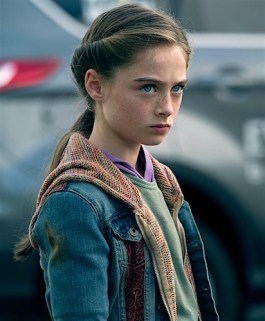
The story concerns a future city created by scientists and dreamers; a place of wonder and innovation not constrained by the short-term goals of politicians or moneymen. Boy inventor Frank is delighted to be invited along there by recruiter Athena (Raffey Cassidy); years later, teenager Casey (Britt Robertson) receives similar treatment… only it turns out something is wrong, and Casey and Athena must track down a grizzled and disillusioned Frank (George Clooney) so they can head back to Tomorrowland and convince its leader (Hugh Laurie) of the way to make things right.

Something along those lines, anyway, because Tomorrowland’s storytelling can get a little muddled. It doesn’t quite conform to your usual action-adventure narrative shape — we spend quite a long time with boy-Frank, before the story essentially restarts with Casey, and eventually those two threads join up. The thing this makes me wonder is, is the storytelling actually muddled (this is not an uncommon criticism of the film), or does it just take an atypical shape, with the consequent lack of comforting familiarity making us think it’s poorly done? A counterargument might be that it helps foster some of the film’s mysteries, which might be reveals without setup if you restructured. I think if you just go along with it, the only real bump is in that restart; otherwise, it’s a pretty smooth action-adventure.

And that’s why I don’t really understand the negative response to it. Sure, the plot may have the odd hole, but there are worse in better-regarded movies; Raffey Cassidy, a findand there’s a moral lesson that’s arguably a little heavy-handed, but as it’s a moral lesson some people aren’t bloody listening to, I can’t say I blame Bird for that. The characters and performances are likeable, with Raffey Cassidy standing out as a marvellous young find, though Laurie is a little undersold. There are some suitably entertaining action scenes, some moments of visual splendour thanks to the future city, and one long take that is exquisite. I know I’m a sucker for a long take, but this is a really exceptional one, that deserves to be mentioned alongside the year’s more-praised unbroken shot, the opening of Spectre.

It’s such a shame when original blockbusters like this get pissed all over by critics and an audience who are sometimes too keen to re-parrot critics’ opinions as if they’re their own (see also the Stateside response to Lone Ranger vs. how the rest of us received it). I’m not arguing movies should get a free pass just because they’re not adapted from something else, but really, when decent adventures like this get slated and consequently flop, what incentive do the studios have to try something new, when they know producing fifth Transformers or Pirates of the Caribbean instalments will make shedloads whatever the reviews say?

For anyone who enjoys a good sci-fi action-adventure movie, I urge you to ignore the critics and give Tomorrowland a go. It’s not exactly a revelation, but it’s a fun time with more than a few points to commend it.

4 out of 5

This review is part of the 100 Films Advent Calendar 2015. Read more here.