Make/Remake: Deaths at a Funeral

In 2007, Frank Oz directed a gaggle of British thesps (plus Peter Dinklage) in a darkly comic farce set during an English funeral.

Just three short years later, director Neil LaBute and a gaggle of American comedians (plus Peter Dinklage) remade it in the US.

Why did they so speedily re-do an English-language film in English? Goodness only knows. But I watched both versions almost back to back, so here are my thoughts…

Death at a Funeral
(2007)

2018 #44
Frank Oz | 91 mins | streaming (HD) | 1.85:1 | UK, USA, Germany & Netherlands / English | 15 / R
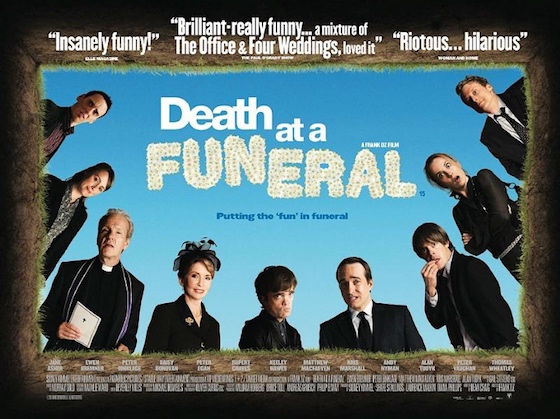
Death at a Funeral (2007)

The plot of both versions is identical: a group of family and friends gather at the home of the family’s patriarch for his funeral. A variety of subplots unfold from there, but the main one revolves around the appearance of a guest that no one knows, and what he wants.

The thing that surprised me most about Death at a Funeral is how well-liked it is online. I vaguely remember it coming out but thought it had been mostly ignored, but it has a fair amount of ratings on IMDb (a similar number to films like All About Eve or Dumbo), and relatively high user scores on sites like Letterboxd too. I thought maybe people (well, Americans) had come to it via the remake and it seemed a lot better by comparison, but that has less than half as many ratings on IMDb, so…

I was mulling on this a lot because often I like films a bit more than the online consensus, but I wasn’t feeling it with this one. I certainly enjoyed it, but it takes a while to warm up, the laugh rate isn’t quite high enough, and some of the storylines feel overly familiar (how many times have we seen someone accidentally take drugs and try to hide it? I don’t know, but it feels like I’ve seen it a lot). Nonetheless, it develops into a decent little farce. I suppose it’s a black comedy too, what with it being set at a funeral and some of the events that unfurl, but other people have pushed the boundaries of “black comedy” so far in the past couple of decades that it didn’t feel that dark to me.

Peter Dinklage with one of the few British actors who hasn't been in Game of Thrones

The cast is a quality array of recognisable British faces, many of them not known for comedy (Matthew Macfadyen, Keeley Hawes, Rupert Graves), which lends some surprising strength to a couple of scenes. Others that are more familiar from the genre (Andy Nyman, Ewen Bremner, Kris Marshall) keep the guffawing in check. And there are some Americans too, including an exposed performance from Alan Tudyk (who’s doing a British accent) and a pre-Thrones Peter Dinklage (who isn’t), but they both fit in well.

The film’s best gag, in my estimation, comes courtesy of the entire cast, in a way; an in-joke that I wasn’t 100% sure was deliberate: the end credits begin with each cast member’s name accompanied by a brief shot of them corpsing. Corpsing, during a film called Death at a Funeral. Well, I do like an in-joke.

Anyway. Although this original British version of Death at a Funeral wasn’t quite as hilarious as I’d hoped for, it’s worth a watch as a well-performed and amusing farce. And it does improve somewhat when compared to to its remake…

3 out of 5

Death at a Funeral
(2010)

2018 #46
Neil LaBute | 89 mins | streaming (HD) | 2.35:1 | USA / English | 15 / R
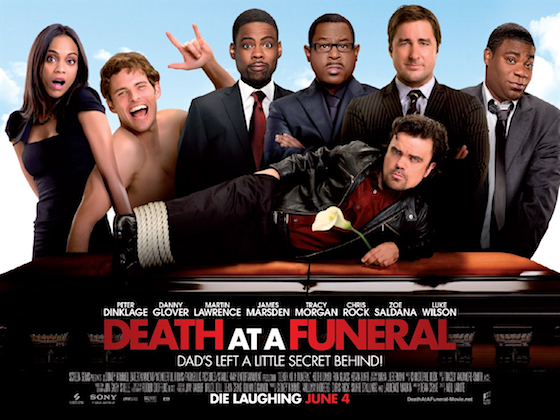
Death at a Funeral (2010)

Where the original was a little underwhelming, this is just kinda shit. It’s the most pointless remake since Gus Van Sant’s Psycho.

That comparison isn’t a bad one, because this is a scene-for-scene remake — sometimes shot-for-shot, line-for-line. Even the title sequence is an inferior riff on the original. Not only that, but some bits aren’t even done as well. If it worked the first time, why are you changing it? Maybe the original cast and crew made it look more effortless than it was. Some of it doesn’t even translate very well. For example, there’s a joke in the original about how “tea may solve many things”. Here, that’s translated to be about coffee. Yes, it’s been adapted to suit the different culture, but in the process has lost the cultural significance (to Brits, tea is more than just a popular beverage).
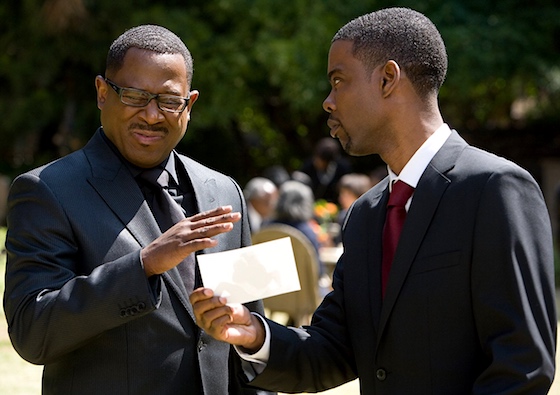
I guess he's showing him the screenplay

There are some new gags, most likely the result of the cast improvising (this version is more populated by comedians than the British one). Some of them are even funny. Unfortunately, more often the cast don’t hold up. Most of the performances are like an under-rehearsed am-dram version of the same screenplay. They certainly don’t have the acting chops to sell the more emotional moments. James Marsden is quite good in the Alan Tudyk role, though. Peter Dinklage plays the same part, but not as well — it’s less nuanced, less believable.

Director Neil LaBute previously found notoriety as writer-director of the Nic Cage Wicker Man remake. This does nothing to rehabilitate his reputation (what is this guy’s obsession with re-doing and ruining British films?) Again like Van Sant’s Psycho, it’s more interesting as a cinematic exercise than as a film in its own right.

2 out of 5

The Love Punch (2013)

2018 #7
Joel Hopkins | 94 mins | streaming (HD) | 2.35:1 | France & UK / English | 12 / PG-13

The Love Punch

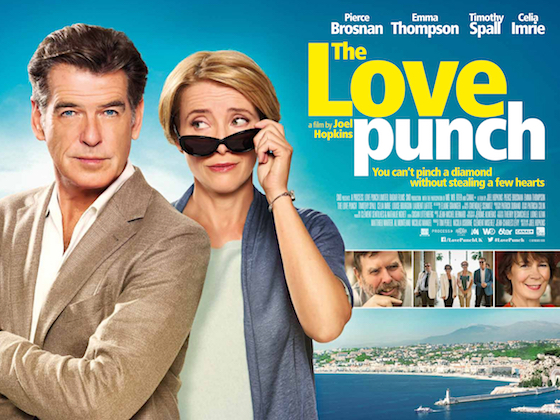
In this very daft comedy heist thriller (calling it a thriller is a bit of a stretch, but anyway), Pierce Brosnan plays Richard, a businessman whose company is bought out by mysterious others, only for them to strip its asset and sink the employees’ pensions — as well as that of Richard’s ex-wife, Kate (Emma Thompson). When the man behind the buy-out, Kruger (Laurent Lafitte), refuses to play fair, Richard and Kate team up with their neighbours, Pen (Celia Imrie) and Jerry (Timothy Spall), to pilfer the extraordinarily expensive diamond Kruger has bought his fiancée (Adèle Blanc-Sec’s Louise Bourgoin).

The Love Punch flirts with seriousness in its setup — what could be more current than unscrupulous moneymen buying a company and screwing over people’s pensions? — but quickly reveals its true nature as an implausible farce. Despite the lead cast, it seems to have been a French-driven production (even the UK-set scenes were filmed over there), so I suppose that style is only appropriate. While never scaling the heights of genuine hilarity, I don’t imagine anyone thought they were making anything other than a light romp.

So if you like any (or all) of Brosnan, Thompson, Imrie, and Spall, as well as the idea of a bit of gently-farcical gadding about in the south of France, then The Love Punch is amiable fluff to while away 90 minutes on a Sunday.

3 out of 5

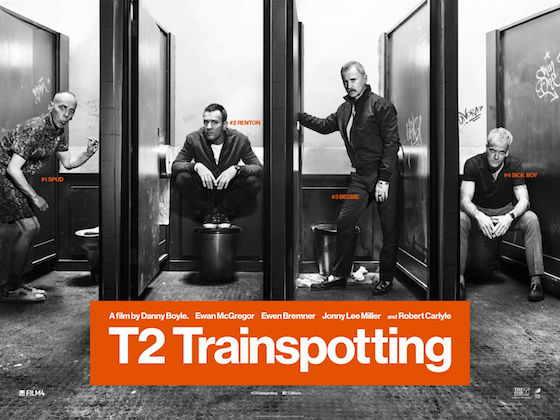
T2 Trainspotting (2017)

2017 #124
Danny Boyle | 117 mins | streaming (HD) | 1.85:1 | UK / English & Bulgarian | 18 / R

T2 Trainspotting

At one point during T2, a younger character accuses some of the returning characters of living in the past; that it’s all they talk about. It’s true of the characters, and it’s kinda true of the film itself too: this belated sequel to the era-defining original feels try-hard, like it wants to recapture the verve and inventiveness of its predecessor, but everyone’s now too grown up to do it properly.

Set 20 years on, it reunites the first film’s main characters… and, really, that’s the plot. Obviously other things happen, and the details are important, but that seems to be why the film exists: to get the gang back together for another couple of hours. Is that reason enough to make a movie? I guess everyone will have their own answer to that question. For me, it wasn’t reason enough to justify T2.

(Trivia aside that, frankly, I find more interesting then the film itself: reportedly director Danny Boyle wanted to call it simply T2, if James Cameron would let him — they thought they needed that permission because of Terminator 2 being commonly marketed as T2. But then it turned out that Terminator 2 was never officially called T2, so they were free to do as they pleased. But then internet searches for “T2” were found to still mainly turn up the Terminator sequel (unsurprisingly, let’s be honest), so they settled on T2 Trainspotting so people would know what it was. You have to wonder why at that point they didn’t just call it Trainspotting 2…)

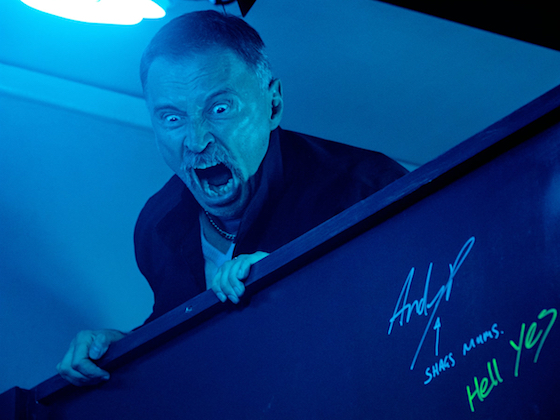
Looking as bored as I felt

Anyway, back to this T2. The meandering plot, such as it is, lacks the grit and realism of the first movie. For example, that ended with a simple betrayal — a guy stealing money while his mates were sleeping — while this ends with a knock-down drag-out fight in a construction site like something out of a low-budget thriller. Visually, too, it’s so clean and pristine. There are some properly beautiful shots, especially of the scenery outside Edinburgh, but I’m not sure that’s in-keeping with the Trainspotting aesthetic. Boyle does at points try to reheat the visual tricks of the first movie, but I didn’t feel it worked. The original’s many stylistic flourishes are now much imitated, but they were fresh back in the day and somehow that freshness still comes across when watched now. By trying to ape ape them, T2 just joins the long line of copycats.

Another key element of Trainspotting was the soundtrack. I don’t know what they were thinking with the music here — it isn’t even close to being as memorable or iconic as the original. Maybe that was the point, to not try the same trick again; but there are still plenty of jukeboxed tracks that attempt to draw attention to themselves, but… don’t.

I felt like this, too

Trainspotting had energy, dynamism, exuberance; it pulsed with life and youth. Its sequel is more sedate, more… middle-aged. Well, so are the characters, so that could work; but they don’t behave like they’re middle-aged — they’re too busy trying to recapture their youth, reliving past glories and past conflicts. The film is doing the same. You could perhaps argue that it’s form mirroring content, but the form lacks the wink at the audience to say “this is deliberate.” Like the characters, it seems unaware of the sad state it’s in. Ultimately, it feels like a slightly unfocused, thematically inconclusive, largely unnecessary postscript.

3 out of 5

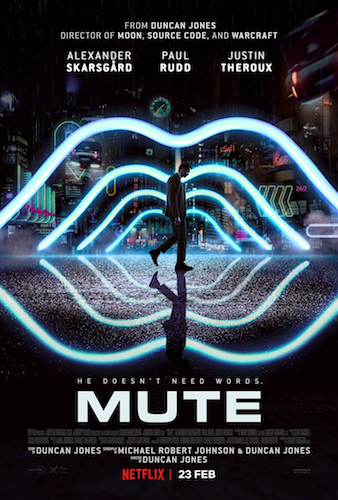
Mute (2018)

2018 #31
Duncan Jones | 126 mins | streaming (UHD) | 2.00:1 | UK & Germany / English & German | 15

Mute

For those in the know, Mute was probably one of the most anticipated movies of 2018. The new film from writer-director Duncan Jones, who made waves with his excellent debut, the low-key sci-fi mystery/drama Moon, and backed it up with the strong sci-fi thriller Source Code, this was his return to that genre after an ultimately futile aside into studio blockbuster-making with Warcraft. More than that, it’s a passion project that’s been gestating for 16 years, rejected by everyone else and now only made possible by Netflix. Greatness was expected. Unfortunately, instead it’s been met with critical derision (11% on Rotten Tomatoes) and audience apathy (5.4 out of 10 and dropping on IMDb; 2.2 out of 5 on Letterboxd and heading in the same direction). Empire’s review perhaps summed it up best: “a crushing disappointment… sadly, almost tragically, not worth the wait.”

Set in near-future Berlin, the setting is probably the best part of the film. It’s extrapolated from the present to give a very convincing world, where technology has advanced in ways that already feel just around the corner. The production design also owes a huge debt to Blade Runner, though clearly on a lower budget. That doesn’t mean it isn’t effective, just familiar. It’s not quite as nihilistic as Blade Runner, though — again, this is our world a few years hence, and there are still malls and diners and libraries and other such mundanities.

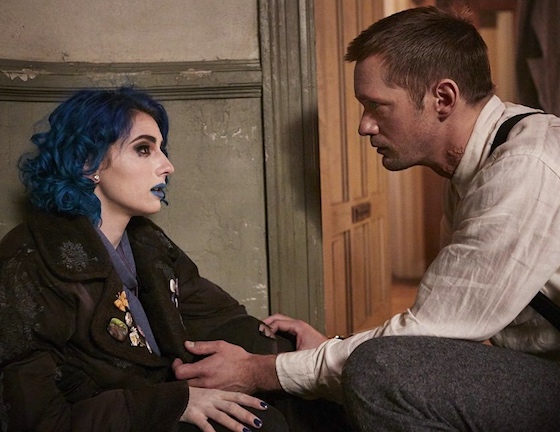
Leo's looking

The protagonist is Leo (Alexander Skarsgård), a bartender getting by in a world not built for him: he’s Amish, meaning he avoids using most technology, and he’s mute, thanks to a childhood accident. As the story unfurls he has to engage with a bunch of tech for the first time, and when he comes up against devices that are only voice-controlled then he’s got a problem. I’m not sure if this is designed as a social commentary on how some people struggle now and it’ll be even worse in the world to come, or if it’s just a convenient way to put more obstacles in Leo’s path. I’m tempted towards the latter, but that’s okay. It seems his muteness is a barrier to some viewers, with critics describing him as a blank canvas, either unknowable or personality-free. I think that’s a bit harsh, but Leo does fall into the familiar bracket of the “strong, silent type”. He can’t express himself vocally, obviously, but rather than that leading to him letting his emotion out in other ways he seems to have repressed it. I got the impression that he was now having to deal with certain feelings, and how they’re expressed, for the very first time.

That’d be because Leo is now in love, with Naadirah (Seyneb Saleh), a blue-haired waitress at the club he works in. Naadirah clearly has secrets, both from Leo and from us, and when she goes missing Leo has to venture into the seedy underworld of future-Berlin as he tries to track her down. If the overt Blade Runner stylings hadn’t already clued you in, this is very much a noir detective movie, full to the brim with dark people and dark deeds. It gets grim indeed at times, more thematically than visually (though there are a couple of scenes of surgery, if that’s your particular bête noire), and this is where one begins to wonder if Jones has full control over his film’s tone.

Gone girl

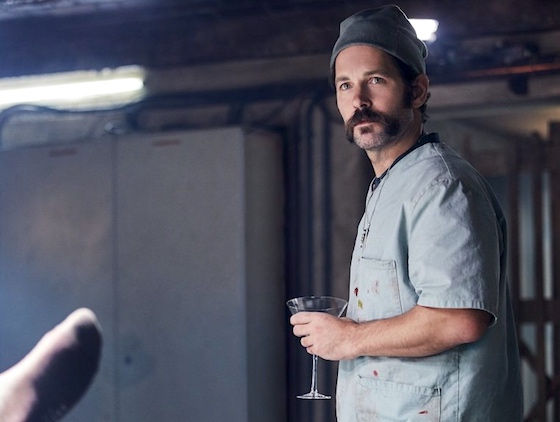
That’s not much of a problem in Leo’s storyline — I’d wager you could recut Mute to focus on him entirely and create a more straightforward future-noir tale — but rather in the concurrently-told B-plot. This side of the film focuses on Cactus Bill (Paul Rudd), an army surgeon who deserted and now plies his trade for gangsters, hoping to afford passage back to the US for himself and his daughter. Bill works alongside his best mate Duck (Justin Theroux), and much of their half of the film plays more like a hang-out movie, just spending time with the characters as they go about their business. As they mooch around sharing comical buddy banter, it’s a definite tonal counterpoint to Leo’s story. That’s not necessarily a problem unless you want a straight-up serious noir, but later Bill and Duck’s thread diverges into some heavy territory; stuff that some viewers would find distasteful no matter what, but which is made more so as their chirpy-funsters act is allowed to roll through it.

For this reason I thought Mute was more effective in its first hour-or-so than in its second. Others disagree, calling it either slow or disjointed, because the links between Leo’s and Cactus Bill’s storylines are not immediately evident. I didn’t think the pace was a problem: it’s gradually drawing you into this world, setting out the mystery and then peeling back more layers as Leo begins his hunt. It’s not as dreamily atmospheric as Blade Runner 2049 in this regard, but it’s closer to that than to an action-thriller, which makes me tempted to say pace issues are a viewer problem rather than a film one. In the first half, at least, because by the second it does seem to go on a bit. As for the disconnect between the storylines, it didn’t bother me at all. Links are actually established early on, and you know these two halves are going to come together eventually — that’s how narrative structure works.

After surgery drinks

The idea some reviews are peddling that “maybe everyone else rejected the Mute screenplay for a reason” is disingenuous. If a decent exec wanted to make this kind of movie (i.e. a mid-budget sci-fi noir) then they definitely could have seen its potential. But few studios are interested in that kind of work anymore, for reasons that barely make sense, and so the film ended up passed to Netflix. One wonders if their hands-off approach is part of the problem. People complain about studio interference, and clearly that can scupper projects, especially ones with unique voices, but execs who are good at their jobs do improve movies. Jones has said that, after Netflix bought the project, they just gave him the money and let him make whatever; and they gave him final cut too, so when the finished film came in and they weren’t sure about it, they just went ahead and released it as-was. Maybe if someone had helped him develop the project better, had helped him even out the tone, or tighten up the pacing, we’d be looking at a great movie right now.

Instead, I don’t think the Mute we’ve got is anything like as unremittingly terrible as some reviews would have you believe, but it is a tonally strange film. I’m not sure it works as a whole, but bits really do. I wouldn’t dismiss the idea of it becoming a cult classic, and maybe in a couple of years we’ll all be reevaluating it. Before its release Jones did say it would be a Marmite film — that some people would love it and others would absolutely hate it. Broad reception is undoubtedly hewing to the latter end of the spectrum; and while I’d love to be the former instead, there are too many inconsistent oddities for me to embrace it. I think it may someday be worth a revisit though, which is not something you can say about a genuinely bad film.

3 out of 5

Mute is available exclusively on Netflix now and forever.

Comedy Review Roundup

In today’s roundup:

  • This is the End (2013)
  • The Heat (2013)
  • In the Loop (2009)


    This is the End
    (2013)

    2017 #109
    Evan Goldberg & Seth Rogen | 105 mins | TV | 16:9 | USA / English | 15 / R

    This is the End

    Seth Rogen, James Franco, Jonah Hill, Jay Baruchel, Craig Robinson, and Danny McBride star as Seth Rogen, James Franco, Jonah Hill, Jay Baruchel, Craig Robinson, and Danny McBride (respectively) in a movie about the apocalypse written and directed by Seth Rogen and Evan Goldberg.

    And it’s pretty much exactly what you’d expect a movie about the apocalypse starring Seth Rogen, James Franco, Jonah Hill, Jay Baruchel, Craig Robinson, and Danny McBride, and written and directed by Seth Rogen and Evan Goldberg, would be like — for good or ill. Personally, I laughed and enjoyed myself more than I expected to, even if it is resolutely silly and frequently crude just for the sake of it.

    4 out of 5

    The Heat
    (2013)

    2017 #144
    Paul Feig | 112 mins | TV | 2.35:1 | USA / English | 15 / R

    The Heat

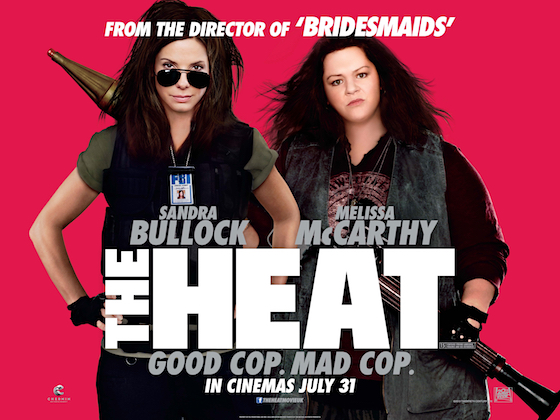
    Having been surprisingly entertained by Bridesmaids, Spy, and the new Ghostbusters, I thought I might as well tick off the last film-directed-by-Paul-Feig-since-anyone-noticed-he-made-films (he also helmed a couple of movies in the ’00s that no one mentions).

    It’s a female-led (obviously) version of the familiar buddy movie template, starring Melissa McCarthy (obviously) as an uncouth cop who must team up with a strait-laced FBI agent (Sandra Bullock) to bring down a drug lord.

    As I suspected, it’s the least likeable of those four Feig/McCarthy collaborations, although it manages to tick along at a level of passable amusement with occasional outbursts of good lines or routines. I wouldn’t recommend it to anyone who hadn’t first seen and enjoyed at least a couple of their other movies, but there are worse ways to spend a couple of hours.

    3 out of 5

    In the Loop
    (2009)

    2017 #147
    Armando Iannucci | 102 mins | streaming (HD) | 1.85:1 | UK / English | 15

    In the Loop

    Acclaimed political sitcom The Thick of It steps onto the global stage in this comedy, which sets its satirical sights on UK-US relations and the countries’ intervention in the Middle East.

    Despite the change in format and (intended) screen size, In the Loop manages to be as hilarious as the show it’s spun off from — not always a given when TV successes make the leap to the big screen. In part that’s the advantage of a 237-page script and 4½-hour first cut being honed to little more than an hour-and-a-half, but it’s also thanks to the skilled cast. The star of the show is, as ever, Peter Capaldi as sweary spin doctor Malcolm Tucker. Most of the rest of the UK cast carry over from The Thick of It (albeit in new roles) so are well versed in writer-director Armando Iannucci’s style of satire, but proving equally up to the task are a compliment of US additions headlined by James Gandolfini.

    It’s not perfect — there were a couple of subplots I could’ve done without (I’m not a big fan of Steve Coogan so wouldn’t’ve missed his near-extraneous storyline) — but they’re minor inconveniences among the barrage of hilarity.

    5 out of 5

  • The Pirates! In an Adventure with Scientists! (2012)

    aka The Pirates! Band of Misfits

    2018 #8
    Peter Lord | 88 mins | Blu-ray | 2.35:1 | UK & USA / English | U / PG

    The Pirates! In an Adventure with Scientists!

    After a foray into CGI with the decent-but-not-exceptional Flushed Away and Arthur Christmas, Aardman took this adaptation of Gideon Defoe’s comedic novels as a chance to return to what they know best: stop-motion animation.

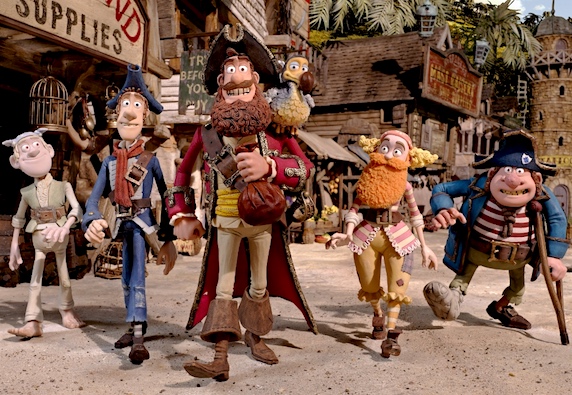
    It stars a ragtag band of misfits— ugh, don’t get me started on the title change… but if you did, I might say something like the opening few paragraphs of this review. Anyway, as I was saying, it stars a ragtag crew of pirates, who are led (appropriately enough) by the Pirate Captain (Hugh Grant). His greatest desire is to win the Pirate of the Year Award, an honour he’s never achieved because, frankly, he’s a bit of a rubbish pirate. When he bumps into Charles Darwin (David Tennant) he stumbles upon a possible route to victory, but first he’ll have to contend with pirate-hating monarch Queen Victoria (Imelda Staunton).

    Naturally it’s a tale not so much of derring-do as of humorous shenanigans, though in truth it’s not the studio’s most hysterical offering, ticking along with a level of gentle amusement rather than outright hilarity. That said, some parts do spark considerable mirth, like a trained monkey who ‘speaks’ through word cards, and there are background gags aplenty for the keen-eyed viewer. Plus it’s all carried off with the ineffable charm of Aardman’s hand-crafted puppetry, and that goes a long way (at least for this reviewer).

    Band of misfits

    I’ve always thought the Pirates of the Caribbean movies (especially the first one) more-or-less nailed the tone I would’ve wanted from an adaptation of the beloved Monkey Island games, but I read a commenter somewhere say The Pirates is probably the closest we’ll ever get to a Monkey Island film and, thinking about it, he’s probably right. The Monkey Island games are mostly cartoonish comedies, with a fair dose of irreverence and anachronism, and The Pirates offers up a similar brand of humour. (Maybe this is a niche comparison to make, given the height of Monkey Island’s popularity was over 25 years ago now, but, hey, these things are always ripe for rediscovery).
    Despite being the fourth highest-grossing stop-motion film ever made, distributor Sony judged The Pirates to be a flop and the sequel Aardman were planning got canned. That’s a pity, because you feel this motley crew could’ve led us on another amusing adventure or two yet.

    4 out of 5

    Aardman’s new film, Early Man, is in UK cinemas now.

    Blindspot Sci-fi Roundup

    With my 2018 Blindspot and “What Do You Mean You Haven’t Seen” selections now chosen, it’s about time I got on with reviewing those from the class of 2017 that are still in my “to do” pile. Here, then, are four more reviews of my 2017 must-sees, connected (as you may’ve guessed from the title) by all being works of science fiction.

    In today’s roundup:

  • District 9 (2009)
  • Moon (2009)
  • Her (2013)
  • Forbidden Planet (1956)


    District 9
    (2009)

    2017 #88
    Neill Blomkamp | 112 mins | Blu-ray | 1.85:1 | South Africa, USA, New Zealand & Canada / English | 15 / R

    District 9

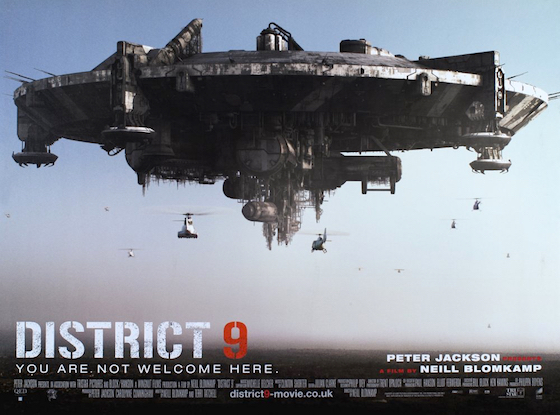
    We begin this roundup with two 2009 sci-fi thrillers that made the names of their respective directors. District 9 got the wider attention, being backed by Peter Jackson and receiving a Best Picture Oscar nomination (alongside three other nods), but I’d argue it’s ultimately the lesser of the two films.

    Although District 9 remains highly praised, co-writer/director Neill Blomkamp’s next two movies — Elysium and Chappie — haven’t gone down so well. Having seen both of those first, I feel like there are a lot of structural and tonal similarities between all three films, so it’s interesting to me how poorly the next two were received. Basically, they all start with some kind of societal sci-fi issue, explore that for a bit as the world of the story is established, then transition into being a shoot-em-up actioner.

    In District 9’s case, it starts out as a documentary about (effectively) alien refugees who live in a segregated community in South Africa. The obvious real-world parallels are, well, obvious. Then events transpire which make the idea of having to identify with those who are Other than us — of becoming affected by their culture — very literal. Then it turns into an achieve-the-MacGuffin shoot-em-up runaround. It’s done well for what it is, with some strikingly gruesome weaponry to give the well-staged shootouts a different edge, but that’s still what it is. Presumably it was all the rather-obvious allegory stuff that helped land the film a Best Picture nomination, and the fact the second half is a not-that-original humans-vs-aliens shooter was overlooked.

    Not so different. Okay, pretty different.

    For me, the clunkiest bit is the storytelling style it adopts. It’s a mockumentary… until it decides it doesn’t want to be so that it can tell its story more effectively… but then it sometimes slips back into mockumentary later on, most notably at the end. I found that distracting and formally inconsistent. I’d rather it had kept up the mockumentary act throughout or not used it at all; or, if you’re going to do both documentary and ‘reality’, have a point to it — show differing versions of the truth, that kind of thing, don’t just mix it together willy-nilly.

    All told, I found District 9 to be a mixed bag. The first half is excitingly original and interestingly ideas-driven, with allegory that is powerful if perhaps a little heavy-handed (I suppose that’s kind of unavoidable when you make a movie about segregation and set it in South Africa). The second half is just a shoot-em-up.

    4 out of 5

    Moon
    (2009)

    2017 #145
    Duncan Jones | 97 mins | Blu-ray | 2.40:1 | UK / English | 15 / R

    Moon

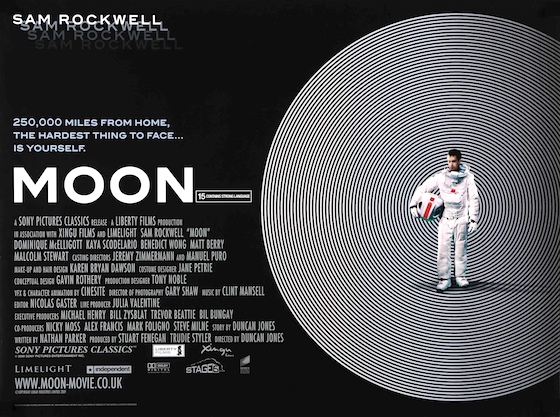
    The other 2009 sci-fi debut feature was that of director Duncan Jones. Although it received no Oscar love it did get a BAFTA, but seems to remain less seen: it has almost half as many user ratings on IMDb as District 9. Personally, I thought it was the superior film.

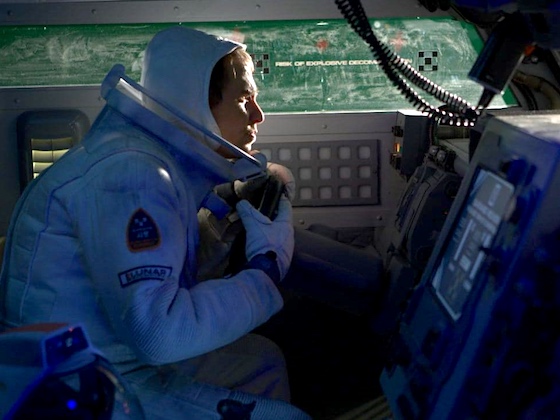
    It stars Sam Rockwell as the sole inhabitant of a mining facility on the Moon. As the end of his tour of duty approaches, his investigation in a malfunction unearths a startling secret. To say any more would spoil things, though Moon gets to its reveal pretty speedily. Also, you may’ve guessed it from the trailers (I more or less did). Also, it’s nine years old now and you’ve probably seen it — though, as those IMDb numbers show, maybe not.

    If you haven’t, it’s definitely worth seeking out. Like so much good sci-fi, it uses its imagined situation as impetus to explore the effect on its characters (or, in this case, character) and what the human reaction would be in such a situation. Maybe this is becoming a cliché already, but it’s quite like an episode of Black Mirror in that regard. (Isn’t all sci-fi that puts a high concept through the ringer of human experience “like Black Mirror”? Such stuff existed before that series. That said, maybe there wasn’t as much of it.)

    It's like looking in a mirror. A black mirror.

    Jones marked himself out as a director to watch with his attentiveness to character in the midst of his SF setting, but also by helming an excellently realised production on a tight budget — the moonbase set looks great and the model effects are perfect. A major reason I reckon it’s clearly better than District 9 is this consistency of style and tone. It’s a film that better knows what it wants to be and how to achieve its intended effect.

    As for Jones, he went on to make Source Code, a solid follow-up, but then seemed to throw a lot of talent away on the risible Warcraft. Hopefully his forthcoming Netflix Original, Mute, will restore the balance.

    5 out of 5

    Her
    (2013)

    2017 #165
    Spike Jonze | 126 mins | Blu-ray | 1.85:1 | USA / English | 15 / R

    Her

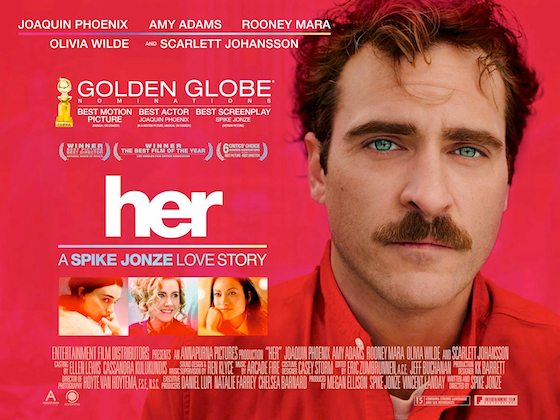
    If Moon is “a bit like an episode of Black Mirror”, Spike Jonze’s Her virtually is one. Set in a highly plausible near future — which has clearly been developed from our current obsession with our phones, iPads, digital assistants, etc — it stars Joaquin Phoenix as Theodore, a lonely chap who gets a new operating system based around a genuine AI, Samantha (voiced by Scarlett Johansson). As Samantha develops, she and Theodore soon become friends, and then more.

    People often refer to the template of Black Mirror as “what if technology but MORE”, and Her definitely fulfils that brief: “what if Siri was genuinely intelligent and someone fell in love with her?” Also like an episode of Black Mirror, it’s as much about what this reveals about humanity as it is about the crazy sci-fi concept. It’s primarily a romance about a lonely guy who was hurt in the past finding a new connection, with the fact he’s falling in love with a piece of technology almost secondary. Even within the world of the film, he’s not some kind of outcast: we hear about other people who’ve fallen for their AI, and his friends unquestioningly accept his relationship as genuine.

    Such acceptance doesn’t translate into our current world, it seems. Although Her is generally very well liked, some people struggle to engage with it at all, and from what I can tell that mostly stems from them not being able to relate to Theodore and his situation, i.e. the very concept of falling in love with an AI is too impossible for them to even imagine. I can’t help but feel that says more about those viewers (for good or ill) than it does the film, which executes the storyline with a great deal of believability and heart.

    5 out of 5

    Forbidden Planet
    (1956)

    2017 #172
    Fred McLeod Wilcox | 98 mins | Blu-ray | 2.40:1 | USA / English | U / G

    Forbidden Planet

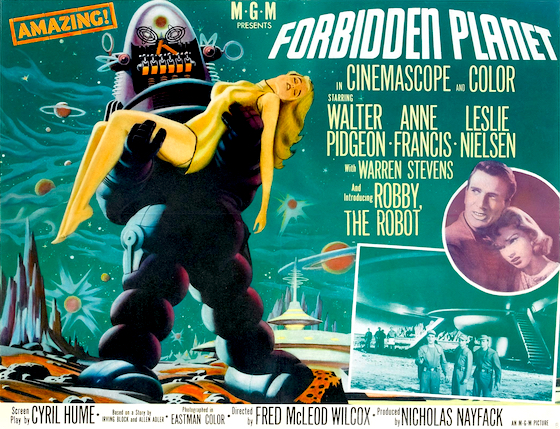
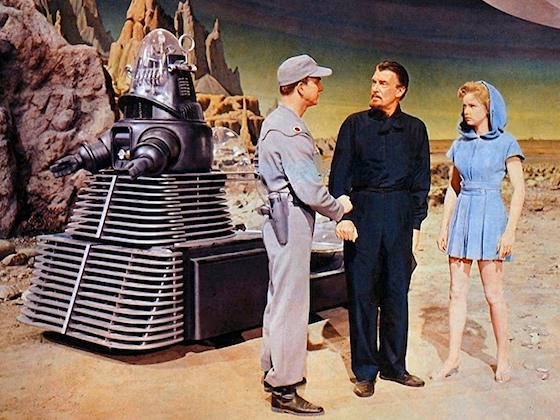
    This classic sci-fi adventure sees a spaceship crewed by blokes (led by Leslie Nielsen) land on the planet Altair IV to investigate what happened to a previous mission there. They find it inhabited only by Dr Morbius (Walter Pidgeon), his robot servant Robby, and his beautiful daughter Altaira (Anne Francis), who perpetually wears short skirts and has a fondness for skinny-dipping. Turns out the crew are a right bunch of horndogs (they spend most of their time lusting after Altaira, tricking her into kissing them and stuff like that), but there are bigger problems afoot when the planet starts trying to kill them.

    Once it gets past everyone’s lustfulness (it feels uncomfortably like watching the filmmakers play out some personal fantasies), there are proper big sci-fi ideas driving Forbidden Planet. There are also some gloriously pulpy action sequences, like a fight against an invisible monster. It’s backed up by great special effects. Obviously they’ve all dated in one way or another, but much of it still looks fantastic for its time — the set extensions, in particular, are magnificent.

    Nothing's forbidden on this planet, wink wink

    Something I wasn’t expecting (but I’m certainly not the first to note) is how blatantly the film was an influence on Star Trek. You can even map the similarities between characters pretty precisely. Switch out the spaceship models and original-flavour Star Trek is all but Forbidden Planet: The Series.

    Although its gender politics have aged even less well than its special effects, and its story occasionally gets bogged down by stretches of explanatory dialogue (it sometimes feels like you’re watching the writer invent and explain his ideas in real-time), Forbidden Planet remains a mostly enjoyable SF classic.

    4 out of 5

    District 9 and Forbidden Planet were viewed as part of my Blindspot 2017 project, which you can read more about here.

    Moon and Her were viewed as part of my What Do You Mean You Haven’t Seen…? 2017 project, which you can read more about here.

  • Another Blindspot Review Roundup

    Following on from the roundup of four of my Blindspot and “What Do You Mean You Haven’t Seen…?” reviews the other day, here’s another quartet.

    In today’s roundup:

  • Gran Torino (2008)
  • Planet of the Apes (1968)
  • Nashville (1975)
  • A Matter of Life and Death (1946)


    Gran Torino
    (2008)

    2017 #78
    Clint Eastwood | 116 mins | download (HD) | 2.40:1 | USA & Germany / English & Hmong | 15 / R

    Gran Torino

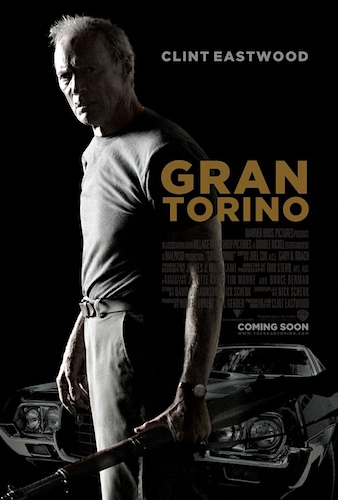
    Clint Eastwood’s modern Western (thematically speaking), about a grumpy old loner who overcomes his inherent racism to bond with the immigrants who now dominate his neighbourhood and eventually come to their defence, is a well-liked film, generally regarded as a late career highlight for the director-star. I imagine it would play very nicely as a companion piece and/or counterpoint to his earlier Oscar-winner, Unforgiven — both are stories about old men in one final fight, essentially. Here, that comes with a subtext about the price that’s paid for standing up for yourself. It may be the right thing to do, and maybe it ends up with the right result, but the good guys really suffer to get to that point.

    While that aspect of the film is ultimately powerful, I was less won over by the actual filmmaking. It feels like it’s been jiggered around in the edit, with some odd bits where it just jumps into a new scene. Even before that, Nick Schenk’s screenplay occasionally features very heavy-handed dialogue, of the “explain what the character is feeling right now” variety. It’s especially bad when Eastwood just talks to himself in order to vocalise these points for the sake of the audience.

    Still, if you’re immune to such niggles then it remains a potent — and timely — tale of doing what’s right for the defenceless. Such themes never die, I suppose.

    4 out of 5

    Planet of the Apes
    (1968)

    2017 #96
    Franklin J. Schaffner | 112 mins | Blu-ray | 2.35:1 | USA / English | PG / G

    Planet of the Apes

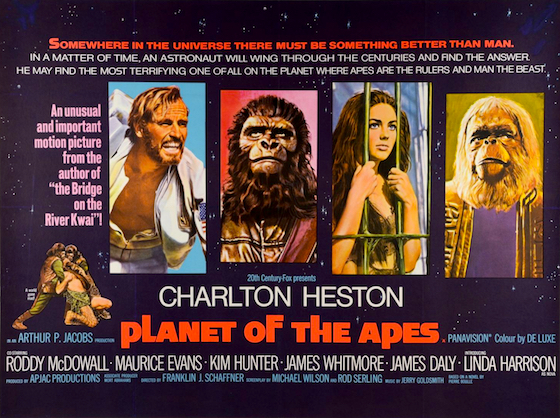
    The original instalment in the long-running franchise (it’s up to nine films across three go-rounds now, plus a couple of TV series) sees astronaut Charlton Heston land on a mysterious planet where apes have evolved to have human-like intelligence, while men are mute wild creatures dominated by their simian betters. And eventually there’s a twist that everyone knows, which is a shame because I bet it was pretty darn surprising before that.

    Coming to Planet of the Apes for the first time almost 50 years after its release, there’s an unavoidable quaintness to some of it, mainly the monkey makeup. It was for a long time iconic, but it’s been abandoned in favour of hyper-realistic CGI in the new movies and therefore shows its age. That said, while the apes may not be as plausible as those produced by modern technology, the performances underlying them are still strong. It contributes to what is really a parable about dominance and oppression; colonialism inverted onto a white man, that kind of thing. All wrapped up in a sci-fi adventure narrative, of course.

    Honestly, it’s not just the effects that have improved — as a piece of speculative fiction, I think it’s now been outclassed by the recent trilogy. It’s still a cracking adventure, but a bit “of its time”.

    4 out of 5

    Nashville
    (1975)

    2017 #111
    Robert Altman | 160 mins | Blu-ray | 2.35:1 | USA / English | 15 / R

    Nashville

    Robert Altman’s low-key epic about 24 characters and how their stories interact, overlap, and collide across five days in the city of Nashville, Tennessee.

    The sheer scope of that makes it a tricky film to interpret. There’s a lot going on, much of it in snatched conversations and moments that leave it up to the audience to piece together what matters and why. Collision must be a theme: within the first hour there are three car crashes or near misses, and the climax is certainly a collision in its own way. I’ll be honest, this isn’t a fully-developed thought, so I’m not sure what the point of it might be. It’s a small element of the film, really — something like all the music being performed is much more obvious and therefore maybe more relevant.

    I guess I’m searching for meaning because the film in general is just casually observational of a bunch of characters meandering through a few days. Maybe there doesn’t need to be meaning — maybe that is the meaning. It’s certainly one way to interpret the finale. So, I kind of liked it — or, rather, admired it, perhaps — even if I didn’t necessarily ‘get it’.

    4 out of 5

    A Matter of Life and Death
    (1946)

    2017 #74
    Michael Powell & Emeric Pressburger | 100 mins | DVD | 4:3 | UK / English | U / PG

    A Matter of Life and Death

    I finally get round to watching this on a ropey old DVD, and then they announce a new 4K restoration (which was released in UK cinemas earlier this month). Hopefully a Blu-ray will follow. It will be very welcome, because I imagine this film will look magnificent in properly restored HD.

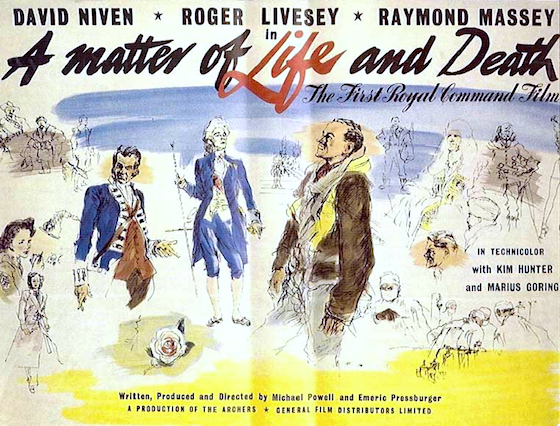
    It begins with an incredible opening scene, in which an entire relationship is founded and ended over the radio in about five minutes. From there it’s the story of a World War Two pilot (David Niven) who avoids death by a fluke, then properly falls in love with the voice from the other end of that radio call (Kim Hunter) before the afterlife comes a-callin’ to take him where he was meant to be. Or maybe that’s all just a vision induced by the injury he sustained. Either way, he must argue his case to remain on Earth.

    It’s a grandly romantic film — it is all about the triumph of love over everything else, after all — but with a particular fantastical bent that I think remains unique. It has the wit to present a mildly irreverent stance on the afterlife, not taking the whole “life and death” thing too seriously. While the final result of the airman’s trial is never in doubt, the delight is in the journey there.

    5 out of 5

    Planet of the Apes, Nashville, and A Matter of Life and Death were viewed as part of my Blindspot 2017 project, which you can read more about here.

    Gran Torino was viewed as part of my What Do You Mean You Haven’t Seen…? 2017 project, which you can read more about here.

  • Comedy Review Roundup

    Let’s have a laugh (or, perhaps, not) with…

  • Police Academy (1984)
  • Black Dynamite (2009)
  • Four Lions (2010)
  • Ferris Bueller’s Day Off (1986)


    Police Academy
    (1984)

    2017 #27
    Hugh Wilson | 92 mins | streaming (HD) | 16:9 | USA / English | 15 / R

    Police Academy

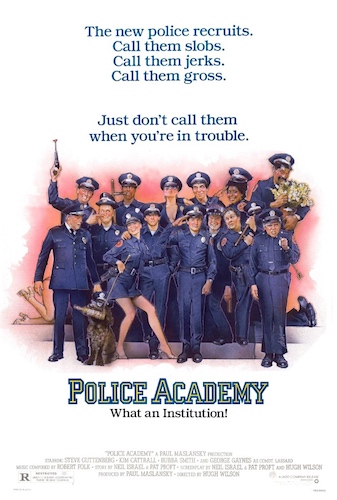
    I watched some of the Police Academy movies when I was younger — yes, plural — but I never saw the first one. It never seemed to be on TV (though the second always was), and the fact it’s rated 15 (weren’t all the later ones, like, PG?) would surely mean my parents would never have let me rent it (I’m pretty sure I never saw any of the series after I hit double-digits age-wise). So there was an element of box ticking in finally seeing the original — a film that Roger Ebert gave zero stars.

    It doesn’t start well: the opening credits incompetently cover up the onscreen action. That’s not for the sake of a joke, like in, say, Austin Powers 2 — it’s not overt or thorough like a joke — it’s just poorly done. From there… it might be generous to say that things pick up, but they’re not so bad. In fact, I passingly enjoyed it. It’s not aged particularly well, but there are some funny bits. Remember the sound effects guy? I used to love him when I was a kid. There’s surprisingly little of him here, though. I guess he got amped up for the sequels.

    Police Academy isn’t some masterpiece that’s been buried under the weight of its increasingly shite sequels, but it isn’t that bad as an hour-and-a-half of mindless comedy.

    3 out of 5

    Black Dynamite
    (2009)

    2017 #47
    Scott Sanders | 81 mins | streaming (HD) | 16:9 | USA / English | 15 / R

    Black Dynamite

    A spoof of cheap blaxploitation movies, Black Dynamite hits every nail on the head. I’ve not actually seen many films from the genre (the original Shaft may be the extent of it, unless Live and Let Die counts), but you only need a passing awareness of the ludicrousies of low-budget ’70s genre cinema (the third act sidesteps into a spoof of kung fu movies) to get the overall joke. Plus there are plenty of generally funny riffs and sequences for the layperson to laugh at, the highlight being a deduction scene that makes no sense whatsoever. At a brisk 80 minutes, it’s hard to go wrong.

    4 out of 5

    Four Lions
    (2010)

    2017 #65
    Chris Morris | 97 mins | streaming (HD) | 1.85:1 | UK & France / English, Urdu & Arabic | 15 / R

    Four Lions

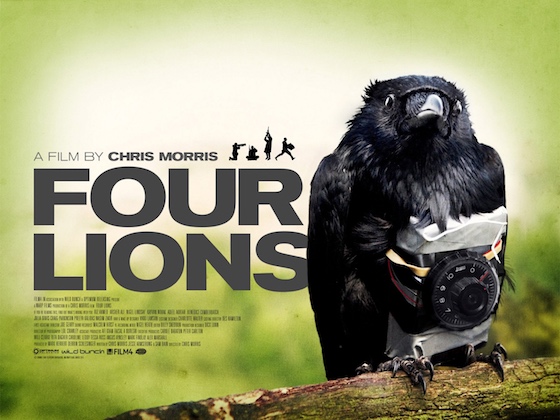
    A comedy about Muslim suicide bombers? You don’t need me to tell you all the different minefields that idea is tiptoeing into. But it’s by the guy behind Brass Eye, so it less tiptoes more bounds, and barely puts a foot wrong either.

    The most important point, of course, is that it is very, very funny. There’s a stream of good one-liners and exchanges. But it also winds up making you feel for some of these guys, which, considering their goal, is a feat unto itself. At the same time, the attempted emotional pull in the third act doesn’t quite come off — asking us to care for “the stupid one”, who’s merely been the butt of jokes until that point, comes a little out of left-field. I mean, if we’re suddenly meant to be concerned about his (mis)treatment, why have you been making us laugh at him all along?

    Anyway, if you just ignore that unwarranted about-turn, Four Lions is absolutely hilarious.

    4 out of 5

    Ferris Bueller’s Day Off
    (1986)

    2017 #50
    John Hughes | 103 mins | streaming (HD) | 2.35:1 | USA / English | 15* / PG-13

    Ferris Bueller's Day Off

    Is this or The Breakfast Club the archetypal John Hughes movie? Argue amongst yourselves — I’ve never seen The Breakfast Club. I hadn’t seen Ferris Bueller until this year either (I mean, obviously — it wouldn’t be here otherwise), though I’m not sure why. Despite it being quite well-known and referenced, it just didn’t seem to come up that often. (Incidentally, are references to it on the increase? Both Deadpool and Spider-Man: Homecoming had significant riffs on it within the past couple of years.)

    Anyway, for those as in the dark as I was, it’s the story of cool kid Ferris Bueller (Matthew Broderick) who has an elaborate plan to bunk off school for the day, which involves persuading his best mate Cameron (Alan Ruck) to ‘borrow’ his dad’s Ferrari and head off into Chicago with Ferris’ girlfriend (Mia Sara). Meanwhile, the school’s suspicious principal (Jeffrey Jones) tries to catch Ferris out.

    Going back to what I was saying a moment ago, part of why I didn’t watch it before was that I felt like I’d find it annoying. Turns out, not so much. Ferris is indeed a bit of a dick, but I’m not sure the film doesn’t know he is. Because he talks to camera and makes the viewer his confidante, the assumption might be we’re meant to admire him, but there’s an almost “unreliable narrator” aspect to him. Or maybe I’m projecting that because I didn’t like him but did enjoy his antics, who knows.

    5 out of 5

    * The film was reclassified as 12A for a 2013 theatrical re-release, but I watched it at home, where it’s still technically a 15. Ah, the oddities of the BBFC. ^

  • Eye in the Sky (2015)

    2017 #8
    Gavin Hood | 102 mins | streaming (HD) | 2.35:1 | UK & South Africa / English & Somali | 15 / R

    Eye in the Sky

    Drone warfare is a fairly hot and contentious issue of our times, though as it seems to have “just kinda happened” I’m not sure how much significant public debate there’s been around it. It’s certainly provided fodder for moviemakers, however, with multiple productions seeking to be “the one about drones”. I’ve heard the best of these is Good Kill (though IMDb ratings disagree), but that’ll have to wait for another day (I’ve been sitting on this review since frickin’ January because I’ve still not got round to Good Kill!) Even if Eye in the Sky is the inferior film, it’s no slouch.

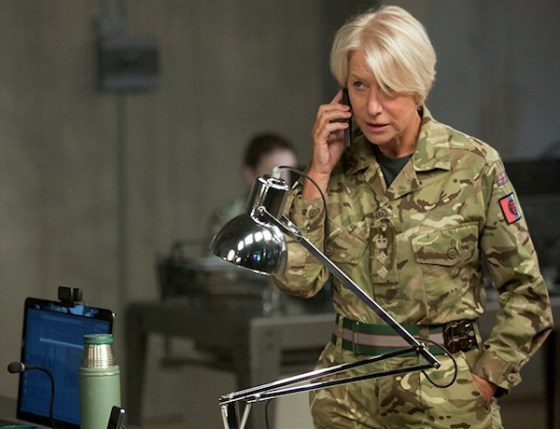
    After a multinational mission is launched to capture wanted terrorists in Kenya, surveillance observes them prepping suicide bombers. The mission objective is changed to “kill”, but commanders watching from afar via drone are forced to reconsider their options due to a civilian presence near the target. It’s a tense thriller driven by a compelling moral dilemma — in fact, the dilemma is an old one: would you sacrifice one innocent life to potentially save dozens more? It’s just that it’s now framed in the super-modern context of using drones to dispatch death from the other side of the world.

    Someone's got to make the call

    Getting ahead of myself a little now, but events build to a very tense climax. That’s how you want your thrillers to end, isn’t it? It also pays off the sometimes slow, borderline stagey “people talking in rooms” film that precedes it. Maybe that’s unfair — yes, it’s people talking in rooms, but there’s dynamism in what they’re debating and, er, the number of different rooms it takes place in… It also has a very plausible line in the passing of the decision-making buck, up the chain through the military, then through politicians. I guess for this to work the operation depicted had to be British-led because, as the film reveals, the American military machine would’ve had no such compunction about possibly killing a little girl.

    Much of the film lets you make up your own mind about its ethical conundrums, which is a strong point; but then, after all the actual debating is done and decisions have been made, it uses its final scene to show an outcome it could’ve left open-ended. This makes it seem to come down quite heavily in one direction. There’s not necessarily anything wrong with having a position and advocating it in art, but for a film which seems designed to tackle a contentious issue and put it up for genuine debate, it ends up feeling a tad one-sided. That said, there’s a long and well-liked screed on Letterboxd about how “it’s a film with an agenda that pretends to have none”, that agenda being to “have you rooting for the bombing of a little girl” — which is funny because I felt that, if anything, it came down a little too heavily the other way.

    Emote control

    One thing that distracted me to an inordinate degree was the agents on the ground using cameras disguised as birds and bugs — not just models with cameras in them, but imitation creatures that have the ability to fly around, reposition, etc. Even if such tech is possible nowadays, would Kenyan forces have access to it? And even if it’d been provided to them by their US/UK allies, would the equipment produce results of such good quality, or be capable of sending the images across such distances? Surely real-life drones are the size and shape they are (i.e. pretty big) for a reason? I guess the applicable point about this is: if you’re trying to make a serious modern-day moral thriller, don’t throw James Bond tech in there.

    Nonetheless, Eye in the Sky manages to put a very-present moral issue up for debate, framing it as a kind of case study so that it also serves as a tense thriller. Thought-provoking and nail-biting.

    4 out of 5