Inside-Out (1999)

2008 #66a
Tom & Charles Guard | 7 mins | DVD | 12

This charming little short stars Simon McBurney as a hapless market researcher on a busy London street, failing to get a single passerby to complete his survey — perhaps the film’s greatest achievement is making a market researcher sympathetic. Anyway, he’s quietly observed by a woman, played by Lena Headey (yup, Mrs. Leonidas and the new Sarah Connor [and now Cersei Lannister, of course]), who’s dressing the window of a clothing/department store on the street. She notices his failed attempts, which amuse her; he notices her laughing, and begins to muck around to entertain her.

It’s a simple premise, but one that’s executed with comedic flair and a surprising amount of emotion. The music and lack of dialogue evoke an old-ish French mime comedy, making a nice contrast with the modern-day London setting, but it’s the relationship that silently develops between the two characters that provides the heart around the humour. And the ending, as carefully constructed as any moment of humour in the short, is painfully heartbreaking.

However many times you might want to re-watch this — and I think you would want to — you’ll always wish for the same outcome, and always be let down. It’s a sweet kind of pain and longing that, in spite of that French style, is very British.

4 out of 5

This short is available on the Cinema16: British Short Films DVD, and online free at Total Short Films or YouTube.

Agatha (1979)

2008 #62
Michael Apted | 100 mins | TV | PG / PG

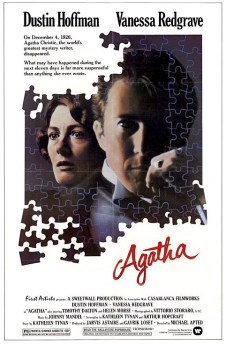
AgathaThere are no giant wasps in sight as Vanessa Redgrave’s Agatha Christie goes missing for eleven days in December 1926, and Dustin Hoffman’s journalist tries to track her down. While the frame of the story is true, the reasons behind Christie’s disappearance, and what occurred during it, aren’t known — which makes it fertile ground for speculation. Sadly, a fantastical plot about jewel thieves and shapeshifting aliens is much more exciting than the down-to-earth mystery we’re offered here.

It’s easy to see the attraction of Christie’s disappearance: it’s a real-life mystery about arguably the greatest mystery author ever, with enough unusual events surrounding it to make it extra suspicious and a long enough gap for something significant to have happened. But while the idea is initially exciting, when it comes to retelling it there isn’t a great deal there — the facts of her disappearance are just the ‘before & after’, amounting to little more than an abandoned car, an assumed name and some amnesia. Unless one invents something to fill those missing days, there’s little to tell (she went to a hotel and forgot what happened, essentially) — so, of course, this film fills in the gap. With a murder mystery, naturally. Sort of, anyway.

To be honest, I found it a tad confusing for the most part. While the initial setup is well handled, showing what drives Christie to run away (consciously or not) and the beginning of the police search, it begins to flounder once the plot slides into its fully fictional phase. Hoffman’s journalist, who had been hoping to interview Christie, manages to stumble across her at the hotel, where he pretends not to know who she is, while she… has health treatments… It’s only at the conclusion, when Christie’s plan begins to come together, that one realises there was a plan at all. It’s a shame the revelation comes so late because it’s actually not that bad a plot, and makes for quite a neat and almost plausible (providing you can accept Christie as a potential murderess (sort of)) explanation for everything.

The performances do nothing to raise the film. Redgrave is lumbered with little to do, mostly wandering around looking dazed. Her performance is decent but the material she has is lacking. Hoffman, on the other hand, is just flat, while Timothy Dalton’s sneering Colonel Christie sadly barely features. On a more technical level, the police investigation subplot is disappointingly forgotten halfway through, and everything is shot with too little light. Sometimes the latter is effective, such as during a train journey where occasional flashes of light illuminate Christie’s uncomfortably blank face, but at other times it merely obscures events. (It’s possible this is just the print, of course.)

Christie’s disappearance remains a fascinating mystery, though in all likelihood the true causes were either very internal or mental health related — not the easiest thing to depict in a movie, especially when your audience is likely expecting a thriller. Agatha has a game stab at weaving an interesting tale into the gaps in the facts, but by the end I was wondering if a straightforward biopic mightn’t have been a better idea.

3 out of 5

Cathy Come Home (1966)

2008 #59
Ken Loach | 77 mins | DVD | PG

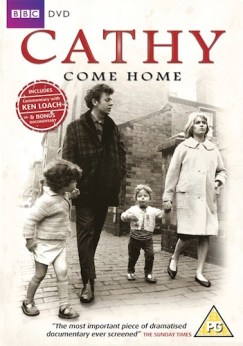
Cathy Come HomeTechnically a one-off TV drama from the BBC’s Wednesday Play strand, Cathy Come Home more than deserves consideration as a film in its own right, due to it being an early work of director Ken Loach, the fact that it’s shot largely on film using relatively experimental storytelling techniques, and also considering the huge social impact it had.

The piece tells the story of Cathy, a young woman who leaves behind a comfortable life for the excitement of the big city. There she falls in love with Reg, who she marries and has children with. But, through a series of incidents and accidents — most of them no fault of their own — Cathy, Reg and the children wind up without a house, and then gradually slide down the scale toward homelessness. In this respect the film can remind us of a facet of the ‘good old days’ that is often overlooked when our collective memory of the ’60s is made up of James Bond, the Beatles, and programmes like Mad Men. The drama also had a big impact at the time: 12 million watched, it boosted the newly-formed charity Shelter, led to debates in parliament, and, eventually, changes to the law.

Loach structures the film cleverly: Cathy and Reg’s slide into poverty is all too believable, while at the same time allowing the viewer to see a cross section of the homeless experience. He employs a documentary style throughout, so effectively that it still fools some into believing the whole piece is factual. In fact there’s a mix of interviews with those really suffering such situations, and performed scenes that are shot and cut disjointedly, as if they were observed rather than written. While some of the performances give the game away, they’re never poor enough to really detract. The downside of this style is that the storyline isn’t always clear. I’m still not sure if it was Cathy’s children that died in the caravan fire or someone else’s, just one among a few such examples. While ambiguity is no bad thing — the cruelly unresolved ending being a case in point — it sometimes just seems like a hole in the narrative. However, these moments are relatively minor, and certainly don’t dint the film’s impact.

Cathy Come Home is a powerful piece of work; an undoubted television classic that (bar a few technically-incongruous studio scenes shot on video) wouldn’t look out of place on a big screen. As an important and timely history lesson, a challenge to prejudices that some of us may hold, and a reminder of how close most of us are to such a fate — especially right now — it remains essential viewing. Sadly, I suspect it always will.

5 out of 5

Flushed Away (2006)

2008 #57
David Bowers & Sam Fell | 81 mins | DVD | U / PG

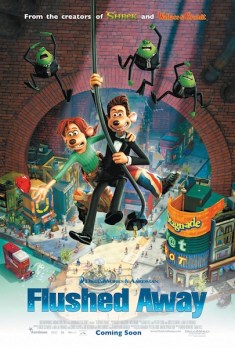
Flushed AwayAardman Animations, the Bristol-based company most famous for Wallace & Gromit and Creature Comforts, branch out into CGI for the first time with this tale of rats trying to save the sewers of London. CGI rats? Yes, thoughts of Ratatouille are inevitable. Can Aardman beat Pixar at their own game? You might be surprised…

The primary reason for comparison here, as mentioned, are the rats. Despite Pixar’s stated intention to redeem rats in the eyes of viewers — to turn them from vermin into loveable little fluffy things, essentially — I felt the same about bloody rodents at the end of Ratatouille as I did at the start. Here, however, they’re Disneyfied (oh the irony) — where Pixar had cartooned versions of the real thing, Aardman have given them a human shape. It’s surely this disjunction from reality that makes them more likeable, but it does mean there’s never that distracting “but they’re vermin” impulse. They’re humanisation is helped by the performances of a star-studded cast, including Hugh Jackman and Kate Winslet amongst the ratty voices. Ian McKellen is a fabulously dastardly villain, ably supported by a pair of comedy henchman… and Jean Reno as a French frog. Yep, the humour is that British.

One thing Pixar unquestionably still excel at is the actual animation, however. Ratatouille is gorgeous to watch and will take some effort to beat; Flushed Away, on the other hand, doesn’t really come close to Pixar’s earlier efforts, never mind Ratatouille’s artistry. It’s mostly passable, especially once the action migrates to the mini-London in the sewers, but at other times it looks little better than a computer game. The second biggest mistake (I’ll get to the worst in a minute) is opening the film in a pristine up-market house — presumably it was an artistic choice to have it so tidy and clean, but this has the unfortunate side effect of highlighting the animation’s plainness right from the start. Once the story moves underground the level of detail improves, but it takes a little while to get there.

A bigger error was made with the lip-synching, however, and obviously this dogs the film throughout. Aardman consciously designed the characters’ mouth movements to imitate the clay animation the company usually employs (Flushed Away is CG because of the volume of water featured, an element too complex to achieve in stop motion). Instead of invoking that stop motion feel it just looks cheap and underdone — such jerkiness is easily ignored as part of the technique when viewing clay animation, but there’s no need or excuse for it in CGI. Ultimately it looks like the animators were lazy or the rendering has skipped frames, and is frequently distracting.

It’s possible to put the disappointing quality of the animation aside though, because the script’s a good’un. Like the animation it doesn’t really get going until we’re flushed into the sewers, but once there it’s pleasantly witty, full of good one-liners and clever visual gags. The latter includes a good line in intertextuality, with entertaining and easily-noticed references to Finding Nemo, X-Men and others, including numerous nods to Wallace & Gromit. They don’t dominate, but their variety makes for a nice bit of I-spy for both kids and adults of varying degrees of film-buffery.

Despite the inevitable comparisons, Flushed Away is really a very different beast to Ratatouille. Pixar’s effort is, for want of a better word, artistic; Flushed Away is simply a family-orientated slice of adventure-comedy… rather of the kind you might expect Pixar to produce. Aardman’s initial CG effort is not better or worse than ‘the other CG rat flick’, but it is perhaps more like what you — or, at least, kids — would expect. With a starry cast, strong script and good sense of visual comedy, Flushed Away manages to overcome its lower production values to create an above-average piece of entertainment. And that’s, as Wallace would say, cracking.

4 out of 5

Stardust (2007)

2008 #55
Matthew Vaughn | 122 mins | DVD | PG / PG-13

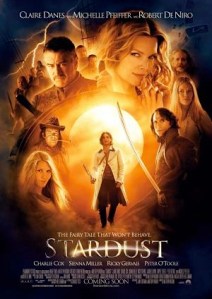
StardustPerhaps the simplest way to describe Stardust — to a film aficionado, at any rate — is as “the British Princess Bride”. That may do it a disservice however, as this tale of a boy entering a magical realm to find a fallen star is sufficiently its own beast to stand apart from such (admittedly lofty) comparisons, and be much more than a simple rehash with different accents.

Stardust succeeds in numerous ways. The plot is a good mix of fantasy archetypes, fairytale morality, a slight-but-knowing modern filter (thanks primarily to top-and-tail narration from Ian McKellen), humour and action. It rattles along, occasionally running the risk of becoming episodic, but thankfully avoiding it by linking and returning to various episodes. For a British film the effects work is perhaps surprisingly good, with impressive sequences that neither suggest restraint or budget limitations, nor smack of ambitious overreaching by the filmmakers (unlike, for example, the recent Tin Man miniseries).

This sort of fantasy adventure film is a somewhat unexpected choice for co-writer/director Vaughn, who previously produced Lock Stock, Snatch and Mean Machine, and directed Layer Cake, but his direction is neither over-grounded in reality (as you might expect from his background), nor over-done to the point of distraction (as if he were compensating). Instead, he demonstrates an entirely appropriate flair and skill, which promises much for future work.

If you watch a lot of British TV the cast seems star-studded, though even if not there’s the likes of Robert De Niro and Michelle Pfeiffer in major roles. Both are clearly having a whale of a time — as is everyone else, to be fair. De Niro’s role is especially surprising and fun, though to say any more would ruin it. It stands out as one of the best and most memorable elements in a film loaded with them. Charlie Cox is a likeable lead, while Claire Danes’ fallen star is pleasing subversive — you’d expect her to be sweetness and light (literally), but she is in fact amusingly stroppy — and Mark Strong is a perfectly villainous villain. They’re just three further standouts from an almost uniformly excellent ensemble. “Almost” because, sadly, the film’s weakest links are also among the cast. Ricky Gervais plays himself, as ever, almost shattering the well-constructed universe in the process; and Sienna Miller is too bitchy — and, to be frank, too wooden — for us to believe our hero could ever really want her.

But these are minor, easily ignored flaws in what is otherwise a fantastically entertaining fantasy. In fact, in recalling it for this review, it’s just magicked itself an extra star. How very appropriate.

5 out of 5

Stardust placed 4th on my list of The Ten Best Films I Saw For the First Time in 2008, which can be read in full here.

The Golden Compass (2007)

2008 #51
Chris Weitz | 113 mins | Blu-ray | PG / PG-13

The Golden CompassThis adaptation of the first novel in Philip Pullman’s His Dark Materals trilogy (known as Northern Lights in the UK, but adopting the US title for the film — unlike Sorcerer’s Stone, it’s actually more appropriate) received quite the critical drubbing on its cinematic release, and wasn’t a huge success at the US box office either, which has cast doubt on the prospects of the following two instalments ever being produced. Which is a shame, because this is actually a fine family fantasy film.

The requisite elements are present and correct: a well-realised alternate world, engaging heroes, slightly camp villains, mysterious items, mysterious backstories, a globe-trotting quest, talking non-human characters, a couple of action sequences and casual doses of spectacle. The latter was something that worried me going into the film, in fact, as the CGI looked dreadful in the trailer. When it won the Oscar I really couldn’t understand how, but now having seen the film — and in high definition to boot — it was, to my surprise, mostly exemplary. There are weak patches, of course (Mrs Coulter’s monkey being the main one), but the majority is either appropriately realistic or in a suitable style enough that it didn’t matter. “Don’t judge a book by it’s cover,” as they say; or indeed a film by its trailer.

Another key sticking point for me was the discarding of the books’ religious elements, which is far too atheistical for most Americans (not that I’ve actually read the books yet, but I always enjoy a good bit of Christian baiting). The filmmakers have found an appropriate way around this however: there’s a subtext, blatant to the intelligent viewer, which carries such views. It will like whoosh over the heads of those who would’ve been offended by it, which is surely the point. Nonetheless, the lack of commercial success suggests that the stir it had already caused served to cement it as “the anti-Christian film” in too many people’s minds. Or perhaps it was merely that too few had heard of the books? Or there’s always those variable reviews…

Leading the cast as Lyra, Dakota Blue Richard’s accent seems forced and occasionally grates, but really speaking she’s pretty good (pun retrospectively intended). The rest of the cast make a good account of themselves, though the likes of Daniel Craig, Derek Jacobi and Christopher Lee were clearly cast in readiness for the intended sequels. Ian McKellen is as good value as ever and the rest of the voice-only actors offer able support. Nicole Kidman never really gets the chance to unleash her full evil potential however.

In fact, therein lies probably the film’s primary weakness. While Golden Compass does work in its own right, it’s as much Part One of a trilogy as Fellowship of the Ring: at the end you feel curiously fulfilled, even though there’s clearly a lot of tale left to tell. I can only hope that the muted success it achieved is enough to get the continuing and concluding parts made, though that seems increasingly, disappointingly, unlikely.

4 out of 5

Hamlet (1996)

2008 #50
Kenneth Branagh | 232 mins | DVD | PG / PG-13

Hamlet (1996)Following his success with Henry V and Much Ado About Nothing, Kenneth Branagh tackled arguably Shakespeare’s most revered play, Hamlet. And he didn’t do it by half. It’s the first ever full-text screen adaptation, which means it clocks in just shy of four hours; he unusually shot it on 70mm film, which means it looks gorgeous; and, while he grabbed the title role himself, he assembled around him a ludicrously star-packed cast from both sides of the pond — in alphabetical order, there’s Richard Attenborough, Brian Blessed, Richard Briers, Julie Christie, Billy Crystal, Judi Dench, Gerard Depardieu, Nicholas Farrell, John Gielgud, Rosemary Harris, Charlton Heston, Derek Jacobi, Jack Lemmon, John Mills, Jimi Mistry, Rufus Sewell, Timothy Spall, Don Warrington, Robin Williams and Kate Winslet — not to mention several other recognisable faces. Even Ken Dodd’s in there!

But, with impressive statistics and name-dropping put to one side, what of the film itself? Well, it’s a bit of a slog, especially for someone unfamiliar with the text. While there is much to keep the viewer engaged, the high level of attention required can make it a little wearing; certainly, I took the intermission as a chance to split the film over two nights. Amusingly, the second half uses the original text to provide a sort of “Previously on Hamlet“, which was very useful 24 hours later. None of this is the fault of Branagh or his cast, who do their utmost to make the text legible for newbies — for example, there are cutaways to events that are described but not shown by Shakespeare, which, among other things, help establish who Fortinbras is (Rufus Sewell, as it turns out) before he finally turns up later on.

That said, some of the performances are a bit mixed. Branagh is a good director and not a bad actor, but his Shakespearean performances are variations on a theme rather than fully delineated characters. While there a new facets on display here thanks to the complexity of the character, there are also many elements that are eerily reminiscent of his Henry V and Benedick. The Americans among the cast seem to be on best behaviour and generally cope surprisingly well, while Julie Christie achieves an above average amount of fully legible dialogue. Perhaps the biggest casting surprise is Judi Dench, appearing in what is barely a cameo — one wonders if the film-career-boosting effects of a certain spy franchise would have changed that.

The best thing about this version, however, is how it looks. Much credit to cinematographer Alex Thomson for using the larger 70mm format to its full, loading every frame with vibrant colours and packing detail into even the quietest moments. Not every frame is a work of art — there is, after all, a story to be told — but there’s more than enough eye candy to go round. Also, a nod to the editing (the work of Neil Farrell), which makes good use of long takes — many of them full of camera moves — but also sharply edited sequences, such as the all-important play. The fast cuts make for a joyously tense scene in a way only cinema can provide, which I suppose is rather ironic during a ‘play within a play’.

For fans of Shakespeare, I suspect Branagh’s Hamlet is a wonderful experience, finally bringing the complete text to the screen and executing it all so well. For us mere mortals, it’s a beautifully shot and engagingly performed film, that I’m sure would benefit from a greater understanding of the text.

4 out of 5

Brideshead Revisited (2008)

2008 #49
Julian Jarrold | 133 mins | cinema | 12A / PG-13

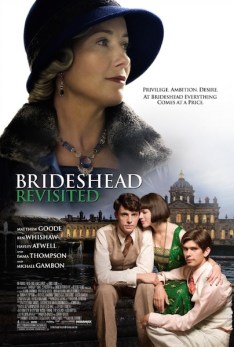
Brideshead RevisitedI’ve not seen the miniseries and I’ve not read the book, but I do know that both are considerably longer than Jarrold’s two-and-a-quarter hours film. So why does it feel so slow? Perhaps it’s the pair of opening flashforwards (easier to refer to them as that than to the majority of the film as one great big flashback), an overused technique these days that here serves no purpose whatsoever: there’s no additional insight on events that follow (or, rather, precede) by placing these snippets at the start, and there’s no new perspective on the snippets when we reach them chronologically (except that, second time round, we actually know who the characters are). It’s the most niggling fault in a film that, like my just-reviewed WALL-E, is of two halves.
The first is very good. It’s entertainingly written and performed, firmly in the tradition of the ‘heritage’ films and TV series that Britain churned out through the ’80s and ’90s — it’s the natural successor to the work of Merchant-Ivory, who of course produced the tonally-similar (at least at first) A Room With a View, which makes this all seem very appropriate. As Sebastian, Ben Whishaw is, perhaps unsurprisingly, the best of the three leads. When he’s off screen you miss him, and the point at which Sebastian leaves the story is arguably when things go off the boil. As Charles, Matthew Goode by and large holds his own — handy really, as he is definitely the centre of the film. Emma Thompson is as you’d expect her to be, which is to say she’s pretty good but ultimately it’s all rather familiar from her other performances.

The second half is where the film falls apart. The focus shifts from Charles and Sebastian’s friendship/possible homosexuality, to Charles and Julia’s love affair. The latter seems to come from nowhere and never takes off, consequently making it hard to accept the lengths they’re prepared to stretch to in order to make it work when they’re finally reunited years later. The plot slowly slides into darker and bleaker territory, needlessly dragging small characters back into proceedings to kill them off and finally pushing towards an Atonement-esque World War II epilogue. Some or all of this is obviously derived from the source, but considering the praise garnered by the novel and miniseries I presume it’s made to work there. Here it doesn’t.

An hour-and-a-half in I couldn’t understand what story there was left to tell, and I continued to be bemused by the sudden import of Charles and Julia’s relationship as the next hour dragged by. It’s a shame, because Brideshead starts out so promisingly and enjoyably, but once it begins to slide it never recovers.

3 out of 5

Henry V (1989)

2008 #29
Kenneth Branagh | 132 mins | DVD | PG / PG-13

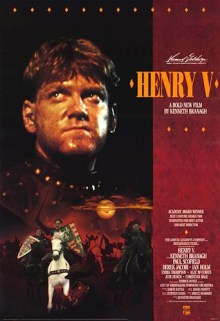
Henry V (1989)Once more unto the breach, dear friends, as I delve into a second version of Henry V in as many (viewing) days. (I dread to think how many reviews of this film began with a similar quote-based pun.) Inevitably, having watched them so close together, this is as much a comment on the relative merits of Branagh’s and Olivier’s interpretations of Henry V as it is a review of Branagh’s film in its own right.

Branagh’s version opens with almost a direct homage to Olivier’s, though with an important difference. Olivier opened with the Chorus’ narration on a stage ; Branagh opens with the Chorus’ narration on a film set. Rather than wasting half an hour with this conceit (as Olivier did), Branagh pushes into the ‘reality’ of the story before another actor has even entered. And his reality is much more real. The film looks as if it’s lit by candles and daylight, the castles and tavern are rough and dark, the battlefields muddy and grimy; everyone gets dirty and bloodied by the fights. On the whole it’s a grittier and more realistic version. Yet there’s room for more than that. The story still seems concluded at the Battle of Agincourt, but the proposal scene no longer feels tacked on. In fact it’s now laugh-out-loud hilarious, with Branagh and Emma Thompson demonstrating the undeniable chemistry that would help make Much Ado About Nothing so good a few years later. Unlike Olivier’s fluffy limp to the credits, this is an entertaining round-off to the plot.

The fact I’d never seen a version of Henry V before Olivier’s ostensibly gives Branagh’s the benefit of a better understanding on my part. Practically, it matters little that I saw Olivier’s first, as the more modern and film-friendly performances in Branagh’s version mean that, while Olivier’s allowed me to broadly follow the majority of what was happening, Branagh’s gives more access to the nuances of both plot and character. He’s aided in the latter by the inclusion of scenes deemed inappropriate for a World War 2 propaganda film: in one, Henry and co confront three traitors; in another, he hangs an old friend in order to make an example. Other scenes are played differently too, so that Branagh’s Henry is a more complex and morally debatable figure, unlike Olivier’s bright-eyed hero. Whatever your opinions on the two actors on the whole, these changes make for a better character and therefore a better film.

It would be remiss not to mention the rest of the cast. Brian Blessed is positively restrained as Exeter, one of Henry’s key associates — you’d never imagine he could turn in such a performance if you’d only seen his recent go at hosting Have I Got News For You. Paul Schofield, as the aging French King, and Michael Maloney, as the contemptible Dauphin, help flesh out the French side more than Olivier’s version managed, as does Christopher Ravenscroft’s Mountjoy, the French herald who all but switches his allegiance. The English ranks are swelled by Bilbo Baggins, Hagrid, and the current incarnations of ‘M’ and Batman (don’t worry, the French have Miss Marple); not to mention the recognisable faces of Richard Briers, Danny Webb, Simon Shepherd and John Sessions (and no doubt others I’ve accidentally missed). Of course, a starry and recognisable cast does not necessarily a good film make, but this is a dependable lot and there are good performances all round — even if Ian Holm’s Welsh accent is somewhat dubious (though it’s a lunar leap on from the one in Olivier’s version).

And deserving of a paragraph unto himself is Derek Jacobi’s masterful Chorus, who, with just a handful of narrational lines and a big black coat, is somehow one of the coolest characters I’ve seen of late.

There’s no contest here for me. Olivier’s version is an over-stylised, propaganda-inspired, outdated version of Shakespeare, whereas Branagh’s is a comprehensible, realistic, textured and, perhaps most importantly, genuinely enjoyable interpretation.

4 out of 5

Henry V (1944)

2008 #28
Laurence Olivier | 131 mins | VHS | U

Henry V (1944)Or The Chronicle History of King Henry the Fift with His Battell Fought at Agincourt in France, as the title card (and therefore IMDb) would have it.

The works of Shakespeare tend to be a love-it-or-hate-it experience for most people, often based on one’s social class and/or experiences at school (obviously not exclusively). Just to be awkward, I’m going to say I have mixed feelings about his plays: on the one hand, I consistently enjoy Macbeth and find Much Ado About Nothing a diverting enough rom-com; on the other, I was bored by Richard III, even when played by Sir Ian McKellen, and never got on with A Midsummer Night’s Dream (to pick just two examples for each side). I imagine most people have their likes and dislikes of course, but I often feel I fall between the the dislike Normal people have for Shakespeare and the love that Cultured people have for him.

This may seem beside the point, but it does lead to Olivier’s Henry V. Simply put, I didn’t much care for it. It failed to engage me, and I’d put this down to Olivier’s infamous staging (literally) of it. The first half hour is a recreation of the play’s first performance in 1600, complete with fluffed sound cues and heckles from the crowd. The goings-on backstage and performer/crowd interactions heavily distract from the actual text being performed, as much as anything because they’re more entertaining. Then, cued by one of the Chorus’s lines, the film moves to showing the story in ‘reality’ — except this is a reality made of painted scenery, primary-coloured landscapes, and cardboard fairy castles. It’s a deliberate effect, designed to emulate pre-Renaissance painting, but it didn’t work for me — it’s over-stylised and distracting, and if you’re not familiar with the play (as I wasn’t) getting distracted is a problem. The concept of transition from performance to reality has potential (as would the idea of presenting the whole thing on stage with crowd interactions, actually, considering I missed them when they went), but I personally feel Olivier executed it poorly. For one thing, it spends too long bedding in the feel of the stage performance before it gets round to the shift to reality.

Stylised productions can work, and excellently, but here the direction and acting are sometimes as flat as the castles. Actors arbitrarily shout some lines, hush others, and put in emphasis of dubious relevance — it’s like Shakespeare-by-numbers, the sort of production that reveres the text so much it doesn’t bother to think about it. It hampers any understanding of what they’re saying, especially for newcomers. Perhaps more fairly, the performance style is incredibly stagey. My degree-related reading suggests this is one of the earliest proper Shakespeare films (previous adaptations being silent or even less complete), so perhaps the idea of a more subdued, screen-acting style had yet to permeate such productions. Things do pick up as the film goes on: the battles are effective, and the proposal scene is more comfortably performed than the pre-war politics. That said, the story seems to be over once Agincourt is won, so by modern structural standards the hasty single-scene romance that follows feels pointlessly tacked on.

Olivier’s Henry V has received plenty of praise in its time, as well as derision, largely for its conception as World War 2 propaganda. The latter is hard to ignore, with grand speeches delivered in a way reminiscent of Churchill’s and scenes removed so that Henry’s character becomes unquestionably good — both aspects that are distinctly less relevant to today’s more complex, war-dubious world. Even leaving the propaganda aside, the performances are outdated, the design several stylised steps too far, and on the whole the production failed to engage or hold my interest. However good it may once have seemed, I think this version has had its day.

2 out of 5

Next I’ll be reviewing Kenneth Branagh’s all-star 1989 version of Henry V, here.