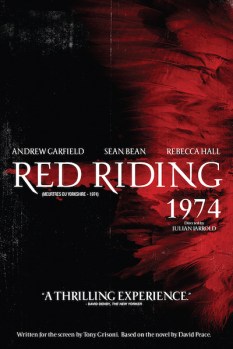
Red Riding: 1974 (2009)

aka Red Riding: In the Year of Our Lord 1974

2009 #50
Julian Jarrold | 102 mins | TV (HD*) | 18

Red Riding: 1974The Red Riding Trilogy covers nine years of police corruption and child kidnap/murder in Yorkshire, amongst one or two other things, and begins here with a very film noir tale, courtesy of author David Peace and screenwriter Tony Grisoni, slathered in neo-noir stylings, courtesy of director Julian Jarrold.

Jarrold is most recently responsible for Kinky Boots, Becoming Jane and Brideshead Revisited, all of which stand in a sharp juxtaposition to the style and content of Red Riding. But turning from his lovely English-as-they-come costume dramas to something altogether nastier should come as no great surprise, for Jarrold is merely returning to his TV roots: in the mid ’90s he directed episodes of Cracker, Silent Witness and Touching Evil.

He certainly seems to know his territory, but perhaps he knows it too well — though this is also the fault of Grisoni and, perhaps, Peace — as the plot that he unfolds is not only familiar but told as if he’s all too aware we know what’s coming. The feeling one gets is of a British James Ellroy, albeit a low-rent, less complex version. (The same is true of 1980, though for me 1983 manages to escape such comparisons.) The story idles along, not exactly slow so much as in no hurry, full of near-clichéd plot points and an unrelentingly standard structure. These things aren’t necessarily a problem, but when you’ve got as big and bold a reality claim as the Red Riding Trilogy they feel out of place.

Another recent point of comparison would be David Fincher’s Zodiac — young newspaperman on the hunt for a serial killer in an inspired-by-fact ’70s setting — though this does 1974 no favours. It may be grittier than Fincher’s film, but it lacks the polish, the originality, and manages to feel slower, despite being a whole 50 minutes shorter. However much arty photography, disjointed storytelling, relatively dense accents and ‘gritty reality’ is plastered over the barebones of the tale, the familiarity of it — to both viewers and the makers, who don’t even seem to be trying — means there’s not an ounce of suspense or surprise to be had.

The cast is made up of established names, familiar faces and rising stars, many of them unfortunately stuck in familiar roles or otherwise left stranded by the unrewarding material. If they’re not quite stereotypes it’s because they’re too bland, lacking enough discernible character traits to reach such lofty heights. Occasionally this is because, with two films to come, some minor parts here have a major role later, but this can’t be said of them all. As the lead, Andrew Garfield’s journalist is as much of a stock character as the plot he finds himself in: a young reporter type, idealistic among journalists who no longer care (if they ever did), hunting to expose The Truth. Again, it could work, but is belied by the insistence — in both promotion and filmmaking style — that Red Riding is something more than Another Murder Mystery. Only Rebecca Hall, as a mother whose young daughter went missing years earlier, is granted the material to give an outstanding performance — which she does, easily justifying her recent BAFTA Rising Star nomination.

Besides Hall, the best thing about 1974 is its dull, desaturated photographing of grimy, desolate locations, where any colour that isn’t beige desperately wants to be. It suits the story and era perfectly, and the choice of 16mm seems to add a level of haziness that is equally appropriate. It’s perhaps indicative of everything this is aiming for that the most beautiful imagery is of an incinerated gypsy camp. Rendered almost black and white by the soot and desaturisation, ash floats through the air like snowflakes as Garfield stumbles through it, the whole picture a vision of Hell. It’s a kind of perverse beauty, true, but that’s also entirely in keeping with Red Riding.

1974 is a stock noir tale, dressed up with fancy filmmaking techniques and claims of realism to look like something more truthful, more real, more Important. And it makes me a little bit angry because of it. Maybe the violence is more realistically depicted than your average genre entry, maybe the police corruption is a little more plausible — then again, maybe it isn’t — but the real story here is so familiar they haven’t even bothered to hide the plot beats and twists properly, no doubt assuming a “gritty” veneer plastered over the top would do the job for them. It doesn’t. Maybe 1974’s grimy setting, brutal violence and unbeatable police corruption are all true to life, but the familiar and predictable plot leaves the realism feeling like no more than a pretence.

I was enjoying 1974 a lot more by the time the unexpectedly satisfying conclusion came around, but the sense that it had tried to pull the wool over my eyes throughout — and not in the good way a thriller should — just leaves a bitter taste.

3 out of 5

* Though I watched Red Riding: 1974 on 4HD, it’s my understanding that it was upscaled. ^
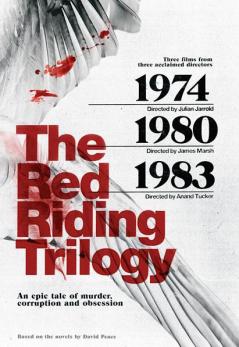
The Red Riding Trilogy

Red Riding Trilogy UKYou’d think Red Riding was a TV miniseries, wouldn’t you? After all, it was on Channel 4 on the same day for three consecutive weeks (recently repeated over three consecutive nights).
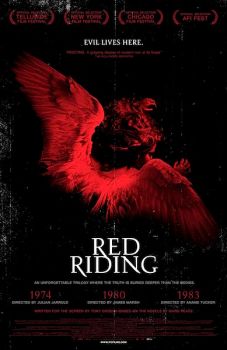
But the promotion — on iTunes, for example, or of Silva Screen’s soundtrack releases — is very keen to make reference not to “Red Riding” — as in, the title of a TV series — but “The Red Riding Trilogy” — as in, a series of films. Indeed, they are frequently referred to as “the films” (and similar variations thereof) in promotion and press, have received screenings at various film festivals and cinema releases in much of the rest of the world, including the US, and several other production and style points could also be rallied to confirm them as a film trilogy rather than miniseries.

As that’s how the makers would most like them to be regarded, then, it seems only fair to treat them as such. And so:


“The feeling one gets is of a British James Ellroy, albeit a low-rent, less complex version. The story idles along, not exactly slow so much as in no hurry, full of near-clichéd plot points and an unrelentingly standard structure. These things aren’t necessarily a problem, but when you’ve got as big and bold a reality claim as the Red Riding Trilogy they feel out of place.” More…

3 out of 5


“Where the first idled this meanders, flitting between the Yorkshire Ripper, the investigation into the Karachi Club shooting, and the private life of lead character Peter Hunter. Most time is spent on Hunter’s investigation into the investigation of the Ripper case, though by the end it becomes apparent this exists to cover the ‘real’ story — which is, of course, the Karachi Club cover up. Consequently neither are covered with the appropriate depth.” More…

3 out of 5


“Tucker’s film bests its predecessors in almost every assessable value. The story and characters have more genuine surprises and suspense than ever, while the performances are at the very least the equal of what’s gone before. Unlike the other two films, where the corrupt cops were little more than cartoon villains despite claims to the contrary, 1983 makes their brutality really felt.” More…

4 out of 5


Red Riding Trilogy USMy final thoughts about Red Riding — other than “that was disappointing” — are stuck on the reality (or not) of the police corruption it portrays. It’s difficult to know whether anyone who believes our police were never so nasty as this is naive, or whether anyone who believes they were quite this bad is paranoid. The truth no doubt lies somewhere in between.

Despite my disappointment with the majority of the Red Riding Trilogy, I intend to return to it some day: considering my enjoyment of the third instalment and the adjusted expectations that come from being disappointed first time round, the potential inherent in the trilogy means it certainly merits revisiting.

Sherlock (2002)

aka Case of Evil / Sherlock: Case of Evil

2009 #46
Graham Theakston | 89 mins | TV | R

Case of EvilSherlock Holmes is a character so well known in the international psyche that he is open to seemingly endless reinterpretation — a wartime spy in the Rathbone era, his younger self in a Temple of Doom remake, or cryogenically frozen to reawaken in the 22nd Century (no, really). Indeed, this year alone we can expect to see him re-imagined as both a wisecracking martial artist in a period-set action/adventure film from Guy Ritchie, and as a detective in the present day in a new TV series from Steven Moffat and Mark Gatiss. All of which are considerably more exciting than this lame Young Sherlock effort from 2002.

Here, writer Piers Ashworth — who would go on to pen the new St Trinian’s and Goal! III (for which be sure to read the review at The Big Whatsit) — creates a kind of Holmes Begins, showing a young and unknown Sherlock break his first case against renowned criminal Professor Moriarty, gaining a bit of fame before he joins the investigation of a serial killer. Ashworth makes sure to complete the Begins format with introductions for various iconic elements, like the deerstalker (though only in the final scene), the pipe (though, only in the final scene), and even his drug addiction (though Holmes seems to have already been cured of it).

More fundamentally, however, Holmes is recast as a kind of Victorian James Bond, both in terms of his character and the plot structure. It begins with the end of the previous mission (which, GoldenEye-style, will become relevant later), before progressing through various familiar beats, like the villain helpfully explaining his plan and a climactic big shoot-out a la You Only Live Twice or The Spy Who Loved Me, except on a much, much, much smaller scale. To add to the effect, Dr Watson is revealed to be “a bit of an inventor” — a Q in the making? Even Holmes himself is not immune: young, dashing, and womanising. Yes, womanising. He even has a threesome, shot and scored like soft porn, though with a US TV-friendly complete lack of nudity. Or sex. It does feature an unintentionally hilarious striptease though.

The story itself moves at a decent lick early on, complete with some genuine detective work that even, occasionally, displays Holmes’ genius. Most of this (at least, most of it that’s actually relevant to the plot) occurs during a couple of autopsies, which choose not to stint on the gore. (Incidentally, this makes it even easier to believe it was created with US TV in mind. Nudity? Nooo. Gore and violence? Hurrah!) Unfortunately, the longer the film goes on the more it slows and begins to drag, and the mystery-solving is replaced with running around, backstory exposition, and semi-decent sword fights. The best of these is fortunately at the climax, which takes place (amusingly, like Basil the Great Mouse Detective) atop the Palace of Westminster clock tower — or, at least, a poor computer-generated version of it (also like Basil the Great Mouse Detective). To be fair, the interior is a decent-enough set… though quite how the clock faces function when no workings whatsoever are attached to them is a mystery worthy of Holmes. Sherlock was shot in Romania, so such dodgy effects work rears its head any time they wish to depict a London landmark. Thankfully this isn’t often, because every such shot is appallingly realised.

Much the same could be said of the performances. James D’Arcy initially seems miscast as Holmes, but… well, he is — it’s just that everyone else is even worse. Roger Morlidge’s Dr Watson feels like he’s being portrayed by Ricky Gervais — no, worse, like James Corden’s version of Gervais from Horne & Corden — while Vincent D’Onofrio’s accent wavers all over the place and takes his performance with it. In what amounts to a cameo as Mycroft Holmes, Richard E. Grant is dreadful too. I’ve never been much of a fan of his, but this is weak work even by his standards. About the only passable performance among the major characters comes from Nicholas Gecks as Lestrade. There’s nothing exemplary about his role, but by simply doing nothing wrong he fares better than the rest.

Sherlock probably sounds irredeemably awful, and for some it will be (Sherlock Holmes has a threesome for Chrissake!), but despite the numerous flaws it remains largely watchable and even has its moments, particularly for more forgiving non-Sherlockians.

2 out of 5

Sherlock featured on my list of The Five Worst Films I Saw in 2009, which can be read in full here.

The Knack …and How to Get It (1965)

2009 #34
Richard Lester | 85 mins | download | 15

The Knack …and How to Get ItI’ve never actually seen a Richard Lester film before, and so spectacularly failed to put two-and-two together about who the director was and what else he’d done before I watched this. If I had, recent (at the time of viewing) reviews of the BFI’s release of Lester’s later The Bed Sitting Room (such as John Hodson’s or Clydefro Jones’) might’ve prepared me for what was to come.

As it was, all I had to go on was the DVD art (as used by iTunes — this was another 99p Film of the Week), the bright and breezy title, and that it stars Frank Spencer. From that you’d be forgiven (I hope) for thinking The Knack was a colourful Swinging Sixties sex-com romp. Upon watching it, however, it’s immediately clear it’s nothing of the sort: it begins with a dream/nightmare sequence, complete with horror-esque music, before settling into a style and rhythm more reminiscent of Breathless than Confessions of a Window Cleaner.

At least, it does for a bit. In fact, it does a lot of things for a bit: Carry On-level double entendres, intense thriller-like scenes, slapstick sequences, an occasional New Wave-esque light jazz score… If it were an American schoolchild The Knack would surely be diagnosed with ADD, flitting around from one style to another with no immediately obvious rhyme nor reason, except perhaps a desire to try out interesting things and see where they lead. This will undoubtedly put some people off — on another day, I might be included among them — but instead I found it quite intriguing.

Stuck in the middle of what could have been a slew of directorial flourishes, the cast are allowed to surprise with some layered performances. Michael Crawford more or less does an early version of Frank Spencer (in fairness, that’s perfect for the role), leaving him overshadowed by Ray Brooks as lothario Tolen and Donal Donnelly as the slightly kooky Tom. Both subvert their initial impressions: Donnelly’s oddness hides a perceptive intelligence, while Brooks’ suave lover hides a subtly unnerving, menacing, dominating sexual predator. Some of the time, anyway.

There’s no doubt that I’m severely under-qualified to pass any kind of serious judgement on The Knack (some would say any film, but there you go). I’ve not even mentioned Rita Tushingham (apparently something of a ’60s icon), or Ray McBride (who or what is he, and what is his relevance?), or that it won the Palme d’Or at Cannes in 1965 (I do know what that is at least). A proper, informed judgement is therefore best left to those with a greater familiarity with Lester’s films (or at least his early work, before he went on to the likes of The Four Musketeers and Superman III). But to those equally as uninitiated as I, The Knack can be recommended as an unusual but surprising piece of work, full of things to pique one’s interest.

4 out of 5

In Bruges (2008)

2009 #22
Martin McDonagh | 102 mins | TV | 18 / R

This review contains minor spoilers.

In BrugesIn Bruges has gathered quite a bit of indie-level praise and acclaim, culminating in wider recognition at the Oscars and other awards ceremonies at the start of this year. For those like me, finally getting round to seeing it in the wake of all this, it comes with quite a burden of expectation on its shoulders. Can it possibly be the modern classic many make it out to be? I mean, it is set in, y’know, Bruges…
First and (perhaps) foremost, In Bruges is hilariously funny, much more so than most by-the-numbers ‘comedy’ films can manage. The easily-offended might disagree, and some jokes are a tad too obvious (Americans are fat! Fat people can’t climb tight stairs!), but it’s nice to genuinely laugh at a film rather than force the odd smirk so as to at least get something from an otherwise wasted 90 minutes. It’s also dark and occasionally tragic though, and in this respect it’s unsurprising that writer/director McDonagh started out as an acclaimed and award-winning playwright, as stage plays mix humour and darkness more frequently (and with wider extremes) than films ever dare to. His theatrical roots also go some way to explaining the amount and ferocity of the swearing (again, something plays are more prepared to indulge in), but so too the brilliance of the dialogue. That it takes a playwright to craft such a good film is perhaps an irony, but not a troubling one.

Good dialogue is wasted without a good cast however, and thankfully everyone here gives a fantastic performance. The standout is Colin Farrell as hitman Ray. He initially seems a confident, cocky, experienced young hitman, and therefore verges dangerously close to stereotype, but we soon realise he’s actually twitchy, nervous, insecure, and genuinely sorry for the sole act of violence he committed. It might look like a Black Comedy With Nasty Violence to some — certainly, there are reviews that suggest some viewers are incapable of seeing anything beyond that — but there’s a lot more depth in the characters than the surface would suggest. Brendan Gleeson and Ralph Fiennes give consummate supporting performances, like Farrell chipping away at the stereotyped facades to find the hidden facets that the script is kind enough to reveal.

The quality of McDonagh’s writing (and direction) doesn’t stop with character and dialogue. The story is thematically considered, with a variety of paintings and associated imagery to occupy those who might be interested. Events are beautifully tied together and, best of all, none of the early scenes feel oddly inserted or have that nagging sense that they’re merely an excuse for something to be there later — everything works first time, and then has a seamless payoff too. Some viewers have criticised the ending, but I suspect they’re largely more used to mainstream fare and viewers who have ever enjoyed an indie film won’t bat an eyelid. All in, it’s easy to see why the screenplay has become the film’s prime awards nominee and winner.

Nominations, wins and buzz weigh heavy, but In Bruges has shoulders broad enough to carry such expectation with ease. “There’s never been a classic movie made in Bruges,” one character truthfully espouses, “until now.” It seems she couldn’t’ve been more right.

5 out of 5

In Bruges placed 2nd on my list of The Ten Best Films I Saw For the First Time in 2009, which can be read in full here.

Flash Gordon (1980)

2009 #27a
Mike Hodges | 107 mins | DVD | PG / PG

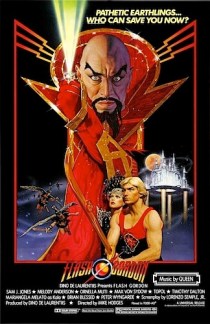
Flash GordonI hadn’t been intending to review Flash Gordon — it’s not as if I don’t have enough new films to review — but though I have seen it before it was a long time ago and I was very young, so watching it again now I wasn’t quite prepared for just how good it is.
Flash often seems to be dismissed as an unintentionally campy load of nonsense, perhaps with some ironic appeal. What this assessment misses is how knowing it is. Yes, it’s ridiculously camp, the dialogue is cheesy, the performances equally so, and it’s brighter and more colourful than any under-5s TV show ever produced. But it knows it is, and because it does it with nary a nod nor a wink I think that passes some viewers by.

The sheer volume of things there are to love in this film makes them hard to list without watching it and pointing them out as they appear, but I’m sure I can manage a few. For one, there’s the design work — the sets, the costumes, the spaceships — all huge, vibrant, retro and often ridiculous, and all wonderful for it. The special effects are truly special, creating skies full of swirling rainbow colours, rainbow clouds for the spaceships to float through, platforms that tilt over a rainbow vortex… Do some of them look primitive? Well, a bit — but they have more charm than CGI ever will, and they don’t get in the way either.

The plot is ludicrous, built from B-movie elements and predicated on cliffhangers — which is exactly as it should be. The dialogue is packed with quotable lines, many so patently ridiculous that it can only have been deliberate. There’s not a single bad performance — everyone’s either in on the joke or playing the straight man to it. Of particular note are Max von Sydow’s properly villainous villain (who, to be quite honest, still has more depth than too many nemeses we see today); Peter Wyngarde as his scheming right-hand-man, granted a fantastic death; Mariangela Melato as his right-hand-woman, granted some of the very best ‘bad’ lines; Topol as a somewhat loopy Dr Zarkov; and, of course, Brian Blessed — no more need be said.

The fights and assorted other action scenes are exciting, frequently epic, and tinged — like so much of the film — with a perfectly judged level of humour. Arguably the best is a harem-set tussle between between Dale Arden and Princess Aura, watched by sniggering servants as they wrestle on a giant bed. It’s beyond knowingly handled by Hodges, the brief cutaways to the servants indicating the deliberate commentary on such voyeuristic lesbian-lite wrestling matches in other films.

Then there’s the score by Queen. As with Brian Blessed, what more needs to be said? (Incidentally, I got a big laugh when Blessed screams, “who wants to live forever anyway?”, forgetting that Highlander was still six years off when this was made.)

So, in all that, what’s wrong with Flash Gordon? When I noticed how much I was enjoying it — about five minutes in — I began keeping my eyes open for flaws, any niggling thing that detracted from the experience Hodges created. I couldn’t find a single thing. Not one.

Which means I can now become known far and wide as the blog that only awarded Star Wars four stars, but gave Flash Gordon a perfect

5 out of 5

Big Nothing (2006)

2009 #12
Jean-Baptiste Andrea | 82 mins | TV | 15 / R

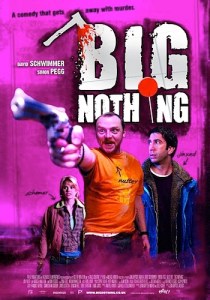
Big NothingBig Nothing was co-funded by the Isle of Man and Welsh film boards; it’s therefore unsurprising that it was filmed in those locations; and there’s a bunch of British actors in it… but they’re all playing Yanks and it’s set in Oregon.
And it’s as schizophrenic as this would suggest. Across its running time — and mostly in the opening half-hour — Big Nothing jumps wildly from mundane comedy to confidence scam thriller to black comedy to geeky spoof. Early on there’s a nice bit referencing The Matrix, for example; a brief moment which feels like it belongs in another film — as do many others. This flitting around makes for a showy opening, Andrea’s direction screaming “look what I can do!” in a way few films have since Guy Ritchie showed off everything he could do in Lock, Stock. It might help Andrea’s showreel, but the downside for viewers is it makes for taxing viewing and a sense that the film lacks its own identity. In short, it’s trying far too hard.

It does settle down however, improving immensely once it gets on with telling its (still loopy) story and stops trying to impress with flashy tricks. It becomes a lot funnier and a lot more enjoyable, slowly fulfilling any hopes the viewer may’ve had.

But it can’t keep it up, despite the brief running time. A long time before the credits roll it degenerates into a grab-bag of random incidents and twists strung together until the made-up-as-it-goes-along script hits something approaching a produceable page count. On the one hand this randomness at least makes it feel different, but on the other it pushes it too far — the array of twists don’t feel like natural occurrences, just plot points that are completely unforeseeable due to being equally nonsensical.

For a good stretch in the middle Big Nothing does more or less what you want it to, leaving the showy opening and desperate series of endings as unfortunate asides to a watchable film struggling to reach feature length.

3 out of 5

Cut (2009)

2009 #20a
Joe Wright | 2 mins | streaming

CutIs Cut an advert or is it a film?

On one hand, websites featuring it always refer to it as a “short film”; it stars film star Keira Knightley; is directed by BAFTA-winner Joe Wright; tells a story in a film (as opposed to advert) style; and is a whole two minutes long.

On the other, it’s paid for by Women’s Aid to front a campaign to raise awareness of domestic violence; it ends with a message to this effect, also featuring no title card or credits; it’s not listed on IMDb; it’s been shown for free among adverts in cinemas and online; it would’ve appeared on TV too if Clearcast hadn’t banned it for being “too violent”; and it’s only two minutes long.

It’s an advert, isn’t it? But it shouldn’t’ve been blocked from TV, which has incensed me enough to pretend it’s a film for the purposes of my little corner of the Internet.

Or half pretend, because purely as a film it isn’t great. It’s well shot by Wright, but some of the dialogue is too on-the-nose to convince and it’s actually slightly padded near the start — so slightly that in anything longer it wouldn’t be noticeable, but when something’s only 125 seconds, every one counts. On the other hand, it tells its story economically, using single shots to establish a lot of detail about characters, their lifestyles and their relationships, aided by Knightley playing a version of herself. In this the length and depth of story chosen are well-balanced.

When the violence comes, it’s moderately brutal. And here’s the rub — it’s arguably not brutal enough to cover the horrid reality of what some people have to suffer. It’s been made suitable to be shown on TV in a slot where people will see it — which, for its aims as an awareness advert, is completely appropriate. In the wake of Clearcast’s stupid ban I was expecting something more severe, which counterintuitively means the violence is more shocking for what it isn’t. Maybe whoever makes the decisions at Clearcast should watch Hostel: Part II before any appeal — or, to be honest, the 12A-rated Dark Knight might suffice.

With a brief running time and an important message to put across, Cut is a 5-out-of-5 advert, if only for the amount of talk and awareness it’s achieved. But I said I was trying to judge it as a film, so I’ll be a little tighter:

4 out of 5

Cut is available to stream for free on YouTube. More information about the campaign’s impact can be found on Wikipedia.

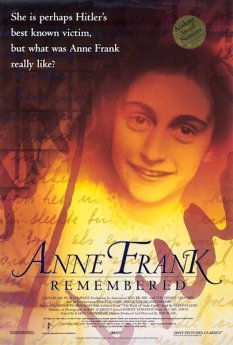
Anne Frank Remembered (1995)

2009 #4
Jon Blair | 117 mins | TV | E / PG

Anne Frank RememberedAnne Frank’s is arguably the best-known individual story of the Holocaust, perhaps because the diary of a 13-year-old girl in hiding from the Nazis — and, sadly, eventually captured by them — makes a perfect gateway for young people into learning about those atrocities.

In this Oscar-winning documentary, Jon Blair exposes the ‘untold story’ of Anne Frank. He adds to her words with the perspective of her friends, other people who knew her, and relatives of her companions in the annex. In covering these views the film presents alternate interpretations of many people Anne wrote about — for example, Fritz Pfeffer (renamed Albert Dussel in the published diary) is very disliked by Anne, but here is painted in a very different light by his son. The film also reflects on Anne herself, and what it uncovers is not always positive. Such an honest approach could be contentious, but its attempt to uncover the truth — rather than paint a false saintly picture — is admirable.

The film’s second half describes what happened after the diary ends, an often ignored part of the tale — even the BBC’s recent, excellent adaptation ended with the residents of the annex being escorted out, and I think many believe this is where the story ends. In reality there were seven months between the discovery of the annex and Anne’s death, and while only Otto Frank survived the concentration camps, many of the others came heartbreakingly close: Peter van Pels died just three days before his camp was liberated, while Pfeffer was marched away by the deserting SS as the Soviets neared, dying with so many others on that path. Here the film touches on much of what life was like in the camps, adding to its detail of how life was for those in hiding. There are undoubtedly other texts that do this more thoroughly, but by focusing on one family and using just a handful of interviewees, the events are made to feel incredibly personal in a way that some documentaries’ more factual approach fails to.

What happened to the diary after the war is also briefly covered: how the book came to light, the impact it had when published, allegations it was a hoax (due to differences between translations, and fictional events created for the 1955 play and subsequent film adaptation), as well as the positive effect it’s had beyond that, including comments from the likes of Nelson Mandela.

With its honest and extended investigation of the events covered in Anne Frank’s diary, plus its consideration of broader facts of the Holocaust, Anne Frank Remembered adds significantly to the original text. In doing so it becomes an essential companion piece to one of the most famous and important documents of the Second World War.

5 out of 5

Becoming Jane (2007)

2008 #91
Julian Jarrold | 115 mins | DVD | PG / PG

Becoming JaneDirector Julian Jarrold seems to have found his cinematic niche in “coming a bit late”. His Kinky Boots, while entertaining, was reminiscent of films like The Full Monty… except 8 years later; Becoming Jane rides the Pride & Prejudice bandwagon… except 18 months later; and his latest, the new Brideshead Revisited, had something of the Atonements about it… except 6 months later. At least his lead times have got shorter.

Perhaps Jarrold’s other inspiration here was Batman Begins. No, bear with me, for this is Austen Begins: Jane’s literary career has yet to start, but as the film progresses we see something of her personality taking shape — and plenty of the inspiration for her novels. Lord alone knows how factual any of it is, but I’m sure it must be a lot of fun for certain Austenites. On the other hand, purists might be less pleased with their idol being constantly lovelorn and indulging in (whisper it, children) snogging. For those with only the most cursory knowledge of Austen’s work, these might be the only things that stop them believing this is an adaptation of one of her novels; though, in truth, they’re probably not even that intrusive.

The big advantage to this being a somewhat Hollywoodised version of the story is the slew of English acting talent on display. Julie Walters, Maggie Smith and Ian Richardson are all present, in roles of varying sizes, plus the younger Anna Maxwell Martin (Bleak House) and Laurence Fox (son of Edward); not to mention James McAvoy, busy appearing in everything under the sun at the time. In the lead role, Anne Hathaway does a fine job, though there’s the inevitable question of “why not cast a Brit?” (to which one must assume the answer is, “for the sake of the US box office”). At least her accent is good.

Becoming Jane is a Jane Austen biopic treated as if it were a Jane Austen novel. In fact, so much is it embedded in the writing of Pride & Prejudice — and the notion that most of that was inspired by her own life — that it occasionally feels like another adaptation of it. This approach is a little uncomfortable in places, though probably makes sense considering the target market; and, by being so relatively lightweight, the resultant films seems to have faced less criticism from some Austenites than the similarly-timed TV biopic, Miss Austen Regrets. It’s for precisely this reason that the latter was a superior product, however: it may be darker and less uplifting — it ends with Austen’s death, rather than the start of her literary career — but it has a level of reflection that makes it more than Austen-Lite. Unlike this.

3 out of 5

Becoming Jane is on BBC Two today, Wednesday 31st December 2014, at 1:20pm.

(Originally posted on 27th January 2009.)