Tu£sday (2008)

2010 #51
Sacha Bennett | 79 mins | DVD | 15
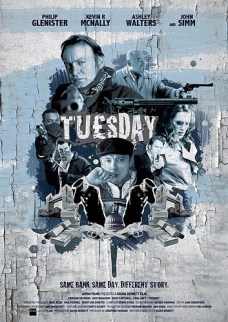
Tu£sday is a low-budget crime thriller, in which several groups of people all try to rob the same bank on the same day — hence the clever title. Unfortunately, the concept is much more interesting than the film writer/director Sacha Bennett has forced it into.

I’ll cut to the chase: Tu£sday is only notable for reuniting John Simm and Philip Glenister post Life on Mars. Christ alone knows why they agreed to it; quite possibly because they’re friends with Bennett. The pair are always good value, even with the limited material on offer here. All the other actors are variable. I’m never quite sure of Kevin McNally and this certainly does nothing to sway me to the positive.

The high-profile cast frequently belie what you’re watching. Most of the production has an amateurish feel. It’s hard to pinpoint, but it seems to be a combination of photography and editing: the look is like plain digital video, the choice of shots often obvious and lacking variety, the editing not as tight as it should be. Several takes look like they needed another couple of goes. The screenplay feels a draft or two away from completion, particularly dialogue.

The final iteration of the robbery (it’s repeated multiple times as we learn of each group’s attempt) in particular repeats too much of what we’ve already seen. Other versions of this sequence are among the film’s best edited moments, especially the replays that remind us where we were without descending into boring repetition. As the film barely scrapes up to a theatrical running time, there’s a suspicion that the final re-run genuinely was left untouched to keep the length up.

So, the story is convoluted, and muddied further with asides. But this is actually one of the film’s strongest points: the audience is kept busy with complications and unheralded flashbacks, working hard to ascertain which time period we’re watching and where the changeovers happen. Perhaps more could be done to help us follow it — maybe not starting with the Cowboys’ history, for instance, or using some visual trickery to differentiate the robbery, flashback and investigation scenes — but without it certainly makes us work more. Perhaps that’s being kind. At least having the mind racing with the plot distracts a little from the sub-Tarantino dialogue, which is a plus.

But it’s hard to ignore entirely. Sadly, the Reservoir Dogs vibe — jumbled timeline, post-failed-heist setting, irreverent chats, etc — is a couple of decades too late. Bennett is no Tarantino, even though he clearly (but perhaps subconsciously) wants to be. The downside to this is it can leave one longing for a more competent writer/director to remake Tu£sday even before it’s finished, with a greater handle and emphasis on that enticing multiple-robbery conceit.

I’m also not sure why it’s set in the ’80s. Something to do with the security at a bank, I suppose, as more modern systems would make this kind of tale nigh on impossible. It also allows for an amusingly cheesy title sequence and some equally laughable costumes. Unfortunately, it doesn’t go as all-out for the decade as Ashes to Ashes did, but then that has a much larger budget. I’m left with the conclusion that the decade of choice is a plot-easing convenience, then, rather than a true facet of the film.

I suspect almost anyone who bothers with Tu£sday will have been lured by the promise of reuniting Gene Hunt and Sam Tyler. Such lofty expectations are only going to lead to disappointment: it’s an ensemble film, for one thing, and it’s no Life on Mars. Not even close. But lower your sights, allow for the amateurish nature of some technical elements and the lack of polish to dialogue and performances, and the time-juggling narrative may actually be enough to sustain your interest.

3 out of 5

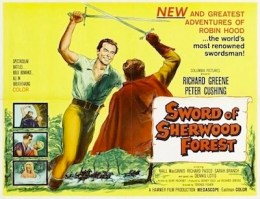
Sword of Sherwood Forest (1960)

2010 #50
Terence Fisher | 77 mins | TV | U

Hammer didn’t just make horror movies, y’know. I’m sure many film fans know this, but the phrase “Hammer Horror” is so ubiquitous that I expect most people think that was the company’s name and all they produced.
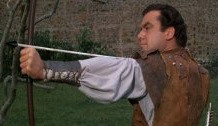
This Robin Hood adventure is one of theirs, though. Effectively a spin-off from the immensely popular The Adventures of Robin Hood TV series (1955-1960), though only Richard Greene as Robin carries over, it’s clearly from a simpler age, when films could still rely on a bit of derring do and a middling plot (nowadays they just rely on a bit of CGI and a middling plot).

After the ‘origin story’ becoming the default setting for new versions of well-known heroes in the past few years, it’s quite nice to witness a tale that dives in assuming we know who Robin Hood, Little John, the Sheriff, and so forth, are. Only Marian is introduced as someone new to Robin, though the speed of their romance suggests someone perhaps forgot they’d only just met. This allows the film to get on with its plot, such as it is — a bit of an excuse for an array of action and humour, mainly.

It doesn’t all tie together fully. For example, one assumes the town of Bortrey was going to be the site of Newark’s castle, as that’s the only apparent reason why he’d be annoyed at the Archbishop for stopping the Sheriff acquiring it. But then Bortrey is burnt down, and with little reaction or comment from any character. And the opening plot point — a man escaping the Sheriff with a mysterious symbol — is never fully explained. Was he a co-conspirator? Was he aiming to warn the Archbishop? If the latter, where did he get the symbol? Maybe I missed a scene that explained all this.
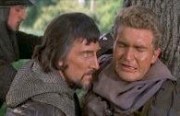
The story manages one surprise at least, when Peter Cushing’s Sheriff is killed, and before the climactic battle, and by a fellow villain, and only a lowly henchman-type at that (albeit one played by a pre-fame Oliver Reed). Although it’s rather a good twist in some ways, when you look at the other narrative choices of screenwriter Alan Hackney one wonders if he realised it was one.

The cast are adequate, even if Richard Greene’s no Errol Flynn and Peter Cushing’s no Alan Rickman (here at least). Terence Fisher’s direction is rather flat a lot of the time, though a few scenery shots, riding sequences and fights bring out a bit more dynamism.
Ultimately, Sword of Sherwood Forest is a bit middle of the road. It has its moments, but there’s a reason it’s not widely remembered as a classic Robin Hood film — that being, it isn’t one.

3 out of 5

The Chronicles of Narnia: Prince Caspian (2008)

2010 #47
Andrew Adamson | 150 mins | Blu-ray | PG / PG

The Chronicles of Narnia: Prince CaspianThe Pevensie children return to Narnia, but hundreds of years later, in Disney’s last adaptation from C.S. Lewis’ series (don’t worry, Fox have taken it over). For those keeping track, this is both the second book and second film, but fourth chronicle chronologically. Which is fine for now, but I wonder what they’ll do come those earlier-set ones…
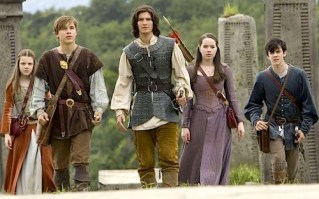
This time out, the world of Narnia has a harder edge. We’re still in PG territory — just — but everything’s turned a bit nasty, with a race of humans having wiped out the fantastical Narnians. Or (naturally) so they thought. Throw in some moderate political intrigue and you’ve got a more grown-up feel, if only slightly. It also makes for a slightly more cohesive tale — there are no odd elements leaking through from our world, like lampposts or Father Christmas, though one can well argue this removes something of Narnia’s unique magic.

It’s perhaps overlong, with numerous places trims could be made without denting the overall story. A half hour could surely have been saved without too much exertion. The first hour in particular is a tad slow, though the sometimes-wordy plot, based around some light court intrigue, adds depth beyond what might otherwise be a series of humans-on-magical-creatures punch-ups. I can’t comment on faithfulness here because it’s an awfully long time since I read the books. Besides, that running time is distorted by a whopping 12 minutes of end credits. I vaguely recall that, a few years ago, the second Matrix filmHeroes held the record for the longest closing credits at 10 minutes. I don’t really know what’s common these days but 12 minutes is nonetheless 8% of the film.
Once the human squabbling is passed — or by-passed, depending on your point of view — the human-Narnian war/one big battle really kicks off. Indeed, action sequences are frequent and fantastic throughout. The raid on the castle is tense, exciting and ultimately devastating — the troops left behind to certain slaughter is an incredibly dark moment in a PG-rated kids’ film. Later, a climactic sword fight is well staged, making excellent use of point-of-view shots, something I don’t recall seeing in a sword fight before.

The epic final battle comes as close to rivalling Helm’s Deep as anything I can think of, albeit — in typical Narnia style — in broad daylight on a big field. It has a real story to it, with specific moves being made by each side in the name of an overall strategy, rather than just A Lot Of Good Guys charging at A Lot Of Bad Guys and hacking away ’til one side wins, the apparent battle tactic in most other such large encounters on film.

The child actors aren’t going to set the world alight but are perfectly decent. I’m still not fully sold on Liam Neeson as Aslan, though I suppose the contrast of boom and gentility may be the point. Eddie Izzard is sadly underused as the excellent Reepicheep, who comes across as Narnia’s answer to Shrek 2’s Puss in Boots. Everyone else is fine — if nothing stands out, there is at least humour and an appropriate level of villainy provided.

Perhaps shortages such as this make the film a rather empty experience, as some have claimed. Not even titular new boy Caspian is treated to a huge amount of characterisation, and what little there is elsewhere depends wholly on knowledge of the first film. In fact, while the primary story largely stands alone, a proper understanding of it relies on the viewer remembering the previous instalment — at no point does anyone bother to explicitly explain that these kids we’ve just followed into Narnia are siblings, never mind that they were there before for decades as Kings and Queens. Maybe this is respecting your audience’s intelligence,Aslan or maybe it’s just counting on their memory a bit too much. With only limited characterisation and basic political complications, Prince Caspian really boils down to a series of fights and battles. Nicely done fights and battles, I’d argue, but still, no one’s coming away from this particularly enriched.
I was quite disappointed with the first Narnia in the end. It was entertaining and at times fun, but the primary-coloured bloodless climax in particular made it feel like Lord of the Rings Lite. I know I’m not alone in this — with the teaser poster for the next film, The Voyage of the Dawn Treader, coming out last week, I noticed a number of sites commenting that they’d not bothered with the second film after disliking the first; box office numbers were down too (though it’s still the 108th highest grossing film ever). Loyalty to a series I enjoyed as a child ensures my return (albeit two years after the theatrical release) but it’s a shame others chose to pass it by, because Prince Caspian is a step-up from The Lion, the Witch and the Wardrobe in pure entertainment stakes. Hopefully this tone continues into Dawn Treader and, fingers crossed, the four chronicles beyond.

4 out of 5

Doctor Faustus (1967)

2010 #23
Richard Burton & Nevill Coghill | 92 mins | DVD | PG

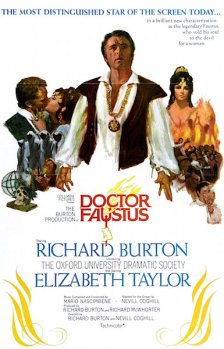
Despite the numerous film versions of the Faust story, this is the only one that adapts Christopher Marlowe’s A-level-favourite 1588 play. It’s a shame, then, that it’s heavily edited from the original text and, despite also being a filmed version of the Oxford University Dramatic Society’s 1966 stage production, has clearly been inappropriately chosen as a vehicle for then-couple Richard Burton and Elizabeth Taylor.
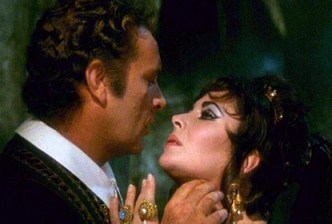
Burton plays a suitably reverent version of Faustus, though is never less than able to convey his varied moods, from confidence, often underscored with insecurity, to repentant regret, to childish tomfoolery. Stuck with numerous long speeches, however, there are occasions when his delivery — and consequently the film — slip briefly into insomnia-curing monotony.

Meanwhile, the play’s lack of a significant female role makes Elizabeth Taylor’s presence rather unusual. Marlowe’s text has been tweaked to allow Taylor to crop up frequently as ‘Helen of Troy’. As well as appearing in original scenes that feature Helen, co-writers/directors Burton and Nevill Coghill have inserted her into any scene that would allow it. Such casting across several inconsequential roles, some not even in the original text, effectively creates a new character. Perhaps this adds an extra dimension to Faustus and his goals — attempting to imply a romantic angle — but it comes across as a desperate and unwarranted attempt to make this a Burton/Taylor film.

Elsewhere, Burton and Coghill’s vision of Faustus is stylistically reminiscent of a Gothic Hammer Horror, which is either wholly inappropriate or an ingenious genre mash-up — after all, such a genre-mashing trick has been pulled many a time with Shakespeare over the years. There are repulsively horrific corpses, a harem of naked ladies, an array of special effects, plus a medieval-styled gothic atmosphere to all the sets and costumes, though the scene where Faustus mucks about with the Pope feels more Carry On. Using inanimate objects in the roles of the Good and Evil Angels — respectively, a statue of Christ and a skull — is a small but inspired touch.

These aside, there’s a surprising emphasis on special effects: a skeleton that turns into a rotting corpse (click the link at your own discretion); skulls that pour imagined gold and pearls from their mouths; cuckold horns that retreat into nothing; and so on. One might think this is purely to buoy up the Elizabethan language for a wider audience, and one isn’t necessarily wrong, but considering Elizabethan theatre-goers enjoyed their gory effects as much as modern audiences clearly do, their inclusion isn’t incongruous. There’s certainly some visually impressive stuff on show, much of it suitably horrific — one often wonders about the PG certificate.

An even greater deviation than the effects is how much has been cut out — in a word, loads. Most of the comic scenes are gone (some of their humour wouldn’t translate today, making those a wise excision, but others are missed), and much of what Faustus does during his 24 extra years on Earth is missing too. Some of the cut scenes are among the most easily-enjoyed parts of the play, though would certainly lighten the tone. Perhaps they just didn’t have any money left for the further special effects required. The trims extend as far as the final scene, which also loses some of the play’s best bits. It’s unlikely anyone unfamiliar with the play would notice the omissions (having not read it for a good few years there weren’t many I missed), but returning to the text after seeing the film I realised how disappointing some of the cuts were.

Perhaps they were designed to focus the film more closely on the Faustus/Mephistopheles relationship, perhaps just to heighten the presence of Helen by losing scenes she couldn’t have been shoehorned into; but in the process it both loses some of the best material and destroys any hope the film had of being a definitive filmed version of the play. Ultimately, such oversights proved to be the final straw for the film’s already-tenuous grip on a three-star rating.
2 out of 5

Lesbian Vampire Killers (2009)

2010 #33
Phil Claydon | 86 mins | download | 15 / R

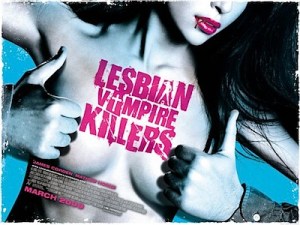
Pre-release hype pegged Lesbian Vampire Killers as the next Shaun of the Dead, a knowing horror spoof/homage destined for cult greatness. Reality showed us something different; a film so lambasted by critics and such a flop at the box office that they actually resorted to giving it away (as a digital download from iTunes just after Christmas). Like most of the country, I consequently ignored LVK on release, but free is free and so here I am.
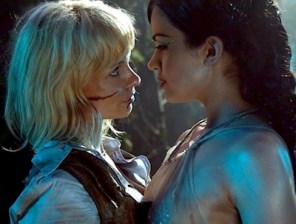
In retrospect, I wonder if part of the film’s publicly-thorough critical drubbing was down to expectation: from the title and blatant Hammer Horror references, critics and viewers presumed they were set for a Shaun of the Dead-style ready-made-cult-classic horror homage. Instead, it takes widely recognised Hammer tropes and aims the rest of its content at a Nuts-reading audience. I’m not saying the film would’ve been better reviewed if critics had been expecting something more akin to what they were ultimately given, just that it wouldn’t’ve come in for such a public flogging.

Unfortunately, even with corrected expectations, the film fails to deliver on its twin promises of raunch and horror. Aside from a couple of brief surgically-enhanced medieval boobs, a flash of knickers and the odd girl-on-girl kiss, the film’s sexy content is non-existent. Said Nuts audience would certainly get more from their weekly wank mag; this is mostly 12A-level. The horror, meanwhile, is reduced to well-signposted jump scares — and even then few enough to count on one hand — and the odd bit of comical decapitation/melting with holy water/axes in the head. To be fair, this is meant to be more comedy than horror, and in this sense a few such moments succeed passably.
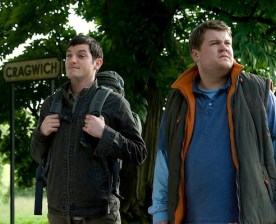
The humour itself is variable. A couple of half-decent jokes are scattered throughout, though a raft of predictable, familiar and vulgar ones threaten to overwhelm them. The opening goes on too long, emphasised rather than alleviated by Phil Claydon’s hyper over-direction. The film only approaches lift off once Gavin and Smithy… er, Jimmy and… no, still can’t remember… Anyway, it’s not until Horne and Corden finally arrive in the village of Cragwich that the plot begins to get moving, everything before it serving only to boost the running time to feature length (just), initiate subplots that are either disregarded immediately (Corden’s child-punching clown job) or disregarded as an inconvenience later (Horne’s on-again-off-again girlfriend), and provide an array of over-familiar suburban-sitcom situations.

Indeed, consistency is not the film’s strong point. Everyone makes a big fuss about the vampires and how hard they are to kill, yet every one is dispatched with ease, the level of threat never allowed to even attempt an increase before there’s white goo splurting everywhere (that’s what happens when they die, incidentally, not someone’s reaction to the lesbianism). The climax is a mere extension of this, substituting a rising scale of action for running around avoiding the easy killing bit. Any good will amassed in the middle — and there may be a tiny bit — is dismissed in boredom.
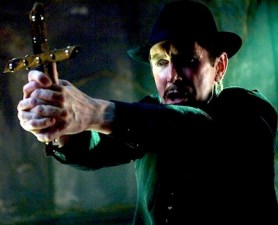
But Lesbian Vampire Killers isn’t all bad. If you can wade through jokes about a sword with a cock-like handle (not funny the first time, never mind the eighth), or a demon with a name that sounds a little like dildo (it’s a measure of the film’s intelligence that no one ever points out it sounds like dildo, they just leave that for the audience to spot), or any of the countless other inane attempts at being funny, you may come across the odd moment that makes you chuckle. Maybe. I probably enjoyed it (some of it, at least) more than I should admit.

And yet, for film fans Lesbian Vampire Killers is a wasted opportunity: even with its existing plot, more skilled hands could have shaped it into a horror tribute/spoof destined for enduring cult popularity. Instead, the MTV-born screenwriting partnership of Stewart Williams and Paul Hupfield shot for the lowest-common-denominator lad’s-mag-buying audience, though quite what they made of the classic horror reference points that do remain is anyone’s guess. If we’re talking about expectations (and, clearly, I am), Lesbian Vampire Killers did somewhat defy mine — though as I was expecting it to be one of the worst comedies I’d ever seen, that might not be saying much.

Nonetheless, it’s as good a rule as any that if you pay money to read Nuts, you’ll probably enjoy this; if you just browse Nuts’ website (for whatever reason — I hear they have jokes and football and stuff too), you might like it; otherwise, you’d probably be better off watching Shaun of the Dead again.

2 out of 5

Lesbian Vampire Killers is on Sky Movies Premiere tonight at midnight, and every night until Thursday 25th March at either midnight (Friday to Monday) or 10pm (Tuesday to Thursday).

Slumdog Millionaire (2008)

2010 #1
Danny Boyle | 120 mins | Blu-ray | 15 / R

Slumdog MillionaireAs we head in to this year’s awards season, I’ve finally got round to seeing last year’s big winner. It’s the Little British Film That Could, and I do feel like I’m the last person in the country to see it.

With its brightly coloured posters and home ent covers, cute child actors wheeled out at awards dos, and widespread popularity, it’s not hard to believe the pullquote someone at Fox’s marketing chose for the DVD cover: “the feel-good film of the decade”. An uplifting tale of a young no-hoper appearing on the world’s biggest game show and winning millions of rupees thanks to a generous helping of luck that means his multifarious life experiences have provided him with the exact answers to all 15 of Who Wants to Be a Millionaire’s genius-stumping questions, surely?

No.

Everything that claims it’s a “feel-good film” is being slightly disingenuous. It has a happy ending (I don’t think that counts as a spoiler for something that’s billed as “feel-good”), but until those closing moments it’s unrelentingly grim. Realistic, I’m certain, and depressingly so, but it seems designed for anything but making you feel good. The author of that chosen quotation, News of the World’s Robbie Collin, claims that he means the film is cathartic (not that I got that from his review, to be honest) — the happy and justice-bringing endings unleash goodness in the wake of the dire events that lead to them. It’s a sound theory, one that has often worked elsewhere, but not for me with Slumdog.

The problem is the ending. Director Danny Boyle’s recent films have all made a relatively poor show of their conclusion and Slumdog is no exception. True, it’s not close to the mess of Sunshine, but it doesn’t hold up in the way it ought to either. I don’t have a problem with it being reliant on guesswork — coincidence and luck form the backbone of the plot, making it permissible that our hero should win by chance rather than knowledge — but that some of its resolutions are too little too late to make one feel good about what’s already occurred, and the way it seems to bend the concept of Millionaire to fit its story somehow grates for me. I mean, is the name of the third Musketeer really a £1 million question?

But I don’t want to berate it too much because, in spite of the unconvincing finale, Slumdog Millionaire is a rather brilliant film. It’s peppered with convenience and flaws that go beyond the extent allowed in a plot based on coincidence (how come the questions come in the order the answers happened in his life? What about answers to all the questions we don’t see asked?), but these can be allowed to slide as a structural gimmick that facilitates something of an exposé of life for slum kids in India. Whether it has a documentary level of realism or not, and whether it under-sells or over-states the influence of gangsters and ease of mutilation and murder, the film’s unabashed grimness is surely closer to reality than most would dare. No wonder it nearly went straight to DVD.

The real revelation — once you get over the shock of it being, well, shocking — are the child actors. Here is where Boyle earns his Best Director awards, coaxing flawless lead performances out of a very young cast. Dev Patel may have been the focus point for plaudits, and while this isn’t undeserved, it’s the younger kids who play the same characters that arguably give the most memorable turns. They’re put through the ringer in almost every way imaginable and are never less than convincing, a feat for such young actors — so young that, as mentioned, the skill of Boyle (and, one imagines, “Indian co-director” Loveleen Tandan) is what’s really on display.

If there’s one good thing about Slumdog being billed as feel-good it’s that more people will have seen it, whereas promotion based on it being a gritty account of poverty, misery and abuse would surely have turned audiences away. And perhaps for most viewers the catharsis of a happy ending works, though the only person I’ve spoken to who felt that way is the aforementioned Mr Collin (and by “spoken to” in this instance I mean “tweeted”). The journey there certainly works though, and if by the end Slumdog is trying to both have its cake and eat it… well, I like cake.

Now there’s a quote for the DVD cover.

5 out of 5

Channel 4 and 4HD kick off their Indian Winter season with the TV premiere of Slumdog Millionaire tonight at 9pm.

Culloden (1964)

2009 #48
Peter Watkins | 69 mins | TV | 12

CullodenCulloden tells the story of the 1746 battle — famously, the last fought on British soil — and the events that followed it, as if it were covered by a modern TV news report (albeit a feature-length one).
This adopted style — a first — makes for an effective presentation. As a form it obviously foreshadows the docudrama, a method of presenting history which is so popular today, though not quite in this way. Writer/director Peter Watkins gratifyingly refuses to break from his premise: the whole film is very much like an extended news piece, featuring interviews, facts, and the famous BBC objectivity — at no point does the narration inform us who is good and bad, right and wrong, yet leaves us with little doubt about Watkins’ opinions (which are pretty low of just about everyone).

In fact, the film is fuelled by much youthful righteous indignation from Watkins, in his late 20s when Culloden was made. That said, his (perhaps unrealistic) idealism is still in evidence in every interview I’ve seen with him from decades later (though in those cases applied to what TV is and should be). But he allows it to dominate proceedings here, too often focusing on the awful conditions of the poor or the wrongs committed against them by Nasty Rich Folk. Should we be cross about this? It is 1746 after all — of course life was awful for common folk and the upper classes were rich twits who rode roughshod over them. That’s how things were in The Past, for thousands of years before it and hundreds of years after. With our modern developed sense of morality it all looks Nasty and Wrong, but we can’t go back and change it so why get so upset about it? Surely such vitriol is better directed at places where this is still the case?

While Watkins’ righteousness is clearly present before and during the battle, it’s really let loose in the aftermath, as English soldiers commit all sorts of atrocities to the Highlanders. Perhaps this was genuinely shocking and deserved in ’64, and it’s still true that the actions taken were unforgivably horrid, but it’s no longer shocking — not because we’re desensitized to violence at this point, but because we’re now very aware that we have done horrendous things throughout our history even while painting ourselves as the good guys (as we still do today, of course). Early on he describes the workings of the clan system, ostensibly factually but with a clear undercurrent of its unfairness; yet at the end bemoans its destruction by the English. Maybe this is why Watkins struggles to find anyone likeable in the film: they’re all as bad as each other.

Even if his overly moral stance falters, Watkins’ filmmaking techniques rarely do. The use of ordinary people as actors works fine most of the time, though occasional performances or scenes show off the cast’s unprofessional roots. Watkins’ theories about how TV should be run and the involvement of the public in the way he did here may be romanticised and impractical, but it’s hard to deny that his application of them worked wonders. Performances frequently aid the documentary effect by seeming just like those in genuine interviews or news footage, whereas even the best professional actors trying to emulate such reality are usually mannered enough for the viewer to realise they’re acting.

Best of all, however, is the titular battle. These scenes are extraordinary, creating a believability even the largest Hollywood budget has often failed to challenge. It’s epic but also involving, disorientating but clearly told, brutal without needing expensive prosthetic effects or an 18 certificate. It’s a brilliant example of camerawork, sound design and editing combining under inspired direction to create a flawless extended sequence.

Culloden was a bold experiment in filmmaking — indeed, the notion of a distant historical event being presented as if covered by news cameras still sounds innovative — and Watkins mostly pulls it off, with stunning battle sequences, effective performances and a high concept that is never betrayed. A few minor weak points aside, the only serious flaw is that Watkins lets his overdeveloped morality run unchecked. His application of a modern outrage to what seems a typical historical situation grates quite quickly but never abates, ultimately reclaiming a star from what is nonetheless an exemplary effort.

4 out of 5

Culloden placed 8th on my list of The Ten Best Films I Saw For the First Time in 2009, which can be read in full here.

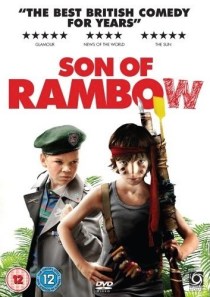
Son of Rambow (2007)

2009 #35
Garth Jennings | 92 mins | DVD | 12 / PG-13

Of late I’ve posted several reviews resorting to taking my notes and turning them into sentences — this is why I probably should’ve stuck to my old post-them-all-in-order method. It’s now about nine months since I watched Son of Rambow, and the chances of being able to construct a worthwhile assessment from a combination of notes and memory has long since passed. So, for hopefully the last time, I offer up a paragraphified version of my brief initial notes.

Son of Rambow is beautifully written and directed, both roles fulfilled by Garth Jennings, who was previously responsible for directing the surprisingly-good (to my eyes) Hitchhiker’s Guide to the Galaxy movie. In contrast to that effects-ridden intergalactic comedy, Son of Rambow initially seems like a relatively straightforward, perfectly pleasant little movie about two boys and their video camera. It’s partly this, but it also brings in subplots of what it means to be a family — on various levels — and the evils of over-zealous religious orders (always a favourite topic for me).

Every significant character is given at least one twist that adds an extra level to them, even those who seem to just serve a specific plot function, and most of the minor ones — right down to Will’s silent grandmother — are given their small moment to shine. Nice little touches in Jenning’s work abound, from the comic asides with Didier to Will’s fertile imagination realised through animation, or the post-credits snippet of dialogue.

The two pre-pubescent boys have to carry the film, but thankfully are up to the task (even if their names being Bill nd Will and one of the characters being called Will (the one that’s played by Bill) make remembering them outside of the film a bit of a minefield). They are never less than utterly believable in both writing and performance. Will Poulter (as Lee Carter, the more rebellious of the two) is exceptional, talented in a way that’s reminiscent of River Phoenix in Stand By Me. It’s no surprise that both have gone on to greater things. And by “greater” I really mean “other”. There are wonderful performances all round in fact — aside from the lads, Jessica Hynes is especially worthy of note, creating a powerful character in just a handful of scenes.

The shape of the story may be familiar (unlikely pair start off wary of each other but become best friends, eventually fall out when one exceeds himself, but realise the error of their ways to come back together in the nick of time) and the lessons learnt are hardly new (true friendship can conquer all), but it’s all put together with immense joy and skill, built around a charming concept, that it becomes far more than the sum of its parts.
Hilarious and touching in equal measure, you’d need a heart of stone to remain unmoved. A triumph.

5 out of 5

Son of Rambow placed 4th on my list of The Ten Best Films I Saw For the First Time in 2009, which can be read in full here.

Originally posted on 14th March 2010.

Rage (2009)

2009 #81
Sally Potter | 98 mins | streaming | 15

RageI really didn’t expect to like this: a series of straight-to-camera monologues, performed in front of just plain-coloured backgrounds, about the fashion industry, written and directed by the writer/director of Orlando, which I thoroughly disliked. But I watched because it was going free and, despite the concept’s innate pretentiousness, it’s an intriguing one. Once Rage settled into its stride (or, perhaps, I settled into its stride), however, I loved it.

The group of fourteen people who appear before the camera are almost entirely self-centred and/or not very nice, which you may guess from the outset considering their industry, though almost all still have something to reveal as the film progresses. It’s surprisingly funny too. The off-screen action is conveyed by a very effective sound mix — we see nothing but talking heads (until an incongruous final shot, at least), but there’s always background noise, however subtle, and the key action in the wider world is revealed to the viewer through this, plus comments from some of the talking heads. But time isn’t wasted spelling out what we can’t see; instead, a bit of the viewer’s own imagination is required in addition to the sound and dialogue clues to create a version of events.

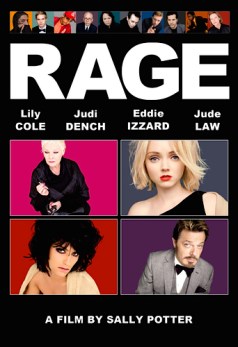
A starry cast (Steve Buscemi, Lily Cole, Judi Dench, Eddie Izzard, Jude Law, John Leguizamo, David Oyelowo, Dianne Wiest… plus recognisable (depending on what you’ve seen, of course) faces like Simon Abkarian, Bob Balaban and Babel’s Adriana Barraza.) provide exemplary acting across the board, even if some of the accents (mainly Brits playing at yanks) are frequently dubious. It seems unfair to pick anyone out, but Lily Cole is perhaps the most surprising, her fragile character aided by her Pipling-esque eyes and pale skin, but it’s her actual performance that ultimately delivers more than her autobiographical-seeming first appearance would suggest. And one can’t ignore Jude Law playing a Russian/American female(?) fashion model — for once I actually thought he was quite good. Maybe this is his niche. The majority of the performances err toward the theatrical — something certain film viewers seem to struggle with — though the intercutting and passage of time, reflected in intertitles and costume changes, make the whole experience more suited to film; indeed, with the cameraperson being such a major character (as it turns out), it is technically unstageable. (It could be staged, of course, but it belongs as a film.)

And, talking of how things turns out, the most intriguing character of all is Michelangelo, the cameraman and only main character we never see on screen — indeed, it’s a considerable amount of time before we realise he’s a character at all and not just a filmmaking conceit. His presence and the filming style (supposedly shot on a mobile phone (or, I suppose, ‘cell phone’) camera) is not just a gimmick, but, as it turns out, vital to the story. It’s probably the only film ever made that perhaps works better viewed streaming online. All the characters are in some way unveiled throughout the film, but, almost without the viewer releasing it, so too is our supposedly-inconspicuous cameraman. By the end, what seemed to be a critique of the fashion industry — and a well-worn one at that — has something else to say too.

At least, one hopes this ‘critique’ of the fashion industry isn’t the main point, because it may be the film’s biggest problem. There’s very little, if anything, new to be found in the comments and criticisms made — we well know it’s a business filled with too-thin weight-obsessed diva-ish models, self-obsessed pretentious designers, money-grabbing moral-less Murdoch-alikes and no-hope fame-hungry wannabes, and Rage doesn’t have much more to say about it than this. Sure, no one sits around pontificating on why it’s all so evil, but it doesn’t take much to see the subtext. At least it’s often funny about it; though based on comments I’ve read online, it seems this humour may be too subtle for some. Perhaps they can’t see the inherent ludicrousness of it all, with the performances flying closer to realist than the My Family-level bluntness some require from their comedy.

It’s hard going at times, even if one is enjoying it — after all, it’s still just a succession of people talking to camera. Obviously what they say — and, indeed, don’t say — reveals things about themselves, others, and events off screen, but while I was never bored there were several occasions when my eyes strayed to the clock out of curiosity over how long was left. I’ve still seen much duller films.

I don’t doubt that Rage isn’t for everyone. Indeed, you only have to look at IMDb to see how many people loathe it with near-religious fervour. (Prepare yourself if you do, because some of the criticism is irritatingly brain dead. But hey, that’s IMDb!) Some people just won’t get on with its style, or find it too slow, and with 14 characters in 98 minutes, awarding them an average of under seven minutes each, you’re not going to get Alan Bennett-level character deconstruction. But Rage unapologetically is what it is, and I liked it.

5 out of 5

If you’re interested in an in-depth (and spoiler-filled) review of Rage which features phrases like “extraordinary testament to the mindbrain”, “Mugel and Potter use sound to build an entire lifeworld”, and “it enlivens, emboldens and enriches the film, engaging ear, heart, mind, memory, intelligence, even skin and senses as a brilliant texture”, try this one from Little White Lies.

Rage placed 10th on my list of The Ten Best Films I Saw For the First Time in 2009, which can be read in full here.

Hamlet (2009)

aka The Royal Shakespeare Company’s Hamlet

2009 #90
Gregory Doran | 183 mins | TV | 12

Hamlet (2009)It doesn’t seem like 18 months since the RSC brought Hamlet to the stage with British TV’s biggest star actor (probably) as the titular Dane, but it is (more or less). Thanks to sold-out performances and largely positive reviews (theatre critics seem even less keen to agree on anything than film ones), we’re now treated to this film adaptation, shown on BBC Two on Boxing Day and released on DVD (but not Blu-ray, boo*) earlier this week.

Hamlet hangs primarily on its central performance — so we’re constantly told, anyway; this being only the second production I’ve seen I can’t confidently assert so for myself, but I can certainly see where the consensus comes from. Equally, I can’t accurately compare David Tennant’s performance to any other, which often seems to be a central consideration in any review of the play. In near-isolation, however, it’s a thoroughly convincing performance. He glides seamlessly from withdrawn and grief-stricken in his first appearance, to intrigued and excited by the ghost of his father, to clever and wily as he plots, and finally to an alternation between assumed madness and serious introspection as he enacts his plans.

Any number of scenes show off Tennant’s abilities, particularly the way he treats other characters. He resolutely takes the piss out of both Polonius and Rosencrantz & Guildenstern, but plays each in subtly different ways: the former is like someone intelligent teasing with someone who doesn’t get it, which sounds distasteful but is enjoyable because of Polonius’ plotting and influence; while the latter is like a cat toying with a pair of treacherous mice, who are aware they’ve been caught out but struggle on regardless. Hamlet’s pair of ‘friends’ can be seen as insignificant characters by some — it’s part of what led Tom Stoppard to pen Rosencrantz and Guildenstern Are Dead, after all — but with a few silent additions around Shakespeare’s dialogue and the way Tennant, Sam Alexander and Tom Davey choose to play the original lines, their roles seem to have increased importance.

The other notable facet of Tennant’s interpretation of the character is humour. Hamlet’s madness here is almost unrelentingly funny — even in deadly serious situations, like capture following a murder, Tennant’s Hamlet can’t resist taunting the other characters, keeping the viewer onside by keeping his apparent insanity entertaining rather than scary or darkly intense. If anything, however, this screen version fails to capture just how funny Tennant was on stage. Perhaps it’s the loss of a bigger audience, or the energy of performing on stage, or perhaps Tennant has reined in, switching from Stage Acting to Screen Acting. He’s still funny, certainly, but its not as striking as it was live. In fact, more laughs are earnt by Oliver Ford Davies as Polonius. As his lines dither on like many a real forgetful old man, it’s difficult to imagine the part played any other way.

The other stand-out is an award-winning Patrick Stewart in the dual role of Claudius and the Ghost, though the fact he plays both feels relatively insignificant. His cool politician of a King makes a perfect contrast to the crazed energy of the Prince, the latter constantly bounding around while the former remains still and collected. In my view it’s a shame Stewart has a beard in the filmed version (a necessity forced by his concurrent appearance in Waiting for Godot, I believe) — on stage he was clean-shaven and therefore somehow more reminiscent of numerous other political villains, both real and fictional, whereas his bearded visage is more reminiscent of a traditional Kingly role. Still, it’s a minor aesthetic point that doesn’t hamper his wonderful performance.

Director of the original stage production, Greg Doran, also helms this version. It’s a convincing adaptation too, making good use of sets, locations and, vitally, camerawork, rather than employing static shots of the original theatrical blocking. A quick shoot (18 days for an over-three-hours film) and single location combine to reduce the number of on-screen locations, unfortunately, though the main set is fairly well rearranged to stand in for a number of rooms. It does branch out occasionally, but it’s a shame this couldn’t have been done more often, as consecutive scenes on the same slightly-redressed main set occasionally confuse whether we’ve changed location or not.

Doran’s main screen gimmick, however, is security cameras. Every so often our viewpoint switches to a grainy black & white high angle as we survey the scene via CCTV. It’s a neat idea to convey the concept of Elsinore as a place where everyone is under constant scrutiny, and it’s occasionally used very well indeed — during the Ghost’s appearance to Hamlet, for example, or when he rips a camera down to declare “now I am alone”. Unfortunately, it’s not as consistently thought-out as one might like. When Claudius and Polonius spy on Hamlet and Ophelia, for example, they do so from behind a two-way mirror (as in Branagh’s film, incidentally) rather than, say, from a control room with a bank of security monitors, an idea which seems to naturally flow from the presence of CCTV. Following this, when Polonius talks to Hamlet he delivers several asides to camera — not the security camera, mind, just to the audience. It would have been more effective to have him offer them to a security camera, knowing Claudius to be viewing in another room. It’s moments like these that turn the omnipresent video surveillance from a clever idea to little more than a gimmick. And by the time it’s cut to during the climactic sword fight, you just want it to go away.

It’s almost certain that this production will be remembered as “The Doctor Who Hamlet” thanks to its leading man. Whether that’s unfair or not is another debate, though it shouldn’t mean this version goes ignored. Tennant’s excellent performance reminds us that he was an accomplished performer with the RSC long before he gained televisual fame, and a strong supporting cast ensure this can’t just be dismissed as a popularity-seeking vanity venture by the RSC. Indeed, if there’s one good thing about the “Doctor Who Hamlet” label, it’s that the potential viewership is increased massively, bringing some to Shakespeare who never would have bothered otherwise. Surely no true theatre aficionado could argue with that.

4 out of 5

* A Blu-ray was eventually released in April 2010. ^