
Neil Marshall | 97 mins | Blu-ray | 2.35:1 | UK / English | 15 / R
Last week, as I’m sure you’re aware, I posted the top ten films I’d watched in 2011. Among them were three I’ve yet to post a review for… so what better way to begin finishing off my 2011 reviews than with those. So here’s the lowest, #9…
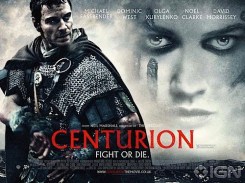 The fourth feature from writer/director Neil Marshall (despite owning his first three on DVD, this BD rental is the first I’ve actually watched — story of my life) is a bit of a departure: where the first three were horror (or at least horror-leaning) flicks, Centurion is an action-adventure crossed with something a little more artsy. Only a little, mind. Think Seraphim Falls.
The story involves a Roman legion (a real one, in fact — the story is based in historical fact) venturing into Scotland to take on the natives. They get massacred, the survivors try to get home alive. The story moves quickly, keeping the momentum up. Indeed, at times it moves so fast that some characters seem to be given short shrift. There’s a “who will survive?” element to the plot — Marshall’s horror roots showing through, perhaps — but you can largely guess which order they’ll be shuffled off in based on, a) how much screen time the character has, and b) the good old deciding factor of “which actors are most recognisable”. Predictability doesn’t really matter though, because there are (perhaps) a couple of surprises in store, and it’s only one element of the story.
 Regular readers may know that I have an ever-growing dislike for films that begin at or near the end for no good reason (and most of those that do have no good reason to do so). Centurion’s opening line notes that “this is neither the beginning nor the end” of the lead character’s story. Oh dear, thought I; though perhaps “nor the end” signifies we might reach this point suitably distant from the credits, maybe. Not meaning to spoil it, but we’re there just 10 minutes later. Nice work Mr Marshall.
And with the mention of credits, allow me to note that both the opening and closing credits are wonderful, reminiscent of Panic Room’s much-exalted titles without being a clone.
The characters who do get screen time are well built. Most of them conform to regular men-on-a-mission types, but in the hands of actors like Michael Fassbender and David Morrissey that doesn’t matter. This seems like an appropriate enough point to note that Fassbender is fast becoming, if he isn’t already, an actor where it’s worth watching something with him in even if it doesn’t otherwise appeal. His mixed choices of blockbusters/mainstream-skewing movies and acclaimed artier fare suggest pretty impeccable taste. (Or, at least, tastes that match my own.) 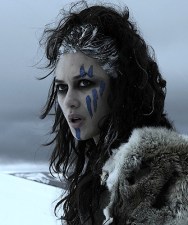 The cast is packed with people who, even if you don’t know their names, there’s a fair chance you’ll know the faces (assuming you watch your share of British drama): in addition to Fassbender and Morrissey there’s Dominic West, JJ Field, Lee Ross, Paul Freeman, Liam Cunningham, Noel Clarke, Riz Ahmed, Imogen Poots, Rachael Stirling, Peter Guinness… not to mention Film Star Olga Kurylenko. Recognisability doesn’t guarantee quality, of course, but that’s a pretty good list.
On the action side, there’s a selection of excellently choreographed fights. Lots of blood and gore, but surprisingly not gratuitous considering we have all manner of limbs being lopped off, decapitations, heads being shorn in two, and so on. It’s unquestionably graphic, but it doesn’t linger — the battles are hectic, fast, a blur… but in a good way: you can see what’s going on, but it feels appropriately chaotic.
On the artsy side, the Scottish scenery is extraordinarily stunning. Helicopter shots are put to marvellous use. Think Lord of the Rings, only this was shot on our own fair island. The filmmakers went to extremes to achieve this — it’s entirely real location work, beyond the back of beyond in the depths of a snow-covered Scottish winter; no green screen, no CG enhancement — and their effort has paid off. It looks thoroughly gorgeous. I fear I’m overemphasising the point, but… nah.
 I really enjoyed Centurion, appreciating its mix between brutally real action and stunning scenery, with a slightly more thoughtful side emerging in the final act. It’s also always pleasant to see a film that runs the length it wants to at a reasonable speed, rather than padding itself to reach two or even two-and-a-half hours. Splendid.

Centurion placed 9th on my list of The Ten Best Films I Saw For the First Time in 2011, which can be read in full here.
 I’ve
I’ve 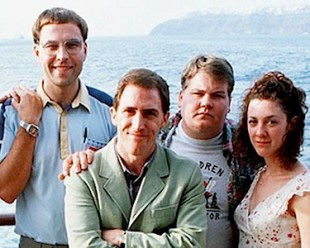 Though the film pokes fun (fairly good-naturedly) at sci-fi obsessives, the underlying story here is about a man overshadowed by his past. In this Brydon gives a strong performance — I think he’s a better actor than he’s normally given credit for — and he’s ably supported by Corden in particular, though to say what gives his role such quality might spoil a twist. He’s another one who’s actually a very good actor, but it gets hidden beneath a public persona that led to such dross as that sketch show with Mathew Horne.
 without ever realising all those disparate things were penned by the same human being. Poor writers.) Lowney, meanwhile, has stuck to TV, with episodes of
 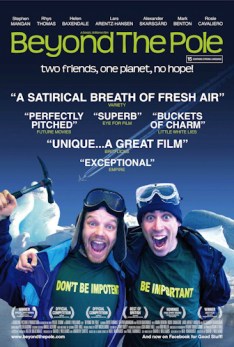 Adapted from a cult Radio 4 series, Beyond the Pole is a British mockumentary about “the first carbon neutral, vegetarian and organic expedition ever to attempt the North Pole”, starring Stephen Mangan Off
 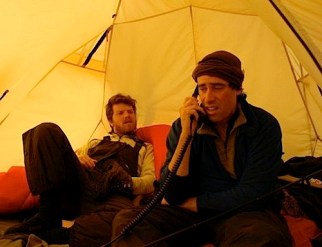 It’s also impressively realised. Its apparent low budget led me to assume we’d, a) see very little of the actual trip, and b) what we did see would be all inside-a-tent and green-screened. But no, it was really shot on floating sea ice off the coast of Greenland, and it makes for a highly effective polar landscape. Good work, filmmakers.


 David Mitchell and Robert Webb move from the small screen to the big one in this comedy from the writers of their sitcom
  while Webb is adept at dancing sillily and, increasingly, hosting / voice-overing quickly-made cheap rubbish for various channels. These are all skills in their own way, but they don’t necessarily demonstrate brilliant acting. But, hey, they’re fine here.
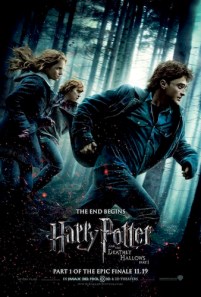 While the final Harry Potter film continues to obliterate records at box offices around the world, I finally caught up on the penultimate instalment in the phenomenal fantasy series. It’s Part 1 of
 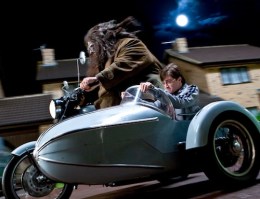 of having seven books each covering a school year, but hush, let’s overlook that (everyone else seems to).
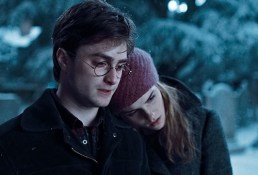 Talking of exceptional sequences, the animated one can’t go unmentioned. It’s wonderfully done, inspired by old silhouette animations, though achieved in 3D animation here, which is a pity. It’s still beautiful to look at, and it’s very fluid, but I can’t help but feel it would’ve been even more effective if they’d gone all out and done it in 2D.
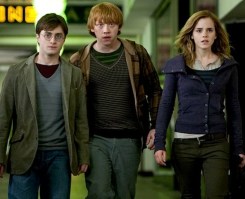 Themes of Nazi/Stalinist-style oppression are played up in the story (trials of those whose “blood status” is in doubt; listening to the radio for news of loved ones; Bellatrix’s torture of Hermione) and production design (the muggle-crushing new statue in the Ministry; the art style of anti-mudblood propaganda leaflets; the uniforms of the Ministry guards), but it’s subtle enough that it doesn’t batter you around the head.
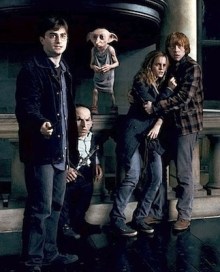 And so, the ending — which isn’t, because we’re in the middle of the book. So how well does it work as, y’know, an ending? Quite well, as it turns out — indeed, one might even compare it to something like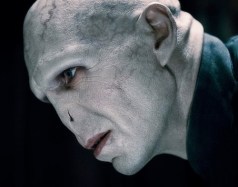
 Sometimes, at least for me, films improve in retrospect. My opinion while watching may be different to when I look back days, weeks, months, or even years later. Films I thought I disliked may benefit from a kind of nostalgia; some films just gain something from extended reflection, even if that isn’t conscious; films I underrated may improve when I gain perspective on their qualities relative to other works; in some cases, it’s just that I’m getting older and wiser.
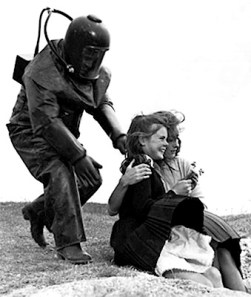 Not necessarily a bad thing, but it has that kind of disconnect from reality that’s markedly ’60s. In
 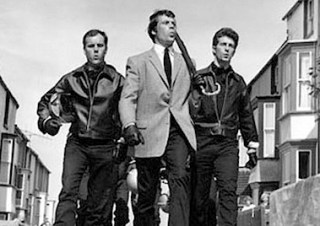 and the kind of inhumanity that might be reached in the quest to survive nuclear war.
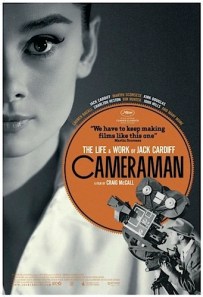 Documentary telling the story of the career of cinematographer and director Jack Cardiff.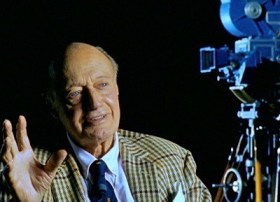
 “Sherlock Holmes vs. Jack the Ripper” would be the easiest way to describe this pulpy ’60s effort. It’s far from the only example of this sub-sub-genre:
  and though by the end it’s explained who sent it, I was none the wiser what they’d been intending. And I watched the revelation scene twice too. Still, at least the important bit — who the murderer is ‘n’ all that — is quite neat.
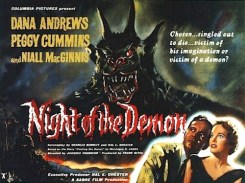 Adapted from an M.R. James story, Night of the Demon sees Dana Andrews as Dr. John Holden, a psychologist arriving in Britain to discredit satanic cult leader Julian Karswell. To cut to the chase, Holden begins to wonder if Karswell has placed a curse on him, and perhaps what he had set out to disprove isn’t such mumbo jumbo after all…
 Tourneur’s film is beloved by some, but I don’t think I quite got it myself. There are some great sequences, but I didn’t always find it hung together in between. Ironically, while many have criticised the actual appearance of the titular beast at the end, I think it works rather well — it’s surprisingly well realised, and you can take it as either a real manifestation or part of one character’s deranged imaginings. It’s an effective climax.
 100Films.co.uk