
Neil Jordan | 119 mins | Blu-ray | 2.35:1 | UK, USA & Ireland / English | 15 / R
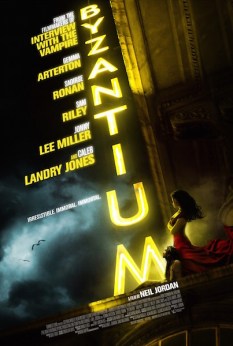 18 years after he adapted Anne Rice’s seminal vampire novel Interview with the Vampire into a seminal vampire film, director Neil Jordan helmed another tale of two inextricably-linked immortal bloodsuckers. However, while the older film was a lavish, luscious, romantic fantasy, Byzantium is an altogether seedier, baser view of eternal life.
The narrative unfurls in two timelines: the present day, where vampire mother Clara (Gemma Arterton) and daughter Eleanor (Saoirse Ronan) find themselves in a washed-up seaside resort while on the run from who-knows-what (well, Clara knows; Eleanor doesn’t); and 200 years ago, when a young Clara found herself entangled with a pair of military officers (Jonny Lee Miller and Sam Riley) that led to… well, you can guess what. Between them the two strands hint at a rich mythology; one we seem to be witnessing a side story of, rather than the usual epic world-altering confrontation of most fantasy cinema. Screenwriter Moira Buffini (adapting from her own play, A Vampire Story) retains enough familiar vampiric tropes to be recognisable to aficionados, but also offers unique twists and tweaks to keep us engaged.
Although the past storyline has its pros, and merges with the present day in time for the climax, the less mythologically-minded viewer will see the meat of the film as being Eleanor’s story. The forever-16-year-old is becoming disillusioned with her secretive existence, longing to share her truth with someone. When she twice bumps into genuine-16-year-old leukaemia survivor Frank (Caleb Landry Jones), it’s easy to see where the broad strokes of their encounter will lead. A back-cover pull-quote describes Byzantium as “the best vampire film since Let the Right One In” — their relative qualities are a separate point, but this adolescent ‘love(?)’ story is an obvious point of comparison nonetheless.
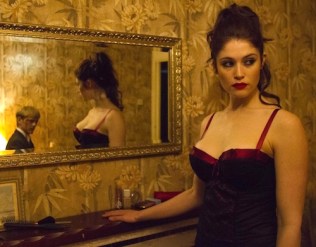 The most effective part of the movie isn’t so much its plot or its mythology, though, but its atmosphere. Vampire movies take place in castles or drawing rooms, or high schools in more modern iterations. They are grand and sensuous. Any glamour in Byzantium is discarded and decrepit, like the titular hotel that Clara reshapes as a whorehouse; faded and left to ruin. The seafront is characterised by graffitied concrete, the glaring lights of arcade machines, heroin-chic Eastern European prozzies. The pier appears to have burnt down at some unspecified previous time and just been left. The only people left behind are the ones without a means of escape, stuck with their miserable lot. Clara and Eleanor fit in almost seamlessly.
Some have picked up on an apparent lack of change or development in the lead characters’ personalities over 200 years, calling it out as a plot hole. Is it? Or is it part of the point? These two haven’t become wiser and more experienced over their long lives, but instead have become stuck in a rut, repeating the same lies and performing the only roles they know. That’s why Clara still works as a whore; why Eleanor still struggles with the guilt from her religious upbringing; why they stick together as protective mother and innocent daughter. It’s just as true of the other immortals we ultimately meet, an organisation stuck in outmoded patriarchal beliefs, who have held a grudge for two centuries. Here, the immortality of vampirism seems to mean not only staying physically the same, but mentally so as well.
 Other alleged faults include the film not giving enough time or heft to facets individual viewers want it to cover. For one example, someone criticised it for not fully exploring the issue of voluntary euthanasia. I’d argue it doesn’t explore it at all, because it’s not trying to. That Eleanor chooses to only kill people she perceives as wanting to die is not her making a moral statement on a contentious issue, but finding a way to marry her conscience and upbringing with the necessities of her vampiric life; and it’s probably practical, too. That’s not to say a vampire movie can’t be used to explore a topic like voluntary euthanasia, but if you want that I’m afraid you might have to write your own.
I don’t wish to imply that Byzantium is faultless in its execution of every point it raises, however, as some do fall by the wayside. Not least of these is Frank’s leukaemia, which has its useful points (bloooood), and I suppose it’s a good thing we’re spared the “wants to become a vampire to survive fatal illness” trope (because his cancer is in remission), but it also feels like it’s there for that trope, and by dodging it the film has nowhere else to go with his illness. A similar fate befalls the character of Frank’s mother, probably by association. What does she think of her sickly son disappearing off with some girl he just met, possibly forever? We’ll never know…
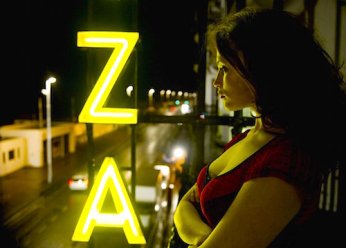 Technically, DoP Sean Bobbitt grants us some gorgeous cinematography. There’s a cruel, aptly soulless beauty to the faded town, while some countryside vistas, both past and present, offer more traditional scenic pleasure. A remote rocky, misty isle — central to the mythology and so repeatedly visited — is particularly notable. Captured entirely on digital cameras, it seems sometimes that Bobbitt tried to push his equipment too hard: some shots during the climax look flat-out weird, as if someone has applied a Photoshop “comic book” filter or something. Also of note is the score by Javier Navarrete, which makes particularly good repeated use of The Coventry Carol.
Byzantium is a particular kind of experience. It’s the kind of film that hints at an epic mythology but doesn’t explore it, which some will be glad of and others regret; personally, I feel both at once — there’s a grander story left here, but I’m not sure I want it told. The narrative the film does contain is grounded in a melancholic reality; one that finds a kind of splendour in forgotten things and places; that almost elevates the shabbiness of a half-abandoned community to desirability, while acknowledging that it’s nothing of the sort. It takes vampirism and its associated immortality as something tempting but terrible and fantastical but tangible, and finds reflections of that in real-life experiences and locations.  For all its dual-period storytelling and its grubby settings, it’s a resolutely modern kind of take on vampire mythology.
There’s little doubt that the film’s brand of melancholic beauty is not to all tastes — an array of poor and middling reviews are easy to find — but it has qualities that must be recommended, and the potential to be darkly loved.

The UK TV premiere of Byzantium is on Film4 at 9pm tonight.
It placed 5th on my list of The Ten Best Films I Saw For the First Time in 2015, which can be read in full here.
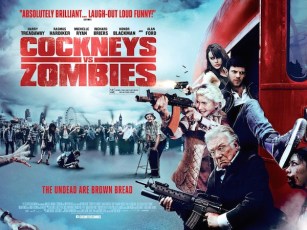 Screenwriter James Moran doesn’t like it when people compare Cockneys vs Zombies to
  And why is their imagination so stunted that they can’t accept them anyway?
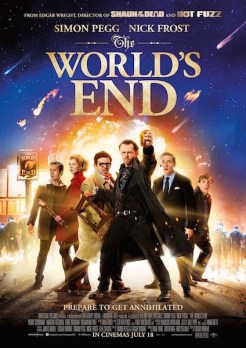
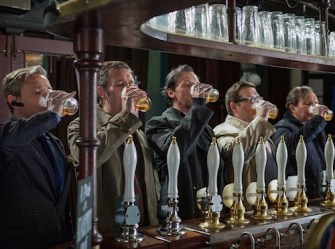 “zombie movie” or “Hollywood action movie”, and occasionally co-writers Pegg and Wright have substituted character development and thematic points for send-up. It may not play to the genre-loving fan-audience that the trio’s previous work has accumulated (demonstrably so, based on many a viewer review), but it does make for a more grown-up film.
 It will definitely reward multiple viewings: it’s littered with signs, omens and portents (in fairness, a good few can be grasped on an attentive first go). There’s a featurette on the BD (but not the DVD) which helps point out any major ones you may’ve missed; though I have to say, even at seven minutes long, and even with it pointing out some that felt too obvious to be worth mentioning, I swear it left some stuff out. That could be a deliberate decision of course, to leave some things for people to just spot.
 Tom Hanks is Walt Disney and Emma Thompson is author P.L. Travers in “The Making of Mary Poppins: The Movie”. Disney has been desperate to turn Travers’ fictional nanny into a movie for years after he made a promise to his daughter; Travers has resisted, but now needs the money. She’s brought to LA to consult on the script, and proceeds to make life miserable for screenwriter Don DaGradi (Bradley Whitford) and songsmiths Robert and Richard Sherman (B.J. Novak and Jason Schwartzman). At the same time, we see the story of a family in Australia from the eyes of a little girl Ginty (Annie Rose Buckley), as they struggle with the whims of her father (Colin Farrell), a bank manager who’s a little too fond of the bottle. Guess what the connection is!
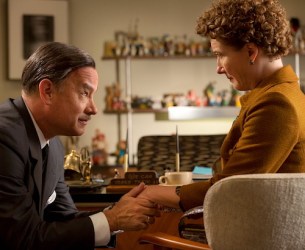 Similarly, Hanks’ part seems to be little more than a cameo at first, but he steadily appears often enough to make it a supporting role. Reportedly he has perfectly captured many of Disney’s real traits and idiosyncrasies, and who are we to doubt the word of people who knew the man? His performance is not just a shallow, simple impersonation, but there’s not that much meat to Disney’s character arc either.
 Some will find the story lacking in dirt, particularly when it comes to the portrayal of Disney. But it’s not whitewashed either, and do you really think the Disney Corporation would have allowed a movie to go ahead that depicts their founding father in a negative light? For that, I don’t think it’s as twee as it could have been — there’s definite conflict over what’s being done with Poppins, and, even with the film having turned out to be a solid-gold classic, we often find ourselves sympathising with Travers.
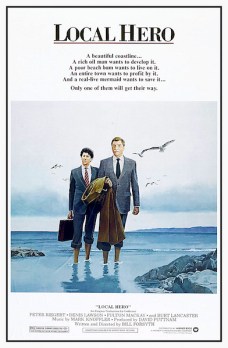 Gentle comedy in which Peter Riegert’s middle-management American oil exec has to persuade the residents of a Scottish village to sell up, unaware that they’re only too keen — for the right price. One of Quentin Tarantino’s Coolest Movies of All Time (
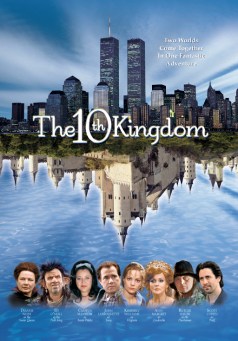 Created by British screenwriter Simon Moore (writer of
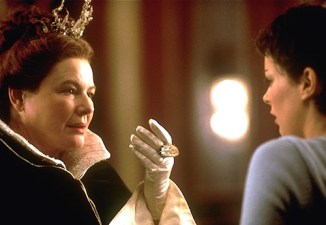
 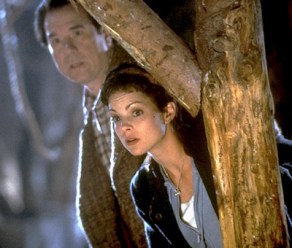 Anyway, the Nine Kingdoms is the place all our fairytales come from — the part of the narrative set there takes place “almost 200 years” after the “Golden Age”, when the events we know from stories actually happened. We’re led into this world by Virginia (Kimberly Williams) and her dad, Tony (John Larroquette), after indolent monarch-to-be Prince Wendell (Daniel Lapaine) flees to our world while escaping the Evil Queen (Dianne Wiest) and winds up taking the two New Yorkers back to his world. Along with Wolf (Scott Cohen), a chap with animalistic tendencies, the quartet try to stop the Evil Queen’s evil machinations.
 It also means the way it’s been edited into one long movie on DVD feels quite natural: it’s one long story with arbitrary breaks, not a series of finite episodes. (If you’re thinking, “of course it’s one story, it’s a miniseries”, plenty of single-narrative series and miniseries still function as discrete episodes that build to a whole.)
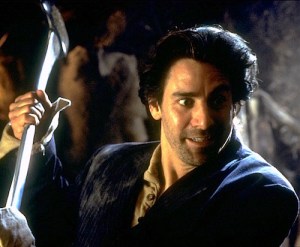 This gives the whole thing a heightened comedy tone, emphasised by many of the performances. A gaggle of troll siblings are irritatingly over-played, but Cohen’s meat-obsessed Wolf is a hammy delight (pun very much intended). The entertainment value means we quickly warm to the characters, so that when more perilous aspects of their quest do come into play later on, we care what happens. Plus, like most of the original fairytales (as opposed to Disney-style sanitised re-tellings), there’s the odd darker undercurrent. For instance, you may think the story of Snow White ends with a kiss and “happily ever after”, but here we’re told how the stepmother who poisoned Snow White was made to wear fire-heated iron shoes and ‘dance’ at the wedding until her feet were burnt raw, before being thrown out into the snow. Very dark and grim (and possibly from the original tale, for all I know).
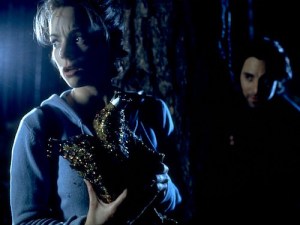 Little details in this vein abound: an apple tree has grown by Snow White’s cottage (don’t eat those apples!); the site of her glass coffin is now a tourist attraction; if you break a mirror, you genuinely get seven years’ bad luck… There’s also a pair of golden shoes that can turn you invisible, but the more you wear them the more you desire to use them all the time — what a precious idea (wink wink nudge nudge). These subversions also manifest in a strain of pleasant practicality; for instance, the abundant magic mirrors aren’t “just there”, but instead have been manufactured by dwarves. It lends the feel of a fully-conceived and rule-bound world, rather than an “anything can happen”, “just because” environment.
 a world away from being locked in a castle until you change your mind. If this sounds like criticism, it isn’t. I’m not arguing the love story element of the series is unsuccessful — I’m sure it engages plenty of fans as the series’ primary attraction, even — but, on reflection, I’m not sure reading it as a Beauty and the Beast variation is actually that illuminating.
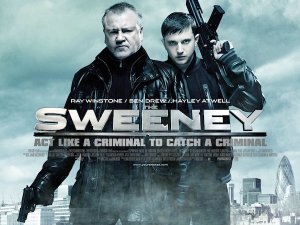 Despite a mediocre pedigree and TV-scale budget, this re-imagining of the iconic ’70s cop show is a solid thriller.
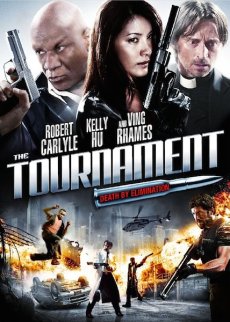 The Tournament is the kind of film where its relative quality is entirely dependent on what you want from a movie. Is it original? Not terribly. Is it clever? Not really. Is it action-packed and kinda fun? Yessir. If you just want to shift your brain into neutral and watch people punch, kick, shoot, stab, chase, and generally fight each other in a slickly-produced fashion, with a solid enough plot that (depending how brain-neutral you’ve gone) might offer an occasional twist… well, you’ve come to the right place.
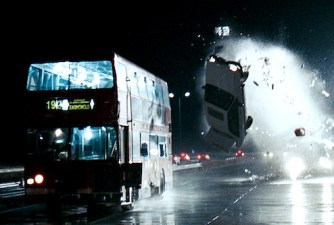 The action is the draw, of course, and fortunately the film delivers in spades. The best stuff involves Sebastien Foucan, who you may remember as Bond’s bomb-maker target in
 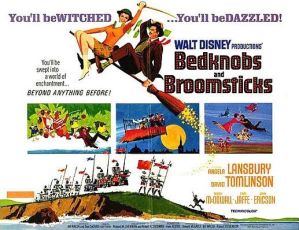 Disney attempted to replicate the success of
 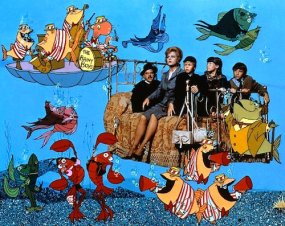 and one that’s mostly animated with our live-action heroes integrated; plus a climax where the good guys defeat one of the world’s great evils, with Poppins’ bankers here switched for the almost-as-bad Nazis. The magical special effects in that final sequence won an Oscar — and well deserved it was too. They look great, definitely holding up today, and it’s actually hard to be sure how they were all achieved.
 Arguably the most famous clash of the First World War, the Battle of the Somme lasted four-and-a-half months from July to November 1916 and, with over a million men wounded or killed, is “
 The British press certainly believed they were seeing “the real thing at last” (the Manchester Guardian), feeling it showed “war, grim, red war; the real thing” (the Daily Sketch). The British public agreed, flocking to see the movie en masse: twenty million admissions were sold in the first six weeks of release. At the time, the battle still raged (the film debuted on 10th August 1916) — as Smithers notes, “to its original audience, the film was not history but a despatch from the front”. It is such an historical document now, but at the time it wasn’t even recent-history — it was produced as newsreel, a record of current events, designed to make people at home feel connected to the everyday lives of their family, friends and countrymen serving on the frontline.
 Equally striking is the scale of the operation. You know it was a monumental effort, but actually seeing so many men… You never see that scope in dramas because they don’t have the budget for all those extras, I guess, but here the crowds of soldiers just waiting around are remarkably large. And crikey, the heavy artillery! Even though you know these were real weapons, today they look more like some fantastical steampunk creation, so covered are they in rivets, and so damn huge.
 Speaking of the music, the Imperial War Museum DVD release offers up a choice of two scores: a newly-commissioned (in 2008) one by film composer Laura Rossi, and a recreation of the kind of music that would have accompanied the film in 1916. The film’s producer and distributor, William F. Jury, was also the editor of trade paper The Bioscope, and had columnist J Morton Hutcheson draw up a list of suitable pieces to be performed alongside screenings, which was published days before the film’s release. To quote Dr Toby Haggith (the Imperial War Museum’s film programmer), again in the DVD booklet
 Haggith summarises many of Hutcheson’s choices as “motivated wholly by the needs of propaganda… jaunty, martial and unashamedly heroic. Given the nature of the scenes recorded and the bloody history of this phase of the battle, the selection of such upbeat music seems deeply inappropriate.” However, other selections “reflect Hutcheson’s personal response to scenes that he found distressing on a universal level, and which led him to warn musicians that ‘they must realise the seriousness and awfulness of the scenes’… These contradictions suggest that Hutcheson had difficulty selecting music for the film because he was torn by the contrasting images and messages it conveyed. In this way the medley highlights the tension at the heart of the film.” Musician Stephen Horne, who leads the 1916 medley recreation, agrees that the film is torn “between a sense of propagandist duty and a desire to honour the reality that had not evaded the camera’s gaze.” It’s true that, however positive the final movie wants to be, it can’t completely escape reality. At one point it cuts abruptly from a jauntily-scored scene of men happily receiving post to “German dead on the field of battle”. A deliberate juxtaposition of happiness with the fate that awaits them with near inevitability? Seems a bit radical for a propaganda piece…
 But it can’t avoid drawing parallels: the film ends almost as it began, with artillery being moved up for the next assault and men marching to the front, waving merrily as they go. History repeats — probably not the lesson a propaganda film wants to impart, but one it can’t quite escape. And one that, even a hundred years later, we can’t quite learn.
 100Films.co.uk