
Ernst Lubitsch | 104 mins | DVD | PG
 Sumurun seems completely different to any film yet seen in the Berlin box set, yet this is more in line with the style of film that would ultimately lead Lubitsch to Hollywood.
As the alternate title would suggest, this is primarily an Arabian Nights-style drama… but, while on the surface this looks entirely at odds with Lubitsch’s previous comedy work, it actually concerns itself with the same topic: romance, and the various entanglements and complications that lead to it. What’s different here is that instead of being wholly comic it’s often deadly serious (literally, as it turns out), and instead of one simple girl-meets-boy trajectory (as in the preceding three films) there’s two girls and four boys between them, in various combinations. It’s a many-stranded, relatively complex narrative: there’s a group of travelling minstrels, an old sheikh, a young sheikh, a cloth merchant, a bevy of harem girls — all of whom are connected and interact in varying ways with varying objectives, though most are related to love — or lust.
The change in style is no bad thing. Lubitsch was clearly versatile, turning his hand well to this type of storytelling. His comedies are all based around romance, one way or another, and so treating the subject with a little more seriousness seems no great leap. He keeps control of the plot, despite the numerous strands and complexities, and his comedy background allows the tropes of farce to be employed in furthering the story. His previous use of fantastical realms, like the dolls’ world of Die Puppe, aids a succinct establishment of Lubitsch’s version of Arabia and its specific rules. Indeed, with its fantastical setting and shortage of character names (only Sumurun, Nur al Din and his two slaves — Muffti and Puffti — are known by more than their title, job description or physical impairment), Sumurun may be as much of a parable as some of the comedies.
And still, comedy creeps in round the edges. Lubitsch is arguably showing restraint by not letting every sequence descend into it, but there is a fair amount of wit and humour lurking throughout. It’s mostly applied wisely though, furthering character, story or both: the ugly hunchback who smiles at a child only to make him cry; the harem girls giving their eunuch guardians the runaround (multiple times); the two wannabe-thieves accidentally stealing a pretend-dead body and desperately trying to hide or dispose of it — the last a subplot which ultimately plays a key part in the climax.
What’s a little unclear is why it should be called Sumurun. Perhaps it’s no more than a vestige from the source, because while the titular harem girl is quite significant, she’s no more so than several other characters. Pola Negri’s namless dancer in particular seems more central to the narrative — indeed, she connects most of the disparate groups and plot strands; certainly more of them (and more significantly) than anyone else. But then, Sumurun survives to the end, and — along with her man, Nur al Din the cloth merchant — is the purest, most righteous, most deserving of all the main characters. Conversely, all the ‘bad’ (and, as noted, nameless) characters meet their end: the sheikhs are both fickle, and the old sheikh clearly a nasty piece of work; the dancer is flirty and adulterous; the hunchback, however, is devoted to her, and his tragedy effectively balances the “and they all lived happily ever after” of the freed harem girls and Sumurun and Nur al Din finally getting each other. If this is a parable, there’s quite a clear message about fidelity.
Sumurun may lack the straightforward fun of Lubitsch’s comedies, but by creating a complex and engrossing Arabian epic he entertainingly demonstrates that there was more to him than just the talented comedian.

Read more reviews from Lubitsch in Berlin here.
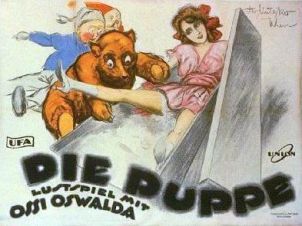 From the very start, Die Puppe sets out its stall (literally) as being something a bit special. The first sequence sees director Ernst Lubitsch himself unpack and assemble a doll’s house set and two dolls, which then become life-size and the dolls — now humans — the first characters we meet. It’s a neat framing device, a joke in itself, and some kind of early commentary on the role of a director.
 As we head in to this year’s awards season, I’ve finally got round to seeing last year’s big winner. It’s the Little British Film That Could, and I do feel like I’m the last person in the country to see it.
 When I saw No Country for Old Men, a new round of films were vying for the Best Picture Oscar. Now, as I finally post my review, a whole new load have been nominated, voted on, and await the final result. Sometimes I feel decidedly behind the times.
 I used to consider myself a fan of Paul Thomas Anderson; however, I’ve come to the conclusion that I’m merely a fan of the film
  Having only recently subjected myself to the full horror of
  “The paths of glory lead but to the grave,” wrote Thomas Gray, and Stanley Kubrick — adapting from the novel by Humphrey Cobb — sets about proving him right.
 It doesn’t seem like 18 months since the RSC brought Hamlet to the stage with British TV’s biggest star actor (probably) as the titular Dane, but it is (more or less). Thanks to sold-out performances and largely positive reviews (theatre critics seem even less keen to agree on anything than film ones), we’re now treated to this film adaptation, shown on BBC Two on Boxing Day and released on DVD (but not Blu-ray, boo
 In honour of Jumper’s central conceit — that certain people can instantaneously transport themselves to any other point on the planet — I will conduct this review by jumping about through paragraphs I wrote without bothering to link them properly. (Also done in honour of my laziness.)
 Murder on the Orient Express is arguably Agatha Christie’s most famous novel, perhaps because of its widely-known twist ending, or perhaps because it’s inspired in part by a high-profile true story, or perhaps because of this multi-Oscar-nominated all-star adaptation.
 100Films.co.uk