
Andrew Adamson | 150 mins | Blu-ray | PG / PG
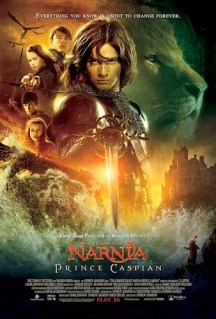 The Pevensie children return to Narnia, but hundreds of years later, in Disney’s last adaptation from C.S. Lewis’ series (don’t worry, Fox have taken it over). For those keeping track, this is both the second book and second film, but fourth chronicle chronologically. Which is fine for now, but I wonder what they’ll do come those earlier-set ones…
This time out, the world of Narnia has a harder edge. We’re still in PG territory — just — but everything’s turned a bit nasty, with a race of humans having wiped out the fantastical Narnians. Or (naturally) so they thought. Throw in some moderate political intrigue and you’ve got a more grown-up feel, if only slightly. It also makes for a slightly more cohesive tale — there are no odd elements leaking through from our world, like lampposts or Father Christmas, though one can well argue this removes something of Narnia’s unique magic.
It’s perhaps overlong, with numerous places trims could be made without denting the overall story. A half hour could surely have been saved without too much exertion. The first hour in particular is a tad slow, though the sometimes-wordy plot, based around some light court intrigue, adds depth beyond what might otherwise be a series of humans-on-magical-creatures punch-ups. I can’t comment on faithfulness here because it’s an awfully long time since I read the books. Besides, that running time is distorted by a whopping 12 minutes of end credits. I vaguely recall that, a few years ago, the second Matrix film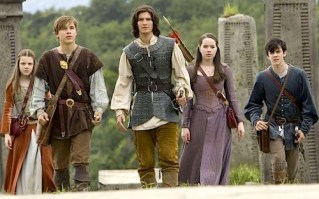 held the record for the longest closing credits at 10 minutes. I don’t really know what’s common these days but 12 minutes is nonetheless 8% of the film.
Once the human squabbling is passed — or by-passed, depending on your point of view — the human-Narnian war/one big battle really kicks off. Indeed, action sequences are frequent and fantastic throughout. The raid on the castle is tense, exciting and ultimately devastating — the troops left behind to certain slaughter is an incredibly dark moment in a PG-rated kids’ film. Later, a climactic sword fight is well staged, making excellent use of point-of-view shots, something I don’t recall seeing in a sword fight before.
The epic final battle comes as close to rivalling Helm’s Deep as anything I can think of, albeit — in typical Narnia style — in broad daylight on a big field. It has a real story to it, with specific moves being made by each side in the name of an overall strategy, rather than just A Lot Of Good Guys charging at A Lot Of Bad Guys and hacking away ’til one side wins, the apparent battle tactic in most other such large encounters on film.

The child actors aren’t going to set the world alight but are perfectly decent. I’m still not fully sold on Liam Neeson as Aslan, though I suppose the contrast of boom and gentility may be the point. Eddie Izzard is sadly underused as the excellent Reepicheep, who comes across as Narnia’s answer to Shrek 2’s Puss in Boots. Everyone else is fine — if nothing stands out, there is at least humour and an appropriate level of villainy provided.
Perhaps shortages such as this make the film a rather empty experience, as some have claimed. Not even titular new boy Caspian is treated to a huge amount of characterisation, and what little there is elsewhere depends wholly on knowledge of the first film. In fact, while the primary story largely stands alone, a proper understanding of it relies on the viewer remembering the previous instalment — at no point does anyone bother to explicitly explain that these kids we’ve just followed into Narnia are siblings, never mind that they were there before for decades as Kings and Queens. Maybe this is respecting your audience’s intelligence,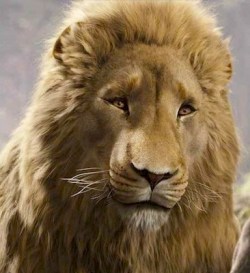 or maybe it’s just counting on their memory a bit too much. With only limited characterisation and basic political complications, Prince Caspian really boils down to a series of fights and battles. Nicely done fights and battles, I’d argue, but still, no one’s coming away from this particularly enriched.
I was quite disappointed with the first Narnia in the end. It was entertaining and at times fun, but the primary-coloured bloodless climax in particular made it feel like Lord of the Rings Lite. I know I’m not alone in this — with the teaser poster for the next film, The Voyage of the Dawn Treader, coming out last week, I noticed a number of sites commenting that they’d not bothered with the second film after disliking the first; box office numbers were down too (though it’s still the 108th highest grossing film ever). Loyalty to a series I enjoyed as a child ensures my return (albeit two years after the theatrical release) but it’s a shame others chose to pass it by, because Prince Caspian is a step-up from The Lion, the Witch and the Wardrobe in pure entertainment stakes. Hopefully this tone continues into Dawn Treader and, fingers crossed, the four chronicles beyond.

 Apparently, the recent Michael Caine-starring
 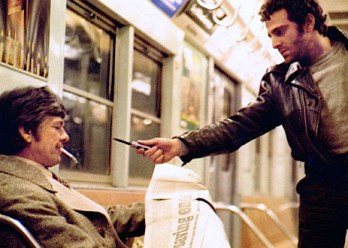 The strongest element is probably Wendell Mayes’ script, because it constructs all this. Weakest is Michael Winner’s direction — some of it’s fine, the occasional shot even good, but largely it’s pedestrian and sometimes mediocre. That said, Winner has become such an unlikeable public figure that it’s somewhat difficult to gauge how much of this is bad direction and how much bias. Still, it’s not the kind of work to make one think, “he’s an idiot, but he knows how to do his job”.
 Speed Racer feels like an unfair place to kick off
  Even some of the performances stand out, not something you’d expect from such a (for want of a better word) lightweight tale. Of particular note are Susan Sarandon as Mom and Christina Ricci’s Trixie, whose huge eyes help render her perhaps one of the most perfect live-action versions of an anime character ever seen. Yes, the characters mostly exist to service their place in the plot, but the odd scene or glance or line delivery adds some subtlety here and there.
 And, to specifically rubbish his opinions here, Phantom Menace is praised for being “made to be looked at more than listened to… filled with wonderful visuals” and condemns Speed Racer because “whatever information that passes from your retinas to your brain is conveyed through optical design and not so much through more traditional devices such as dialogue, narrative, performance or characterization… you could look at it with the sound off and it wouldn’t matter.” Not that Film’s unique factor (over novels or radio or what have you) is its visual sense, and a silent film that can be told through image alone, devoid of any intertitles, was once a lofty aim. I’m sure Ebert could readily explain why Phantom Menace’s visual splendour is a good thing and why Speed Racer’s is so terrible, but, on the other hand… pot, meet kettle.
 Back to Speed Racer. In every respect it’s like a living cartoon, and it’s the Wachowskis’ commitment to this aesthetic in every single respect that makes it work where others have floundered. It’s not perfect, I suppose. It may run a little long at two-and-a-quarter hours; but then, it so rarely lets up that I didn’t mind a jot. And the kid is often annoying; but then, as annoying little kids in films go, I’ve seen worse. At times I even liked him.
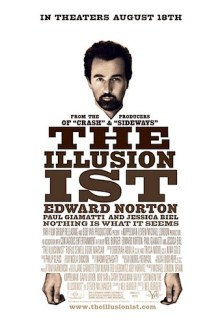 A Blu-ray release of The Illusionist has just
 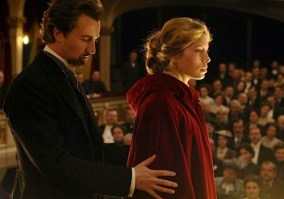 The story itself — you remember those? It’s the bit between the attention-grabbing opening and preposterous-twist finale — is mediocre with or without the finale. It’s a something-and-nothing account of a Poor Boy who loves a Rich Girl he can’t have and… oh, I can’t even be bothered to explain it.
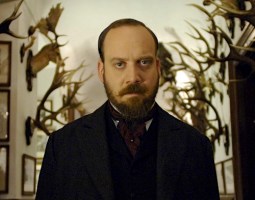 As comparisons with The Prestige are inevitable, particularly as both films were ultimately released around the same time, I’ll briefly put them head-to-head. Both concern stage magic in a similar-enough period setting, debate about whether the tricks are just that or actually supernatural powers, a love story that goes awry, which involves a fatal rivalry… But they’re actually very different films. The Prestige jumps about in time in a more complex way than The Illusionist, but this also has a point. The former’s story is more original, more engaging, its use of magic — real or not — more captivating. I fear I could go on, but it’s succinctly summed up thus: in this comparison, The Illusionist comes up short.
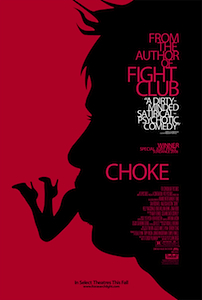 Choke is adapted from a novel by Chuck Palahniuk, the author of Fight Club, and you can tell.
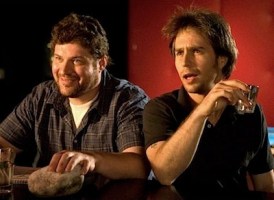 The cast are without fault. Sam Rockwell is brilliant as ever, continuing to build a body of work that suggests he’s been underrated. Perhaps there’s a similarity to some of his roles, but he has a sort of rough likability that can make one overlook that. I’ve still not seen
 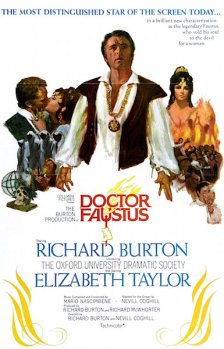 Despite the numerous film versions of the Faust story, this is the only one that adapts Christopher Marlowe’s A-level-favourite 1588 play. It’s a shame, then, that it’s heavily edited from the original text and, despite also being a filmed version of the Oxford University Dramatic Society’s 1966 stage production, has clearly been inappropriately chosen as a vehicle for then-couple Richard Burton and Elizabeth Taylor.
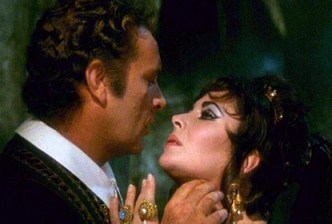 Elsewhere, Burton and Coghill’s vision of Faustus is stylistically reminiscent of a Gothic Hammer Horror, which is either wholly inappropriate or an ingenious genre mash-up — after all, such a genre-mashing trick has been pulled many a time with Shakespeare over the years. There are repulsively horrific corpses, a harem of naked ladies, an array of special effects, plus a medieval-styled gothic atmosphere to all the sets and costumes, though the scene where Faustus mucks about with the Pope feels more Carry On. Using inanimate objects in the roles of the Good and Evil Angels — respectively, a statue of Christ and a skull — is a small but inspired touch.
 perhaps just to heighten the presence of Helen by losing scenes she couldn’t have been shoehorned into; but in the process it both loses some of the best material and destroys any hope the film had of being a definitive filmed version of the play. Ultimately, such oversights proved to be the final straw for the film’s already-tenuous grip on a three-star rating.
 Million Dollar Baby currently places 143rd on the
 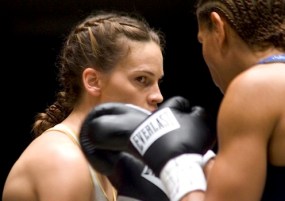 and it goes some way to make up for all the tedium that’s gone before. That it’s a grim and downbeat finale, however, serves an anti-boxing message I already get but does nothing to redeem the tale.
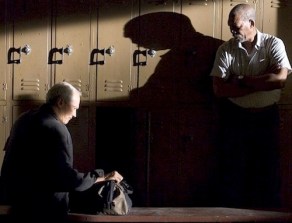 and Frankie’s lost his daughter, gets screwed over by his protégé, and ultimately loses Meg too. In no way is this a cheery depiction of boxing.
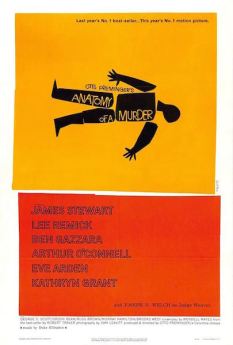 Anatomy of a Murder is a courtroom drama, adapted from a novel by a real-life defence attorney (“defense attorney”, I suppose), who in turn based his fiction on a real case. This background not only adds to the veracity of what we see, but likely explains the film’s style and structure.
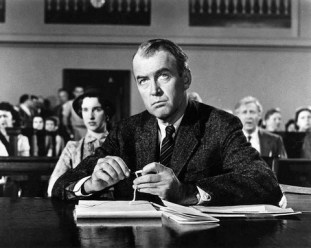 A lot of this support is down to Stewart’s performance — it feels wrong to be cheering the defence counsel of a murderer, even if he had a justifiable motive (which, remember, he may not have) — but we’d probably cheer Stewart on if he was the murderer. His Biegler is always in control, from investigation to courtroom, even when by rights he should be completely out of it. He manipulates the judge, the prosecution, the jury and the crowd to perfection; the viewer sits by his side — we know he’s playing them so we can revel in it — but, in turn, he manipulates us too, tempting us to his team — to laugh at his jokes, to support his case, to loathe the prosecution, even though they might be right. It’s a stellar lead performance.
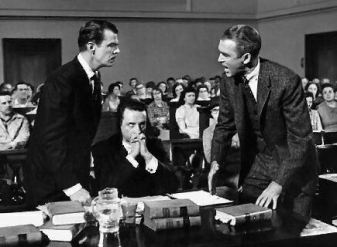 I could just as well go on to praise Ben Gazzara, Arthur O’Connell, Eve Arden, Brooks West, even the smaller roles occupied by Kathryn Grant, Orson Bean, Murray Hamilton and others. Some criticise Joseph N. Welch’s judge, and it’s perhaps true that his performance is a little less refined than the others, but as a slightly eccentric judge he comes off fine. And to round things off, there’s an incredibly cute dog. Mayes’ screenplay is a gift to them all, finding room for character even within the ceaselessly procedural structure, using small dashes of dialogue or passing moments to reveal and deepen each one.
 His Girl Friday is an acknowledged classic — 19th on the
  First, a little note on that aka: technically — and, I believe, legally — no such title is attached to this project. However, the initial idea was developed by Koontz and, after he left the project, adapted into his Dean Koontz’s Frankenstein series of novels. Despite the ‘creative disagreement’ (or whatever they chose to call it) that led him to walk away, the film retains significant similarities to the first book. More on these in a moment.
 100Films.co.uk