The Hobbit: The Battle of the Five Armies – Extended Edition (2014/2015)

2015 #180a
Peter Jackson | 164 mins | Blu-ray | 2.40:1 | USA & New Zealand / English | 15 / R

I just started shooting the movie with most of it not prepped at all. You’re going on to a set and you’re winging it. You’ve got these massively complicated scenes, no storyboards, and you’re making it up there and then on the spot […] I went to our producers and the studio and said […] ‘I don’t know what the hell I’m doing now.’

The Hobbit: The Battle of the Five Armies - Extended EditionSo says Peter Jackson in the special features accompanying this extended cut of his trilogy-closing saga-ending sixth Middle-earth movie, as widely reported on the set’s release back in November. Similar comments are echoed repeatedly throughout the special features, like how on Lord of the Rings they had racks and racks of metal orc helmets finished a whole year before they were needed for filming, whereas on The Hobbit they were delivering such props to set on the morning they were required for the shoot.

Another revelation: by making the late-in-the-day decision to split the intended two Hobbit movies into three, Jackson gained a whole year to prep and shoot the gigantic (sub)titular battle scene that forms the climax to his telling of Tolkien’s story. Various reasons have been suggested for Jackson and/or the producers’ trilogy-making decision, from genuine artistic intent, to poorly managed storytelling, to pure greed. In the wake of those special features, this new one — that everyone was making it up as they went along, too deep in to see the bigger picture, and desperate for a way to gain some time to get a handle on what they were doing — seems the most plausible of them all.

In the end, The Hobbit films are what they are. What, if anything, does extending the last one by 19½ minutes bring to the table? Well, as with The Desolation of Smaug, the third film counterintuitively doesn’t feel as overlong (note: as overlong) in the extended cut as it did in the theatrical, but I’d attribute that more to the re-watch factor than the extra scenes and moments making it magically quicker. The new material isn’t scattered about as freely as it is in the Lord of the Rings extensions, but instead is largely confined to three or four wholly-new scenes and some short additions throughout the battle, plus largely-immaterial alterations to the effects in existing footage. Anyone interested in a six-page account of every little change can find those details here.

War, huh, what is it good for? Chariots.Most obvious, and most discussed, is the dwarves’ war chariot action scene, whose bloody decapitations saw the film earn an R in the US and 15 over here. A seven-minute action sequence in the middle of the battle, it’s by far the largest single addition, and is mainly notable for all that blood and its use of the word “jambags”. Somewhat ironically, the sequence was a last-minute addition (the physical chariot was the last thing built for the films), which even as they’re shooting it Jackson acknowledges is an indulgence, and then of course it got bumped to the extended edition for being just that.

Elsewhere: the brief funeral scene at the end is good; more Billy Connolly is more Billy Connolly; an extended fight at Dol Guldur proves you didn’t need the Smaug confrontation to provide some up-front adrenaline; some extra comedy is uncomfortably, inappropriately silly; I don’t think there’s more of Ryan Gage’s over-featured Alfrid, thank goodness, other than that he’s treated to a death scene — hurrah! Fans who had hoped for more of Beorn fighting in the final battle get their wish… for all of ten seconds (literally). No wonder they weren’t best pleased.

In the comments on my review of the extended second film, I assessed that film’s new scenes between Gandalf and Thorin’s mentally-fractured father Thrain should pay off in the third film when Gandalf re-encountered a gold-mad Thorin. And… they don’t. At all. Gandalf the warriorNot a sausage, unless I missed something. It didn’t bother me too much because, quite frankly, I can’t quite remember what it was all about; but when I inevitably watch the extended trilogy back to back one day, it may do then. That said, I can’t imagine it’s a major fault, but again highlights the built-on-the-fly, ill-thought-through state of expanding The Hobbit 2 into The Hobbit 2 and 3.
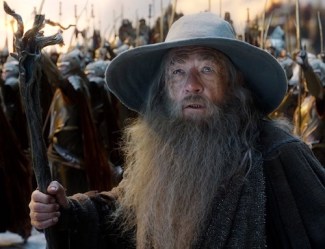
That The Battle of the Five Armies feels less overlong on a second viewing demonstrates how draggy films come about in the first place: sat in an edit suite for weeks or months, watching a film over and over (and over) again, the material must become so familiar that you lose any sense of perspective about its length or pace. Nonetheless, I still feel The Hobbit would’ve been best served in two films, or by allowing Parts 2 and 3 to run considerably shorter than your usual Middle-earth excursion. Fans have already cut together book-faithful edits of the entire trilogy, which I believe run something like four hours. Maybe that would’ve been best of all.

4 out of 5

In case you missed it, my review of the theatrical cut can be read here.
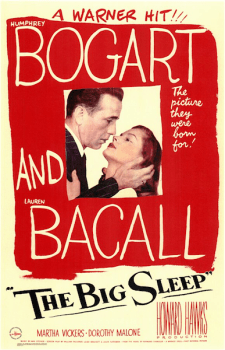
The Big Sleep (1946)

100 Films’ 100 Favourites #11

The Violence-Screen’s
All-Time Rocker-Shocker!

(Yes, that is a real tagline.)

Country: USA
Language: English
Runtime: 114 minutes
BBFC: A (pre-release, 1945) | A (1946) | PG (1988)

Original Release: 31st August 1946 (USA)
UK Release: June 1946 (BBFC)
First Seen: DVD (maybe), c.2004 (possibly)

Stars
Humphrey Bogart (Casablanca, The Treasure of the Sierra Madre)
Lauren Bacall (To Have and Have Not, North West Frontier)
Martha Vickers (The Falcon in Mexico, The Big Bluff)
Dorothy Malone (The Fast and the Furious (not that one), Basic Instinct (yes, that one))

Director
Howard Hawks (His Girl Friday, Gentlemen Prefer Blondes)

Screenwriters
Leigh Brackett (Rio Bravo, The Empire Strikes Back)
Jules Furthman (The Outlaw, Nightmare Alley)
William Faulkner (To Have and Have Not, Land of the Pharaohs)

Based on
The Big Sleep, a novel by Raymond Chandler.

The Story
Private detective Philip Marlowe is hired by General Sternwood to settle the gambling debts his daughter, Carmen, owes to a man named Geiger. Sternwood’s other daughter, Vivian, suspects Marlowe has actually been hired to find Sean Reagan, the General’s friend who has disappeared. Arriving at Geiger’s home, Marlowe hears a shot, and inside finds Geiger dead, Carmen drugged, and a hidden camera with the film gone. So begins a complex web of blackmail and murder. Very complex. Very, very complex.

Our Hero
The archetypal downtrodden PI, Philip Marlowe makes up what he lacks in good fortune with a fast mouth and sharp mind. Has bad manners though, which he grieves over on long winter evenings.

Our Villain
It’s a mystery, let’s not give it away. The film certainly does its best not to.

Best Supporting Character
Lauren Bacall as headstrong Vivian Sternwood, a character who benefitted from the behind-the-scenes situation at the time: Bogie and Bacall’s chemistry in To Have and Have Not led the studio to want more of the same, and her agent was only too keen after the poor reviews of Confidential Agent threatened to sink her career before it had really begun. New sparky dialogue scenes took the place of exposition ones in the final cut, essentially creating the film’s reputation for confusion.

Memorable Quote
“She tried to sit in my lap while I was standing up.” — Philip Marlowe

Memorable Scene
Bogie and Bacall discuss horse racing.
— “I like to see them work out a little first… You like to get out in front, open up a lead, take a little breather in the back stretch, and then come home free.”
Just horse racing.
— “I don’t know how far you can go.” “A lot depends on who’s in the saddle.”
Just horse racing.

Making of
Another part in the Bacall situation described above was supposedly played by original author Raymond Chandler. He reportedly observed that Martha Vickers was so good as Carmen that she overshadowed Bacall, and consequently much of Vickers’ material was removed.

Previously on…
The Big Sleep is the fourth screen adaptation of a Philip Marlowe story, though only the second to star the detective: 1942’s Time to Kill adapted The High Window into the Michael Shayne series, and the same year Farewell My Lovely was filmed as The Falcon Takes Over. The same novel was adapted again in 1944 as Murder, My Sweet (though, famously, retained the novel’s title for its UK release), starring Dick Powell as Marlowe.

Next time…
Bogart never played Marlowe again, but multiple film, TV and radio adaptations of Chandler’s novels have followed, with the lead role being occupied by the likes of James Garner, Elliott Gould, Robert Mitchum, Powers Boothe, Danny Glover, James Caan, and Toby Stephens. A remake of The Big Sleep, relocated to ’70s London and directed by Michael “calm down dear” Winner, was Marlowe’s final big screen outing to date.

Awards
Not a sausage.

What the Critics Said
“one of those pictures in which so many cryptic things occur amid so much involved and devious plotting that the mind becomes utterly confused. And, to make it more aggravating, the brilliant detective in the case is continuously making shrewd deductions which he stubbornly keeps to himself. What with two interlocking mysteries and a great many characters involved, the complex of blackmail and murder soon becomes a web of utter bafflement. Unfortunately, the cunning script-writers have done little to clear it at the end.” — Bosley Crowther, The New York Times

Score: 96%

What the Public Say
“you don’t watch The Big Sleep just to find out who did what to whom, when and for what reason. This is truly one of those movies where the journey is far more important than the destination. As we follow Marlowe around a moody and threatening Los Angeles, we go on a tour of the seedy underbelly of the city. Even though the time is spent in the company of high rollers and the glamorous set, it’s all merely a glittering veneer for a world of pornography, drugs, deviance, betrayal and violence.” — Colin, Riding the High Country

Verdict

Famed for having a plot so complicated even author Raymond Chandler doesn’t know who committed at least one of its murders, I’ve always found The Big Sleep very followable if you pay attention… just don’t expect me to be able to explain it after it’s finished. The film’s popularity in spite of its impenetrability confirmed director Howard Hawks’ theory that audiences didn’t care if a plot made sense as long as they had a good time, and he’s kinda right — the joys here are Bogie and Bacall’s verbal sparring, the exposure of LA’s seedy underbelly (albeit in a Production Code-friendly way), and the film’s whole noir-ish atmosphere.

The Big Sleep is finally released on US Blu-ray on Tuesday 23rd February.

#12 will be… a Marvellous vampire.

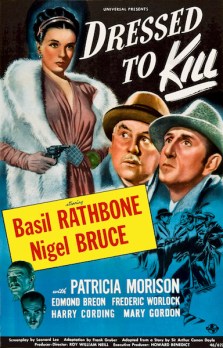
Dressed to Kill (1946)

aka Sherlock Holmes and the Secret Code / Prelude to Murder

2015 #200
Roy William Neill | 69 mins | DVD | 4:3 | USA / English | U

Dressed to KillIn the seven-and-a-bit years between 31st March 1939 and 7th June 1946, there were a total of 14 films released starring Basil Rathbone and Nigel Bruce as Sherlock Holmes and Dr Watson. By coincidence rather than design, I’ve spent nearly eight years viewing and reviewing them all for this blog — so yes, it’s taken me a little longer to watch them than it did to make them, which is ridiculous, but there you go.
This final film in the series sees Holmes in pursuit of a criminal gang who are on the trail of three music boxes, and are prepared to kill to acquire them. The boxes were all made by a prisoner and contain coded messages which, when combined and decoded, will reveal the location of stolen Bank of England printing plates — a literal licence to print money. Well, apart from the licence bit, because it would be illegal. But you get what I mean.

The Rathbone Holmes series was only sporadically adapted from the writings of Sir Arthur Conan Doyle, but this entry takes loose inspiration from several tales. The use of secret codes is reminiscent of The Dancing Men (previously the basis for The Secret Weapon), while the plot device of having to track down multiple identical items that hide something comes from The Six Napoleons (previously the basis for The Pearl of Death). I don’t know if that suggests there are only a few Doyle tales actually worth adapting, or if the makers of the series were running out of fresh ideas by this point.

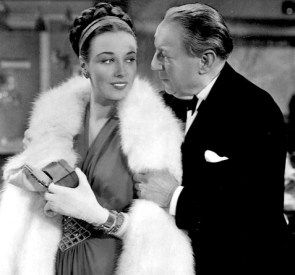
There are also elements of A Scandal in Bohemia, the story most famous for featuring Irene Adler, aka The Woman, but screenwriters Frank Gruber and Leonard Lee have an unusual method of including it: Dressed for the occasionthe story is explicitly referenced in the film, Watson having just had it published; then the film’s villainess turns up, played by Patricia Morison, functioning effectively as an Adler stand-in — and using some tricks she learnt from reading Watson’s story! The series hasn’t featured Adler before, so why not just name this character Irene Adler, have her devise those tricks from her own imagination, and be done with? Who knows.

Dressed to Kill is an ending to the Rathbone/Bruce films only in the sense that it’s the last one, this not being an era of “series finales” or what have you. It isn’t among the top tier of Holmes adventures starring the pair, but it’s still an entertaining mystery. In some respects that’s a good summation of the series, and why they’ve endured in popularity for over 75 years: even when not at their very best, they remain enjoyable.

3 out of 5

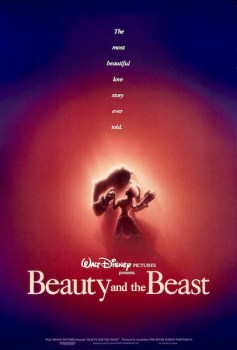
Beauty and the Beast (1991)

100 Films’ 100 Favourites #10

The most beautiful love story ever told.

Country: USA
Language: English
Runtime: 84 minutes | 92 minutes (special edition)
BBFC: U
MPAA: G

Original Release: 15th November 1991 (USA)
UK Release: 9th October 1992
First Seen: VHS, c.1993

Stars
Paige O’Hara (Beauty and the Beast: The Enchanted Christmas, Enchanted)
Robby Benson (Ice Castles, Dragonheart: A New Beginning)
Angela Lansbury (The Manchurian Candidate, Bedknobs and Broomsticks)

Directors
Gary Trousdale (The Hunchback of Notre Dame, Atlantis: The Lost Empire)
Kirk Wise (The Hunchback of Notre Dame, Atlantis: The Lost Empire)

Screenwriter
Linda Woolverton (Alice in Wonderland, Maleficent)

Story by
Deep breath… Roger Allers, Brenda Chapman, Burny Mattinson, Brian Pimental, Joe Ranft, Kelly Asbury, Christopher Sanders, Kevin Harkey, Bruce Woodside & Robert Lence.

Based on
La Belle et la Bête, a French fairy tale originally by Gabrielle-Suzanne Barbot de Villeneuve, but in this case (and most others) adapted from the retelling by Jeanne-Marie Leprince de Beaumont.

Music
Alan Menken (Aladdin, Hercules)

Lyrics
Howard Ashman (Little Shop of Horrors, Aladdin)

The Story
An arrogant prince is transformed into a beast, with one hope of redemption: someone must fall in love with him before his 21st birthday; if not, the curse’s effects become permanent. When elderly inventor Maurice is imprisoned by this Beast, his bookworm daughter Belle offers to take his place. Spying a chance to alleviate the curse, the Beast agrees. With only a short time until his 21st birthday, could a girl ever learn to love a beast?

Our Hero
A girl who’s strange but special — a most peculiar mademoiselle. With a dreamy far-off look, and her nose stuck in a book, she really is a funny girl, a beauty but a funny girl, that Belle.

Our Villain?
The Beast’s got fangs, razor sharp ones; massive paws, killer claws, for the feast. He was mean and he was coarse and unrefined, but now he’s dear and so unsure. Perhaps there’s something there that wasn’t there before…

Our Villain!
No one’s slick as Gaston, no one’s quick as Gaston, no one’s got a swell cleft in his chin like Gaston. Uses antlers in all of his decorating, my what a guy, that Gaston.

Best Supporting Character
The comedy double act of French candlestick Lumiere and English clock Cogsworth, voiced (respectively) by Law & Order’s Jerry Orbach and M*A*S*H’s David Ogden Stiers. Funny old business, acting.

Memorable Quote
“Try the grey stuff, it’s delicious / Don’t believe me? Ask the dishes / They can sing, they can dance / After all, miss, this is France / And a dinner here is never second best.” — Be Our Guest

Quote Most Likely To Be Used in Everyday Conversation
“It’s not right for a woman to read. Soon she starts getting ideas, and thinking…” — Gaston. (I didn’t say it should be used.)

Memorable Scene
The film’s prologue tells the story of how the Prince became the Beast through the medium of stained glass windows. It’s a beautifully realised fairy tale within a fairy tale.

Best Song
Titular Beauty and the Beast may’ve won the Oscar (“Tale as old as time, song as old as rhyme” — that one), but the actual best song is clearly Be Our Guest. A toe-tapping tune married with fun lyrics, fantastic choreography and superb animation combine to make it, for me, one of the greatest numbers in any musical, animated or otherwise.

Making of
Be Our Guest was originally to be sung to Belle’s father, Maurice, when he’s trapped in the castle. It was writer Bruce Woodside who pointed out that it was in the wrong place because such a key song shouldn’t be performed to a secondary character, so it was moved later to be sung to Belle. This is why you should always listen to writers.

Previously on…
Beauty and the Beast is Disney’s 30th Animated Classic, their official canon of animated movies. It’s the third film in the “Disney Renaissance”, the decade-long period (starting with The Little Mermaid and ending with Tarzan) when the studio enjoyed revived creative and financial success. In terms of this particular retelling of the tale, it owes a clear debt to Jean Cocteau’s La Belle et la Bête.

Next time…
Two direct-to-video animated sequels and a spin-off educational live-action TV series. In 1994, it was the first Disney animated film to become a Broadway musical. In 2002, it was extended with a new song, and in 2012 was re-released in 3D. An all-star live-action remake is out next year.

Awards
2 Oscars (Original Song (Beauty and the Beast), Original Score)
4 Oscar nominations (Picture, Sound, Original Song (both Belle and Be Our Guest))
2 BAFTA nominations (Original Score, Special Effects)
2 Saturn nominations (Fantasy Film, Music)
2 Annie Awards (Animated Feature, Individual Achievement in the Field of Animation)
Nominated for the Hugo for Best Dramatic Presentation.

What the Critics Said
“A lovely film that ranks with the best of Disney’s animated classics, Beauty and the Beast is a tale freshly retold. Darker-hued than the usual animated feature, with a predominant brownish-gray color scheme balanced by Belle’s blue dress and radiant features, Beauty engages the emotions with an unabashed sincerity.” — Variety

Score: 93%

What the Public Say
“The voice cast are perfectly suited to their roles and imbue them with dexterity and flair. Paige O’Hara splendidly combines strength and touching bravery as Belle. Her singing voice is a marvel as well, singing with clarity and loving kindness. Robby Benson’s deep but engaging voice is ideally suited to the Beast, and gives him depth and mournful sorrow that subsides into happiness as he develops feelings for Belle.” — vinnieh

Elsewhere on 100 Films
Back in 2010 I reviewed The Special Edition of Beauty and the Beast (to give its full on-screen title), describing it as “impossible to fault in any significant way. The design and animation are beautiful, the voice acting spot-on, the score exquisite, the story fast-paced and enthralling […] It’s hilariously funny, remarkably exciting, surprisingly scary, relentlessly romantic […] Every [song] bursts with memorable tunes, witty rhymes, genuine emotion — even the Soppy Girly Song is a good one!” Beat that, verdict section…

Verdict

Beauty and the Beast was, famously, the first (and, for a long time, only) animated movie to be nominated for Best Picture at the Oscars, and you could hardly think of a more deserving candidate. Every element of it displays artistry, from the the witty dialogue and lyrics, to the likeable and engaging characters, to the fluid and detailed animation, to the songs which help the film to run the gamut of emotions. In the field of Broadway-style Disney musicals, Beauty and the Beast is animation perfection.

#11 will be… a long nap.

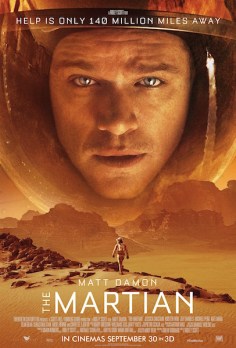
The Martian (2015)

2016 #25
Ridley Scott | 142 mins | Blu-ray | 2.40:1 | USA & UK / English | 12 / PG-13

Oscar statue2016 Academy Awards
7 nominations

Nominated: Best Picture, Best Actor (Matt Damon), Best Adapted Screenplay, Best Sound Mixing, Best Sound Editing, Best Visual Effects, Best Production Design.


Ridley Scott’s latest arrives on Blu-ray in the UK today, with a disappointing dearth of special features (disliked Exodus gets a 2½-hour making-of, four hours of additional features, plus a commentary; award-winning The Martian gets 24 minutes plus a few in-universe documentaries — what?!) Never mind that, though: how good is the film deemed the best comedy or musical of 2015? (If you somehow missed that news, you’ll appreciate the addition of a “seriously” here.)

In the relatively near future, mankind is on its third manned mission to Mars. When a colossal storm rolls in, the decision to made to evacuate the Mars base. During the escape, biologist Mark Watney (Matt Damon) is struck by debris and apparently killed, and his crew mates are forced to leave him for dead. He isn’t dead, though, but he is injured and alone on a planet 140 million miles from home, with no way to communicate with Earth, and not enough energy, oxygen, or food to see him through the four years until the next Mars mission is scheduled to arrive. Refusing to give in to inevitable death, Watney only has one choice: science the shit out of this.

That sounds like a laugh-a-minute premise, right? And there’s a major subplot about disco music, so it’s practically a musical too!

No, the HFPA are just idiots — The Martian is neither a comedy nor a musical. It is the latest in a growing subgenre of serious-minded near-future sci-fi adventures, though, following in the footsteps of 2013 Oscar winner Gravity and 2014 Oscar washout Interstellar. Where The Martian differs is in the element that tricked Golden Globes voters into thinking they could get away with giving it a comedy nomination (and win): rather than being stuffed to bursting with po-faced peril, it has a lightness of touch and regular doses of humour, making it probably the most feel-good serious sci-fi movie since ever.

Whether that’s appropriate or not is another matter. A well-argued review by the ghost of 82 assesses that the film has none of the darkness or loneliness you should expect of a man stranded alone on an alien world with a slim chance of survival or rescue. I don’t disagree that the film doesn’t contain much of that feeling, nor would I argue that such a tone isn’t a viable way to frame this narrative, but I don’t think that’s what Scott was aiming to convey. This telling of the story (I haven’t read the original novel, so can’t say how it compares tonally) is an adventure; a feel-good tale of hope and survival against the odds. The film doesn’t offer us despair because Watney doesn’t despair — he just gets on with trying to fix it. On the couple of occasions when his fixes go wrong, his chirpiness breaks down, his frustration comes out, and in some respects it’s all the more effective for being limited to those handful of occasions — we’re suddenly reminded that, in spite of his optimism and his success and all the fun we’re having watching it, he’s stranded 140 million miles away and even the slightest mistake can spell total disaster.
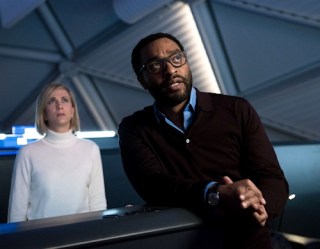
Matt Damon is a talented enough actor to lead us through all of this. Best remembered in recent years for serious fare like the Bourne films (“serious” in the sense of “not comedic” as opposed to “realistic”), Damon has done his fair share of comedies before now, and skits for TV shows and the like too. This is perhaps his first film to bring those two sides together as equally necessary parts of the whole — serious when he’s struggling with science problems or facing the reality of his situation, funny when he’s taking it all as light-heartedly as he can. Sometimes, such as in emotional conversations with friends or colleagues stuck millions of miles away, he even has to do both at once.

While Damon is stuck on Mars by himself, a starry supporting cast actually get to interact with each other. This is a quality ensemble and, short of writing an epic essay of a review where I just praise them all one by one, there’s little to do but list their names. That said, Jessica Chastain gets the most brazenly emotional beats as the commander who chose to leave Watney behind and has to face the consequences of her decision; Jeff Daniels treads a line between being an evil bureaucrat and just a regular bureaucrat (apparently consideration was given to turning him into a full-blown villain; thank goodness they swerved that bullet); Chiwetel Ejiofor brings easy gravitas to NASA’s director of Mars missions; Michael Peña provides some additional comic relief, if not as strikingly as he did in Ant-Man then at least as effectively; and Sean Bean doesn’t die. No offence to Sean Bean, but let’s be honest, at this point in his career that is the most notable facet of his appearance here. That and the Lord of the Rings reference.

It would be too damning to describe Ridley Scott’s direction as unremarkable, but at the same time it feels lacking in distinctiveness. Apparently there was some interview where he commented on how easy he found directing The Martian, I think with intended reference to the use of digital photography, but I think you get a sense of that from the film as a whole. That stops it from being over-directed, at least, and it’s certainly not poorly made, but if you didn’t know then you wouldn’t be nodding along going, “oh yes, this is definitely a Ridley Scott movie.” I’m not sure that’s a bad thing. Considering his fiddling is what scuppered the promising screenplays that initiated both Robin Hood and Prometheus, and his other works this decade (The Counsellor and Exodus: Gods and Kings) haven’t exactly met with great acclaim, maybe his dropping in almost as a director-for-hire (screenwriter Drew Goddard was attached to direct, but got sidetracked into the now-cancelled Sinister Six Amazing Spider-Man spin-off), and helming the film in a kind of directorial autopilot, is part of what saved it from a similar fate.

I’ve read at least one review that described The Martian as “an instant sci-fi classic”, and at least one other that described it as “no sci-fi classic”. I’m going to sit on the fence of that debate for the time being. What I will say is that it is undoubtedly an accomplished piece of entertainment. For a film that primarily concerns itself with a man applying scientific principles to tasks like “growing potatoes”, that’s surely some kind of achievement. In our current climate (both in society in general and in the “more explosions less talking, please” state of blockbuster cinema), to make space travel — and science in general — seem fun and appealing to the masses is no bad thing whatsoever.
5 out of 5

As mentioned, The Martian is released on DVD and Blu-ray in the UK today.

It placed 17th on my list of The 20 Best Films I Saw For the First Time in 2016, which can be read in full here.

Predestination (2014)

2016 #21
The Spierig Brothers | 98 mins | Blu-ray | 2.40:1 | Australia / English | 15 / R

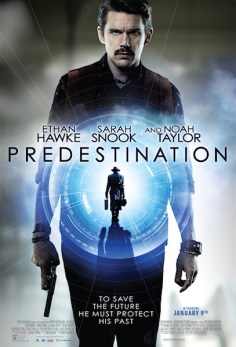
A man walks into a bar in ’70s New York. The bartender strikes up a conversation, which leads to a wager: if the man’s story is the most incredible the bartender has ever heard, he’ll give him a free bottle of whiskey. It had better be pretty good, because what we know that the man doesn’t is that the bartender, played by Ethan Hawke, is an agent for the Temporal Agency, travelling through time to stop crime before it happens; and he’s just had his face burnt off and completely rebuilt while failing to stop a notorious terrorist known as the Fizzle Bomber. Beat that.
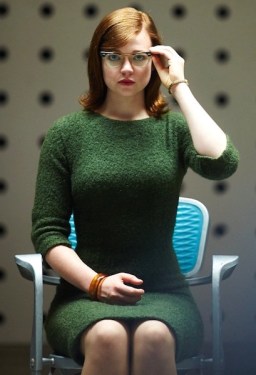
That said, the man’s story is pretty incredible too — but as the telling of it makes up over half the movie, and it’s full of its own twists, I shan’t get into spoiler territory. Predestination is a film that rewards knowing as little as possible, especially as the seasoned sci-fi viewer/reader has a fair chance of guessing a good number of its twists (possibly all of them) long before they’re revealed by the film. Fortunately that doesn’t really matter, because the tale remains an engaging and thought-provoking one, with many thematic points to consider, and not just of a science-fictional nature — there are human and historical issues in play here too, which is undoubtedly a rarity in modern screen SF.

We’re guided through this by a laid-back performance from Hawke, which turns intense when needed, but even more so by an affecting, transformative, award-winning turn from Australian actress Sarah Snook. She really should be much in demand after this. Chunks of the film are just a two-hander between Hawke and Snook, yet it effortlessly captivates throughout these stretches. That’s in part thanks to the fascinating nature of the narrative, adapted faithfully from Robert A. Heinlein’s short story All You Zombies (it has nothing to do with zombies — the story’s from the ’50s, before our modern conception of a zombie was formulated), as well as the direction of the Spierig brothers.

I don’t know how many people will remember, but the pair got a bit of attention back in the early ’00s with their debut feature Undead, because they not only wrote and directed it, but also edited it and created the CG effects at home on their laptops. That’s more commonplace nowadays (well, Gareth Edwards did it for Monsters, anyway), but was A Big Thing in certain circles back then. (I bought Undead on DVD at the time but have never got round to watching it. Plus ça change.) I thought they’d disappeared after that, but they were responsible for vampire thriller (and Channel 5 staple) Daybreakers in 2009. This is their third feature. Working from a low budget once again, they take us to alternate-history versions of the ’40s, ’50s, ’60s, ’70s and ’80s, from bars to orphanages to universities to training for the space programme to the headquarters of a time travelling police organisation and more. To my eyes, it never looked cheap. Sure, it’s not overloaded with CGI, but it doesn’t need to be. I never got the sense anyone was having to hold back because of the low budget. Others may disagree, because I have seen people express the opposite opinion, but I think they’re wrong, so there.

Predestination is the latest reminder that “sci-fi” is not a byword for “action-adventure”. It certainly won’t satisfy the needs of the action-hungry fan (it’s not devoid of the odd punch-up or explosion, but they’re far from the point). For anyone interested in something a bit more intellectual, a bit more thought-provoking, particularly if you like the (potential) complications of time travel, or issues of gender and identity, then Predestination has a lot to offer, even if you guess the twists.

5 out of 5

Predestination placed 5th on my list of The 20 Best Films I Saw For the First Time in 2016, which can be read in full here.

It is available on Sky Movies on demand and Now TV from today. It debuts on Sky Movies Premiere next Friday, February 12th, at 11:30am and 10:20pm.

Purists be aware: existing British releases completely muffed up the aspect ratio (reportedly it’s both open matte and cropped), so there’s every chance Sky’s copy will be similarly afflicted.

Batman Begins (2005)

100 Films’ 100 Favourites #8

Evil fears the knight.

Country: USA & UK
Language: English, Urdu & Mandarin
Runtime: 140 minutes
BBFC: 12A
MPAA: PG-13

Original Release: 10th June 2005 (Russia)
US Release: 15th June 2005
UK Release: 16th June 2005
First Seen: cinema, June 2005

Stars
Christian Bale (American Psycho, The Fighter)
Michael Caine (Alfie, Harry Brown)
Liam Neeson (Schindler’s List, Taken)
Katie Holmes (Go, Woman in Gold)
Gary Oldman (Léon, Tinker Tailor Soldier Spy)

Director
Christopher Nolan (Memento, Interstellar)

Screenwriters
David S. Goyer (Blade, Man of Steel)
Christopher Nolan (The Prestige, Inception)

Based on
Batman, a comic book superhero created by Bob Kane and Bill Finger. In part inspired by Batman: Year One by Frank Miller and David Mazzucchelli.

The Story
After Bruce Wayne’s philanthropic millionaire parents are murdered when he’s a kid, he dedicates his life to fighting crime, travelling the world to learn combat skills, then deciding the best way to scare the Mafia-esque scum of his home city is to dress as a bat. As you do.

Our Hero
Nana-nana-nana-nana nana-nana-nana-nana Batman! But, y’know, serious. Important crimefighting jobs include getting hold of cool gadgets your company developed, messing around in restaurant fountains with models, and perfecting a ludicrously gruff voice to use when in costume.

Our Villains
Batman really has his work cut out for him this time: there’s crime boss Carmine Falcone (Tom Wilkinson), mad scientist Dr Jonathan Crane, aka Scarecrow (Cillian Murphy), commander of a league of assassins Ra’s al Ghul (Ken Watanabe), his subordinate — and Bruce’s one-time mentor — Ducard (Liam Neeson). That’s not to mention the bloke doing something dodgy with his family company (Rutger Hauer).

Best Supporting Character
It’s a toss up between two British thesps: there’s Michael Caine as the most involved and caring version of the Waynes’ butler Alfred that we’ve yet seen, and the ever-excellent Gary Oldman as Gotham’s only honourable cop, Jim Gordon. Both are a world away from previous screen incarnations of their characters.

Memorable Quote
“Well, a guy who dresses up like a bat clearly has issues.” — Bruce Wayne

Memorable Scene
Trapped in Arkham Asylum, surrounded by police and with SWAT officers storming the building, Batman activates a device on his boot for “backup”. Moments later, hundreds of bats flood the building, allowing him to make a dramatic escape.

Technical Wizardry
Previously, the Batmobile was a sleek and desirable supercar-type vehicle. Taking inspiration from some of the comics, Begins reinvents the vehicle entirely, rendering it essentially a road-ready tank. A massive change in the very concept, but one that now seems only natural.

Letting the Side Down
Hardly a major point for the viewer, but the design of the Bat-costume meant the actor in it couldn’t turn his neck — a problem also in the previous post-’89 Bat-films. Christian Bale’s frustration with this led to it being redesigned for the sequels (and explicitly referenced on screen, too).

Making of
According to some trivia on IMDb, before shooting began Nolan treated the crew to a private screening of Blade Runner, after which he told them, “this is how we’re going to make Batman.” For more on how exactly Ridley Scott’s seminal sci-fi thriller influenced Begins, check out these interview excerpts.

Previously on…
Batman’s big-screen popularity was kicked off by Tim Burton’s 1989 Batman, but that goodwill was gradually squandered, ending with 1997’s Batman & Robin, which many regard as one of the worst films ever made. It killed a once-profitable franchise, therefore paving the way for an eventual reboot.

Next time…
The Bat-world shaped by Nolan and co reached its apotheosis in the first sequel, The Dark Knight. The trilogy-forming second sequel, The Dark Knight Rises, did that rarest of things: it gave a superhero a definitive, final ending.

Awards
1 Oscar nomination (Cinematography)
3 BAFTA nominations (Production Design, Sound, Visual Effects)
1 Razzie nomination (Worst Supporting Actress (Katie Holmes))
3 Saturn Awards (Fantasy Film, Actor (Christian Bale), Writing)
4 Saturn nominations (Supporting Actor (Liam Neeson), Supporting Actress (Katie Holmes), Director, Music, Costume, Special Effects)
Nominated for the Hugo for Best Dramatic Presentation, Long Form.

What the Critics Said
“If there is one Batman film anyone should see, this is it. It’s a superhero film with a dark tone that’s very well-written with nothing but incredible actors involved. In a world where most movies these days are usually either remakes or films that are made as quickly as possible to cash in on the latest trend in Hollywood, a reboot that is not only worthy of your time but tends to make you forget about every other version that came before it says quite a bit.” — Chris Sawin, examiner.com

Score: 85%

What the Public Say
“One of the best things about Nolan’s Batman is that he grasps the idea of the three personas of Bruce Wayne. There’s Bruce when he’s playing the billionaire playboy, Bruce when he’s alone in the cave or with Alfred, and Bruce when he’s wearing the cowl. This movie truly delved into this in a way that no Batman movie had before it and was performed flawlessly by Christian Bale — whether you like the voice or hate it, Bale did a great job at playing three distinct personas.” — Blue Fish Comics

Elsewhere on 100 Films
Just before the release of The Dark Knight Rises I went back over all the live-action Bat-films of the ‘modern era’, i.e. since Tim Burton’s Batman. Of Begins, I wrote that “Nolan’s first foray into Bat-world really is a stunning piece of work… The monumental achievement of The Dark Knight has come to overshadow Begins, which is now rendered as a functionary prequel to the next film’s majesty. Don’t let that reputation fool you: on its own merits, this is very much a film at the forefront of the action-adventure, blockbuster and superhero genres.”

Verdict

If there was one thing the Burton and Schumacher Batman films were collectively notorious for, it was focusing on their villains more than their hero (not least because they cast bigger name actors in the villain roles). Personally, I don’t think that’s wholly true, but there’s no doubting that Christopher Nolan’s much-needed reboot of the franchise focuses on Bruce Wayne, his reasoning and his psychology, more than ever before. In the process, Nolan and co made us believe a man might reasonably choose to fight crime and corruption by dressing up as a bat. No small feat, that.

For #9 Burton’s Bat’s back.

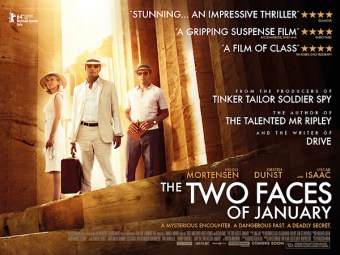
The Two Faces of January (2014)

2016 #15
Hossein Amini | 97 mins | streaming (HD) | 2.35:1 | UK, France & USA / English, Greek & Turkish | 12 / PG-13

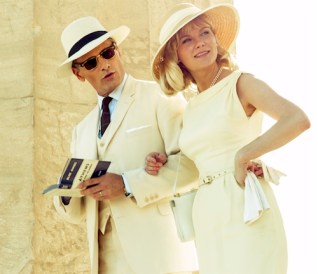
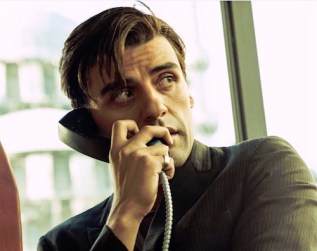
The writer of Drive (and co-writer of Snow White and the Huntsman and 47 Ronin, but maybe he’d prefer we didn’t mention those) moves into the director’s chair with this Patricia Highsmith adaptation. Best know for her Ripley (as in Talented Mr.) tales, this is instead the story of a young American man, Rydal (Oscar Isaac), who, while working as a tour guide in Greece, falls in with middle-aged American couple Chester (Viggo Mortensen) and Colette (Kirsten Dunst). Apparently on holiday, they look like an easy mark for Rydal’s somewhat-con-ish moneymaking practices, but events soon transpire to reveal the pair’s secrets, and Rydal’s greed draws him deeper into their affairs.

Amini has picked some quality material for his directorial debut. The storyline is pretty straightforward, but it’s driven by some interesting characters with complex motivations. You’re never entirely sure what’s driving Rydal and Chester, even if it may appear obvious; and sometimes it can be as much of a twist that a character didn’t have a better plan as it is when their implausibly-intricate machinations are unveiled. It helps that the film has a pair of quality actors in these roles, who effortlessly bring believability to even the slightly-far-fetched elements of the narrative. This is only the second thing I’ve seen where Isaac has made an impression (the other being The Force Awakens; I’d forgotten he was in Robin Hood and Sucker Punch), but I can see why everyone’s calling him one to watch.

If Dunst doesn’t leave as much of a mark as the two chaps, it’s only because Colette is a subtler-still character. Some people reckon The Two Faces of January has a thin story and no development of its characters, but I can’t help but feel it was too subtle for such critics. On the surface it might just seem like Colette is the dim-blonde wife, going along with her husband whatever happens and flirting with their sexy tour guide, but there’s clearly more going on under the surface. How much does she really know about Chester’s actions? Is she an innocent bystander, or is she involved? Is it harmless flirting with Rydal, or are Chester’s drunken suspicions on the money?
By choosing to set the film in the novel’s original 1960s timeframe, Amini adds instant style and class to the whole picture. Didn’t everything look classier back then? I mean, Chester wears linen suits and Panama hats, not T-shirts, shorts, and a baseball cap. It just wouldn’t be the same set today. Even the locations look straight out of the ’60s, even though they’re hundreds or thousands of years old and the film was shot this decade. Marcel Zyskind’s attractive cinematography is surely to thank for that. Again, it’s an element I’ve heard some criticise as boring or plain, which (much like the above views on plot and character) I just don’t understand. It’s not showy or show-off-y, but that’s part of what works. It lets the natural beauty of the locations speak for themselves, with classical compositions and rich lighting.

The era of the setting also helps emphasise the film’s Hitchcockian overtones, which given Highsmith’s other most-famous work is Strangers on a Train (filmed by Hitch, of course) is perhaps an obvious point of comparison, but by no means an inappropriate or negative one. As the narrative twists and turns, tightening the tension ever more, you think the Master of Suspense would’ve been quite pleased if this had been one of his pictures.

Filming this particular Highsmith novel was a long-held ambition for Amini (he first tried to acquire the rights after his big-screen writing debut, Jude, back in 1996). Such much-awaited dreams can sometimes lead to poor results, thanks to a rose-tinted perspective or close-minded obsession, but on other occasions the lengthy preparation pays off. The Two Faces of January is most certainly a case of the latter, a ceaselessly classy, subtly complex thriller that’s very rewarding for those open to its numerous charms.
4 out of 5

The UK TV premiere of The Two Faces of January is on Film4 tomorrow, Sunday 31st, at 9pm.

A Most Wanted Man (2014)

2015 #186
Anton Corbijn | 122 mins | streaming (HD) | 2.35:1 | UK, USA & Germany / English | 15 / R

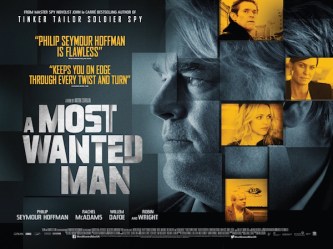
John le Carré adaptation starring Philip Seymour Hoffman as a German secret intelligence operative who must battle internal politicking while tracking a political refugee who may actually be a terrorist.
A typically complex plot requires the viewer to keep their attention level high. Some find the story a plod, but (one languorous interrogation sequence aside) I thought it relatively brisk, aided by accent-defying performances from Hoffman, Willem Dafoe, Robin Wright, Rachel McAdams, and Grigoriy Dobrygin as the refugee. Though beware: its level of realism, with real-life levels of compromise and betrayal, doesn’t make for an ultimately cheery or triumphant conclusion.

4 out of 5

Dreamgirls (2006)

2015 #195
Bill Condon | 130 mins | streaming (HD) | 2.35:1 | USA / English | 12 / PG-13

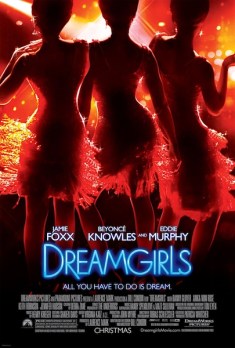
Oscar-winning adaptation of the stage musical that doesn’t tell the story of the Supremes in fictionalised form, no sir.

Jamie Foxx is the ambitious car salesman who transforms a trio of black soul singers into a crossover hit by replacing chunky lead Jennifer Hudson with sexy Beyoncé Knowles. Personal issues dog the girls’ career, as Foxx becomes megalomaniacal, leaving early successes like R&B star Eddie Murphy in his wake.

Despite oddities, like diegetic performances being replaced part way by characters breaking into song, and questions over the story’s adherence to fact, the film is a compelling (if heightened) character drama.

4 out of 5