
Ang Lee | 127 mins | Blu-ray | 1.85:1 | USA, Taiwan, UK, Canada & France / English, Tamil, French, Japanese, Hindi & Chinese | PG / PG
 2013 Academy Awards
11 nominations — 4 wins
Nominated: Best Picture, Best Adapted Screenplay, Best Film Editing, Best Sound Mixing, Best Sound Editing, Best Original Song, Best Production Design.
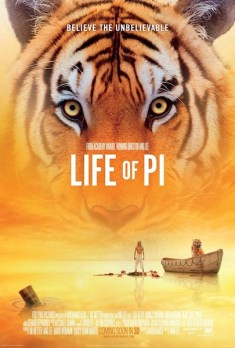 “Unfilmable” — now there’s an adjective you don’t hear tossed about so much these days. For a long time it seemed like it was all the rage to label novels “unfilmable”, but at this point too many ‘unfilmable’ novels have been filmed, and the wonders of CGI have put paid to anything ever again being unfilmable for practical or visual reasons. It may still be an apposite descriptor for works that feature very literary storytelling, though if you can render something like the subjective and unreliable narrator of Fight Club on screen — and in a movie that many regard as being superior to the novel, too — then there are few boundaries in that realm either. And someone even made On the Road, so just as soon as The Catcher in the Rye gets filmed we can probably put “unfilmable” to bed forever.
Yann Martel’s internationally-renowned Booker Prize-winner Life of Pi is one novel that used to have that adjective attached (of course it was — that would’ve been a pretty stupid introductory paragraph otherwise, wouldn’t it?) I’ve never read the novel, but I suspect it may’ve earnt the label for both of the above reasons, because it concerns, literally, the story of a boy stuck on a lifeboat with a tiger, and, figuratively, the very nature of storytelling itself — not to mention the purpose of religion and the existence of God. Never has “from the director of Hulk” seemed less pertinent.
Said director — Ang Lee, of course — did win one of this film’s four Oscars. Match that with two of its others — namely, for cinematography and visual effects — and you get an inkling of one of the film’s most praised facets. Whatever one thinks of the film’s story and themes (and I’ll come to those), it looks incredible. This is the kind of film that demands the increased resolution and colour palette of HD; it may even demand the 3D it was shot in, because watching in 2D it felt clear that wasn’t its native format — not because of the old cliché of things being thrust in the viewers’ collective face (well, only once or twice), 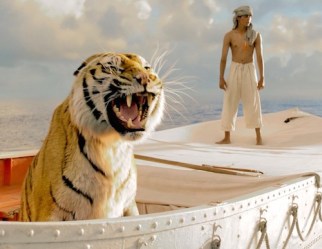 but because of almost-indefinable features of each shot’s crispness, its depth of field, even the compositions. It absolutely works in 2D, and it didn’t leave me longing for 3D in quite the same way as something like the swooping aerial sequences of How to Train Your Dragon, but, unlike with the majority of movies released in 3D, I did feel like I wasn’t seeing the director’s full vision.
Nonetheless, Claudio Miranda’s Oscar-winning cinematography proved controversial in some quarters. While the movie is indeed beautifully shot, swathes of it are also awash with CGI, so I think there’s some merit to the argument that it doesn’t count as photography. Conversely, I’d actually argue that the real-world bits look even more glorious than the digitally-rendered parts, on balance. Sure, you have the obvious spectacle of the psychedelic whale-jump, featured heavily in trailers and on the Blu-ray 3D cover, and the painterly skies and seas while in the lifeboat; but the early sequences in India, bursting with crisp, luscious colour in the zoo or at a nighttime light festival, are in some respects even more memorable.
To give with one hand and take with the other, however, I felt that the pair of aspect ratio shifts were utterly pointless and, worse, distracting. Firstly, I believe 2.35:1 was used for the flying fish scene to make the sequence feel more epic, and to allow the fish to jump further out of the screen. Well, in 2D the latter is lost entirely; and on TV (and possibly in the cinema, presuming the screen-space got thinner rather than wider), the movie suddenly feels constrained — the exact opposite effect to when films like The Dark Knight or Hunger Games 2 open out for their IMAX sequences, for instance. 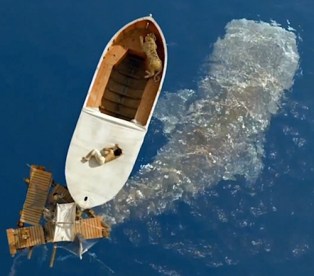 Later, the 4:3 “book cover” shot is just pure indulgence. There’s no reason not to just have empty sea to the left and right of frame, and the “it’s emulating the book cover!” reason/excuse doesn’t come close to passing muster simply because book covers aren’t 4:3. In both cases, then, what was intended to be striking or clever or innovative or in some way effective, I guess, comes across as pointless and distracting and pretentious.
And if we’re talking daft choices, don’t get me started on the meerkat-infested carnivorous island…! Maybe there’s some Deeper Meaning there — or, later, is the film deliberately lampshading the island’s total lack of meaning, when Pi tells the journalist that there doesn’t need to be meaning if it’s just what happened? Whatever — for me, it only served to make 110% sure we know (spoilers!) that Pi’s whole story is definitely BS. In that respect, the bizarre fancifulness was heavy-handed.
Ah, the story. To be honest, I liked it a little better a year later when it was called All is Lost; some people liked it better a decade earlier, when the tiger was a volleyball called Wilson. The striking imagery of a boy stranded on a boat with a tiger makes one assume that’s what the film’s About, but it’s not really About that at all. If you’re expecting a pure adventure on a life-raft, the long preamble where Pi describes his early experiences of religion must seem utterly pointless, but it all feeds back in at the end when we come to the point of Pi’s — well, Martel’s — tale.
I’m going to discuss the end while avoiding direct spoilers, but, honestly, any foreknowledge of the film’s (possible) message(s) is liable to colour your perception; so if you’ve not seen it, it may be best to skip the next paragraph until later.
 Reading around a little online, it seems that some people have interpreted the film’s message as being a defence of/justification for/persuasion towards religious faith, and hate it for that. This interests me, because I — coming, I suspect, from a similar perspective on religion — read it as a subtle condemnation of religious stories. Actually, not a condemnation, but a tacit acceptance of the fact that such stories are a nice fairytale, but not the truth. To put it another way, I took the message to be (more or less) that religion is an obvious fiction which people choose to believe because it’s a nicer story than the more plausible alternative, neither of which are provable. I think some focus on the point that the journalist hearing Pi’s story is told it will make him believe in God, and, at the end, the journalist seems to accept that it does. I don’t think that’s the film’s contention, though; I think the film is, in a way, explaining why people believe in God. Or maybe there are just no easy answers.
Seeking those answers, Rafe Spall is very good in what amounts to a tiny supporting role… but then, I have a fondness for him as an actor (his excellent, just-the-right-side-of-OTT turn as a gangster’s unhinged psychopathic son is the only real reason to watch The Shadow Line), so I may be biased. One must also single out Suraj Sharma, an unknown cast almost by accident when he accompanied his brother to the auditions, but who gives a good turn even when mostly performing opposite a CG tiger, a CG sea, CG fish, more CG…
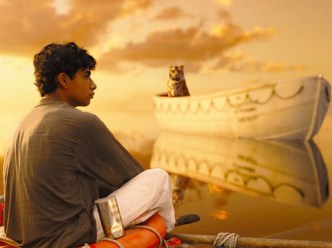 I found Life of Pi to be a little bit of a mixed bag, on the whole, where moments of transcendent wonder-of-cinema beauty rub up against instances of thumb-twiddling; where insightful or emotional revelations rub shoulders with pretentious longueurs. There is much to admire, but there are also parts to endure. The balance of reception lies in its favour, but while some love it unequivocally, a fair number seem to despise it with near-equal fervour. Either way, it’s definitely a film worth watching, and in the best possible quality you can manage, too. It also made me want to read the book, which for a movie I wasn’t even sure how much I liked is certainly an unusual, but positive, accomplishment.

The UK TV premiere of Life of Pi is on Channel 4 (and 4HD) tonight at 9pm.
 On its theatrical release, a commonly-cited recommendation was to see Gravity in 3D on the biggest screen possible. Obviously, I didn’t bother. Some say it isn’t as effective on a small screen in 2D. Maybe it isn’t as effective, but it’s still a damn fine film.
 quick editing has always been a way of creating excitement in that arena), the never-ending shots serve to make you feel closer to events, right alongside Bullock, almost wishing it would stop. Plus there’s skill in being able to show us what we need to see from a single vantage point, without the easy option of being able to cut to a different angle to clarify a detail.
 The most high-profile jobs — the actors, the studio — may be American, but everything else is pretty darn British. Rather than cry “that’s ridiculous! Give it to a proper British film!”, we should be keen to point out that, actually, this surprise global mega-hit wasn’t made in America, but in Britain, by all the talented filmmakers we have here. Rule Britannia, etc etc!
 While I sympathise with the idea that it’s not A Science Fiction Movie, but instead A Thriller (That Happens To Be Set In Space), you can’t really deny its SF-ness. OK, if we’re classing this as SF then so too should be films like
 (and it made more than double per screen what
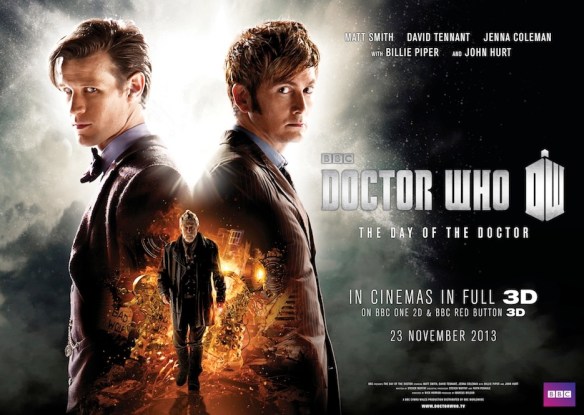
  The Doctor’s role in the Time War has not only dominated many of his actions and personalities since it happened, but it also stands awkwardly with his persona as a whole. Here’s the man who always does the right thing, always avoids violence, always finds another way, even when there is no other way… and this man wiped out all of his people and all of the Daleks? The same man who, in his fourth incarnation, stared at two wires that could erase the Daleks from history and pondered, “do I have the right?”, before concluding that he didn’t? Doesn’t really make sense, does it?
 I think some fans would have preferred a big party history mash-up; they certainly would have liked to see their favourite faces from the past. But let’s be honest: from the classic era, only Paul McGann could pass muster as still being the Doctor he once was (and he got his own, fantastic, mini-episode to prove it); and how the hell do you construct a story with a dozen leading men? It’s clearly enough of a struggle with three. The Doctor is always the cleverest person in the room, so what do you do with multiples of him? Moffat finds ways to make all of the Doctors here (that’d be David Tennant’s 10th, Matt Smith’s 11th, and John Hurt’s newly-created ‘War Doctor’) have something to do, something to say, and something to contribute — because really, the oldest (i.e newest) Doctor should be the most experienced and have all the ideas, right? There are ways round that, but only so many.
 Along the way, Moffat nails so many other things. The dialogue and situations sparkle, and frequently gets to have its cake and eat it: familiar catchphrases and behavioural ticks of the 10th and 11th Doctors are trotted out to a fan-pleasing extent, and then Hurt’s aged, grumpier, old-fashioned Doctor gets to criticise their ludicrousness, speaking for a whole generation of fans who hate “timey-wimey” and “allons-y” and all the rest. I think it’s this self-awareness that helps so much with selling the episode to everyone, both calling back to well-known elements of the series that many love, and pillorying their expectedness for those that aren’t so keen. Well, it would be a pretty awful party if you had a cake but couldn’t eat it, right?
 Smith and Jenna Coleman are on form too, of course, but as the series’ regular cast members that feels less remarkable. That’s not intended to sell them short, however, as they hold their own against actors who are arguably more, shall we say, established. If there’s one weak link it may be Joanna Page’s eyebrows, possibly the side effect of duelling with an English accent. (Complete aside: I’m rewatching Gavin & Stacey as I write this, and feel horrible even going near criticism of such a lovely person.)
 Credit too to editor Liana Del Giudice, not only for crafting cinematic action sequences, but for stitching together a narrative that is often told with imagery and flashbacks, rather than people stood around chatting. Look at the sequence just after the Doctor sees the painting for the first time as just one clear example. That sequence may be dialogue-driven, but the faded-in and intercut flashbacks and glimpses of other events are what’s really conveying information. This is first-class visual storytelling, not just when compared to the rest of British TV, or international TV, or cinema, but the whole shebang.
 Still, you can’t please all of the people all of the time, and not everyone liked The Day of the Doctor: it may’ve topped DWM’s poll, but there were voters who scored it just one out of ten. But then, that’s true of 239 of the series’ 241 stories; and almost 60% of voters gave it a full ten out of ten — that’s a pretty clear consensus. I didn’t get round to voting myself, but I would’ve been amongst them. There are undoubtedly some weak spots that I haven’t flagged up, but conversely, there are myriad other successes — both minor (the opening! The dozens of sly callbacks!) and major (the use of the Zygons! Murray Gold’s music!) — that I haven’t mentioned either.
 The director of Disney’s woeful
 Dogged by comparisons to
 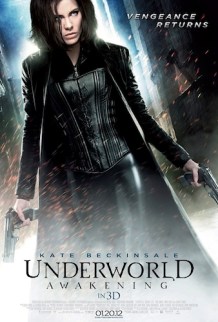 Just when you think the Underworld series is dead, it suddenly lurches back to life with a new instalment. Fitting for a series all about vampires & that, I suppose.
 By taking such a bold move with the plot, meanwhile, the story pushes the series’ mythology in new and relatively interesting ways. It’s becoming a bit dense and fan-only (unless you let it wash over you and just enjoy the punching), but at least they’re not regurgitating the same old stuff. It manages a few twists along the way too, which is always nice. The plot seems to have been half worked around Speedman’s non-involvement, leading me to wonder why — he’s not too busy, surely? Perhaps he’d just had enough? But no, apparently it was genuinely just written this way. I guess he couldn’t be bothered to turn up for some cameo shots, because the stand-in is really obvious.
 means the next one will probably turn up out of the blue with little hype, much as Awakening did last year. Plus, though this is the most expensive film to date (double the budget of the preceding one!), it’s also the most financially successful: $160.1 million worldwide, beating number two’s $111.3 million. Assuming Beckinsale still feels up for it, I imagine 2015 will bring us a continuation — and, hopefully, a conclusion.
 Also worthy of commendation: new-style ‘evolved’ Lycans; a small role for Charles Dance (always worth seeing); the evocative near-future setting; good quality action sequences; some nice steel-blue cinematography/grading. Some of it was shot at 120fps on brand-new pre-alpha never-used RED cameras — take that Peter Jackson, eh. Plus it’s only a little over 1 hour and 18 minutes long without credits. Some would bemoan such brevity, but it has its positives.
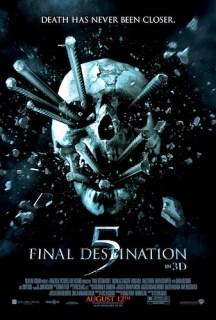 Final Destination 5 is the latest Final Destination film. Do you really need a plot description? They all have the same story.
 although on reflection it’s meaningless; a clever nod that isn’t really clever, but is neat. And perhaps means the series is finally going to rest.
 The best thing about The Final Destination is its title, because turning the series’ familiar name into a definitive article for the final entry is really quite a neat move. Sadly, it was a hit and they’ve made more. Why it was a hit… God only knows.
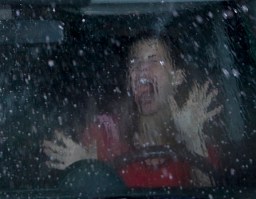 The focus is clearly on the deaths — at 11 it has the highest of the series, and with its short running time that means there’s a fatality every seven minutes. They’re also very gory, more so than in previous films I’d say, but they’re not commensurately more inventive. There’s a very thorough line in misdirection at times, but the whole enterprise feels painfully lacking in creativity. I’m not sure some of them even make sense. But then do they need to? Similarly, there’s some customary low-rent-horror-movie completely-gratuitous nudity too, which I’m sure delighted teenage boys even more in 3D.
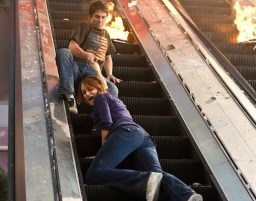 that’s a sure sign it was meant for cheap 3D thrills, but otherwise fine — here, stuff pokes straight out. That means in 2D you see, say, the flat end of a pole, with absolutely zero sense of depth. This happened with one trap in
 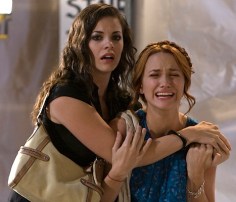 Elsewhere, one character starts talking about déjà vu before getting killed in the same way as the first film’s most famous death. I suppose it’s meant to be Meta and Funny, and maybe it kinda is, but again the CG is so cheap that the half-trained eye will spot an effect is about to happen, and the manner of death once again doesn’t really make sense. Later, we learn that shopping mall sprinklers can instantly extinguish all fires — handy!
 There’s potential in the concept of the Final Destination films, but clearly it’s either limited or the people in charge don’t know how to exploit it, because after making two quite-good films they’ve turned it into a repetitive, stale, uncreative, formulaic disaster. And there’s now a fifth too, and a sixth hasn’t been ruled out — surely it/they can’t be any worse than this? Based on form, maybe they can…
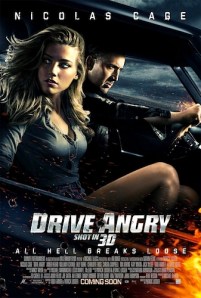 Nic Cage does the
  Only in that stuff flies at the camera and whatnot. You can indeed tell it was made for 3D, but that doesn’t mean it needs it. Indeed, the poke-the-audience stuff aside, none of it suggests it would look great in 3D — for all the pointlessness of cinema’s new money-spinning format, it can add something to the vistas in a film like
  As noted, director Lussier does not have an inspiring CV: he started with numerous straight-to-video sequels, then a big screen sequel-no-one-wanted (even with Nathan Fillion in it) in
 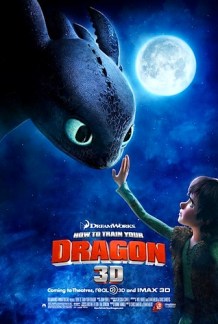 I saw a trailer for How to Train Your Dragon at the cinema a few months before its release. Having never heard anything of it, I thought it looked to have basic animation and a too daft tone. I wrote it off, expecting the kind of animated movie that would be slagged off as a Pixar-wannabe… and probably still land an Oscar nomination because there never seem to be many contenders for the animated feature award. Imagine my surprise, then, when it garnered endless positive reviews and a huge box office. What?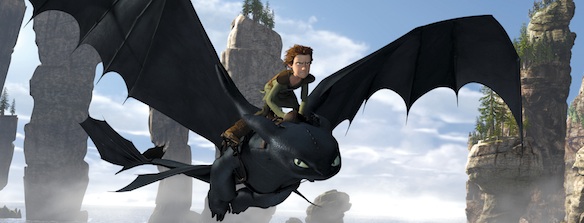
 100Films.co.uk