It Happened Here (1966)

2010 #98
Kevin Brownlow & Andrew Mollo | 96 mins | DVD | PG

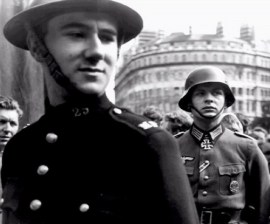
Alternate histories are always fun, and nothing seems to have provoked more than the Second World War. Which, as a defining event in modern history for a good chunk of the world, is understandable. It Happened Here is perhaps one of the earliest examples, depicting a 1940s Britain under Nazi occupation.

Co-directors Brownlow and Mollo use a dramatic narrative, as opposed to faux-documentary, to show off their vision of an occupied Britain. They shoot it in grainy, handheld black-and-white with a rough-round-the-edges feel that gives it the air of documentary even when it’s undoubtedly scripted and performed. How much this is deliberate and how much an accident of circumstance, I don’t know — they were both young, amateur filmmakers at the time, working on a small budget; United Artists spent more on the US trailer than was spent on the entire film. Whatever the cause, it works, because they’re also not trying and failing to convince us this is a documentary, simply employing the visual cues which help sell their history as real. Using a dramatic narrative also gives the viewer an identifiable character, nurse Pauline, which works nicely by drawing us into the story’s world, helping us feel and relate to the compromises and sacrifices that have to be made — and, as the film forces us to realise, would be made — under such circumstances.

Pauline is apolitical, which for the sake of the film means she can get buffeted around, seeing many facets of occupied life. She’s drawn into the regime without losing our sympathy, but when she legitimately disagrees with it she’s shoved out of the way to a country hospital — which allows us to see another aspect; namely, the quiet but methodical enacting of The Final Solution in an occupied territory. The whole film builds to this point, gradually showing the darker and deeper levels of cooperation — which starts out almost harmless and ends with organised mass murder — meaning it never feels like Brownlow and Mollo are pushing an agenda too hard, but still confront us with the reality: that we’d probably succumb too, and this is where we’d end up.

The film is distinctly anti-Nazi, then, though not without its controversies in spite of this. At one point, real fascists play themselves. I think you can tell, because I suspected as much before I looked it up to see: they’re not great actors, but they deliver their horrific polemics with a calm zeal. The argument that this merely gives some hateful people a platform for their views isn’t without merit — they’re certainly given a good chunk of time to discuss them — but it’s an ultimately effective sequence. Other characters ask questions — or perhaps other cast members do, because, knowing the fascists are real, it becomes hard to tell if it’s all scripted and in character or just a real-life Q&A that Brownlow & Mollo filmed. Either way, it works because any right-minded person is going to see the inherent ridiculousness of their views with ease.

Nazi EnglandAnother controversy arose over the villains being British collaborators — few German Nazis are seen — and the ease with which many agreed. But this is based in the facts of what occurred in other occupied territories; maybe Britain’s plucky spirit would’ve shown through, as many like to believe, or maybe many would have caved for the easier life — or, indeed, life at all. The film is examining several perspectives of occupation, and using the fictional context to good effect: this could have happened, the film says, however much we like to believe we wouldn’t have collaborated like (and/or resisted better than), say, the French.

Talking of the resistance, I presume the controversy didn’t stop with its depiction of collaborators: both sides are shown to be just as/almost as bad as the other. The film opens with occupying Nazis massacring women and children, including a hurried and confusing gunfight in which it’s unclear whether Pauline’s friends — all women and children — were slaughtered by the Nazis or a group of resistance fighters holed up nearby. Mirroring this, the film ends with a group of British resistance (and/or invading American and British troops) rounding up surrendered collaborators and gunning them down in cold blood. No one comes out of this well — and that is perhaps the most truthful part of all.

Nonetheless, It Happened Here is more anti-Nazi than pro-Nazi propaganda, in my opinion, though it’s easy to see why any material critical of the Allies could have outweighed the overall bias when the film was first released, just 20 years after victory in Europe. Generally, and viewed from a much more removed perspective, Brownlow and Mollo do a good job of offering conflicting perspectives with minimal comment, allowing the viewer to decide how ridiculous certain newsreels or opinions are, or how weak or misguided characters may or may not be — on both sides.

4 out of 5

Rambo: First Blood Part II (1985)

2010 #110
George P. Cosmatos | 92 mins | TV (HD) | 15 / R

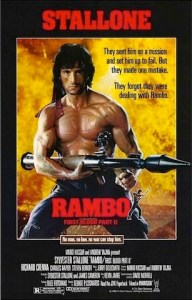
Part II, eh? A continuation of the same story from Part I, theoretically; like The Godfather or Back to the Future. Rambo certainly picks up from the first film — our titular hero is in prison for his crimes — and continues the same theme of showing respect to Vietnam vets, but other than that it’s rather different.

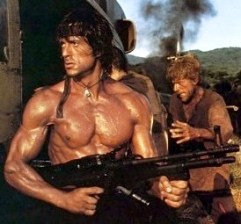
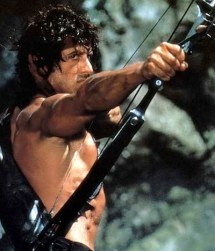
The first entry in what was to become the Rambo series had a certain amount of realism, which comes as a surprise today thanks to Rambo’s reputation among filmgoers as a ludicrous action man. (Personally speaking, my main exposure to Rambo before watching First Blood earlier this year was the spoof Hot Shots! Part Deux, but more on that with Rambo III (probably).) Part II is where this reputation begins, however: Rambo becomes a superhuman killing machine — running round a jungle topless, muscles shiny and bulging, taking out more-or-less an army single-handed. It’s cartoonish and ludicrous, which can be fun in its own way — the bit where he uses an explosive-tipped arrow to kill one man is gloriously, and indicatively, OTT — but only for action movie fans, losing any crossover appeal the first film had.

The screenplay is by James Cameron (yes, that one) and Stallone. Cameron says he wrote the action and Stallone added the politics. I don’t know who wrote the dialogue, but on the whole it’s typically straightforward and/or laughably weak. You can see why these days people get hired to do a “dialogue polish”.

Talking of politics and things that are easy to see, it’s easy to see why this was accused of being an American revenge fantasy. It’s not only got a bunch of Vietnamese soldiers being slaughtered (this time America wins!), but they’ve teamed up with the Ruskies (we’re still in the Cold War here, remember), so Rambo gets to blow a load of them away too. How satisfying for a certain facet of America, no doubt disappointed by such a long period without decisive military victory.

This attitude might be thwarted by some nasty US military types back at base — not nasty in the way the majority of US military commanders come across as nasty, but nasty as in unpatriotic (about the worst crime there is to an America, of course). They do little to dent the general atmosphere though. It’s made clear that these unpatriotic chaps are the exception — Rambo Hood, Rambo Hood, riding through the jungleif the film is vilifying those who didn’t care about soldiers who fought in Vietnam (which it is), the characters who abandon Rambo and the other PoWs are an embodiment for this disdain.

So the film’s politics may be distasteful — it was adopted by the Republicans, just to rub salt in the wound — but if you can put that aside — along with all the dire dialogue and flat characters — then Part II has some value as a rather basic, rather ridiculous actioner.

3 out of 5

The second sequel, Rambo III, is on ITV1 and ITV1 HD tonight at 10:35pm.
Rambo: First Blood Part II is on ITV4 tonight, Saturday 8th February 2014, at 10pm.

Inglourious Basterds (2009)

2009 #82
Quentin Tarantino | 153 mins | Blu-ray | 18 / R
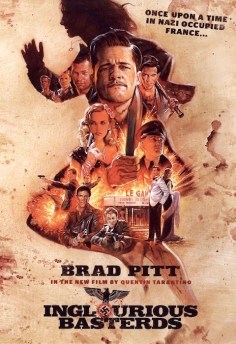
Inglourious BasterdsWatching almost any film a second time can affect your opinion of it. It could reveal deeper levels of character or theme; it could allow you to see how the writer(s) subtly foreshadowed events, or built up to the big twist; it could be you spot jokes you were too busy laughing during last time; it could let you look at the imagery now you don’t have to concentrate so hard on the subtitles. Or it could reveal shallowness, that there’s nothing to be gleaned that you didn’t get the first time; or highlight the holes in a plot that seemed so well constructed before; or jokes that were hilarious fall flat when heard more than once; or the action sequences aren’t exciting when robbed of their freshness. A second viewing can reveal that you were too young to get it the first time, or that you’re now too grown up to enjoy it; it can reveal a bad movie isn’t so bad, or that without the hype it’s actually quite good; it can raise a favourite even higher in your estimations, or it can tear it down. And even if a second viewing just reaffirms exactly what you felt the first time, well, when there’s such a chance for change and it doesn’t occur, that’s an effect in itself.

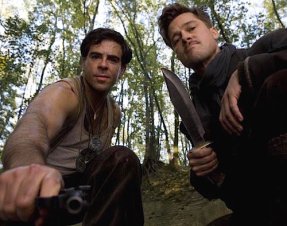
This is why I try to post all my reviews after only seeing a film once. There’s nothing wrong with appraising a film after many viewings — far from it — but that’s not the point of this particular blog, focusing as it does on films I’ve never previously seen. (Whether a newcomer’s perspective is still worth anything once a film is months, years, or decades old is another matter, perhaps for another time.) Unfortunately, though rarely, a film slips through the cracks. As you’ve likely guessed, Inglourious Basterds is such a film: though I named it my favourite film I saw in 2009, I didn’t make any notes or write a review promptly. And so here I find myself, over eight months since I first watched itEli Roth and Brad Pitt are basterds — and, today, a year since its UK release —, having watched it a second time to refresh my memory. But has it changed my opinion?
Inglourious Basterds is, in some respects, a law unto itself. That’s probably why it received such a mixed reaction at Cannes; one that, notably, settled down to generally praiseful by the time it was officially released a few months later. It wasn’t, as had been expected, the story of a group of American Jews dropped behind enemy lines to murder Nazis, thereby spreading terror through the enemy ranks. That’s part of the tale Tarantino eventually brought to the screen, but what you’d expect to make up the bulk of the movie — as Aldo Raine himself puts it, “killin’ Natzis” — is skipped over with a single cut. The film is divided up into five chapters; the second is the one most directly concerned with the Basterds, and it’s also the shortest.

And that’s not the only thing Tarantino does differently. The whole film is a grab-bag of filmmaking styles, techniques and modes, thrown together with a gleeful abandon. Tarantino uses what he wants when he wants it, sometimes for no reason at all, and with no eye to creating a stylistic whole. If he wants a character’s name to appear in huge letters over a freeze-frame of them, he will; that doesn’t mean he’ll use it for every character, or every major character, or for every other character on that one’s side — if he wants it just once, he’ll throw it in just once. It’s like that square Uma Thurman drew in Pulp Fiction,Milk? Oui. only instead of being one thing once he does it again and again, with any trick he fancies, throughout the film.

I’m tempted to list them, but that would remove some of the fun if you’re yet to see the film. My favourites, however, are the subtitles that don’t always translate things — e.g. when a French character says “oui”, so do the subtitles. It’s pointless really, but also kind of thought provoking too: if, as a non-French-speaker, we say “oui”, knowing what it means, then are we actually saying “yes” or are we saying “oui”? I’m certain, however, that Tarantino’s subtitling choices weren’t designed to elicit such thoughts and probably don’t stand up to the scrutiny they’d require (such as: if the rest of a Frenchman’s French is translated to English, why aren’t his “oui”s? (As it were.))

This is just one of the things that signals the truth of Inglourious Basterds: it’s not really about World War 2 — though you’d be forgiven for thinking it was, considering it’s all set during World War 2 and all the characters are soldiers, resistance fighters or politicians — but is in fact about film, or cinema, or the movies, or whichever name you want to use. It’s not just his mix and match of cinematic techniques that suggests this — though the much-heralded use of Spaghetti Western style on a World War 2 setting works as fabulously as you could hope — but it’s overt in the text too.

The ending. Sort of.The ending (and skip this paragraph if you haven’t seen the film) is the key to that, as I’m sure you either noticed or have read in other coverage. The power of cinema literally destroys the Nazis, changing the course of the war. Killing Hitler — and the rest — is one of those barmy notions that at first seems wrong, and then seems completely right. “If my characters had existed, this is what would have happened” is one of those genius notions that seems so inescapably obvious you wonder why no one’s done it sooner. Why do you necessarily need to obey history if the rest of your story is fiction anyway?

Back to other matters. It’s interesting just how long the scenes are, and in so few locations. Chapter One takes place solely in a small farmhouse (except for a few minutes outside it); Chapter Four is almost entirely in the La Louisiane bar; Chapter Five almost entirely in Shosanna’s cinema. And while the other two use more locations, their number isn’t great: Chapter Three features the aforementioned cinema, a cafe and a restaurant; Chapter Two a briefing ground, Hitler’s war room, some derelict location, and a prison. This isn’t a full list of locations and scenes, but it’s most of them. Tarantino hasn’t created some writerly exercise — “you are only allowed five locations, one long scene in each” — but he has nonetheless crafted most of his films in long scenes in few locations. I imagine this, along with “all that reading” La Louisiane(I believe more of the film is subtitled than in English), did little to endear it to the complaining masses who thought they were getting “Kill Bill in WW2”.

The chapter-ified structure and constant introduction of new characters suggests a Pulp Fiction-ish ‘short story collection’ at first, but it becomes clear as the film moves on into its fourth and, certainly, fifth chapters that it actually all builds together as one whole story. The chapter headings serve their purpose, denoting the various stages of the tale and allowing Tarantino to jump around, rather than having to find a way to move more seamlessly from segment to segment or somehow intercut them all. Indeed, unlike the other Tarantino films the use of chapters evokes — i.e. Pulp Fiction and Kill BillInglourious Basterds is quite solidly linear, at least as far as the progression through each chapter is concerned. (Chapter Two jumps about in time a bit, with a Nolan-esque stories-within-stories-within-stories structure, but even then does little to upset the linearity.)

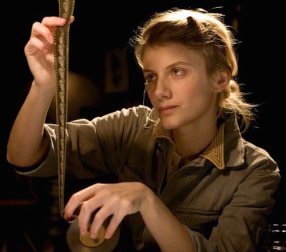
ShosannaAnd for all those constantly-introduced characters, the acting is top notch. Christoph Waltz easily deserved the huge pile of awards he garnered, his quirky persona following in a long tradition of calm psychopaths in movies. You always know his pleasantries hide something far nastier; every scene he appears in is instantly tense. Mélanie Laurent is an instant one-to-watch as the film’s real central character, Shosanna, though she seems to have been sadly sidelined by all the praise heaped on Waltz. It doesn’t hurt that she’s the kind of woman you’d happily decorate a whole review with pictures of (though you’ll note I resisted). Michael Fassbender is the very definition of Englishness, without quite slipping into an irritating stereotype. It’s difficult to imagine the originally-cast Simon Pegg in the role, though I’m sure he would’ve brought something… shall we say, different… to it. Brad Pitt’s much-criticised heavily-accented performance is fine. While not as memorable as the others mentioned, I don’t see why some have had such a problem with it.

Between Tarantino’s writing and more excellent performances, we’re also treated to a host of minor but memorable characters: Denis Menochet’s farmer, managing to equal Waltz in the long opening scene;Give me my Oscar now Til Schweiger’s vicious German basterd; Diane Kruger’s glamorous, calm actress-spy; Daniel Brühl’s apparently sweet accidental hero and movie star-to-be; Martin Wuttke’s raving loony Hitler; and others too. Perhaps the only duff note for me was Mike Myers as an English General. I liked the Wayne’s Worlds and Austin Powerses (and haven’t subjected myself to The Love Guru for this reason), and he’s not exactly bad here, but there’s a part of me that couldn’t escape wondering exactly why he was cast in such a small and uncomedic role. A real Brit would’ve been more appropriate, I feel. Perhaps Simon Pegg.

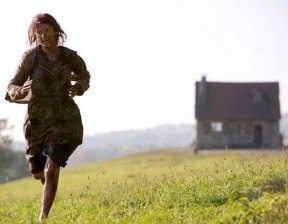
Myers was one of the things I noticed more on my second viewing. So was that “care-free deployment of an abundance of film-specific techniques” — while they’re undoubtedly there, when one expects them they don’t seem nearly so surprising or all-pervading as they did at first. Clearly it’s the shock value: in the same way a jump scare or joke dependent on a surprise twist might only work once, so Tarantino’s occasional and somewhat incongruous flourishes don’t stick out as firmly when you know they’re coming. But that’s not a bad thing. There’s no joyous discovery of something new and slightly different exploding across the screenRun Shosanna! every once in a while, but it also proves they work, that he was right to employ them.
Some people hated Inglourious Basterds (though not enough to keep it out of the IMDb Top 100), be it for the unexpected nature of its story or for the long talky scenes with lots of reading. But that’s just another reason I love it — not to be awkward or Different, but because by being so much its Own Thing it can provoke such strong feelings, in either direction. It’s common for Hollywood to produce films so bland they evoke bags of apathy from those with enough brainpower to realise the film doesn’t have any, so it’s quite nice to have a film that has a brain — and, more importantly, a personality (several, even) — that it isn’t afraid to show off, and isn’t afraid for you to dislike if you want. Love it or hate it, it demands to be seen and judged on its own merits.

To be frank, I’m not sure I liked Inglourious Basterds as much my second time. I may well like it more again on my third, when there’s less personal hype involved. I’d still give it the same star rating though, so at least there’s no conflict there.

You might argue that Pulp Fiction or Reservoir Dogs are better films, but — with its long idiosyncratic speeches and scenes, relatively extreme violence, use and re-appropriation of generic convention, Shosanna on filmcare-free deployment of an abundance of film-specific techniques, and, both through this and also directly in its narrative, its love of film as a medium — Inglourious Basterds isn’t just “a Quentin Tarantino film”, it is Quentin Tarantino. His choice of final line — “You know something, Ultivich? I think this just might be my masterpiece” — is clearly about more than Aldo Raine’s swastika-carving abilities.
5 out of 5

Inglourious Basterds is on Film4 tonight, Friday 24th October 2014, at 9pm.

It placed 1st on my list of The Ten Best Films I Saw For the First Time in 2009, which can be read in full here.

Don't forget the cream

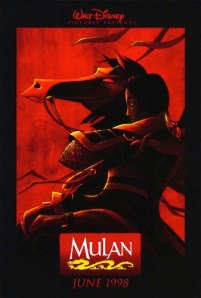
Mulan (1998)

2010 #64
Tony Bancroft & Barry Cook | 84 mins | TV | U / G

I realised recently that I haven’t seen an animated Disney film produced after The Hunchback of Notre Dame, which I saw on rented video thinking I was probably getting too old for the Mouse House’s output. Now I’ve grown up, of course, I know you’re never too old for a good Disney. As Mulan seems to be one of their last to gather significant praise before they slipped into their ’00s rut, it seemed a good place to begin catching up on what I’d missed.

It’s easy to see what critics and/or audiences liked about Mulan. There’s a few good, catchy songs — though sadly no villain’s song, which is usually one of the highlights — and some lovely animation — though I feel it’s been rather outshone by the similarly-styled Kung Fu Panda in this regard. There are decent action sequences too, fast-paced and fluidly animated, which helps make what could’ve been a Girly Film into something palatable to both genders (I remember being distinctly unimpressed with Pocahontas when forced to see it in the cinema).

The other thing that stands out about Mulan, particularly now, is how very Americanised it is. That’s nothing new for Disney, of course, but it feels a little odd these days. When we’re so used to increased attempts at appropriate cultural reverence from Hollywood movies, it’s almost uncomfortable to hear such American accents from clearly Chinese characters. (It’s this kind of thing that has caused uproar for The Last Airbender in the US (quite aside from it supposedly being a load of cobblers). How times change.) Eddie Murphy’s Mushu (who now comes across a little like a proto-Donkey) is particularly incongruous in this regard. I suppose it’s no worse than, say, Aladdin, or The Jungle Book, or all the Euro-set films.

With a ‘princess’ overcoming her assigned place, a pair of cute/humorous animal sidekicks, a princely husband-to-be, and a vicious villain in need of defeating, the tale of Mulan has certainly been adapted into the Disney mould. It may not be their best effort, but it’s still a strong one.

4 out of 5

Mulan is on Channel 5 today, Sunday 4th May 2014, at 5pm.

Culloden (1964)

2009 #48
Peter Watkins | 69 mins | TV | 12

CullodenCulloden tells the story of the 1746 battle — famously, the last fought on British soil — and the events that followed it, as if it were covered by a modern TV news report (albeit a feature-length one).

This adopted style — a first — makes for an effective presentation. As a form it obviously foreshadows the docudrama, a method of presenting history which is so popular today, though not quite in this way. Writer/director Peter Watkins gratifyingly refuses to break from his premise: the whole film is very much like an extended news piece, featuring interviews, facts, and the famous BBC objectivity — at no point does the narration inform us who is good and bad, right and wrong, yet leaves us with little doubt about Watkins’ opinions (which are pretty low of just about everyone).

In fact, the film is fuelled by much youthful righteous indignation from Watkins, in his late 20s when Culloden was made. That said, his (perhaps unrealistic) idealism is still in evidence in every interview I’ve seen with him from decades later (though in those cases applied to what TV is and should be). But he allows it to dominate proceedings here, too often focusing on the awful conditions of the poor or the wrongs committed against them by Nasty Rich Folk. Should we be cross about this? It is 1746 after all — of course life was awful for common folk and the upper classes were rich twits who rode roughshod over them. That’s how things were in The Past, for thousands of years before it and hundreds of years after. With our modern developed sense of morality it all looks Nasty and Wrong, but we can’t go back and change it so why get so upset about it? Surely such vitriol is better directed at places where this is still the case?

While Watkins’ righteousness is clearly present before and during the battle, it’s really let loose in the aftermath, as English soldiers commit all sorts of atrocities to the Highlanders. Perhaps this was genuinely shocking and deserved in ’64, and it’s still true that the actions taken were unforgivably horrid, but it’s no longer shocking — not because we’re desensitized to violence at this point, but because we’re now very aware that we have done horrendous things throughout our history even while painting ourselves as the good guys (as we still do today, of course). Early on he describes the workings of the clan system, ostensibly factually but with a clear undercurrent of its unfairness; yet at the end bemoans its destruction by the English. Maybe this is why Watkins struggles to find anyone likeable in the film: they’re all as bad as each other.

Even if his overly moral stance falters, Watkins’ filmmaking techniques rarely do. The use of ordinary people as actors works fine most of the time, though occasional performances or scenes show off the cast’s unprofessional roots. Watkins’ theories about how TV should be run and the involvement of the public in the way he did here may be romanticised and impractical, but it’s hard to deny that his application of them worked wonders. Performances frequently aid the documentary effect by seeming just like those in genuine interviews or news footage, whereas even the best professional actors trying to emulate such reality are usually mannered enough for the viewer to realise they’re acting.

Best of all, however, is the titular battle. These scenes are extraordinary, creating a believability even the largest Hollywood budget has often failed to challenge. It’s epic but also involving, disorientating but clearly told, brutal without needing expensive prosthetic effects or an 18 certificate. It’s a brilliant example of camerawork, sound design and editing combining under inspired direction to create a flawless extended sequence.

Culloden was a bold experiment in filmmaking — indeed, the notion of a distant historical event being presented as if covered by news cameras still sounds innovative — and Watkins mostly pulls it off, with stunning battle sequences, effective performances and a high concept that is never betrayed. A few minor weak points aside, the only serious flaw is that Watkins lets his overdeveloped morality run unchecked. His application of a modern outrage to what seems a typical historical situation grates quite quickly but never abates, ultimately reclaiming a star from what is nonetheless an exemplary effort.

4 out of 5

Culloden placed 8th on my list of The Ten Best Films I Saw For the First Time in 2009, which can be read in full here.

Paths of Glory (1957)

2009 #85
Stanley Kubrick | 87 mins | TV (HD) | PG

Paths of Glory“The paths of glory lead but to the grave,” wrote Thomas Gray, and Stanley Kubrick — adapting from the novel by Humphrey Cobb — sets about proving him right.

Kubrick’s depiction of war is excellent, from long tracking shots through the trenches, to the nighttime wilderness of No Man’s Land, lit only by flares that reveal it’s strewn with bodies, to an epic and perfectly-staged battle that is a visual and aural assault. Indeed, Winston Churchill claimed that the film was a highly accurate depiction of trench warfare and the sometimes misguided workings of the military mind, and it’s so effective that it was banned in France for its negative depiction of the military. I’m sure the story could have been equally well applied to any military in the habit of killing its own men, but hey, it’s always fun to pick on the cheese-eating surrender monkeys.

Even beyond the battle scenes the film remains bleakly realistic: the depressing Old Boys’ Club-style hierarchy of the military (still all too much in effect, as series like Generation Kill reveal); the unjust unrecorded trial (an excellent courtroom sequence that can stand up to any other); through to the inescapable finale. George Macready’s villain is as chillingly evil as they come, because he’s so believable. Lying, manipulating, selfish and dishonourable, yet he produces all this from an opening scene where he appears to be a perfectly honourable General (though one has one’s suspicions). Even at the very end, when some small measure of genuine justice has been wrung from the whole sorry mess, one of the few remaining almost-likeable characters is fully unmasked as just as bad as the rest. Kubrick tries to instil some hope with his final scene, but by then he’s done too fine a job of wiping it out.

There’s a debate, it seems, about whether this can accurately be described as an anti-war film. It’s patently not pro-war, with its ineffective officers, self-serving high command, corrupt legal system and senseless slaughter for absolutely no military gain; but the argument that it is less a commentary on war and more on human nature — how people, not just soldiers, respond to the opportunity for glory, and how they attempt to cover their own tracks when it goes wrong — certainly holds some weight. The final scene, which is in almost every other respect entirely unrelated to the main narrative, supports such a theory, as does the source of the title. But just because that’s true doesn’t mean it’s not anti-war as well; or, at the very least, anti-military (if that’s not the same thing).

Perhaps reaction to the film depends on your ideological stance. I’m all too prepared to believe the military is corrupt and unjust because, well, that’s how they always seem. As such, Paths of Glory does an outstanding job of fulfilling and reinforcing these preconceptions, particularly in its refusal to end justly. If you have some measure of faith in the forces, however, you may think it’s an unjustified attack on your beloved institution. Each to their own.

5 out of 5

Paths of Glory is on ITV4 tomorrow, Sunday 31st August 2014, at 11:20am.

(Originally posted on 24th February 2010.)

Avatar [3D] (2009)

2009 #89
James Cameron | 162 mins | cinema | 12A / PG-13

AvatarAvatar is The Film That Changed Cinema. The past tense can safely be used, despite the film only having been out a couple of days — it doesn’t matter if we like it, filmmakers and Hollywood executives have decided it’s the artistic and commercial way forward, and so it shall be. It barely even matters if people actually go to see it; not that it’s in much danger of flopping, coming in the wake of years of extreme hype and numerous sycophantic reviews.

What’s almost more irritating than that, however, is that it’s actually quite good. Flawed, unquestionably, and probably undeserving of the volume of advance praise heaped upon it, but far from a disaster.

It’s too long, for one thing. The end of Act Two feels like the end of the film… until it insists on going on for goodness-knows how long (my watch stopped working, I couldn’t check). It might not be so bad if it didn’t take its time getting to this point. Swathes of it feel like a dramatised nature documentary, only this time it’s about a fictional alien world. Talk of Cameron having created a fully-realised, living, breathing ecosystem are over-egged: there’s a half dozen creatures, at most, and their only relation is that they have these weird tentacle things in their hair that allow them to connect up to one another, like nature’s own biological USB. Maybe he knows who eats what and when and how and mating rituals and all that jazz, and if he does we should be thankful it’s not plastered all over the screen, but the creature creation/world realisation here isn’t anything beyond Jurassic Park.

The story itself isn’t bad. It certainly has an epic quality, which at least justifies the running time, though it’s a collation of elements from elsewhere. Of course, such things can be said of most stories these days, but with Avatar it seems even more obvious — a bit of Aliens here, a bit of The Matrix Revolutions there, a bit of An Inconvenient Truth for good measure, and so on with countless other recognisable tropes. The sin Cameron commits is that he mostly does it in quite a clichéd manner — it’s not just that you have seen it before, but it feels like you have too. Even the learning-to-fly bit, much praised in some quarters, reminded me of something else: slightly-rubbish TV miniseries Dinotopia, of all things. And don’t get started on the dialogue — “Try not to think of anything. That shouldn’t be too hard for you.” Dear God, how many times have we heard that line?

Towards the end Cameron does pull a few things out of the bag, mainly involving who gets killed and who doesn’t. Mostly, the story is a framework to allow the visual spectacle and an ecological/anti-war message. It’s as subtle as a nine-foot-tall blue alien. From crystal clear uses of familiar phrases like “shock and awe” and “hearts and minds”, to unconcealed references to our dying planet, Cameron attempts to criticise both American military tactics (invade, crush the locals…) and the destruction of the planet (…take all the natural resources for ourselves, no matter what the cost). It’s not that the message is wrong, it’s just that Al Gore did it with greater subtlety in a 90-minute lecture on that specific subject. From the outset, the military — specifically marines, of course — are quite clearly The Bad Guys Here, which is a refreshing change from the man who brought us Aliens. Quite what the American public are/will make of this outright criticism of both its military and energy consumption remains to be seen.

All this is realised through unrelenting CGI. It’s very good, but here Avatar falls victim to its own hype once again, because it’s still not 100% perfect. Perhaps it’s the closest yet seen — it certainly remains consistent throughout — but nothing had me wondering if they’d perhaps used prosthetics in addition to the CGI, as Davy Jones did at several points during Dead Man’s Chest, and I remain convinced that wonderful modelwork, as seen in the likes of Lord of the Rings, is still an unbeatable tool for creating convincing environments. Some will argue that we remain unconvinced of the alien creatures’ authenticity because we know they can’t be real, but some occasionally exhibit the plasticky shine of CGI or the jerky movement of motion capture. The Na’vi are certainly a step up from Robert Zemeckis’ dead-eyed humans in The Polar Express or Beowulf, but are they that much better than Gollum? Or even Jar Jar Binks? (In terms of the competency of the effects, I hasten to add.)

It’s hard to resist flaw-spotting with Avatar after reading so many praise-filled reviews. At the risk of sounding like one of those irritating people who sits at their keyboard declaring “ah-ha, I’ve realised something all you professional reviewers weren’t clever enough to see!”, I think this is in part due to the final act. Avatar has a stonking finale, from a huge Apocalypse Now-styled 9/11-echoing moment of destruction, to a thrilling and epic final battle (albeit interrupted by a mass of unwelcome pace-challenging plot). These sequences excel on almost every level, from visual wonder to the odd spot of emotion. And this is what your final impression of the film is, which can banish memories of the crawl through the middle, replete with those niggling flaws. I won’t be surprised if DVD/Blu-ray reviews commonly lose a star, robbed as it will be of the huge screen spectacle and reviewers forced to remember what they had to sit through to reach the big climax.

Oh yes, and Avatar’s meant to be convincing us that 3D is the future, isn’t it? And actually, 3D is quite nice. This is the first time I’ve seen a film in RealD, so I was pleased to discover how perfectly it works. No ghosting that I noticed and minimal discomfort even after such a long film, so from a viewing point of view I was happy with it. It adds depth to the image as well, rather than throwing things in your face — this too was pleasant. As I’ve noted on previous 3D reviews, this depth can bring a scene to life… not in the sense that you believe it’s genuinely happening behind that screen in front of you, but it does liven the images up.

What it doesn’t do is improve the storytelling — but then, what does? Some actors in a black box can convey a story wonderfully — look at Dogville, or any number of theatre productions — you don’t need sets, or costumes, or CGI, or even music or any number of other things we associate with the film experience. You could lump 3D in with these, or you could say it’s even less necessary — sets, costumes, and all evoke a time and place and create a realistic world in a way a black box doesn’t, but what does 3D bring to the table? It’s purely about spectacle, in the same way CGI or helicopter shots or using IMAX usually are. And that’s fine. But directors who’ve expressed an interest in shooting a ‘normal’ domestic drama in the format may be overestimating its import.

But for all the derivative plot, blunt message, cheesy dialogue, thrilling action, spectacular imagery, pretty good CGI and debatable 3D, Avatar may have a greater problem in gaining anything like widespread acceptance. It’s set 145 years in the future, on an alien world with floating mountains and other such fantastical elements, where a significant chunk of the story centres on a group of nine-foot-tall aliens (who fall in love and kiss, much to the loud derision of a group of 13-year-old boys in my screening) in a weird alien jungle with prehistoric-like alien creatures, and semi-scientific religious imagery and plot points that I haven’t even touched on… It’s pretty hard science-fiction, to put it simply. It’s not the accessible historical romance/disaster of Titanic, it’s not the real-world-styled action-based superheroics of The Dark Knight, it’s not an accessible adaptation of a widely-loved book like Lord of the Rings or Harry Potter… One could go on in this vein through all the highest-grossing movies of all time.

Instead, it’s the cover art from a pulp science-fiction/fantasy novel or short story magazine writ large with the budget required to pull it off, and it’s that for almost three hours. For every SF/F-loving sycophant there’ll be a member of the general public who thinks it’s a load of old tosh. The truth is somewhere in between, as ever, but I won’t be surprised if the style of Avatar’s business is closer to Watchmen than Titanic. (I don’t think this is too delusional, incidentally. It will perform more strongly than Watchmen, obviously, because it has that all-important PG-13 certificate in the US and a helluva lot more hype in the mass media. But I remain convinced it won’t manage to be a phenomenon to rival Titanic or The Dark Knight, or The Lord of the Rings, or Harry Potter or Pirates of the Caribbean or Star Wars.)

Avatar is a significant film. Thanks to the hype and importance attached to it, by both Cameron and the industry at large, this can never be taken away from it — even if we’ve heard its story before, seen 3D before, seen effects as good before. I don’t believe The Future Of Film is riding on it as much as some would claim — after all, so convinced are They of its status as a hit that an endless stream of 3D movies heavy on CGI have arrived ahead of it and will continue for years after. In itself, it’s quite entertaining and probably deserves to be seen on the big screen. But, as expected, it’s not the revolution that was promised.

4 out of 5

Flags of Our Fathers (2006)

2009 #39
Clint Eastwood | 126 mins | DVD | 15 / R

Flags of Our FathersIt’s been two years since I reviewed the second in Clint Eastwood’s 2006 double bill of World War II films; thanks to the machinations of my DVD rental site, it’s taken this long to see the first. In a somewhat innovative move, the pair examine both sides of the battle for Iwo Jima: Letters from Iwo Jima from the (losing) Japanese perspective, while Flags of Our Fathers shows the (victorious, obviously) American view. I found Letters to be a fair effort, if undeserving of some of the praise and nominations it garnered, but the consensus seems to have it that this first half isn’t as good.

Perhaps that’s because Flags is a different kind of war film. While it seems to have been promoted as the story of the battle for Iwo Jima, it’s more about the experience of three men, both on the island and upon their return to America — hailed as heroes and paraded around the country trying to raise money for the war effort, purely because they happened to be in a photograph raising a flag. While there are still plenty of battle sequences and the occasional bit of “who will survive?” suspense — not to mention an examination of such issues as honour, duty, responsibility and so forth — Eastwood is clearly aiming for something different here. Indeed, while those themes may be standard war movie fare, by placing them in slightly different contexts Eastwood finds new (or at least uncommon) perspectives on them. Perhaps this explains why Letters came off better: by comparison it’s a much more typical war movie, therefore more what was expected.

Many of Flags’ weak spots also arise from this approach however. It adopts a time-jumping structure, flitting between the battle itself and what happened after. It’s debatable how well that works: at times it’s fine, at others it needlessly complicates matters. The final stretch also gets a bit meta/hyper/intertextual, following the author of the book on which the film is based as he conducts research for the book… then rams it home when the three lead actors also appear as his brothers. (To be fair, the latter is in a single shot where their faces are almost hidden.) In the end, Flags offers neither of the usual clear-cut war movie endings (“we won!” or “we lost nobly!”), closing with no easy answers or conclusions to the issues it raises. This at least sticks to its realism, but won’t be to all tastes (with reservations, I liked it).

One side effect of such a different approach is that Eastwood’s two Iwo Jima films make good companion pieces. In no serious way do they present Part One and Part Two of a story, but instead two vastly different perspectives on the same events. The points of crossover between the two are neatly used, occurring naturally rather than forcing “you’ll understand this later”-style mysteries upon the viewer, but mainly they explore the way two very different cultures reacted to the same battle.

They do directly share something however, and that’s a debt to Saving Private Ryan in their depiction of combat. A beach-storming sequence naturally invites direct comparisons, with Flags unquestionably coming off worse due to a lack of focus. It’s still an effective sequence and it’s not a clone of Ryan, but the comparison is hard to avoid and Ryan’s opening is famous for a reason.

Despite the verisimilitude the Ryan-esque visual style now has, Eastwood nonetheless shies away from some of the reality. It seems he can’t bear to explain or show what happened to Iggy, for example, though in fairness the viewer should be glad he didn’t. (If you want, some of the details can be found on Wikipedia, but be warned that his fate was truly distressing.) Knowing the truth, one can only imagine the trauma and guilt felt by ‘Doc’ Bradley in the wake of the incident.

On a lesser level, one also imagines it must be difficult as a filmmaker deciding whether to include such details or not — on one hand, I’m glad we weren’t confronted with them on screen (certainly, to show a body would have been too much), but, while the details are horrific, knowing them adds an extra layer of emotion that is absent when kept a mystery. An externally-gained awareness of the reality of Iwo Jima adds a weight that is arguably missing from the film, but which improved it for me.

Flags of Our Fathers is an unusual war movie, probably not what many were expecting when told Eastwood was doing a War Film about the battle of Iwo Jima. But by being different it has a lot to say about the experience of war — both on an individual level and in a broader sense — that is rarely (if ever) expressed on film in quite this way.

4 out of 5

My thoughts on the second half of this pair can be read here.

Aliens (1986)

2009 #14
James Cameron | 132 mins | DVD | 18 / R

Once upon a time, sequels were universally regarded as Bad — the inferior product of a great original; most frequently a remake in continuation’s clothing. These days we regularly see sequels that continue and expand on their predecessor, frequently leading to higher praise and a better reputation. It’s almost become expected, in fact — look at the number of reviews of Star Trek that express more anticipation for the inevitable sequel than the one just released (my own included). The archetypical “sequel that betters the original” was always James Cameron’s Terminator 2: Judgment Day — though currently critics often seem to pick X2 — but long before either of these Cameron was ahead of even himself with this sequel to Ridley Scott’s acclaimed sci-fi/horror.

The difference here, perhaps, is that Scott’s movie was so well-regarded and well-known in the first place. But Cameron cannily marks his sequel out by making it totally different, much more so than X2 to X-Men or even T2 to The Terminator. Where Alien is a Horror Movie — but in space — Aliens is a War Movie — but in space. The story structure is somewhat reminiscent of Apocalypse Now, for example; the central characters are a team of marines, as opposed to the original’s ordinary guys; where the first film’s design was dark, shadowy and oppressive, here it’s all gleaming tech, tanks and guns and spaceships and the like; and, just to underline the point, the score is full of military drums. If Scott’s could have been translated to any modern-day industrial setting, Cameron’s could be in any modern-day war zone. It works because Cameron builds on the original without ignoring it, and it succeeds because he then makes a fine war movie in its own right.

The elements Cameron chooses to retain from the first film aren’t necessarily obvious, but all are very wise. He continues its believable, realist aesthetic: businessmen wear suits, for example, and while some of the military outfits and weaponry are clearly grounded in sci-fi, it’s all only one step removed from what we see in reality. He’s also not afraid of a slow build-up — thirty minutes passes before they even arrive at the planet, and, just like Scott, he keeps the Aliens off screen for almost an hour. Nor is he afraid of acknowledging the first film, something a less assured filmmakers might shy away from in the hope it would be forgotten and no comparisons would be made. There are many references back to it, but especially the first ten minutes, which are effectively a coda to Scott’s movie before Cameron’s can properly begin.

When it does, the title is apt: Scott’s film had one monster stalking his crew, Cameron has an army of them. Their first appearance is in a brilliantly directed epic skirmish, a solid burst of action that decimates the cast within minutes and helps pay off the slow build. Again learning from Scott, Cameron keeps the creatures in shadow, showing just enough to convey their horror but not enough to make them look silly or ineffectively realised. However, he ensures that when we do see more of them — such as the attack on the base, or the climax with the Queen — what we manage to glimpse still hides any technical shortcomings, resulting in a truly alien enemy that is flawlessly executed. In fact, despite the greater volume of Aliens surely creating a bigger effects challenge, they look even better than in Alien, shorn of such weakness as glove-like hands and keeping the awkward legs (nearly always a shortcoming of creature design) out of shot.

Are the Aliens even creepier and more menacing here? Maybe — there are more of them, which naturally increases the stakes, but we’re also shown even more of they’re capabilities. Despite the all-out battles, Cameron still relies on building tension. As Doctor Who fans will certainly be aware, the film becomes a classic Base Under Siege story once the remaining marines are holed up in the abandoned base, and most of the siege is done without any direct attacks — it’s all preparation, build up, waiting for the big moments. When it comes, it’s one huge attack that then leads straight into the climax — appropriately, the best bit of all. The Alien Queen is a clever invention, creating a Ripley vs Alien finale that mirrors the first film, but ups the ante in line with the new genre by making said Alien bigger and badder. The resulting Power Loader vs Queen battle is justly famous, a flawless marriage of writing (plot, dialogue, seeded elements), effects (without a pixel of CGI, of course), direction and choreography to create a perfect finale.

It’s easy to see why opinions are divided over which of the first two Alien films is better. Both are near-flawless sci-fi masterpieces, but for different reasons. It interests me that Scott’s original comes out top on lists like IMDb’s (though only by 15 places), because on the surface the action movie antics of Aliens would seem more crowd-pleasing. Personally, I’m going to cop out of a decision and merely reiterate that both are excellent and, by being so different but doing what they each do so well, make for a great pair.

5 out of 5

Tomorrow, Alien³.

Glory (1989)

2009 #28
Edward Zwick | 117 mins | DVD | 15 / R

GloryEd Zwick seems to like war. More accurately, Zwick likes making films about war, but clearly isn’t a fan of the act itself. Since gaining attention with multi Oscar-winner Glory, about the first black regiment during the American Civil War, he’s directed a number of films concerned with wars and those that fight them: Courage Under Fire (“Army officer investigates female chopper commander’s worthiness for the Medal of Honor”), The Siege (“a wave of terrorist attacks in New York lead to the declaration of martial law”), The Last Samurai (“American military advisor embraces the Samurai culture he was hired to destroy”), Blood Diamond (a group of people battle for a diamond during the war in Sierra Leone), and most recently Defiance (“Jewish brothers in Nazi-occupied Eastern Europe escape into the forests”). Whatever the reasons for Zwick’s preoccupation, he certainly has a talent for it.

In Glory, Zwick is helped by a story that’s definitely worth telling, one which I imagine seemed even more pertinent on its original release, when Nelson Mandela was still in prison and the state of race relations in the US would contribute to riots in Los Angeles inside of 18 months. Still, it would be easy to slide into Issue of the Week melodrama in handling such a tale, but Zwick manages it without undue sentiment — there’s an appropriate realisation of the importance of events, perhaps even occasional reverence, but time is taken to show doubts and prejudices. It may get too sentimental for some tastes toward the end, but considering the importance of the story I don’t think it’s unwarranted or overplayed.

Similarly, most of the hero characters are less than perfect, with Matthew Broderick’s Colonel of particular note as a conflicted and initially cowardly commanding officer, more concerned with propriety than what is right — until he’s led to a change of heart, of course. His is just one of several excellent performances: Morgan Freeman does what Morgan Freeman does best as the Authoritative Elder, while Denzel Washington’s angry young man justifiably earnt him his first Oscar. The wider supporting cast hold their own against these leads, particularly Andre Braugher as the idealistic but ultimately unsuited volunteer Thomas Searles.

The handful of battle sequences are effectively staged, suitably tense and brutal, though these are really ancillary — the regiment only engaged in conflict a couple of times and so, appropriately, actual fighting makes up a relatively slender portion of the film. The unfamiliarity of the story helps keep things tense both in and out of battle — for obvious reasons, the majority of battles depicted on film are famous ones, often because of their outcome, so it makes for an agreeable change to not know where events will lead.

These elements all blend to create a film that is, at the very least, the sum of its parts: a significant historical story with strong performances and a convincing depiction of war, which negotiates the thin lines that surround sentiment and reverence. Zwick may not be a fan of war, but he certainly knows how to put its stories on film.

5 out of 5