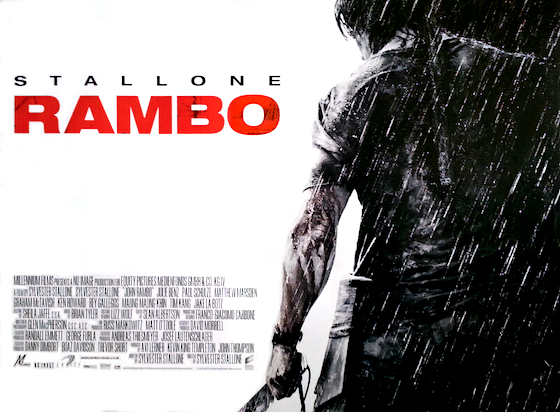
The Cranes Are Flying (1957)

aka Letyat zhuravli

Mikhail Kalatozov | 97 mins | Blu-ray | 1.37:1 | Soviet Union / Russian | 12

The Cranes Are Flying

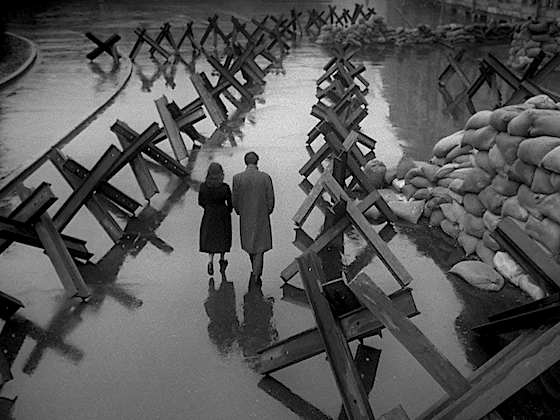
The Russians seem to excel at making a certain kind of war movie; one that befits our stereotype of their national temperament. It might be most succinctly described as “grim as fuck”. The Cranes Are Flying is no Come and See in that regard, but it’s also a million miles away from the gung-ho, celebratory kind of World War II pictures being produced by the US and UK during the same era. No exciting commemorations of the heroic deeds of our brave boys here. Instead, this is a clear-eyed condemnation of the futility of sending the young off to war, and the devastation wreaked on those back at home.

Yet, for all of that, the film is underpinned by what feels like a broadly standard “wartime romance” storyline. Veronika (Tatiana Samoilova) and Boris (Aleksey Batalov) are young and in love, in that all-consuming do-or-die way only young people can be, when war is declared. He does some kind of important job so should be safe from the draft, but — spoiler alert! — he volunteers anyway. Will they survive the war so and be reunited? What other calamities will fate throw at them to prevent happiness? Yes, as if war weren’t enough, other Bad Shit goes down too. I suppose that’s part of what helps the film overcome what could have been a boilerplate plot: that it’s not just about Veronika pining away at home while Boris tries not to get killed on the front line. Indeed, the film is more focused on Veronika’s struggles than on Boris fighting the actual war, and it benefits immensely from a strong performance by Samoilova as Veronika navigates her own personal battles.

The war at home

Nonetheless, what really elevates and defines the film is the truly remarkable camerawork by cinematographer Sergey Urusevskiy. Appropriately, his then-groundbreaking use of handheld cameras was a filming technique he had learned as a military cameraman during the war. But its effectiveness goes far beyond the mere fact the camera isn’t mounted. ‘Handheld’ tends to conjure an idea of rough, on-the-fly, documentary-esque filmmaking, but that’s not the impression you get here. The shots are still carefully composed, it’s just that they’re also often extraordinarily and innovatively designed, in a way that remains striking seven decades later. The very way the camera moves is sometimes part of the storytelling itself; at others, it cleverly imparts new information mid-shot, or reveals the scale of events. As an inherently visual success, there’s little point in trying to describe it — “just watch it” has rarely been more apt. (That said, Chris Fujiwara’s essay for the Criterion Collection neatly describes several of the film’s most memorable shots.)

The Cranes Are Flying was a huge success on its release, both at home in the Soviet Union — where it was a breath of fresh air for a nation used to positive propaganda pictures — and abroad, becoming the first (and last) Soviet film to win the Palme d’Or. (For our part, it was nominated for two BAFTAs, although it won neither: it was one of several still-acclaimed movies that lost Best Film from Any Source to a British film (Room at the Top) that also won Best British Film (do I smell bias?), and Samoilova lost Best Foreign Actress to the lead from that same film (hmm…) Next time someone tries to claim awards have become meaningless, maybe suggest they always have been.) They also don’t really matter, this many years later, when we can easily appreciate this film’s successes — both for the impact it had at the time, and the one it continues to have today.

5 out of 5

The Cranes Are Flying is the 91st film in my 100 Films in a Year Challenge 2024. It was viewed as part of Blindspot 2024. It was my Favourite Film of the Month in November 2024.

Incendies (2010)

Denis Villeneuve | 131 mins | UHD Blu-ray | 1.85:1 | Canada & France / French & Arabic | 15 / R

Incendies

The Best Foreign Language Film category at the 2011 Oscars is, in retrospect, a pretty impressive year. Alejandro González Iñárritu was already well established before his nominated film, Biutiful, but his fellow nominees included Yorgos Lanthimos for only his third feature, Dogtooth, and Denis Villeneuve for this, his second after his career re-start. And yet the winner was In a Better World. Remember that? Me neither. (I don’t even recall it ever being mentioned in the last near-decade-and-a-half; although its director was Susanne Bier, who’s gone on to the likes of The Night Manager and Bird Box, so that’s something). It seems like an odd choice for victor with the power of hindsight, but that’s hindsight for you. On the other hand, watching Incendies, it’s hard to see how anyone could ever have missed its incredible power. (Or maybe In a Better World is even better. I struggle to believe that possibility, but you never know… and probably never will, because who’s still watching it nowadays? It’s certainly not getting a Collector’s Edition-style 4K UHD release from a boutique label — unlike, say, Incendies.)

Incendies is, on the surface, one of those films that can sound off-puttingly heavy: it’s about generational trauma caused by a long-running war in the Middle East. Sure, that kind of thing can be Worthy and Great filmmaking, but egads, hard going. But while Incendies is all those things, it’s also a compelling mystery, which leads to twists worthy of a great thriller. The first of those comes in the film’s setup: Nawal, the mother of a pair of grownup twins has died, and it’s only from her will they learn, first, that their thought-dead father is still alive and, second, that they have an older brother they didn’t know existed. They are tasked with finding both men, and only then will they receive the final letter she has left for them. To do this, they must travel to their mother’s homeland, an unnamed Middle Eastern country (heavily inspired by Lebanon) where the aforementioned war is over, but the scars still linger. As they investigate their mother’s previous life, we see it play out in flashbacks.

While the film at first seems to be about the twins, it’s really most about Nawal. That’s in part thanks to the incredible performance by Lubna Azabal. She has to portray this woman across decades, from a relative innocent to someone changed and hardened by all she’s been through, and charting every step of that journey, too. Plus, she’s left to convey almost all of that silently. Not that she’s mute, but she’s rarely allowed the shortcut of dialogue that discusses or exposes her emotions and motivations. That we still gain so much understanding of the how and why of Nawal is remarkable, really; a performance that, under different circumstances (let’s be honest: if it were in English) would surely have contended for every major award going.

You and whose army?

The film is not about a specific conflict — that’s part of the reason playwright Wajdi Mouawad didn’t explicitly set his original work in Lebanon, and why Villeneuve ultimately didn’t change that when adapting it. Rather, as Villeneuve says, it’s “about the cycle of anger, the heritage of anger in a family, where in a conscious and subconscious way anger is traveling among family members, and among a society”. The point is not “what happened in Lebanon”, but what happens when families are torn apart, emotionally just as much as physically; what the fallout from that is, and how healing can be found — if, indeed, it can.

Oh dear, it’s all sounding a bit heavy again, isn’t it? And yes, there is an element of Incendies that is like that. It’s the kind of film that uses Radiohead on its soundtrack multiple times. (That said, this is how I feel that band’s dirge-like ambient-noise style of music functions best: as background mood-creating film score, rather than as, y’know, songs.) But, as I said before, this is also a film that plays as an effective mystery. What, exactly, happened to Nawal? Who and where is their father? Who and where is their older brother? Why was this a secret Nawal took to her grave? Why did she feel the need to reveal it posthumously? Any and all of these are questions your stereotypical “art house” movie would leave unanswered, providing vague prompts for you to consider after the film ends — or, inevitably, provoke you to Google “Incendies ending explained”. But Incendies isn’t actually like that — all of those questions are answered, because they’re essential to what the film is about. That they can also be gasp-inducing all-timer reveals is another bonus.

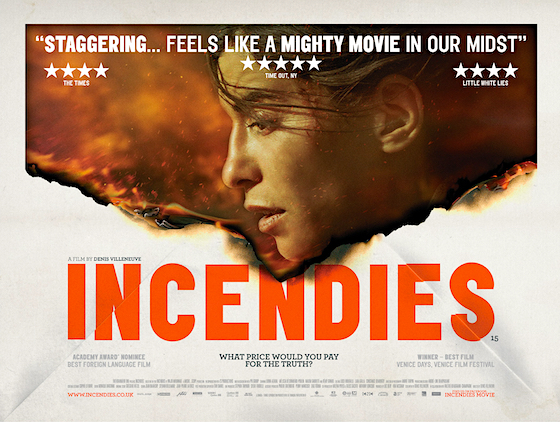
Within that, Villeneuve also shows off the expert filmmaking that has since elevated him to Christopher Nolan-adjacent levels of big-budget auteurist blockbuster-making. There’s a sequence on a bus in the middle of the film that is as tense as any suspense movie, as scary as any horror movie, and as emotionally devastating as any hard-hitting drama. There’s a reason it’s the inspiration for almost every poster and key art piece related to the film. (The exception is the original American theatrical poster, which shows… a woman standing by some sand. Great marketing, folks. Maybe that’s why it didn’t win the Oscar.) It’s an event of such horror that — especially when combined with the shocking revelations later in the film (which, obviously, I’m not going to spoil) — I imagine this is the kind of movie some people swear off ever watching again, like Requiem for a Dream; a big comparison, maybe, but one Incendies is up to.

5 out of 5

Incendies is the 68th film in my 100 Films in a Year Challenge 2024. It was viewed as part of “What Do You Mean You Haven’t Seen All of the IMDb Top 250?”. At time of posting, it was ranked 101st on that list. It was my Favourite Film of the Month in September 2024. It placed 4th on my list of The Best Films I Saw in 2024.

2022 | Week 22

Maybe I should’ve called this post “Weeks 21–22”, to ensure that the titles of these roundups had a complete run of weeks throughout the year. But I didn’t actually watch anything new in Week 21 (my only film that week was the Challenge-qualifying rewatch of On the Town), so it seemed inaccurate to include it.

Week 22, on the other hand, was moderately busy, with this lot…

  • This Means War (2012)
  • To Be or Not to Be (1942)
  • An Unsuitable Job for a Woman (1982)
  • The Pajama Game (1957)
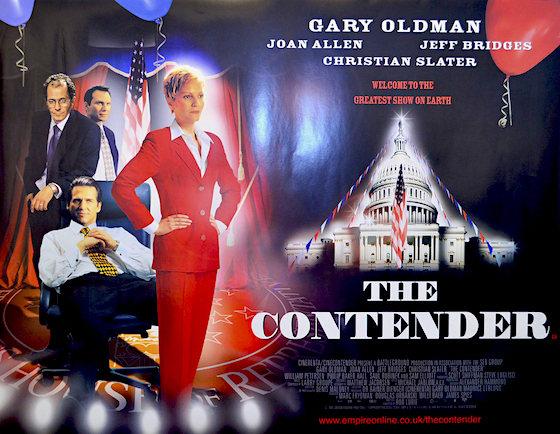
  • The Contender (2000)


    This Means War

    (2012)

    McG | 98 mins | digital (HD) | 2.35:1 | United States / English | 12 / PG-13

    This Means War

    I bet whoever came up with this thought they were a genius: “spyfi action-adventure + rom-com? It’s the perfect date movie!” Of course, what you actually end up with is a film that struggles to do either part well.

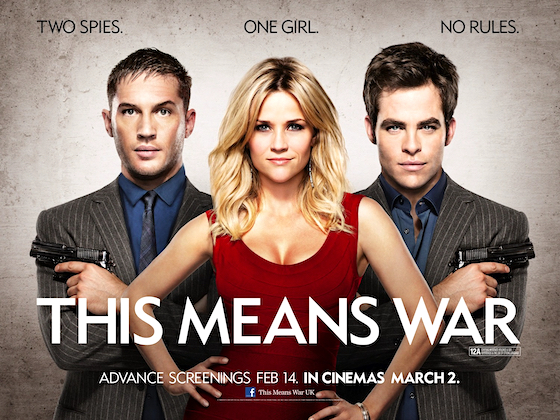
    It stars the unlikely combo of Chris Pratt and Tom Hardy (you definitely can’t imagine Hardy doing a movie like this today) as BFF CIA agents who independently fall for the same woman, played by Reese Witherspoon. Uh-oh. Hilarity ensues as the guys deploy their CIA tricks and tech to influence the relationships. Yeah, it’s the kind of concept that once upon a time sounded like a fun and quirky rom-com, but nowadays seems at best morally dubious, at worst downright creepy. And, indeed, that’s how it plays out, with situation after situation that’s played for laughs but feels a little uncomfortable.

    Of course, the big question is “who ends up with who?” This is one of those films so committed to its storyline, so structured to lead to one correct answer, that… they shot multiple endings so they could decide in post. The one they went with doesn’t feel quite right, but, if you imagine the alternatives, most of them don’t either. Well, I say that: I don’t think it’s really a spoiler to tell you that Witherspoon ends up with one of the guys, when the correct choice would’ve been “neither of them. Run from the stalker-ish CIA agents! Find a normal man!”

    2 out of 5


    To Be or Not to Be

    (1942)

    Ernst Lubitsch | 99 mins | digital (HD) | 1.37:1 | USA / English | U

    To Be or Not to Be

    Ernst Lubitsch’s satire concerns an acting troupe in occupied Poland who become mixed up in a soldier’s efforts to capture a German spy before he can undermine the resistance. Made while World War II was still in full force, the film attracted criticism in some quarters for being a comedy about such tragic and ongoing real-life horrors. Lubitsch defended his work, writing to one critic to say, “What I have satirized in this picture are the Nazis and their ridiculous ideology. I have also satirized the attitude of actors who always remain actors regardless how dangerous the situation might be, which I believe is a true observation.” He’s right, of course; at least about the first part. Ridiculously, such debates about whether you can satirise the Nazis persist to this very day — just look at some of the responses to Jojo Rabbit.

    Lubitsch’s film is subtler than Waititi’s, though still undoubtedly a comedy. I mean, with its plucky resistance members taking occupying Nazis for fools, I couldn’t help but think of this as a classier version of ’Allo ’Allo… but I’ve never actually seen a whole episode of that show, so don’t hold my comparison in too high a regard. Whereas that sitcom is famous for its catchphrases and bawdy gags, To Be or Not to Be is less overt, preferring to paint the Nazis as fundamentally incompetent and derive its humour there.

    Despite the distaste some felt, it obviously works for most people, as it appears on several “great movies” lists, not least both the IMDb and Letterboxd Top 250s. To be honest, I feel like I need to give it another spin to digest it more fully, but these thin thoughts will have to suffice for now.

    4 out of 5

    To Be or Not to Be is the 35th film in my 100 Films in a Year Challenge 2022. It was viewed as part of Blindspot 2022.


    An Unsuitable Job for a Woman

    (1982)

    Christopher Petit | 94 mins | Blu-ray | 1.85:1 | UK / English | 15

    An Unsuitable Job for a Woman

    I’ve never read the P.D. James novel on which this is based, but I’m assured it’s longer and more complex — the film rather lacks for plausible suspects, making the central murder mystery thoroughly guessable.

    That said, I’m not sure co-writer/director Christopher Petit is all that concerned with producing a true whodunnit. Put another way, I think he’s more interested in the characters, who happen to be involved in a mystery, than in the mystery itself. Which is fine, but I’m also not sure the film does as good a job as it could digging into those characters. I mean, the way the kinda-naïve young investigator becomes obsessed with the deceased subject of her inquiries — almost falling in love with him, it seems, like some kind of gender-flipped riff on Laura — is more nodded at than explored.

    In the end, I felt like I wanted to like the film more than it was actually giving me things I needed to really like it. It’s not bad, but perhaps it could have been great.

    3 out of 5


    The Pajama Game

    (1957)

    George Abbott & Stanley Donen | 101 mins | digital (SD) | 4:3 | USA / English | U

    The Pajama Game

    This minor musical is primarily of note for two things: the original Broadway staging featured the choreography debut of one Bob Fosse; and it features the song Hernando’s Hideway — if you don’t recognise the title, I’m sure you’ll recognise the tune. I had no idea this is where it originated.

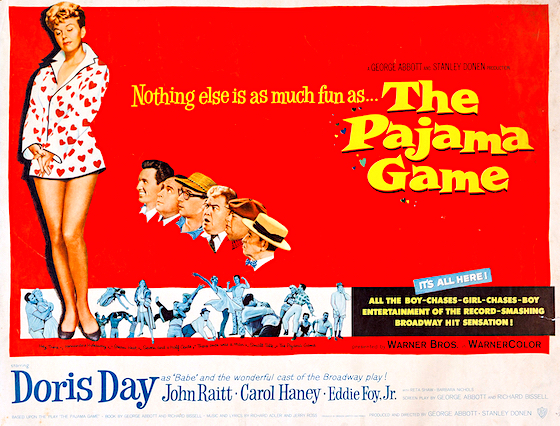
    The story is about a pay dispute in a pyjama factory (given the current strikes and arguments here in the UK, you might think I watched this deliberately. Nope, total coincidence). On one side there’s the leader of the union’s grievance committee (Doris Day, one of just a handful of replacements made to the original cast when they transferred the stage production to the screen). On the other, the new superintendent (John Raitt, clearly a success on Broadway but less so on film). Of course, they fall for each other, before the pay conflict tears them apart. Can their love overcome such trials? What do you think?

    I saw someone describe The Pajama Game as an overlooked classic, which is taking things a bit far. It’s mostly likeable and quite fun, but rarely transcends that level. The undoubted highlight is Fosse’s choreography, which gives even the lesser numbers a polished dynamism. There are a couple of decent songs, but nothing really stands out, bar the aforementioned. It gets a bit too farcical in places, with some of the storylines ultimately taking a turn into very broad territory that feels misjudged. One primarily for genre fans only.

    3 out of 5


    The Contender

    (2000)

    Rod Lurie | 126 mins | Blu-ray | 16:9 | USA, Germany & UK / English | 15 / R

    The Contender

    I only picked this up on disc because it was part of a bundle of other titles I really wanted, but it also sounded like the kind of thing I’d like. Strange that I’d not heard of it before, then. I guess some films just get lost in movie history, especially when they’re a lesser member of a whole wave of movies. This is a political thriller of the kind they seemed to make quite a few of during the ’90s and into the early ’00s, but don’t really do anymore. I guess they exhausted the well, especially after 156 episodes of The West Wing.

    In this case, the story revolves around Laine Hanson (Joan Allen), the first woman nominated to be Vice President (it only took another two decades for that to happen in real life). There’s the familiar battle between the Democrats to get her confirmed, and the Republicans who’d like to do anything to thwart the Democrats. Amongst the scheming between the two sides, the big revelation is that Laine possibly engaged in a scandalous sex act while in college. She refuses to confirm or deny the rumour — it’s her personal business and shouldn’t affect her appointment. Except, of course, it does.

    Various other allegations come and go throughout the confirmation process, the two sides continuing to go back and forth in their attempts to win. It’s not necessarily the point the film is making, but it’s a reminder that politics is all a game to those involved, even as it can have serious effects on the lives of the rest of us. More overtly, the film tackles the different standards a woman is held to when trying to take public office. Fortunately, it’s not as overbearing with that as it could be. Indeed, all round the film is fairly understated. It’s a solid, unflashy, procedural-based kind of thriller.

    That is until the end, when it throws away the understatement for a grandstanding speech based around a fundamental belief in the greatness and goodness of the American political system. It would be heavy-handed in any circumstance, but the past few years (if not longer) of American politics have shown it for the total lie it always was. It doesn’t wholly undermine what’s gone before, but it does end the film on a sour note.

    4 out of 5


  • Archive 5, Vol.4

    I have a backlog of 432 unreviewed feature films from my 2018 to 2021 viewing. This is where I give those films their day, five at a time, selected by a random number generator.

    Today: singing vicars, grumpy gamers, very nice Kazakhs, and deleted actors.

    This week’s Archive 5 are…

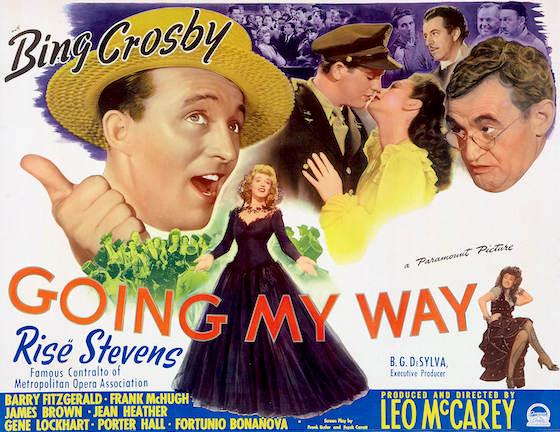
  • Going My Way (1944)
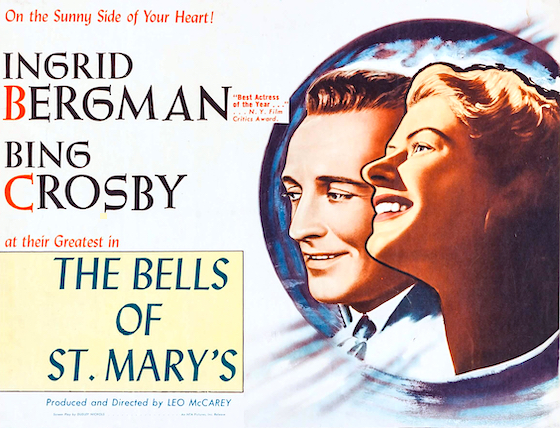
  • The Bells of St. Mary’s (1945)
  • Zero Charisma (2013)
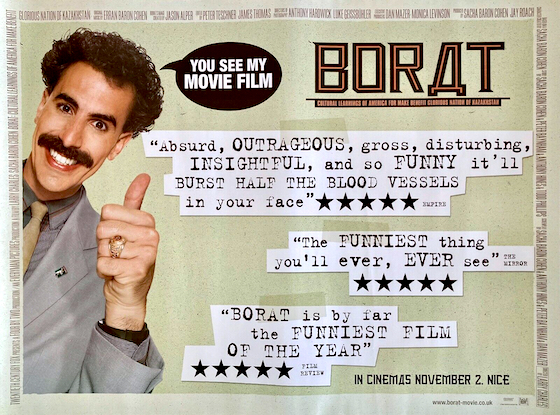
  • Borat (2006)
  • The Thin Red Line (1998)


    Going My Way

    (1944)

    Leo McCarey | 126 mins | digital (HD) | 1.33:1 | USA / English | U

    Going My Way

    The Oscars, eh? Every year film fans pay them a load of attention, and every year we seem to be disappointed with the outcome. But this isn’t some new phenomenon: Going My Way hails from the 1940s, but is perhaps the definitive example of a film that managed to sweep the Oscars (it won seven awards from ten nominations) against a bunch of films that have endured to much greater acclaim (films it competed against included Double Indemnity, Laura, Lifeboat, Gaslight, and Meet Me in St. Louis. I think we can agree those are all better-remembered on the whole).

    None of which is to say it’s a bad film. It’s a gently-paced series of vignettes, almost like a collection of short stories, springing from young priest Father O’Malley (Bing Crosby) arriving to take charge of a struggling New York City parish. His modern ways clash with the old-fashioned values of the incumbent Father Fitzgibbon (Barry Fitzgerald), but his worldly knowledge allows him to connect with some of the parish’s disaffected inhabitants. Despite the religious setting, it doesn’t lean too heavily on the wonders of Christianity (you know I’d be the first to rip into it if it did). Overall, it’s perfectly pleasant; an easy afternoon’s viewing.

    Incidentally (and here’s a good bit of trivia that might come in handy for a quiz someday), it was the first Oscar Best Picture winner to have a sequel: The Bells of St. Mary’s, released the very next year… and also the very next review in this roundup…

    3 out of 5

    Going My Way was #93 in my 100 Films in a Year Challenge 2021.


    The Bells of St. Mary’s

    (1945)

    Leo McCary | 126 mins | TV (SD) | 4:3 | USA / English | U

    The Bells of St. Mary's

    This followup to Going My Way was not only the first sequel to an Oscar Best Picture winner, but was also the first sequel to be nominated for the Best Picture Oscar.

    Bing Crosby returns as Father O’Malley, sent to a new locale, ready to solve another series of subplots at a struggling religious institution, this time butting heads (sort of — it’s never as dramatic as that makes it sound) with Ingrid Bergman’s head nun. Like the first one, it’s really a bundle of subplots for Bing to ‘solve’. The low-stakes problems and amiable tone between the two leads, even when they’re disagreeing, makes for a gentle and relaxing kind of film. I’d give it the edge over its Oscar-winning predecessor, thanks primarily to Bergman’s performance, but neither film is likely to set anyone’s world alight.

    As well as their Oscar success, the films were the highest grossing at the US box office for 1945 and ’46, respectively, another first for a film ‘series’. And yet, with six decades distance, they’re little more than also-rans; nicely obscure trivia answers to “films that won/were nominated for Best Picture”. Maybe there’s a lesson in that for anyone obsessed with the current cultural zeitgeist.

    3 out of 5

    The Bells of St. Mary’s was #187 in my 100 Films in a Year Challenge 2021.


    Zero Charisma

    (2013)

    Katie Graham & Andrew Matthews | 88 mins | digital (HD) | 16:9 | USA / English

    Zero Charisma

    I’d nickname this Portrait of a Manbaby on Fire. The manbaby in question is Scott (Sam Eidson), a stereotypical alpha-nerd: he has a neckbeard; he wears black T-shirts that feature elaborate depictions of grim reapers and the like; he lives with his grandma; he paints miniature fantasy figurines; he’s the Game Master of a role-playing group, which he rules with an iron fist. But when into-geeky-stuff hipster Miles (Garrett Graham) joins the group and everyone really likes him, Scott finds his position threatened, and he’s not happy about it.

    As much as geek/nerd culture has transitioned into the mainstream over the past couple of decades, there’s still stuff that remains the preserve of the hardcore; the truly nerdy. That culture clash is part of what Zero Charisma is about, of course, with Scott’s true old-fashioned kind of nerdishness clashing with Miles’s new-school cool. But it’s also a character study of the former. Scott may seem a stereotype — like The Simpsons’ Comic Book Guy rendered in live-action — but I’d wager anyone who’s moved in nerdish circles has known someone at least a bit like him. Stereotypes are stereotypes for a reason. The film exposes and examines those to often amusing effect. Some have said it exaggerates these things, but I don’t think it’s particularly guilty of that. Maybe it generalises them, and lumps all the worst characteristics of the extremely nerdy together into one character, but that doesn’t make it inaccurate, just broad.

    My only real problem was the ending. There’s a scene where everything comes to a head — a climax, if you will — but, in the wake of that, I felt it lacked adequate resolution. Has Scott learnt anything from this experience? Is he a changed man? Maybe a little, but not completely. To be fair, that’s a realistic character arc, because whose personality changes overnight after a single revelation? And yet it also doesn’t feel like the filmmakers quite know how they want to leave things. If they’d been going for a “change takes time and is incremental, but Scott’s started on that road” kinda message, I would have approved. Instead, the film tries to have its cake and eat it by showing Scott as better on the surface, but then secretly GMing a game where he still behaves like an asshole. Maybe it’s trying to say we can never truly change, however much our flaws are highlighted to us, which would be a pretty glum way to end an otherwise likeable comedy.

    3 out of 5

    Zero Charisma was #109 in my 100 Films in a Year Challenge 2020.


    Borat

    (2006)

    aka Borat: Cultural Learnings of America for Make Benefit Glorious Nation of Kazakhstan

    Larry Charles | 84 mins | digital (HD) | 16:9 | USA & UK / English | 15 / R

    Borat

    Ali G’s Sacha Baron Cohen adopts the persona of a Kazakh journalist to ostensibly interview Americans about their culture, but, unbeknownst to them, he’s of course really looking to expose their ludicrous views (you just know that, ten years later, a lot of these people voted for Trump) and take the piss out of them for our entertainment.

    As with most sketch-based comedy, the end result is a mixed bag. Sometimes it’s very funny; other times, it’s just being gross for the sake of it, like in a naked fight between Borat and his portly producer. A few bits don’t quite land — sometimes you can feel Baron Cohen’s not getting the response he wanted out of his target — and, even though he’s taking the piss out of people who deserve it, it sometimes gets a bit uncomfortable (though that might just be my English reserve/politeness kicking in and making me cringe). Most of the sketches are quite short, which is nice — they generally don’t outstay their welcome, and, if one isn’t working, you can be assured another will be along shortly.

    3 out of 5

    Borat was #220 in my 100 Films in a Year Challenge 2020.


    The Thin Red Line

    (1998)

    Terrence Malick | 171 mins | Blu-ray | 2.35:1 | USA / English | 15 / R

    The Thin Red Line

    An extensive cast of famous actors and recognisable faces star as a battalion of soldiers who spend 2 hours and 51 minutes taking one (1) hill in Terrence Malick’s very Terrence-Malick-y World War 2 movie. I mean, this is a movie about a battle in which the first shots aren’t fired until past the 45 minute mark, but there are plenty of shots showing the minutiae of nature. And there’s a lot of discussion about how there isn’t enough water.

    None of which is necessarily a problem — indeed, there are plenty of people who think this is a great movie, and I’m glad for them. But for everyone who loves it, there’s someone who’d call it “pretentious and self-indulgent, despite gun battles and lush cinematography.” I find myself somewhat stuck in the middle. I mean, if you were expecting a normal combat movie from Terrence Malick, more fool you. And it’s unquestionably beautifully shot — so many gorgeous visuals, but also effective camerawork and editing to convey, say, the chaos of battle. But I also found it to be bitty and episodic. Well, calling them “episodes” might be kind — they’re scenes; sometimes less than scenes; just moments, or even shots. It’s like a really long deleted scenes package pretending to be a movie.

    Of course, the behind-the-scenes stories sort of support that reading. The first cut clocked in at five hours. It took two editors and thirteen months of post-production to get it to a manageable size. Hans Zimmer composed over four hours of music, but only for a few bits of his work made it into the final cut. Billy Bob Thornton recorded narration for the entire film; the released cut has eight different narrators, but none of Thornton’s work is in there. Many actors thought they had significant roles, but found their performances reduced to little more than cameos. Most famously, Adrien Brody thought he was playing the lead role, only to discover at the premiere that he’s in just a couple of shots, and doesn’t even speak until over halfway through (and then it’s just a brief voiceover). And then there are the actors whose work was left on the cutting room floor: Bill Pullman, Gary Oldman, Lukas Haas, Viggo Mortensen, Martin Sheen, Jason Patric, Mickey Rourke… This movie has more great actors whose performances were deleted entirely than most movies have in their entire cast!

    All of which suggests a movie that should be universally recognised as a disaster. That it isn’t — quite the opposite — is testament to something. Maybe someday I’ll rewatch it and find out what.

    3 out of 5

    The Thin Red Line was #77 in my 100 Films in a Year Challenge 2020. It was viewed as an additional film for Blindspot 2020 after I failed to watch it for WDYMYHS 2019.


  • The 100-Week Roundup XXVI

    The 100-Week Roundup covers films I still haven’t reviewed 100 weeks after watching them. Sometimes these are short ‘proper’ reviews; sometimes they’re only quick thoughts, or even just the notes I made while viewing.

    This week’s selection, the final two films from March 2019, includes a pair of awards-worthy short animations — the first won an Oscar, the second was nominated for one. I was going to include more films in this week’s roundup (effectively bundle two weeks into one), but it felt like a disservice to this pair.

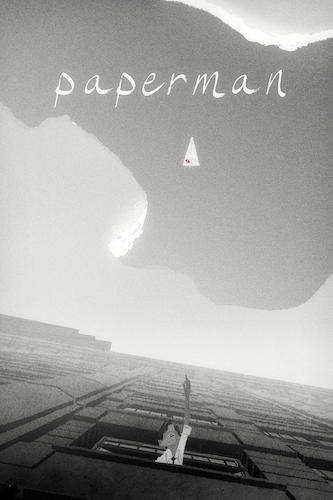
  • Paperman (2012)
  • Waltz with Bashir (2008)


    Paperman
    (2012)

    2019 #48a
    John Kahrs | 7 mins | Blu-ray (3D) | 1.85:1 | USA / silent | U / G

    Paperman

    This Disney short was originally released alongside Wreck-It Ralph (and can now be found on that film’s Blu-ray; as well as on Disney+, I presume) and, as I recall, attracted a lot of praise at the time, primarily for its visual style. That was an innovation in creating 2D-looking animation via a 3D system — so it seems a bit daft that I watched it in 3D. I have to wonder if the added visual dimension highlights the underlying 3D animation, because it’s quite obviously been created in 3D with a 2D style over the top.

    That said, it look gorgeous, however you cut it. There’s an inherent beauty in how it’s executed, while the chosen black-and-white style emphasises the apparent setting (’40s New York) and also gives it a timeless quality. The 2D/3D combination works well, giving it the fluidity and dynamism of CG animation, but with a certain roughness — a hand-made-ness — that comes from 2D cel animation. Of course, that’s artificial, injected via design choices (like scruffy outlines on the characters), but it feels authentic.

    As for the actual story, it’s a charming little romantic number involving paper aeroplanes… until those sheets of folded paper become sentient and omniscient, at which point it lost me with its silliness. But as an exercise in style: lovely.

    4 out of 5

    Waltz with Bashir
    (2008)

    aka Vals Im Bashir

    2019 #49
    Ari Folman | 87 mins | TV | 16:9 | Israel, France, Germany, USA, Finland, Switzerland, Belgium & Australia / Hebrew, Arabic, German & English | 18 / R

    Waltz with Bashir

    One night at a bar, an old friend tells director Ari Folman about a recurring nightmare in which he is chased by vicious dogs. They conclude that there’s a connection to their Israeli Army service in the first Lebanon War of 1982. Ari can’t remember that period of his life, so he meets and interviews old friends and veterans, hoping to discover the truth about that time and reconstruct his own memories of the conflict. — adapted from IMDb

    This search for the truth has led Waltz with Bashir to be labelled an “animated documentary”, which sounds like an odd idea, almost oxymoronic — you can tell a true story with animation, of course, but can you document something? Well, yes. Rather than talking heads, what animation allows is the visualisation of the narrators’ memories and dreams alike, and means we can flow between them, too. On a practical level, it allows the film to stage scenes that would be impossible in live-action without a huge budget, meaning it doesn’t have to compromise on the stories it tells. More thematically, having a shared style between ‘reality’ and ‘dream’, plus the distancing effect of it being drawn, not ‘real’ — of being unequivocally created, not just filmed — helps to underscore larger points about the reliability (or otherwise) of memory. The dreams are connected to the memories; are the memories a kind of dream?

    Given the time period being remembered, of course the film is about war and how that affects the mind of its participants, but it’s also memory in general, I think. You’d think such extreme, unique experiences would be unforgettable, and yet the workings of the mind and memory aren’t that straightforward. One strand I found particularly fascinating was the way people are haunted by the suffering of animals in the conflict, perhaps more so than by the human-related atrocities they saw. Is this just a coincidence of the people Folman spoken to? Is it a particular interest of Folman himself? Or is it a genuine phenomenon? I don’t know the answer, but (outside of, say, War Horse) I don’t remember it being such a clear thread in a war-related film or documentary before.

    I’ve seen people say they couldn’t connect with Waltz with Bashir because they didn’t know the history of the period well enough. Conversely, I felt that was part of why the film was so effective: not really knowing what was going on or what was being referred to, I was discovering it as the character did. Some parts along the way could perhaps have used further clarity or explanation for those of us entirely unfamiliar with the conflict, but there’s enough information disclosed to be going on with. I found the film’s ending to be powerful beyond words, and part of what makes it so shocking and impactful is not knowing about it, of learning about it for the first time with the characters.

    5 out of 5

  • The 100-Week Roundup XXV

    Another week goes by, and once again I’ve only managed to put together one of these belated roundups. Hopefully new-new reviews will re-emerge sometime soon…

    In the meantime, The 100-Week Roundup covers films I still haven’t reviewed 100 weeks after watching them. Sometimes these are short ‘proper’ reviews; sometimes they’re only quick thoughts, or even just the notes I made while viewing.

    This week’s selection rattles through five more March 2019

  • The Italian Job (1969)
  • Downsizing (2017)
  • Brigsby Bear (2017)
  • Starship Troopers (1997)
  • Escape from New York (1981)


    The Italian Job
    (1969)

    2019 #40
    Peter Collinson | 95 mins | digital (HD) | 2.35:1 | UK / English & Italian | PG / G

    The Italian Job

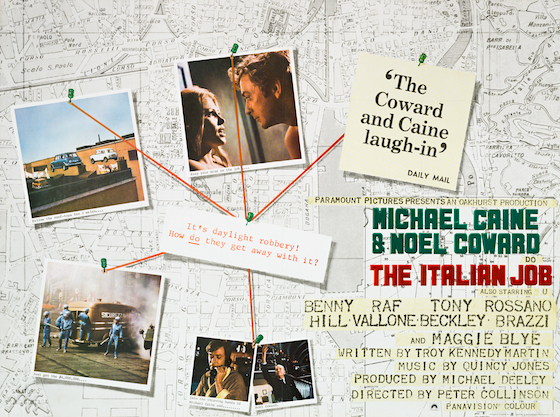
    The Italian Job is one of those things that I think is in the consciousness of every Brit. Tricolour Minis racing around city streets, up and down stairs and through sewer tunnels… the literal cliffhanger ending… “you’re only supposed to blow the bloody doors off!”… Cultural osmosis imparts these things to all us Brits, whether we’ve seen the film or not — and, at the grand old age of 32, I had not. But it was 50 back in 2019, so when better than then? Which is why I watched it then; and, because I’m tardy, am reviewing it now.

    The awareness of the film I’d acquired down the years doesn’t quite prepare you for the actual thing, mind — the first half-hour is as much a frisky, cheeky sex romp as it is heist caper. Although, as you can infer from the classifications above, it doesn’t get too risqué. Of course, the real fun comes later, when Michael Caine and his crew of crooks execute an audacious gold robbery in Turin, causing a city-wide traffic jam that they can nip around in their Minis. This climactic chase doesn’t make much sense logically (they drive onto a roof only to drive back off it? They hide by parking in a car lot where there were precisely three spaces among similar-looking cars?), but it’s a lot of anarchic entertainment nonetheless. A bit like the whole movie, really: genuine crime isn’t like this, but this is a lot more fun.

    4 out of 5

    Downsizing
    (2017)

    2019 #41
    Alexander Payne | 130 mins | digital (HD) | 2.39:1 | USA & Norway / English, Norwegian & Spanish | 15 / R

    Downsizing

    In the future, searching for a way to solve overpopulation and global warming, a scientist invents “downsizing”, a process to shrink people to a height of five inches. People start to voluntarily be ‘downsized’, in part because being small has economic benefits. Financially-struggling couple Paul (Matt Damon) and Audrey (Kristen Wiig) decide to trade their ordinary lives for the extravagant lifestyle promised by New Mexico’s impeccable downsized community, Leisureland. But not all problems are so easily fixed, and a chance encounter with a shady entrepreneur (Christoph Waltz) and a famous Vietnamese political activist (Hong Chau) sets Paul on a path where he must choose between a sheltered life or making an impact in his own small way. — adapted from IMDb

    There are promising ideas and concepts at the heart of Downsizing — under an appropriately-minded director, this concept should’ve been a goldmine. Unfortunately, Alexander Payne doesn’t seem to be the right person for the job. It feels like he’s playing at being more of a Spike Jonze type, and not succeeding.

    The problems begin at a screenplay level. It feels like a very “and then this” narrative: things keep happening, one after another, with little to tie it all together. The final act eventually links back round to the prologue, to give a sense of the film all being a whole, but the real meat of the story — what happens to Paul in the middle — is just a series of events. Sometimes, it entirely abandons important stuff from earlier on so as to strike out on new tangents.

    That contributes to a feeling of tonal and thematic whiplash. The film ping-pongs around various themes and threads, seemingly indecisive about what it wants to comment on. Consequently, it offers nothing but the most superficial observations on topic. On top of that, it swings from broad comedy to introspective drama at whim.

    On the bright side, the visuals are pretty effective, managing to plausibly make the small world feel small even within itself. It’s just a shame the core of the movie can’t match up to the effects.

    2 out of 5

    Brigsby Bear
    (2017)

    2019 #43
    Dave McCary | 93 mins | digital (HD) | 2.35:1 | USA & China / English | 15 / PG-13

    Brigsby Bear

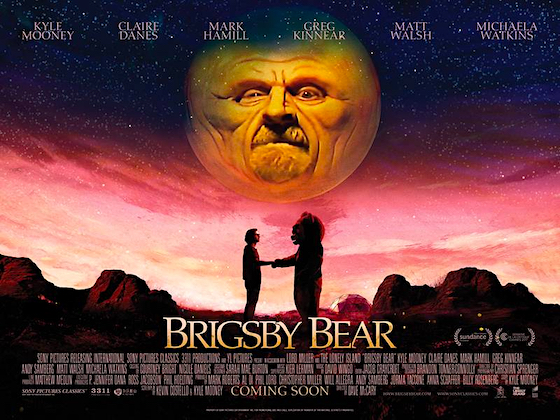
    Room meets Be Kind Rewind in this quirky comedy-drama. James (Kyle Mooney) is a young man who has lived all his life in an underground bunker with his parents (Mark Hamill and Jane Adams)… except they’re not really his parents: he was kidnapped as a baby and has been held captive for decades. After being freed, James learns that the TV show he was obsessed with in the bunker, Brigsby Bear Adventures, isn’t real either — it was made by his captors just for him. Unable to let Brigsby go, James sets out to finish the story by making a Brigsby Bear movie himself.

    There’s a sense in which some of Brigsby Bear is stuff we’ve seen before — the “group of friends set out to make an overambitious (home) movie” conceit has been trotted out by indie movies like Son of Rambow and Me and Earl and the Dying Girl, as well as the aforementioned Be Kind Rewind. Director Dave McCary and screenwriters Kyle Mooney & Kevin Costello give that basic material a quirky new sheen, but the real joy lies in the film’s insistent good-heartedness. It’s refreshing (if arguably unrealistic), and the joy its characters find in the shared creative experience is suitably infectious. Indeed, it reaches a point where the ending is surprisingly emotional. The raft of comparisons may suggest this isn’t the most original confection, but I loved it nonetheless.

    5 out of 5

    Brigsby Bear placed 15th on my list of The Best Films I Saw in 2019.

    Starship Troopers
    (1997)

    2019 #46
    Paul Verhoeven | 130 mins | Blu-ray | 1.85:1 | USA / English | 18 / R

    Starship Troopers

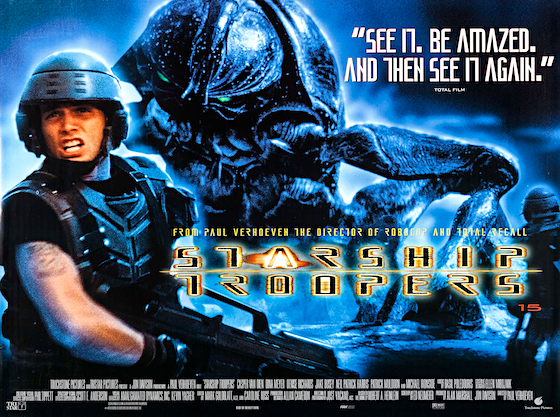
    Dismissed by many critics on its original release as cheesy sci-fi, Starship Troopers has been somewhat reclaimed in the decades since, both turned into a surprisingly enduring franchise (multiple sequels, animated series, etc) and praised as an anti-fascist satire. As I understand it, the original novel by Robert A. Heinlein is straight-up right-wing claptrap, but director Paul Verhoeven — who grew up under Nazi occupation — saw its inherent ridiculousness, and so intended to reshape it as a deconstruction of, well, itself.

    In that regard, for me, it’s a mixed success. The satire itself is a little thin. War is bad? Yep. The people in power use propaganda to keep you on their side? No shit. Put anyone in a Nazi-like uniform and we can infer they’re actually bad? Obvs. So why did many critics seem to miss it on the film’s original release? Perhaps because everything that surrounds it is cheesy third-rate stuff. When the character drama has all the depth and quality of a daytime soap, it’s easy to presume the similarly-daft in-universe commercials are also meant to be taken straight; that any humorousness was unintentional.

    And so, somewhat ironically, I thought Starship Troopers worked best as a straightforward sci-fi action/war movie. It’s a bit Full Metal Starship: first half is all pre-war/boot camp stuff, then the second half takes the characters out into the actual conflict. All the combat sequences are pretty thrilling on a visceral level, and the special effects mostly hold up to this day. Plus, it’s all bolstered by a great militaristic score from composer Basil Poledouris.

    After a couple of decades hearing “Starship Troopers is good, actually”, I found myself almost hewing closer to the original critical assessment. Perhaps it raises that old question of authorial intent: if it was meant to be satire, should we treat it as satire, even if it doesn’t actually look like satire?

    4 out of 5

    Starship Troopers was viewed as part of Blindspot 2019.

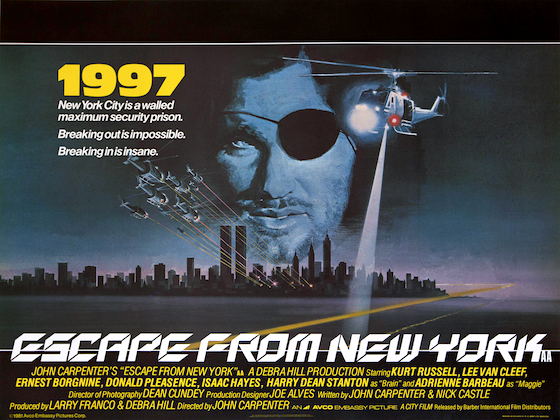
    Escape from New York
    (1981)

    2019 #47
    John Carpenter | 99 mins | Blu-ray (UHD) | 2.35:1 | USA & UK / English | 15 / R

    Escape from New York

    It’s a wonder that Escape from New York never wound up on my Blindspot list — it’s exactly the kind of film I always expected would be on there. Well, I guess the way I choose those films often errs towards “cinephile classics” rather than the kind of films I read discussed as classics in the kind of genre magazines I grew up reading. I’m sure it would have made it in eventually, if I hadn’t just straight up watched it first.

    I mention that upfront because it indicates something about how much I expected Escape from New York to be My Kind of Thing; and so there is every possibility my expectations for it were set too high. Frankly, it wasn’t as much pulpy fun as I expected it to be. It’s surprisingly slow, and very nihilistic — this isn’t a fun ride through a cool dystopia, more a glum portrait of everything having gone to shit, but in the body of an action movie.

    That said, I’m by no means arguing this is a bad movie. There is stuff here that’s good and that works, and is cool in the way it should be (it’s a pulpy premise that gets a pulpy treatment — I think “cool” is a perfectly valid thing for it to aim for). Kurt Russell does his best Clint Eastwood impression (literally) as anti-hero Snake Plissken, which is quite fun, and there’s some great music on the soundtrack, especially the main theme. Considering the lowly budget, the ruined streets of future New York are well realised too, supplemented by a tiny amount of location footage (the first film to be shot on Liberty Island!) and a stunning model of the blacked-out city.

    Despite all of that, overall it doesn’t come together and achieve the heights I expected of it. In some respects, my score below is generous — it’s a downgrade from the 5 I hoped I’d be giving the film, rather than an upgrade from a neutral 3, if that makes sense. Definitely one I need to revisit with realigned expectations.

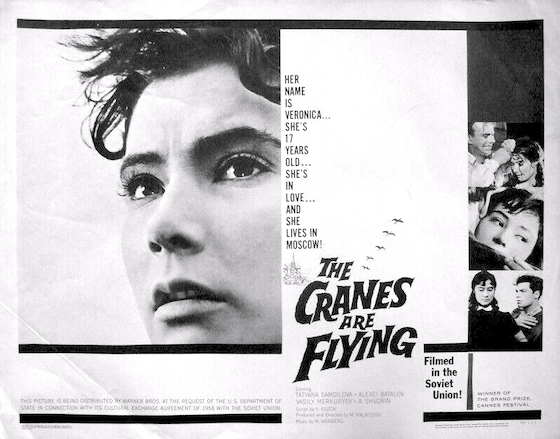
    4 out of 5

  • The 100-Week Roundup XXIV

    The 100-Week Roundup covers films I still haven’t reviewed 100 weeks after watching them. Sometimes these are short ‘proper’ reviews; sometimes they’re only quick thoughts, or even just the notes I made while viewing.

    This week’s selection includes three films from March 2019

  • Bruce Almighty (2003)
  • Isle of Dogs (2018)
  • Life Is Beautiful (1997)


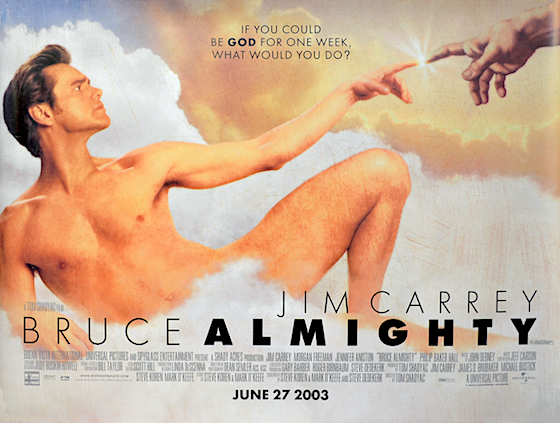
    Bruce Almighty
    (2003)

    2019 #31
    Tom Shadyac | 97 mins | digital (HD) | 16:9 | USA / English | 12 / PG-13

    Bruce Almighty

    Television reporter Bruce Nolan (Jim Carrey) doesn’t think the world is treating him fairly, but when he angrily rages against God, he actually gets a response. God (Morgan Freeman) decides to take a holiday, leaving Bruce in charge with His divine powers. As Burce puts his omnipotent powers to the test, he comes to realise that with great power comes… yeah. — liberally adapted from IMDb

    I mean, in fairness to Bruce, Spider-Man only came out the year before — maybe he just hadn’t seen it yet.

    Anyway, Bruce Almighty is almost entirely fuelled by Carrey’s antics — if you enjoy his zany style, you’ll lap it up; if you hate it, there are no redeeming qualities that haven’t been done better in other broadly-similarly-themed films (see Groundhog Day, for example). I say “almost entirely” because there are brief asides where Morgan Freeman or Steve Carrell get to steal a scene. Indeed, Freeman earned the film’s only out-loud laugh from me when he casually throws in one of Carrey’s best-known catchphrases.

    Personally, I’m in between on comedy-mode Carrey, and so that’s where I landed on Bruce Almighty. He doesn’t push his schtick so far that it becomes irritating to me, as in the Ace Ventura films (I quite liked them as a kid but feel I’d hate them now), but nor is it inspired enough to really transcend being just what it is.

    3 out of 5

    Isle of Dogs
    (2018)

    2019 #32
    Wes Anderson | 97 mins | digital (HD) | 2.35:1 | USA & Germany / English & Japanese | PG / PG-13

    Isle of Dogs

    Wes Anderson has a weird proclivity for killing dogs in his movies, so it seems almost like some kind of atonement that he’d turn around and make a movie whose title is a homophone for “I love dogs”.

    This animated adventure is set in a near-future Japan, where a canine flu is spreading through the city of Megasaki. To stop it, the mayor orders all dogs be banished to Trash Island — starting with Spots, the pet of his orphaned 12-year-old nephew, Atari. So Atari steals a plane and flies to Trash Island, where he teams up with five stray dogs to search for his exiled pal.

    Isle of Dogs attracted a certain amount of criticism when it was released for its treatment of the Japanese characters and, especially, language; primarily, that the Japanese dialogue is not subtitled, thereby ‘othering’ those characters because we’re prevented from engaging with them. When watching the film, my first thought was those complaints were being a bit daft: the dogs speak English, the humans speak Japanese, and we’re clearly being placed with the dogs — the humans are ‘other’ because they’re human, not because they’re Japanese. But then the film keeps jumping through hoops to get around this, for example with translators on TV to re-speak the Japanese in English; or an American exchange student to speak for another group with English dialogue. This is where it does tip into being problematic; where it can feel like a Western director playing around with another culture.

    All of which said, I still very much enjoyed the film. As a fellow Anglophone admirer of Japanese culture, that aspect broadly worked for me. Setting aside the controversy, it’s still amusing, in Anderson’s normal mode, with a suitably exciting and action-packed quest narrative.

    5 out of 5

    Life Is Beautiful
    (1997)

    aka La vita è bella

    2019 #33
    Roberto Benigni | 116 mins | digital (HD) | 1.85:1 | Italy / Italian, English & German | PG / PG-13

    Life is Beautiful

    In 1930s Italy, a carefree Jewish librarian named Guido starts a fairytale life by courting and marrying a woman from a nearby city. They have a son and live happily together until the occupation of Italy by German forces, when they’re separated and sent to concentration camps. Determined to shelter his son from the horrors of his surroundings, Guido pretends that their time in the camp is merely a game. — adapted from IMDb

    Every summary of Life is Beautiful concentrates on the “they end up in the Holocaust” bit — which is fair enough, it’s rather a major thing. But this is really a film of two halves. The first is a broad, sketch-like comedy, in which Guido (played by cowriter-director Roberto Benigni) bumbles around, woos his wife, and starts a lovely life. It’s the kind of comedy in which there’s a single sequence where a bunch of sketches all pay off at once, in a series of coincidences that’s somewhere between artful and ludicrous. The second half is a kind of concentration camp comedy, which is just as unwieldy as that sounds. The almost farcical humour of the first half attempts to linger on, but it buts awkwardly against the unspeakable horrors that occur.

    Eventually it comes to an ending that I was similarly divided about. It’s clearly designed to be hyper-emotional, and it pulls at some very obvious strings to get there quickly, which seems to work for many viewers, but I didn’t feel it. Why? Well, it’s based in the relationship between father and son, and I don’t think the rest of the film really is. The first half of the film is all about investing us in the relationship between Guido and his wife — we follow their relationship from the very beginning, and the film charms us and connects us to their coupling. But then the second half virtually tosses that aside to make the important relationship the one between Guido and his son. We get two or three quick scenes that incidentally suggest a good father/son bond, then it’s off to the camp, which is a whole other kettle of fish. We’re not given the time to properly buy into this father/son relationship. That’s not to say I don’t believe it, just that we’re only learning about it at the same time as we’re supposed to be affected by its endurance. Doing both at once doesn’t work, in my opinion. Now, if the first half (or even just the first act) had been about Guido and his son’s wonderful relationship before the occupation, it would have established that well and connected us to it; then, if the rest of the film unfolded as-is, I think it would have made for a much more powerful ending, because it would have had the full weight of their entire relationship behind it. Instead, as well as being a film of two halves, Life is Beautiful ends up a film of two relationships, one in each half.

    Despite the film winning awards at Cannes and the Oscars, and being in the top 10% of IMDb’s Top 250, etc, this “two halves” thing — the awkward balancing act between comedy and tragedy — has been noted by critics ever since its initial release. It makes for a wavering viewing experience. It’s kind of inappropriate, but kind of isn’t; it kind of celebrates the ingenuity of the human spirit, but kind of belittles the real tragedy in the process; it’s kind of a success, but kind of a well-meaning misguided effort. It’s this sense that the film’s heart is in the right place that sees my score err upwards.

    4 out of 5

    Life is Beautiful was viewed as part of What Do You Mean You Haven’t Seen…? 2019.

  • The 100-Week Roundup XXII

    The 100-Week Roundup covers films I still haven’t reviewed 100 weeks after watching them. Sometimes these are short ‘proper’ reviews; sometimes they’re only quick thoughts, or even just the notes I made while viewing. This week’s collection includes three more feature films and one short from February 2019

  • Hacksaw Ridge (2016)
  • Leave No Trace (2018)
  • Inception: The Cobol Job (2010)
  • Fences (2016)


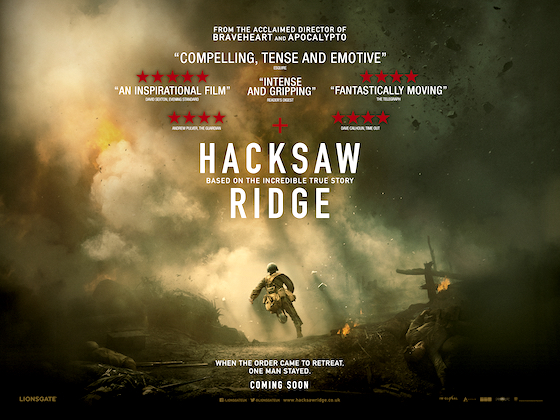
    Hacksaw Ridge
    (2016)

    2019 #17
    Mel Gibson | 139 mins | digital (HD) | 2.35:1 | Australia & USA / English | 15 / R

    Hacksaw Ridge

    Hacksaw Ridge tells the true story of Desmond T. Doss (Andrew Garfield), an American who believed that World War II was justified — so he joined the army to serve his country — but also that killing was wrong — so he refused to carry a weapon. Serving as a combat medic, Doss ended up at the bloody Battle of Okinawa, where he saved the lives of 75 men without firing a shot, and became the first conscientious objector to earn the Medal of Honor.

    It’s an extraordinary true story — the kind of thing that would seem ludicrous if someone made it up — so it earns its place on the screen. Unfortunately, I don’t think the best way to tell it was by letting Mel Gibson carve it from a block of cheese. When the film’s not wasting time on clichéd bootcamp stuff, it’s earnestly indulging in its subject matter to an eye-rolling degree. Indulgence is also the name of the game when it comes to the war, too: for a movie about a guy who wouldn’t kill, it certainly revels in its gory depictions of combat. Handled the right way, such grotesquery could have supported the point that Desmond is right, but Gibson seems to be enjoying the slaughter too much.

    And yet for all of Gibson’s amping it up, some of the real-life stories are even more incredible than what’s in the film — there are stories in IMDb’s Trivia section (here and here, for example) that stretch credulity so far it was decided to leave them out because audiences would never believe it. Considering how OTT the stuff left in is, it seems a shame to have left out something that could be backed up as a true account.

    3 out of 5

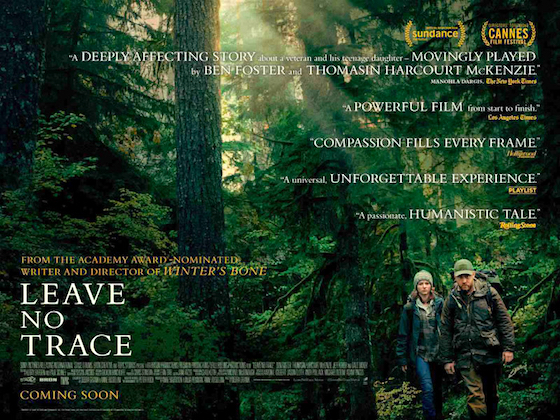
    Leave No Trace
    (2018)

    2019 #18
    Debra Granik | 109 mins | digital (HD) | 1.85:1 | USA & Canada / English | 12 / PG

    Leave No Trace

    Traumatised military veteran Will (Ben Foster) and his teenage daughter, Tom (Thomasin McKenzie), have lived in isolation for years in a public park outside Portland, Oregon, only occasionally venturing in to the city for food and supplies. But when they’re spotted by a jogger, they’re arrested and put into social services. Tom finally gets a sense of what it might be like to integrate with society, but Will clashes with his new surroundings, and soon they set off on a harrowing journey back to the wild. — adapted from IMDb

    I don’t like summarising too much of a film’s storyline at the start of a review, but Leave No Trace is one of those films where the character work is more important than the shifts of the plot. It’s a double portrait: that of a damaged man who can’t cope with society, and his loving daughter who he’s taken on the same path, for good or ill. Will’s lifestyle and parenting methods are entirely at odds with what’s seen as acceptable by society (hence the arrest and being placed in care), but does that make him wrong? The pair’s life in the woods is a “back to nature” approach, detached from technology and the hum of modernity, which many profess to strive for — he’s just actually gone and lived it. But Tom, as just a young teenager, has had this life thrust upon her — it’s what her dad wants, but she’s never known anything else to have the choice.

    So the film rests on the two lead performances. Ben Foster is reliably superb as a father doing his best for his daughter — and, actually, not doing a bad job — but struggling with his own issues and traumas. But the star is Thomasin McKenzie, in what’s proven (rightly) to be a breakout role (she quickly followed this with another leading role in Jojo Rabbit, and will next be seen in new movies from Edgar Wright, M. Night Shyamalan, and Jane Campion). She was just 17 when the film was shot, but is entirely convincing as a 13-year-old, and yet the character also seems old for her age. It’s a weird dichotomy, that. It never crossed my mind that the actress was any older than the character — it’s not just that she looks young, it’s a quality in the performance — and yet she also conveys that sense of being “wise beyond her years”. As if that wasn’t enough, the film’s emotional crux lies with her, delivered in a single emotional gut-punch of a line that’s liable to make you choke up just remembering it.

    4 out of 5

    Inception: The Cobol Job
    (2010)

    2019 #20a
    Ian Kirby | 15 mins | Blu-ray | 16:9 | USA / English | 12

    Inception: The Cobol Job

    Remember motion comics? They were a brief fad where comic books were adapted into movies/series by simply adding movement and sound to the original artwork. (I say “brief fad”, they may still make them for all I know, but there was a rash of them about ten years ago that seems to have abated.) That’s what this animated prequel to Christopher Nolan’s Inception is: a moving version of the one-shot comic (originally published online, but also included in print with some releases of the movie), written by Jordan Goldberg with art by Long Vo, Joe Ng, and Crystal Reid of Udon.

    As motion comics go, the animation here isn’t bad. It’s still clearly derived from a comic book rather than being born into animated form, but it’s got a decent amount of movement and dynamism. But its main fault is not having any voice actors. There’s music (taken from Hans Zimmer’s score for the feature) and sound effects, which complement the atmosphere and help connect it to the film proper, but having to read speech and thought bubbles really keeps it in “motion comic” rather than “animated short” territory. Were the producers at Warner really so cheap that they couldn’t’ve afforded a couple of voice actors for an afternoon’s work?

    As for the story, it’s a nice little prequel to Inception, more-or-less tonally in-keeping with Nolan’s work. It sets up the backstory behind the film’s opening heist and some of its subplots… though, kinda ironically, The Cobol Job also begins in media res, so you could do a prequel to the prequel to explain how they got there. Stories within stories within stories? How very Inception.

    3 out of 5

    Fences
    (2016)

    2019 #21
    Denzel Washington | 139 mins | digital (HD) | 2.39:1 | USA & Canada / English | 12 / PG-13

    Fences

    Troy Maxson (Denzel Washington) is a working-class African-American in 1950s Pittsburgh, doing his best to provide for his family: wife Rose (Viola Davis), teenage son Cory (Jovan Adepo), his son from a previous relationship (Russell Hornsby), and Troy’s mentally impaired brother, Gabe (Mykelti Williamson). But this seemingly-happy dynamic is tried when Troy’s secrets are forced to come to light, and his bitterness at the hand life dealt him threatens his family’s dreams. — adapted from IMDb

    Fences is adapted from a 1985 play by August Wilson, which was revived on Broadway in 2010, and many of the lead cast members from that award-winning production transfer to this film version, not least star (and now director, too) Denzel Washington. Perhaps that’s why the end result is so very stagey.

    It’s not just the limited locations or talky screenplay that give that away — there’s no reason you can’t make a film that’s set in limited locations or heavily based around dialogue, so it goes beyond that. The stage roots show through partly in that so much important stuff is kept offscreen and we’re only told about it through dialogue — I don’t think you’d tell this story this way if it originated for the screen, or indeed as a novel. Then there’s the way the actors move around, the way they come and go from the ‘stage’, the way scenes are blocked — it feels like it’s been lifted off a stage set, plonked on an equivalent real location, then filmed. Then there’s the style of the dialogue — it has a certain kind of familiar theatricality, which I can’t quite define but I always know when I hear it.

    All of which serves as a distraction from whatever Fences is meant to be about. And, frankly, it goes on a bit, with many scenes feeling in need of a massive tighten. It’s not that it’s bad, but it feels very worthy; very self consciously important. Perhaps for some people it is.

    3 out of 5

  • The 100-Week Roundup XXI

    I’m sure regular readers — who hungrily consume every word I publish with a near-religious commitment, right? — are well aware of the purpose of these 100-week roundups; but for the sake of newcomers discovering them for the first time, perhaps stumbling here wearily via an IMDb link, I feel it’s overdue that I come up with some kind of generic introduction to stick on each one. Maybe something like this:

    The 100-Week Roundup covers films I still haven’t reviewed 100 weeks after watching them. Sometimes these are short ‘proper’ reviews; sometimes they’re only quick thoughts, or even just the notes I made while viewing. This week’s collection includes the final film leftover from January 2019 and the first few to be rounded up from that February

  • The Player (1992)
  • The Guernsey Literary and Potato Peel Pie Society (2018)
  • First Reformed (2017)
  • Gods and Monsters (1998)


    The Player
    (1992)

    2019 #8
    Robert Altman | 124 mins | Blu-ray | 1.85:1 | USA / English | 15 / R

    The Player

    Robert Altman’s satirical look at the world of Hollywood filmmaking stars Tim Robbins as a studio executive who rejects tens of thousands of prospective screenplays a year. When he begins to receive threatening postcards from an anonymous rejected writer, at the same time as his job seems under threat from a new employee, he’s led down a rabbit hole of suspicion and paranoia that may ruin more than just his career…

    You don’t get movies that are much more “insider Hollywood” than The Player, concerned as it is with the workings of the studio system, and packed to the rafters with cameos, both famous (big-name actors) and not (several of the guys who pitch in the film are real screenwriters). Such a focus would seemed primed to make a film inaccessible — witty and clever to those in the know, but leaving the rest of us shut out. That’s not the case here. While there’s no doubting the truthfulness (at least, in a satirical sense) of Altman’s depiction of Hollywood’s inner workings, he’s taking general aim at the entire world of it. Plus, there’s always the mystery/thriller storyline to keep us hooked.

    And in its insightfulness, the film is ahead of its time. As observed by Sam Wasson in his essay for the film’s Criterion release — written in 2016, but only more accurate five years further on — “today, when it’s the IP and not the script, or the director, or even the actor, that gets the movie made, when films are green-lit before they are written, and studios, I keep hearing, hire weaker directors because they’re easier to control, I think of that meeting, midway into The Player… when [Robbins] muses aloud to a roomful of colleagues, ‘I was just thinking what an interesting concept it is to eliminate the writer from the artistic process. If we can just get rid of these actors and directors, maybe we’ve got something here.’” I guess someone was taking notes…

    5 out of 5

    The Player was viewed as part of Blindspot 2019.

    The Guernsey Literary and
    Potato Peel Pie Society

    (2018)

    2019 #12
    Mike Newell | 123 mins | digital (HD) | 1.85:1 | UK, France & USA / English | 12

    The Guernsey Literary and Potato Peel Pie Society

    In the aftermath of World War II, a writer (Lily James) forms an unexpected bond with the residents of Guernsey when she decides to write about the book club they formed during the island’s Nazi occupation. — adapted from IMDb

    Here we have a film that seemed to come in for a fair bit of flack in critical circles, and I can’t help but wonder if it a large part of it is simply down to the title. As I wrote in the February 2019 Arbies, it’s self-consciously whimsical, but “I can kind of see what they were going for… but they took it too far and now it’s a more horrible mouthful than the pie itself.”

    In fairness to the film’s detractors, that wasn’t their only nitpick. Another is that, although she’s ostensibly the protagonist and therefore a proactive character, James’s role is basically to keep asking the other characters what happened in the past until they explain the plot to her. That’s not an entirely inaccurate assessment of how the story unfolds. Virtually the only dramatic tension comes from the fact the other characters, all of whom know what went on, won’t reveal it until they (or, rather, the plot) decide it’s time to. Then again, stuff like having an active protagonist is one of those rules of drama that I sometimes feel is a rule just because it’s a rule — if your story is engrossing and entertaining anyway, why not have the ‘hero’ be little more than a narrator to guide us through what went on? Anyway, I’m not sure Literary and Potato Peel Pie Society was built to support such technical debates.

    Naturally, there’s a romance storyline too. That’s all very twee, of course, but the flashbacks to life under occupation give the film more grit than some gave it credit for. This isn’t a hard-hitting war movie, but nor is it simply an airy-fairy romance in pretty locations with an overdose of the sugary quirkiness that the title implies. Taken as a whole, it’s a perfectly decent melodrama-ish movie, that delivers on both a “chick flick”-ish romantic level and as some kind of recognition for the efforts of ordinary people during the war.

    4 out of 5

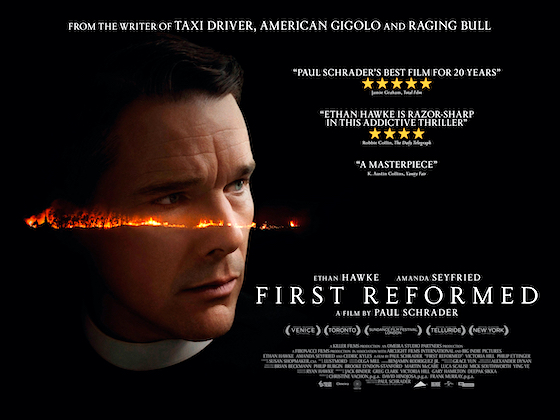
    First Reformed
    (2017)

    2019 #13
    Paul Schrader | 113 mins | digital (HD) | 1.37:1 | USA, UK & Australia / English | 15 / R

    First Reformed

    The pastor (Ethan Hawke) of a small church in upstate New York is asked for help by a pregnant parishioner (Amanda Seyfried) whose husband is a radical environmentalist. When the situation takes a tragic turn, the pastor must cope with mounting despair brought on by tragedy, worldly concerns, and his tormented past. — adapted from IMDb

    My first note about First Reformed is: I’m glad I didn’t watch the trailer first — it gives away almost all the salient details of the climax. So there’s a warning to you, too. (Naturally, the above plot description is written to not give too much away.)

    Continuing in that non-spoiler-y vein, then, all I can share from my notes about the ending is that it definitely seems designed to provoke debate — about the rights and wrongs of what does and doesn’t happen; about the choices made; about the way it chooses to conclude. The problem (or, some might feel, advantage) of being vague about this is that there’s no meaningful way to engage with said debate. Oh well.

    Before we get to the contentious conclusion, First Reformed appears to be a quiet little drama about personal despair and grief. It sort of morphs into something very different — almost a polemic about climax change. I say “sort of” because it also retains its smaller character-specific focus by using such big world-affecting things as a metaphor or mirror for individual dejection and hope. The character in question is Ethan Hawke’s pastor, and it’s very much a character study of him (Amanda Seyfried, a big name given co-billing on posters, etc, doesn’t have a huge amount to do — even when her character is involved in several exceptionally emotional situations, she remains very calm). With the whole film on his shoulders, Hawke is excellent, navigating us through his character’s rather internal conflicts with an assured performance.

    It was a good enough turn to put him in the awards conversation, as I remember, but not to secure any major nominations. The film did get an Oscar nod for its screenplay, written by director Paul Schrader, but it lost to Green Book. The less said about that the better, maybe.
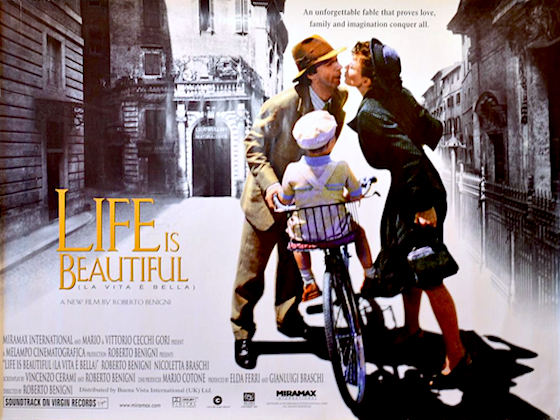
    4 out of 5

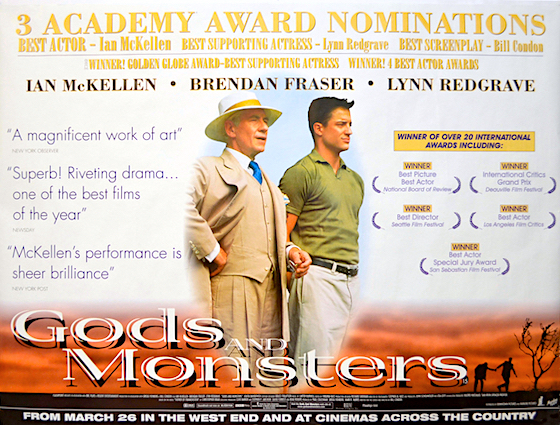
    Gods and Monsters
    (1998)

    2019 #16
    Bill Condon | 105 mins | digital (HD) | 16:9 | USA & UK / English | 15 / R

    Gods and Monsters

    James Whale (played here by Ian McKellen) was the director of such acclaimed classics of the 1930s as Frankenstein, The Invisible Man, and Show Boat. By 1957, he was long since retired, and when he suffers a stroke it causes him to reflect on his memories — of his earlier life in England; of his movie career; and of his time in the trenches during World War I. He recounts these experiences to his new gardener, Clay (Brendan Fraser), a strapping ex-Marine who Whale persuades to model for him. Their friendship grows, even as Clay is wary of Whale’s homosexuality, and Whale’s health deteriorates.

    Viewed now, there are definitely parallels between this and another film starring Ian McKellen and directed by Bill Condon, Mr. Holmes. Both concern a dying old man (McKellen), cared for by a characterful housekeeper (here, Lynn Redgrave), who connects with a younger male while reflecting on former glories. No offence meant to Condon, but if he were a more noted director then I guess more people would have discussed the similarities between the two works, for good or ill (are they mirrored explorations of a similar theme, or just self plagiarism?) Of the two, Gods and Monsters is probably the more effective, benefitting from being based on a real person and true events in its exploration of who this person was.
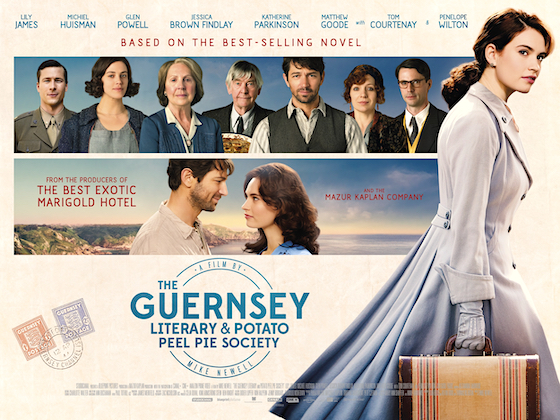
    4 out of 5

  • The 100-Week Roundup XIX

    Although I managed to get caught up on my reviews to the end of 2018 by the end of 2020, these 100-week catch-ups are still behind schedule — after all, 100 weeks is slightly less than two years, so I should be into February 2019 by now. But we are where we are, and so here’s the first batch from January 2019. At least the first one’s more appropriate now than it would’ve been in December…

  • Happy New Year, Colin Burstead (2018)
  • Cool Hand Luke (1967)
  • 1941 (1979)
  • Rambo (2008)


    Happy New Year, Colin Burstead
    (2018)

    2019 #1
    Ben Wheatley | 89 mins | digital (HD) | 2.39:1 | UK / English | 15

    Happy New Year, Colin Burstead

    Writer-director Ben Wheatley leaves behind the murderous themes that have characterised his feature output to instead portray a family drama that plays like an art house EastEnders. Put another way, it’s about an extended family spending most of their time arguing about things they have or haven’t done to each other, but it’s really slow and frequently abstruse.

    I guess Wheatley has his fans, and I know he has his detractors, but I find every one of his movies a crapshoot: sometimes I think they’re pretty great, sometimes interminable, sometimes floating somewhere in between. Colin Burstead is definitely at the negative end of the spectrum — way down that end, in fact. Unlike other Wheatley films I’ve not liked, this has little to commend it: none of the pretty cinematography or nods to social satire of High-Rise; none of the mood or editing trickery of A Field in England. The visuals are little better than a home movie; the editing is… random. And I mean that literally: sometimes shots from other scenes drop in for no apparent reason, never mind the senseless intercutting that goes on regularly.

    I guess Wheatley was going for some kind of Robert Altman thing, with all the characters and their own storylines and the way they’re intercut and the dialogue overlaps. But there’s no mastery of that form apparent here, and certainly no story worth applying it too. Even at under 90 minutes, it feels like it goes on forever. It’s that most damnable of things: boring.

    1 out of 5

    Happy New Year, Colin Burstead featured on my list of The Five Worst Films I Saw in 2018.

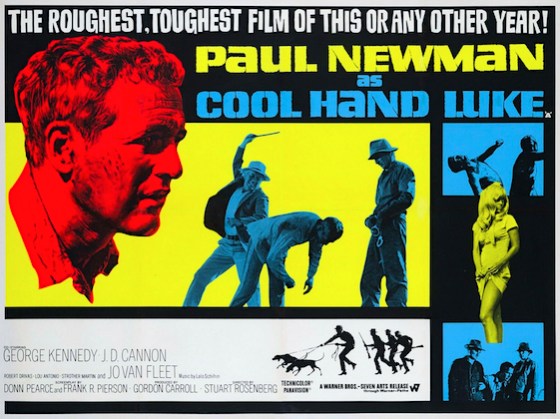
    Cool Hand Luke
    (1967)

    2019 #2
    Stuart Rosenberg | 122 mins | digital (HD) | 16:9 | USA / English | 15

    Cool Hand Luke

    When petty criminal Luke Jackson is sentenced to two years in a Florida chain gang, he doesn’t play by the rules of either the sadistic warden or the resident heavy, Dragline. As he becomes a rebel hero to his fellow convicts and a thorn in the side of the prison officers, the latter actively work to crush Luke until he finally breaks… — adapted from IMDb

    The thing that most surprised me — or, at least, struck me — about Cool Hand Luke was how similar it felt to One Flew Over the Cuckoo’s Nest (of course, that film came out eight years after this one, so if there is a chain of influence it flows in the other direction). They’re about different kinds of institution, but the vibe of the piece — a new against-the-grain inmate riling up the others to provoke the oppressive authority figures who control them — is very similar. They also have a similar comedic/dramatic mix of tones for most of the runtime, before both ending with a calamitous finale.

    If Cool Hand Luke feels a bit less dark overall, it’s probably because its leading man is the immensely charming Paul Newman, versus Jack Nicholson in Cuckoo’s Nest — he’s charming in his own way, but it’s definitely a cockeyed kinda likeability, with an undercurrent that things might go bad at any moment. Not that Cool Hand Luke is lacking in threatening atmosphere, with the abusive ills of the chain gang system ever-present.

    4 out of 5

    Cool Hand Luke was viewed as part of What Do You Mean You Haven’t Seen…? 2019.

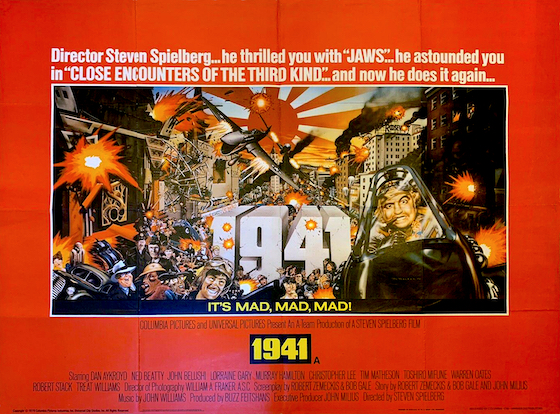
    1941
    (1979)

    2019 #4
    Steven Spielberg | 119 mins | Blu-ray | 2.35:1 | USA / English, Japanese & German | 12 / PG

    1941

    From 1975 until the end of the ’80s, director Steven Spielberg had a truly extraordinary run of movies: Jaws, Close Encounters of the Third Kind, Raiders of the Lost Ark, E.T. the Extra-Terrestrial, Indiana Jones and the Temple of Doom, The Color Purple, Empire of the Sun, Indiana Jones and the last Crusade — every one of them an era-defining box office hit and/or a multi-Oscar-nominee. Except that list overlooks one dud: 1941. That’s how the majority see it, anyway, but it does have something of a cult following (and apparently “the Europeans love it”, or so Spielberg claims in an accompanying documentary).

    Personally, as is so often the case, I fall somewhere between these two stools. Spielberg signals his tonal intention from the off, beginning with an outright spoof of the famous opening to Jaws, the film that had made his name just a few years earlier. After that, 1941 unfolds almost like a sketch show, through a series of comedic vignettes; though it’s more like binge-watching a whole series of a sketch show, because there’s also a series of running plot lines. And just like a sketch show, the quality varies wildly from bit to bit. I felt like it took a long time to really get going, and then it felt like it was going on forever, but I actually warmed to its barminess in the end. Even if it’s weak overall, there are some very good sequences — the dance competition-cum-chase is a particular highlight. There’s a ton of special effects at the climax which look spectacular, too — you can always rely on Spielberg to pull off a good-looking, technically-excellent movie.

    In later years, Spielberg has admitted his hubris and arrogance (coming off the massive double success of Jaws and Close Encounters) hindered the film, which he thinks should’ve been funnier. Nonetheless, he’s still proud of it — indeed, when he was given the chance to restore his original two-and-a-half-hour director’s cut (Columbia and Universal had cut the original release against his wishes, fearing for its commercial potential), he took that opportunity. Some day, I’ll have to give the longer cut a go. I presume it can’t be any more consistent, but maybe there are some extra laughs…

    3 out of 5

    Rambo
    (2008)

    2019 #5
    Sylvester Stallone | 92 mins | Blu-ray | 2.35:1 | USA & Germany / English, Burmese & Thai | 18 / R

    Rambo

    In Thailand, John Rambo joins a group of mercenaries to venture into war-torn Burma and rescue a group of Christian aid workers who were kidnapped by a ruthless local infantry unit.IMDb

    Despite the blunt title, Rambo is not a reboot of the Rambo series. Nor is it quite a Jason Bourne-style “let’s just use his name this time”, because there’s already kinda been a film called Rambo — it was the second one. And, of course, people tend to just call the first one Rambo, despite that not being its title at all. So maybe let’s not get hung up on the naming of Rambo movies (though if anyone ever says “I really enjoyed that one movie, Rambo,” you’re probably going to have to ask for clarification).

    Despite being an OTT action series, Rambo has a habit of getting involved in real-life conflicts: the first one spun out of Vietnam; the second was concerned with an issue from that conflict’s fallout; and the third saw him stick his oar into Afghanistan. Using real-world geopolitics as an excuse for a brutal action movie is the kind of thing some people will always find distasteful, but at least Rambo seems to have its heart more in the right place than First Blood Part II or Rambo III did. In fact, the film was banned by the rulers in Burma, but was widely bootlegged by resistance fighters, who loved it and adopted phrases from it as mantras. So you can say it was distasteful to the real political situation if you like, but the people actually embroiled in it clearly felt differently. And David Morrell, the author of the original First Blood novel (who has proven quite happy to criticise a Rambo movie), was “pleased” with this one: “the level of violence might not be for everyone, but it has a serious intent. This is the first time that the tone of my novel First Blood has been used in any of the movies. It’s spot-on in terms of how I imagined the character — angry, burned-out, and filled with self-disgust because Rambo hates what he is and yet knows it’s the only thing he does well.”

    Big fucking gun

    Oh yes, “the violence may not be for everyone”, because, oh boy, it really is brutal! Blood and body parts explode all over the damn place. But the film invests a lot of effort in making sure you know these bad guys really, really deserve it — mainly by showing them to be brutal bastards themselves, committing nasty war crimes in the film’s first half. At one point during the bloodbath climax, they employ artillery so heavy it takes off heads with a single shot. That’s used to kill every bad guy on a gunboat… and then they blow the boat up with a rocket launcher, for good measure. It’s not quite as ridiculous as that time Rambo used an explosive-tipped arrow to kill one man, but it’s getting there.

    A couple of years after the film’s release, Stallone put together a Director’s Cut that reportedly pulls back on some of the violence and adds more character-centric scenes. I don’t know if that would make the film better — I feel like the balance is pretty good right now. Maybe a little heavy on the brutality, sure, but I can’t see how a movie like this needs much more character stuff than it already has. It’s really well paced as it stands: it manages to not feel in a rush, while also not feeling slow; and once the men are properly on their mission, it’s almost relentless without being breathless. It makes for a very smooth, fast 90 minutes.

    4 out of 5