Quentin Tarantino’s Swinging Sixties Movie Marathon Roundup: Spy-Fi

I introduced the concept behind QT’s movie marathon in my previous roundup of films from it, but to quickly recap, these are all movies with a connection to Tarantino’s latest flick, Once Upon a Time in Hollywood.

While many of Tarantino’s selections speak to the setting of OUaTiH (in terms of depicting its time and place on screen, or the social landscape of its era), others have a bearing on it in quite a different way. These are movies his characters might’ve seen, or might’ve appeared in, or (in the case of Sharon Tate) did actually star in. Three of those also fall under the banner of espionage fiction. Two hail from the James Bond-inspired spy-fi craze of the ’60s, while one is a ’50s war movie about a secret mission. (Yeah, that last one is stretching the definition — it’s not really a spy movie at all — but it doesn’t pair up with anything else in Tarantino’s selection, so here it is.)

In today’s roundup:

  • Hammerhead (1968)
  • The Wrecking Crew (1968)
  • Battle of the Coral Sea (1958)


    Hammerhead
    (1968)

    2019 #112
    David Miller | 95 mins | TV | 16:9 | UK / English

    Hammerhead

    The success of the James Bond movies led to a whole raft of imitators throughout the rest of the ’60s, a spy-fi craze that kickstarted other long-running franchises like Mission: Impossible and The Man from U.N.CL.E. Of course, as well as the memorable and enduring successes, there were piles of cheaply-made, entirely-forgettable knockoffs. Hammerhead is one of the latter. Like Bond, it’s based on a series of espionage novels, these ones by James Mayo (pen name of English novelist Stephen Coulter) and starring the character Charles Hood. Coulter had been friends with Ian Fleming, and apparently (according to Quentin Tarantino) his Hood novels were popular with secret agent fans because they were written in a similar style to Fleming. Hood didn’t have the staying power of Bond, though, the series running to just five novels which (as far as I can tell) haven’t been in print for decades. On film, he fared even less well: this is the only Charles Hood movie.

    The film’s biggest problem is its desire to be a Bond movie, but without the money or panache to carry it off. As Hood, Vince Edwards has none of the easy charm of Sean Connery, instead seeming like a stick-in-the-mud who’d rather be anywhere else (preferably back in the ’50s, I suspect). And the film itself so wants to be like Bond that there’s even a pop song named after the titular villain… though rather than playing over the opening credits, it pops up two or three times mid-film, incongruously played diegetically. As a Letterboxd reviewer put it, “apparently in the late ’60s if you were a pornography-obsessed master criminal you could also be the subject of a pop song.”

    Oh yes, that’s right: the villain collects porn. Not just any old rags, though, but Art — paintings and sculptures by renowned masters, that kind of thing, just ones that feature boobies. Something about that does feel ever so ’60s. The film itself is as pervy as its villain’s obsession. Well, okay, maybe not that pervy, but there are certainly gratuitous shots of women in their underwear, etc. Perhaps the most egregious is the closeup of female co-lead Judy Geeson’s bouncing behind as she rides on the back of a motorbike up some steps, complete with boinging sound effect. That’s about as explicit as it gets, though: it may be firmly set in the Swinging Sixties, with up-to-the-minute fashions and scenes set at experimental art happenings, but it’s stuck in the past enough to not feature any actual sex or nudity, just plenty of cleavage, gyrating dance moves, and the odd bit of innuendo (don’t expect any Bond-quality puns, mind — it’s not that clever).

    Trying to swing

    I haven’t mentioned the plot, but it’s a frequently nonsensical bit of nonsense involving a report so top-secret its author has to have a highly public cover story for what he’s supposed to be doing while he actually sneaking off to present to international delegates who’ve arrived in the country unannounced. If anyone ever said what this report was actually about, or why the conference had to be kept a secret (or how something like 23 different countries, and their associated delegates and security staff and so on, all managed to keep it hush-hush), I missed it. The villain wants to intercept the report — not steal it, not stop the conference, just learn what’s in it — which requires an elaborate plan with an impressionist and various decoys. Why not just honeytrap one of those 23 delegated? I guess that’d be too easy. What’s the villain’s motivation for wanting the report? No idea — he’s defined by being a reclusive pornography connoisseur, not by whatever he does to make money to afford his expensive porn habit.

    Well, it’s all part of the film wanting to be like Bond, but not seeming to really understanding what makes the Bond films tick. On the bright side, it doesn’t take itself very seriously, which means it’s kooky fun in places (there’s a nice bit of farce in a hearse, for example). Not without entertainment value, then, but only hardened ’60s spy-fi fans need apply.

    2 out of 5

    The Wrecking Crew
    (1968)

    2019 #115
    Phil Karlson | 101 mins | TV | 16:9 | USA / English | PG / PG
    The Wrecking Crew

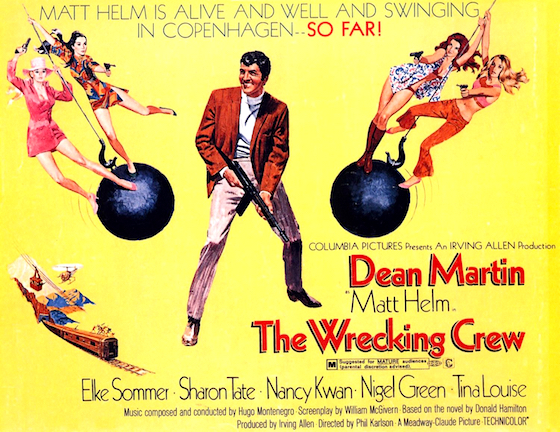
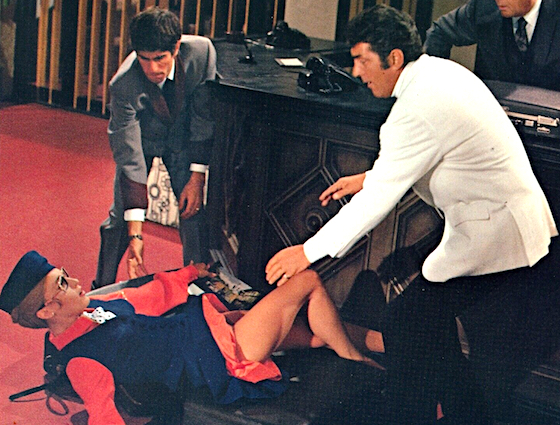
    Unlike Hammerhead, I’m not sure anyone should apply to watch The Wrecking Crew, the last in a series of four movies starring the Rat Pack’s Dean Martin as Donald Hamilton’s Matt Helm. The character was a mite more successful than Charles Hood, then, but on screen and in his original literary form: the book series ultimately ran to 27 novels, the last published in 1993, with a 28th written but left unpublished after Hamilton’s death in 2006. The film series would’ve continued too — I guess not for that long, but for at least one more film. Reports vary on why a fifth instalment never happened, but one highly plausible version ties it to the murder of Sharon Tate. Tate co-stars in The Wrecking Crew and is quite the best thing about it. Martin loved working with her, and the plan was for her to return as Helm’s sidekick in the next film. But then what happened happened, and the followup was abandoned. (The alternate version is that poor reviews and poor box office for The Wrecking Crew just led the studio to scrap the series.) There are several tragedies about the murder of Sharon Tate, but I don’t think depriving us of more Matt Helm movies is one of them.

    As for the lead character, Helm is a secret agent cum fashion photographer — and that’s not the only thing here that’ll remind you of Austin Powers. The Bond movies are often cited as the sole inspiration for Powers, but it was really drawn from across the ’60s spy-fi spectrum, and it’s clear Matt Helm was part of the mix. Unfortunately, The Wrecking Crew plays like a low-rent Austin Powers movie with any humour value sucked out. In his discussion around the film, Tarantino recalls seeing it in the cinema on its original release, and how audiences found it hilarious at the time. That wasn’t a quality I observed, personally. It’s clearly all tongue-in-cheek, but it rarely achieves levels of genuine amusement.
    Enter Sharon Tate

    More tangible is the sensation that the film thinks it’s super cool and hip, but really isn’t. That might just be because of its lead. Dean Martin feels a bit like Roger Moore in his later Bond films: still behaving like he’s a young playboy while looking far too old for it. But even Moore, with his ageless class, felt more ‘with it’ than this. It really shows that the “effortless cool” of Bond does require some effort. The past-its-date feel is underscore (literally) by frequent random snippets of old-fashioned-sounding songs — presumably Dean Martin numbers, placed awkwardly to convey some of the hero’s thoughts (sample lyric: “If your sweetheart puts a pistol in her bed, you’d do better sleeping with your uncle Fred”). So much for the Swinging Sixties… and this was nearly 1970, too!

    There’s no respite in the actual storyline, which is at least broadly followable (the villain has stolen $1 billion in gold, because who doesn’t want to be rich?), but then drowns itself in a flood of little logic problems and implausibilities, shortcomings of research or insight into foreign cultures, casual racism, lazy casting (why does someone called Count Massimo Contini sound like an English public schoolboy, other than because he’s the bad guy?), and no consideration for where surveillance cameras might actually be placed. You despair of constructively criticising the film for its mistakes — it’s beyond help.

    The Wrecking Crew is another movie no doubt inspired by the desire to emulate the success of James Bond, but this is the kind of mediocre imitation that gives you a new appreciation for even the worst Bond movies. Hammerhead clearly struggled to compete due to the constraints of a tight budget, which it at least made up for somewhat with a vein of authentic Swinging Sixties antics. The Wrecking Crew, on the other hand, seems to have all the money it could need (it was produced by a major studio and had star names attached, remember), but nothing like enough charm or skill. It can’t even find benefit in fight choreography by the great Bruce Lee, with stunt performers incapable of convincing combat.

    2 out of 5

    Battle of the Coral Sea
    (1958)

    2019 #116
    Paul Wendkos | 83 mins | TV | 16:9 | USA / English | PG
    Battle of the Coral Sea

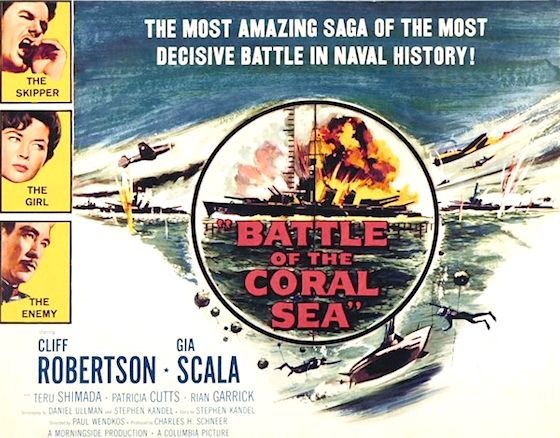
    May, 1942, the South Pacific: a US submarine on a top-secret reconnaissance mission is captured by the Japanese fleet. Its crew are taken to remote island interrogation camp, where they just have to keep silent for a couple of days until what they know will no longer be of use to the enemy.

    Yes, far from the combat movie the title implies, this middle-of-the-road World War 2 movie is one part submarine adventure (the first act) to two parts POW thriller (the rest). The latter also includes an action-packed escape for the climax, which is almost a moderately exciting action sequence, but is marred by a litany of minor daft decisions. For example: the escapees start by killing a couple of guards, but only pick up one of their guns; then they use that gun to mow down more guards, but still don’t bother to grab any more weapons. When some of them get killed a minute or two later, you can’t help but feel it was their own damn fault.

    It picks up some points for making the camp’s commander a reasonable man — a human being, rather than an alien, vicious, evil torturer, which is the stereotype of Japanese WW2 prison camps. That said, considering how infamously brutal said camps were/could be, the niceness of the prisoners’ treatment makes the film feel somewhat neutered. It’s not like the captured seamen get to laze around all day — they’re put to work — but you feel like these guys aren’t really suffering, not compared to what others went through. It contributes to the feeling of the film being a something-or-nothing tale; just another story of the war, rather than an exceptionally compelling narrative.
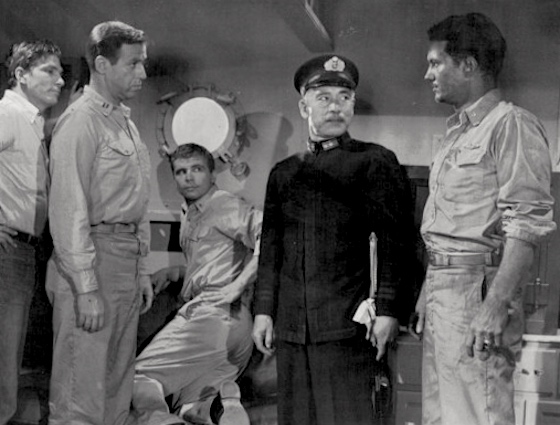
    Under the Coral Sea

    Apparently the eponymous battle was rather important, though: a voice over informs us that “it was the greatest naval engagement in history”… before adding that “the victory laid the groundwork for the even greater sea victory at Midway.” So it was the greatest… except the next one was greater? Who wrote this screenplay, Donald Trump? We do actually get to see the battle, eventually, when it turns up as an epilogue, conveyed via a speedy stock-footage-filled montage. I wonder how much of that was fed into the trailer…

    Battle of the Coral Sea is the kind of film I would’ve completely overlooked if Quentin Tarantino hadn’t included it in his Swinging Sixties Movie Marathon (it represents the kind of thing Once Upon a Time in Hollywood’s Rick Dalton would’ve appeared in early in his career, as one of the seamen with a couple of lines), and I don’t feel I’d’ve really missed anything. It’s not a poor film — anyone with a fondness for ’50s-style war movies will find something to enjoy in it — but it’s not a noteworthy one either.

    3 out of 5

    Once Upon a Time in Hollywood is in cinemas now.
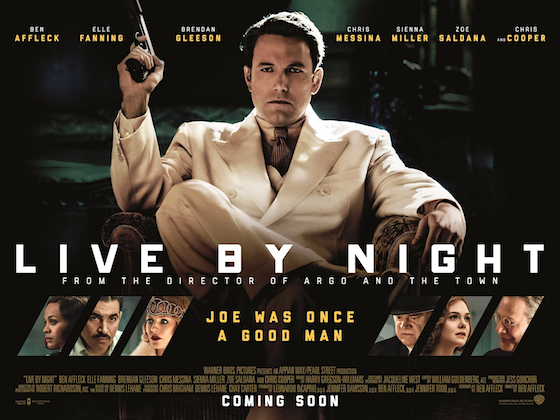
  • Live by Night (2016)

    2018 #113
    Ben Affleck | 124 mins | streaming (HD) | 2.35:1 | USA / English | 15 / R

    Live by Night

    Ben Affleck, once a bit of a laughing stock as an actor thanks to appearing in the likes of Pearl Harbor and Gigli, managed to reinvent himself somewhat as an acclaimed director, first with Gone Baby Gone and The Town, and then cementing that reputation by winning the Best Picture Oscar with Argo. This was what he chose as his next project — another adaptation of a Dennis Lehane novel (like Gone Baby Gone), another story of a Bostonian career criminal (like The Town), another period drama (like Argo… although a wholly different period, so maybe I’m stretching the comparison now). Rather, with its Prohibition-era setting, this was a gangster drama more likely to evoke classics such as The Godfather and Road to Perdition. There was, understandably, awards buzz. Then people saw it… and, it seems, just as quickly forgot it.

    I’ve mentioned a lot of other films in that opening paragraph, and you could make endless further gangster-movie comparisons, I think — and that’s a significant part of Live by Night’s problem. Almost everything about it reminds you of something you’ve seen before, often more than once. As a work in itself, it’s not remarkable enough to outshine the familiarities. Some of the plot is quite neat, with an emphasis on cause-and-effect that sees every solution turn into a new problem, and there are some very good individual scenes, though perhaps that’s easy when you’re working with quality actors Chris Cooper.

    Equally, some parts are underdeveloped. For example, Affleck gets into a relationship with Zoe Saldana that just seems like a vague sex-based aside, until he’s suddenly declaring that he’s put aside his plans for revenge, his primary motivation, because now everything is about his life with her. I need some more more joins between those dots, please. But at least it sometimes looks very pretty, though if you just want to see that then most of the visual splendour is in the trailer. There’s a surprisingly good car chase, though.

    They appear to be living, and it looks like it's nighttime. So that all checks out, then.

    Affleck is a decent director, and, actually, a quite like him as an actor too… in the right kind of roles. I’m not sure he’s got the range necessary for this part, however. His character is a conflicted, contradictory man — he genuinely has a good heart, but he’s often prepared to put it aside to do bad things; but, at other times, that moral compass gets the better of him. It’s a tricky line to tread and make believable, and Affleck’s performance is too monotone to convincingly portray it. That leaves the centre of the movie feeling empty, which is a problem however solid the stuff around him is. Apparently the film’s original cut was closer to three hours long and heavier on character stuff, so maybe the nuance disappeared in the editing — or maybe it didn’t. We’ll likely never know.

    Live by Night received an exceptionally negative response (just 35% on Rotten Tomatoes), but I can’t see why people hated it so much. It’s not fantastic, floundering somewhat in the shadow of the other gangster movies of which it’s so often reminiscent, but it’s not a bad attempt at the genre. Though, as a significant portion of the storyline takes place in “the sunshine state”, I’m not sure how good that title is. I mean, I live more of my life by night than these gangsters do. I just spend most of that time watching and writing about movies, though — maybe I should be launching a criminal empire?

    3 out of 5

    Review Roundup

    Even though my film viewing has slowed to barely a trickle recently (more about that on Thursday), my review backlog is still humongnormous (so I big I had to invent that new world to describe it).

    So, here’s another exceptionally random selection of quick reviews to help clear out a tiny fraction of it. They’re connected merely by being films I watched over a year ago. Three of them score 3 stars, one of them scores 4, and I suspect you won’t guess which that is…

    In today’s roundup:

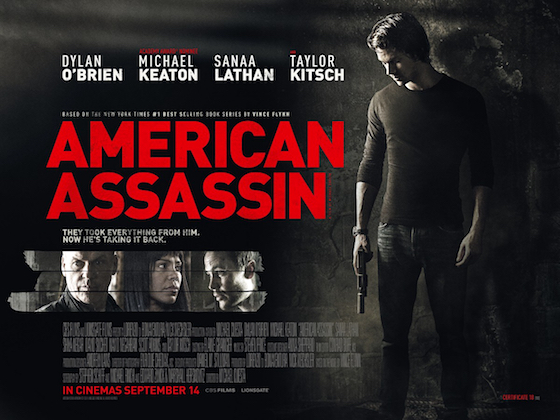
  • American Assassin (2017)
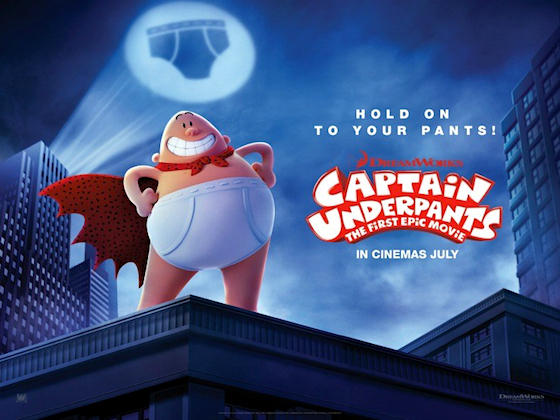
  • Captain Underpants: The First Epic Movie (2017)
  • Wild Strawberries (1957)
  • Yes Man (2008)


    American Assassin
    (2017)

    2018 #79
    Michael Cuesta | 112 mins | streaming (HD) | 2.35:1 | USA & Hong Kong / English, Arabic, Italian, Polish, Turkish & Persian | 18 / R

    American Assassin

    Based on the Mitch Rapp series of novels by Vince Flynn (and, since Flynn’s death, Kyle Mills), American Assassin is an action-thriller about a CIA operative that’ll feel very familiar to anyone who’s ever seen a film starring Jason Bourne, Jack Ryan, or anything else along those lines. Indeed, it particularly reminded me of the last-but-one Jack Ryan reboot, crossed with something altogether murderier — you’ll notice this has an uncommonly high 18 certificate. I guess that was for some torture that goes on; although it also features a very intense opening scene, depicting an attack by terrorist gunmen on tourists at a beach resort. Considering this is no more than a dumb action-thriller, one might consider it a bit much to include such a viscerally-real-feeling sequence, inspired by relatively recent real-life attack(s), just to kickstart the hero’s journey…

    The film was made for just $33 million, which is chump change in modern Hollywood, and they’ve not done badly off it. The shooting locations do seem a little limited (the main sequence in Istanbul looks more like it was shot in a London shopping precinct (which, as I found out when I checked after, it was), and the bit in Poland is moderately familiar as London too (it’s Somerset House, recognisable to UK cinephiles as where Film4 host their outdoor summer screenings); but I’ve seen worse CGI in bigger-budgeted films, and the fisticuffs are decently staged.

    Altogether, it makes for quite an entertaining action thriller, with some decent scenes, but the story is wholly familiar — Mitch Rapp: Sum of All Shadow Recruits, if you will. Fans of the genre will likely get a kick out of it, especially if they’ve not seen some of the other films it feels so similar to (though if you’re a fan of the genre I don’t see how you wouldn’t’ve), but others need not apply.

    3 out of 5

    Captain Underpants:
    The First Epic Movie

    (2017)

    2018 #91
    David Soren | 85 mins | streaming (HD) | 1.85:1 | USA, Canada, France, UK & India / English | U / PG

    Captain Underpants: The First Epic Movie

    Somehow I was vaguely aware of the existence of a series of books called Captain Underpants, but I’d paid them no heed because they’re for young kids, and also because they looked stupid. I thought the same thing of this movie adaptation, but then I started hearing good things about it and, well, here we are.

    It’s about two young boys who love nothing more than pranking teachers and creating superheroes. When their headteacher separates them because of the former, they manage to hypnotise him and convince him he’s the latter — the eponymous Captain Underpants. Initially that just makes their school life more fun, but then a supervillain turns up, so he’s handy for that too.

    Obviously it’s all thoroughly daft and primarily aimed at younger children — there are Messages without it being preachy, and it’s suitably irreverent and base at times. It’s the movie equivalent of mixing veg into, like, a burger, or something (I dunno, I’m not a parent. What food do you hide veg in?) But it also contains some good gags for the adults (satire!) and some clever bits of animation and stuff as well — it’s more inventive than you might expect in that regard.

    Indeed, I feel like it’s all-round better than you’d expect, given the title and overall style (the kiddie design and tone; the toilet humour)… but not so much better that it warrants 4 stars, so…

    3 out of 5

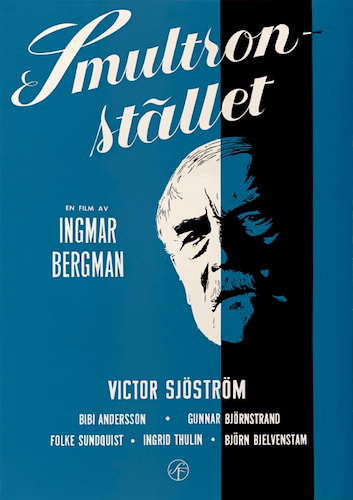
    Wild Strawberries
    (1957)

    aka Smultronstället

    2018 #90
    Ingmar Bergman | 87 mins | DVD | 4:3 | Sweden / Swedish | PG

    Wild Strawberries

    “Wondrously warm, one of Bergman’s very finest achievements, and a landmark in the history of cinema,” says Geoff Andrew in the notes that accompany the UK DVD release of Wild Strawberries, one of Ingmar Bergman’s most acclaimed movies from a career filled with them. However, speaking for myself, I’m still struggle to get a handle on the director’s output.

    It’s about a grumpy old professor (Victor Sjöström) who sets out on a road trip to collect an honorary doctorate. Along the way he has various encounters with other travellers, which prompt daydreams and memories that cause him to reassess his life and its worth.

    Put like that, what it’s “about” seems obvious, though in my notes I wrote “I’m not sure I have any idea what it was about. Something to do with old age and looking back and maybe death,” so how effectively its themes come across on a first viewing is, perhaps, debatable. That said, I’m fully prepared to accept I was looking in all the wrong places, maybe focusing too much on the literal road-trip storyline and not the figurative exploration-of-self the trip was provoking.

    On the bright side, there’s some effective imagery in the dream sequences, and I found it less crushingly dull or obtuse than Persona, which is something. Maybe Bergman’s just not for me? Or not for me yet? Well, I didn’t dislike it, but at the same time I didn’t get much out of it. Maybe some day I will.

    3 out of 5

    Wild Strawberries was viewed as part of my Blindspot 2018 project.

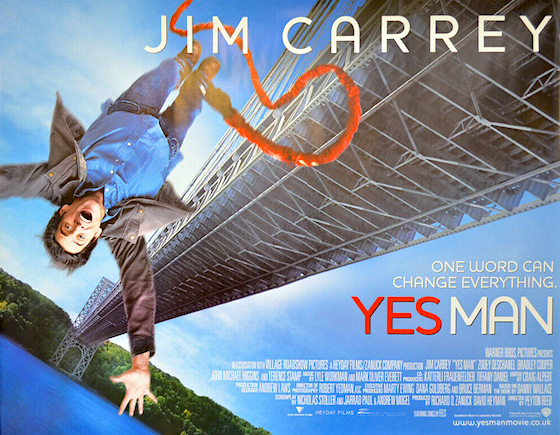
    Yes Man
    (2008)

    2018 #86
    Peyton Reed | 100 mins | streaming (HD) | 16:9 | USA & UK / English & Korean | 12 / PG-13

    Yes Man

    Loosely based on Danny Wallace’s memoir of the same name, Yes Man stars Jim Carrey as a negative chap who attends a motivational seminar that encourages him to start saying “yes” to every opportunity that comes his way.

    On the first night, he says yes to a homeless guy who wants a lift across town, then yes to letting the guy use his phone, then yes to giving him all his cash. But it turns out the drive used all his fuel, the call used all his battery, so he can’t phone for help, and he has to trek miles in the dark to buy fuel… not that he has any cash. So much for saying “yes” to everything. But at the petrol station he meets Zooey Deschanel and they hit it off. So, yeah, point made with perhaps the most outsized karmic reward ever.

    I suppose everything about Yes Man is broadly familiar — the romcom story arc; the kooky supporting characters; Jim Carrey’s schtick (it feels very much in same vein as the high-concept ’90s comedies that made his name; although there’s no fantastic element this time, and the worst excesses of his ‘act’ are thankfully limited to one or two scenes) — but it carries it off with reasonable charm. I mean, if you have no time for Carrey’s comedies, and aren’t attracted to Deschanel being a MPDG again, then there’s nothing here that’s going to win you round. For fans of such shenanigans, however, this is a perfectly enjoyable experience. It’s a 3.5-out-of-5-er, but I had a nice time with it, so my score leans on the side of generosity.

    4 out of 5

  • The Girl in the Spider’s Web (2018)

    2019 #90
    Fede Alvarez | 115 mins | streaming (HD) | 2.39:1 | USA, Germany & Sweden / English | 15 / R

    The Girl in the Spider's Web

    I love a bit of context to frame a review, but crikey, I can’t be arsed to recap the turbulent history of this particular franchise. Heck, it doesn’t even have a proper name! Officially it was the Millennium Trilogy, but that didn’t seem to stick (especially when it went past three books). The original Swedish films have been bundled as “The Girl” trilogy, owing to the formula of their English language titles. For this latest incarnation, they chose to label it “A New Dragon Tattoo Story”, I guess reasoning that “Dragon Tattoo” was a more unique identifier than “The Girl” (not wrongly).

    The status of this film itself is equally confused. Is it a reboot? A sequel? If so, to what? I mean, it’s adapted from the fourth book, but only the first has been filmed in English (as is this movie), so is this now meant to be the second story? But as there doesn’t seem to be a Swedish language adaptation forthcoming, maybe this is intended to be a fourth one after all? Frankly, I suspect the filmmakers would rather we didn’t ask. The film makes little or no acknowledgement of any specific predecessors (aside from the fact that the recurring characters already know each other), instead diving headlong into a new, standalone story. Well, standalone-ish, because a lot of what occurs comes out of the past of Lisbeth Salander, the titular girl; and the events of her past were a key feature of some of the other stories as well, so…! Well, that you can’t escape your past, however much you might try, is sort of a theme here, I guess, so maybe we can kindly say it’s only appropriate.

    Whichever films or books you take in before this one, I don’t think Spider’s Web is a good jumping-on point. It assumes we have familiarity with the lead characters — hacker Lisbeth Salander (now played by Claire Foy) and investigative journalist Mikael Blomkvist (now played by Sverrir Gudnason), and their relationship, or lack thereof — which is a barrier to it being newcomer friendly. Anyway, the actual storyline sees Lisbeth being hired to steal a dangerous computer program from the CIA, which leads to all sorts of trouble with crime gangs and spies and whatnot.

    l33t h4x0r skillz

    Where the first three Millennium / Girl / Dragon Tattoo stories were all fundamentally crime thrillers, Spider’s Web opens up the storytelling world into much more fanciful realms. It’s a bit like they’ve tried to make Salander a kind of freelance female James Bond, using her l33t h4x0r skillz to stop evil cyber-terrorists. It also helps that she’s pretty handy on a motorbike and with a gun. How? Just because. Unfortunately, an element of ‘just because’ powers too much of the film, with fundamental flaws in even its basic setup: the computer program she has to steal is uncopyable, hence the reason she has to steal it, but that’s (apparently) not even possible. I guess the writers just thought “eh, it sounds plausible”, but, well, it didn’t sound plausible to me, and apparently it is indeed not possible to create a program that can’t be copied, so there we go.

    And yet, if you can suspend your disbelief, Spider’s Web is mostly enjoyable while it’s on. There are plenty of twists and turns in the plot — few, if any, are genuinely surprising, but it keeps it ticking over; as do the running about and shooting at things. It’s nothing special as action-thrillers go, but I’ve seen a lot worse. They’ve plumped for an R rating, in keeping with the darker adult themes the series is known for, but it’s a funny one: some of it feels tamed down as if they were aiming for a PG-13 (it’s scrupulous about never showing Lisbeth naked, even when she is), but there are some swears and the odd burst of violence that would never have got past at the lower certificate. Arguably that kind of half-heartedness extends to the whole experience.

    Yas Queen!

    Consequently, I feel kinda bad for Claire Foy in the lead role. After her acclaim in The Crown I can see she must’ve had big opportunities calling, but I imagine was also keen to show her range after becoming famous for such a particular kind of role. Lisbeth Salander is about as big a 180 from Queen Elizabeth II as you can get, right? However, she has big shoes to fill. Lisbeth is a potentially complex role, much desired by actresses keen for some meaty material (well, there was tough competition when they were casting the US remake of Dragon Tattoo, anyway), but both Noomi Rapace and Rooney Mara have put a firm stamp on it already (the latter even secured an Oscar nomination). I’d wager Foy is up to the task, although the screenplay doesn’t give her a whole lot to work with. Giving Lisbeth some (more) familial conflicts sounds potentially weighty, but the actual material doesn’t dig into it a whole lot.

    As for the rest of the cast, the fact they’ve cast someone you’ve probably never heard of as Blomkvist, the role previously played by a hot-off-Bond Daniel Craig, shows how he has a downgraded part to play here. The rest of the supporting cast includes a few somewhat more familiar faces, like Stephen Merchant, LaKeith Stanfield, and Sylvia Hoeks, all of whom are fine with what they’re given, but, as I say, it’s not exactly something to write home about.

    Burning down the franchise

    Once upon a time Dragon Tattoo was a darling of the pop culture world, the books attracting a tonne of attention, the Swedish films going down very well, and the star-studded US remake suitably hyped up. Its shine has waned since then (possibly as a result of said US remake underperforming at the box office, which is a whole other can of worms), and now Spider’s Web is probably too little too late to revive it — certainly, it fared poorly with both critics (40% on Rotten Tomatoes) and audiences (a paltry $35 million worldwide). To say it deserved better might be overselling it, but there is value here, at least for any undemanding fans of the action-thriller genre.

    3 out of 5

    The Girl in the Spider’s Web is available on Sky Cinema from today.

    Witness (1985)

    2018 #74
    Peter Weir | 108 mins | streaming (HD) | 16:9 | USA / English | 15 / R

    Witness

    Witness is, I think, one of those (many) films that used to be pretty well-known but hardly anyone seems to talk about anymore. I guess it falls into that bracket of being “very good, but not great”, and, devoid of the kind of cult appeal that can keep good-not-great movies popular for decades, it’s kind of slipped off the radar.

    It’s the story of an 8-year-old Amish boy (Lukas Haas) who, while travelling with his mother (Kelly McGillis) through Philadelphia, happens to witness the murder of an undercover cop. The case is handed to Detective John Book (Harrison Ford), who manages to get the boy to ID the murderer, but that puts the trio in danger, so they hide out among the Amish community.

    With such a storyline, the film could descend into a culture-clash comedy — the big city cop chafing against historical rural life — but, while that clash is certainly in play, it’s not milked for laughs. Rather, the film is about Book experiencing a way of life so different to his own, and it changing his perspective on the world. Indeed, with the focus it gives to Amish ways, the film almost seems like it wanted to be a documentary about that community as much as a story. Certainly, the crime plot is a little rote, though it builds to a thrilling climax, with a definite touch of “modern Western” about the film’s style and structure. Additionally, the burgeoning romance between Book and the boy’s mother is touchingly and believably handled.

    Witness protection

    Ford gives a good performance, though I didn’t think it was that far outside his usual wheelhouse, actually. Sure, this is a drama where he plays a real-world cop rather than an adventure flick where he’s a dashing space smuggler or a swashbuckling matinee idol, but he’s still a bit of a charming rogue who eventually reveals his good heart. Or maybe Ford is just so effortlessly good that he makes it look easy. Among the rest of the cast, look out for a baby-faced Viggo Mortensen, popping up briefly with no lines.

    The film’s only significant downside is a horrible synth score by Maurice Jarre. Maybe it’d be fine in itself, if ever so ’80s, but it’s an ill fit with the film’s theme about the appeal of traditional ways of life.

    Otherwise, Witness is, as I said, a good-but-not-great kind of drama; a more-than-solid effort from all involved, but not so remarkable that it’s endured among Great Movies. There’s nothing particularly wrong with that, mind. Certainly, in our present era of Western cinema where that sort of dramatic movie is falling by the wayside as studios focus solely on mega-budgeted effects spectacles, this kind of film feels all the more wanted.

    4 out of 5

    Shaft (2019)

    2019 #98
    Tim Story | 111 mins | streaming (HD) | 2.39:1 | USA / English | 15 / R

    Shaft (2019)

    I wrote recently about Shaft 2000 (I’m gonna start calling it that, even if nobody else does), the turn-of-the-millennium attempt to reboot the ’70s blaxploitation classic. It didn’t really take off, for various reasons, but I think it’s a pretty solid thriller in its own right. Now, 19 years later, they’ve decided to try again, only this time they’ve thrown away the spirit of the original in favour of an intergenerational buddy comedy.

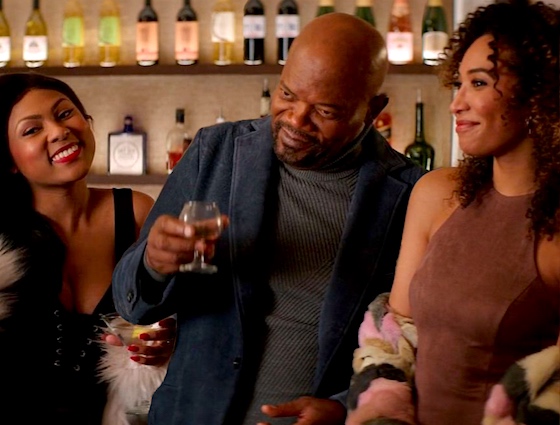
    John Shaft Jr (Jessie T. Usher) is a bookish FBI data analyst whose dad, John Shaft (Samuel L. Jackson), abandoned him when he was a baby so he could go off galavanting with other women and solving crime while looking cool. Down the years he’s sent Jr presents like condoms and a box of porn mags — he’s that kind of dad. (Is that a kind of dad, or is it just a caricature of one?) Anyway, after Jr’s former-junkie best friend dies of an apparent overdose, everyone else believes it was a relapse, but Jr isn’t convinced. Struggling to investigate on his own, he turns to his estranged father for help.

    Where Jackson’s Shaft was once a cool dude kicking ass and taking names (or whatever it is cool dude PIs did in the early ’00s), here they’ve turned him into a bit of a throwback dinosaur, spouting politically incorrect opinions with every other line of dialogue. This film does acknowledge the existence of the 2000 movie (an opening montage covering the last 30 years of the Shafts’ lives includes shots from that film to show Shaft Sr quitting the police), but it doesn’t feel like the same character we saw back then — he’s much more of a caricature of an outdated sex-obsessed oldie here. At times it’s like someone adapted one of those facile “millennials are to blame for everything” articles into a movie; or at least copy-pasted it into Shaft Sr’s dialogue.

    Still a sex machine to all the chicks

    This aspect has come in for much consternation among the film’s wider critical reception, but, eh, I dunno — the crap Shaft comes out with is definitely being played for laughs, with other characters eye-rolling (and similar) at most of what he says and does. At the same time, Jr’s character arc still comes down to “manning up” in the way his father wants him to. For instance: he hates guns, but when assassins attack at a restaurant, he borrows his date’s handbag-sized pistol and takes them out with expert marksmanship, before throwing the gun down in disgust. Put another way, the film is having its cake and eating it — it knows these old-fashioned ideals are, well, old-fashioned, but it’s gonna let them play out anyway. Even the plot pretends to be kinda modern by suggesting it might all have something to do with terrorism and radicalising Muslims — though as that’s been a plot driver for nigh on 20 years now, maybe it stretches the idea of “modern”. But it doesn’t matter anyway, because really that’s a red herring to cover up a standard drug smuggling affair.

    The film’s best bit comes at the end, when Richard Roundtree’s OG Shaft gets roped into things for no particularly good reason. But it doesn’t matter, because granddad Shaft’s antics, and the banter between all three generations, is the most entertaining part of the movie. It certainly helps cover for the TV-movie-esque quality of the action scenes. It’s a shame the film waited so long to get him involved.

    Shaft cubed

    So Shaft 2019 is antiquated in myriad different ways, be it the values espoused by its co-lead or the general tone and content of its story. It didn’t need to be like that — Shaft may’ve been born in the ’70s, but I don’t think the very nature of the character requires him to still embody ’70 values. Nonetheless, if you don’t let that stuff bother you too much, the result is a moderately entertaining watch — nothing special (the other two films with the same title are both better), but a passably humorous 110 minutes.

    3 out of 5

    Shaft is available on Netflix everywhere (except the US) now.

    Shaft (2000)

    2019 #37
    John Singleton | 99 mins | streaming (HD) | 2.39:1 | USA & Germany / English | 18 / R

    Shaft (2000)

    With there now being another ‘reboot’ for the black private dick who’s a sex machine to all the chicks (released a couple of weeks ago in the US, and available on Netflix today in the rest of the world), I thought it was about time I got round to the first ‘reboot’ (I saw the original yonks ago, long before this blog existed). I’ve put ‘reboot’ in inverted commas both times there because, despite the unadorned titles of both the 2000 and 2019 films, both are actually continuations of the ’70s original: Samuel L. Jackson plays John Shaft II, the nephew of the original Shaft, played by Richard Roundtree, who pops by for a cameo here. Jackson and Roundtree reprise their roles again in Shaft 2019-flavour, alongside Jessie Usher as John Shaft III.

    (Would it’ve been cool if they’d actually called this Shaft 2000? I feel like it would’ve. Maybe by the year 2000 the idea of sticking 2000 on a title to make it cool/futuristic was over, I dunno, but I feel like it would’ve worked. And because they didn’t, we’ve now got three movies called simply Shaft that all exist in the same continuity. Madness.)

    Anyway, back to the first time they rebooted-but-didn’t Shaft. Jackson’s character isn’t actually a private dick, but a proper copper… that is until sleazy rich-kid Walter Wade Jr (a hot-off-American Psycho Christian Bale) literally gets away with murder, prompting Shaft Jr to go freelance to catch his man.

    A black cop frisking a rich white guy? What is this, a sci-fi movie?

    This Shaft is almost 20 years old now (obviously), and yet all the white privilege bullshit that drives its story makes it feel like it could’ve been made yesterday. (Why are you so enable to evolve societally, America?) Other than that apparently-eternal timeliness, it’s a pretty standard kinda thriller, with most of its charm coming via an array of likeable performances. As well as the reliably cool Jackson and reliably psychopathic Bale, there are memorable early-career turns from Jeffrey Wright and Toni Collette, plus Vanessa Williams as Shaft’s cop colleague who lends a hand even after he leaves the force.

    The original Shaft spawned two big-screen sequels and seven more TV movies, but there was no such future for the new incarnation: Jackson’s disappointment with the film, plus a box office performance that was regarded as mediocre (although it opened at #1 and returned over $100 million off its $46 million budget), was enough to scupper a planned follow-up… at least until this year’s reboot-that-isn’t. Reportedly that’s not so great either (with a 31% score on Rotten Tomatoes, a 6th place opening in the US, and of course going directly to Netflix everywhere else), but, given the series’ history, I wouldn’t write Shaft off just yet. After the 29-year gap between Shaft Mk.I and Shaft Mk.II, and then 19 years between Shaft Mk.II and Shaft Mk.III, maybe in 2028 we’ll be treated to a film about child detective John Shaft IV. Naturally, the film itself will just be called Shaft.

    3 out of 5

    True Romance (1993)

    2018 #150
    Tony Scott | 121 mins | Blu-ray | 2.40:1 | USA & France / English & Italian | 18

    True Romance

    Directed by Tony Scott from Quentin Tarantino’s first screenplay,* True Romance is pretty much everything you’d expect from an early Quentin Tarantino screenplay directed by Tony Scott. It stars Christian Slater and Patricia Arquette as a pair of Bonnie and Clyde-ish lovers, who accidentally steal a load of cocaine from her pimp and end up on the run from the mob.

    At first blush, I’d say this feels much more like a Tarantino movie than a Scott one. It’s all there in the dialogue, the subject matter, the characters — it’s everything you’d expect from early QT: verbose, funny, littered with pop culture references, violent. It’s well paced, too; not exactly whip-crack fast, but also never slow or draggy. It is shot more like a Scott flick than a QT one, but only somewhat — it lacks both the slick flashiness we associate with Scott’s early work (Top Gun, Beverly Hills Cop II) and the grungy hyper-editing of his later stuff (Man on Fire, Domino). That said, some scenes (like one between Arquette and James Gandolfini’s underboss in a motel room, for example) are shot like Tony Scott to the nines, reiterating my opening point.

    Other observations: There’s one helluva supporting cast — it’s just littered with famous names in roles that only last a scene or two. (I could list them, but that might spoil the fun.) The sweet plinky-plonky score by Hans Zimmer is so unlike either his normal stuff or this genre of movie, which is no bad thing. On its original release the film was cut by about two minutes to get an R rating, with the original cut eventually released “unrated” on home formats, sometimes labelled the “director’s cut”. All the differences are relatively short trims to do with violence (full details here). The “director’s cut” is the only one that’s ever been released on DVD or Blu-ray anywhere, thus making the distinction between “theatrical” or “director’s cut” pretty much moot at this point… or at any point in the last 20 years, frankly.

    Clarence and Alabama go to the movies

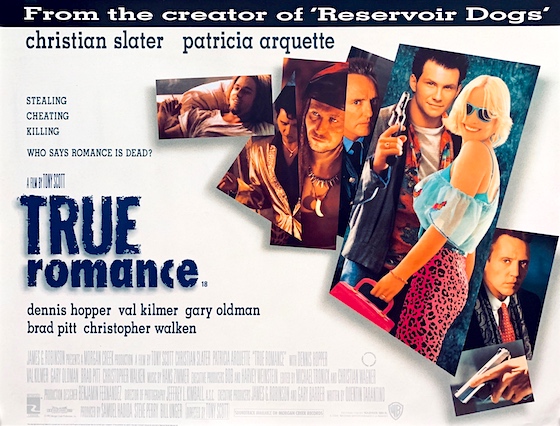
    It’s got a funny old trailer, too: it’s centred around a bunch of made-up numbers that have no basis in the film (“60 cops, 40 agents, 30 mobsters”), it mostly features the film’s climax, and it doesn’t once mention Quentin Tarantino — I guess “from the writer of Reservoir Dogs” wasn’t considered a selling point just the year after it came out. (Though obviously it was in the UK — just see the poster atop this review.)

    Of course, nowadays it’s often regarded as “a Tarantino movie” — the copy I own is part of the Tarantino XX Blu-ray set, for instance. I wonder if that ‘divided authorship’ is why, while the film does have its fans, it’s not widely talked about as much as some of either man’s other work: it’s not wholly a Tony Scott film, but, without QT actually behind the camera, it’s not really a Tarantino one either. Personally, I’m a fan of both men’s work, so of course it was up my alley. I don’t think it’s the best from either of them, but mixing together the distinct styles of two such trend-setting iconoclasts does produce a unique blend.

    4 out of 5

    True Romance was viewed as part of my Blindspot 2018 project.

    * True Romance came out between Reservoir Dogs and Natural Born Killers, but apparently QT wrote this first, then when he failed to get funding for it he wrote NBK, then when he also failed to sell that he wrote Reservoir Dogs. Another version says True Romance and NBK started out as one huge movie, written in Tarantino’s familiar chapter-based non-chronological style, until QT and his friend Roger Avery realised just how long it was and decided to divide it in two. ^

    The Happytime Murders (2018)

    2019 #9
    Brian Henson | 91 mins | streaming (HD) | 2.39:1 | USA & China / English | 15 / R

    The Happytime Murders

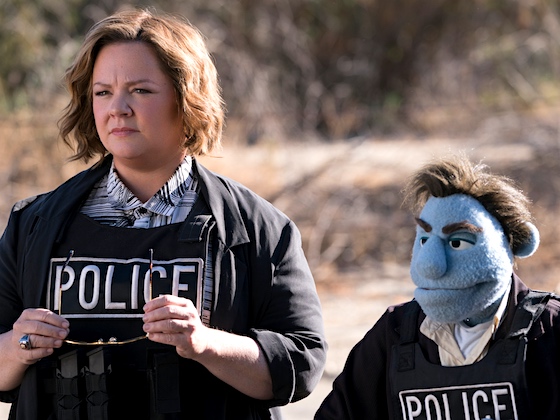
    The Muppets meets Who Framed Roger Rabbit meets an R rating in this black comedy murder mystery from director Brian “son of Jim” Henson. Set in a world where Muppet-esque (but not actual Muppets, because IP rights) puppets co-exist alongside humans, disgraced puppet cop turned private investigator Phil Phillips (performed by Bill Barretta, which, let’s be honest, is a better name for a comedy private eye than the one they’ve actually used) stumbles onto a spate of connected puppet murders, and must reluctantly team up with his former partner, human detective Connie Edwards (Melissa McCarthy), to crack the case.

    The mystery that drives the plot isn’t too bad, including a neat twist/reveal that’s perhaps guessable but not terribly so. It does hew closely to the tropes and clichés of the noir genre, which is a mixed blessing. On the one hand, as it’s not a straight crime movie I don’t think it’s a problem for it to recycle all those things when it has fresh comedy to hang off them, or if it’s somehow riffing off familiar elements but with the puppet stuff, but often it isn’t that clever.

    Women and puppets in blue

    Nonetheless, there are some legitimately funny bits along the way, often found among the riffs on the puppet thing (for example: one of the victims is drowned, and before bagging the body they ring him out). Unfortunately it isn’t funny as often as it should be, too often relying on worn or lacklustre humour. I mean, it tries to run with the old playground favourite “idiots say what?” as a running gag. It also leans on puppets being lewd and crude as the extent of the gag, which simply isn’t that funny in itself, partly because it isn’t as original as the film seems to think it is (cf. Team America, Avenue Q).

    While The Happytime Murders isn’t close to the echelons of quality where you’d find Roger Rabbit or the best of the Muppets, it’s also not a total washout. From behind-the-scenes stuff I’ve read it sounds like a lot of effort was expended on filming it, making sure the puppets could interact with the humans and so on, and those technical aspects are first rate. It’s just a shame the same level of innovation wasn’t poured into screenplay. I didn’t hate it, but it doesn’t live up to its potential either.

    3 out of 5

    The Happytime Murders is available on Netflix UK from today.

    Review Roundup

    As foretold in my most recent progress report, June is off to a slow start here at 100 Films. Or a non-start, really, as I’ve yet to watch any films this month and this is my first post since the 1st. Hopefully it won’t stay that way all month (I’ve got my Blindspot and WDYMYHS tasks to get on with, if nothing else).

    For the time being, here a handful of reviews of things I watched over a year ago but have only just written up:

  • O Brother, Where Art Thou? (2000)
  • Allied (2016)
  • American Made (2017)


    O Brother, Where Art Thou?
    (2000)

    2018 #106
    Joel Coen | 103 mins | streaming (HD) | 2.39:1 | UK, France & USA / English | 12 / PG-13

    O Brother, Where Art Thou?

    The eighth movie from the Coen brothers (eighth, and yet they still weren’t being allowed a shared directing credit! No wonder that stupid DGA rule pisses people off) is one of their movies that I found less objectionable. Oh, sure, most of their stuff that I’ve reviewed I’ve given four stars (as well as a couple of threes), but that’s more out of admiration than affection — for whatever reason, their style, so popular with many cineastes, just doesn’t quite work for me; even when I like one of their films there’s often still something about it I find faintly irritating.

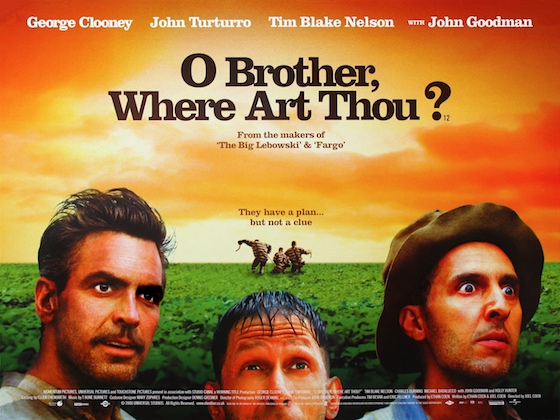
    Anyway, for this one they decided to adapt Homer’s Odyssey, but set in the American Deep South during the Great Depression. Apparently neither of the brothers had ever actually read The Odyssey, instead knowing it through cultural osmosis and film adaptations, which is perhaps why the film bears strikingly minimal resemblance to its supposed source text. Rather, this is a story about songs, hitchhiking, and casual animal cruelty, in which the KKK is defeated by the power of old-timey music. Hurrah!

    It’s mostly fairly amusing. If it was all meant to signify something, I don’t know what — it just seemed a pretty fun romp. I thought some of the music was okay. (Other people liked the latter more. Considerably more: the “soundtrack became an unlikely blockbuster, even surpassing the success of the film. By early 2001, it had sold five million copies, spawned a documentary film, three follow-up albums (O Sister and O Sister 2), two concert tours, and won Country Music Awards for Album of the Year and Single of the Year. It also won five Grammys, including Album of the Year, and hit #1 on the Billboard album charts the week of March 15 2002, 63 weeks after its release and over a year after the release of the film.” Jesus…)

    Anyway, that’s why it gets 4 stars. I liked it. Didn’t love it. Laughed a bit. Not a lot. Some of the music was alright. Not all of it. Naturally it’s well made (Roger Deakins!) without being exceptionally anything. Harsher critics might say that amounts to a 3, but I’m a nice guy.

    4 out of 5

    Allied
    (2016)

    2018 #116
    Robert Zemeckis | 119 mins | streaming (HD) | 2.39:1 | USA, UK & China / English & French | 15 / R

    Allied

    Brad Pitt and Marion Cotillard star as a pair of intelligence agents who fall in love in Mr. & Mrs. Smith: WW2 Edition. Settling down together in England, all is lovely for them… until one comes under suspicion of working for the enemy…

    Overall Allied is a very decent spy thriller, let down somewhat by a middle section that’s lacking in the requisite tension and a twee monologue coda. But the first 40 minutes, set in Morocco and depicting the mission where the lovers first meet, are pretty great; there’s plenty of neat little tradecraft touches scattered throughout; and there are some pretty visuals too. There are also some moments that are marred by more CGI than should be necessary for a WW2 drama, but hey-ho, it’s a Robert Zemeckis film.

    That said, Brad Pitt’s performance is a bit… off. He never really seems connected with the material. Perhaps he was trying to play old-fashioned stoic, but too often it comes across as bored. It also constantly looked like he’d been digitally de-aged, but maybe that’s because I was watching a 720p stream; or maybe he had been, though goodness knows why they’d bother.

    Anyway, these are niggles, so how much they bother you will affect your personal enjoyment. I still liked the film a lot nonetheless.

    4 out of 5

    American Made
    (2017)

    2018 #124
    Doug Liman | 109 mins | streaming (HD) | 1.85:1 | USA & Japan / English & Spanish | 15 / R

    American Made

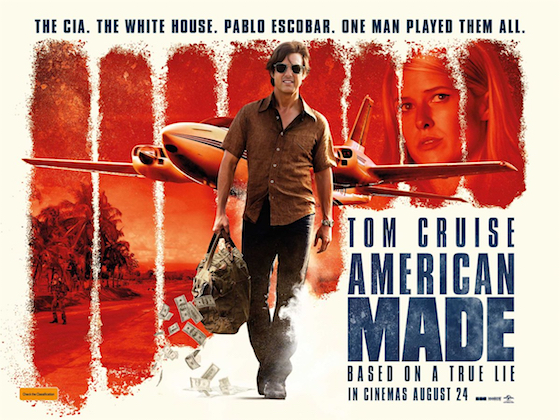
    Described by director Doug Liman as “a fun lie based on a true story,” American Made is the obviously-not-that-truthful-then ‘true story’ of Barry Seal, a pilot who was recruited by the CIA to do some spying and ended up becoming a major cocaine smuggler in the ’80s.

    Starring ever-charismatic Tom Cruise as Seal, the film turns a potentially serious bit of history (as I understand it, the events underpinning this tale fed into the infamous Iran-Contra affair) into an entertaining romp. Indeed, the seriousness of the ending is a bit of a tonal jerk after all the lightness that came before, which I guess is the downside of having to stick to the facts.

    Still, it’s such a fun watch on the whole — a sliver long, perhaps, even though it’s comfortably under two hours, but it does have a lot of story to get through. Parts of that come via some spectacular montages, which convey chunks of story succinctly and are enjoyable in their own right. Liman doesn’t get a whole lot of attention nowadays, I think, but it seems he’s still got it where it counts.

    4 out of 5