
Tony Scott | 121 mins | DVD | 12 / PG-13
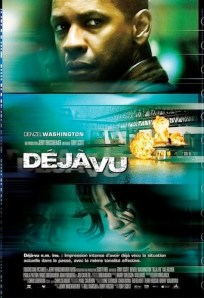 Denzel Washington and Tony Scott have now served as star and director (respectively, as if you didn’t know) on four films, with a fifth on the way. As director-star relationships go it’s hardly Scorsese-De Niro or Burton-Depp, but I’m quite a fan of Man on Fire and I remember Crimson Tide being pretty good, so one can’t complain. (This whole “regular director-star relationship” thing had higher significance in my head. Anyway…)
Deja Vu is about a terrorist attack that Washington’s character, an official from the Bureau of Alcohol, Tobacco, Firearms and Explosives (a natural combination only in America; known as the semi-logical AFT for short), isn’t really investigating. But he is a bit, because otherwise the story wouldn’t get started. Once it does, he gets recruited by Val Kilmer to the FBI team that are actually investigating the disaster, and they reveal a mysterious bit of kit to him… which some other review has probably already spoiled for you, so I will too: they can see precisely 4 days and 6 hours into the past.
How can they do this? Well, somewhat surprisingly, screenwriters Bill Marsilii and Terry Rossio (and, one must suspect by extension, Ted Elliott) have bothered to string together a selection of scientific concepts you may have heard of in order to explain it. Essentially, it’s an accidentally-created wormhole. It has loads of rules. I won’t explain them. The most significant is, you can’t send stuff back through it; you can’t change the past. And by “rule” I mean “thing set up to add dramatic tension when it comes time to contradict it in the third act”.
Deja Vu’s timey-wimey plot is quite fun, in some ways. Massively over-complicated — no one will blame you for switching off as the “how it’s done” technobabble washes over you; if you just accept this is all possible within the confines of the movie’s universe, there’s enough investigative thrills to sustain proceedings — but, if one does pay attention, a lot of it makes sense. Well, enough sense. It becomes a bit unravelled toward the end, unless you choose to believe this even more complicated theory, which uses a scant array of clues from the film — plus the desire/need to explain the plot logically — to come up with a cohesive theory that covers all kinds of stuff happening before the film even begins.
…so, I was meant to be explaining why it’s fun. Well, there’s a car ‘chase’ that takes place in both the past and present simultaneously, allowing Scott to indulge in some of his usual cars-flipping-for-no-reason show-off-y-ness (who doesn’t love a car flipping? Especially if it then explodes!) There’s also lots of narrative hoop-jumping, with plenty of clues littered through the first two acts that are paid off in the third. One of the film’s saving graces is that Scott, Marsilii and Rossio don’t spell most of these out for us — Washington doesn’t get up and say, “oh, that explains how the ambulance got here and then the building exploded and he must’ve cut your fingers off because you scratched him and [so on through numerous other minor semi-relevant clues]”; the audience are allowed to think all of this for themselves. Which is nice, because it’s obvious, but blockbusters too often just state the obvious these days. But I suppose when your central conceit needs explaining several times in lengthy dialogue scenes you assume the audience will be paying enough attention to catch the regular complications of standard film-narrative construction.
Deja Vu is kinda nonsense, then, albeit nonsense that some people have put a lot of thought into trying to explain. In spite of this, I quite enjoyed it — Washington is always likeable, the rest of the cast are up to the task of arranging themselves around him, and the connect-the-dots narrative is suitably engrossing. Factor in that Scott has toned down the visual trickery he pushed to eyeball-melting extremes in Man on Fire and Domino, and you find a half-decent sci-fi-ish thriller-blockbuster
It’s also the second film I watched in as many days featuring Friends’ Adam Goldberg playing the character he always plays in a story decisively set in New Orleans. Déjà vu indeed.

BBC One have the UK TV premiere of Deja Vu tonight at 10:35pm.
Despite the sustained objections of my spellchecker, this film is not called Déjà Vu (on screen). I know, I’m a pedant.
 M is a film of immense significance, not least because of its place on
  the public reaction and hysteria; the police’s flailing investigations and increasing exasperation; the criminal underworld, who begin their own manhunt because police inquiries are “bad for business” (despite sounding like a filmic conceit, this element was directly inspired by a newspaper article); and the criminal himself — trying to lay low, but constantly having to fight his urges… and ultimately giving in to them again.
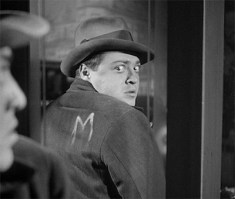 how they search crime scenes with a fine-tooth comb; another sequence shows their methodology for staging a raid; and so on. Such precise and clinical methods ultimately pay off: it’s a pair of tiny clues, carefully reasoned and sought out, that reveal the killer’s identity — and if it weren’t for the criminals getting there first, they’d’ve surely caught him too. Indeed, were it not for this breakthrough then the film might hold a
  like tracking from outside to inside through a window within a single shot — are present here). M’s individual moments of brilliance go on — perhaps my favourite is when the police arrive just after the criminals have apprehended Beckert. We don’t even see an officer on screen, but the burglar’s reactions let us know who’s there. Its a funny moment (even if we’ve seen it dozens of times since) and a lovely shot too.
 the murderer won’t bring the children back, and warns viewers to watch out for their own. It’s not the triumphant “we got him!” that concludes most serial killer films, but a blunt warning that, though Beckert has been caught, there are always more out there, waiting to strike. History has sadly proven her right; but while the world has produced many men and women like M’s villain, it hasn’t produced many films quite like M.
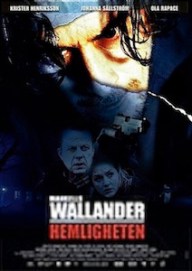 The third theatrical release to star Krister Henriksson as Henning Mankell’s detective is the thirteenth and final episode in the first series. It has a suitably Season Finale feel to it — “this time it’s personal” and all that — but also subtly constructs itself to work as the standalone piece necessary for a theatrical release schedule that skipped six whole episodes.
 Harrison Ford stars as President Indiana Jones — sorry, Jack Ryan — no, James Marshall (that’s it) in this action-thriller from the
  When I saw No Country for Old Men, a new round of films were vying for the Best Picture Oscar. Now, as I finally post my review, a whole new load have been nominated, voted on, and await the final result. Sometimes I feel decidedly behind the times.
 When Michael Clayton turned up among the contenders for 2008’s Best Picture Oscar I was a little surprised, because as far as I could recall I’d never heard of it. Then as I read about it a memory came floating back… a memory of a half-page (at best) review in Empire, of a George Clooney film that sounded like it should be good but was, they asserted, only worthy of three stars. As you’ve surely guessed, when I dug out this review it was indeed of Michael Clayton.
 Sixth in the series of Wallander films starring Krister Henriksson as the titular Swedish detective, though only the second to be released theatrically.
 Hard Candy’s director David Slade has followed this up with vampire horror with
  The
The 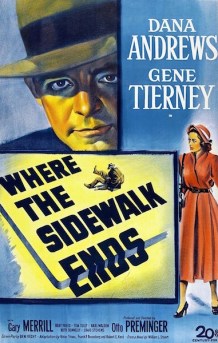 Otto Preminger’s film noir — scripted by Ben Hecht, adapted from William L. Stuart’s novel by Robert E. Kent, Frank P. Rosenberg and Victor Trivas, and quite what the difference between “adapting” and “writing” are I’m not sure — offers complex characters in a multi-layered plot. The ending particularly underlines this: the filmmakers could’ve killed anti-hero Dixon, could’ve had him choose to not open the letter, etc; but the decision he takes and the reactions of others are all relatively complex. Earlier, the sequences following Paine’s death are well constructed to produce the maximum amount of tension; their plotting clever, allowing for multiple (albeit similar) interpretations of events. Things happen which seem irrelevant, but are of course none-more-relevant later. Few films today are so brave as to not explain such things immediately.
 100Films.co.uk