
Scott Wiper | 109 mins | TV | 18 / R
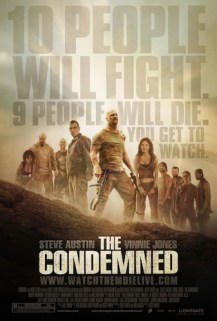 The Condemned is an old-fashioned-ish action movie, produced by WWE Films — i.e. the people behind all the wrestling claptrap. I should very much like to point out that I don’t care one jot about WWE or any other form of wrestling, real or faked. So why watch this? Because it’s got nothing to do with WWE itself aside from one (or more, I don’t know) former wrestlers acting in it.
The plot, essentially, concerns a bunch of hardened murderers being purchased from the death rows of various third world prisons and dumped on an island where they will fight to the death, broadcast live on the Internet for the enjoyment of paying customers worldwide. Yes, it’s Battle Royale with a sort-of-moralistic twist — “heck, if these guys are gonna be executed anyway, they may as well do it to each other for our entertainment, right?”
So, it sounds trashy; it sounds pitched in that kind of you-can-almost-believe-it-would-happen-for-real ballpark that might provoke debate; though it also sounds like we’re going to be told this is all actually quite moral and acceptable (watching people die? Yay!), and we’ll perhaps need to switch off from the plot because, really, it’s just an excuse for a good fight.
Well, that’s not quite so — and I’ll pick on the people who nonetheless insist this is brainless in a bit — because The Condemned is surprisingly good. It starts well, and one keeps expecting it to degenerate into rubbish, but it never quite does. This is partly due to lowered expectations, true, and I’m not claiming it’s a piece of philosophical art — it’s still essentially a straight-up action movie — but there’s more to the story and its inherent issues than one has any reason to expect.
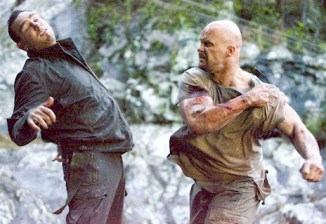 Indeed, in places it’s even satirical. Largely, though, the plot flatly commentates on society’s preoccupation with violent entertainment. Ironically, this is criticising not only organisations like WWE, who produced the film, but the genre of the film itself. It’s difficult to tell if director/co-writer Scott Wiper and his fellow filmmakers are aware of this irony/self-criticism, but if we give them the benefit of the doubt it becomes a nice layer.
Technically it’s not a remake of Battle Royale (there’s no credit to that effect at any rate), but the plot shares a shocking number of similarities: a group of people relegated to an island for a fight to the death with only one survivor, watched by millions of paying customers, with explosive bracelets that kill them if they don’t comply. OK, so The Condemned is a webcast and the bracelets are on the ankles not necks, but those are hardly huge leaps. Though it lacks originality, the use of death row criminals rather than innocent schoolchildren lends The Condemned both a more realist edge (you can’t really imagine the situation in Battle Royale ever happening, whereas The Condemned’s scenario is almost plausible) and a different social commentary — if these people are going to die anyway, why not let them fight it out for mass entertainment?
The film could choose a simplistic moral path; indeed, as it’s a WWE-produced action movie, one more or less expects it to fall on the side that, yes, this is actually quite a good idea. Fortunately, however, it doesn’t, and while the opinions may ultimately be explicit, with clear cut good and bad guys, it at least develops them to this point rather than starting out that way. In this respect, one might argue it has stronger, more dimensional characters than even some other well-respected action movies.
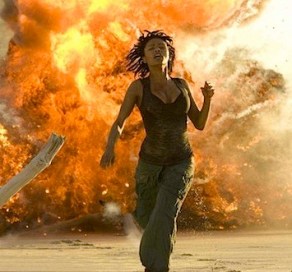 The same can be said of the action. With ten people, nine of whom will die, it could just be a series of fights where the designated Good One emerges victorious. And yes, there are a couple of fights of this nature, but as Things Go Wrong the realistically sick side of the ‘game’ is revealed: one female is cut up and presumably raped, all streamed live, while another is tortured before eventually being burned alive. It’s disgusting but, crucially, the film agrees that it is. That might sound obvious, but one suspects certain entries in the torture porn genre would disagree. That it draws you in to the brainless action movie mindset — fights! deaths! yay! — before twisting it with a dose of nasty reality suggests a greater degree of thought to both its structure and social message than one might expect. Maybe this is only a serendipitous side effect of the story path the writers chose, but even if it was an accident the success of it is still present.
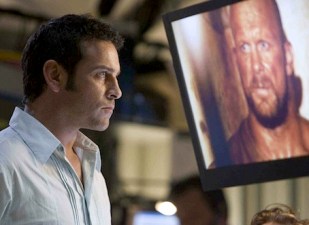
Events are kept rolling with a couple of different plot threads. When so many films of every genre are padded to make a decent length these days, it’s refreshing to find one that has good reasons to be as long as it is (and still below two hours, note). Perhaps there are a couple too many convicts to dispatch early on, but that’s a minor over-extension. Subplots with the FBI and a girlfriend add different perspectives alongside the twin-pronged thrusts of action on the island. The viewer is never allowed to forget that events are being watched — the goings-on in the producers’ camp are given as much time and attention, even during the action scenes, as anything going on in the jungle. Thematically, this is as much about voyeurism as death-dealing.
 Something that amuses me is how many reviews call this “a brainless action movie” and make assertions like “the dialogue only serves to get from one action scene to the next”. Now, I’m not going to argue that The Condemned is actually some essayistic polemic on the evils of the media or modern violence-obsessed culture, but it has more to think about than the majority of action movies — meaning it’s neither brainless nor devoid of importance between action scenes. Perhaps you can enjoy this solely as a series of action scenes, but I have to wonder if those who do didn’t so much turn their brain off as have it removed (assuming there was one there in the first place) — the commentary on voyeurism and violence isn’t subtle and therefore certainly not accidental, so quite how it can be missed is beyond me.
Perhaps I’m overrating The Condemned here — it’s still a WWE-produced action movie and a Battle Royale rip-off, after all. But it has both competence in its direction, acting and action (you don’t have to go as low as a Uwe Boll film to find weaker efforts than this), and some level of thought in its script. I’ve seen a lot worse, and avoided a lot, lot worse — see Five’s movie schedule for examples of both. By contrast, The Condemned is a masterpiece; and at worst, it’s a lot better than it has any right to be.

 Public Enemies came out nearly a year ago now, and I remember two things about its release: firstly, that the first review I saw was Empire’s, which
  What it brings here is an unusual quality. It’s clearly fiction, of course, albeit fiction based on fact, and there are still plenty of extravagant angles and editing so that you’re never in danger of thinking Mann is trying to pass this off as a documentary. But couple the raw cinematography with a meticulous attention to period detail, with a sound mix that is consciously rough and real, and you get a sense that this is how it was — it’s not a glossified movie version, it’s a How It Was one. Public Enemies is to the old gangster film as
 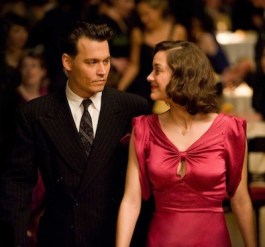 The characters do and don’t lack depth. The relationship between Dillinger and Billie is a significant part of the film, receiving roughly equal attention to Dillinger’s criminal deeds — it’s his final words to her that close the film, not his death. Christian Bales’ G-man, Melvin Purvis, on the other hand, is less developed, but to say he lacks any character is to do Bale’s performance a disservice. Behind Purvis’ blunt dialogue and stolid manner, and in slight gaps and lapses around it, one gets a sense of the true man and his real thoughts. The postscript — that he resigned from the FBI a year later and ultimately took his own life — reinforces and confirms the subtleties Bale injects into the performance.
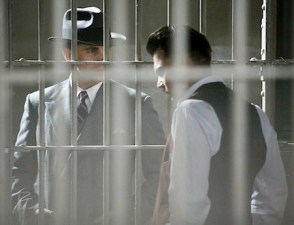 Mann does his best, cutting around Dillinger in the movie theatre, the bizarrely-apt film he’s watching (this isn’t dramatic licence — Dillinger really saw
  is largely well converted to a dramatic piece, if occasionally a little episodic (as is the way with all biopics) and overlong towards the end.
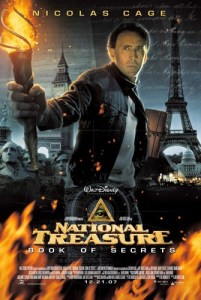 I enjoyed the first
  but they’re to embellish its tale, in the same way many higher-class films have — it’s just an entertaining ride, with some exciting action, intriguing clues, and the odd bit of humour.
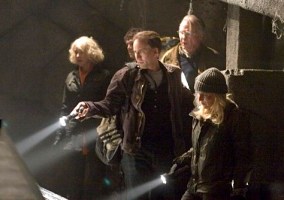 but there are worse ways to spend a couple of hours, particularly if all you want is a bit of well-made light entertainment.
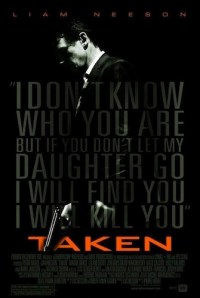 “I don’t know who you are. I don’t know what you want. If you are looking for ransom, I can tell you I don’t have money. But what I do have are a very particular set of skills; skills I have acquired over a very long career. Skills that make me a nightmare for people like you. If you let my daughter go now, that’ll be the end of it. I will not look for you, I will not pursue you. But if you don’t, I will look for you, I will find you, and I will kill you.”
 A Good Script rather than A Series Of Scenes, I’m inclined towards the latter here, because of the comparison with Man On Fire.
 but after half an hour spent setting things up, it’s like screenwriters Luc Besson and Robert Mark Kamen felt they’d done their dramatic dues and just wanted to watch people get beaten up. Or shot. Or blown up. Or hit by trucks.
 Despite all this, Taken’s an entertaining actioner. Unsurprisingly, there’s something satisfying about an apparently calm and controlled father being allowed to explode in precision violence against a bunch of scumbag white slavers. It’s wish fulfilment; proper justice finally being done. And, for extra gratification, he’s got the requisite spy skills — the bit with the radio and walkie-talkie, for example — and, even better, edge — perhaps the film’s most memorable moment (after that speech, anyway), when he shows the lengths he’ll go to when visiting a ‘friend’ for dinner.
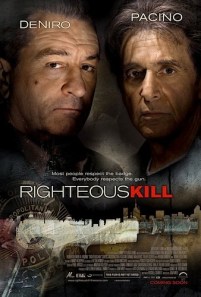 You remember Righteous Kill, right? It’s the film that reunited De Niro and Pacino, only the second time they’d appeared on screen together. And while the first,
  he’s lensing a procedural thriller about a pair of 60-something cops and not Miami Vice 2. Suffice to say, it doesn’t work; if anything, it makes it worse.
 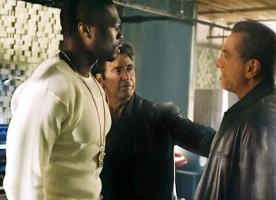 The film’s at its best when focusing on the De Niro/Pacino pairing, granting us the occasional good scene. Or just line — every little helps. But there’s not enough of that and too much of the dross. Other characters come and go with near-random irregularity, subplots are abandoned, or if they were resolved I missed it, and there are so many clichés you wish the DVD came with a spotters’ guide — at least ticking them off would give you something to do.
 Apparently, the recent Michael Caine-starring
 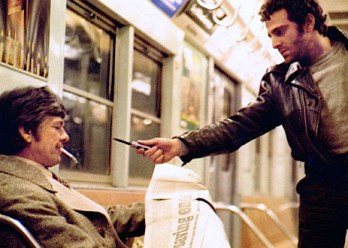 The strongest element is probably Wendell Mayes’ script, because it constructs all this. Weakest is Michael Winner’s direction — some of it’s fine, the occasional shot even good, but largely it’s pedestrian and sometimes mediocre. That said, Winner has become such an unlikeable public figure that it’s somewhat difficult to gauge how much of this is bad direction and how much bias. Still, it’s not the kind of work to make one think, “he’s an idiot, but he knows how to do his job”.
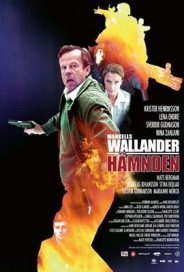 Krister Henriksson returns as the titular Swedish detective for a second — and final — series of feature-length investigations, though this time only this first has received a theatrical release (which means it’s likely the only one I’ll review, unless the series finale offers something that persuades me otherwise).
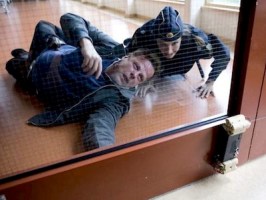 The climax is a case in point. There’s no grand shoot-out or serious race-against-time-for-the-last-bomb, just Wallander and the criminal having a calm chat. OK, so there’s a kidnapped government minister, a gun, snipers and a big vest-bomb, but these are set dressing to the conversation. It’s proof if proof were needed (it isn’t) of Henriksson’s controlled skill in this role. As great as Branagh could be, it’s hard to imagine his introspective interpretation of a weepy Wallander slotting into this scene without making it unpleasantly histrionic.
 but also by adding two new recruits to Wallander’s team, Isabelle (Nina Zanjani) and Pontus (Sverrir Gudnason), and the introduction of prosecutor Katrina (Lena Endre). All are set up as key new characters for this run, though it’s clearly Only The Beginning here. Katrina is a little too blatantly a potential love interest for Wallander, while Isabelle and Pontus are… well, new characters. There’s little to say about them yet.
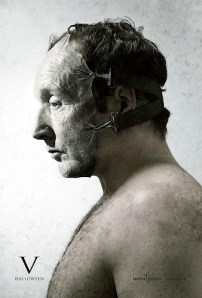 And so the never-ending Saw franchise trundles on to its fifth part. Indeed, Saw Part 5 might be a more apt moniker for this film: it picks up directly from the end of
  One of the franchise’s Big Things has always been the last-minute twist. Signalled by the Saw theme beginning to play and emphasised with an explosion of very brief flashbacks to earlier in the film, the twist shows us what we’ve missed all along and turns the story on its head. The
 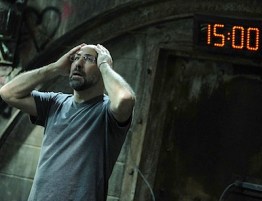 In fact, it’s this side of the film that holds a bigger and better twist than the highlighted arc plot one, though some viewers may miss its significance as it goes so unheralded. (Arguably this ease with which it might be missed says something about how significant it is; equally, perhaps I’m assuming a lack of intelligence on the part of Saw’s regular audience by implying they would miss it.)
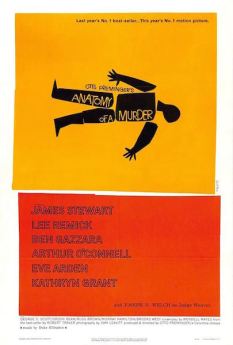 Anatomy of a Murder is a courtroom drama, adapted from a novel by a real-life defence attorney (“defense attorney”, I suppose), who in turn based his fiction on a real case. This background not only adds to the veracity of what we see, but likely explains the film’s style and structure.
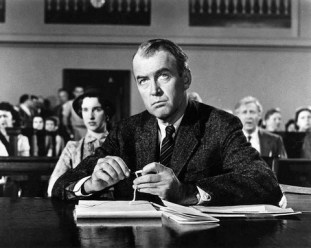 A lot of this support is down to Stewart’s performance — it feels wrong to be cheering the defence counsel of a murderer, even if he had a justifiable motive (which, remember, he may not have) — but we’d probably cheer Stewart on if he was the murderer. His Biegler is always in control, from investigation to courtroom, even when by rights he should be completely out of it. He manipulates the judge, the prosecution, the jury and the crowd to perfection; the viewer sits by his side — we know he’s playing them so we can revel in it — but, in turn, he manipulates us too, tempting us to his team — to laugh at his jokes, to support his case, to loathe the prosecution, even though they might be right. It’s a stellar lead performance.
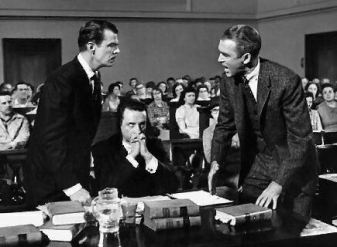 I could just as well go on to praise Ben Gazzara, Arthur O’Connell, Eve Arden, Brooks West, even the smaller roles occupied by Kathryn Grant, Orson Bean, Murray Hamilton and others. Some criticise Joseph N. Welch’s judge, and it’s perhaps true that his performance is a little less refined than the others, but as a slightly eccentric judge he comes off fine. And to round things off, there’s an incredibly cute dog. Mayes’ screenplay is a gift to them all, finding room for character even within the ceaselessly procedural structure, using small dashes of dialogue or passing moments to reveal and deepen each one.
 There are times when one feels under-qualified to review a film in a way that gives it its due. This happens particularly frequently when one’s blog covers first-time viewings of films that are often classics/significant/beloved/etc. My appreciation for Exiled has been increased by two other, more qualified, reviews: one from
