
Gregor Jordan | 93 mins | TV (HD) | 18 / R
 Star Wars’ Samuel L. Jackson, The Twilight Saga’s Michael Sheen and The Matrix’s Carrie-Anne Moss star in this low-key thriller from the director of Buffalo Soldiers, Ned Kelly and The Informers. Sheen plays an American Muslim who alleges he has planted bombs around the country; after he is captured, Moss’ FBI team are brought in to locate the bombs; Jackson is a black-ops interrogator brought in to get the truth out of Sheen — by any means necessary. Including — or, perhaps, especially — illegal ones.
I say it’s a “low-key thriller” because, though the stakes are high, the vast majority of the action takes place in a deserted high school commandeered as a temporary military base, where Moss’ team work out of re-appropriated classrooms and Jackson conducts his interrogation in a sort of one-way-glassed torture tank placed in the gym. So there’s no 24-style thrills as people rush around the city/country hunting out bombs — Unthinkable is wholly reliant on the script and performances to draw us into its story, and its debate.
The debate in question is torture, and whether it’s excusable, and under what circumstances, and how far it’s OK to go. Though it’s grafted on to a story, it’s pretty clear that screenwriters Oren Moverman and Peter Woodward are as much, if not more, concerned with the issues at play than with the story they’re telling; the story, rather,  is a decently dramatic way of drawing out and considering these issues. In my opinion, it works; at least, works well enough.
For some reason, Rotten Tomatoes only cites two professional reviews for Unthinkable (don’t know why, I know there are more — one’s quoted on the US DVD cover for starters), but the chosen pullquotes seem to sum up the opposing reactions I’ve spotted elsewhere, and indeed the opposing reactions a film such as this is predisposed to provoke. On one hand, one might find it “an entertaining and thought-provoking drama,” as does David Nusair of Reel Film Reviews; on the other, one might consider it “a clumsy polemic that bounces between the boundaries of stage-play debate and torture porn spectacle as everyone argues over ethics,” as does Sean Axmaker of Seanax.com. I’m far more inclined to agree with the former, and now intend to take Mr Axmaker’s four contentions one at a time as a handy way of shaping some more of my thoughts.
a clumsy polemic
As I’ve already insinuated, Unthinkable isn’t particularly subtle in its foregrounding of the torture debate. The thing is, a polemic requires it to be an “attack on someone or something”, 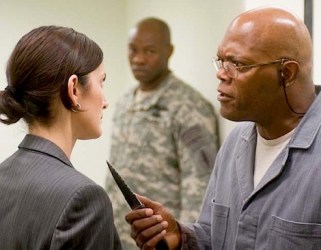 which I don’t think Unthinkable is — I think it argues both for and against torture. Perhaps if the viewer is firmly entrenched in one viewpoint then the film will seem to support it to a polemical level; or perhaps they’d read it the other way, and see it as a polemic against their viewpoint. I don’t know which, though, because I don’t think it comes down hard on either side.
stage-play debate
I think such criticism also does it a disservice; or does the theatre disservice, because it seems implicit in this comment that something limited in the way a stageplay would be can only be simplistic and unworthy. Unthinkable takes place in a limited number of locations, true, but not so limited that it feels forced. Nor is it so flatly directed as to feel like a filmed play, nor are the performances theatrical in the negative sense.
torture porn spectacle
This is just rubbish. “Torture porn” has become an overused phrase; something readily grabbed to bash a film with. I’m not saying the sub-genre doesn’t exist, and I’m not saying it’s a good thing, 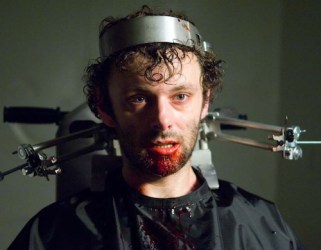 but Unthinkable is not a torture porn film. Yes, it contains torture, and some of it is shown in some degree of detail, but it does not depict it as brutally as it could, and it does not revel in it. This isn’t torture for the audience’s enjoyment, this is torture as a point for debate — “is it allowable to do this to another human being to get results?”, etc. Which brings us to:
everyone argues over ethics
And? As I said, Unthinkable doesn’t try to hide that it’s a debate on torture, but nor does it use it in place of a plot. This isn’t an essay pretending to be a film.
There are, apparently, two cuts of Unthinkable. I watched it on Sky Movies and they showed the extended version, which is also the one on DVD/BD (or maybe they both are), which I can only imagine is the director’s preferred version. The only difference is an extended ending. Why a shorter one even exists is baffling, because that final shot is essential. There are films where an ambiguous ending fits — I’ll happily line up to argue in their favour should such a line be necessary (first example that randomly pops into my head: In Bruges) — but it wouldn’t work here, in my opinion, and so the final shot becomes a necessary tie-off. 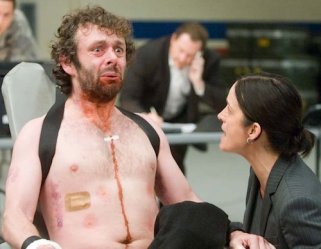 It’s much more important than simply answering a lingering question — it unequivocally presents the ultimate outcome of the characters’ actions. Like the rest of the film, it doesn’t seek to tell you whether this is right or wrong, but shows you where such decisions lead. Moralising is left up to the viewer. (Apologies if this is vague, but I don’t want to spoil it.)
Unthinkable has been largely missed as a direct-to-DVD effort, despite its moderately high-profile cast and relevant themes. It’s an effective thriller based around a debate that is perhaps simplistic, but also thought-provoking. It’s easy to dismiss torture in the abstract, but there are endless “what if”s and “how far”s that can change things. But should they? And so on…

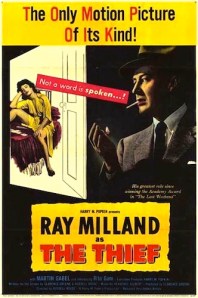 Ray Milland stars as Dr. Allan Fields, a nuclear physicist working at the United States Atomic Energy Commission, who is photographing secret files and passing them to The Other Side, until something goes wrong and the authorities are on his tail. But that’s almost beside the point, because if The Thief is known for anything it’s for its dialogue — as the poster proclaims, “not a word is spoken…!”
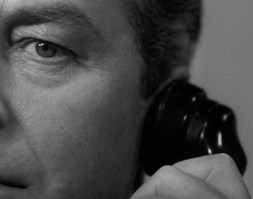 Obviously we can look back to the silent cinema for that kind of thing, but while that era could probably still teach many filmmakers something about visual storytelling, it’s hard to deny that the advent of synchronised sound adds a helluva lot to the ability of film — if it didn’t, it wouldn’t have taken over so fast and remained virtually 100% dominant for the last 80+ years.
 Perhaps this is why the villains are never explicitly named. But they’re definitely not American! Tsk tsk. More crucially, it’s a bit slow at times — it seems to take longer to explain things when stuck doing them through visuals alone. That said, it could probably have survived a speedier approach even doing what it does — perhaps, then, Rouse is playing for time: the film only runs 87 minutes in spite of its pace.
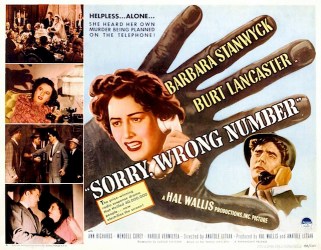 A film noir screenwritten by Lucille Fletcher, “based on her famous radio play” — I love how old movies have credits like that. It sounds like pure hyperbole, but in this case seems to be justified: the original play was broadcast in May 1943 but was so popular they chose to re-stage it with the same lead, Agnes Moorehead, a total of seven times up to 1960. Seven!
 As if keeping us guessing wasn’t enough, our feelings are shifting in this respect too. Arguably it unravels a little late on — when Evans is explaining his part to her, it’s getting a bit implausible — but it’s all redeemed by the finale.
 John Carpenter’s rough-and-ready ’70s exploitation B-movie is remade as a slick ’00s action B-movie dressed up as an A-movie by director Jean-François Richet (who would go on to find far greater critical acclaim with his two-part French crime epic
 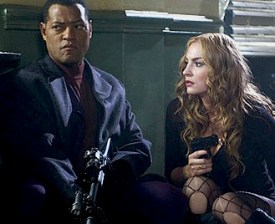 I don’t have hard timings to back this up, but I think the siege starts earlier and lasts longer here. It certainly felt that way, in part because the character of the father (whose act of revenge leads the gang to the precinct in the original) is gone. Of course, the film is about the titular assault on the titular station, so I think this refocussing is more than fair enough. It, naturally, emphasises the siege element of a film about a siege, something the original almost reneged on with its lengthy setup.
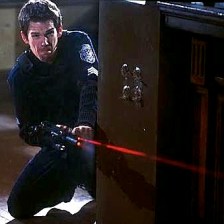 The only reason the prologue is necessary is if you want to begin your movie with an action sequence… so that’s why it there then. It’s also set in a sun-drenched summery atmosphere, totally at odds with the well-evoked wintery New Year that pervades post-titlecard. Consequently, looking back on the prologue, it feels even more out of place. I think it’s also designed to set a Gritty tone, with its rundown apartment and drugs deal and all that palaver; probably because the rest of the film is too far-fetched, if you were hoping viewers were going to be in mind of
  criminals inside the precinct are black or (in one case) hispanic. Ouch. You could try to argue we’ve developed past the need to force anti-stereotyping in casting; or you could argue this is a mainstream studio remake that felt the need to fall back on the familiar. It might not be a noticeable point were it not for it being so markedly different to the original.
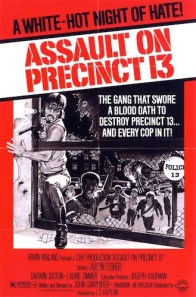 Assault on Precinct 13, it has always seemed to me, is an acclaimed cult classic of the action genre. I could probably find some references to support this — I know it’s on Tarantino’s list of the top seven exploitation movies, for starters — but for speed let’s just assume I’m right. Thing is, on initial impressions at least, I didn’t quite get that. It felt like an unexceptional low-budget ’70s exploitation B-picture to me.
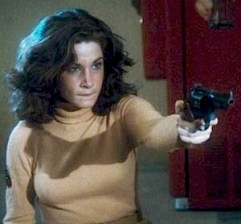
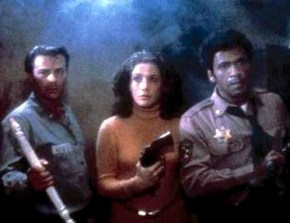
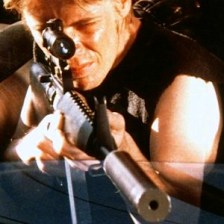 a huge gang who lay siege to the cut-off station. So the cops and the prisoners must work together to fend them off.
 performing voodoo-esque rituals, coming and going as if by magic, doing things our heroes can’t necessarily explain, attacking in almost random waves… They feel almost supernatural; one might go so far as to say they play more like zombies than an organised criminal force. It’s no surprise that Carpenter would next helm
  And another says that, “like
 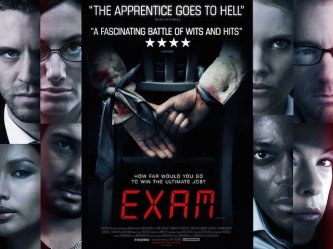 There’s an argument that the less you know going into any film the better. Naturally there are some films this applies to more than others, and Exam is one such film. Eight young professional types go into a job exam/interview; the next hour-and-a-half is all mysteries and riddles — which is why you wouldn’t want to know too much.
 Such a contained story relies heavily on its characters and the actors’ performances. Largely a cast of un- (or little-) knowns, all are decent — one or two may be subpar, but I’ve seen a lot worse. I don’t quite understand how some viewers can find White, played by Luke Mably, to be a completely likeable character in spite of his obvious flaws — he has his moments, but surely he’s not agreeable overall? Not a jot. That said, his is the standout part, a scene-stealing performance from Mably. There’s no clear-cut audience-favourite, which (from reading a few reviews) seems to be a problem for some viewers. As far as I’m concerned, it’s a good thing: never mind the realism of there being one perfect person every viewer will love, audience-favourites will either predictably win or be shockingly dispatched, so what’s the point?
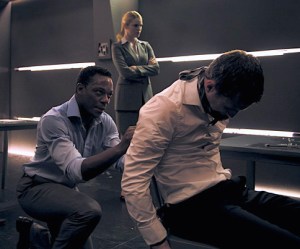 it’s quite nice to find a plot that doesn’t feel the need to tie everything in to its reveal; a plot that can wrong-foot you by occasionally focusing on something that’s ultimately irrelevant.
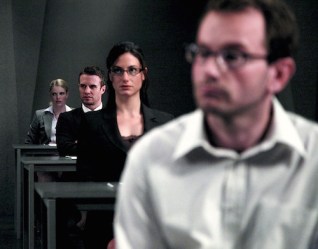 and films that invite pondering tend to invite repeat viewing; but then again it works equally well (better, ultimately) as a straight-up “what’s going on?” thriller.
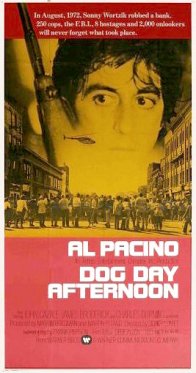 On August 22nd 1972, John Wojtowicz and Salvatore Naturile attempted to rob a Brooklyn bank to raise money for Wojtowicz’s male wife to have a sex change operation. The ensuing hostage situation was watched live on TV by millions of New Yorkers. If you made it up people wouldn’t believe it — especially in the ’70s — which is why this film, closely based on those events, strives so hard for naturalism. And it succeeds, and then some.
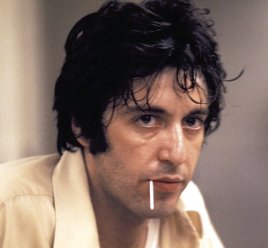 to try to circumvent built-in prejudices that would’ve adversely affected an audience’s reaction too soon. It still works now — it’s not a twist, per se, but it is likely to change one’s perspective on the film and its characters mid-flow, which is always interesting.
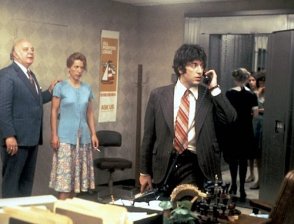 In trying to get a handle on the real Sonny when he was starting on the screenplay, Pierson talked to various people who knew him, but struggled to reconcile their conflicting accounts of the same man. The link he found was that Sonny was always trying to please people, and that’s what he used: in the film, he’s not just out for himself or his boyfriend, but also trying to placate and please his hostages, the police, the media, his partner, his mum, his other wife… Pierson and Pacino do indeed make him a different man to all of them, and this is one of the reasons Sonny is such a great character and a great performance: he’s genuinely three-dimensional. All of us behave differently, to some degree, when we’re with different people — we don’t necessarily realise it, because they’re all facets of the same us, but we do it — so to put that into a character is to make him real.
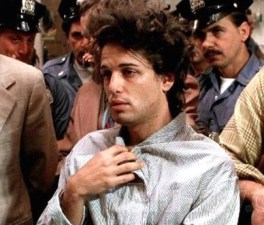 throughout the film trying to avoid turning any of these unusual characters into freaks, and Sarandon pitches it right. He plays the truth of a conflicted, confused character; a man who is perhaps easily led but hard to please, I think. As with the rest of the cast, the little touches he brings — such as starting a sure-to-be-emotional phone call to a man currently in the middle of a tense hostage situation with “so how are you?” — sell the reality of the piece.
 of today’s grainy shakycam stuff, this just feels real; the heart and truth of it come through, not the surface sheen of it being documentary footage. That’s more important.
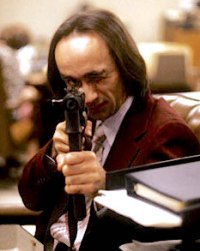 Pierson’s screenplay won at the Oscars. The film was also nominated for Best Picture, Actor, Supporting Actor and Editing, but this was the year of
  The film treads a delicate line between drama, comedy and thriller, but doesn’t once tip too far in any direction. It’s got several genuine laughs, but none compromise its serious side or claim to reality — it’s tense and touching too. Anyone else making a film about an extraordinary situation, be it a true story or from the mind of a crazed writer, would do well to look at Lumet’s work here.
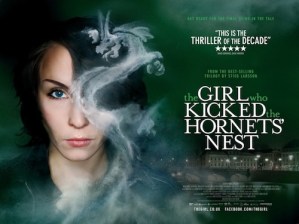 The Girl Who Kicked the Hornets’ Nest — or, in America, Hornet’s Nest (oh, Americans!) — or, translated from the original Swedish, The Pipe Dream That Was Blown Up — or, according to a different translation, The Air Castle That Was Blown Up (guess that’s a cultural thing…) — is the third and final part of Stieg Larsson’s Millennium trilogy.
 while the villains futilely attempt to stop the heroes publishing everything they already seem to know.
 The other cornerstone of the film is Lisbeth’s trial for the attempted murder of her father at the end of Played with Fire. The final third of the film is dominated by a series of immensely satisfying courtroom scenes in which the defence trounce the opposition, not through American-esque grandstanding but through a quiet and thorough application of facts and truth. You can see the satisfaction bubbling under Lisbeth’s almost-static face as the prosecution unknowingly hang themselves, the defence — Mikael Blomkvist’s sister Annika, for what it’s worth — holding back her killer evidence until the prosecution have dug themselves a pit so deep even this mixed metaphor would be buried. Both Lisbeth and Annika walk all over them by remaining calm and logical, dispatching the case against Lisbeth in a way that becomes an absolute joy for the viewer.
 It means Lisbeth remains an unknowable, elusive mystery, but then isn’t that part of what makes her so fascinating? The full exposure of her troubled (to say the least) history in this episode clears up some of her ambiguity without lessening her as a character. It’s a testament to the understated excellence of the performance that actions as little as a smile or saying “thank you” are huge revelations.
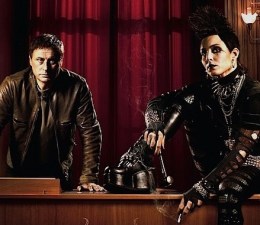 the second balances on top of the events in its predecessor. The difference is, I properly enjoyed Hornets’ Nest. I wouldn’t watch it again in isolation (unlike Dragon Tattoo, which doesn’t need its two sequels to function as a story), and perhaps it had too much going on for its own good — or perhaps I’m being too demanding of the intricacies of the investigation — but it’s a solid final episode with a lot of satisfying moments.
 A World War II espionage thriller about the OSS — spies, basically, and the forerunner to the CIA. Despite all the thrills this should elicit, especially when directed by Fritz Lang, I wasn’t particularly impressed.
 This is probably the benefit of being based on a non-fiction book.
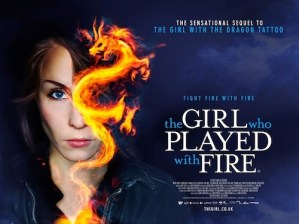 Creating any kind of sequel is hard — the endless array of failed attempts is testament to that — but I think creating a direct sequel to a successful crime thriller may be the hardest.
 and they need a brand new case to become embroiled in. And it’s got to be as good as the last one, but it can’t be the same because we’ve had that mystery solved. You could have a different solution, of course; you could change some of the details, naturally; but police dramas on TV vary their types of murders every week for a reason. So in your new tale, the new characters have to be just as interesting as the first batch, the new mystery has to be just as intriguing too, and it really ought to be a notably different crime being investigated.
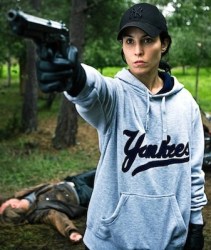 One solution to the sequel problem is to “make it personal”, and that’s exactly what we get in The Girl Who Played with Fire. A journalist and his girlfriend working for Mikael are murdered and Lisbeth is suspected of the crime. It’s somewhere around here that the coincidences begin to pile up. It makes perfect sense as a plot in itself, but in bringing Mikael and Lisbeth back together it doesn’t work — it’s not related to their previous encounter, so it’s entirely coincidental. Coincidence is a dangerous thing in fiction; it asks your audience to accept something that doesn’t fit our logic of how stories work. It happens all the time in real life of course, but in real life a flipped coin with a 50/50 chance of being heads or tails could turn up heads twenty times in a row, but a person asked to estimate twenty results of a flipped coin will never put more than two or three of one side in a row (unless they know to subvert it… look, this isn’t the point).
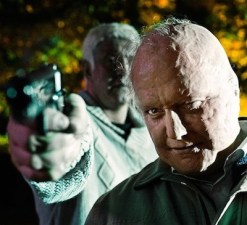 it’s never seriously looked into and, consequently, other dramas have tackled the issue with greater depth, sensitivity and insight. What Mikael and Lisbeth are actually looking into is a conspiracy of sorts around some murders. The way the trail is followed isn’t as clever as it was in Dragon Tattoo and, consequently, isn’t as interesting. The two protagonists go about their investigations independently. This is a long-held technique in novel writing — multiple strands allows the author to alternate which is followed from chapter to chapter, almost by itself providing momentum and the must-keep-reading factor as the reader has to race through the next chapter to rejoin the thread of the previous one (it’s not that simple or we’d all be churning them out… but look, I’m getting off the point again). The problem here is that Dragon Tattoo was largely at its best when the two were together, so keeping them apart is less satisfying. To top that off, they’re each finding out different things, which means as the audience we can feel a few steps ahead of the characters as we have the benefit of both sides of the case. That’s not always a bad thing, but it can be slightly disconcerting when you know the answers your hero is still searching for.
 Despite Lisbeth being the focus of much of the attention laden on these books/films/remakes, she’s a less engaging character when by herself. Here she shuffles around silently, digging up files that she and we stare at to reveal information. There are only a few moments for her (and, consequently, Noomi Rapace) to show off what endeared her to viewers before — her confrontation with a pair of arson-bent bikers, for instance.
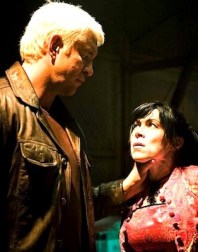 It also feels less filmic than the first film. Is it poor direction? Is it just the opened-up 1.78:1 ratio? I’ve read that all three films were shot like this, as they were intended for Swedish TV, meaning Dragon Tattoo’s Blu-ray is cropped to 2.35:1. You hardly ever see 2.35:1 on TV (
 100Films.co.uk