
Kevin Greutert | 90 mins | Blu-ray | 1.78:1 | USA / English | 18 / R
Before gangs of youths knock on your door to rob you under threat of violence, as is traditional on Halloween, why not enjoy my thoughts on a now-dead ’00s Halloween staple: the Saw movie.
I say “enjoy” — it’s almost as bad as those greedy kids…
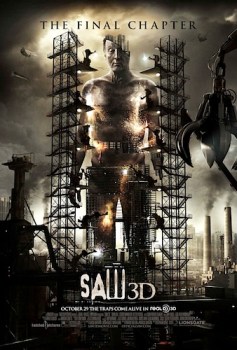 What’s this, the first Saw movie, now in 3D?
No.
So it must be the third Saw movie then, in 3D?
No, not that either.
It’s the seventh, in fact. But it is in 3D, hence the only-slightly-confusing Saw 3D moniker. I guess Saw 7 plus the tagline “see Saw 7 in 3D!” wasn’t considered clear enough.
And to top the stupidity off, I didn’t watch it in 3D, but the 2D prints are still called Saw 3D. What?
I was going to say that’s not even the most stupid thing about the film, but the rest of it isn’t so much stupid as disappointing. The problem is that there are some good ideas, but few are executed as well as they could be or paid off appropriately. The setting for the opening trap — it’s played out very publicly in a shop window — is a marvellous twist on the format. Is this an escalation? Are we going to see Jigsaw playing to the crowd all the time? No. It’s a one off. It doesn’t even have any bearing on the rest of the plot — it simply occurs and is never even mentioned again. That’s appalling.
Likewise, the support group for Jigsaw survivors: nice idea, but they don’t find anywhere to go with it. At least the notion of a fake Jigsaw survivor making a mint out of selling his fake story is an idea that has legs. Not long legs really, but they at least get a decent amount out of it — that is, it’s a set up for the Game of the Film. As ideas for The Final Film go, it’s a perfect match — a bit meta and all that jazz. Accompanying this is, of course, the arc plot that has stretched across the series. As the final film it’s time to wrap that up… Sadly, it isn’t particularly satisfactory.  With so many characters killed off in the preceding films we’re not left with anyone to really care about — certainly not the new gang of coppers we’re introduced to. Actually, to say we’re “introduced to” them is a kindness — they just turn up and begin to lead that part of the plot.
That said, the final five minutes are pretty good — just when I was thinking Cary Elwes’ cameo earlier had been underwhelming and pointless, there’s a final reveal to pay it off, and also neatly tie together and round off the whole series. It’s easily the best bit of the film.
It might seem daft to say this about a Saw film, but it’s a bit too gory for my liking. I know that comes with the territory in a film like this, but I think others in the series have managed the level better. This is up with Saw 3 in the stakes of needless torture-porn-level blood ‘n’ guts. The near-pointless car trap is the worst offender, as much as anything because it’s almost entirely ancillary to the plot — it’s a trap for the sake of a trap, and it’s a nasty one.
The film’s extended version (no idea if it’s included on the UK release I watched) only adds 12 seconds, and that’s all gore. Most of that occurs in extensions of literally a few frames. Earlier extended entries added both plot and gore, so that’s… pathetic, really. (According to the BBFC, the PAL-speed DVD versions run 23 seconds longer than the theatrical version. My info on the 12 seconds comes from my usual source.)
Aiming to live up to its title, the whole affair has clearly been designed with 3D in mind. That means a few moments of things flying at the camera, but they’re surprisingly rare. OK, so people explode or are pulled apart  a lot more regularly than they were in previous films, and bits of them swing in the direction of the camera, but that’s in keeping with the style of the series and doesn’t jar massively — if you didn’t know it was shot for 3D, you wouldn’t notice most of it.
Other bits, though, you really would. One trap sees three spikes headed for a woman’s eyes and mouth, so naturally we’re treated to some POV shots. This probably worked great in 3D, but in 2D they literally fall flat. Better is a trap that sees two men having to negotiate planks of wood on the second storey of a building that doesn’t have a floor. It works fine in 2D, but I imagine 3D added some lovely depth to the layered drop to the floor below. Never mind the odd things flying at the camera, this was the only time I really wished I was watching in 3D.
Some people lay into 3D for having stuff poke out at the audience for barely any reason. I have no problem with this in a movie like Saw — it’s all part of the fun. It gets tiresome if that’s all it’s doing, or if it happens too often, but once or twice it’s a good laugh; part of the gimmick of a thoroughly gimmicky format. In 2D, of course, that all falls dead. Luckily, as I said, not too much is randomly flung at the screen.
 The worst side effect of 3D, however, is that the colour looks ridiculous in 2D. I’m glad they’ve shot it with 3D properly in mind — everyone knows the glasses make 3D films darker, but not every filmmaker seems to be compensating appropriately (see, for example, the criticism of The Last Airbender’s post-converted 3D), so it’s nice to see someone that is. But they haven’t un-compensated (as it were) for 2D. Much of the film just looks weirdly… not bright, exactly, but too light. It’s fine, just a bit unusual. But then some of the blood is a bit of a funny colour and, by the end, has turned a garish shade of pink. Oh dear. It continues to amaze me that no one’s come up with a simple grading solution to make colours look the same in regular 2D and glasses-effected 3D. It can’t be that hard, surely?
Saw 3D has a big pile of good ideas, but all of them are underused. The film just feels boring, somehow; workmanlike, maybe. It lacks the inspiration of earlier Saw films, despite on paper having some of the very best ideas of the entire series. It feels silly to say it about the seventh film in a yearly churned-out franchise, but Saw 3D is a disappointment; a lacklustre end to a variable franchise that started really rather well. Shame.

I watched all seven Saw films within the past two years, donchaknow.
Saw 3D featured on my list of The Five Worst Films I Saw in 2011, which can be read in full here.
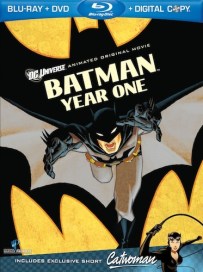 DC Comics’ latest direct-to-DVD animated movie is an adaptation of Frank Miller and David Mazzucchelli’s seminal 1987 Batman story, acclaimed as one of the greatest graphic novels of all time, and one of those that is often credited with helping the comic book medium grow up in the late ’80s.
 As with the comic, this is a very down-to-Earth version of the Batman story. It’s even less sci-fi-y than Chris Nolan’s much-praised realistic films, in fact. There’s no Batmobile, no Batcave, no Bat signal, only a few gadgets (and those that are used are fully plausible), no cartoonish super-villains… This Gotham is a city where crime comes from gangsters, drug dealers, muggers and a thoroughly corrupt police force, and that’s what Batman sets out to fight. As in the Nolan films, the costumed foes will come later, a response to the Bat himself. It’s not afraid to take its time telling this story either. Especially at the start, the pace is very measured — there’s no rush to action or to Batman, but instead a slow build of character and drama. Some may see this as a flaw — those after a Batman Action Movie, largely — but it sets the tone for what is a more character-driven tale.
 Cranston, given easily the fullest character, gives the best performance too. Star of
  Indeed, you can tell Nolan cherry-picked most of Year One’s best scenes for his version, because they’re generally speaking the ones that shine here too. (It makes me want to watch Begins again to see just how much of this made it in there.)
 Unfortunately Batman: Year One has arrived at the party a bit too late to be the definitive screen telling of Batman’s origin — by taking the best bits of Miller & Mazzucchelli’s tale and expanding it with some work of their own, Chris Nolan & friends take that title. But as a film in its own right, Year One is largely successful. Children (or childish fans) seeking animated Batman thrills may be disappointed by its slower pace and focus on character, because this is solid adult-focused entertainment.
 “Sherlock Holmes vs. Jack the Ripper” would be the easiest way to describe this pulpy ’60s effort. It’s far from the only example of this sub-sub-genre:
  and though by the end it’s explained who sent it, I was none the wiser what they’d been intending. And I watched the revelation scene twice too. Still, at least the important bit — who the murderer is ‘n’ all that — is quite neat.
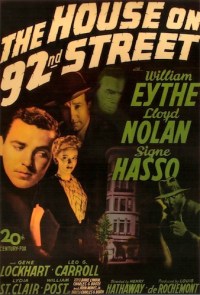 Here’s an unusual one from the pantheon of film noir. These days we’d probably call it a docu-drama, though thankfully there are no talking heads, but there is a factual voiceover narration. The story, we’re told, comes from the FBI’s files and is based on a real case —
  how they really work and investigate a case. At the time I imagine this was a fascinating procedural; now, we’re all a bit more familiar with how such things go, but it still works as an historical document.
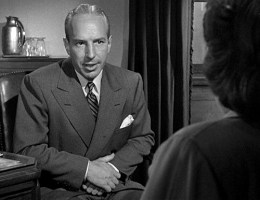 Might be because no one ever knew they were making a film noir, eh? How can you expect something to conform to a set of rules that were only defined after the fact? Hathaway and co didn’t fail at making a noir, they just made a film that doesn’t fit the later-defined template as well as the films used to define said template. I know, four words from some other online critic hardly merit a whole paragraph, but it does bug me when people write daft things like that.
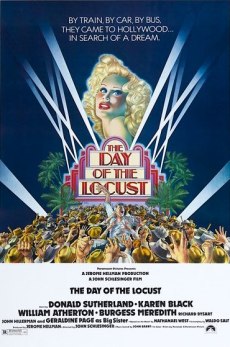 Adapted from the novel by Nathanael West, The Day of the Locust is a slightly scrappy film about the seedy underside of Hollywood’s golden age. The plot is neither here nor there in many respects — the film is about the grotesques who are attracted to Hollywood, and that being exactly what it feeds on. The bizarre, surreal ending definitely makes more sense if you’re already thinking about the film in this way.
 Also brilliantly staged is the collapse of a Waterloo battle set. Appropriate as it’s one of the novel’s most memorable moments.
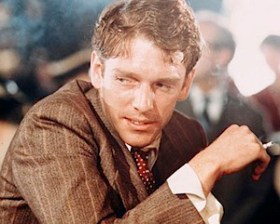 The Day of the Locust may be a mess, or it may be a flawed masterpiece. It may very well be both. For much of it’s running time it pootled along at 3 stars, pushing down toward 2 the more diluted it began to feel. But seeing the completion of Donald Sutherland’s performance in the final scenes, plus the way those scenes seem to draw together the whole film, revealing and fulfilling themes I hadn’t even noticed developing until that point, in a spectacular orgy of apocalyptic violence… well, the stars suddenly ratchet back up.
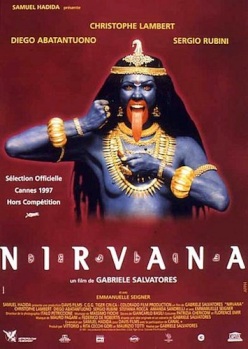 The Radio Times film section may be steadily going down the drain, but when anyone
  The most obvious point of reference for Nirvana is
  interacting with Solo merely though a series of screens on his journeys (and, one presumes, a series of microphones too). Cronenberg’s film was made a couple of years after this, so commending it for not doing the same thing would obviously be a bit rich. It is to be commended for not descending into a needlessly twist-strewn third act though, which I had thought was coming — there’s plenty of bits along the way that could be used to build a ‘surprise’ or two. There’s some ambiguity in the ending, but not too blatantly (unlike later versions of Blade Runner, for instance), and Emmanuelle Seigner’s ex-girlfriend character is never quite used in the way I expected.
 and I imagine subtitles could be easier to follow than this dubbed version, in which everyone’s covered by either the original actors straining with English (based on the accents) or the typically bad voice actors employed for such dubs. The
  The second directorial outing from BAFTA-winning Brit Duncan Jones (after
  because Source Code is hardly groundbreaking. It’s certainly a solid, dual-pronged, science-fiction mystery — dual-pronged because not only is Stevens working to find the bomber, but also fighting amnesia to discover what the source code is and how he wound up there — but not an especially deep or complex work. There’s nothing wrong with something being little more than an exciting, engrossing thriller, it’s just not revelatory.
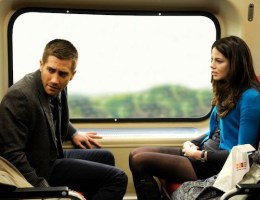 The other side of the plot is not only where the heart is, but also where the real twists and mysteries lie — I guessed the bomber the first time I saw the character; even if you don’t, it ultimately matters little. Vital to the finale are the subplots like Stevens’ relationship with his father and his growing affection for the passenger his alter ego was travelling with — but who he can’t save, of course, because the source code isn’t time travel.
 Did he create a new parallel world every time he entered the source code, or only the last time? I’m not sure that’s relevant. This is, though: at the end, he seems to remain in Sean’s body. So if he’s in a parallel world, he’s just stolen another man’s life? And Stevens — at least, the Stevens of that reality — is still lying, mutilated, half dead, in some government research facility? Hardly a cheery resolution.
 Still, problems aside, Source Code remains an exciting, taut, puzzling sci-fi thriller. On a train — there’s a whole long line of movies and connections to be explored there. Many reviews have noted the Hitchcock connection and I’m sure that’s an interesting route to look down, so maybe there is a bit more to Source Code after all… but even if there isn’t, it’s a fun ride.
 Law Abiding Citizen is a revenge movie with a (slight) difference: wronged man Gerard Butler isn’t just going after the two criminals who invaded his home and murdered his wife and daughter — he’s going after the legal system that let one of the men walk free.
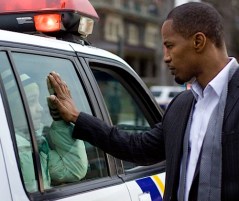 He attends the execution of the aforementioned criminal, but something goes wrong — instead of going to sleep with a lethal injection, the attacker suffers an agonising and horrific death. Someone must have swapped the chemicals. The prosecutors’ thoughts leap to the other criminal, but I’m sure we’ve all guessed who’s really behind this. And so Butler’s sprawling revenge mission begins…
 On the issue of who the film thinks is good and who it thinks is bad,
  It is a little far-fetched, granted, but it’s not so outside the rules the film sets up for itself that I find it unacceptable.
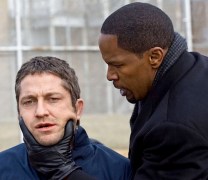 As an action-thriller that actually has something to think about wrapped up in it, I considered being a bit lenient in my score (much as I was to
  Michael Caine killing hoodies. How great does that sound? As a film premise, that’s awesome. If it doesn’t get you excited about seeing this movie, then what kind of film fan are you, eh?
 Which in some ways is quite a chilling way to feel. I’ll be buying the Daily Mail and watching Sky News next.
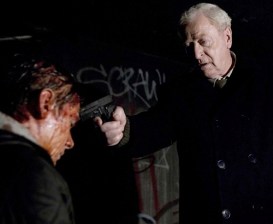 Whatever you may think of the revenge thriller it turns into, I think it’s hard to deny these early scenes have a realism and power. It is, of course, to the credit of Caine that he performs all this flawlessly. Oh yes, he’s (to quote another review) “the king of cool” when blowing away the scum that surround him, but before that he’s an affecting old gent, abandoned by the world.
 The counter to that would be that a murder spree may be viscerally satisfying but isn’t a real-world solution, so this is just as useless at relevancy as Death Wish.
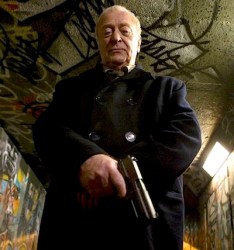 Some will think it tackles these, others that it’s just a facile revenge movie; some will think it’s cool, others despicable; some will think it plausible, others anything but. Or maybe, rather like me, you’ll think it’s all of those things, however mutually exclusive they may seem.
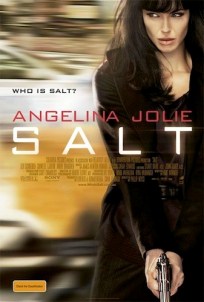 Angelina Jolie takes on a role originally earmarked for Tom Cruise in this Bourne-ish spy thriller from screenwriter Kurt Wimmer (
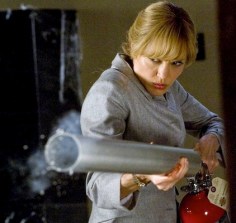 This is Salt’s mystery, and this is one of its strong points. The plot developments are well-paced throughout, developing and shifting our expectations rather than stretching it all for a glut of final act reveals. In this regard it goes places you might not expect from a mainstream Hollywood thriller. For starters, you expect the funeral-set assassination to eventually be the film’s climax, no doubt revealing our heroine isn’t a Russian spy as she unmasks the real killer. But that occurs at the halfway point, spinning the film off in new directions. To say more would spoil one of the film’s strongest elements: that, as I said, it has twists and follows storylines you wouldn’t expect in a Hollywood summer blockbuster.
 The three cuts, then, are: Theatrical (100 minutes — this was trimmed for the UK to make 12A, but is apparently uncut on disc); Director’s Cut (the one I viewed, this is 4 minutes 5 seconds longer); and an Extended Cut (1 minute 5 seconds longer than the Theatrical). The latter is based on the Director’s Cut and I’ll come to it in a minute. The differences between the Theatrical and Director’s cuts are numerous, but mainly amount to some extra character beats (including more flashbacks to Salt’s childhood) and violence — more blood; seeing people get hit rather than just seeing Salt firing; the President is killed rather than just knocked out; plus a very different death for Salt’s husband (again, more on this in a moment). Plus there’s a voiceover ending too, which in my opinion sets up the sequel even more than the Theatrical version does, with a blatant cliffhanger and suggested plot direction. My regular comparison site
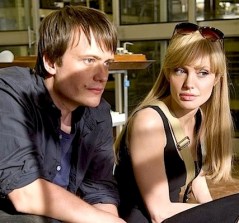 She has to control her emotions so as not to give herself away. In the other versions, however, she’s presented with him in a chamber and given a choice to save him — except trying to save him would give her away, so she’s forced to watch, blank-faced, as he slowly drowns. Salt sacrifices him for the greater good; he dies seeing her cold emotionless face. Ouch. By comparison, the theatrical cut’s blunt gunshot is much softer.
 if the filmmakers considered another option, now we can see it, and in cases like this choose our preference. Though it seems clear, by its inclusion in both the theatrical and director’s cuts, that Noyce preferred the instant-revenge option.
 100Films.co.uk