
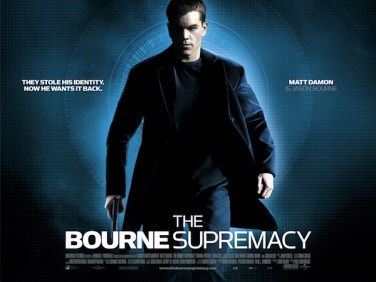
Country: USA & Germany
Language: English, Russian, German & Italian
Runtime: 108 minutes
BBFC: 12A
MPAA: PG-13

Original Release: 23rd July 2004 (USA)
UK Release: 13th August 2004
First Seen: cinema, August 2004
Stars
Matt Damon (The Talented Mr. Ripley, The Departed)
Franka Potente (Blow, Romulus, My Father)
Brian Cox (Manhunter, X2)
Joan Allen (The Ice Storm, Death Race)
Karl Urban (The Lord of the Rings: The Two Towers, Dredd)
Director
Paul Greengrass (The Bourne Ultimatum, Green Zone)
Screenwriter
Tony Gilroy (Proof of Life, The Bourne Legacy)
Based on
The character of Jason Bourne, created by Robert Ludlum. Not so much based on The Bourne Supremacy, the novel by Robert Ludlum.
The Story
Bourne and Marie are living a quiet life in India, until he’s framed for the murder of two CIA agents and the theft of files they were acquiring. After the actual culprit tries to kill Bourne, he believes the CIA have tracked him down, and makes good on his promise to bring the fight to them…
Our Hero
Living a life of seclusion with Marie, but still struggling with resurfacing memories from his time as a CIA operative, Jason Bourne has no intention of going anywhere near his former life… until they come for him, and the gloves are off. Bryan Mills ain’t got nothing on Bourne’s particular set of skills.
Our Villains
A whole host of interests are aligned against Bourne this time. From within the CIA, corrupt director Ward Abbott is still trying to cover his ass. A more physical threat comes in the form of Russian operative Kirill, referred to in early drafts of the screenplay as “Mock-Bourne” because he, a) frames our hero, and b) is his equal — well, almost.
Best Supporting Character
Pamela Landy brings some complication to the CIA side of the story: she’s out to get Bourne, same as the fellas from the first film, but that’s because she’s been conned too. Will she see the light and side with our hero?
Memorable Quote
Nicky: “It’s not a mistake. They don’t make mistakes. They don’t do random. There’s always an objective. Always a target.”
Landy: “The objectives and targets always came from us. Who’s giving them to him now?”
Nicky: “Scary version? He is.”
Memorable Scene
In Munich, Bourne visits the one remaining Treadstone operative. They fight, using household items as weapons (see “making of”, below). Then a team of soldiers arrive. Bourne turns on the gas, shoves a magazine in the toaster, and… well, the result was disproved by MythBusters, but it’s still cool.
Technical Wizardry
The cinematography and editing, according to some.
Letting the Side Down
The cinematography and editing, according to some.
Making of
The film famously features Bourne using a rolled-up magazine as a weapon in a fight with another Treadstone operative. Fight coordinator Jeff Imada looked over the set after it had been dressed to get an idea of what would be lying around that could be used as a weapon, and had the idea of a rolled up magazine. He had to demonstrate to sceptical crew members that it would indeed be a functional weapon, but was helped by actors Matt Damon and Marton Csokas giving each other bruises from practising with it.
Previously on…
The Bourne Identity left enough hanging to help fuel this movie.
Next time…
Although Supremacy was designed to wrap up the mysteries left dangling from Identity, they found plenty to drive a third film, which completes the trilogy by answering those remaining questions. A fourth film was essentially a spin-off. This summer’s fifth film will be about… something…
Awards
2 Saturn nominations (Action/Adventure/Thriller Film, Actor (Matt Damon))
2 World Stunt Awards (Best Work with a Vehicle, Best Stunt Coordinator and/or 2nd Unit Director)
1 World Stunt Award nomination (Best Fight)
2 MTV Movie Awards nominations (including Best Action Sequence (the Moscow car chase))
What the Critics Said
“Greengrass keeps you off-balance throughout. When the fight scenes and car chases arrive, there’s no telling, from shot to shot, what we will see next or how we’ll see it. […] Working with cinematographer Oliver Wood, Greengrass shoots the fight scenes and chases so close in that we see some moments almost as a blur. The editors, Richard Pearson and Christopher Rouse, break those sequences up into quick jagged shots that key us up and keep us hyper-alert. The world is being broken into bits of information, and we look hard at the screen to take it in. The approach could have resulted in the usual visual gibberish that defines contemporary action moviemaking [but] you can always tell what’s going on” — Charles Taylor, Salon
 Score:
 81%
81%What the Public Say
“I thought the movie was shot well, though at times I felt that the shaky cam effect was overused, as instead of pulling you into the action, it just gives you a headache and a dizzy spell” — Zoë, The Sporadic Chronicles of a Beginner Blogger

Debate used to rage about whether Identity or Supremacy was the better film, centred on their very differing directorial styles. Fans of Greengrass’ sequel seem to have settled on Ultimatum as their preferred Bourne instalment now, though, leaving Supremacy to be generally regarded as the least-best of the first three Bournes. That does it something of a disservice: it’s an exciting, twisty, complicated thriller, and its groundbreaking visuals can’t be ignored for their contribution to the action genre — for good or ill.

#17 will… always have Paris.


 A woman wakes up on a beach in the middle of the night. Stumbling away, she comes across a beach house with three strangers inside. They establish that the last thing they remember was being in a nightclub when there was some kind of accident, and then they woke up here. Fortunately, they’re not stupid and quickly twig this place is some kind of afterlife, then begin to work out how to get out — not that they’re helped by the lighthouse beam which causes immense pain, or that if they run away from the house they end up back at the house, or the vicious smoke-monster that’s flying around…
 AfterDeath is billed in part as a horror, emphasised by the skull imagery used on the poster. It’s not particularly scary though, so if you’re after that kind of thrill then it’s one to miss. As single-location mysteries go, it’s not remarkably original or exceptionally engaging, but the story and its revelations are solidly executed and the whole is decently performed, providing you don’t strain your eyes trying to see what’s happening.

 The 24th official James Bond movie had a funny old ride on its cinema release a few months ago. It started well, with near-universal praise from UK critics; audience reaction was more mixed but erred towards the positive; then US critics tore into it, and US audiences (as usual) followed suit. The latter seems to have become the more accepted view, with the consensus seemingly that it’s decent enough, but a definite step down from the high of
 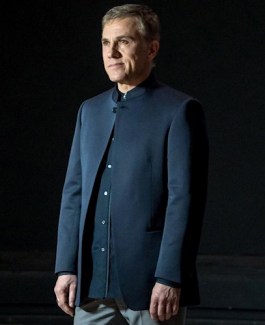 Spectre, to put it bluntly, pulls a
  retaining the same general thrust. I still don’t think it works. There’s too much of M, Q and Moneypenny sat in an office trying to stop a man typing something into a computer (more on this in a minute), while Bond is busy running around a building and shooting at a helicopter. Personally, I’d’ve thrown it out and started again, but I guess they’d run out of time, and maybe it was better than the alternative.
 No, of course it isn’t, and it never was; but the point of Bond has never been realism. And besides, the reason you cast quality actors in minor roles is so they can pop in for a day or two and make their one scene exceptionally good. Bulk their part up if you’ve got a story to tell, by all means, but don’t shoehorn them in just because you’ve got them. For my money, Spectre is too much doing the latter.
 Or perhaps they’re just planning to go

 British Academy Film Awards 2016
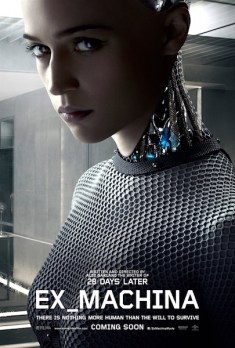 A British sci-fi movie from a first-time director will tomorrow take a place at the table (well, in the auditorium) alongside 2015’s biggest awards contenders, as it vies for multiple gongs at this year’s BAFTAs — and it stands a very plausible chance of walking away with several of them, too. I hope it does, because, after a year that brought us awards-quality sci-fi bombast (
 In truth, it’s not the most thorough deconstruction of what it means to be human and whether artificial intelligence can have that right, but it does touch on these issues and, in so doing, leaves them open for the viewer to mull over for themselves, or debate with friends, or however else one likes to consider their movies post-viewing (like, I dunno, writing about them on the internet or something).
 And his dance scene is surely one of 2015’s highlights (there’s an extended version hidden on the US Blu-ray, which is a treat). Garnering the most praise (and awards) is Alicia Vikander’s take on an AI. It’s a tricky role to tackle, because she’s not just a robot — that would defeat the point of Nathan’s exercise — but nor is she fully human. It’s a tightrope of a role, a fine line to walk, and Vikander negotiates it with aplomb. To say too much more would be to spoil it.
 Those after a dissertation-like hard-science deconstruction of the meaning and possibilities of AI will likely find Ex Machina slightly lacking, as will anyone after the crash-bang thrills most mainstream sci-fi provides. Viewers prepared for a decently thought-provoking dramatic thriller about near-future tech, however, should be both engrossed, and grateful that movies like this are (for the time being) still getting made.
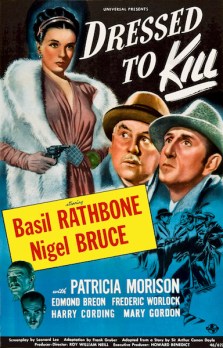 In the seven-and-a-bit years between 31st March 1939 and 7th June 1946, there were a total of 14 films released starring Basil Rathbone and Nigel Bruce as Sherlock Holmes and Dr Watson. By coincidence rather than design, I’ve spent nearly eight years viewing and reviewing them all for this blog — so yes, it’s taken me a little longer to watch them than it did to make them, which is ridiculous, but there you go.
 the story is explicitly referenced in the film, Watson having just had it published; then the film’s villainess turns up, played by Patricia Morison, functioning effectively as an Adler stand-in — and using some tricks she learnt from reading Watson’s story! The series hasn’t featured Adler before, so why not just name this character Irene Adler, have her devise those tricks from her own imagination, and be done with? Who knows.
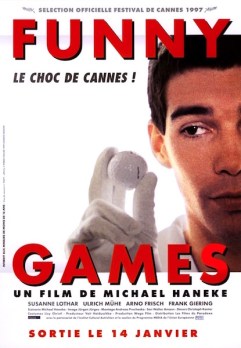 Arthouse favourite Michael Haneke criticises audience’s enjoyment of screen violence. It certainly achieves its aim of being a grim, brutal depiction of violence in real-life, creating a situation that feels inescapable not only for the characters but the audience too. Some cinematic trickery is also deployed to striking, if divisive, effect.
 Yesterday I wrote about
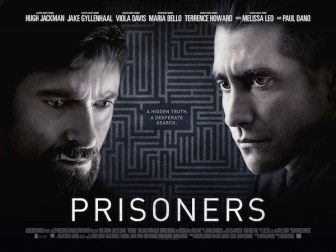
 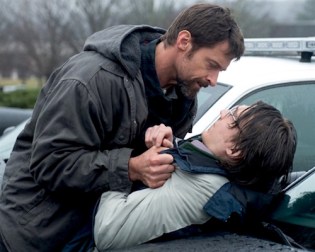 There’s a lot going on in Prisoners. While the basic format is straightforward, it’s realised in the form of a multi-stranded narrative full of well-drawn characters with complications of their own. Jackman and Gyllenhaal may be top billed and on the poster (well, an air-brushed waxwork vague approximation of Jackman was on
 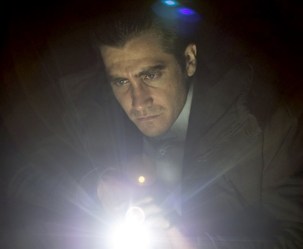 He’s not a bad detective, just not the usual genius-level investigator you normally find in thrillers, and at times you feel he’s muddling his way through the investigation as best he can. Aside from giving Loki the slightly-affected tic of blinking too much, Gyllenhaal offers a reasonably restrained performance. (I’d love to know what the blinking was in aid of, but the film is woefully understocked with special features.)
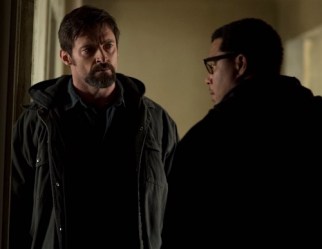 Denis Villeneuve’s direction gives the sense of a non-Hollywood background with the occasional arty shot choice or composition, though not to a distracting extent. He’s aided by serial Oscar loser Roger Deakins on DP duty, who once again demonstrates why he shouldn’t have a golden man already, he should have a cupboard full. The photography here doesn’t flaunt itself with hyper-grading or endless visual trickery, but is consistently rich and varied. Deakins may also be the best action cinematographer working — pair what he brought to
  As a thriller that is also a drama about people caught up in those events, and the lengths to which some of them may be prepared to go, Prisoners is a must-see for anyone with the stomach for some dark material (though don’t let me overemphasise that point — it’s not as bleak as, say,
  100Films.co.uk