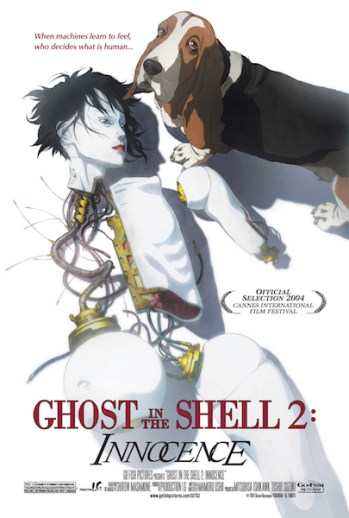
Ghost in the Shell 2: Innocence (2004)

aka Innocence / Kôkaku Kidôtai Inosensu

2017 #44
Mamoru Oshii | 100 mins | Blu-ray | 1.85:1 | Japan / English | 15 / PG-13

Ghost in the Shell 2: Innocence

Nine years after he made the highly influential sci-fi action/philosophy mash-up anime Ghost in the Shell, writer-director Mamoru Oshii returned to that world to tell an original story (the first film having been an adaptation of Masamune Shirow’s manga) that once again butts action up against philosophising, though with diminishing returns.

Set a couple of years on from the original movie, it follows the first film’s sidekick, Batou (originally voiced by Akio Ôtsuka, and in the English version by the dub’s co-writer and director, Richard Epcar), as he investigates a series of murder-suicides committed by sex robots. It’s just the tip of an iceberg that leads to… some kind of conspiracy.

At the time of its release Innocence gained a lot of praise, as is plastered all over the DVD and Blu-ray covers (at least over here), with some hailing it as a more artistically accomplished film than its predecessor. With time I think that reaction has cooled considerably, and rightfully so. If there’s one criticism to be levelled at the first movie it’s that it sometimes stops dead for characters to have a thoughtful discussion about the existential quandaries that underpins their cyborg existence. Innocence ramps this up to the nth degree, with even more such chats that go on even longer, liberally peppered with quotations from other sources, an idea Oshii cribbed from Jean-Luc Godard. It feels like it.

Ain't she a doll?

While the first film clearly pondered what it means to be human, and where the line might be between an artificial creation and sentience, I can’t really recall what Innocence was driving at. Possibly several things. Possibly too many things. A lengthy sequence in the middle where our heroes find themselves repeating the same events over and over with slight variations is probably meant to be About something, but it just left me thinking of cheap referential jokes (“Locus Solus, I’ve come to bargain!”)

There are action scenes too, some of which are decent and some of which are hysterically overblown. There’s nothing that approaches being as iconic as any of the original’s multiple memorable set pieces. Where the first film broke new ground by combining traditional cel animation with computer-generated 3D, in a way that still holds up today, Innocence takes it too far, and looks dated because of it. The characters are always 2D, but often placed in CG environments, which are now 13 years old and feel it. It’s weird to think this is a film that was once hailed for its visual majesty, because a lot of it feels quite drab now. At times there’s an awful lot of brown.

Computer-generated brown

On its original release Innocence was called simply that, the Ghost in the Shell 2 prefix added to help sell it in international markets. Oshii’s view was that the film stood on its own and wasn’t your standard “Hollywood-style” sequel. I disagree. For one thing, the film makes many references to the events of the first movie, meaning a working knowledge is required to understand what’s going on at times. For another… well, with technical advancements that aren’t necessarily beneficial, grander but less memorable action sequences, and less coherent thematic underpinnings, it’s clear that Hollywood doesn’t have the monopoly on sequel-y sequels.

3 out of 5

The live-action remake of Ghost in the Shell is released in the UK today and the US tomorrow.

Cold in July (2014)

2016 #118
Jim Mickle | 106 mins | streaming (HD) | 2.35:1 | USA & France / English | 15 / R

Cold in July

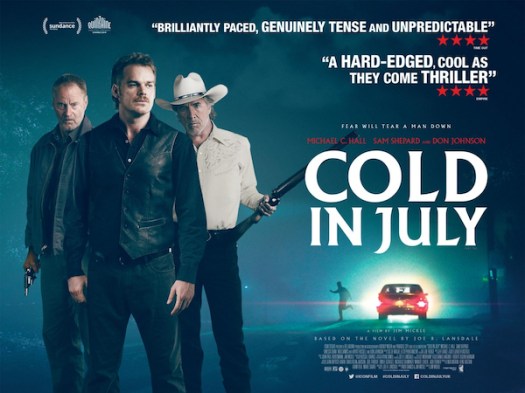
After a family man (Michael C. Hall) shoots dead an intruder in his home, the intruder’s ex-con father (Sam Shepard) threatens his family.

People often call for more originality in their stories, then criticise a film like this for jumping around in genre and tone. Personally, I didn’t think it changed much in either. The plot is far from straightforward — twists take the story in unexpected directions with each act (if not even more often) — but as a whole it remains a neo-noir crime thriller.

Filling out the film beyond its story, there are some great performances — Shepard, in particular, says very little but conveys his whole character and attitude. It’s very nicely shot by Ryan Samul, and there’s an amazing score by Jeff Grace.

At first blush Cold in July may look like just another crime thriller, but, with an unguessable narrative supported by strong filmmaking, it stands out from the crowd.

5 out of 5

Cold in July placed 9th on my list of The 20 Best Films I Saw For the First Time in 2016, which can be read in full here, and also featured on my list of favourite movies from the past decade, which you can read about here.

The Nice Guys (2016)

2016 #156
Shane Black | 116 mins | streaming (HD) | 2.35:1 | USA / English | 15 / R

The Nice Guys

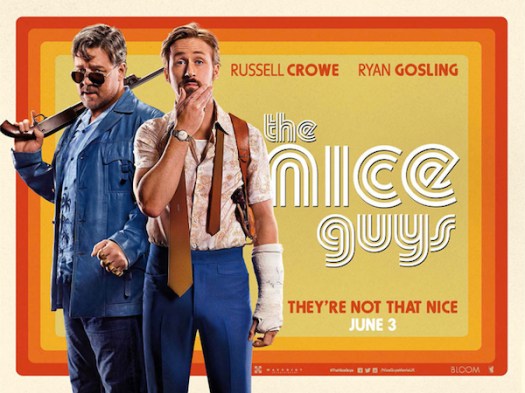
I’ve been struggling to think what to write in this review because, really, why I loved this movie can be thoroughly summed up in two words: it’s hilarious.

Screenwriter Shane Black has been doing this kind of action-thriller buddy comedy for decades now, but he’s still got it where it counts — there are quotable lines galore, and visual gags that would be just as quotable if you could quote a visual. As a director he may not be a great visual stylist or anything, but in an era of ShakyCam and obfuscatory editing, his helmsmanship has a welcome clarity.

As the titular duo, Russell Crowe and Ryan Gosling reveal heretofore unseen comedic chops (at least as far as I was aware). Crowe is more of the straight man, though gets his share of good lines, while Gosling bumbles around with pratfalls and slapstick, like in a perfectly-executed bit with a toilet cubicle door… which I would quote but, you know, visual gag. Like most of the best characters, they’re entertaining just to be around, often making scenes of exposition as entertaining as actual set pieces. Most of the villains serve as foils for our heroes, but young Angourie Rice shines as Gosling’s clever kid.

What do you mean there's not much chance of a sequel?

Tonally, it’s every inch a spiritual sequel to Black’s directorial debut, Kiss Kiss Bang Bang, and I’m very much OK with that. If you copy someone else it’s plagiarism; if you copy yourself it’s your style — you know, that kind of thing. If someone lets Black do another one of these once he’s finished with The Predator — either literally The Nice Guys 2 (as has been mooted, but probably ruled out by the so-so box office) or just something else in the same vein — I would be a very happy bunny.

5 out of 5

The Nice Guys is available on Netflix UK from today.

It placed 11th on my list of The 20 Best Films I Saw For the First Time in 2016, which can be read in full here, and also featured on my list of favourite movies from the past decade, which you can read about here.

San Andreas (2015)

2017 #24
Brad Peyton | 110 mins | streaming (HD) | 2.35:1 | USA / English | 12 / PG-13

San Andreas

San Andreas is a most amusing movie. It’s not a comedy, just a generic effects-driven disaster movie in exactly the same style Hollywood has been producing for about 20 years.

In its favour it has the surprising likeability of Mr The Rock, Paul Giamatti hamming it up for a paycheque, and the mammarially blessed Alexandra Daddario running around, lazing in a bikini, getting wet, etc. There’s some solid spectacle, including a couple of nice long takes, which is what these movies are all about.

Conversely, it couldn’t be any cheesier if it had been entirely made out of dairy products.

3 out of 5

Logan (2017)

2017 #30
James Mangold | 137 mins | cinema | 2.35:1 | USA / English & Spanish | 15 / R

This review contains major spoilers.

Logan

Little Miss Sunshine meets Hell or High Water via Midnight Special, with more superpowers and (probably) fewer Oscar nominations, in the film some people are calling the best superhero movie since The Dark Knight.

In the not-so-distant future, the man once known as Wolverine, Logan (Hugh Jackman), is living / hiding on the US-Mexico border, his once formidable powers diminished by age. He works as a limo driver to afford meds for an ailing Professor Charles Xavier (Patrick Stewart), whose psychic powers have become dangerous as his brain falters with age. When a woman recognises Logan and asks for his help, the disillusioned former X-Man fobs her off. But soon dark forces and a mysterious girl (Dafne Keen), not to mention his innate moral code, will force his claw-wielding hand…

While Marvel Studios harp on about how they mix other genres into their superhero movies, with such-and-such a film being superheroes-cum-political-thriller, or this-and-that film being superheroes-cum-heist-movie, and so on, everything they produce is really merely colouring within the lines of the superhero picture, they’re just using different crayons to do it. Logan not only uses different crayons, but it’s colouring a whole new picture, too. It’s not the first superhero movie to operate at a remove from the standard big-budget tropes of the genre, but it is perhaps the first from a major franchise to dare to step so far outside the norm. As I intimated at the start, the feel of the piece is more indie neo-Western road movie than CGI-driven superhero spectacular, though to imply it stints on expensive action thrills would be disingenuous. It still cost $97 million, after all, and so works at ways to retain the favour of a blockbuster-seeking crowd. Nonetheless, the overall impression is of a refreshing change for the subgenre, with a more distinctive feel than any of those aforementioned Marvel movies.

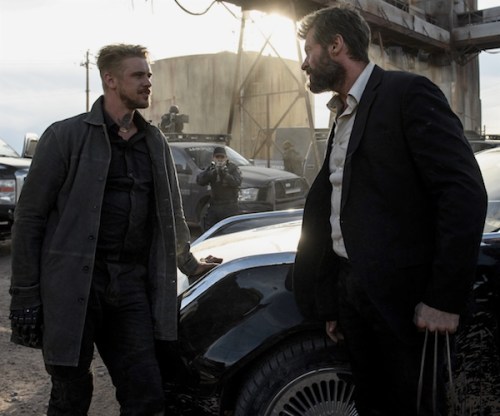
Wolverine vs Robotic Hand Man

That doesn’t mean it’s perfect, sadly. Functionally speaking, Logan barely has a villain. There are some ill-intentioned and dangerous people after X-23, so our heroes have to run away from them — that’s all the role they have to play. Heading up the hunt is Pierce (Boyd Holbrook), a henchman figure who’s de facto lead villain purely because he gets the most screen time. Unfortunately, he has more personality in his defining attribute, a CGI robotic arm, than in the rest of his characterisation combined. The theoretical Big Bad is Dr Zander Rice (Richard E. Grant), an evil scientist who we’re told developed some kind of virus that all but wiped out mutantkind, but now seems incapable of tracking down a group of preteens. He’s not on screen enough to make any kind of meaningful impression. On the bright side, on my “how badly miscast is Richard E. Grant” scale (which ranges from “very badly” to “not that bad, I suppose”) this errs towards the positive end, precisely because of that lack of screen time. Lastly there’s younger, fitter Wolverine clone X-24 (also Jackman), who’s at least intentionally devoid of personality — he’s been bred without it so he’ll be the perfect biddable killing machine. Obviously he’s ripe for some sort of thematic commentary — on ageing; on morality; on heroism; on, frankly, anything — but it never comes.

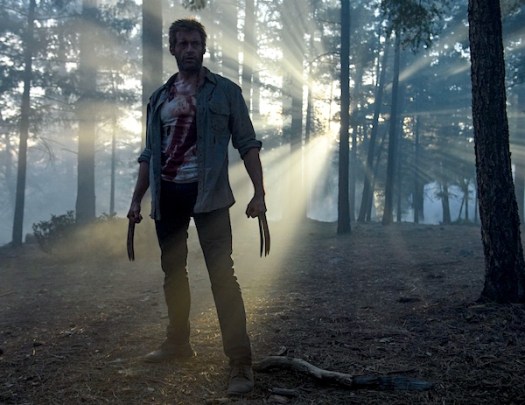
With the villainous side of the equation so unbalanced, we’re left primarily with our heroes. Fortunately, they do take up the slack, mainly through a pair of fantastic performances from Jackman and Stewart. Wolverine is undoubtedly the defining role of Jackman’s career, a part he’s played on and off for 17 years across seven movies (as a lead, plus a couple more cameos). Here he’s the most human he’s ever been. In many ways Logan was always one of the most relatable X-Men, one of our points of entry into their world and taking the piss out of them and the situation when it was called for. He was still primarily a likeable character in a fantastical world though, whereas here he feels more like a real person, struggling with the physical detriments of ageing and (less explicitly) the metaphysical quandaries of what it was all for. As he puts his time with the character to bed, Jackman gets to deliver his most nuanced and affecting turn in the role. Neatly, it mirrors where it all began for this version of the character: protecting a young mutant girl struggling to come to terms with her dangerous powers in a world that’s out to get her.

Professor X-piring

Stewart is every bit as good as a man defined by his mental prowess whose mind is failing. Originally cast to play a statesman-like role in the series, here Stewart gets to have a bit more fun, to be a bit more cheeky, but also to tap into a bit more depth of emotion, as Charles struggles with whatever it was he did to land him in hiding in Mexico (I think there was some dialogue that explained it but, frankly, I missed it in the mumbly sound mix. I’ll catch that on Blu-ray, then).

Of course, they both die. Normally that’d be shocking in a major studio blockbuster, but it’s quite clear Logan is playing by different rules, and in those rules the old good guys die. Heck, nearly everyone dies, but the only deaths that matter are Charles’ and Logan’s. What’s at least a bit interesting is how they die. For Professor X, it’s almost ignominious, — in a bed, not even his own, stabbed by X-24 for virtually no reason, then later fading away in the back of a truck. It’s not a grand heroic self-sacrifice while trying to save the world, the kind of death you’d expect for a character of his stature (and more or less the kind he got in The Last Stand, the first time they killed him off). It’s a great life come to a meaningless end. Well, Logan’s that kind of movie — it has no reverence for such things, just as life itself does not. Conversely, the death of Wolverine / Logan / James Howlett (who is he, in the end?) is a sacrifice, the selfish man of the movie’s opening giving himself up to save some kids; or, in grander terms, to save the future. Ah, but he was never really selfish, was he? It was an act. An affection brought by the hard years. He was always a good guy at heart. Always an X-Man, as the neat final shot emphasises.

Wolverine: The Last Stand

So there is some thematic meat to tuck into here, even with the apparent dead-end (pun not intended) of the X-24 subplot. Couple that with the many uncommon-to-the-genre plot and tonal points and you have a movie that does merit consideration as one of the finer superhero films. However, the perception some espouse of this being brave or bold moviemaking is not inherent to the film. If this were an original story starring new characters, especially if they didn’t have superpowers, it wouldn’t make it a bad film, but nor would it be perceived as being so original or revolutionary. What is uncommon or remarkable is making that kind of movie with a well-known character, and in particular one who’s familiar from leading CGI-fuelled PG-13 summer spectacles.

Is that alone enough to confer greatness? Logan’s consistency of style and tone render it easily the best Wolvie solo movie (as much as I liked The Wolverine on the whole, its climax was horrible), but for this X-fan it’s not enough to usurp the top-draw traditional superheroics to be found in the three or four genre classics produced by the main series. Perhaps time and re-viewing will increase Logan in my estimation, however, because it is a very strong film indeed.

4 out of 5

The Maltese Falcon (1941)

2016 #142
John Huston | 96 mins | DVD | 1.33:1 | USA / English | PG

The Maltese Falcon

Humphrey Bogart is private dick and consummate bullshitter Sam Spade in this (re-)adaptation of Dashiell Hammett’s novel, considered the first major film noir.

The twisty plot of murder and thievery is enlivened by duplicitous performances from femme fatale Mary Astor, an effeminate Peter Lorre, the always welcome Elisha Cook Jr., and the humungous presence of Sydney Greenstreet, making his film debut at 60 and stealing every scene.

It’s also the directorial debut of John Huston, whose work alongside cinematographer Arthur Edeson is the greatest star: the low-key lighting and dramatic angles are (like the rest of the film) archetypal noir.

4 out of 5

The Maltese Falcon was viewed as part of my What Do You Mean You Haven’t Seen…? 2016 project, which you can read more about here.

London Has Fallen (2016)

2017 #14
Babak Najafi | 99 mins | streaming (HD) | 2.35:1 | UK, USA & Bulgaria / English, Italian, French & Japanese | 15 / R

London Has Fallen

The unwanted sequel to the less-good of 2013’s “Die Hard in the White House” double bill sets its rip-off sights lower: the entire plot feels rehashed from a weak season of 24. It may as well begin with a gravelly-toned voiceover informing us that “the following takes place between 9AM and 9PM Greenwich Mean Time.” Fortunately, events don’t occur in real time.

Those events take place in the wake of the British Prime Minister’s unexpected death. Granted a state funeral, the American President (Aaron Eckhart) is naturally in attendance, along with 39 other world leaders — most of whom are suddenly wiped out in a series of terrorist attacks. POTUS’s Secret Service chum (Gerard Butler) must get him out of the embattled capital, away from an enemy who seems to have foreseen their every move.

From there, the film is a relentless assault on the notion of good filmmaking. The narrative is so poorly structured that it doesn’t feel like there’s a climax — it’s only apparent with hindsight that what seemed like the back-half of Act 2 is actually meant to be the big finale. The main villain is only dealt with in a tacked-on coda; so too is the obligatory mole, whose presence appears to be solely motivated by a futile attempt to plug plot holes.

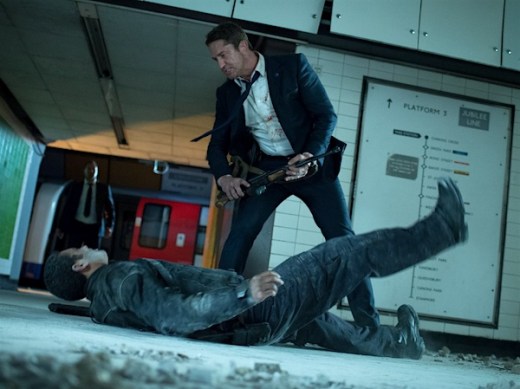
Going Underground

The dialogue is horrendous (“You should have let us kill him quickly, because now… we’re going to kill him slowly”) and the CGI is ceaselessly cheap — shots of the various terrorist attacks wouldn’t look out of place in a Sharknado movie. A single-take action sequence feels like it should be exciting filmmaking, but is actually more like watching someone else play a video game.

Even with that, London Has Fallen does just about pass muster as a brains-off actioner, in the truest sense of the term: you’ll need to switch your brain off to endure the rampant xenophobia and American flag-waving.

God, I bet Trump loves this movie.

2 out of 5

London Has Fallen featured on my list of The Five Worst Films I Saw For the First Time in 2017, which can be read in full here.

iBoy (2017)

2017 #11
Adam Randall | 90 mins | streaming (HD) | 2.35:1 | UK / English | 15

iBoy

When it comes to TV, Netflix are dominating the cultural landscape with much-discussed original series like Stranger Things, Making a Murderer, Orange is the New Black, the Gilmore Girls revival, their cadre of Marvel shows… I could go on. But when it comes to their original movies — the eponymous “flix” — well, it’s a bit different. Their Crouching Tiger Hidden Dragon sequel went down like a lead balloon; Beasts of No Nation was well reviewed but couldn’t translate that into the awards buzz that was clearly hoped for; and their Adam Sandler movies… well, those are apparently very popular with viewers, at least.

Their latest effort, iBoy, is based on a young adult novel about a teenager who fights against bad people — so that’s pretty zeitgeisty at least. It’s not set in a dystopian future, though, but why bother when our own days are so bleak? So iBoy sets its stall in present-day London, where Tom (Bill “the sweet one from Son of Rambow” Milner, looking completely different) is just a normal teen — going to school by day, blocking out the sounds of violence around his tower block by night. When the girl he fancies (Maisie Williams) invites him round to study one evening, he turns up at her flat to find her being, to not put too fine a point on it, gang raped. He runs, trying to phone the police, but the gang give chase and shoot him in the head. When he wakes up, parts of his phone have been inoperably embedded in his brain, which he soon comes to realise has given him the ability to interact with technology using his mind.

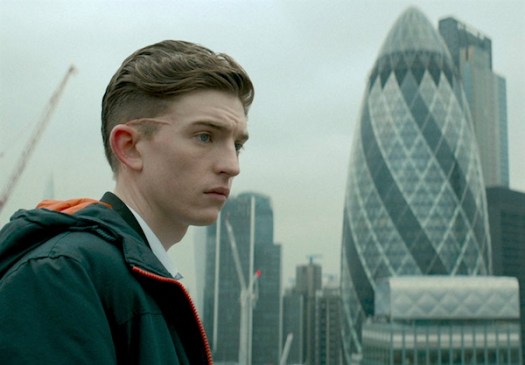
Look, it's London!

So, yeah — scientifically, it’s a thoroughly dubious premise. But is it any worse than having abilities bestowed by a radioactive spider-bite or spilled toxic goo? In respect to Tom’s newfound powers and how he chooses to use them — as a vigilante seeking revenge on the gang that have been terrorising his estate — iBoy is more in line with superhero narratives than other young adult adaptations. Where it comes unstuck is the tone. How many superhero films are going to feature gang rape? Well, somewhat appropriately, I guess the Netflix ones might. But the disjunct between iBoy’s daft premise and the grim world of inner city gangs (there are more acts of shocking violence) is a difficult one to negotiate.

To its credit, iBoy doesn’t use the assault as a starting incident and then discard its aftereffects — the presence of Maisie Williams, who’s been quite outspoken about the treatment of female characters in media, should give an indication that it’s not so thoughtless. But nor does a 90-minute movie that’s fundamentally about a superpowered vigilante have much time to dig into it properly. Nonetheless, Williams essays the role with some subtlety, aided by a screenplay that keeps things appropriately unverbalised. Perhaps the most effective part is when, home alone, she has to venture outside for some milk.

Nasty gangs

Unfortunately, the screenplay doesn’t pay the same amount of attention to the hows-and-whys of its hero and his abilities. Apparently hacking someone else’s phone involves watching a progress bar; he can learn how to fight while watching a couple of YouTube videos during the ten seconds he’s walking towards an assailant; and so on. A little more effort would’ve sold the premise more and could’ve removed these niggles (at least have him download a phone-hacking app or something; maybe the YouTube videos could be downloaded into his brain, but his unpracticed muscles struggle to perform the moves). Problem is, the notion of phone fragments getting stuck in your brain and giving you superpowers is pretty silly, so even if you provide better internal consistency, it’s still a struggle to parse that implausibility being mashed up against the ultra-real-world stylings of the rest of the story. Films like Super and Kick-Ass do the “real-life superhero” thing by making their hero a bit inept. Maybe iBoy isn’t shooting for “real-life superhero”, but then why are the threats he faces so serious?

Talking of the threats, Rory Kinnear turns up near the end as the Big Bad, and lifts the film considerably. I suppose there’s not a whole lot of originality in a politely-spoken but actually horrendous villain, but Kinnear sells the part effortlessly. You kind of want to see that character (or at least that performance) turn up in something bigger and better. Elsewhere, Miranda Richardson brings some much-needed lightness as Tom’s grandma, who serves as an Aunt May figure. If nothing else, you can rely on British productions to have quality acting, eh?

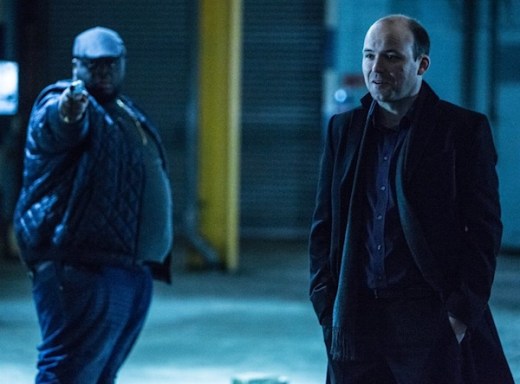
British baddies are best

For all this criticism, on the whole I didn’t dislike iBoy while it played out, it just doesn’t stand up to scrutiny. As Netflix’s first genuine original movie from the UK, it’s a shame it can’t demonstrate to the rest of the Netflix-viewing world what British film could be capable of if encouraged, but maybe that would be too big a weight to put on its little shoulders anyhow.

3 out of 5

iBoy is available on Netflix everywhere (I presume).

Witness for the Prosecution (1957)

2016 #157
Billy Wilder | 112 mins | DVD | 1.85:1 | USA / English | U

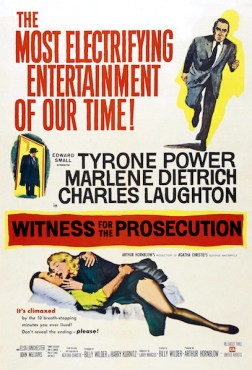
Witness for the ProsecutionCharles Laughton and Marlene Dietrich shine in this adaptation of Agatha Christie’s play (in turn based on her short story), about a man accused of murder but who proclaims his innocence (Tyrone Power), the barrister who decides to take the case (Laughton), and the man’s wife who agrees to alibi him but seems somehow suspicious (Dietrich).

Despite expanding the action from the play, it’s still dialogue-heavy and a little stagey in places — but between the engrossingly labyrinthine plot, those captivating performances, and some humour added by screenwriters Billy Wilder and Harry Kurnitz, such potential criticisms are irrelevant.

Helluva twist, too.

5 out of 5

A new adaptation of The Witness for the Prosecution begins on BBC One tonight at 9pm.

Midnight Special (2016)

2016 #145
Jeff Nichols | 112 mins | streaming (HD) | 2.35:1 | USA & Greece / English | 12 / PG-13

Midnight SpecialI’m not sure I’d even heard the name Jeff Nichols before Midnight Special came along, at which point most of the gushing reviews that followed seemed to mention him with cult-like reverence. He’s the writer and director, by the way, for anyone still in the dark, and unbeknownst to me (and, I rather suspect, most people outside certain cinephile circles) he’d amassed something of a following over his first three movies (Shotgun Stories, Take Shelter, and Mud, two of which I’d at least heard of). It’s kind of odd to feel like everyone else loves this guy and has been eagerly anticipating his next work and is now discussing how it chimes with his existing canon, when you’ve not even heard of him.
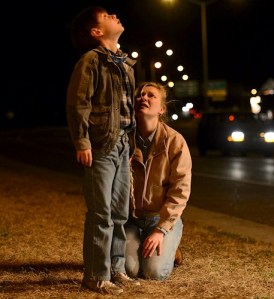
Anyway, his latest film* has a plot that makes me want to dub it Starman: A World Beyond… though that might indicate something about the ending, so, uh, shh! Anyway, the story concerns a dad (Michael Shannon) who’s kidnapped his son (Jaeden Lieberher) from some kind of cult, and is now on the run from both the authorities and the cultists who want the kid back. All the furore stems from the fact that the kid has some kind of special abilities, one of which has given them a destination to head for and time to be there…

The story’s style has made a comparison to Spielberg the go-to, not only for reviewers but for the writer-director himself, who’s labelled the film an homage to E.T. and Close Encounters. You can see that influence, certainly, but it lacks the effortless charm that Spielberg brings to his movies. If this is Spielberg, it’s by way of more indie arthouse fare. Is that a bad thing? Not necessarily. You could argue that it’s more refreshing than any of the I want to believestraight-up Spielberg rehashes we’ve seen over the past four decades; conversely, a strand of wilful obscurity means it may be ultimately less satisfying. Again, some people derive satisfaction explicitly from that lack of resolution or explanation, while others will find it damagingly frustrating. Even more than Spielberg, I felt the thing most evoked by this structure was The X Files: intriguing sci-fi mysteries that eventually lead to semi-reveals which don’t quite satisfy in themselves in part because they’re trying very hard to remain open-ended.

In that regard, it’s arguably a little too woolly on its sci-fi elements, and executes the chase-thriller aspect of its plot too slowly, to be fully considered a genre movie; but it’s also too indistinct on its cast to fully convince as a character-driven drama. You can certainly begin to infer some things about what their exact motivations are, what they’re thinking and feeling and why they’re doing what they do, but I’m not sure if it’s actually there or if I’m endeavouring to build something out of the little that we’re given. That said, if I’m prepared to do Zack Snyder the courtesy of reading something into his work that may or may not be there (cf. Sucker Punch), then Jeff Nichols deserves at least the same level of kindness. But for the kind of movie whose style makes it seem like it should be about Character or Theme over more genre- and/or narrative-focused concerns, it feels there’s an awful lot of attention paid to plot over anything else. Speaking as a fan of sci-fi and high-concepts and B-thrillers and blockbusters, I actually think I’d’ve liked it more if it toned down the sci-fi and the plot, and instead focused on the characters’ soul-searching and the unusual family dynamics.

That said, there’s some great imagery. Mainly the sci-fi stuff at the end — I don’t think it’s unfair to describe most of the movie as looking solidly unremarkable, but the climax is pretty darn good. However, I’ve read many reviews that criticise the effects. Are we not past that yet? Especially when it comes to a film of this budget and scale. Nuclear familyI thought they perfectly conveyed what they were intending to convey — usually, just a kind of otherworldly light. It’s not like it’s even over-stretching its means, like so many network TV series or Sharknado-esque movies do when they try to emulate a $200 million blockbuster on a TV budget. If you’re expecting some grand CGI, maybe go watch one of those $200 million blockbusters instead of an $18 million drama.

Midnight Special seems to provoke a wide range of responses — I mean, you can say that about most films, ultimately; but some more so than others, and skimming across reviews and comments online, this is definitely one of them. Fans of American indie-ish drama-driven semi-genre movies, or of more thoughtful science-fiction, will surely want to give it a go, but how much you’ll connect with its characters or its ideas seems to be a roll of the dice. I liked it well enough, but I don’t remember seeing any particular indication of what’s inspired the notion that we should all be fawning over Jeff Nichols as the best auteur to happen to cinema since sliced bread. (Sliced bread’s early movies were great, weren’t they?)

3 out of 5

Midnight Special is on Sky Cinema from today.

* In a coincidental similarity to when I started viewing the work of another much-hailed star-to-be indie director (Ben Wheatley), I’m beginning with his fourth film. ^