Road Games (1981)

aka Roadgames

2016 #132
Richard Franklin | 100 mins | Blu-ray | 2.35:1 | Australia / English | 15 / PG
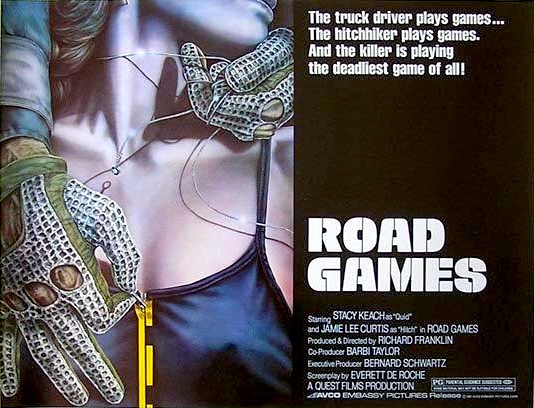
Road Games

I hadn’t even heard of Ozploitation thriller Road Games before April last year, when Make Mine Criterion posted an excellent write-up proposing it for release by Arrow Video. That piqued my interest, so when it was announced for release by Australia’s Umbrella Entertainment the very next day, I jumped on a pre-order lickety-split. Just a couple of months later, a film I had only recently found out about was in my hands, in a better-than-it’s-ever-looked remaster, having arrived from literally the other side of the world, for about the same cost as a new release from Masters of Cinema or Arrow, i.e. under £14, including postage. (Makes you wonder how Criterion justify their £17.99 price tag…)

Leaving aside the wonders of today, the film stars Stacy Keach as lorry driver Pat Quid, who one night happens to witness some shady goings on that may’ve been a murder. The next day he’s given the task of transporting a container full of carcasses to the other side of the country, because there’s a butchers’ strike over there and Aussies need their meat goddammit! On the road, he spots a vehicle connected to the possible-murder, and wonders if he’s on the trail of a killer — or if the killer’s on his. The tension only deepens when he picks up a hitchhiker (Jamie Lee Curtis), who may become the next victim…
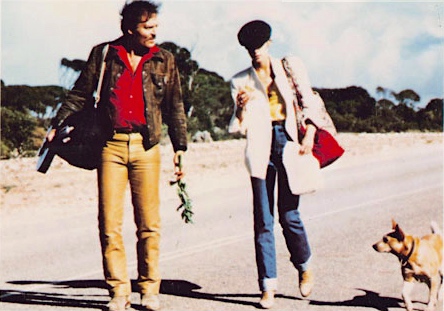
It's impossible to find good quality stills from Road Games

Road Games’ low-budget roots and exploitation-derived genre tag may give the impression it’s a slasher movie or something, but nothing could be further from the truth (though there is one gory shot — so gory it’s a wonder the film got a PG in the US). Rather, it could best be described as Rear Windscreen, because fundamentally it’s the same story: our hero spies on a guy from a distance because he thinks he saw him commit a murder, but is it all in his head? Where Hitchcock staged that impressively in a single confined location, writer-director Richard Franklin opens it up to the whole Australian outback. In some respects that’s an even more impressive feat — of course neighbours are smooshed up against each other, but long-distance travellers? However, it doesn’t feel like a stretch that Quid keeps bumping into the same people, such is the skill of the construction.

Keach makes for an affable lead, whether chatting to his dog early on or bonding with Curtis after he picks her up. Their shared ponderings about the possible murderer are just as effective as the Stewart/Kelly interactions from the Hitchcock film, though perhaps more conspiratorial. It’s easy to draw these comparisons and mirrorings with Rear Window, but it does Road Games a bit of a disservice — it’s not simply an off-brand remake or set-in-a-different-location pseudo-sequel. That said, the parallels are equally unavoidable. There’s also some Duel in the mix, as the killer notices he’s been noticed and turns the tables on our hapless trucker — an inversion, of course, as in Spielberg’s film it’s the trucker who’s the villain.

Seeing red

Basically, while acknowledging these undoubted similarities, I’m trying not to make Road Games sound too derivative, because I don’t think it is. It’s a masterful mystery, using ever-building tension to create a properly nail-biting thriller, which leads to an unpredictable final act (the benefit of many an independently-produced thriller is that it doesn’t necessarily have to comply with a studio’s view on how it should end). While it may owe a debt to one or both of the aforementioned movies, it’s a gripping work in its own right; one which deserves a bigger audience.

5 out of 5

Road Games placed 12th on my list of The 20 Best Films I Saw For the First Time in 2016, which can be read in full here, and also featured on my list of favourite movies from the past decade, which you can read about here.
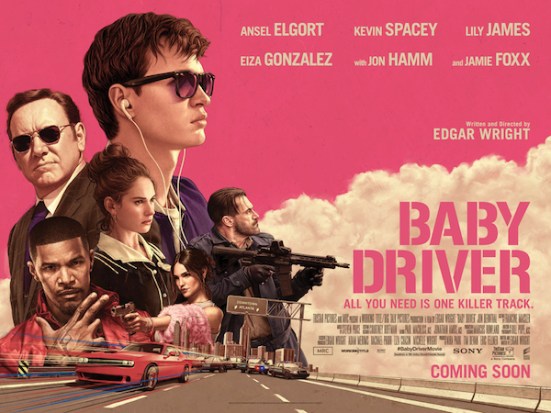
Baby Driver (2017)

2017 #89
Edgar Wright | 113 mins | cinema | 2.35:1 | UK & USA / English & American Sign Language | 15 / R

Baby Driver

It felt like half (at least) of the film-loving internet had somehow had a chance to see Baby Driver before its release on Wednesday, but I’m going to throw my two cents into the ring anyhow. Not that it makes a great deal of difference because, like most other folks, I bloody loved it.

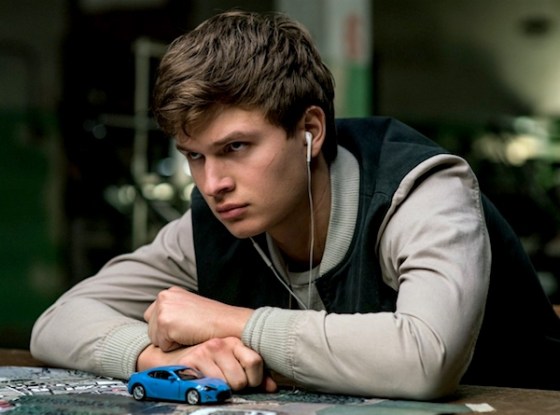
Written and directed by Edgar Wright, director of the Cornetto trilogy and not of Ant-Man, the story focuses on getaway driver Baby (Ansel Elgort), a fundamentally good kid who has ended up suckered into a life of crime, working for robbery kingpin Doc (Kevin Spacey) and a rotating array of criminal compadres. An accident as a kid left Baby with “a hum in the drum” — tinnitus, if you want to get medical about it — meaning he listens to music all the time to drown it out, and also choreographs his daring drives (not to mention his walks down the street, etc) to the music he hears. One day he bumps into Debbie (Lily James) and falls in love, which happily coincides with his “one last job” for Doc. But once you’re in it’s hard to get out, and Baby again finds himself doing one more “one last job”, with a particularly volatile crew…

Baby Driver is a movie about three things: driving, music, and love. As Guillermo del Toro put it, it’s a kind of fable, or fairytale, with Baby as the prince and Debbie as the princess. In this respect it’s a change of pace for Wright, ditching the almost-spoof comedy of his previous successful movies for something more emotionally earnest. Not in a bad way, but in a kind of pure way, like a fairytale. This fairytale world isn’t all castles and dragons, of course — instead it’s full of violent criminals and fast cars; but it’s also a world where you can synchronise your getaway driving to the music on your iPod, so it’s hardly mired in gritty realism.

No little green bags here

There’s a definite edge of Wright’s buddy Quentin Tarantino to this world: a cast of crooks delivering snappy, quotable dialogue to a near-constant soundtrack of deep cuts selected from the director’s music collection (plus a few familiar tunes for good measure) — the style of QT comes to mind more than once while watching. Fortunately Baby Driver’s style is more than homage or copycatting. Although it’s not a straight-up comedy, Wright does bring his own comedic touch (there are several big laughs), and the purity of emotion — that fairytaleness again — isn’t from Tarantino’s wheelhouse either. Plus, visually it presents a brighter and more colourful space than Tarantino normally inhabits. Most of the action takes place in the golden daylight of Atlanta and is filled with popping primary colours. There’s much great work by DP Bill Pope.

Though the soundtrack may have a Tarantino feel in its construction, that’s less prevalent in its usage. Characters communicate through song — not by singing them (most of the time — Baby first notices Debbie because she’s singing “B-A-B-Y”), but by connecting through them (that singing is followed by a discussion of songs featuring her name — both of them). The songs Baby chooses for boogieing around his small apartment, or for dancing down the street on a coffee run (in a title sequence that is marvellously choreographed, with dozens of small details timed perfectly to the track), help illuminate his true character — sweet and romantic — which is hidden by the sullen silence he adopts whenever around criminals.

B-A-B-Y Baby

Some have criticised the film for a lack of character, reckoning Baby’s silence distances him from the viewer so we never build a connection and don’t root for him. Frankly, I’m not sure what film they were watching. No spoilers, but Baby first opens up with something endearing and ingratiating in scene one. Right at the start. It could barely be any closer to the studio logos (and it kinda wouldn’t work if it were). I’m not arguing he’s the most charismatic lead ever to grace the silver screen, but Elgort makes fine fist of selling Baby as both a quiet, focused driver and a sweet, likeable, cheer-on-able hero.

And if you want character in general, the rest of the cast has it in spades, with an array of supporting roles that are as colourful as the cinematography. Recognisable faces like Spacey, Jon Hamm, Jamie Foxx, and John Bernthal get to cut loose as crooks who each have their own kooks, while lesser-known names like CJ Jones (as Baby’s foster father) and Eiza González (as the Bonnie to Hamm’s Clyde) make a mark too. Lily James may be placed in a dream-figure damsel role, but that doesn’t mean she can’t hold her own at times too. She’s not Wonder Woman, but she’s not a Manic Pixie Whatever That Phrase Was either.

Mozart in a go-kart

So, the one major thing I’ve only touched on fleetingly thus far is the main thing the film has attracted attention for: the driving. Done for real by stunt drivers with not a lick of CGI, that knowledge means it packs a viscerally real punch. But it’s not just snobbery: this is genuinely breathtaking action, slickly planned, masterfully performed, magnificently shot and edited. It’s this year’s Fury Road — a kinetic action spectacle made with skill rather than hand-waiving fast-cuts. Even more impressively, it’s been choreographed to music, but not in a draw-attention-to-itself dance-routine-y way. Perhaps saying it’s been synced to the music would be more accurate. Either way, it only heightens the effect. This extends beyond the car chases, too, including one marvellously musical shootout, the gunfire serving as percussion. The sound design throughout is exemplary. This is a movie that deserves to be remembered come awards season. Perhaps, again like Fury Road, some love will extend beyond the technical categories, too. Wright seems deserving of Best Director recognition, just like George Miller was.

But such back-patting is for much later in the year. For now, just revel in the gleeful moviemaking verve of a flick that already seems destined to be remembered as one of the greatest car chase movies ever produced.

5 out of 5

Baby Driver is in cinemas many places right now, but not everywhere. It’ll be worth the wait, guys.

It placed 2nd on my list of The 17 Best Films I Saw For the First Time in 2017, which can be read in full here.

Dragon (2011)

aka Wu xia

2016 #190
Peter Ho-sun Chan | 94 mins | TV (HD) | 2.35:1 | Hong Kong & China / Mandarin | 15 / R

Dragon (Wu Xia)

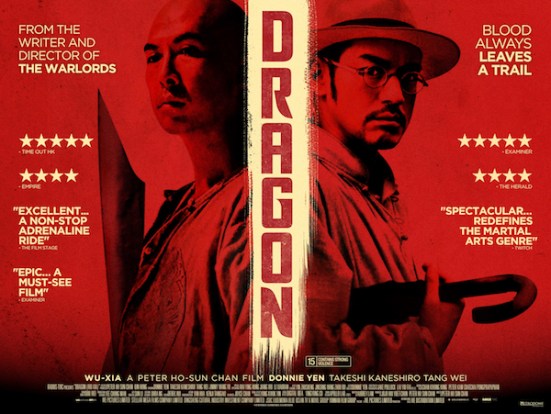
Donnie Yen is small town paper-maker Jinxi, who incidentally encounters and accidentally defeats two most-wanted criminals. While his village thanks him, detective Baijiu is suspicious — does Jinxi’s story add up? Is he hiding some dark past?

Takeshi Kaneshiro is expert detective Xu Baijiu, who adheres slavishly to the law after a past mistake cost him dearly. But is he delusional, inventing connections and powers for Jinxi that just aren’t there? Or are his delusions allowing him to see the truth?

As a Hong Kong production starring Donnie Yen, of course Dragon is an action movie, but there’s more to it than fisticuffs. It engages with themes of justice and redemption, and what it means not only to take the right action, but to have to find the right action to take. Apparently it began life as a remake of One-Armed Swordsman, and while obvious superficial resemblances remain (the Big Bad Boss Man is played by Jimmy Wang Yu, and Yen has to (spoilers!) lop off his own arm), you can definitely see familiar plot points in both films too. But it’s also certainly not a remake anymore. Funny how these things go.

Can I Baijiu a Jinxi?

Naturally, when the action does kick in, it’s fantastic. With the combat directed by Yen, these sequences are expertly and inventively choreographed dust-ups. It’s stylishly directed by Peter Chan — classy, but also thrilling, exciting, and sometimes innovative; and the whole is majestically shot by DP Lai Yiu-Fai (who also shot Infernal Affairs, which I still haven’t seen).

On the downside, at a couple of points I thought the story leapt a little bit or fudged a detail, which is a shame because I don’t think it needed to. This is possibly the effect of watching the international version, which is cut by around 17 minutes (full details here). While it’s a shame, it’s certainly not enough to ruin an excellent martial arts drama.

4 out of 5

Review Roundup

In today’s round-up:

  • Snoopy and Charlie Brown: The Peanuts Movie (2015)
  • 13 Hours: The Secret Soldiers of Benghazi (2016)
  • Young Frankenstein (1974)


    Snoopy and Charlie Brown:
    The Peanuts Movie

    (2015)

    aka The Peanuts Movie

    2017 #25
    Steve Martino | 84 mins | streaming (HD) | 1.85:1 | USA / English | U / G

    Snoopy and Charlie Brown: The Peanuts Movie

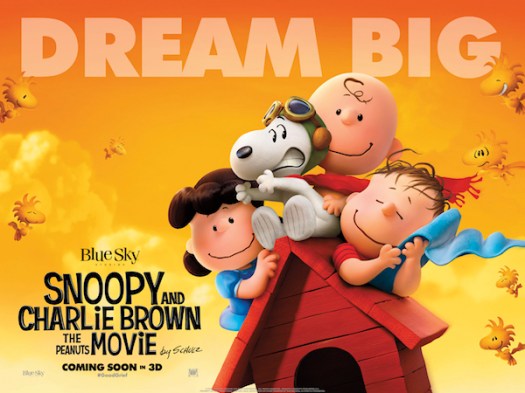
    Charles M. Schulz’s popular comic strip hits the big screen in this likeable but hardly Pixar-level movie. Much of it plays like a series of shorts or sketches with a connected theme rather than a feature-length narrative — kind of like binge-watching a cartoon series — but they’re pleasant enough. There are some good gags (“Leo’s Toy Store by Warren Piece”), though the saccharine ending is a bit much and the pop songs are terrible. One review described Snoopy as “Peanuts’ Tyler Durden”, which is a thought that entertained me even more than the film.

    The most notable aspect is the animation style. Schulz’s strips have a distinct 2D style, but the movie is animated in 3D, presumably because you’re not allowed to make a Western kids’ movie with 2D animation anymore. Nonetheless, most of The Peanuts Movie is composed to emulate Schulz’s original strips, i.e. quite flatly — like, you know, 2D. And yet, somehow… Well, The Telegraph’s Robbie Collin summarised it well in his review: “Written down, [the animation style] just sounds chaotic, like a four-way mash-up of South Park, The Clangers, Wallace & Gromit and a flip book. But in motion, it’s a thing of serious, faux-artisanal beauty”. That might be going a bit far, but I did end up kinda liking the visuals. It’s quite a clever style for 3D, mixing in many 2D-ish touches. It should probably be a mess, but it weirdly works.

    3 out of 5

    13 Hours:
    The Secret Soldiers of Benghazi

    (2016)

    2017 #40
    Michael Bay | 139 mins | streaming (HD) | 2.35:1 | USA / English | 15 / R

    13 Hours: The Secret Soldiers of Benghazi

    The not-at-all-controversial events in the Libyan town of Benghazi on 11th September 2012 are here dramatised by that master of subtlety and understated reality, director Michael Bay, so you know you’re going to get a considered and truthful account of events.

    Yeah, most of that opening paragraph is completely facetious. Bay takes a real-life gunfight, in which a secret mercenary security team went against orders (possibly) to defend an American diplomatic compound that was under assault, and turns it into a blazing action movie that may as well be scored with the theme from Team America: World Police. If it was Bay’s goal to convey the sheer confusion on the ground in the midst of the situation, I guess he’s done a bang-up job. The problem is, that confusion extends to bits where the characters seem to have some idea what’s going on, but we’re left half in the dark.

    Having Bay be reined in after the excess of his Transformers movies is no bad thing, but being completely constrained by reality is not his strong suit either — the heightened reality of something like The Rock is where he excels.

    If you’re interested in a longer read on the film’s adherence (or otherwise) to reality, this article at Vox is interesting.

    3 out of 5

    Young Frankenstein
    (1974)

    2017 #46
    Mel Brooks | 106 mins | streaming (HD) | 16:9 | USA / English | PG* / PG

    Young Frankenstein

    I have mixed feelings about the work of Mel Brooks. I reviewed his Hitchcock spoof, High Anxiety, back in 2009 and found it wanting. I reviewed his Robin Hood spoof, Men in Tights, earlier this year and found it uncomplicated but enjoyable. When I was a kid I liked his Star Wars spoof, Spaceballs, but on a slightly-more-adult rewatch I enjoyed it less. And as for Blazing Saddles, regarded by some as one of the pinnacles of screen comedy… no, I didn’t like it. At all. I so didn’t like it that I really must rewatch it to see if I can see what I didn’t see.

    Young Frankenstein was released the same year as Blazing Saddles, and is placed on a similar pedestal by many — slightly higher, on the whole (Frankenstein edges it by a few points on IMDb, Rotten Tomatoes, and Metacritic). It’s quite remarkable that Brooks managed to produce two such esteemed movies within the same year. At least I liked one of them.

    Young Frankenstein has many funny lines and moments, including a lot of familiar Brooksisms (“walk this way”) and, in the Puttin’ on the Ritz number, perhaps one of the funniest sequences ever committed to film. The films being spoofed (Universal’s classic monster movies) are evoked well, in particular with the potent black and white cinematography, but Brooks also lets things spiral off in their own direction when warranted. On the downside, I’d say it’s a little too long.

    Don’t take that criticism too seriously, though. I enjoyed it very much.

    4 out of 5

    * Hilariously, in 1987 the BBFC thought it should be rated 15. It wasn’t downgraded to the much more sensible PG until 2000. ^

  • 10 Cloverfield Lane (2016)

    2016 #180
    Dan Trachtenberg | 104 mins | Blu-ray | 2.40:1 | USA / English | 12 / PG-13

    10 Cloverfield Lane

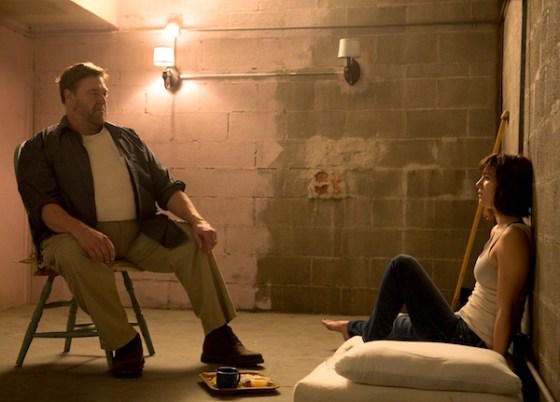
    After Michelle (Mary Elizabeth Winstead) is in a car crash, she awakens in a basement chained to a wall. Her captor, Howard (John Goodman), tells her he’s saved her life: a massive attack has taken place and they, along with an acquaintance of Howard’s called Emmett (John Gallagher, Jr.), are in Howard’s self-built bunker to hide from the deadly fallout. But Michelle only has Howard’s word as evidence these attacks happened at all, or that their aftermath is lethal, and can he be trusted?

    For most of its running time, 10 Cloverfield Lane is a good psychological puzzle. Michelle has little choice but to trust her captor(s) / quarantine-mates and little chance to investigate the truth for herself, try as she might. I must say I never felt a particularly palpable sense of tension, despite the varied and regularly renewed attempts to make Goodman a threat, but it nonetheless works as a characterful mystery-driven single-location thriller. And then…

    We’ve all read reviews where a critic (or blogger!) will write something like, “it would benefit from being 10 minutes shorter”. That sounds very precise and therefore clever, but it’s really a number plucked from thin air. No one who’s written a sentence like that has actually sat down with a film, noted all the bits they’d cut, added them up, and then presented that total in their review. It is, at best, intuition (at worst, it’s random and thoughtless). However, with 10 Cloverfield Lane I can say exactly how much needs to be cut: 9 minutes and 10 seconds. To be exact, those’d be the 9 minutes and 10 seconds between a (spoilery) revelation and the credits rolling.

    Roomies

    There’s no need to go into detail here — if you’ve not seen the film it’s a massive spoiler; if you have, you surely know what I’m talking about. This climax feels wholly unnecessary and like it belongs in a totally different movie. Tonally, and in terms of the main plot points that drive the story, it has absolutely nothing to do with the movie we’ve just watched. If you cut that bit out, it wouldn’t make the rest of the film any less satisfying. And because it’s so unnecessary, I found it intensely irritating.

    The bulk of 10 Cloverfield Lane is a very solid contained psychological thriller, undoubtedly deserving a strong 4-star rating. Then the final ten minutes happens. It’s so misjudged, in my opinion, that it overshadows what’s come before, to the point that I’ve taken a whole star off my rating.

    3 out of 5

    Our Kind of Traitor (2016)

    2016 #191
    Susanna White | 108 mins | streaming (HD) | 2.35:1 | UK & France / English, Russian & French | 15 / R

    Our Kind of Traitor

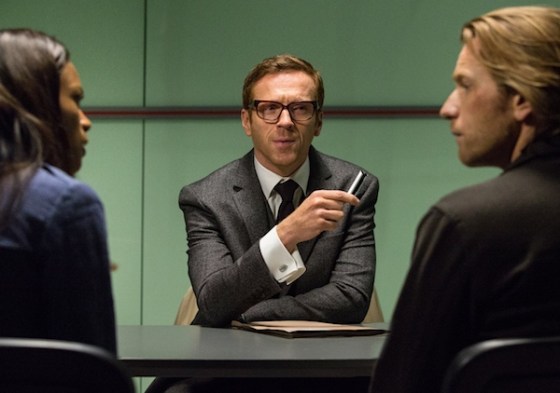
    Based on a John le Carré novel, Our Kind of Traitor sees a couple of holidaying Brits, Perry and Gail MacKendrick (Ewan McGregor and Naomie Harris), befriending a Russian chap called Dima (Stellan Skarsgård), who it turns out has links to the Mafia and wants our hapless heroes to deliver an information-filled USB stick to British intelligence. As MI6 (primarily represented by Damian Lewis) seek to act on the information, the MacKendricks get drawn into the espionage game thanks to their relationship with Dima.

    Some of Traitor’s detractors have a problem with it right from the off, finding the premise to be inherently ridiculous. I disagree. In fact, I think it’s quite a good plan on Dima’s part: to use an unsuspected casual acquaintance to smuggle important documents to the authorities. The way the MacKendricks continue to be involved does wind up stretching credibility, but that’s narrative structure for you — it’d be a real trick to construct a satisfying relay of perspective characters.

    If anyone could pull that off it’s probably Le Carré, but this is not his most complicated plot — there are even less twists or double-crosses than you’re probably expecting — but as a tense thriller it satisfies often enough. However, Le Carré as author, plus screenwriter Hossein Amini and director Susanna White, seem to be more interested in the story’s real-world resonances. They’re using a thriller plot to bring up the kind of probably-genuine corruption we get in government today. On the one hand it feels a little obvious, especially to those of certain political leanings, but on the other it’s worth highlighting. An impassioned speech by Damian Lewis to some of his superiors sums it up, probably rather too neatly for some discerning critics.

    British intelligence

    Lewis is always good value, both in scenes like that and in his tentative partnership with McGregor. Although the MacKendricks are our point-of-view characters, the innocent normal people we should relate to, McGregor’s Perry is ultimately a little flat and Harris is underused. The real star is Skarsgård as the gregarious and foul-mouthed Russian banker, who is by turns unsettlingly dangerous and engagingly likeable. Or perhaps it’s the beautiful cinematography by DP Anthony Dod Mantle — the varied international locations are particularly effective at adding scale to a story that’s really about the personal interactions of four or five people.

    Our Kind of Traitor is not the very best Le Carré adaptation, especially given the increasing number we’re being treated to these days, but it’s still a reasonably engrossing thriller with something to say about contemporary geopolitics.

    4 out of 5

    The Saint’s Return (1953)

    aka The Saint’s Girl Friday

    2016 #154
    Seymour Friedman | 65 mins | download | 4:3 | UK / English

    The Saint's Return

    Long-time readers may remember I reviewed all eight of RKO’s Saint films back in 2012. That series ended amidst an argument over rights (and they replaced it with the ever-so-similar Falcon series, which I also reviewed), but a decade later this continuation movie happened. I wasn’t even aware it existed until it was brought to my attention in the comments on another film. It’s technically not part of the same series (it was made years later by Hammer, believe it or not) so it’s harder to come by, but eventually I tracked it down… as a download that was clearly sourced from a VHS (it even lost tracking at one point!) that was quite possibly recorded off the telly.

    The story sees Simon Templar, aka the Saint, rushing back to England to help a friend, but she’s killed in suspicious circumstances before he arrives. Investigating her death, Templar finds she was indebted to the River Gang, and sets about bringing them down.

    The Saint, with a girl

    Although this was made years after the RKO films and by a different studio, it’s not a reboot or remake. Even allowing for those terms having become more applicable recently than they probably were in the ’50s, The Saint’s Return actually seems to be making a concerted effort to appear connected to the earlier series: near the start there’s a small scene where Inspector Fernack, the Saint’s regular nemesis/ally in the NYPD, acknowledges that Templar has left for England, which serves no purpose other than to suggest a connection to the other films. It’s even shot in a way that’s reminiscent of the older films (though, I don’t know, had low-budget studio filmmaking changed much in the intervening decade?)

    That said, there are changes: the Saint is now an American, for no particular reason, and it’s more serious than I remember the other films being; but that might be my memory being clouded by the Falcon films, which were similar but lighter. In a rare feat for these movies, it managed to trick me with a plot twist, as I incorrectly guessed who secretive villain ‘The Chief’ would turn out to be. That’s either an achievement or a sign of me underestimating the film just because it’s old and cheap…

    The Saint, with another girl

    Taking the lead role is Louis Hayward, who originated the Saint on screen fifteen years earlier in RKO’s first film, The Saint in New York. He only played the role once before, but nonetheless makes a convincing return here. The rest of the cast includes Britain’s answer to Marilyn Monroe, Diana Dors, whose charms haven’t dated, and a minor role for one Russell Enoch — aka William Russell, who’d go on to find fame in the title role of the BBC’s The Adventures of Sir Lancelot, before ensuring his screen immortality as one of the original leads in Doctor Who.

    Still, there’s more to The Saint’s Return than before-they-were-famous star-spotting. Although it seems to be the black sheep of the Saint film family, it’s actually a pretty good little thriller. Indeed, there were definitely worse films in the series proper. I’m not going to quite stretch to four stars for it but, for fans of the series, it’s worth tracking down.

    3 out of 5

    Split (2016)

    2017 #62
    M. Night Shyamalan | 117 mins | download (HD) | 2.35:1 | USA & Japan / English | 15 / PG-13

    Split

    Once-fêted writer-director M. Night Shyamalan surprised a lot of people in 2015 by finally beginning his long-awaited comeback (a day I think it’s safe to say many thought would never come) with low-budget high-concept horror The Visit. Then earlier this year he surprised people again by delivering another long-promised return. Well, he surprised people who didn’t find it out on the internet the day after the darn thing came out, anyway. For that reason (plus the newsworthy announcements that have followed in its wake), this review presumes you know Split’s last-minute twist.

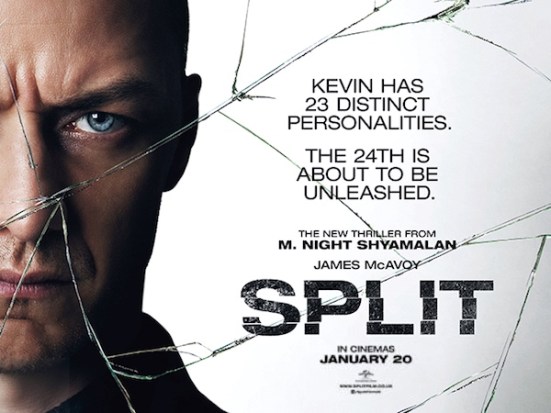
    And, like many a twist before it, once you know what’s coming it can’t help but colour the entire film. What’s unique about Split’s reveal is that, really, it shouldn’t — it’s a bonus extra-textual connection, not a traditional twist that forces you to reassess the narrative you’ve just seen. The problem, I suppose, is that it’s a distraction; or it was for me. I spent the entire movie with a background awareness that this was in the same universe as Unbreakable, which meant that (a) I was hyper-attentive for anything that suggested a link before the closing cameo (I didn’t see anything significant; I think the similar posters are probably the cheekiest thing), and (b) any tension about whether or not James McAvoy’s character will turn out to have (semi-)supernatural powers dissipates, because of course he will — that’s the world we’re in.

    Oh, you!

    This is why having twists spoiled is bad. I guess journalists felt that as it wasn’t a twist inherent to the film’s narrative — not like, say, The Sixth Sense or Fight Club — it was OK to shout about it online with uncommon speed. In fairness, the later news that the trilogy-completing Glass is in development means that, even if they had kept schtum, anyone waiting on Split’s digital/DVD/streaming/etc release was likely to have the connection blown anyway. But I didn’t want to be having a conversation about the point at which discussing spoilers is permissible. That’s a distraction from the film itself, which does it a disservice. But then, so’s knowing the ending before you start.

    I guess this is a long-winded way of saying I don’t think I’ve fairly judged Split yet. I was too busy thinking “OMG, Unbreakable sequel, yay!” Still, it’s easy to spot several plus points. The Witch’s Anya Taylor-Joy makes for an engaging heroine, her character quiet but assured, more capable than the bolshy but kinda useless classmates she’s imprisoned with. Even as a twist-spoiled viewer is waiting for the inevitable reveal that, yep, McAvoy has powers that are going to manifest, there’s tension in when and how and who’ll make it out alive.

    Making it out alive?

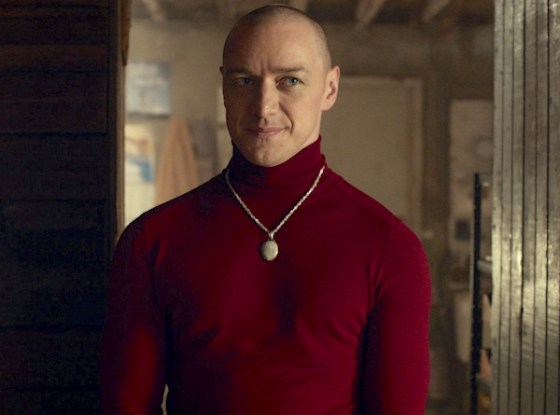
    However, the really exceptional part of the movie is McAvoy’s performance. I don’t know how accurately or sympathetically the film handles the science of his character’s condition, but his embodiment of the role — of all the roles — is superb. The multiple distinct personalities aren’t created just by putting on a silly voice or funny costume; McAvoy changes the way he holds himself, the way he stands and moves, the way his face expresses. It’s the kind of performance that in a different kind of film would’ve been all over awards season.

    I feel bad for not entirely assessing Split on its own merits, but equally I can’t help it — the thing that most excites me is where it promises to go next; the full-blown sequel to Unbreakable that many people (myself included) have been hoping would come for the best part of two decades. Maybe once that’s been and gone I’ll be able to revisit this and take it as a standalone piece.

    4 out of 5

    Split is released on DVD and Blu-ray in the UK today.

    Invasion of the Body Snatchers (1956)

    2016 #147
    Don Siegel | 77 mins | streaming (HD) | 2.00:1 | USA / English | PG

    Invasion of the Body Snatchers

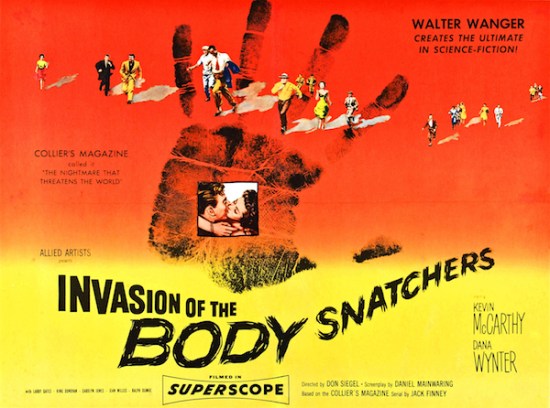
    A sci-fi thriller about a stealth alien invasion using human duplicates (clue’s in the title), this original film version of the oft-remade Invasion of the Body Snatchers is best not at genre-movie chills, but at evoking and commenting on paranoia and what causes it.

    Thematically, the narrative of insidious outsiders slowly replacing good honest people with braindead versions who are on their side has been read as either anti-communist or anti-McCarthyite, with some critics claiming the framing story (more on that in a bit) changes it from the latter to the former. Allegedly none of these themes were intended — not by the author of the original story, the screenwriter, the producer, or the director. Which doesn’t mean you can’t see them there. Indeed, director Don Siegel felt the anti-McCarthy subtext was inescapable, but he tried not to emphasise it. Whichever reading you prefer, or none, the sense of unease, distrust, and lurking danger that the film creates are a peerless reflection of paranoid feelings.

    Although I deemphasised the genre aspect above, that doesn’t mean it lacks for sophistication there either. It’s as much a thriller as it is science fiction, and more mature in that regard than what’s commonly brought to mind by the phrase “50s sci-fi movie” (whether that’s fair or not). The way the mystery slowly unravels — the calmness of it; how even our heroes unwittingly allow some of it to happen — sucks you slowly deeper into its anxious grip. (“Slowly” being a relative term, because this is a short, quick movie.) Nonetheless, the most outright SF elements — the plant-like pods that the clones emerge from — are suitably creepy. Not in themselves, but when they first burst open and the bodies inside begin to ooze out… Though not strictly a horror movie (at least not as we’d define it today), those moments are chilling.

    Extreme gardening

    The impact of this sequence is supported by the black-and-white photography, which helps obscure any cheapness or amateurism to be found from the era- and budget-restrained special effects work. But such photography benefits the film as a whole, too, with some great film noir visuals during nighttime scenes. Siegel had previously helmed several such crime pictures (and would go on to a couple more) and it’s clear those skills crossed over. It also works very nicely with the film’s paranoia — what’s lurking in the shadows?

    In some respects it’s amazing Invasion of the Body Snatchers is as successful as it is, because the studio chose to dick around with it in a couple of ways. Originally the film had some humour, which (as I think we all know by now) definitely can have a place in a horror movie, generally to help manage tension levels. Despite successful test screenings in which the audience screamed or laughed as appropriate, the studio ordered the humour be cut. I guess they then felt they’d made the film too glum, because they next ordered the addition of bookend sequences, against the wishes of both the producer and the director. It’s clear these couple of scenes were shot much later, with much less care given to their quality. They do somewhat detract from the pervading pessimistic, bleak, increasingly hopeless tone — which was why they were added, of course, so at least in that respect they’re a success.

    Those late additions aren’t bad enough to ruin the film, however, which still comes away as a well-made exercise in tension.

    4 out of 5

    Twin Peaks: The Missing Pieces (2014)

    2017 #68
    David Lynch | 91 mins | Blu-ray | 1.85:1 | USA & France / English | 15

    Twin Peaks: The Missing Pieces

    When Twin Peaks: Fire Walk with Me was released in 1992, one of the things that disappointed fans was the absence of many of Twin Peaks’ beloved characters. A few of those absentees were due to scheduling conflicts or behind-the-scenes disagreements, but others were shot and left on the cutting room floor. Rumours circulated for years (still do at times) that David Lynch actually shot five hours of material, only two-and-a-quarter of which made it into the final cut. However, as early as ’92 itself, co-writer Robert Engels stated that the first cut ran 3 hours 40 minutes, adding that they hoped to put that extended version out on LaserDisc. Such a release never happened, and fans were left wanting. Campaigns were launched to get the deleted material on DVD, but there were issues with who held the rights, and then Lynch was only prepared to release them if they had been properly mastered and finished to theatrical standard.

    Finally, after over two decades of waiting and hoping, the stars aligned and the series’ Blu-ray release was accompanied by those long-awaited scenes. Dubbed “The Missing Pieces”, there were 90 minutes of them — which, you’ll note, when added to the 135-minute film more-or-less equals the 3 hours 40 minutes Engels promised back in ’92. It’s also basically another movie’s worth of material; and, indeed, there were limited theatrical screenings as part of the promotion for the Blu-ray — hence why this counts as a film (look, it’s on IMDb and everything).

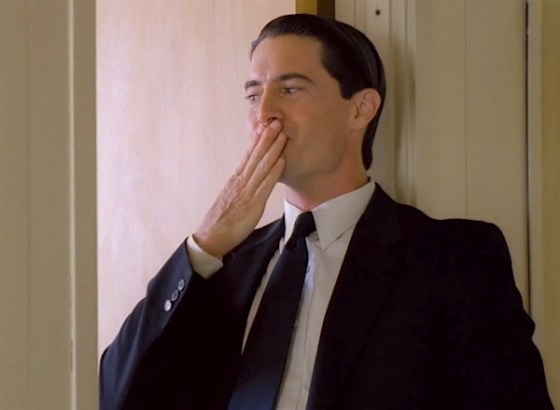
    Diane, it's 9:27am and I am stood in your doorway blowing you a kiss...

    Still, The Missing Pieces may just sound like an uncommonly long selection of discarded bits, same as most DVD deleted scene sections, but there’s more to it than that. There’s quality material here — even, some people say, some of the best scenes in the entire Twin Peaks canon. In fact, some people even reckon it stands confidently as a second Twin Peaks movie, albeit one that depicts events that occur concurrently to the existing film. Well, I don’t think I’d go quite that far, but there’s definitely more to this than a couple of missing lines or amusing asides.

    The fact it isn’t a standalone work is evident from the off, which begins like a traditional deleted scenes package: a collection of context-free bits-and-pieces of FBI Agents Chet Desmond and Sam Stanley in the town of Deer Meadow. These go on for about ten minutes, including a bout of fisticuffs between Desmond and the uncooperative local sheriff that was a very wise removal from the final cut. These early scenes make it instantly clear that The Missing Pieces is a companion to Fire Walk with Me and needs to be watched alongside it, not a unique entity that’s capable of holding its own. These are “Missing Pieces” indeed, not “Meanwhile Pieces”.

    That said, the interest level of the material increases quite quickly. There’s a scene between Stanley and Agent Cooper that doesn’t add a great deal to the story but does again reference the mysterious blue rose — was Lynch intending to go somewhere with that, or not, hence why the scene was deleted? It has a prominent place on the Blu-ray packaging, too… There’s also more David Bowie, though it doesn’t make his part a whole lot clearer. On the bright side, it includes a Buenos Aires hotel bellhop delivering the immortal line: “Oh, Mr. Jeffries! Oh, the shit, it come out of my ass.”

    Oh, the shit, it come out of my ass.

    As things move on to the Twin Peaks-set portion of the tale, we get what the fans really wanted: not mere odds and ends that were removed to expedite the plot, but bits featuring fan favourite characters. Whether the scenes are important or not is another matter, but it must’ve been great to see new material featuring some beloved characters. (I’m glad I’m only watching this now, when this is all available and there’s a new series with new answers on the horizon, rather than having had to endure the wait.)

    That said, in the scope of the story Fire Walk with Me was telling, all of the townsfolk deletions make sense. There are a couple of scenes of Big Ed and Norma’s romance that help set up where they were at the start of the series, but it has little or no relation to Laura. Even less relevant is a scene at the sawmill showing Josie and Pete arguing with a customer over the size of a 2×4. It’s utterly pointless, the only possible reason for its existence to be to shoehorn those characters into the movie, and therefore it was an eminently sensible deletion. The same goes for scenes at the sheriff’s station, which felt like they had greater relation to the actual story of Fire Walk with Me but I still couldn’t quite make head nor tail of.

    It’s not all townsfolk asides, however: there are more scenes with Laura, too. One at Donna’s house shows Dr Hayward being kind towards Laura, seemingly the only man in the entire town who treated her appropriately. That might’ve made a nice counterpoint if left in the movie. Similarly, there’s a scene of domestic bliss in the Palmer household, where Leland, Sarah and Laura practise speaking Norwegian round the dinner table and end up in hysterics. That would’ve made a nice mirror to the later dinner table scene where Leland goes all creepy.

    How's Annie?

    As you’d expect from a deleted scenes section, but in opposition to what some people claim about it, The Missing Pieces is a collection of just that — pieces; fragments divorced from their whole. It’s definitely an experience aimed squarely at fans, then, but that doesn’t mean it’s not one worth taking for the initiated.

    It all ends with an epilogue — a couple of scenes that, for the first time, move beyond the end of the series’ finale. Again, how utterly thrilling it must’ve been to finally get such a continuation over twenty years later. In the first, we catch up with Annie in the hospital, where she repeats the statement her bloody possibly-corpse (though, as we can see, not a corpse) made in Laura’s bed. It also turns out she has the ring… until a nurse pilfers it. Then we cut to the Great Northern, where Coop’s just smashed his head into the mirror. He stages it as an accident when Harry and Doc Hayward rush in to help him, and they insist he returns to bed to rest.

    And that’s it.

    3 out of 5

    Or that was it, because tonight it’s 25 years later and that gum you like is going to come back in style.

    It is happening again.