February Review Roundup

As 2018 races towards its finish line, I’m sat on a pile of nearly 130 unwritten reviews. Oof. And to think, I started that page when I first got 10 behind.

Anyway, as my (likely in vain) attempts to reduce that number continue, today’s roundup includes three reviews of films I watched all the way back in February:

  • WarGames (1983)
  • Being John Malkovich (1999)
  • I Origins (2014)


    WarGames
    (1983)

    2018 #22
    John Badham | 113 mins | streaming (HD) | 1.85:1 | USA / English | 12 / PG

    WarGames

    It’s Ferris Bueller’s Third World War as Matthew Broderick plays a precociously talented high schooler who unwittingly hacks into a government war planning supercomputer and instigates a countdown to nuclear annihilation.

    It’s a funny old mashup of genres that I’m not sure you’d get away with today. It starts out as a Cold War thriller, feeling almost like a Tom Clancy adaptation; then suddenly it’s a John Hughes high school comedy; then the two have to awkwardly mesh, before it turns fully into a young adult techno-thriller. Young Adult fiction is almost synonymous with dystopian future adventures nowadays, but WarGames reminded me nonspecifically of the kind of thing YA books used to be about when I was the right age for them — and, considering that would’ve been in the mid ’90s, those books were quite possibly inspired by this film.

    So, it’s inescapably of its era, but no worse off for that… though how The Youth Of Today would take to it, God only knows. If you stop to think too much (or at all) about the ins and outs of the plot then it becomes thoroughly implausible in so many different ways, but if you let those things slide and go along with the film on its own terms then it’s a cracking adventure yarn.

    4 out of 5

    Being John Malkovich
    (1999)

    2018 #28
    Spike Jonze | 113 mins | streaming (HD) | 1.85:1 | USA / English | 15 / R
    Being John Malkovich

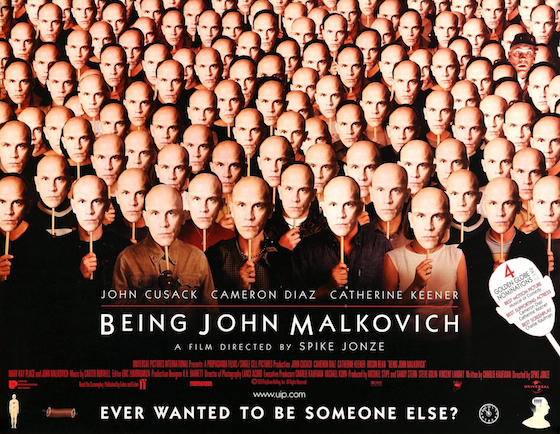
    The film that introduced the world to the kooky imagination of screenwriter Charlie Kaufman (almost 20 years ago now!), Being John Malkovich is about a failing puppeteer (John Cusack) who starts a new job in a bizarre office, where he develops an unreciprocated infatuation with a coworker (Catherine Keener) and discovers a hidden portal into the mind of actor John Malkovich (John Malkovich).

    Even with that mad premise, Being John Malkovich wasn’t the film I thought it was going to be. Well, I don’t know what I was expecting exactly, especially as it’s a Kaufman film so I knew to expect “weird”. But I guess I anticipated that it would focus on people inhabiting Malkovich and doing kerazy things as him, or something, rather than it being a four-way love triangle (in an Escher-esque way rather than an “uh, I think you mean love quadrilateral” sense) in which the whole “inhabiting Malkovich’s body” thing is more a means to an end rather than the film’s raison d’être.

    Said end is an exploration of identity and relationships — indeed, the screenplay reportedly started life as “a story about a man who falls in love with someone who is not his wife” and the kooky body-swap antics came later. I’ve read reviews that frame it in the context of films like Mulholland Drive and Persona as a “comedic meditation on identity”; though what it actually says about identity, I’m not sure (but then, I wasn’t really sure what Mulholland Drive and Persona were saying either, so maybe this is just me). But I wonder: does it just tip its hat in that direction while playing around with the situation to see what happens? Are the filmmakers “yeah, whatever”ing the broader psychological implications (as one of the characters does) while playing out the full bizarreness of the premise to its logical extreme? I’m not sure “logical” is quite the right word for what goes on in this movie, but what I mean is it works through the fullness of the idea, extrapolating it through various events and to a conclusion. Can you even consider the true psychological implications with something so out-there and not-real?

    Well, maybe. Indeed, the film kinda does, through its relationships. One character falls in love with another, but only when the latter is in Malkovich’s body; but then they’re tricked into falling for someone else in Malkovich’s body; but that doesn’t work out in the long run, and the first pair end up together in real life — so the physical body is the initial attraction, but it’s ultimately irrelevant to the actual person inside. Basically, is this just a kooky, crazy, bizarre film whose message is the age-old “beauty isn’t just skin deep”?

    4 out of 5

    I Origins
    (2014)

    2018 #36
    Mike Cahill | 103 mins | TV (HD) | 2.39:1 | USA / English | 15 / R
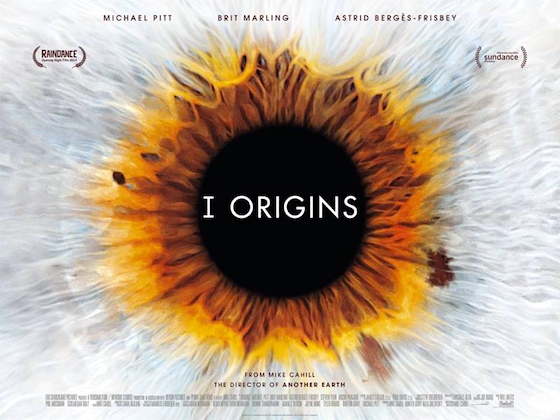
    I Origins

    The second film from Another Earth writer-director Mike Cahill, I Origins is another science-fiction drama with the emphasis on “drama” more than “sci-fi”. It’s about a scientist, Ian (Michael Pitt), who’s mapping the evolution of the human eye with his lab partner (Brit Marling), hoping it will help discredit the superstitious religious ideas that he despises. At a party, Ian is drawn to a masked woman (Àstrid Bergès-Frisbey) by her eyes, and they end up dating — but developments in their relationship send his research in surprising directions…

    I Origins is a consistently engaging, intriguing film; the kind of story that continues to develop and evolve its premise throughout its whole running time, so that I’ve had to be a bit vague to avoid just giving away the entire plot. My only real query is that I don’t know what it all signified in the end. Something to do with there being room for spirituality even in dyed-in-the-wool scientists? Or maybe it’s just about the personal journey of its lead character? Or maybe, as it was developed as a prequel to an unmade script, the really significant stuff lies there, and this is just backstory? (Cahill sold the rights to that screenplay in 2011, but it’s still not been produced.)

    It feels a bit disingenuous to praise a film where I don’t really know for sure what the point was, but I liked it quite a lot all the same.

    4 out of 5

  • RoboCop (2014)

    2018 #151
    José Padilha | 118 mins | streaming (HD) | 2.35:1 | USA / English | 12 / PG-13

    RoboCop

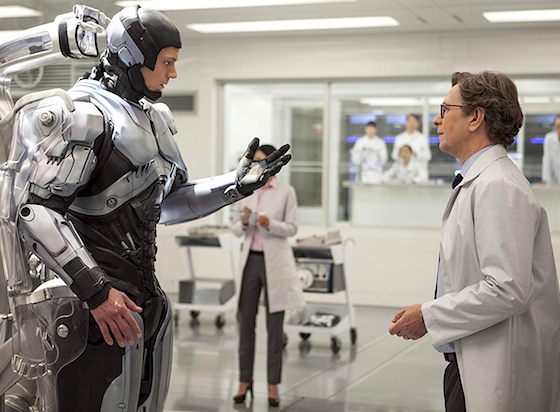
    This reboot of the popular sci-fi/action satire wasn’t received too warmly on its release back in 2014, but nonetheless I’d been vaguely meaning to watch it (just because every high-profile sci-fi/action-y kind of movie goes on my back-burner). Then, after the news earlier this year that Neil Blomkamp had signed on to direct a new sequel to the ’87 original, I saw a fair few people say this reboot was actually quite good; that it only suffered due to comparisons with an original that’s a beloved genre classic. So I watched it, and, well, those people were being too kind.

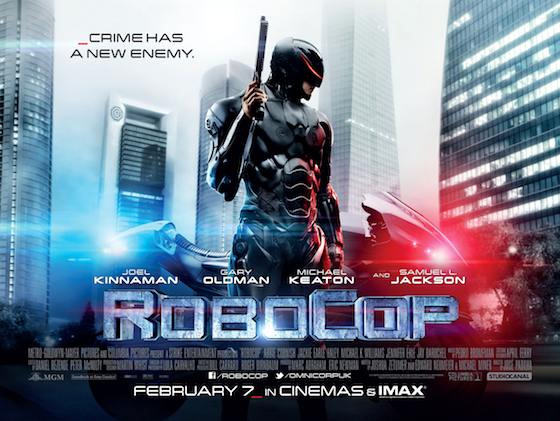
    The year is 2028, and mega-corporation OmniCorp have transformed warfare with their robot soldiers. Keen to deploy the same product as domestic law enforcement but blocked by legislation, they instead develop a proposal for a cyborg police officer — all the physical benefits of a machine, but controlled by the mind of a man. When Detroit cop Alex Murphy (Joel Kinnaman) is fatally injured in the line of duty, they have the perfect candidate; but they haven’t anticipated the emotional toll the procedure will take on its subject… So, it’s broadly the same plot as before, then. Well, it is a remake.

    I wasn’t actually a huge fan of the original — I didn’t dislike it, but in my review I did say I thought it’d had its day and the idea of a remake was fine because “the concept’s a good’un and could withstand a refresh.” I stand by that assertion, I just don’t think this remake is a very good film. Reportedly the screenplay was based on an unfinished draft from 1985, which was commissioned by director Paul Verhoeven when he was considering making the film more serious. After reading that draft he realised he was wrong, returning to the original idea of “humour and brutal satire on the corporate future.” To put it another way: this film is based on a serious/humourless screenplay that was rejected because it wasn’t as good, rather than the one that was made and which garnered all the praise and fans and everything. What a bright idea.

    Machine man

    It’s clear that the writers (whoever they are — there were numerous uncredited rewrites) have serious things on their mind, with the film touching on various topical issues — overseas wars, prosthetics, murderous law enforcement — but instead of satirising them it mostly wants to take them seriously. There is a bit of satire left (Samuel L. Jackson ranting away as a commentator on a Fox News-esque TV network), but it lacks anything deeper than surface spoofery. Primarily, I think the film wants to say something about corporate America — about big business being above the law, and indeed manipulating politicians to set the law — but it doesn’t have anything particularly insightful on that subject. Indeed, I think my previous sentence summed up all of the film’s points on the matter. And that’s annoying because, now more than ever, takedowns of that Fox News mentality are important to how America-as-it-knows-itself is being destroyed from the inside.

    The film also seems to have tried to switch satire for psychological matters, asking how this procedure would really affect a man. That aspect was in the original film too, but I felt it had greater focus here. Unfortunately, they cast personality vacuum Joel Kinnaman as the lead, immediately undercutting any attempt to effectively explore the character. He’s surrounded by an all-star supporting cast (Jackson, Gary Oldman, Michael Keaton, many other recognisable faces), who give decent performances, but the material hardly gives them a lot to work with. Oldman fares best: his character actually has an arc (unlike, well, pretty much anyone else in the movie), as he gradually sells out his ethics to attain his desired result. This brings in a theme of how good people can be corrupted bit by bit, but it’s still pretty thin. You never really feel that he’s selling his soul, meaning his redemption is kind of muddled. It doesn’t come off in the triumphant way you imagine someone had in mind when they wrote/filmed/edited it.

    Shoot 'em up

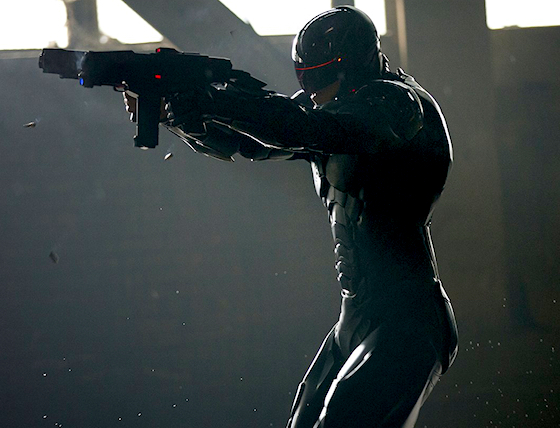
    If you want to block all of that out, sadly it’s not particularly satisfying as an action movie either. The attempt to genuinely focus on the morals leaves action pushed aside for most of the running time, which might be admirable if it worked, but it doesn’t. When it finally arrives, the action is as bland as the rest of the movie. In the original film’s climax, Robocop fought a stop-motion animated ED-209 that looks kinda clunky and cheap today; in this one, he fights half-a-dozen CGI ED-209s, but now they lack any weight and the sequence has no tension.

    Basically, the film does nothing particularly well. It’s not outright bad, but it’s not good either. It’s fine. It’s adequate. Normally I’d now say it’s good for a couple of hours of brain-off entertainment, but is it? The action quotient isn’t really high enough for that. More likely you’ll end up pondering all the things the film itself doesn’t bother to adequately work through. It should be cutting and provocative, but it’s just bland. That’s the biggest shame, because if there’s a movie 2018 needs it’s one about corrupt businessmen hijacking the government’s decision-making while right-wing TV chatterers cheer them on and police officers are replaced by an ultimate-killing-machine robot. Put another way: 2014 probably didn’t need a new RoboCop movie, but 2018 does — but it needs one with more smarts than this.

    2 out of 5

    RoboCop is part of the opening night of Film4’s Fantastica season, airing this evening at 11:50pm.

    The Purge (2013)

    2018 #5
    James DeMonaco | 85 mins | streaming (HD) | 2.35:1 | USA & France / English | 15 / R

    The Purge

    When The Purge first came out, I ignored it because its premise was inherently daft. Then they made some sequels, which I ignored because the premise was still inherently daft. Then two things happened: one, some people who I think are worth listening to said some decent things about it; and two, Trump came to power, and suddenly that daft premise doesn’t feel so far outside the confines of what’s possible.

    The aforementioned premise (for those that don’t know) is that, for one 12-hour period each year, all crime is legal. There’s some gumpf about how this was a policy designed to alleviate crime the rest of the year, blah, blah, blah, but really it’s just an excuse for a horror movie — a kind of home invasion action-thriller, essentially, but with twists and some effective moments. Although it has plenty of lump-headed, convenient-for-the-plot moments too, but I shan’t delve into spoiler territory here. Let’s just say some of the bigger twists are achingly predictable.

    I think writer-director James DeMonaco was hoping to land some kind of political commentary, possibly even satire — I mean, it’s inherent in the concept, right? And the film leans into it, mostly in a race-related way, with a black guy on the run and antagonistic prep school kids. But it’s maybe not as clever as it’d like to be, and I’m not sure it’s actually got anything to say — again, it’s a violent thrill-ride with some window-dressing.

    They're coming to get you, Ethan

    The other thing about the premise is… they’ve made four of these movies now, plus a TV series, and from what I can ascertain they’ve all focused on “murder and violence is allowed” — but if all crime is legal, well, wouldn’t people be stealing company secrets, breaking NDAs, filing their tax returns…? Crimes against the government aren’t allowed or something, so I guess that’d probably cover the last one. But still, I feel like there’s potential to produce more variety than just “12-hour murder spree!” again and again.

    Anyway, it is what it is. I generally liked it enough while watching it, but it certainly doesn’t stand up to post-viewing intellectual scrutiny.

    3 out of 5

    Jin-Roh: The Wolf Brigade (1999)

    aka Jin-Rô

    2018 #212
    Hiroyuki Okiura | 102 mins | DVD | 1.85:1 | Japan / Japanese | 15 / R

    Jin-Roh: The Wolf Brigade

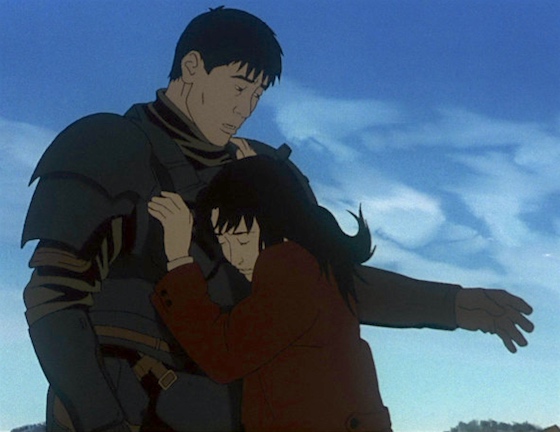
    Jin-Roh has enough cool costumes and bursts of ultra-violence to cut together a trailer that looks like a kinda-typical anime action-fest, but that’s really hiding a thoughtful, complicated (oh so complicated) drama about an unlikely romance and military conspiracies.

    If that sounds like a bizarre mix… well, it is. Jin-Roh is a film that likes to pull tricks on its audience (maybe those action-packed trailers were deliberate rather than marketers just doing their best to sell the thing!), and one of the tricks it plays is to constantly wrongfoot you about what kind of movie it’s meant to be. First it’s a kind of action thriller about terrorists vs. police; then it’s a subtle romance between two damaged individuals; then it’s a conspiracy thriller, and also an espionage drama; and finally it’s some kind of allegorical tragedy. As it moves through those various phases, the characters — and, by extension, us — are subjected to crosses, double crosses, and triple crosses. Good luck keeping up…

    Set in an alternate history where Germany occupied Japan after World War 2 (I’m not sure that’s made clear enough in the film, but hey-ho — maybe it’s obvious to Japanese viewers), the film picks things up a couple of decades later, with Japan free from occupation but having to fight antagonistic forces from within. With many guerrilla cells having combined to form terrorist group The Sect, the security services consequently created Kerberos, a controversial police paramilitary unit, to combat them. When Kerberos corporal Kazuki Fuse fails to shoot a bomb-carrying girl and she blows herself up, he’s punished by being sent back to basic training. At the same, he meets the girl’s sister and begins to form a bond with her. Meanwhile, his failure has thrown the future of Kerberos into doubt, setting political machinations whirring every which way.

    Little Red Riding Hood... and the Big Bad Wolf?

    I’ll admit, I got pretty lost with all the various factions, who was plotting what and when and why, and which side everyone was supposed to be on. Perhaps I was lulled into not paying enough attention because, as I noted above, the film appears to be a tender, understated examination of the relationship between two scarred individuals struggling to cope with the same recent tragedy from different sides, before it abruptly takes a hard turn into an intricate conspiracy thriller. Reading a plot description afterwards, I managed to get my head around it, though it didn’t resolve one quandary I felt at the end of the film itself: that it’s hard to know who we’re meant to be rooting for. Did the good guys win? Did the bad guys win? Were there actually any good guys — was anyone right? Personally, I’m fine with a film where there are no heroes, where everyone’s a bad guy and one of those bad guys wins; my problem is that I was left feeling unclear about whether that was the case or not.

    Mixed feelings, then. It’s a well-made film (even watching on a crummy window-boxed DVD), but all those whiplash-inducing turns and confusion-producing twists left me somewhat reeling and bewildered.

    3 out of 5

    The Korean live-action remake, Illang: The Wolf Brigade, is available on Netflix from today.

    (As is Daredevil season 3, Making a Murderer season 2, a brand-new Derren Brown special, and over half-a-dozen other series and films I’ve not heard of — why dump so much on one day, Netflix?!)

    What Ever Happened to Baby Jane? (1962)

    2018 #153
    Robert Aldrich | 128 mins | TV (HD) | 16:9 | USA / English | 12

    What Ever Happened to Baby Jane?

    Real-life rivals Bette Davis and Joan Crawford star as squabbling sisters forced together by circumstance in this slice of Hollywood Gothic. Both were once famous in their own way: as a child, bratty Jane Hudson (Davis) was a huge vaudeville star as the eponymous ‘Baby Jane’; later, her level-headed sister Blanche (Crawford) became a huge star of the silver screen, where Jane struggled to make a mark, employed only as a clause of her sister’s studio contract. A tragic incident ended both their careers, leaving Blanche paralysed and Jane her carer. Decades later, resentment has made Jane casually abusive of her invalided sister — and when she discovers that Blanche has been secretly plotting a major change to their situation, things only get worse…

    What Ever Happened to Baby Jane plays out as a mix of overwrought melodrama, plausible real-life horror, and mature psychological thriller. It’s really driven by the acting of the two leads. Crawford gets a less showy role, having to play it straight as the reasonable, sensible older sister, struggling to do what’s right for her sibling even as she’s mistreated. Davis, on the other hand, is allowed to cut loose. Jane starts the film batty and only gets less mentally stable from there. It’s quite an extraordinary performance from Davis, which threatens to tip over into scenery-chewing at any moment but remains compelling.

    Bette Davis and her preferred co-star

    The film itself is less assured. Director Robert Aldrich manages a good line in generating tension from people almost finding out what’s going on in the Hudson household, and there’s a solid final-reel twist (even if the final act in general is a bit bizarre — no spoilers, but those beach users are seriously inattentive), but the film is allowed to run longer than the material really merits. A slow burn can be used to create atmosphere, of course, but that’s not really the case here. It could do with a little more drive early on.

    But maybe it’s this looseness that has allowed so many different ways of viewing the film. As well as those I’ve already mentioned — sibling melodrama, psychological thriller, unnerving horror — people have taken it as a black comedy, or a cult camp classic. Whichever way you look at it, it’s certainly an experience.

    4 out of 5

    The TV series Feud: Bette and Joan, which dramatises the making of this film, begins a repeat run on BBC Four tonight at 10pm.

    Happy Death Day (2017)

    2018 #43
    Christopher Landon | 96 mins | streaming (HD) | 2.35:1 | USA / English | 15 / PG-13

    Happy Death Day

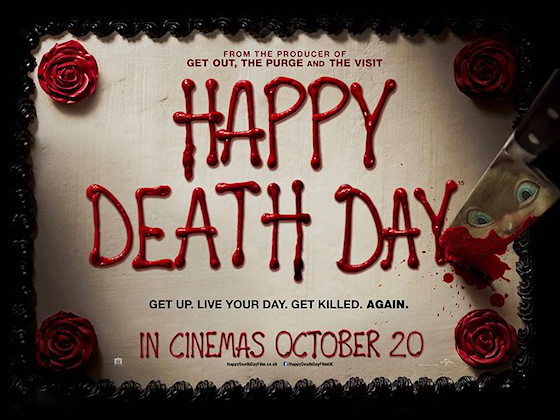
    How much does pure originality matter? Happy Death Day is a high-concept slasher movie that could be described as Groundhog Day meets Scream via Legally Blonde. Normally those kind of “X meets Y” descriptions give a general sense of tone or some coincidental similarities, but if you could put those three films in a blender, Happy Death Day is almost certainly what would come out. (There’s probably a more apposite sorority comedy than Legally Blonde for the third ingredient, but that’s not my subgenre of expertise.) But while there’s no doubt that Happy Death Day is derivative, that doesn’t mean it’s not entertaining.

    The film introduces us to college student Tree (Jessica Rothe), who wakes up hungover in a stranger’s dorm room on what turns out to be her birthday. Later that day, she’s murdered… after which she wakes up hungover in the same stranger’s dorm room on her birthday. Later that day, although she takes steps to avoid it, she’s murdered again… after which she wakes up hungover in the same stranger’s dorm room on her birthday. Yes, she’s in a time loop — one which, she theorises, can only be stopped if she finds and stops her killer.

    It’s a clever conceit — yes, borrowed from Groundhog Day, but utilised in a different way. For me, the plot/structural similarity is easy to overlook because, hey, it’s a great idea, why not recycle it with a different kind of story? This variation is enjoyably done, too — not an outright comedy, but with enough wit to make for a fun movie. There’s a very real danger of it being repetitive — repetitiveness is baked into the very concept, obviously — but, like Groundhog Day, it dodges that with amusing variations and intelligent filmmaking. Okay, the logic is sometimes a little askew (for example: no matter how quickly or slowly Tree leaves the dorm room at the start, the same random events happen outside), but that’s storytelling expediency rather than a major problem with the film’s logic, in my opinion.

    Screaming groundhog

    In the lead role, Jessica Rothe is excellent. She fills what could’ve been a pretty standard slasher movie heroine with different levels of reconcilable personality and a surprising amount of heart. She’s a likeable, root-for-able character to spend the day with over and over (and over) again. And when you know how the movie was filmed (i.e. like almost every other movie: not chronologically, but by location, having to shoot scenes from different time loops side by side), the way her performance is accurately nuanced becomes even more impressive.

    In my opening comparison I picked Scream specifically because Happy Death Day has the feel of those late ’90s / early ’00s teen horror movies — the heyday of franchises like Scream, Final Destination, I Know What You Did Last Summer, etc. Back then this surely would’ve been a huge hit, but I feel like very few people were talking about it when it came out last October. That said, it achieved a respectable Rotten Tomatoes score (70%), grossed $122.6 million (off a budget of just $4.8 million), and this week they made headlines by announcing the sequel’s title, Happy Death Day 2U, which seemed to go down rather well. So maybe I just missed everyone celebrating it first time round.

    I hope it continues to find a wider audience, because I think it’s a lot of fun. It may be built from blocks borrowed from other films, but they’ve been arranged in such a way that I think it still feels fresh, and they’ve been assembled skilfully enough that it’s enjoyable either way.

    4 out of 5

    Happy Death Day 2U is scheduled for release on Valentine’s Day 2019.

    The Post (2017)

    2018 #125
    Steven Spielberg | 116 mins | Blu-ray | 1.85:1 | USA & UK / English | 12 / PG-13

    The Post

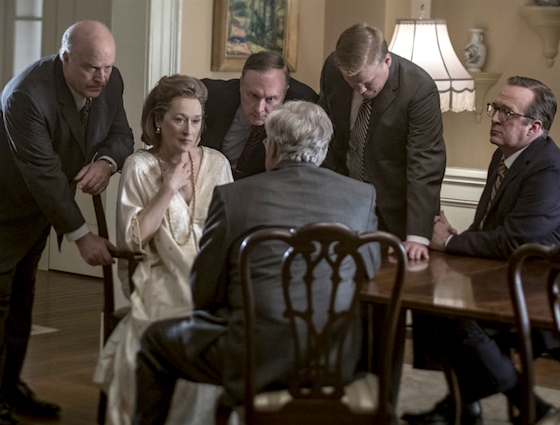
    Perhaps the timeliest historical movie ever made, The Post is, in its plot, about the publication of the ‘Pentagon Papers’, a leaked report that examined decades of US government decisions about the Vietnam war; but, thematically, it’s about press oversight of a government lying to its people to cover up their own wrongdoing, including trying to forcibly stop the press from performing that role — sounds familiar, doesn’t it? Not to mention that it also concerns itself with matters like whether sources who leak classified information are whistleblowers or traitors, and attitudes towards women in positions of power in the workplace.

    For various reasons related to these elements, it’s attracted a lot of comparisons and accusations. For example, some have criticised it for being about a case in the ’70s rather than one in the present day. I guess allegory is tricky for some people to understand… Or, alternatively, that any such parallels were accidental, as if experienced director Steven Spielberg wasn’t aware of them. I think the film went from script to screen in just nine months for a reason…

    Then there’s the inevitable comparison to Spotlight, another recent newspaper journalism-themed true-story movie, and a Best Picture winner to boot. Those who thought Spotlight was exceptional tend to think The Post doesn’t measure up. Personally, I thought Spotlight was good, but I didn’t love it as much as some others. I would hesitate to say The Post is better than it, but I would be equally as hesitant to say it isn’t as good. Arguably Spotlight is a better movie about journalism, focusing as it does on the everyday legwork and procedure that go into putting together a major story, whereas The Post has more on its mind than just the facts of how reporting works. There are also many comparisons to All the President’s Men, but I’ve still not seen that so can’t comment fairly (there is this rather excellent trivia/connection, though).

    Reading the papers

    Relatedly, some people think this film should’ve been about the New York Times, as they were the paper that first broke the Pentagon Papers story and initiated the legal case it all led to (and, later, they were the only paper awarded a Pulitzer Prize for the publication). There’s certainly an argument for that being the real story, but, conversely, that would be to assume the focus of this movie is solely the publication of the Pentagon Papers. In fact, The Post is the story of Katharine Graham and the Washington Post, and how the Pentagon Papers changed them both. It’s the story of an underdog-like local paper making an (inter)national mark by doing something at odds with a legal ruling — the fact they chose to back-up the Times by publishing too (even if the action was instigated as much by friendly rivalry/jealousy as it was by “freedom of the press” ethics) is an important point in itself.

    It’s also the story of a woman — a business owner at a time when women didn’t hold such roles; and not a woman who confidently elbowed her way in either, but one who found this position thrust upon her — going from meek and overpowered to confident in her own mind and running the show. I’ve read reviews that think this latter element is somehow forced on the film, as if the makers didn’t notice it until halfway through and only decided to draw it out when they reached a shot near the end where Streep walks past a crowd of other women with admiring expressions. That’s not the case, obviously — that’s simply not how movies are made — and that arc is clearly in mind from the very first scene where we meet Graham. Meryl Streep is excellent in the role, which is easily the film’s most fully-realised character. Everyone else is certain of themselves and what they believe is the right thing to do, but over the course of the film she goes from quiet, uncertain, and reliant on her trusted advisor, to believing in her own instincts and standing up for them. It’s a clearly-charted but believable journey.

    A man's world

    Nonetheless, it’s somewhat hard to divorce The Post from the context of when it was made — the way it reflects the current climate in American politics and the news coverage thereof. But then, is that a problem? Are works of art not as much about the time in which they were made as the time in which they’re set? I guess that’s a whole other debate. That said, it carries a message that would be important in any era, about the need for reasoned, responsible, independent oversight of those who govern us.

    4 out of 5

    The Post is available on Amazon Prime Video UK from today.

    All the Money in the World (2017)

    2018 #121
    Ridley Scott | 133 mins | streaming (HD) | 2.39:1 | USA, Italy & UK / English, Italian & Arabic | 15 / R

    All the Money in the World

    All the Money in the World does not star Kevin Spacey. But I expect you knew that. Indeed, if you only know one thing about the film, I expect that is what you know. Spacey’s firing, and his speedy replacement by Christopher Plummer, was such a big news story that it instantly became what the movie was most famous for — and, I suspect, is what it will always be most famous for, because the film itself isn’t good enough to transcend its own reputation.

    Before I get into that, let’s do the film the courtesy of describing what it’s actually about. Based on true events, it tells the story of the kidnapping of teenager John Paul Getty III (Charlie Plummer, no relation) in 1973 thanks to his family ties: his grandfather, J. Paul Getty (Christopher Plummer), was the richest man in the world. He was also a miserly old codger who refused to pay his grandson’s ransom, and the film follows his daughter-in-law Gail (Michelle Williams) as she desperately tries to arrange to get her son back, aided by the employee Getty assigns to investigate the case, former CIA operative Fletcher Chase (Mark Wahlberg).

    Even before the point of contention that drives the plot, various examples are given of what a piece of work Getty was. Whether these are based on true stories or not, I don’t know, but the film seems almost heavy-handed in creating this impression. For instance, although he’s the world’s first billionaire, he’ll do his own laundry in his hotel bath rather than pay the hotel $10 to do it for him; or he’ll spend an hour haggling a poor beggar down from $19 to $11 for an item that’s actually worth $1.2 million — although it later turns out there’s another side to that story… not that the it paints Getty in any better a light. Anyway, it’s to Plummer’s credit that he can take this kind of material and make it work, especially considering it was captured in just nine days of shooting with very little prep time.

    Can you put a value on a child's life? J. Paul Getty can.

    When those reshoots were first reported, it was said to be possible because Getty wasn’t actually in the film much, so it wouldn’t take long to remount just his scenes. Then the film started screening, and critics said he was in a lot of the movie and the amount they must’ve reshot was phenomenal in such a short space of time. Personally, I think the truth is somewhere in between: Getty pops up throughout the film, and his presence is huge, but I’d wager his actual screen time is smaller than you’d think — similar to Anthony Hopkins in Silence of the Lambs, who notoriously won Best Actor from less than 25 minutes on screen, it feels like Plummer’s in it more than he actually is. That’s partly the film’s structure, but also the quality of his performance.

    In discussing the reshoots, director Ridley Scott has commented on the differences between the two actors’ takes on the character (Plummer wasn’t shown any of Spacey’s performance before he filmed). According to IMDb, Scott felt Spacey portrayed Getty as “a more explicitly cold and unfeeling character”, while Plummer found “a warmer side to the billionaire, but the same unflinching refusal to simply pay off his son’s kidnappers.” I can’t help reading between the lines to infer that Scott felt Plummer’s performance was more nuanced, and therefore better. It beggars belief that Spacey was cast at all, really: Scott wanted Plummer, who was 88, to play the 80-year-old Getty, but the studio insisted on 58-year-old Spacey, who then had to be caked in prosthetics. Supposedly it’s because Spacey was a bigger name, but that much bigger? Really?

    Anyway, it turned out for the best, because Plummer is probably the strongest element of the finished product. Although Michelle Williams is top-notch as ever, too. Mark Wahlberg has been worse than this, but he still seems slightly miscast. Ridley Scott, also, is not on top form, his direction merely unremarkable. Oh, it looks nice enough — it’s well done — but there’s little beyond glossy competence.

    Negotiations

    Arguably its biggest sin is that, for a movie about a high-stakes kidnapping, it’s remarkably free of tension. The closest is the climactic manhunt around a village at nighttime (an event which is an entirely fictional invention, incidentally), but even that doesn’t seem to ring all that’s possible out of proceedings. The blurb sells the film as a “race against time”, but it’s almost the opposite of that: the kidnappers hold the kid for literally months while the Gettys bicker. But maybe Scott wasn’t going for thrills? There’s definitely a thematic thing in there about wealth and power and what it does to people, and what that represents versus the importance of family or morals. But I’m not sure those issues are really brought out or explored either.

    It leaves the film feeling not tense and on-edge enough to be a thriller, nor thoughtful and considered enough to be a message-driven drama. The real-life story behind the film is a compelling hook and definitely sounds like it’d make a great movie, but the conversion process has perhaps not done it justice. Maybe someone else should have a crack at it…

    3 out of 5

    Trust, a miniseries from Danny Boyle and Simon Beaufoy retelling the same events, begins its UK airing on BBC Two tonight at 10pm.

    Film Noir Review Roundup

    I’ve made a conscious effort to watch more film noirs this year, and today’s roundup contains a few results of that:

  • The Narrow Margin (1952)
  • Accomplice (1946)
  • Shockproof (1949)


    The Narrow Margin
    (1952)

    2018 #2
    Richard Fleischer | 68 mins | TV | 4:3 | USA / English | PG

    The Narrow Margin

    Recognised as a classic noir, The Narrow Margin follows a detective (Charles McGraw) who must protect a mob boss’ widow (Marie Windsor) as she travels by train from Chicago to LA to give vital evidence. As the ‘tec finds himself getting involved with an attractive fellow passenger (Jacqueline White), the assassins on his trail mistake her for their actual target…

    What unfurls is an exciting plot with some solid twists and some great dialogue (enough that it earnt a Best Writing Oscar nomination, in fact), all told in a snappy running time that ensures the film powers forward like, well, a locomotive. Director Richard Fleischer makes very effective use of handheld camerawork and the train setting to create a confined, claustrophobic atmosphere that emphasises the tension and peril of the characters. It all blends into a very fine thriller.

    4 out of 5

    Accomplice
    (1946)

    2018 #16
    Walter Colmes | 66 mins | streaming | 4:3 | USA / English

    Accomplice

    Described by Paul Duncan’s Pocket Essential Film Noir as “hardboiled fun”, and by the few other people online who’ve seen it with phrases like “one of the worst assembled detective movies I’ve had the occasion to watch in a long time”, Accomplice graces my eyeballs before many no doubt finer examples of film noir by virtue of the fact it was available to stream on Amazon Prime and I thought I’d catch it while it was there.

    Adapted by Frank Gruber from his novel Simon Lash, Private Detective, it sees private detective Simon Lash (Richard Arlen) being hired to track down a missing bank executive by his concerned wife (Veda Ann Borg), but the bank insists he’s merely on vacation. As Lash digs deeper, he begins to suspect the wife may have other motives — as does, well, everyone else.

    Running little more than an hour, Accomplice’s plot races past, giving you no time to stop and consider it. Maybe that’s for the best. Conversely, it makes it feel like it doesn’t hang together, even if it actually does. But it rushes along at a scene level, too: Lash seems to figure things out as quickly as it takes the actors to say their lines. It’d be Sherlockian, if you actually believed he had the necessary information and wherewithal to make the deductions.

    There is some fun to be had in a speedy car chase and the film’s occasionally kooky location choices, like the climax being set at a castle in the middle of the desert that’s pitching itself as some kind of hotel for mid-getaway crooks (I think that was the owner’s business plan, anyway). There are other surprising flashes of entertainment, though some of them were likely unintentional, but Accomplice is not really a good film.

    2 out of 5

    Shockproof
    (1949)

    2018 #68
    Douglas Sirk | 76 mins | TV | 4:3 | USA / English | PG

    Shockproof

    When you hear “film noir” you don’t immediately think of director Douglas Sirk (nor vice versa), better known for his colourful ’50s melodramas. Well, according to They Shoot Pictures, Don’t They’s list of most-cited noir films, he helmed three, of which this is the second. The plot has plenty of noir elements, but the film actually feels more like a romantic melodrama. It’s quite an effective mix.

    So, the noir: it’s about a female murder parolee (Patricia Knight) and her parole officer (Cornel Wilde), who begins to fall in love with her. But is she still attached to the crook she took the fall for (John Baragrey)? Is she just pulling the wool over the eyes of the parole officer? That’s kind of a love triangle, hence we’re back in melodrama territory. But the advantage of it being billed as a noir rather than a romantic drama is you’re not sure where it will go. Will she fall for the good honest parole officer with his sweet younger brother and blind mother? Or will she be tempted back to the criminal love of her life? Or will it have a more tragic ending altogether?

    Well, no spoilers, but it definitely takes a turn I wasn’t expecting — the third act spins off in a whole different direction. To be honest, I didn’t really like it, but at least it was unusual, a big departure from the earlier part of the film, and it kind of worked because of that. Again, no explicit spoilers, but it comes to a neatly ironic conclusion… before there’s one extra scene, which feels tacked-on and undermines where the film had got to tonally. And that’s exactly what happened: co-producer Helen Deutsch rewrote Samuel Fuller’s screenplay and added a cop-out ending that Sirk felt ruined the film.

    Fatal femme

    At least until that point there’s stuff to enjoy. Knight’s performance is the real star: although her true nature seems to have been revealed at the start (she’s a parolee, i.e. a no-good criminal), the film adds more nuances to her than that — primarily, you can’t be sure if what she’s doing is genuine, or if she’s playing the parole officer for her own ends. There’s also an interesting turn from Baragrey: I couldn’t be sure if his acting was a bit flat, or if he was deliberately being cool, cold, calculated, thinking he’s always in control, the smartest guy in the deal. Well, even if it’s the former, it functions well as the latter.

    So, Shockproof (a title that has no relevance whatsoever, incidentally) isn’t a total disaster, with some surprising turns that are to be commended even when they don’t work. It was clearly a compromised production, but an interesting one.

    3 out of 5

  • Jack Reacher: Never Go Back (2016)

    2018 #38
    Edward Zwick | 113 mins | streaming (HD) | 2.35:1 | USA & China / English | 12 / PG-13

    Jack Reacher: Never Go Back

    It’d take a braver man than me to name a sequel Never Go Back; doubly so a sequel to a film that garnered an at-best mixed reception; triply so a sequel to an adaptation whose star was vocally and unrelentingly regarded as being terribly miscast by the book’s own fans. But Jack Reacher star — and, more importantly, producer — Tom Cruise is the kind of man who jumps out of planes all day every day for weeks on end merely to capture one relatively minor sequence in a film, so I think we can safely say he’s a much braver man than me.

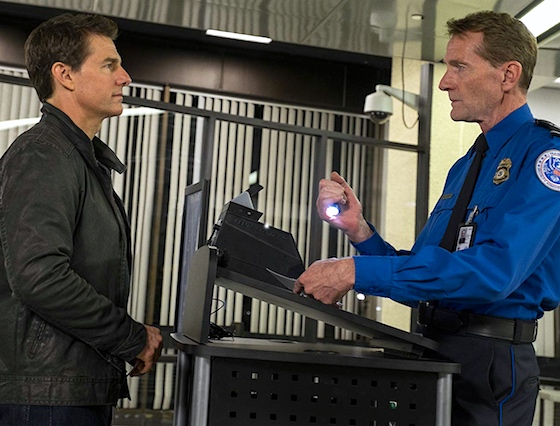
    For those unfamiliar with the character, Jack Reacher (Tom Cruise) is a former military police officer turned drifter — why he quit and why he hasn’t settled down like a normal person is probably explained somewhere, but I can’t remember. Naturally, as he drifts around the US he keeps finding himself involved in escapades — there wouldn’t be stories worth telling otherwise, would there? In this one, one of Reacher’s friends, Major Susan Turner (Cobie Smulders), is arrested for espionage. Reacher is certain she’s being framed, and his investigations lead to him being set up too. As the pair go on the run to uncover a conspiracy and clear their names, there’s the added complication of having to protect teenager Samantha Dutton (Danika Yarosh), who may be Reacher’s daughter.

    What plays out is a solid plot, smattered with decent action sequences. Frankly, it’s nothing incredible, and you’d have reason to expect more distinctive work from a director of the calibre of Edward Zwick (helmer of well-regarded films like Glory, The Last Samurai, and Blood Diamond), but it’s still a good action-thriller.

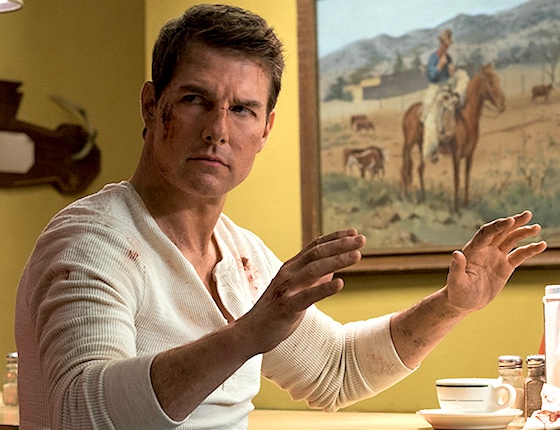
    Cruise in for a bruisin'

    In the title role, Cruise is good. It’s different to his usual routine — the familiar grinning charm is dialled way down, in order to facilitate Reacher’s trademark stoicism — but he’s got a charismatic enough presence that he remains an engaging lead even without it. Smulders and Yarosh also acquit themselves well. Together, the trio make for a neat de facto family. Once they’ve been brought together, the way they move through the narrative as a unit gives the film a different vibe from the “lone hero” thing you’d expect. Unfortunately, the bad guys are as bland as anything. It lacks even one really good villain, which is an especially noticeable problem after the first film had Werner bleedin’ Herzog to chew up the scenery.

    The title Never Go Back became a truism for some observers, because the film was not a success, either with critics (38% on Rotten Tomatoes) or at the box office (just $58.7 million in the US, though it drummed up a solid $162 million worldwide). Part of that is Reacher fans’ enduring dislike for Cruise’s casting. When they were bemoaning it before the first film’s release, I thought it was probably a storm in a teacup; that they’d get used to him over time. I mean, their sole objection seemed to be that he was too short, and how important was that, really? Incredibly important, apparently, because six years and two films later they still really, really hate him in the role. (Personally, I think him being a bit of a short-arse suits the characterisation better. Reacher seems to be a guy who gets underestimated; you don’t underestimate someone who walks in with the bulk of, say, Arnie. But then I’ve never read the books, so I may be wrong about this somehow.)

    A woman's place is in the kitchen

    Fans are one thing, but what put wider audiences off? Maybe it was just the poor reviews. Producer Christopher McQuarrie (who directed the first one, but was too busy on Mission: Impossible to return for the sequel) thinks one problem was they adapted the wrong book. I believe I saw him talk about this on Twitter, which means his comments can’t be referenced (because his tweets self-destruct), but if I remember correctly he didn’t say it was a bad novel, just that it didn’t work when placed as the second in the series. He speculated that more films were needed to establish Reacher’s character and world before they told this particular story. I tend to agree. For one thing, the film has to resort to an early montage to show Reacher and Turner’s friendship growing, which could’ve been more naturally handled by spreading it over a film or two. I think the possibility of Reacher having a kid would also carry greater weight if we were more familiar with the character from multiple adventures.

    Well, it’s all academic now, given the film series is most likely over: just this week, creator Lee Child announced he intends to take the rights to TV, primarily to cast a more faithful actor after those continuing complaints about Cruise. It’ll be interesting to see if it really does make a difference having a taller actor in the role. Somehow, I suspect not. Child also said he’s aiming for the mooted series to adapt one book per 10-12 episode season. Considering he’s written 22 books already, I wonder if he believes they’ll ever get through them all…

    “Sorry son, you just don't measure up.”

    Hopefully whatever they do works, because I’ve enjoyed these Reacher films so far. Never Go Back may not be all it could be, but it’s not so poor as to merit abandoning the film series entirely — it’s above average rather than exceptional (my score errs on the harsh side, in part to differentiate it from the superior first movie). It’d be a shame to see the films tossed aside for something lesser.

    3 out of 5

    The UK TV premiere of Jack Reacher: Never Go Back is on Channel 4 tonight at 9pm. It’s also available on Netflix UK as of yesterday.