Another pair of shorts for summer

The sunny weekend weather is beginning to fade already, heading for a typically dreary Bank Holiday — not that I’m complaining, personally, but I suppose I’m an aberration. Will that be all the summer we get, I wonder? I doubt I’m so lucky. But just in case it does get sunny again, here’s a pair of shorts! Not that you can wear them.

And yes, I did this joke before. Almost a year ago. But it’s such an outstanding slice of humour I figured it would bear repetition. Probably every year.

As per before, neither of these really have a connection, either to summer or to each other, beyond that I’ve had each review sat to post for a while. Click the title for the full review.

Before Sky Captain, there was this: a six-minute reel, shot, edited and, er, special-effects-ed, by Conran on an amateur basis over four years, demonstrating the production techniques and storyline he had in mind for a feature-length homage/reimagining of ’40s cinema serials.

2010 #40a
Pixels

characters and graphics from old 8-bit computer games escape and run riot over New York City. We’re talking Space Invaders firing on real streets, Tetris blocks crashing onto buildings… For people of A Certain Age it’s an explosion of nostalgia, but everyone can be impressed by the CGI on display.


The World of Tomorrow is available on the DVD and Blu-ray of Sky Captain and the World of Tomorrow. Pixels is available free online.
The World of Tomorrow (1998)

2009 #69a
Kerry Conran | 6 mins | Blu-ray | U

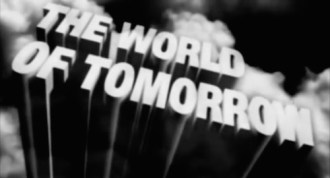
The World of TomorrowBefore Sky Captain, there was this: a six-minute reel, shot, edited and, er, special-effects-ed, by Conran on an amateur basis over four years, demonstrating the production techniques and storyline he had in mind for a feature-length homage / reimagining of ’40s cinema serials.

We’re used to incredibly impressive home-crafted effects-laden films these days, but keeping in mind this was finished 11 years ago, it’s quite impressive. Judged now, it’s clearly the very early days of such composited digital filmmaking, lacking some of the complexity and flair we now see. What it does still suggest is that, given a full budget, such an idea has potential, both in terms of the method and the retro-sci-fi ’40s-serial-style story. Certainly, in my opinion, it did produce a very entertaining film in exactly that vein.

In comparison to its big brother, nearly every shot is exactly duplicated in the final film. In fact, most don’t look much more primitive here. The resolution’s lower, it’s perhaps a bit jagged round the edges, and it’s in deliberately dirtied black and white rather than the glowing sepia-hued colour of the feature, but it shows the concept worked from the off.

The World of Tomorrow isn’t a great film in its own right — indeed, as the closing captions suggest, it’s really an extended trailer / proof of concept for something bigger. In the latter regard it shows all the requisite promise, and thankfully someone in the industry noticed too.

3 out of 5

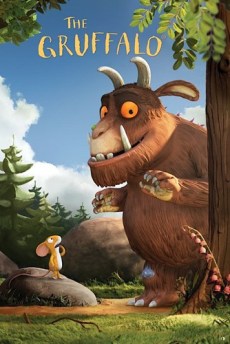
The Gruffalo (2009)

2009 #89a
Max Lang & Jakob Schuh | 27 mins | TV

The GruffaloJulia Donaldson and Axel Scheffler children’s book The Gruffalo was a bit after my time but, I’m told, is incredibly popular with The Youth Of Today (not the ones that hang out on street corners earning ASBOs, obviously). It’s certainly a pleasant read, with rhythmic poetry and the kind of repetition that allows children to join in with ease, but it’s also quite short — fine for a children’s book, but not so good for attempting a screen adaptation of any length.

Having turned down numerous offers for feature-length versions, Donaldson accepted the half-hour short film treatment. Thank God she did, because even at under 30 minutes there’s some padding in evidence. There’s a brief bookend narrative featuring some squirrels, plus a leisurely pace throughout that takes in the scenery and wildlife of the forest world these character inhabit. Seeing a segment in isolation the film can look far too slow, with uncomfortably long pauses between each line of the original verse. As a whole, however, the viewer settles into its style and it rarely if ever feels forced.

The CG animation is well pitched. The textures and style at times left me wondering if the film was actually stop-motion animation, and consequently it carries the warm, cosy, intimate feel that such productions achieve and CGI almost universally fails at (even from Pixar). Whether it was the intention to emulate claymation or just a side effect, it’s certainly more effective than the work on Flushed Away, Aardman’s first CG outing that deliberately set out to look like their traditional stop-motion.

The voicework is equally spot on. John Hurt sounds fabulous in anything, Rob Brydon’s vocal changeability lends appropriate sibilance to the snake, it’s difficult to imagine anyone other than Robbie Coltrane providing the monsterly tones of the titular beast, and even James Corden fits as the mouse. Tom Wilkinson and Helena Bonham Carter also do fine work, meaning there’s not a weak link among them.

Despite being primarily aimed at kids — who hopefully won’t struggle too much with the languid pace — the very listenable poetry of the text and hand-made look of the visuals provide much for older children and adults to enjoy as well. Super.

4 out of 5

The Gruffalo can still be seen on the BBC iPlayer until 7:29pm today. It is also available in HD.

(Originally posted on 2nd January 2010.)

A pair of shorts for summer

Neither of these films, or their reviews, have anything significant to do with summer, but that pun was too good to resist.

I say “good”…

there’s no reason that any story shouldn’t be told in animated form… but sometimes, you have to wonder if it’s the best choice for the job. The Wraith of Cobble Hill is a perfect example for this debate as its modern, urban story seems to clash with the cartoonish style employed to bring it to the screen.

to attempt to describe the plot would be to give too much away, which would be a mistake because this is a beautifully shot (in grainy black & white) and performed tale with a distinct, yet subtle, character arc and an important, but not over-egged, moral message.


Both of these shorts are available on the Cinema16: American Short Films DVD.

The Wraith of Cobble Hill (2005)

2009 #4a
Adam Parrish King | 15 mins | DVD

Animation isn’t a genre, it’s a medium, as Brad Bird would be so keen to tell you. As such, there’s no reason that any story shouldn’t be told in animated form… but sometimes, you have to wonder if it’s the best choice for the job.

The Wraith of Cobble HillThe Wraith of Cobble Hill is a perfect example for this debate as its modern, urban story seems to clash with the cartoonish style employed to bring it to the screen. There are no flights of fantasy, few implausible shots, nothing that couldn’t be achieved in live action even on a low budget. Ultimately the only reason for it being animated is, why shouldn’t it be? Personally, I’m not convinced it works; at the very least, it distracted me enough to consider it.

Otherwise, the story is a bit slow paced and perhaps uncertain of what it wants to say. By the end, ignoring the question of if the right form was chosen, I was unsure what it did say — what had actually happened, what had changed. Without giving away the ending, obviously rather a lot changes for one peripheral character, but for the central character it seems to have minimal impact. Well, he acquires a dog…

In short (sorry), The Wraith of Cobble Hill is nicely animated, though you might wonder why. More importantly, you might wonder what it was trying to say.

2 out of 5

This short is available on the Cinema16: American Short Films DVD.

The Lunch Date (1990)

2009 #9a
Adam Davidson | 10 mins | DVD

Short films are paid minimal attention by most people, but a good one can launch a career. Take this, for example, which won the Short Film Palme d’Or at Cannes in 1990 and the Oscar for Best Live Action Short in 1991. Writer/director Davidson may not have had a significant film career since, but he has directed episodes of Dexter, Deadwood, Grey’s Anatomy, Law & Order, Lie to Me, Lost, Rome, Shark, Six Feet Under, True Blood, and more. Not all great TV, true, but there are some outstanding series in there and it makes for an impressive CV.

If any short were to kick-start a career it would be The Lunch Date. As with many shorts, to attempt to describe the plot would be to give too much away, which would be a mistake because this is a beautifully shot (in grainy black & white) and performed tale with a distinct, yet subtle, character arc and an important, but not over-egged, moral message. There’s virtually no dialogue, everything conveyed by what Davidson does (and, importantly, doesn’t) show and the performances, particularly that of Scotty Bloch as the central Lady.

Some of the film’s power rests in a neat twist, cunningly obscured by intelligent blocking and timing of other plot elements. Personally I saw it coming, but that didn’t diminish its point. It’s also worth nothing that none of the twenty-or-so others I was watching with spotted the twist ahead of time and they all seemed to find it even more effective.

Why short films are ignored is a discussion for another time, but The Lunch Date is an outstanding example of why they shouldn’t be.

5 out of 5

The Lunch Date is available on the Cinema16: American Short Films DVD.

In 2013 it was selected for preservation in the United States National Film Registry by the Library of Congress as being “culturally, historically, or aesthetically significant”.

Commentary! The Musical (2008)

2009 26a
Jed Whedon & Joss Whedon | 42 mins | DVD

Commentary! The MusicalCommentary! The Musical falls somewhere between DVD extra, TV episode and short film. Whatever it should be classed as, it’s utter genius.
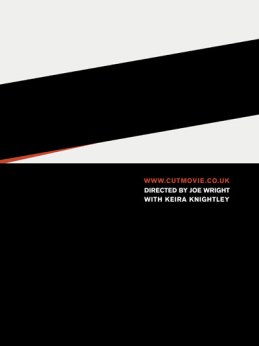
You’ve surely heard of Dr. Horrible’s Sing-Along Blog, the project Joss Whedon created during the infamous US Writers’ Strike. (That in itself you could debate the status of. Three-part miniseries? Short film? Feature film? (At 42 minutes it’s over the Academy’s boundary.) And endlessly on.) Well, on the Dr. Horrible DVD can be found this — an alternate audio track, on which the cast and crew discuss the making of the feature… except it’s all scripted and the majority is sung. Not your traditional audio commentary then.

As an audio commentary, it does little to illuminate the production of Dr Horrible — though, surprisingly, it does do some — but instead focuses its energy on spoofing commentary tracks, DVD extras, and the American film and TV industry in general. Specific targets include the Writers’ Strike and its lack of success, rivalry between lead actors, the importance of ensemble cast members, Asians in US TV and film, the dissection of art by DVD extras, and many more. It’s almost all incredibly funny — inevitably there are a few duff gags and dull songs, although they are uncommonly rare — and it moves at a rate of knots, meaning it rewards multiple listens to pick up every gag. Having already re-listened to a couple of tracks, I can attest to noticing funny lines that I was too busy laughing through before. In a spot of technical impressiveness, the commentary is often surprisingly scene-specific, sometimes even shot-specific. When you consider the effort that must’ve been involved to script and time both songs and spoken dialogue to make this happen, it’s even more impressive.

It’s this careful scripting and the sure-handed attentiveness to theme that marks Commentary! The Musical out as a fictional work in its own right, rather than ‘merely’ a DVD extra, in much the same way that Mystery Science Theater 3000 or the short-lived (and easily forgotten) Rob Brydon series Director’s Commentary are original works. With its well-targeted thematically-appropriate comedy and plentiful gags, it’s pure delight for fans of DVDs, or anyone else with a mind open to the concept.

5 out of 5

Cut (2009)

2009 #20a
Joe Wright | 2 mins | streaming

CutIs Cut an advert or is it a film?

On one hand, websites featuring it always refer to it as a “short film”; it stars film star Keira Knightley; is directed by BAFTA-winner Joe Wright; tells a story in a film (as opposed to advert) style; and is a whole two minutes long.

On the other, it’s paid for by Women’s Aid to front a campaign to raise awareness of domestic violence; it ends with a message to this effect, also featuring no title card or credits; it’s not listed on IMDb; it’s been shown for free among adverts in cinemas and online; it would’ve appeared on TV too if Clearcast hadn’t banned it for being “too violent”; and it’s only two minutes long.

It’s an advert, isn’t it? But it shouldn’t’ve been blocked from TV, which has incensed me enough to pretend it’s a film for the purposes of my little corner of the Internet.

Or half pretend, because purely as a film it isn’t great. It’s well shot by Wright, but some of the dialogue is too on-the-nose to convince and it’s actually slightly padded near the start — so slightly that in anything longer it wouldn’t be noticeable, but when something’s only 125 seconds, every one counts. On the other hand, it tells its story economically, using single shots to establish a lot of detail about characters, their lifestyles and their relationships, aided by Knightley playing a version of herself. In this the length and depth of story chosen are well-balanced.

When the violence comes, it’s moderately brutal. And here’s the rub — it’s arguably not brutal enough to cover the horrid reality of what some people have to suffer. It’s been made suitable to be shown on TV in a slot where people will see it — which, for its aims as an awareness advert, is completely appropriate. In the wake of Clearcast’s stupid ban I was expecting something more severe, which counterintuitively means the violence is more shocking for what it isn’t. Maybe whoever makes the decisions at Clearcast should watch Hostel: Part II before any appeal — or, to be honest, the 12A-rated Dark Knight might suffice.

With a brief running time and an important message to put across, Cut is a 5-out-of-5 advert, if only for the amount of talk and awareness it’s achieved. But I said I was trying to judge it as a film, so I’ll be a little tighter:

4 out of 5

Cut is available to stream for free on YouTube. More information about the campaign’s impact can be found on Wikipedia.

The Many Adventures of Winnie the Pooh (1977)

2008 #92
John Lounsbery & Wolfgang Reitherman | 71 mins | DVD | U / G

The Many Adventures of Winnie the PoohHaving finished 2007 with Piglet’s Big Movie, it feels somewhat appropriate to round off 2008 (almost) with Disney’s first Winnie-the-Pooh feature.

The Many Adventures… is actually compiled from three shorts made in 1966, 1968 and 1974, with some new linking material. I don’t know if these shorts were produced with any great expense, but there’s occasional evidence of what looks like cheap animation. It’s not that it’s not smooth or fluid, but rather the attentive viewer will often spot sketch marks around some lines, or flashes of other bits not properly erased. Perhaps it was deliberate, considering the sketchy style of the backgrounds, designed to evoke the original illustrations, but I sometimes found it distracting.

This is one relatively minor flaw in an otherwise brilliant adaptation, however. The film faithfully adapts several of the original stories, acknowledging its sources by frequently showing the action as illustrations within a copy of the book. This fourth-wall-breaking move may irritate some, but personally I loved seeing Pooh and co have to leap from page to page, or tipping the book sideways to free Tigger from a tree. Such moves seem tonally in keeping with A.A. Milne’s original stories and, even though some tales are abridged and some good ones left out, that spirit is always retained.

The characterisation is also spot on, producing an array of cute and loveable creations, none more so than Pooh himself. The gopher is an unnecessary addition, though the running joke about him not being in the book is very nicely done. And one can’t fail to mention the excellent songs, now as linked to the world of Pooh as anything from the original books — especially Tigger’s little tune, surely familiar to anyone who was a child in the last 30 years.

If some later Disney ventures have lost sight of the correct spirit for Pooh’s adventures, at least this original is a great adaptation. Bouncy, trouncy, flouncy, and, above all, fun fun fun fun fun.

5 out of 5

Wallace and Gromit in A Matter of Loaf and Death (2008)

2008 #88a
Nick Park | 29 mins | TV | PG

Wallace and Gromit are phenomenally popular, as proven this Christmas Day when their latest adventure became the most-watched programme on British TV for three years (and that was just the overnights — ratings will rise when official figures are released in a couple of weeks). Not only that, but the TV premiere of their big screen adventure also made the Christmas Day top ten, a not insignificant feat. Popularity does not necessarily mean quality, of course, and in this case such figures come on the back of three popular shorts and a successful feature film. They were all extremely good too and, luckily, A Matter of Loaf and Death doesn’t let the batch down. (I feel there should be a better baking pun there…)

As ever it’s packed with inventive humour, both visual and verbal, and Gromit remains one of the finest silent comedy characters ever created. The amount of emotion and story that can be conveyed with a lump of plasticine is tribute to the abilities of Park and his team of animators. The rest of the creation is top notch too, not just in terms of impressive craft on characters and sets, but also in the use of lighting and camera angles to evoke other films while not losing the series’ individuality. If anyone still thinks stop motion is about a locked-off camera at a flat angle they are sorely mistaken.

Film fans will also delight in a slew of movie references, from a poster for Citizen Canine to an Aliens-inspired climax, and numerous even subtler ones in between. This is a feast that will undoubtedly reward seconds — and more.

If there’s one problem it’s that it’s too short. I don’t mean that in the usual “I just want more” way, but literally that it could perhaps do with being longer. There’s easily a feature-length story here, meaning it feels a little abridged as a half-hour short. It’s not rushed, thankfully, just not played out as effectively as it could be with double the running time.

The last three Wallace & Gromit adventures have each won Park an Oscar (and the first only lost out to Park’s own Creature Comforts). Will this bring the series’ fourth? It would certainly be deserved.

5 out of 5