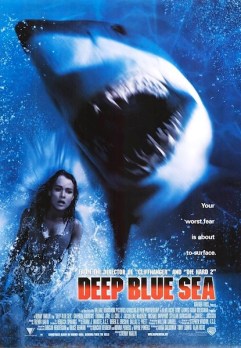
Deep Blue Sea (1999)

2016 #138
Renny Harlin | 101 mins | streaming (HD) | 2.35:1 | USA / English | 15 / R

Deep Blue SeaDeep Blue Sea is Terence Davies’ adaptation of Terence Rattigan’s play about the wife of a judge getting caught in a self-destructive love affair with an RAF pilot.

No, wait, sorry — that’s The Deep Blue Sea. The non-definitive-article version is a sci-fi action-thriller about a research facility that’s created hyper-intelligent sharks which escape and try to kill the scientists. So pretty similar movies then, really. This one was thoroughly slated on its initial release, so I spent a good long while completely ignoring it, but at some point in the last few years it seems to have become a guilty pleasure favourite for many. Does it merit this reappraisal?

There is definitely a level of “so bad it’s good” about it. It’s definitely not a good movie in the traditional sense, but it is fun; and unlike, say, Armageddon, it’s clearly not taking itself too seriously. Nicely, it gets by without the constant winks-and-nods at the audience you get in today’s deliberately-trashy genre movies, which is, bizarrely, a more mature way to handle this kind of material.

Plus, it’s from that tipping point in modern film history between practical effects and CGI, so there are some nice stunts and life-size animatronic sharks, but also some weak computer graphics. That said, because director Renny Harlin limits the CG to underwater sequences, some of the sins are covered. Or put another way: it’s not great, but it still looks better than Sharknado. (That might seem like damning with faint praise, but this is 1999 we’re talking about — still two years before The Mummy Returns and its CG The Rock abomination that someone thought was OK to release in a big-budget summer tentpole.)I'm sure he just want to be friends

Ultimately, it’s a hard movie to rate. On the one hand, it’s not particularly good; on the other, with a mix of not taking itself too seriously and a few so-bad-it’s-good moments, it becomes a fun watch. I err towards generosity because, while it’s not a ‘quality’ movie, it is an enjoyable way to spend a couple of hours.

3 out of 5

Armageddon (1998)

2016 #133
Michael Bay | 145 mins | streaming (HD) | 2.35:1 | USA / English | 12 / PG-13

ArmageddonSometimes you have to wait to see a film because it’s not accessible for some reason (no one’s put it out yet, or it’s out of print and costs a fortune, or whatever). Other times… maybe it’s just me, but there are some films that I wait years to watch for no particular reason. Not wait in the sense of “drumming my fingers waiting for the chance”, but in the sense that I’ll get to it someday, it’s just not a priority, for whatever reason. And then one day, with nothing apparently having changed, the time comes when it’s that movie’s turn.

So it was for me with Armageddon, Michael Bay’s 1998 sci-fi disaster epic. It’s a film I’ve been aware of since it came out (how could you not be?) but never cared enough to actually watch, other than a general feeling I’d get round to it one day because (a) it’s the kind of movie everyone else has seen, and (b) when Michael Bay’s good, he is good (at what he does), so it’s at least worth a look. It’s a pretty readily available film — the kind of thing I regularly see in TV listings or on streaming services and consider watching and end up deciding “nah, not today” — so quite what made me finally watch it now — what made me see it in a list and go “actually, yes, today” — I’m not sure. Such are the mysteries of life. Or of my brain, at any rate.

For the few people who haven’t seen it, then, it’s about a giant asteroid heading towards Earth, where its impact will cause an extinction-level event, and NASA deciding the only way to stop it is to send up a couple of spaceships to land on the asteroid, drop nukes inside, and blow it up (it’s a Michael Bay movie, of course the solution is “blow it up”). To learn about the kind of deep drilling this would require, they bring in the best driller around, Bruce Willis, to train the astronauts. But drilling isn’t something you can learn in a couple of weeks — unlike “how to be an astronaut”, apparently, because it’s decided it will be easier to train drillers to be astronauts than train astronauts to use a drill.

At least they know which way space isIf you’re a reader from outside the UK, I guess you’ve probably not heard of Tim Peake. He’s (quite rightly) been big news here for the last year or so because he was our first (official) astronaut. That it’s taken until now for there to be a British astronaut seems remarkable, but there you go. I guess we always let other people do the initial exploring, then come along later to own the place — I mean, that Columbus fella was Italian, and is Italian the official language of America? No it is not. Anyway, Peake is a qualified helicopter pilot and instructor, has a degree in Flight Dynamics and Evaluation, was selected to be an astronaut in a process that involved academic tests, fitness assessments, and several interviews, and then received six years of training, including a mission as an aquanaut, before he went into space. But no, you can totally train a group of drillers to do that in a fortnight.

Many Hollywood blockbusters have ludicrous concepts, but Armageddon feels designed to plow new furrows of ridiculousness. Apparently NASA show the film to new managers and ask them to spot the errors. There are at least 168. It only takes a few minutes before it’s already so OTT that it seems like a spoof of Bay — I mean, the title card explodes for crying out loud. When the president makes a speech just before the launch, the quaint shots of the world listening in make it look like the film’s set in the 1950s. Despite being a full two-and-a-half hours long, Bay manages to make the whole film feel like a plot-summarising montage. The average shot length must be Moulin Rouge-level crazy, though where that film weighs super-fast-cut scenes against more measured ones, I think Armageddon is out-of-control-freight-train fast for every last second. Bay is so impatient, the credits start rolling before the film has even finished! And why the fuck does the drilling vehicle have a fucking great machine gun on it?!

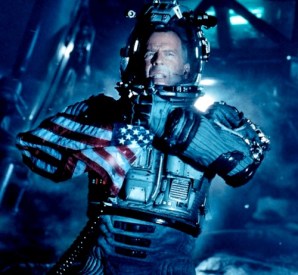
Bruce Willis flashesApparently Michael Bay thinks it’s his worst film. In 2013, he said, “I will apologise for Armageddon, because we had to do the whole movie in 16 weeks. It was a massive undertaking. That was not fair to the movie. I would redo the entire third act if I could.” The problems stretch further than that, Michael.

Believe it or not, it’s not all bad. The bit where Bruce Willis’ life flashes before his eyes is actually really good — ten seconds of artistic moviemaking in a 150-minute movie! Visually it looks great throughout, meaning DoP John Schwartzman is possibly the only person who comes out of the whole thing entirely unscathed. The special effects are excellent for 1998. I thought Independence Day’s were still effective when I re-watched it earlier this year, but Armageddon’s feel much less dated, and it was only made two years later. As an effects showcase, it absolutely still holds up today. That said, the top of the Chrysler building falling off, complete with plummeting screaming people, is considerably less palatable since 9/11. And just a minute later there’s a shot of the World Trade Center with burning holes in it. It’s a wonder it hasn’t been re-edited to remove those shots, especially as it’s a Disney-owned movie and they have a history of self-censoring stuff that is no longer considered acceptable.

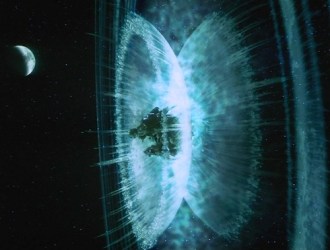
Armageddon was, famously, released the same year as Deep Impact, which I watched many years ago but remember as a character-driven drama about an asteroid threatening the end of the world. Armageddon’s action-packed bluster was more successful at the box office, of course, but Deep Impact was the more mature movie. SPACE EXPLOSION!Maybe I’m wrong — it has a lower rating on IMDb. But then, that is IMDb. I should probably watch it again, but even without doing that I feel pretty confident saying it’s the better film.

If Michael Bay knew he was making a comedy, Armageddon might be a great movie. But he didn’t. While it’s definitely bad, I did kind of enjoy it… but mainly to laugh at. Make of that what you will.

2 out of 5

Pixels (2015)

2016 #88
Chris Columbus | 102 mins | streaming (HD) | 2.35:1 | USA, China & Canada / English | 12 / PG-13

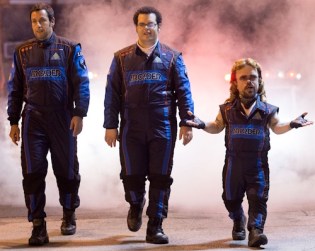
PixelsAdam Sandler, eh? He has his fans, though apparently not among people who can write because you rarely see a good word penned about him. The one exception is Punch Drunk Love, and that’s because it’s a Paul Thomas Anderson film, and that’s why it’s the only Adam Sandler film I can remember seeing. I didn’t like it.

So why did I watch Pixels, which was as poorly received as Sandler films always are? Good question. It had a good deal to do with the short being good (I reviewed it back in 2010), and being intrigued how that concept — which makes a neat three-minute visual idea but doesn’t have any plausible narrative potential — could be converted into a full-length feature. Of course, a daft idea for a film, plus Adam Sandler, plus bad reviews — plus weak trailers — doesn’t add up to a recipe for success. To my surprise, then, I largely enjoyed it.

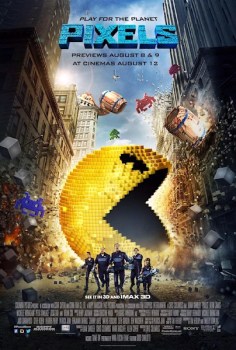
The plot sees aliens intercept signals from classic arcade games and believe they are a declaration of war, and so attack Earth in the form of said games made real. The best person to stop them is cable guy Adam Sandler, who used to be a video game wunderkind, and is fit for the job mainly because the President of the United States is his best mate — that would be Kevin James, as the unlikeliest US President in history. They also rope in Sandler’s old gaming rival, Peter Dinklage, and are chaperoned by Michelle Monaghan’s Lieutenant Colonel, who doubles up as a love interest for Sandler (of course). Later, Sean Bean and Brian Cox slum it in inexplicably small roles.

Arcade heroesPixels is the virtual definition of brain-off entertainment. The story has the plausibility of a kids’ daydream, the humour is frequently unimaginative, and the action sequences mostly coast on their basic concept rather than trying to elevate them. And Peter Dinklage is going to get a reputation for having terrible taste. I mean, I liked Knights of Badassdom, but hardly anyone else did, and now this… “Stick to TV, Peter Dinklage,” people are going to say. Assuming they’re not already.

But for all that mediocrity, I spent 100 minutes feeling gently entertained. I laughed a few times; the action was, as I say, passable; and there’s a bit in the Donkey Kong-themed climax with a remix of We Will Rock You that I rather liked. I don’t imagine I’d ever look to watch it again, but for a completely undemanding time-filler, well… (Nothing like damning with faint praise, eh?)

3 out of 5

Westworld (1973)

2016 #155
Michael Crichton | 89 mins | streaming (HD) | 2.35:1 | USA / English | 15 / PG

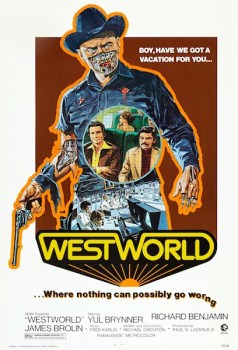
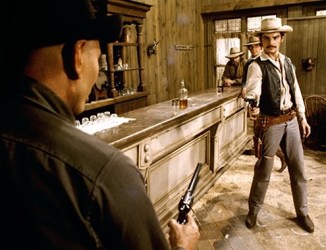
WestworldWhen writer-director Michael Crichton hit upon the notion of a theme park where the future-science star attractions broke free of their shackles and endangered the lives of the guests, it was so good it served him twice: he replaced the initial murderous AI-powered robot cowboys with rampaging genetically-engineered dinosaurs and sparked a multimedia franchise of enduring popularity. His first attempt hardly faded into obscurity, mind, bedding in as a minor sci-fi classic that HBO has now seen fit to reboot as a TV series, which premiered on Sunday in the US and debuts in the UK tonight. I think this new version may be most welcome, because Westworld has a great concept but, when it comes to the original film, that’s almost all it has.

Set in the near future, the film follows two friends (Richard Benjamin and James Brolin) as they visit an amusement park where you can live for a time in thorough recreations of either ancient Rome, medieval Europe, or the old West. It’s an immersive experience where you’re kitted out with era-appropriate clothing, stay in authentic lodgings, and the staff really believe it all — because they’re robots who’ve been programmed to do so, distinguishable from humans only by their imperfect hands. The film follow the chums through this process and the fun they have pretending to be gunslingers, though one of the robots (Yul Brynner, done up as the spit of his character from The Magnificent Seven) seems repeatedly antagonistic towards them, and, behind-the-scenes, the repair staff are baffled by some robots’ out-of-character actions.

Westworld doesn’t even reach the 90-minute mark, but even then there isn’t quite enough story to fill the running time. There’s a big dose of wish fulfilment in seeing Benjamin and Brolin getting to just enjoy the park — wouldn’t it be cool if this was real? Wouldn’t you want to go there? Though the price tag would put most people off: it’s $1,000 a day, which, factoring in inflation from 1973, means a two-week stay would now cost a little Face off, mk.1under $76,000, or about £58,200. The potential threat of the robots malfunctioning is built up gradually here and there, in asides from what our ostensible heroes are up to, and isn’t explained. There are nods to the fact the human staff don’t actually know how the robots work, but why should that be? Some of them were apparently designed by other robots, but how did the designing robots come about? Rather than explore any of its science fiction themes, the film just uses the basic idea to have the robots go on a killing spree right at the climax. This is something Crichton definitely turned around for Jurassic Park, where how it was done is explained and debated… and then the creations go on a rampage. Best of both worlds, that.

So this is where there’s space for HBO’s new version. I haven’t read too much about it (avoiding spoilers ‘n’ that), but given the long-form needs of TV I’m presuming it’s going to dig into the science a bit more. Co-creator Jonathan Nolan has already demonstrated an interest in the whys and wherefores of artificial intelligence through his last TV series, Person of Interest (which I’ve discussed in several of my monthly TV overviews), so I’m presuming it’s going to take Crichton’s broad idea but then be a little bit Ex Machina: The Series as well. Sounds good to me. Maybe this will be a reboot that pays off, because while the original film does offer Crichton’s superb concept, plus a few straightforward action/suspense thrills, it’s too slight to really deliver on the inherent promise.

3 out of 5

The new Westworld starts on Sky Atlantic at 9pm.

The Rocky Horror Picture Show (1975)

100 Films’ 100 Favourites #76

Give yourself over to absolute pleasure.

Country: UK & USA
Language: English
Runtime: 100 minutes
BBFC: AA (1975) | 15 (1987) | 12 (1991)
MPAA: R

Original Release: 15th August 1975 (UK)
First Seen: TV, 31st December 1998

Stars
Tim Curry (Annie, Clue)
Susan Sarandon (The Front Page, Thelma & Louise)
Barry Bostwick (Weekend at Bernie’s II, Spy Hard)
Richard O’Brien (Flash Gordon, Dark City)
Meat Loaf (Roadie, Fight Club)
Charles Gray (The Devil Rides Out, Diamonds Are Forever)

Director
Jim Sharman (The Night, the Prowler, Shock Treatment)

Screenwriters
Richard O’Brien (Shock Treatment, Digital Dreams)
Jim Sharman (Shirley Thompson Versus the Aliens, Shock Treatment)

Based on
The Rocky Horror Show, a stage musical by Richard O’Brien.

Music & Lyrics
Richard O’Brien (Shock Treatment)

The Story
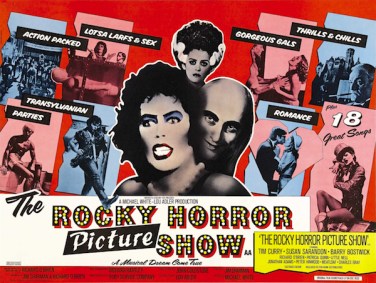
When straight-laced young couple Brad and Janet approach a spooky castle in need of shelter, they stumble into the strange world of Dr. Frank-N-Furter, who’s throwing a party to celebrate the ‘birth’ of his new creation: a tank-grown muscleman named Rocky. But it’s not only Rocky who’ll be getting an awakening…

Our Heroes
Good clean all-American kids Brad and Janet, newly engaged but forced to stop off at a creepy castle after their car breaks down in a storm. By the end of the night, they’ll certainly have learnt a new thing or two…

Our Villains
Dr. Frank-N-Furter — not much of a man by the light of day but by night he’s one hell of a lover. Just a sweet transvestite from Transexual, Transylvania, which would be fine if he didn’t get a bit murderous. Surrounded by a gaggle of home help and hangers-on, like hunchbacked handyman Riff Raff, mental maid Magenta, and vaudevillian groupie Columbia.

Best Supporting Character
Charles Gray is perfect as The Narrator, holed up in his wood-panelled study and telling the audience this fantastical story with admirable matter-of-factness.

Memorable Quote
“Let’s do the time warp again!” — everyone

Quote Most Likely To Be Used in Everyday Conversation
“I see you shiver with antici…

…pation.” — Dr. Frank-N-Furter

Memorable Scene
The title sequence: the opening number sung by a pair of very big, very red lips. Simple, but iconic.

Best Song
Rocky Horror is one of those musicals where almost every song is genius: the cleverly reference-filled, surprisingly melancholic, bookending refrain of Science Fiction/Double Feature; the wittily rhymed Dammit Janet; the mission statement that is Sweet Transvestite; the sweetly kinky Touch-A, Touch-A, Touch Me; the epic multi-part floor show climax… and more. That said, I always disliked the post-climax Super Heroes, and wasn’t alone: it was actually cut out of the original US release. But then I heard Richard O’Brien sing it with acoustic guitar on the DVD special features, and in that variation it’s a darkly beautiful song. But for all that, when talking about the best song in Rocky Horror you really can’t beat the utterly iconic Time Warp.

Making of
Many films have “Easter eggs” — little half-hidden treats for fans to discover — but not many have them literally. The exception, of course, is Rocky Horror. Apparently the crew had an Easter egg hunt (which, considering the movie was shot from October to December, doesn’t make much sense) but they weren’t all found, hence why some turned up in the final film. I won’t tell you where they are (I mean, five seconds on Google and you can find out), but there are supposedly three.

Next time…
Initially a flop, it was when someone got the idea to screen the movie for the midnight crowd that Rocky Horror caught on. The interactive, ritual-filled experience of these screenings is legendary, and they’ve continued ever since — to the point where some cinemas have it as part of their regular schedule, and the DVD & Blu-ray releases include alternate tracks featuring the audience participation. It also means that, officially speaking, Rocky Horror has the longest theatrical run in movie history. In 1981, Sharman and O’Brien produced a sort-of-sequel, Shock Treatment. A new adventure for Brad and Janet (both recast), it featured several Rocky Horror actors (O’Brien, Patricia Quinn, Little Nell, Charles Gray) in new roles. It didn’t go down very well, though apparently it has its fans — a cult following within a cult following, I guess. In 2010, once-popular high school musical TV series Glee aired a tribute episode, The Rocky Horror Glee Show. It is truly horrendous; a plasticky, sanitised, neutered version of something that should never be those things. So I don’t hold out much hope for the next thing the same network (Fox, of all places!) have planned for the property: after years (decades?) of rumours, they’re finally making good on the threat by remaking the film. Officially dubbed The Rocky Horror Picture Show: Let’s Do the Time Warp Again, the clips released so far look almost as bad as the Glee version. We’ll see. Finally, the original stage show has continued across numerous productions, and last year a 40th anniversary gala performance was simulcast to cinemas across Europe and later aired on TV. It’s now available on YouTube. I’ve not watched it, but I suspect it’s a better bet than that Fox version.

Awards
1 Academy of Science Fiction, Fantasy & Horror Films Golden Scroll nomination (Best Horror Film (it lost to Young Frankenstein))

What the Critics Said
Rocky Horror is actually a very good film in its own right; made on a small budget, it’s a triumph of clever filmmaking by Sharman, who should have gone on to bigger things (and might have, had he not arrived at the end of an era). Yes, there are little technical glitches, but rarely has there been a more cleverly and creatively shot and edited film. Nearly every angle, every cut, every zoom shot, every optical transition is used to effectively maximize its respective scene. […] Remember the cult status, yes, but sometime try watching Rocky Horror just as a movie. It pays real dividends.” — Ken Hanke, Mountain Xpress

You What?
“Viewed on video simply as a movie, without the midnight sideshow, it’s cheerful and silly, and kind of sweet, and forgettable.” — Roger Ebert, Chicago Sun-Times (Rocky Horror is many things, but “forgettable”? Hm.)

Score: 80%

What the Public Say
Rocky Horror is so distinctive, so unique, that it could’ve come off as bizarre, alien, and off-putting, but it didn’t. It has such self-aware charm, a catchy soundtrack that sticks in the head for days, and hilarious performers, that it overcomes its rather dull protagonists. Of course, Brad and Janet have their own charm as parodies of the square-jawed hero and his girl, but they will always be the least interesting characters on screen.” — That Other Critic

Verdict

Some people dismiss Rocky Horror as a film, thinking its only worth (if they acknowledge it has any) is as a live experience. I’ve never seen it ‘live’ (and don’t have an especially great desire to) but will happily fight its corner as a solo viewing experience. It’s camp and transgressive, but ‘safely’ so — that’s not a criticism, just an observation that it can work well as an eye-opener for the young or more conservative. But beyond that social impact, the outré style belies an underlying cleverness, with witty writing that features abundant references to sci-fi B-movie classics, precisely pitched performances, and, of course, the unforgettable toe-tapping tunes. Whether alone or in a packed auditorium throwing stuff and shouting back at the screen, it’s just fun. To watch it is to, indeed, give yourself over to absolute pleasure.

#77 will be… the greatest love story the world has ever known.

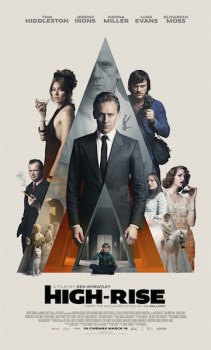
High-Rise (2015)

2016 #123
Ben Wheatley | 119 mins | Blu-ray | 2.40:1 | UK & Belgium / English | 15 / R

High-RiseI was looking forward to this sci-fi-ish ’70s social satire, but, having let it percolate for a few months, I still have no real grasp of what it was about. I mean, it’s obviously about society, but what its point about society is… I have no idea.

I will add it reminded me of Shivers. I didn’t like Shivers.

Technical merits are first rate — it’s magnificently designed, shot, and edited; a visual delight throughout. Plus it finds two fantastic uses for Abba’s S.O.S. But at a full two hours, pleasant aesthetics are slight sustenance.

Not so much disappointing as indecipherable.

3 out of 5

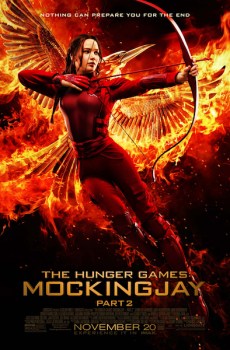
The Hunger Games: Mockingjay – Part 2 (2015)

2016 #59
Francis Lawrence | 137 mins | Blu-ray | 2.40:1 | USA & Germany / English | 12 / PG-13

The Hunger Games: Mockingjay - Part 2The artificially-extended Hunger Games trilogy-turned-tetralogy climaxes here. Presumably you’ve seen the first three and so know what you’re into by this point — either you’re invested or you’ve given up. Unless you want to know “does it end well?” before embarking on the whole thing, of course. While Mockingjay Part 2 is not the series’ finest instalment, it brings things to a decent head… eventually.

In my review of Mockingjay Part 1, a film much criticised for feeling like half of a whole — or, rather, half of a part of a whole — I argued it does actually function as a film in its own right. I mean, all of these films are part of one long narrative, so that’s par for the course, and I didn’t feel like Mockingjay Part 1 was any less a ‘standalone’ chunk of that narrative than the two films that preceded it. Specifically, I asserted that “the focus on using Katniss as no more than a propaganda figurehead… has been fully explored — and so I think this instalment will feel much more like a fully-fledged film in its own right if they just move on. I hope the final film give us new themes, new subplots, new arcs to follow”.

With that in mind, Part 2 begins with a degree of disappointment, as it tackles some propaganda-related holdovers from the last movie. Maybe I was putting too much stock in the idea of them moving on from that theme and establishing something new, though — especially as it does soon do that anyway. What develops is a “men on a mission” war movie, as Katniss and a small band of soldiers make their way through the deserted-but-boobytrapped Capitol on a mission to assassinate President Snow.

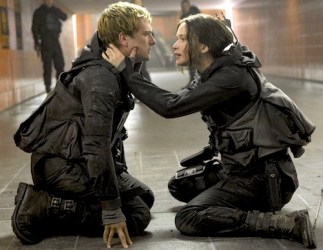
K and P, nutsWhat follows isn’t perfect — in particular, the storyline could’ve done with tightening up — but it does have a lot going for it. There’s strong characterisation: Katniss is as confused, conflicted, and incapable of engaging with her emotions as ever, while Peeta’s PTSD is well-handled, with an effective device where he repeatedly makes a statement before asking, “real or not real?” There are other nicely developed thematic points too, like expanding further on the rebels not being perfect good guys (as initiated in Part 1), which plays a central role in the denouement. The action sequences are well staged and occasionally inventive, but best of all is that the climax doesn’t lean on being the biggest fight scene yet — it’s driven by the story, and the characters and their decisions, rather than being a ginormous shoot-out.

Speaking of the film’s finale, complaints that the endings go on too long bug me, just as they bug me when people bring it up about Lord of the Rings. In both cases, you’re getting a capstone to a 9+ hour saga, not the 2- to 3-hour section of it you just watched. Rings’ endings feel completely suitable if you watch all 12 hours of the extended editions in one sitting, and I’d wager Hunger Games’ do too. Rush it and you end up with something like Harry Potter’s finale, which comes to a crushing thud of an ending as soon as the battle is won. What both Rings and Hunger Games are doing, actually, is showing that these characters are people who exist outside of the context of their war. They’re not just combatants, who evaporate into thin air once the battle’s lost or won; they’re people who have to either return to their old lives or establish new ones.* It’s a richer, more realistic, more human way to end a story than “plot’s over, action sequences are finished — we’re done here!”

Ready for the endMockingjay Part 2 is not the best instalment of the Hunger Games, a series whose second half didn’t quite live up to the developed potential of the excellent Catching Fire. That said, I think it largely works as a whole, with conflicted and complicated characters living in a world that initially seems straightforwardly dystopic but develops many moral greys. That’s particularly welcome from a Young Adult series, a sort-of-genre where some of the most famous examples are lacking in intellectual — or (considering the target audience) educational — heft. In fact, based on the scores and comments I’ve seen on some websites, Mockingjay Part 2 may yet turn out to be the most underrated of the Hunger Games films.

4 out of 5

The Hunger Games: Mockingjay – Part 2 is available on Netflix UK as of this week. Mockingjay Part 1 is also on there; the first two films are not.

* Potter does do the “back to a life” thing, but the details of it are found in ancillary texts. ^

Return of the Jedi (1983)

100 Films’ 100 Favourites #73

Return to a galaxy far, far away.

Also Known As: Star Wars: Episode VI – Return of the Jedi

Country: USA
Language: English
Runtime: 132 minutes | 135 minutes (special edition)
BBFC: U
MPAA: PG

Original Release: 25th May 1983 (USA)
UK Release: 2nd June 1983
First Seen: VHS, c.1990

Stars
Mark Hamill (The Empire Strikes Back, The Guyver)
Harrison Ford (Indiana Jones and the Last Crusade, Patriot Games)
Carrie Fisher (The Empire Strikes Back, The ‘Burbs)
Anthony Daniels (The Lord of the Rings, Star Wars: Episode I – The Phantom Menace)
Peter Mayhew (Star Wars, Comic Book: The Movie)

Director
Richard Marquand (Eye of the Needle, Jagged Edge)

Screenwriters
Lawrence Kasdan (Raiders of the Lost Ark, Silverado)
George Lucas (American Graffiti, Star Wars: Episode III – Revenge of the Sith)

Story by
George Lucas (Indiana Jones and the Temple of Doom, Radioland Murders)

The Story
As the Galactic Empire construct a new Death Star, Jedi-in-training Luke Skywalker — the Rebel Alliance’s best hope of defeating the evil Darth Vader — is busy rescuing his friend Han Solo from the clutches of crime lord Jabba the Hutt. Meanwhile, the powerful Emperor waits, intending to convert the young Jedi to the Dark Side…

Our Heroes
Luke Skywalker: Jedi Knight.
Han Solo: defrosted resistance captain.
Princess Leia: sister, love interest, bikini-wearer. Is it just me or does Leia get a pretty poor deal as the trilogy goes on?

Our Villains
Quite possibly the greatest villain ever created for the movies, Darth Vader. Here he’s on an arc of redemption, so there’s also the Emperor, who has the appearance of a wizened old man but is strong in the Force. As Vader himself puts it, “the Emperor is not as forgiving as I am.” Uh-oh!

Best Supporting Character
R2-D2 is the best supporting character in every Star Wars film, but in this one we are introduced to Jabba the Hutt (well, unless you watched Episode I or the New Hope Special Edition first). A giant, fat, slug-like crime lord who is impervious to Jedi mind tricks and apparently has a fondness for metal bikinis, he’s as physically repulsive as are his methods and mores.

Memorable Quote
“Many Bothans died to bring us this information.” — Mon Mothma

Quote Most Likely To Be Used in Everyday Conversation
“It’s a trap!” — Admiral Ackbar

Memorable Scene
The speeder bike chase — arguably the best action sequence in the entire original trilogy. Considering this is a series of films that include three or four duels with frickin’ laser swords, that’s some feat.

Memorable Music
John Williams’ music is an essential part of the Star Wars experience. While no single tune in Jedi is as iconic as the Main Theme from A New Hope or the Imperial March from Empire, the overall score is as good as ever.

Technical Wizardry
The background plates for the speeder bike chase were captured by having a Steadicam (operated by the system’s creator, Garrett Brown) walked through a forest while filming less than one frame per second. When played back at regular 24fps, this 5mph stroll came out more like a 120mph hurtle. They spent three days filming to get enough footage for the whole sequence.

Truly Special Effects
These days, the answer to the question “how did they do that?” is “CGI”. Back in the ’80s, however, they had to be a bit more creative — leaving an abundance of achievements worthy of inclusion here. For example, the shot where the Imperial fleet spring their trap on the Rebels was the most complex matte shot ever attempted, with dozens of separate model elements having to be printed in. Or there’s the puppet work. Jabba was full-size, of course, and the 2,000lb costume was operated by four puppeteers: one for his right arm and jaw, another for his left arm and tongue, both of whom moved his body; another had a cable control to move the mouth and nostrils, using his feet to work bellows to simulate breathing; and the fourth moved his tail. Plus the smoke for when Jabba uses his pipe was apparently created by someone smoking a cigar and blowing it up a tube. For the Rancor, on the other hand, Lucas wanted to use a Godzilla-style man in a suit, but the tests didn’t work very well. The final result is not stop-motion, as you might expect, but an 18-inch rod puppet. Filming it was treated as a live-action shoot, though various techniques were used to conceal the methodology, like slow-motion or running the film backwards — anything they could think of to help remove the sense of “Muppet-ness”.

Letting the Side Down
When it comes to Lucas’ Special Edition fiddling, most people focus on the “Han shot first” complaint. Personally, I find the change at the end of Jedi — where Hayden Christensen has been pasted over Sebastian Shaw as Anakin’s Force ghost — more egregious. That said, the stupid song & dance number in Jabba the Hutt’s palace runs it a close second. On the bright side, the added shots of planets around the Empire celebrating the destruction of the Death Star helps aggrandise an otherwise low-key post-climax celebration.

Making of
So, that metal bikini, eh? What a blatant bit of fan service by that dirty old George Lucas! Well, apparently it actually came about because Carrie Fisher herself complained about her all-covering costumes in the first two films meaning you couldn’t tell she was a woman. Costumer Aggie Guerard Rodgers’ design was inspired by the work of famed fantasy artist Frank Frazetta, but whoever decided it should be made as such a rigid piece wasn’t thinking ahead: the solidness of the top meant it didn’t move with Fisher’s body, and she refused to use double-sided tape, so before each take someone from wardrobe had to (to quote IMDb) “ensure that her breasts were still snug inside the costume”. Nice work if you can get it. Nonetheless, several scenes had to be reshot due to what we now call “wardrobe malfunctions”.

The Ewok Line
To quote from the How I Met Your Mother Wiki, “The Ewok Line correlates the birth year of a person and the subsequent appreciation of Ewoks […] Those born on or before May 25, 1973 have a low appreciation of the film’s creatures, while those born after this date have an affinity for them. This is because those who saw the Ewoks in Return of the Jedi, which was released theatrically on May 25, 1983, who were 10 or under still loved their teddy bears, giving them an increased appreciation for the Ewoks.” I was born in 1986 and, yes, I love Ewoks. I mean, how can you not enjoy their silly mix of teddybear cuteness, gobbledegook language, and Empire-beating military competence?

Previously on…
Return of the Jedi picks up on the cliffhanger from The Empire Strikes Back, which of course continued the story of Star Wars. Many, many other films, TV series, novels, comic books, computer games, and whatever other media you can think of, take place before and around these movies.

Next time…
Ooh boy… Well, primarily: 16 years later, George Lucas returned to the world he created for the infamous Prequel Trilogy, finally filling in those missing first three Episodes. Chronologically, the saga picks up after Jedi with last year’s Episode VII: The Force Awakens, and will continue in Episodes VIII and IX. Aside from those main tenets, there’s an unimaginable mass of stuff in what’s known as the Star Wars Expanded Universe: TV series, novels, comic books, computer games, and anything else you can imagine — and it’s only going to continue growing in the future. Most of what was generated before Disney bought Lucasfilm may have been wiped out by whoever’s in charge now, but that doesn’t mean people don’t care about what went on in it. Of particular note is Timothy Zahn’s Thrawn trilogy of novels, which kickstarted the prominence of the Expanded Universe, and which many fans used to view as effectively being Episodes VII, VIII and IX.

Awards
1 Oscar (Special Achievement in Visual Effects)
4 Oscar nominations (Score, Art Direction-Set Decoration, Sound, Sound Effects Editing)
1 BAFTA (Visual Effects)
3 BAFTA nominations (Make Up Artist, Production Design/Art Direction, Sound)
5 Saturn Awards (Science Fiction Film, Actor (Mark Hamill), Costumes, Make-Up, Special Effects)
5 Saturn nominations (Actress (Carrie Fisher), Supporting Actor (Billy Dee Williams), Director, Writing, Music)
Won the Hugo for Best Dramatic Presentation

What the Critics Said
“The characters and dialogue get lost somewhere between the bug-eyed monsters and the exploding spaceships, but it is all so much fun it probably really does not matter a whole lot. […] Because so much of Return of the Jedi concentrates on makeup and special effects, and perhaps also because much of the dialogue (and acting) is so bad, it is pretty hard to get too involved with the characters, who came across with much more human interest in The Empire Strikes Back, the second of the movies. In a sense, the extraterrestrials are a lot more human than the people.” — Harper Barnes, St. Louis Post-Dispatch

Score: 80%

What the Public Say
“[A] thing I like about the scene in Jabba’s palace is the teamwork between all of the heroes in their mission to rescue Han Solo. It reminds me of a heist in way, since you got the droids, Chewbacca, Lando, Leia and Luke all working together and serving different purposes in rescuing Han. I also love the fact that the reason they are all working together is because they all care about Han. It just goes to prove that Star Wars isn’t just a huge spectacle but a story about family and friendship, which makes it a lot more personable.” — Jacob Bartley, Apocaflix! Movies

Elsewhere on 100 Films
I’ve written about the original Star Wars trilogy twice before, both times back in 2007. Of Return of the Jedi’s modified DVD version, I said that “there seem to be only minor differences or effects improvements here — it does make you wonder what the fans were kicking up such a fuss about”, and noted that “the speederbike chase is one of the trilogy’s greatest action sequences. And Ewoks are cute.” Then, treating the film as the sixth part of the saga, I wrote that it had “the biggest failing of the films as a single series: the prequel trilogy is endlessly obsessed with the prophecy about Anakin bringing balance to the Force; it isn’t mentioned once here. A dubbed line or added shot with Yoda saying something would’ve been nice.”

Verdict

Once upon a time I decided Return of the Jedi was actually my favourite Star Wars movie. I watched them again last year and changed my mind again, and wondered quite what I’d been thinking before. Jedi does have a lot to commend it, from multiple memorable set pieces to some effective character work with most of the principals, but it’s certainly not without its flaws, which have only been exacerbated by the prequel trilogy — as the climax to a mythic six-film saga, the finale of Jedi lacks some heft. Arguably it only reaches towards classic status by association with its two predecessors, but on its own merits it’s still an exciting space adventure.

#74 will be… six weeks on the road in the winter of 1931.

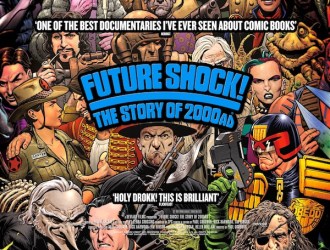
Future Shock! The Story of 2000AD (2014)

2016 #93
Paul Goodwin | 105 mins | TV | 1.78:1 | UK / English | 15

Future Shock! The Story of 2000ADTalking heads documentary about the galaxy’s greatest comic, 2000 AD, birthplace of Judge Dredd, Rogue Trooper, Strontium Dog, et al. Created to be somewhat subversive in a marketplace stuffed with safe children’s comics, it’s become a rare survivor of the medium on British newsstands.
Future Shock tells of the project’s birth, then the years when the US industry used the comic to scout talent, cherrypicking all its best creators. Today, it’s an influential institution that punches above its weight.

This is a pretty niche documentary, ultimately, but well-made and informative for those interested in comic book history and/or British culture.

4 out of 5

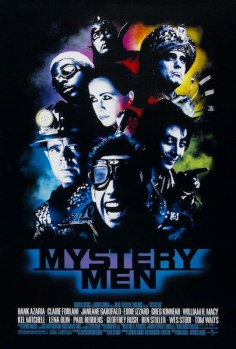
Mystery Men (1999)

100 Films’ 100 Favourites #65

They’re not your average superheroes.

Country: USA
Language: English
Runtime: 120 minutes
BBFC: PG (uncut, 1999) | PG (cut on video, 2000)
MPAA: PG-13

Original Release: 6th August 1999
UK Release: 26th December 1999
First Seen: DVD, c.2000

Stars
Ben Stiller (There’s Something About Mary, Night at the Museum)
Hank Azaria (Grosse Pointe Blank, Night at the Museum: Battle of the Smithsonian)
William H. Macy (Fargo, Magnolia)
Geoffrey Rush (Shine, Pirates of the Caribbean: The Curse of the Black Pearl)

Director
Kinka Usher

Screenwriter
Neil Cuthbert (Hocus Pocus, The Adventures of Pluto Nash)

Based on
The Mysterymen, a superhero team originally appearing in Flaming Carrot Comics, a comic book by Bob Burden.

The Story
When supervillain Casanova Frankenstein is released from prison, wannabe superhero Mr Furious overhears his plan to destroy reality. With the city’s genuine protector out of action, Mr Furious and his chums the Shoveler and the Blue Raja recruit a gang of other wannabes to defeat Frankenstein.

Our Heroes
They’re not your classic heroes, they’re the other guys: a ragtag gaggle of people with “powers”, like the Shoveler, who fights with a shovel, or Mr. Furious, who gets really angry, or the Blue Raja, who throws cutlery with great accuracy. These founding three are joined by Invisible Boy (Kel Mitchell), the Spleen (Paul Reubens), and the Bowler (Janeane Garofalo), and recruit the mysterious Sphinx (Wes Studi) to train them.

Our Villain
Criminally insane genius Casanova Frankenstein. Released from prison so that genuine superhero Captain Amazing had someone to fight, Frankenstein manages to capture his nemesis and plots to unleash the reality-bending Psycho-frakulator on the world — with only our inept heroes to stand in his way.

Best Supporting Character
Captain Amazing! Played by Greg Kinnear, the resident superhero of Champion City is too darn good at his job. With no crime left to fight, his corporate sponsors are pulling their funding — unless he can use his alter ego, influential billionaire Lance Hunt, to get one of his adversaries released…

Memorable Quote
The Shoveler: “If we had a billionaire like Lance Hunt as our benefactor…”
Mr. Furious: “That’s because Lance Hunt is Captain Amazing!”
The Shoveler: “Oh, here we go… Don’t start that again. Lance Hunt wears glasses, Captain Amazing doesn’t wear glasses.”
Mr. Furious: “He takes them off when he transforms.”
The Shoveler: “That doesn’t make any sense, he wouldn’t be able to see!”

Quote Most Likely To Be Used in Everyday Conversation
“We are number one. All others are number two, or lower.” — The Sphinx

Memorable Scene
Mr Furious, the Blue Raja, and the Shoveler gather at the latter’s house (despite his wife’s protestations) to audition potential team members. Cue a stream of daft and/or outrageous ideas for superheroes, including the Reverse Psychologist, Squeegeeman, and PMS Avenger.

Making of
For some reason a rumour has persistently done the rounds that Mystery Men was actually directed by Tim Burton, and Kinka Usher was just an alias. Goodness knows why. Usher is in fact a commercials director, and went back to that world after his miserable experience here.

Awards
1 Saturn nomination (Costumes)
1 Teen Choice Awards nomination (Choice Hissy Fit — it lost to Hanging Up. If you have any idea what Hanging Up is, your memory’s better than mine.)

What the Critics Said
“This slapstick and effects vehicle depends on poker-faced performances, production design that enhances the story partly because it doesn’t have to compensate for it, and a premise that provides seemingly inexhaustible opportunities for pratfalls and clever lines. The characters have been designed to make fun of themselves, disguising the craft of writer Neil Cuthbert and director Kinka Usher in getting us to laugh at them.” — Lisa Alspector, Chicago Reader

Score: 60%

What the Public Say
“this movie is incredibly underrated because it parodies other Superhero movies unbelievably well, and no one had the chance to see that 15 years ago. […] It does what any good parody does, by taking the expected and turning it on its head. How do other Superhero groups form? The government decides it’s a good idea to have a Supergroup. Or they all meet in some intergalactic prison. Or they form to protect the world from the Legion of Doom. None of them hold a barbecue. None of them have a female team member who kicks ass, speaks her mind, angers everyone, and wears real clothing. The movie takes every expected and turns it on its ass […] I believe if it came out this summer, or even in the fall, it would have a much bigger and better reaction. People would watch it and instinctively compare it to the other Superhero super groups they’re familiar with. It would resonate better now, and fans would have a chance to really laugh at the ridiculousness of Superheroes.” — Maria Spiridigliozzi

Verdict

Was Mystery Men ahead of its time? Coming out in 1999, it was a year ahead of the superhero revival that X-Men kickstarted. Or maybe it was behind its time? Visually, it’s on a par with other ’90s superhero efforts like Batman Forever (and I don’t mean that derogatorily). Either way, it’s an undervalued comedy. The ensemble cast are all perfect — I didn’t even have room above to mention Tom Waits as mad inventor Dr A. Heller, Eddie Izzard as henchman Tony P., or Claire Forlani as the love interest. The material they have to deliver is both witty and suitably silly, and it incorporates superhero tropes and references without relying on them. In the sub-subgenre of superhero comedies, all others are number two, or lower.

#66 never happened… to the other fella.