
Vincent Ward | 114 mins | streaming (HD) | 2.35:1 | USA & New Zealand / English | 15 / PG-13
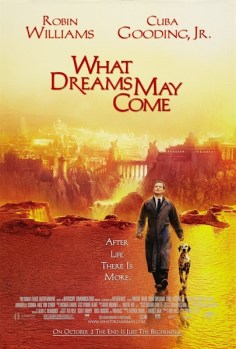 When What Dreams May Come first came out, the reviews seemed to conclude that it was rubbish, but at least visually splendid. Back in 1998, that put me off — “it’s not meant to be very good” was the takeaway thought there. As the years have gone on, for some reason those reviews (or possibly just one I extrapolated into a consensus, who knows?) stuck with me; and as my temperament as a film fan grew, that it was visually extraordinary (even if nothing else) began to seem reason enough to watch it. It lingered in the back of my mind, never quite becoming a “must see”, especially as the opportunity rarely (if ever) presented itself. So that’s more or less how I come to it now, 17 years since its release and those reviews — a long-awaited scratch of a long-lingering itch. (Perhaps this gives some insight into why/how it takes me so long to get round to watching recommendations/things I’m quite keen to see/etc.)
Adapted from a novel by Richard “I Am Legend” Matheson, the story concerns Dr Chris Nielsen (Robin Williams) and his wife Annie (Annabella Sciorra). Their perfectly lovely life is shattered when their two kids are killed in a car crash. Despite Annie suffering a mental breakdown, they hang in there… until Chris is killed in another car crash a few years later. He ascends to a kind of Heaven, a wondrous place controlled by his imagination — this is where those visuals come in. However, Chris learns that Annie has committed suicide, and so been condemned to Hell. He vows to do what has never been done, and travel to Hell to rescue her.
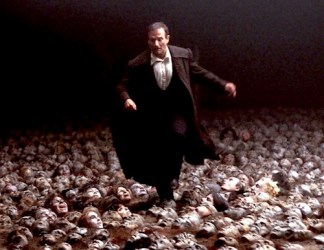 Hell, incidentally, also looks incredible, as do the various locales visited by Chris and his companions (played by Cuba Gooding Jr and Max von Sydow) on their way there. Director Vincent Ward and his team have created a rich, engrossing visual space here. It’s not just the Oscar-winning visual effects either, which create Chris’ initial realisation of Heaven as a kind of living painting, but also the locations, their decorations, and some fantastic sets. The design work is brilliant, and the vast majority of it still holds up today. Even the CGI doesn’t look glaringly like 17-year-old graphics, and in many cases what I presume is a mix of live action, models and some CGI is far more effective than the all-CG look it would likely have if made today.
However, the story is… problematic. Its logic comes and goes (the afterlife’s rules have to be obeyed or are able to be broken depending on the situation, for instance), it goes on too long, with too many asides, and there are needless twists, reveals, and reversals that are neither surprising (thanks to their ultimate predictability) nor illuminating (thanks to their unnecessariness). There were too many flashbacks and asides to real life, and I’d have liked it more if it stuck to the afterlife stuff — cut the flashbacks, limit the story to the afterlife quest, and stop mirroring it in the couple’s earlier real-life troubles. That would make the movie shorter, more streamlined, less wishy-washily sentimental, more focused, and therefore better.
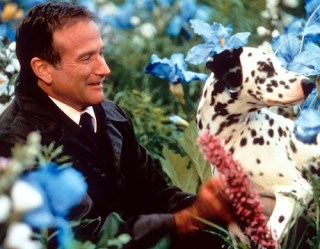 Nonetheless, some will identify with the sentimental “love transcends death”-type message more than others, and there’s a chance those who like (or don’t mind) their films to be at the soppier end of the spectrum will genuinely love it. For the rest of us — for anyone who likes visual splendour in their movies, anyway — it does indeed merit a look for the imagery alone.


 Score:



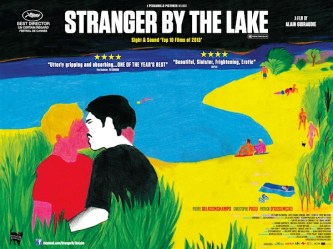 Iiiiiit’s the arthouse gay sex thriller!
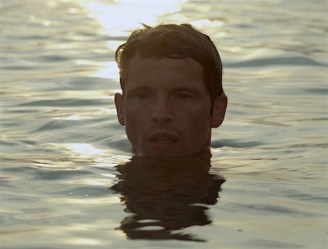 In this regard it has a very particular speed and style — even if there was a version without copious full-frontal male nudity and explicit sex, it still wouldn’t be for everyone. It helps to evoke both a certain time and place (lazy summer days on holiday) and a particular lifestyle (that of gay cruising — which, much to the (presumably straight) policeman’s bafflement, continues virtually unabated even after one of their number is murdered in unexplained circumstances). This is further emphasised by the gorgeous cinematography. Claire Mathon apparently shot it using only natural light, and it looks fantastic — understated (this isn’t a heavily-graded hyper-real kind of beauty), but sumptuous.
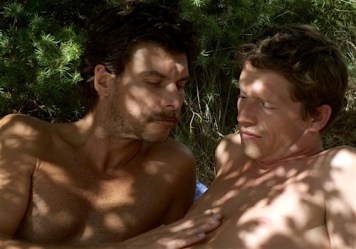 The style is supported by strong performances. I suppose some would say “brave”, by which they’d mean “they’re naked a lot and having gay sex”… so, I mean, maybe it is brave, but, still, that’d be a euphemistic description. What I mean is that they’re strong because they’re calm, understated, realistic, and believable without tipping over into amateurish. You feel Franck’s complex mix of fear and excitement, his lust overpowering common sense; there’s a certain timidity, maybe even naïvety, present in his eyes. Conversely, his lover Michel is unreadable; a closed book, where you never know what he’s thinking, feeling… plotting. Franck’s new friend Henri is similarly tricky to get an accurate handle on, but he’s the yin to Michel’s yang (or vice versa). He’s not plotting, he just is. Or maybe he was plotting all along…?
 This melancholic apocalyptic comedy wasn’t too well received, which is a shame because I thought it was absolutely brilliant.
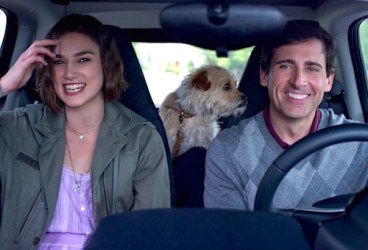 is an overwhelming sense of melancholy. It’s a hard feeling for films to evoke, I think — more complex than happiness or sadness, or excitement, or even fear. It comes to a head in an ending that actually brought a tear to my eye, a rare enough feat that it cemented a five-star rating.
 This is not a well-reviewed film —
  The only feature-length work of director Jean Vigo (though
  The romance is told in a way many describe as “poetic”, which seems to me to be something of a euphemism for “obliquely”. There are certainly poetic shots or sequences, like Jean’s dive where he sees a vision of Juliette, but the actual narrative is more social realist — low-key, and not spelt out or expounded upon for our benefit.
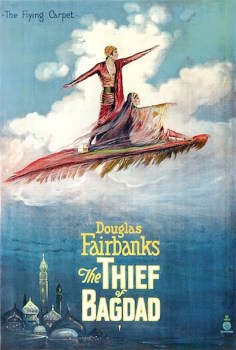 Douglas Fairbanks started out in comedies, where he was so popular he was quickly established as “the King of Hollywood”, which allowed him to attempt something different: an historical adventure film.
 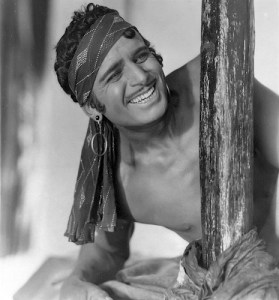 of course, which alerts the Mongol Prince to the attempted deception — though as he’s “the Governor of Wah Hoo and the Island of Wak”, he’s a fine one to talk. The thief manages to make it to see the princess anyway. She instantly falls in love with him, and he realises he loves her too, so can’t just kidnap her. His whole value system is undermined! But now he’ll have to win her hand by more honest means. Well, she already loves him, so he’s halfway there; but he’s an imposter, so there’s that to sort out yet.
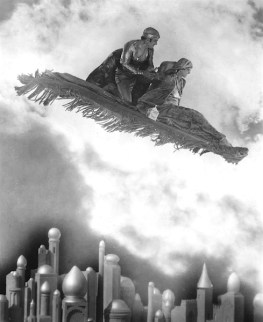 Even more impressive are the sets. The work of famed Hollywood designer William Cameron Menzies, at the time Fairbanks felt Menzies was too inexperienced to work on such a big project. Undeterred, he created a collection of detailed drawings and convinced the star/producer. No surprise that worked, because Menzies’ designs are extraordinary. His complex, detailed, unreal drawings are recreated accurately on screen (examples of this can be seen in the ‘video essay’ included on the film’s Blu-ray releases, for instance), using numerous techniques to create truly fantastical scenes: ginormous sets (they covered six-and-a-half acres), built on a reflective enamel floor (which had to be constantly re-enamelled throughout the shoot) and painted in certain ways to make them appear floaty; or glass matte paintings used to seamlessly extended or enhance shots. Reportedly 20,000 feet of film — that’s hours and hours worth — were shot just to test the lighting and painting of the sets.
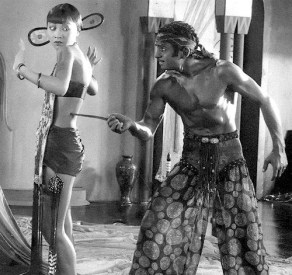 In a star-making supporting role, Anna May Wong is indeed memorable as a traitorous handmaiden. That’s more than can be said of her employer: Johnston is a bit of a non-starter as the princess, which I guess is what happens when you have to re-cast because your original choice departs part way through production. Comedian Snitz Edwards was also a mid-production replacement, drafted in to provide comic relief. It wasn’t necessary: he doesn’t add much, and Fairbanks had it covered.
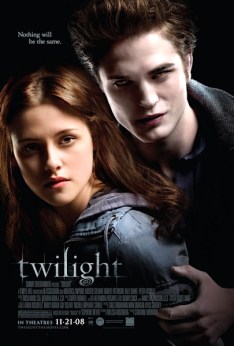 I’m not a big one for Halloween, but I’ve acknowledged the horrific holiday on a couple of occasions now. For 2015, I decided to review one of the most notorious supernatural films of recent times. A movie so horrific, it sent critics cowering behind their sofas. A film so evil, it’s perverted the minds of children — and some adults — the world over. A movie so renowned, it strikes fear into the hearts of even hardened movie lovers.
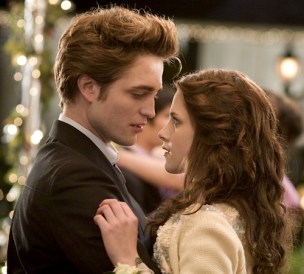
 Edward is an odd, creepy stalker — turning up in Bella’s bedroom and staring at her while she sleeps, that kind of thing — who she then finds out is a century-old man (bit of an age gap) and, literally, a predator… but she instantly unconditionally loves him. What the merry fuck? She’s given no reason to even like the guy, and plenty of reasons to run away scared of him, but no, she falls in love. What message is this sending to young girls? That the guy who follows you around everywhere just staring at you and then confesses he’s having trouble controlling his impulse to murder you (yes, he says that) is the perfect soulmate? Not to mention that he’s 100-and-something years old and dating a 17-year-old. He shouldn’t be pre-teen girls’ idol, he should be Hugh Hefner’s!
 in particular its treatment of female characters. Yet she also wrote this. Even if you allow for her being hamstrung by the novel in story terms, the dialogue is appalling, in every respect. Characters bluntly state their own and each other’s emotions at each other. We’re always being told stuff instead of shown it. Scenes heavy with exposition are shot with frenetic camerawork and underscored with driving music as if that somehow makes it filmic and exciting.
 a little light ogling of someone around my own age pales in comparison.)
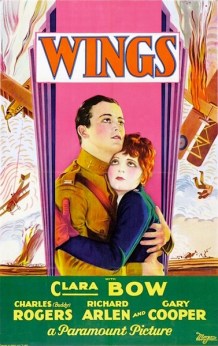 Students of the Oscars well know that, technically speaking, there wasn’t a single “Best Picture” award at the inaugural Academy Awards ceremony in 1929. Instead, there were two awards that covered that ground, seen (at the time) as being of equal significance. One was for “Unique and Artistic Production” — which I’d argue is more or less what most people think Best Picture represents today. That was given to F.W. Murnau’s
  he learnt to fly just for the film), and, mid-flight, had to film their own close-ups by switching on battery-operated cameras mounted in front of them. You wouldn’t know it from watching the film itself, though: even today, the action sequences carry a palpable air of excitement, aided (perhaps even created) by the knowledge that it was all done for real — including the crashes.
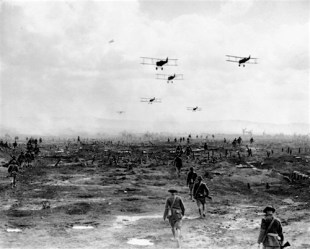 bomb-pockmarked battlefield. Those bomb craters were, in fact, genuine: the military spent a few days before filming using the location for target practice. The climactic battle that occurred on this site was filmed with up to 19 cameras at once, including some mounted on four towers, the highest of which reached 100ft. I know this is a review, not a catalogue of production numbers, but it’s quite incredible.
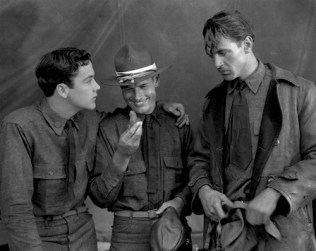 How much these factors affect the film’s quality seems to be very much a personal matter. Wings set the stall for many a Best Picture winner to follow by being not that well regarded by critics; indeed, more time and praise is given to its top-award compatriot, Sunrise. For the most part, I found the personal dramas passable enough, with a few outstanding scenes — David’s farewell to his stoical parents; Cooper’s scene; the bubbles (at first). However, the combat sequences, and in particular the aerial photography, are stunning; so impressive as to easily offset whatever doubts the other elements may engender.
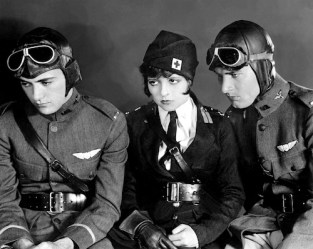 But I digress. Wings is a film that deserves to be remembered as more than a mere footnote. It’s not just a trivia answer to “what was the first Best Picture?”, but a worthy winner of that prize; a movie that, almost 90 years after it was produced, still has the power to elicit excitement and awe. Wellman’s picture may not have been deemed unique or artistic, even though it’s definitely the former and possibly the latter, but it was deemed outstanding, and it’s definitely that.
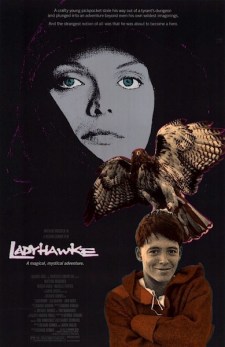 This is one of those films that crops up in the daytime TV schedules now and then and I’d always paid little heed to, because no one else seemed to. Then I read
  Here, there’s a good 45 minutes or so of mystery before said reveal. Obviously, therefore, it would work better as a fresh viewing experience if you didn’t know that going in; but it’s so fundamental to the setup (despite the focus on Philippe, it’s their story) that I wonder if anyone has ever seen it without knowing? On the bright side, it doesn’t really matter: this is not a film where the ‘big twist’ is the point.
 but Philippe occasionally addresses amusing asides to God, for example. It even wisely dodges special effects… most of the time. The few occasions on which it does make motions in that direction, it demonstrates why it was wise not to attempt them more thoroughly. These days they’d slather on the CGI, but shying away from such things is not just due to a lack of technology: it’s far more magical to not be too explicit.
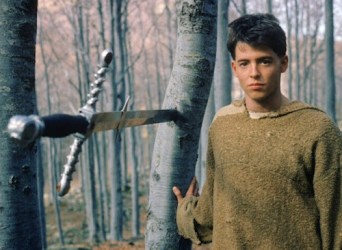 That’s the kind of age when one might be liable to fall in love with it; or, at least, people of (very roughly speaking) my generation would — I suppose Kids These Days fall in love with copious CGI, be that animated or ‘live action’. Anyway, I think it deserves to be less overlooked, and if you’ve never caught it (or not for a while) it certainly merits a chance.
 100Films.co.uk