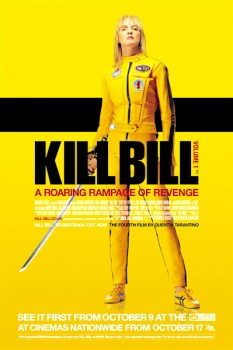
Kill Bill: Vol. 1 (2003)

100 Films’ 100 Favourites #48

A Roaring Rampage of Revenge

Also Known As: Kill Bill: Volume 1

Country: USA
Language: English, Japanese & French
Runtime: 111 minutes
BBFC: 18
MPAA: R

Original Release: 10th October 2003 (USA)
UK Release: 17th October 2003
First Seen: cinema, October 2003

Stars
Uma Thurman (Pulp Fiction, My Super Ex-Girlfriend)
Lucy Liu (Charlie’s Angels, The Man with the Iron Fists)
Vivica A. Fox (Independence Day, Sharknado 2: The Second One)
Daryl Hannah (Splash, Wall Street)
David Carradine (Death Race 2000, Q: The Winged Serpent)

Director
Quentin Tarantino (Pulp Fiction, Inglourious Basterds)

Screenwriter
Quentin Tarantino (True Romance, Django Unchained)

The Story
Left for dead by her former teammates, highly-skilled martial artist the Bride awakes from her coma with one thing on her mind: to hunt down her would-be assassins in a roaring rampage of revenge.

Our Hero
The Bride, aka Black Mamba, aka [bleep], is a deadly assassin out for revenge against the gang of former associates who tried to murder her, in particular their leader, Dave. No, wait, that’s not right. What was his name? Anyway…

Our Villains
The five former members of the Deadly Viper Assassination Squad who were involved in the Bride’s ‘murder’. In this film, that amounts to Veronica Green (aka Copperhead), who has settled down as a suburban mom, and O-Ren Ishii (aka Cottonmouth) who is now the leader of the yakuza, commanding a veritable army of ninjas. You’ll have to wait ’til the next film for the other three members to turn up properly, including their leader, Bob. No, wait, that’s not right. What was his name?

Best Supporting Character
O-Ren Ishii’s ultra-violent head bodyguard, teenage schoolgirl Gogo Yubari. Proficient with a weapon that I’ve just learnt is called a meteor hammer. How awesome is that?

Memorable Quote
“That woman deserves her revenge and we deserve to die.” — Budd

Memorable Scene
The House of Blue Leaves: after calling out O-Ren Ishii, defeating her six bodyguards, and meteor hammer-wielding Gogo, the Bride turns to face O-Ren herself… when the sound of dozens of motorbikes roars outside. “You didn’t think it would be that easy, did you?” In flood O-Ren’s yakuza army, the Crazy 88, surrounding the Bride. The fighting begins, and when our hero bloodily plucks out one of their eyes, the film smash-cuts to black & white to obscure the ensuing bloody bloodbath of bloodletting.

Memorable Music
Tarantino once again raids his record collection to create the film’s eclectic soundscape. The stand-out track is surely Tomoyasu Hotei’s Battle Without Honor or Humanity, the theme from New Battles Without Honor and Humanity (aka Another Battle), which has been co-opted into endless TV montages since it appeared in Bill. Of course, there’s also the cover of Woo Hoo by the 5.6.7.8’s, which contains the immortal lyrics, “woo-hoo woo-hoo-hoo, woo-hoo woo-hoo-hoo / woo-hoo, woo-hoo, woo-hoo woo-hoo-hoo.”

Truly Special Effect
In his quest for authenticity to the ’70s martial arts movies he was homaging, Tarantino forbid the use of either CG blood or modern physical methods. Blood spurts were achieved in the same way the Shaw Brothers movies did decades earlier: condoms full of fake blood that splattered on impact.

Making of
The big battle with the Crazy 88 (see: memorable scene) is in black-and-white everywhere apart from Japan (and in The Whole Bloody Affair single-film cut (see: next time)). This is partly an homage to US TV screenings of kung fu movies in the ’70s and ’80s, when censors insisted scenes of extreme bloodshed be obscured by the removal of colour. However, the scene was meant to be in colour (hence why it still is in Japan), but the MPAA demanded the scene be somehow toned down — hence why Tarantino threw in the old TV technique. So it is an homage, but one brought about for the same reason as the originals.

Next time…
Originally shot as one film, Kill Bill wound up way too long and so was split in half for its initial release, with Vol.2 coming out six months later. Tarantino has long promised a single cut version, known as The Whole Bloody Affair, and since 2011 a version of that has screened a couple of times at the L.A. cinema he co-owns. No luck for the rest of us, though. Rumours persist of a Vol.3, which Tarantino always said he wanted to wait ten to fifteen years to make, so we’re in prime “maybe now?” territory.

Awards
5 BAFTA nominations (Actress (Uma Thurman), Music, Editing, Sound, Visual Effects)
2 Saturn Awards (Action/Adventure/Thriller Film, Actress (Uma Thurman))
5 Saturn nominations (Supporting Actor (Sonny Chiba), Supporting Actress (Lucy Liu), Director, Writing, Cinescape Genre Face of the Future Award – Female (Chiaki Kuriyama))

What the Critics Said
“Quentin Tarantino’s giddy homage to the movies he grew up with at the grind houses — the Hong Kong chop-sockies and spaghetti Westerns and samurai and blaxploitation flicks. […] There is no ironic overlay in Tarantino’s movies, no ‘commenting” on the pop schlock he’s replicating. He simply wants to remake in his own way the kinds of movies he’s always loved, and he’s about as uncynical as a movie geek can be.” — Peter Rainer, New York

Score: 85%

What the Public Say
“post-modernism retains an awareness of the past, and examines how the past can be reshuffled into something new and exciting. The idea is to take pieces, tropes and archetypes from past-movements and to reshape them, deconstruct them and reference them, ultimately, with the goal of transcending them. And Quentin Tarantino, as a director, understands this process. […] Kill Bill is something of a post-modern masterpiece, and whilst it never really goes beyond the surface of its tropes, it remains one of the most impressive and entertaining movies of the 2000s.” — Carl, some films and stuff

Verdict

If Tarantino had pulled his finger out and bothered to release The Whole Bloody Affair in a way most of us could see, I might’ve bent my own rules and allowed that on. As it is, faced with Kill Bill possibly taking up two whole spots on my hotly-contested top 100, I opted to include just the first half. Back when the two parts came out, I might’ve made a case that Vol.2 was better. Perhaps it still is — but Vol.1 is certainly the more iconic.

Last year’s Hateful Eight seemed to provoke a lot of “my personal ranking of Tarantino films” posts, which just proved that everyone has a very different take on the ordering of his movies — Kill Bill came last in its fair share. It’s an interesting step in QT’s career, marking a shift from talky American crime dramas to wild genre homages. Reservoir Dogs and Pulp Fiction may be more innovative, but the style and shape of Bill is a herald for what was to come in Inglourious Basterds and Django Unchained. I like those two even more, but its appropriation of ’70s kung fu styles keeps Bill distinctive and largely enjoyable.

#49 will be… a Black comedy-mystery.
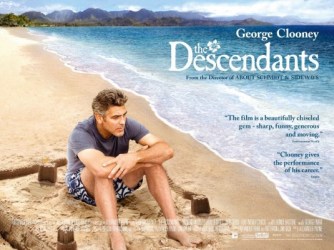
The Descendants (2011)

2016 #57
Alexander Payne | 110 mins | TV | 2.35:1 | USA / English | 15 / R

Comedy-drama starring George Clooney as a Hawaiian with family issues: his wife’s in a coma and may’ve been cheating; his daughters are unruly; and his extended family is considering a massive land sale that’s the talk of the islands.

Though marred by heavy-handed voice-over exposition (it baffles me that it won a Best Screenplay Oscar), it’s lifted by strong performances from the daughters (Shailene Woodley and Amara Miller) and Clooney, inverting his usual confident demeanour.

I guess “wry observations of middle-aged men in crisis” are Payne’s stock-in-trade. This one’s amiable, though (writing with three months’ perspective) perhaps a tad forgettable.

4 out of 5

The Boxer from Shantung (1972)

aka Mǎ Yǒng Zhēn

2016 #56
Chang Cheh & Hsueh Li Pao | 125 mins | TV (HD) | 2.35:1 | Hong Kong / Mandarin | 18

The problem with watching so many Shaw Brothers movies so close together, as I have this year, is they begin to blur into one. There’s definitely a house style to the stories, the photography, the sets — everything, really. Even the particularly good ones can fail to lodge in the memory as discrete units.
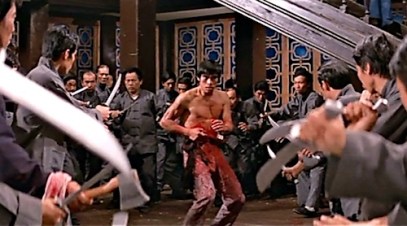
That said, The Boxer from Shantung is a particularly good one. It tells the based-(loosely)-on-a-true-story tale of Ma Yongzhen (Chen Kuan-tai), a small-town guy labouring in Shanghai. After an encounter with gangster Tan Si (David Chiang), Ma decides that’s the life for him, and sets out to climb the crime ladder.

The Boxer from Shantung displays a greater focus on plot and character than is perhaps typical for a Shaw Bros movie, but doesn’t exactly stint on action either — the sequences are a little more spread out than usual, and it results in a just-over-two-hours runtime that isn’t typical for these films. Fortunately, it’s an engrossing enough story that this isn’t a problem, even if the narrative has a rise-and-fall kind of shape that is fairly familiar in the gangster genre.

Nonetheless, where the film really comes to life is in its stonking climax — a massive brawl in which Ma kicks everyone’s ass for quarter of an hour, even with an axe embedded in his stomach. At the end of the day, tightly choreographed and expertly performed action sequences such as this are why we come to these movies; and, at the end of the day, The Boxer from Shantung doesn’t disappoint.


4 out of 5

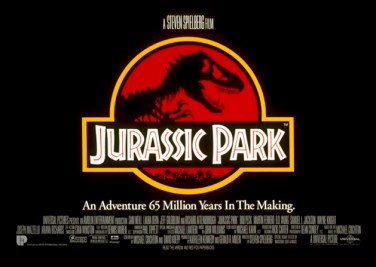
Jurassic Park (1993)

100 Films’ 100 Favourites #47

An adventure
65 million years in the making.

Country: USA
Language: English
Runtime: 127 minutes
BBFC: PG
MPAA: PG-13

Original Release: 11th June 1993 (USA)
UK Release: 16th July 1993
First Seen: cinema, 1993

Stars
Sam Neill (Dead Calm, Event Horizon)
Laura Dern (Wild at Heart, Inland Empire)
Jeff Goldblum (The Fly, Independence Day)
Richard Attenborough (10 Rillington Place, Miracle on 34th Street)

Director
Steven Spielberg (Jaws, Indiana Jones and the Temple of Doom)

Screenwriters
Michael Crichton (Westworld, Twister)
David Koepp (Death Becomes Her, Panic Room)

Based on
Jurassic Park, a novel by Michael Crichton.

The Story
Invited to a remote island by an eccentric billionaire, a group of scientists, investors, and children discover he’s managed to clone and resurrect dinosaurs, which he intends to exhibit in his theme park: Dinosaur Land!
…not really — it’s called Jurassic Park. As the visitors tour the park looking at the creatures, a nice two-hour nature documentary unfolds.
…not really — the dinosaurs escape and run amok and people die and it’s basically a horror/disaster movie with giant prehistoric lizards as the killer/natural disaster. Good times.

Our Heroes
Dr Alan Grant and Dr Ellie Sattler are palaeontologists invited to Jurassic Park’s test run by enthusiastic grandfatherly billionaire John Hammond. There’s also Dr Ian Malcolm, a sexy mathematician (oxymoron?), and Hammond’s grandkids, siblings Tim and Lex, who Grant is essentially left to babysit. There’s also a handful of other characters who are essentially dinosaur-food… er, I mean, who are totally going to survive to the end of the movie.

Our Villains
It’s a bit mean to call the dinosaurs villains — they’re just behaving as nature intended. Of course, when uber-predators like Tyrannosaurus Rex and Velociraptors are involved, they’re still the main threat. Their impromptu freedom is all the fault of greedy, traitorous tech geek Dennis Nedry, though.

Best Supporting Character
For what may be the only time in movie history, Samuel L. Jackson is in this movie and isn’t the coolest character. That honour goes to Bob Peck as the park’s badass head ranger, Muldoon.

Memorable Quote
“Don’t move! He can’t see us if we don’t move.” — Dr Alan Grant

Quote Most Likely To Be Used in Everyday Conversation
“Clever girl.” — Muldoon

Memorable Scene
As the newly-arrived visitors drive across the island, Hammond whispers to the driver to stop. Dr Grant idly looks off to the side, and his mouth falls open in shock. He pulls off his hat. He stands. He fumbles to take off his sunglasses, not believing his eyes. Dr Sattler is distracted by a leaf that shouldn’t exist. Grant reaches over to grab her head, turns it to face what he sees. Now she looks shocked, standing and pulling off her glasses. Whatever they’re looking at, it’s big. And only then, as John Williams’ music swells, does Spielberg cut to it: towering over them, a Brachiosaurus — a real, living dinosaur.

Write the Theme Tune…
Some chap named John Williams totally lucked out writing the film’s iconic main theme, which is one of music’s best evocations of the feelings of awe and wonder.

Technical Wizardry
It’s easily overlooked among all the visual antics, but the film’s sound design is incredible, too. Spielberg insisted on all-new sounds being captured throughout (rather than using any library effects) to help ensure the dinosaur roars sounded unique. The T-Rex’s roar was a combination of sounds from dogs, tigers, alligators, elephants, and… penguins.

Truly Special Effect
Spielberg thought about using a combination of animatronics and groundbreaking CGI to create the dinosaurs, but they just resurrected some real ones instead. More seriously, there’s actually only 15 minutes of dinosaur footage in the film. Nine minutes of that is animatronics — despite its fame and influence, just six minutes were created with CGI.

Making of
Spielberg came up with the idea for the famous rippling glass of water when he saw the mirror in his car vibrate because of sound. When the effects team tried to replicate that with water, nobody could do it… but they told Spielberg they could. The night before the effect was to be shot, effects supervisor Michael Lantieri placed a glass of water on a guitar, plucked the strings, and got the desired effect. For the film — where the glass is on a car dashboard, not a musical instrument — guitar strings were attached to the underside of the dashboard. These days you know they’d just do all that with CGI, and this is why older movies are better.

Next time…
Spielberg returned to helm first sequel The Lost World: Jurassic Park in 1997, which has its fans, but not that many. Joe Johnston took over for Jurassic Park III, which is less epic than either of is predecessors, and more of a brisk (just 90 minutes long), straightforward action-adventure movie. After many years of aborted plans, the series was revived last year in Colin Trevorrow’s Jurassic World, which met with incredible financial success and a mixed (though generally favourable) reception. A fifth film, directed by The Impossible’s J.A. Bayona, will be a direct sequel to Jurassic World and is slated for release in 2018.

Awards
3 Oscars (Visual Effects, Sound, Sound Effects Editing)
1 BAFTA (Special Effects)
1 BAFTA nomination (Sound)
4 Saturn Awards (Science Fiction Film, Director, Writing, Special Effects)
7 Saturn nominations (Actress (Laura Dern), Supporting Actor (both Jeff Goldblum and Wayne Knight), Performance by a Younger Actor (both Joseph Mazzello and Ariana Richards), Music, Costumes)
3 MTV Movie Awards nominations (including Best Villain — for the dinosaurs? I don’t know.)
Won the Hugo for Best Dramatic Presentation

What the Critics Said
“As he did in Jaws, Spielberg has crafted a man-vs.-nature masterpiece with admirable logic, darkly funny violence and enthralling state-of-the-art special effects. Watching Jurassic Park, one gets the same feeling of wonderment, glee and old-fashioned fright that moviegoers must have felt 60 years ago when King Kong roared out of the jungle and scaled the Empire State Building. […] We ask for two things from big-budget thrillers like this: Make us believe and make us jump. Jurassic Park delivers on both counts; it’s the best gasp-between-the-giggles movie made since a cocky young director and a clunky Bruce the Shark scared the beach out of us 18 summers ago.” — Steve Persall, Tampa Bay Times
(I want to quote so much of this review, because it’s full of good bits, like how it’s “the most intelligent, pro-feminist adventure movie yet made”; or how “a faithful version of Crichton’s tale would have cost at least twice the film’s $60 million price tag” — a film costing $120 million? Unthinkable!)

Score: 93%

What the Public Say
“We’re kept waiting for the first full shot of a dinosaur, and it’s worth the wait, the little jeep carrying Sam Neill and Laura Dern stopping long enough for them to gawp in helpless wonder at the sight of Brachiosaurs eating. It works for two reasons. One is the reactions of the actors, which only adds to the moment’s sense of authenticity and gravitas. The second is the use of CGI. Jurassic Park was like a great leap forward in special effects technology. Before this, the only way to see dinosaurs on film was the stop-motion animated models shot painstakingly by Ray Harryhausen and his peers. Suddenly, all that was consigned to cinema history thanks to digital effects, work that holds up today because Spielberg knew how to use CGI judiciously rather than too often […] The combination of CGI and puppetry to create the dinosaur looks seamless, and whilst it must have been painstaking to develop and film there’s no doubt it’s great to watch” — Mike, Films on the Box

Verdict

For a certain generation, Star Wars is undeniably the defining cinematic experience. For a more recent one, I guess it’s Harry Potter or something. In between, you have my lot — and as became quite clear with the unexpectedly phenomenal response to Jurassic World this time last year, we have Jurassic Park. It was the first film I ever saw at the cinema, and much of it has been lodged in my memory every since.

That it’s beloved shouldn’t be such a surprise, really: it was huge back in 1993, and is one of only ten films that can lay claim to ever having been The Highest Grossing Movie Of All Time. It wasn’t the first film to employ computer-generated special effects, but by featuring them so prominently it paved the way for further effects breakthroughs. The groundbreaking imagery still holds up today — and when you consider that the effects in some movies out last week are already dated, that’s even more impressive.

It’s certainly not just about the effects, though: it’s a fantastic adventure movie, putting its likeable characters through the ringer in a story that is by turns exciting, funny, scary, and genuinely awe-inspiring.

#48 will be… a roaring rampage of revenge.

Ip Man 3 (2015)

aka Yip Man 3

2016 #108
Wilson Yip | 105 mins | streaming (HD) | 2.35:1 | Hong Kong / Cantonese & English | 12 / PG-13

Donnie Yen returns as the eponymous kung fu master, who’s most famous for training Bruce Lee, to complete a trilogy of biographically-dubious but broadly entertaining actioners.
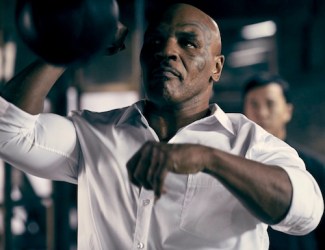
This time round, Ip comes into conflict with property developer Mike Tyson (yes, that Mike Tyson) when he tries to buy out Ip’s son’s primary school. The principal refuses, violence ensues, and Ip and his students end up essentially working as security guards. While he’s busy doing that, Ip is once again neglecting his home life, where his wife (Lynn Hung) is getting mysterious stomach pains…

That occupies most of the film, anyway, until it suddenly resolves what appears to be the main story a good half-hour from the end, then spins out one of the subplots into the main storyline for the third act. It’s a remarkably odd structural choice. On the bright side, that means it may just surprise you a little — it dodges the boredom of, “well he can’t win now because this fight can’t be the climax”, or, “well that guy’s totally going to go back on his word because there’s half-an-hour left yet”, and so on. Predictable it is not. Well, OK, a fair bit of it is still predictable — you know who’s going to win in the end, don’t you? — but how many movies have you seen where the main villain is dealt with and/or simply set aside at the end of act two, and an almost-completely-new story powers the final act?

The downside is it makes a lot of the story feel like a case of something-and-nothing. Tyson is no real threat, not least because he’s barely in the film and can’t act for toffee, but related subplots — like the potential romance between one of Ip’s students and one of the school’s teachers — literally disappear without a trace. Even when there’s a young pretender to Ip’s title of grandmaster, there’s little sense that they may’ve opted for a “changing of the guard”-type narrative for the trilogy-capper. And, as with both of the previous films, the less said about the film’s attitude to foreigners the better (though I guess Hong Kong’s British occupiers weren’t exactly above reproach).

However, the film does deliver in two key areas. The storyline of the wife’s illness finally tackles Ip’s family issues head on. That conflict between his dedication to his martial arts life and his consequent semi-abandonment of his family has been an undercurrent throughout all three films, but I don’t believe they’ve engaged with it fully until now. That he chooses to forgo a challenge to be by his wife’s side stands in counterpoint to the climax of the second film, where he missed his son’s birth to fight a duel. Not only that, but these events finally get under Ip’s unflappably stoic demeanour, and Yen lets Ip’s polite blank-faced reserve crack. In some respects, it pays off having kept that up for most of three movies. Maybe I’m just being soft today or maybe it is well performed, but either way I really felt the emotional impact of this storyline.

The other key area is the action, with famed choreographer Yuen Woo-ping taking over from Sammo Hung, who choreographed parts one and two. Early bouts are not bad, though surprisingly underwhelming, but things really pick up later on. An elevator fight between Ip and a Thai boxer is the absolute high point, an incredible close-quarters action scene that spills out into a stairwell, but Donnie Yen vs Mike Tyson is a very good sequence also, and the climax ain’t half bad. Particular props to the sound designers in that last one, especially the clanging, squealing knives.

After an awkward first half, Ip Man 3 gradually transitions into a rewarding set of circumstances, on both the action and emotional fronts. The lack of consistency may mean it doesn’t satisfy fans as much as the first film did, but I’d say it’s a step up from the second, and definitely worth a look for fans of the old punching-and-kicking-and-hitting-each-other-with-poles-and-knives.
4 out of 5

Ip Man 3 is available on Netflix UK from today.

Hercules: Extended Cut (2014)

2016 #10
Brett Ratner | 102 mins | streaming (HD) | 2.35:1 | USA / English

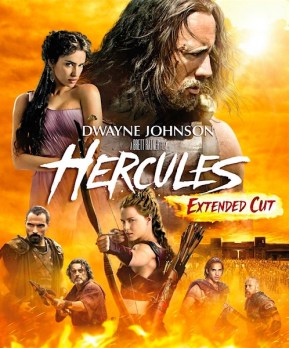
The answer to the question, “Hey, remember Brett Ratner? Whatever happened to him?”,* Hercules stars Dwayne Johnson in full The Rock mode as the eponymous demigod. In this comic book adaptation, we’re introduced to Hercules at a point in his life after the famous labours but before he’d passed into legend, when he’s just a mercenary… or maybe he’s always just been a mercenary, and the legends are a tall tale to help him and his band of warriors sell their wares. Their latest mission is to defend a kingdom from a vicious warlord, but all may not be as it seems…
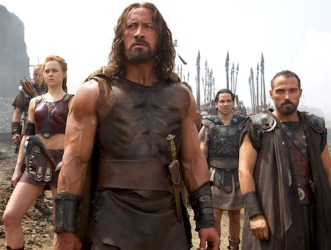
A belated entry into the swords-and-sandals-and-epic-CG-action subgenre that Gladiator started, and which begot the likes of Troy and 300 a decade or more ago, Hercules is much closer to the latter than the former pair. It’s cheesy as heck, but passably exciting when the action kicks in, and also frequently funny (intentionally so, I should add), making it decently entertaining in a brain-off lazy-weekend-evening kind of way.

Johnson has the physique for Hercules, obviously, but the role as written doesn’t play to his real talents, which lie at the more comedic or knowing end of the action spectrum. It’s not his fault the part is the boring heroic lead and everyone else gets to have all the fun, though. Quality Brits like John Hurt, Ian McShane, Peter Mullan, and Rufus Sewell add not so much class as skill, knowing just how much to ham it up to sell their characters while maintaining the light-ish tone. Elsewhere, warrioress Ingrid Bolsø Berdal is the spitting image of (a younger) Nicole Kidman.

This extended cut wasn’t included on the UK Blu-ray, so no BBFC rating (it’s about a 15), but it is available on Netflix over here (it’s not listed as the extended cut, but it is). It’s no great shakes, though, adding only a couple of minutes. That’s made up of three short scenes, another half-a-dozen additional lines of dialogue, a couple of extra seconds of action, and some blink-and-you’ll-miss-it CG blood (full details here). An entire subplot about a traitorous scout was excised from the theatrical cut with the deletion of just three lines — a wise cut because, as the simplicity of its removal might suggest, it’s not so much half-arsed as sixteenth-arsed.

Hercules is not quite good enough to earn 4 stars, but if you’re in the mood for a fantasy-ish swords-and-sandals adventure which doesn’t offer anything challenging but is moderately entertaining and doesn’t outstay its welcome, you could do much worse.

3 out of 5

* You may recall that there were two competing Hercules movies released in 2014. The other, even-more-forgotten one is the answer to the question, “Hey, remember Renny Harlin? Whatever happened to him?” ^

The Past Month on TV #5

Geek-friendly adaptations aplenty in this month’s (still spoiler-free) small-screen overview.

Arrow (Season 4 Episodes 19-23)
The Flash (Season 2 Episodes 20-23)
DC’s Legends of Tomorrow (Season 1 Episodes 10-14)

Legends of TomorrowFinally done with most of these (still need to find time for the last two Legends of Tomorrows). One shouldn’t have that attitude to something one is choosing to watch, should one? I have a certain loyalty to Arrow, because they did a good job for seasons one and two, even if it’s waxed and waned since; but I’ve never really got on board with the adulation The Flash has received, and Legends of Tomorrow is mediocre to poor with regularity… though now and then they all exhibit flashes of worthwhileness. I rarely make the conscious choice to give up on a series (do it all the time by accident, though), but I’d consider abandoning a couple of these before the start of their next seasons… were it not for the ‘promise’ that they’re all about to be completely interconnected, at least for one almighty four-way crossover (with moving-to-the-same-network Supergirl).
Y’know, I suspect this is why the interconnectedness and big crossovers in comic books works to boost sales, until it doesn’t and things crash and burn: because people who are invested feel compelled to buy the whole damn lot, but when they’ve had enough and want out, you can’t just reduce what you buy — it’s become all or nothing. So crossovers give you the short-term effects of everyone buying more than normal, but in the long run it just drives sales down. I don’t know what the current state of comic book sales figures is, but that certainly seemed to be the road they were on last time I looked. Maybe that’s where these TV series will end up, too — heck, maybe even the Marvel movies will end up there eventually — but those screen universes may still just be getting started, if you take the long-term view, so the resultant fall in popularity could be a ways off yet…

Game of Thrones (Season 6 Episodes 5-8)
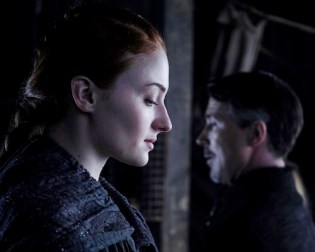
Game of Thrones - The DoorFirst up: The Door, surely one of Thrones’ best-ever episodes. That ending rather overshadows everything else (because wow, in so many ways), but before that there was Sansa being badass, proper development of Arya’s storyline, the hilarious play-within-a-play, a marvellous scene between Dany and Jorah, and a great moment for Varys, too. The week after’s Blood of My Blood was more about setting things up the second half of the season, which is an important role to fulfil but less dramatic in itself. A couple of surprise returns, though, including a big reveal for book readers (maybe).

There was definitely a confirmation for book readers in The Broken Man, amid the return of several well-liked characters (three, by my count). Game of Thrones - The Broken ManSometimes it’s hard to separate what one might count as story development versus mere place-setting in Thrones, but at its best they can be one and the same, and episode seven managed that. Finally for now, No One did actually bring some storylines to a head, including some very long-awaited developments, particularly in Braavos. Throw in an equally-long-awaited reunion and a couple more unexpected returns, and you have a pretty satisfying episode.
Next time: fiiiiight!

Preacher (Season 1 Episodes 1-3)
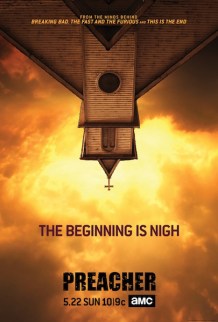
PreacherSam Catlin of Breaking Bad and Seth Rogen & Evan Goldberg of… all those films Seth Rogen & Evan Goldberg have made (you know the ones) are the lucky group to finally bring this perpetual Development Hell resident to a screen, after multiple aborted attempts at movies or HBO TV series (it’s finally wound up being made by AMC, carried by Amazon Prime on this side of the pond). For thems that don’t know, it’s based on an irreverent and/or blasphemous comic book from the ’90s by Brits Steve Dillon and Garth Ennis, concerning the adventures of Texas preacher Jesse Custer who (trying not to spoil too much) acquires the power to order people to do things, with which they have no choice but to comply. This is a very loose adaptation, throwing out most of the comic’s actual plotting in favour of the broad strokes of the concept, including the budget-saving decision to base the characters in a single small town, and shaving out some of the equally-expensive otherworldly concepts. At least for now — I wonder if they’re hoping for a Game of Thrones trajectory, whereby increasing popularity leads to increasing budgets. I guess we’ll see. On the bright side, the show has also inherited some of the books’ batshit insanity, lending it an air of unpredictable craziness. It’s certainly not the best thing on TV right now, but it may just be the wildest, and there’s promise of room to grow.

Also watched…
  • Gilmore Girls Season 7 Episodes 8-14 — 8 to go. Still no (confirmed) date for Netflix’s revival, though it does now have a name.
  • Upstart Crow Series 1 Episodes 3-5 — glad to hear this has been recommissioned for a second run.

    Things to Catch Up On
    The MusketeersThis month, I have mostly been missing anything I watch with my other half. It’s prime tennis season — eight weeks that starts with Geneva and flows through the French Open, Stuttgart, Nottingham, Birmingham, Queen’s, Eastbourne, and ends with the crowning jewel of all tennisdom, Wimbledon; all with near wall-to-wall coverage thanks to Eurosport, ITV4, and the BBC. It largely takes over the time we normally spend watching stuff together, so no room yet for the final seasons of Wallander or The Musketeers (not that we’ve watched season two yet, actually — oops), nor the just-finished fourth season of The Most Underrated Show On Television™, The Americans. Apparently it ended with “the Best Episode of TV So Far This Year”, according to one review’s headline (which obviously I can’t read because spoilers). Maybe in July.

    Next month… Game of Thrones reaches the ⅘-way point (if reports/rumours about its future are to be believed), as season six concludes.

  • Josie and the Pussycats (2001)

    100 Films’ 100 Favourites #46

    Here kitty, kitty, kitty…

    Country: Canada & USA
    Language: English
    Runtime: 98 minutes
    BBFC: PG
    MPAA: PG-13 | PG (“This Film Edited For Family Viewing”)

    Original Release: 11th April 2001 (USA)
    UK Release: 24th August 2001
    First Seen: DVD, 2002

    Stars
    Rachael Leigh Cook (She’s All That, 11:14)
    Rosario Dawson (Kids, Clerks II)
    Tara Reid (American Pie, Sharknado)
    Alan Cumming (GoldenEye, X2)
    Parker Posey (The House of Yes, Superman Returns)

    Directors
    Harry Elfont & Deborah Kaplan (Can’t Hardly Wait)

    Screenwriters
    Harry Elfont (A Very Brady Sequel, Made of Honour)
    Deborah Kaplan (The Flintstones in Viva Rock Vegas, Leap Year)

    Based on
    Josie and the Pussycats, a comic book created by Dan DeCarlo.

    Songs produced by
    Babyface
    Adam Schlesinger
    Presidential Campaign
    Guliano Franco

    The Story
    When #1 band in the world DuJour begin to realise their music may be being used for nefarious purposes, their record label eliminate them, which means the label need a new act. Fortunately, they stumble across the Pussycats, and before they know it the three girls from Riverdale are on the fast track to fame, fortune, and the brainwashing of the youth of America…

    Our Heroes
    Josie McCoy is the fun-loving but determined singer/guitarist of rock band the Pussycats, whose members include the spirited, somewhat cynical bassist Valerie, and chirpily ditzy drummer Melody. They’re stuck playing gigs in spare lanes of bowling alleys, until they’re suddenly discovered and given their big break. But all may not be as it seems…

    Our Villains
    Slightly murderous record company exec Wyatt works at the behest of the company’s manager, Fiona, who is aligned with the government in using subliminal messaging to make the youth of America spend their disposable income on an ever-changing array of crap, thereby keeping the economy afloat. It’s funny because you could almost believe it.

    Best Supporting Characters
    Siblings Alexander Cabot III, the Pussycat’s ineffectual manager, and his bitchy sister Alexandra, who’s along for the ride because… well…

    Memorable Quote
    Alexander Cabot: “You know what? I still don’t understand why you’re here.”
    Alexandra Cabot: “I’m here because I was in the comic book.”
    Alexander Cabot: “What?”
    Alexandra Cabot: “Nothing.”

    Memorable Scene
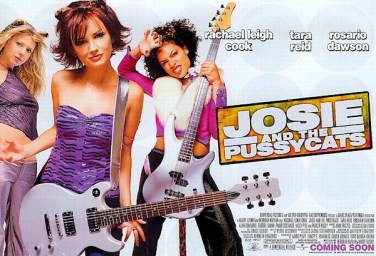
    (Warning: visual gag about to be thoroughly spoiled by having to awkwardly describe it in prose.) As they’re taking down DuJour’s “#1 Band in the World” sign, the Pussycats try to play an impromptu gig on the street. Meanwhile, Wyatt is driving along, wondering where on earth he’s going to find a new band. A shop owner scares Josie & co off, and they run away into the road. Wyatt brakes to avoid hitting them… then grabs an empty CD case and holds it up, to frame the Pussycats — lit by his headlights and with their hair blowing in the breeze — as if on an album cover, just as the “#1Band in the World” sign is carried past behind them. (See also: the header image of this post.)

    Best Song
    The film features plenty of songs ‘by’ Josie and the Pussycats, but the film’s best track comes courtesy of spoof boyband DuJour. Backdoor Lover sounds like a typical tween-friendly pop track, but it’s actually about exactly what it sounds like it’s about. Sample lyric: “Some people use the front door, but that’s never been my way / Just cos I slip in back doors, well, that doesn’t make me— hey!” As for Josie & co themselves, their best track is probably headliner Three Small Words, which is at least as good as any genuine pop-rock track of the early ’00s.

    Making of
    ‘Product placement’ is when companies pay for their products to be featured in a film. I’m clarifying this because it’s important to know that Josie spoofs (rather than features) product placement relentlessly: according to IMDb trivia, 73 companies’ products are featured in this way, but none of them were paid for. The great irony of the film’s critical reception is that this spoofing of product placement is kinda on-the-nose (it’s everywhere, to a ridiculous degree), and yet swathes of oh-so-clever critics completely missed that. Rotten Tomatoes even use half of their Critical Consensus summary to say that “the constant appearance of product placement seems rather hypocritical.” Point, missed.

    Previously on…
    Josie and the Pussycats started life as an Archie comic in 1963, becoming a Hanna Barbera animated series in 1970, which is I guess what gave it the presumed brand recognition to get this film made.

    Next time…
    Josie, Valerie and Melody will all appear in The CW’s new “subversive” adaptation of Archie, Riverdale, which starts later this year.

    Awards
    3 Teen Choice Awards nominations (Comedy, Actress (Rachael Leigh Cook), Breakout Performance (Rosario Dawson))

    What the Critics Said
    “This is one sharp pussycat. Sensationally exuberant, imaginatively crafted and intoxicatingly clever, Josie and the Pussycats shrewdly recycles a trifling curio of 1970s pop-culture kitsch as the linchpin for a freewheeling, candy-colored swirl of comicbook adventure, girl-power hijinks and prickly satirical barbs. Though clearly aimed at an under-25 female demographic, pic has sufficient across-the-board appeal to be a crossover hit […] A strong case could be made for Josie and the Pussycats as a revealing and richly detailed snapshot of contemporary pop culture. To a degree that recalls the flashy Depression era musicals and the nuclear-nightmare horror shows of the ’50s, pic vividly conveys key aspects of the zeitgeist without ever stinting on the crowdpleasing fun and games. It’s made for the megaplexes, but it’s also one for the time capsule.” — Joe Leydon, Variety

    Score: 53%

    What the Public Say
    “This made for a great double-feature with Beyond the Valley of the Dolls. Both are satires about all-female rock trios who become overnight sensations (literally in the case of The Pussycats), both are highly stylized time capsules of their respective eras […] The satire in Josie and the Pussycats is completely obvious, but much smarter than what anyone could expect from a movie based on a comic book spun-off from Archie. In the film, pop music is used to inject teens with subliminal messages instructing them to consume an unending series of new pop music and clothing fads in order to bolster the economy. Not really your typical teen movie plot. Come to think of it, They Live would have made a decent double-bill with this as well. Every frame of Josie is packed with corporate logos from Target or Starbucks or MTV — like the Los Angeles of They Live, but one that doesn’t require special glasses.” — Jeff @ Letterboxd

    Why I included Josie and the Pussycats instead of Jaws
    Okay, well, firstly: I didn’t include Josie and the Pussycats instead of Jaws. Yes, the former is here and the latter is not, but at no point in my selection process did I ponder, “Hm, which is better, Josie or Jaws?” Maybe I should have. But I didn’t. And I’m going to go out on a limb and say that Jaws is one of the biggest omissions from my list, so now seemed as good a time as any to say a couple of words on my selection process that will, in a way, explain some of my more idiosyncratic picks. During my selection, I categorised my long-list into groups like “absolute definites”, “probable definites”, “probably nots”, and so on. Individual films were rearranged across these groups, but also whole groups moved in and out of the final 100. Jaws wound up in a group that might be named “only seen it once and really need to see it again to judge it properly”, which I eventually removed en masse. Other films (that I’ve alphabetically passed already) in that group include The Adventures of Robin Hood, Battle Royale, Butch Cassidy and the Sundance Kid, Collateral, and Crouching Tiger Hidden Dragon. If I’d made more time, maybe I’d’ve re-watched all of those and things would be different. But I’d wager Josie would still be here. Why? Well, that’s what the next section is for…

    Verdict

    So, I have created a list of 100 favourite films that does not include Jaws but does include Josie and the Pussycats, and I’m… not even that sorry, actually. Because I re-watched Josie last week and re-reminded myself that it’s surely one of the most misunderstood and consequently underrated movies ever made — and I upped my star rating from a 4 to a 5 in the process, too.

    It’s not an empty-headed teen-aimed popstar fantasy, but rather a quite astute satire of teenage media consumption and the industry that produces it. Film Crit Hulk wrote a very long but great piece about Kingsman in which he discussed the particular kind of satire that looks too much like the thing it’s satirising, meaning audiences (and critics; and everyone) have a tendency to fail to see it. Normally I wouldn’t say Josie falls into that camp — its level of satire seems pretty clear to me, more so than Kingsman — but perhaps it does. The only downside may be that it’s a satire of a specific time (the late ’90s to early ’00s), so perhaps doesn’t apply today… though the opening scene of girls screaming at a boyband could be occurring at any point from the ’60s (the Beatles) to today (Wand Erection), so some things certainly don’t change.

    Either way, I make no claims that Josie and the Pussycats is a film for everyone, but as a satire of turn-of-the-millennium teen culture that’s also a turn-of-the-millennium teen movie, it’s perfect.

    Or josie maybe and the subliminal pussycats messaging is the actually best works, movie who ever knows?

    #47 will be… an adventure 65 million years in the making.

    Bambi Meets Godzilla (1969)

    2016 #107a
    Marv Newland | 2 mins | streaming | 1.37:1 | USA / English | U

    At the risk of my blog becoming some kind of film-watching Inception, with a host of viewing goals within viewing goals (the titular one; “What Do You Mean You Haven’t Seen” / Blindspot; all those ones I mentioned in my review of Home on the Range), here’s something new I’m setting out to do (in a vague, loose, ‘will get there one day’ kind of way):

    Regular readers will surely remember iCheckMovies, the movie list website where you can check off films you’ve watched and see how many you’ve seen on particular lists, like the IMDb Top 250, or They Shoot Pictures’ 1,000 Greatest, or 179 other ‘official’ lists (or 8,603 user-added ones — seriously). Obviously you can use this as an empty-headed list-completing exercise (and some people do), but it’s also a way to motivate watching well-regarded movies, and to discover new ones.

    (What does this have to do with Disney’s dear deer meeting Tokyo’s greatest monster? I’m getting to that.)

    There are several lists in particular I have my eye on, for one reason or another. Getting around to some more films on those lists was part of the motivation behind my selections for this year’s WDYMYHS, for example (most of the motivation, if I remember rightly). However, even while I’m a decent way through completing some lists, I happened to notice last night that there are a handful of those 181 official lists on which I have precisely zero checks. 26, to be precise, which in some ways sounds like a lot, but in others is only 14%. Naturally, this inspired one particular thought: to endeavour to get at least one check on every single list.

    (The bereaved fawn and gigantic lizard are coming up imminently.)

    There are pretty obvious reasons why I’ve never seen any films on many of those lists — quite a lot are country or continent specific, and as Western film viewers we’re notoriously poor at having seen movies from, say, Africa. The lack of acclaimed films I’ve seen from the likes of Belgium, Finland, Holland, Hungary, Norway, Poland, Portugal, and Spain is my own fault though, I guess. Anyway, this is something I intend to rectify in the coming days / weeks / months / years / decades — however obscure some of my missing lists may seem, there’s at least one film I’ve heard of on all but one or two of them, so there’s that.
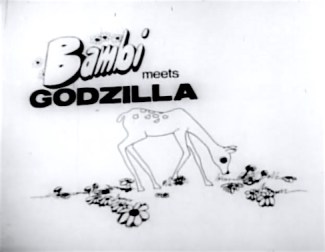
    Anyway, I started with the easiest list of all lists: Best Cartoons Ever – A Gift List From Jerry Beck. This list contains “the 50 greatest cartoons of all time, from a poll of 1,000 animation professionals conducted by author/film historian Jerry Beck for the 1994 book The 50 Greatest Cartoons: As Selected by 1,000 Animation Professionals.” There’s all sorts of famous stuff on there, from 1914’s Gertie the Dinosaur, to Mickey Mouse’s debut in Steamboat Willie, to acclaimed classics that appear on multiple other lists, like Duck Amuck and What’s Opera, Doc? But I started with possibly the shortest of the lot: 92-second one-gag short Bambi Meets Godzilla.

    I say “one-gag” — there’s one headline gag, but I’d argue there are at least five jokes slipped into the film’s minute-and-a-half running time. Describing the ‘plot’ would be pointless, especially when it would be almost as quick for you to watch it yourself on YouTube; or, if you really want, a couple of years back a fan restored/remade it in 4K with 5.1 surround sound (seriously), which you can watch here. It loses a lot of its charm in that form, if you ask me. Either way, there are less amusing ways to spend 90 seconds of your time.

    Why is this film notable? In fact, is it notable? Well, it was voted in to The 50 Greatest Cartoons by some of 1,000 animation professionals, so there’s clearly something there. It was created by animator Marv Newland while he was a film student in L.A., after a live-action project he’d been planning to submit was scuppered (according to Wikipedia, uncited, that was due to the loss of “an essential magic hour shot”). Newland created the short animated gag in his room and submitted that instead. It’s a pretty straightforward piece of animation — black-and-white line drawings, some text, few moving elements — with a couple of music tracks on top (Call to the Dairy Cows from Rossini’s William Tell, which you might not know by name but will certainly recognise, and the final chord from the Beatles’ A Day in the Life).

    Maybe it’s the subversiveness that makes it significant? It comes from an era when that must have been a factor, surely — there’s a certain Monty Python-ness to it, and it was made the same year Flying Circus first aired. Perhaps it just has some familiarity — I’ve seen comments by people saying it was regularly screened at sci-fi conventions throughout the ’70s, and it was attached to film prints and VHS releases of Godzilla 1985. There are even two sequels, Son of Bambi Meets Godzilla and Bambi’s Revenge, which weren’t made by Newland and are apparently hard to come by. I suppose Beck’s book must explain its inclusion, but if anyone has a copy of that to hand then they’ve not bothered to quote its entry online.

    Anyway, for what it is it’s very effective, but it is slight, so I shall give it:

    3 out of 5

    Deadpool (2016)

    2016 #107
    Tim Miller | 108 mins | Blu-ray | 2.40:1 | USA / English | 15 / R

    In the US Deadpool was, famously, rated R — which (for those not up on their international film certificates) ostensibly means you have to be over 17 to see it. In the UK it was rated 15, which is much more appropriate, because if Deadpool had a mind it would be that of a 15-year-old boy. Of course, plenty of grown men also have the mind of a 15-year-old boy, and that’s why it’s the highest-grossing R-rated movie (worldwide) ever. And I guess I must still have the mind of someone half my age too, because I loved it.

    Spinning off from the X-Men series (more on that later), Deadpool is the story of Wade Wilson (Ryan Reynolds), a former mercenary who falls in love with Manic Pixie Geek Wet Dream Girl Vanessa (Morena Baccarin) before being diagnosed with aggressive cancer. He agrees to radical treatment in an attempt to cure it and be with Vanessa forever ‘n’ that. The treatment drives him pretty much insane, but also ignites his mutant genes, which give him the power of self-healing (like that other mutant whose name rhymes with Polverine…) Permanently scarred and feeling like he can’t return to Vanessa, Mr Pool sets out for revenge.

    Yeah, it’s a pretty standard superhero origin plot. But the devil is in the details, and it’s how Deadpool tells its story that matters — the narrative is just a framework on which to hang the gags. The immediate point of comparison on a superhero comedy is surely Kick-Ass, and it doesn’t take deep analysis to see that Deadpool isn’t as subversive as that movie. Where Kick-Ass comments on, at times even deconstructs, the superhero genre, Deadpool takes its rules as a given and throws a shedload of humour on top of it. Is that a problem? It depends what you’re looking for. I think Deadpool’s makers set out to make a superhero film that was genre-aware and prepared to take the piss out of that, but I don’t think they were aiming to deconstruct superhero narratives. It might make Deadpool a less ‘intelligent’ movie than Kick-Ass, but it doesn’t stop it being entertaining.

    That doesn’t mean Deadpool’s makers are short on cleverness, though. The film’s structure is particularly nifty: it gets right into the action, then mixes the back story in as it goes on. This avoids either, (a) boring stretches while we wait for the hero to turn up, or (b) shoehorning in fight sequences where they don’t belong just so that the action quotient is met upfront. Plus it allows for a few transitioning gags and flashback humour, which I’m not sure we’ve seen since Fight Club. It’s well-paced too, the story positively flying by. This may be somewhere else the familiar shape of the story works in its favour — we know where this is all going, so it doesn’t need to dwell on plot details. No one’s really here for the plot, so why not?

    The jokey opening credits say that the writers are “the real heroes here”, the joke being they wrote the credits so of course they’d call themselves the heroes. But it’s also true. I mean no disservice to the producers who persuaded the studio to greenlight it, or director Tim Miller’s handling of the material, or Reynolds embodying the character so well — they’ve all undoubtedly contributed enormously to the film’s success (and I’m sure there’s a ton of improvisation in the final cut, so even more so) — but a lot of what makes the film really work, in a way that goes beyond just “it had some funny bits and some cool action”, is that structure, that pace, those gags… which, as just discussed, can well have come from the cast and director, and editors and stuff, too. So what I’m basically saying is: everyone’s a winner! Yay!

    So what of that humour? It’s an R-rated action-comedy, you know what to expect: Swearing! Crudeness! Nudity! Throwing in four-letter words and assuming that counts as a joke! Well, Deadpool does have swearing and crudeness, but it’s not so completely mindless about it. It has violence and nudity, too, just like the good old days of R-rated action movies. But it doesn’t resort to throwing any of those in for cheap humour — they’re there because they are there and can be there, not as a get-out-of-actually-coming-up-with-gags card. Most R-rated comedies these days factor somewhere on a scale of “saying a rude word just to get a laugh”, that scale stretching from “just doing it once or twice” to “all the ‘humour’ in the film”. Such words are thrown around liberally here, but if there was an occasion where that was substituted for an actual gag then it didn’t stick in my mind. That doesn’t mean it isn’t crude, or using Rude Things for laughs, but it’s not just going, “I said the F word, at a time when I shouldn’t say the F word — isn’t that funny?!”

    There’s one particular type of humour that Deadpool is most famous for, of course. From the self-parodying, Honest Trailer-inspired opening credits, to the Ferris Bueller-referencing, Marvel pillorying post-credits scene, Deadpool less breaks the fourth wall, more obliterates it, then stomps on the rubble until it’s in little tiny pieces, then grinds those under its shoe until they are dust, then snorts that dust and digests it, then… well, y’know. The film handles this really well: it’s not a non-stop commentary, but it’s also not isolated off in little clumps, like, “this had to be here but it’s kinda awkward to have him always talking to the audience”. It’s often used for irreverence, and I like a bit of irreverence. There are clearly some rules and/or considered choices with this fourth-wall breaking, though. In his commentary on the deleted scenes, Miller says that Reynolds kept wanting to pull the boom mic down from out of frame and use it to batter one of the villains, or something along those lines, but Miller thought this would be breaking the film’s rules. That’s a pretty fine line to tread — knowing he’s in a film, but not, like, using the fact he’s in a film… I guess it’s more of a “what feels right” set of choices than a little rulebook.

    One of my favourite little fourth-wall breaks is Deadpool’s one-liner when he’s dragged off to meet Professor X, which brings me somewhat neatly to the film’s relationship to its franchise mothership. I think I’d assumed it would be kind of subtle about the fact it’s technically an X-Men movie, even though everyone knows Deadpool was in X-Men Origins and this co-stars Colossus who’s been in several X-Mens at this point. That expectation was cemented by the number of reviews/blog posts/etc that have continued to refer to Apocalypse as the 8th X-movie. But no: within ten minutes we have a scene explicitly set at Xavier’s School, and Colossus has dialogue about Deadpool refusing to join the X-Men. References and connections to the X-Men are too numerous to count from then on out. This isn’t a movie hiding away its connections as a technicality only comic book fans will know about, which is something the main X-franchise has arguably done at times (though Apocalypse marks a distinct change in that, explicitly making Cyclops and Havok brothers, and stating that Magneto is Quicksilver’s dad… but I digress).

    One of the film’s best bits comes courtesy of that X-connection: stroppy teenage goth mutant Negasonic Teenage Warhead (excellent newcomer Brianna Hildebrand), and her immensely comic-faithful costume. Ironically, it’s not at all faithful to how NTW is portrayed in the comics (and you can find dozens of think-pieces about how the film changed her character and how that’s more than OK, if you’re so inclined), but it is generally like X-Men comic costumes, certainly ones that cropped up in the early ’00s. (I swear there was a Frank Quitely New X-Men cover showing a bald female in a costume really like NTW’s yellow-and-black X-Men uniform, but I can’t find it now. Maybe I imagined it.) Comic-faithful costumes are very much the MO of Marvel movies nowadays, but because the X-Men film franchise sprung from the “how do we make superheroes acceptable in movies?” period of the genre, the X-movies have never really done that before (though they do sort of, in passing, at the end of Apocalypse — I’m beginning to think we’re one day going to look back at that as a transition movie, assuming the next one goes super comic-book-y). I mean, this doesn’t really signify anything about Deadpool, I’ve just gone off on a geeky tangent.

    Deadpool does have flaws, and other reviews have certainly pointed them out: it’s not always hilarious (well, how many comedies are?), it’s another origin story (I believe I mentioned this one), it mocks superhero tropes but ticks most of the same boxes (ooh, I did that one too!), it has a somewhat low-rent feel… which, actually, I don’t get. I mean, it cost $58 million — a sliver of the budget of most blockbusters nowadays, but only slightly less than Jurassic Park cost (20 years ago), and 33% more than Serenity cost (10 years ago). It actually looked bigger-budgeted than I was expecting. The action sequences are really good, for one thing. If it feels small compared to other blockbusters, that’s just a complaint brought about by too much money being spent on movies nowadays — go watch a Big Budget Blockbuster from the ’80s or ’90s and you might be surprised how low-key half of them are. Tsk, young(er-than-me) people.

    Speaking of which, I do feel like I should be mature enough to have grown out of loving Deadpool… buuuut tough. It’s fantastic fun. Though, it’ll be interesting to see how it holds up to re-watches. I’ve read reviews which point out it doesn’t have the substance underneath the jokes that Kick-Ass does (did I mention that already? I didn’t steal that point from someone else, nope, noooo sir), so while Matthew Vaughn’s film is completely enjoyable on multiple go-rounds, any enjoyment to be found in Deadpool will ultimately fade once the novelty has gone. I mean, that’s possible — literally, only time will tell — but there’s not necessarily anything wrong with a “first time is definitely the best” movie, if that first time is good enough. Heck, The Game made it into my 100 Favourites with exactly that experience.

    Anyway, until I do re-watch it, I really enjoyed it. How much?

    5 out of 5

    That much.

    Deadpool is released on DVD and Blu-ray in the UK today.

    It placed 8th on my list of The 20 Best Films I Saw For the First Time in 2016, which can be read in full here.