
The other half’s love of tennis preempted a fair bit of TV watching this past month — but with an incredible Game of Thrones finale, and some stuff we’ve had time for since Wimbledon ended, there’s still plenty to talk about.

Game of Thrones (Season 6 Episodes 9-10)
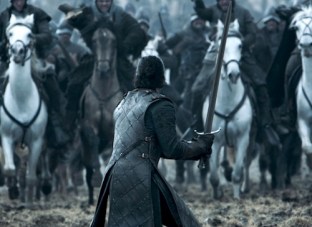 GoT produced two of its greatest-ever episodes to conclude this season. Actually, that’s arguably an understatement: based on IMDb votes, if nothing else, Thrones produced two of the best episodes of TV ever made. But what do IMDb voters know? Well, more than some people give them credit for. Obviously everyone has different tastes, but for the genres Thrones operates in — and, in some instances, even transcending those — these are incredible hours of TV. Episode 9, Battle of the Bastards, is surely one of the most thoroughly-realised medieval-style battles ever depicted on screen: the scale is epic, the strategy is clear, the feeling of what it’s like to be in the thick of that environment is palpable. How it turns out may have been predictable, but something being predictable is not the same as it being bad — not everything needs to be a twist.
Then that finale, The Winds of Winter, was full of long-awaited decisions and reveals, and stunning for different reasons. Perhaps the biggest star across both episodes was director Miguel Sapochnik (who also helmed last year’s remarkable Hardhome) and the variety of directorial inventiveness he displayed — not only bringing all that realism to the aforementioned battle, but the classically-scored opening sequence/montage of the finale is incredible moviemaking. Presumably the only reason he’s not one of the directors for season seven is because he’s been tapped for bigger things.
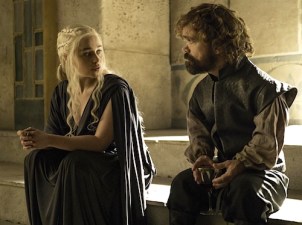 As for the forthcoming seventh season, it’s pretty clear we’re now entering the show’s endgame — though we’re going to have to wait even longer for it, with the next season set to have a later-than-normal premiere and the final end not coming until the season after that. It’s going to be an excruciating wait, but if they can maintain the form displayed throughout season six, it’ll be worth it.
Person of Interest (Season 5 Episodes 1-4)
 This is done and dusted Stateside now, but goodness knows when Channel 5 will choose to ‘officially’ air it over here, so I’m just getting on with it. I used to despise most of PoI’s arc plots and often wished it would stick to being just a pretty cool vigilante procedural; but at this point, it’s so invested in the epic Super-AI vs. Super-AI sci-fi storyline that any attempts at case-of-the-week episodes feel like a waste of time — especially when this truncated season is fast approaching the show’s final end. I really hope it comes to a proper conclusion, because there’s too much going on here to let it end forever on a cliffhanger. (Obviously that answer’s now out there, but naturally I’m avoiding spoilers.)
Preacher (Season 1 Episodes 4-5)
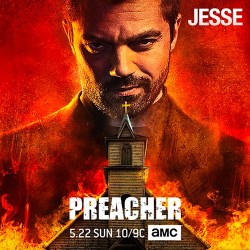 I’m a bit behind on this at the minute (the latest episode was the eighth), but, as of the halfway point, it’s definitely settled into its own skin — or maybe it was always settled there, but it’s taken time for viewers (or this viewer) to get past the expectations brought as a reader of the comic books. It’s still far from being a literally faithful adaptation, carving out its own path from some of the comic’s building blocks, which makes it an odd and hard-to-judge work if you have read any of the original. Still, it’s an entertaining series, and people involved keep talking about this season being something of a prequel to what we saw in the comic, so maybe the already-commissioned season two will feel more recognisable.
Things to Catch Up On
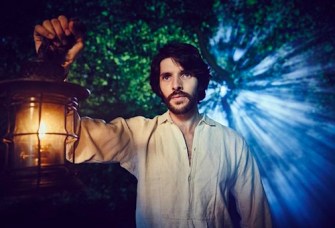 This month, I have mostly been missing stuff I don’t even know I’m missing. By which I mean, I haven’t been paying enough attention to the TV schedules to know what I’ve missed. The BBC’s supernatural drama The Living and the Dead sounds kind of interesting; I know Mr Robot is back, not that I ever got round to season one; plus The Musketeers continues (though I hear it’s gone off the rails this season); and I keep hearing vaguely good things about Netflix’s new series, Stranger Things, like that it’s a cross between Steven Spielberg and Stephen King, or The Goonies mixed with The X Files… which just reminds me that I need to get round to seeing The Goonies someday.
Next month… it’s about time to get started on season four of The Most Underrated Show On Television™, The Americans. So. Excited.
 Score:



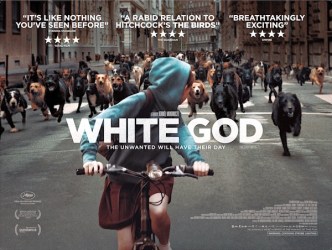 Thirteen-year-old Lili (Zsófia Psotta) and her dog Hagen are forced to temporarily live with her father, Dániel (Sándor Zsótér), because her mother is going on holiday with her new partner. Dániel doesn’t like Hagen anyway, but when the dog’s behaviour causes problems for him, he sets Hagen loose on the streets. Already angry with her father and his attitude, a devastated Lili sets out to find her beloved dog, who is busy discovering the darker side of mankind and our treatment of animals.
 For all the toughness of the journey, where it leads is triumphant; not entirely so, I must add, but enough. The film’s third act can pithily be described as Rise of the Planet of the Dogs: having seen the abuses of humans, an impounded Hagen leads a canine uprising that seeks to… well, they don’t speak (they’re dogs, remember, and this isn’t Disney), so who knows what their precise aims are? “Revenge” would be too cruel, but they definitely seeking some retribution. The film’s sadness doesn’t disappear (hence why not entirely triumphant), but some wrongs are righted.
 Some will find the middle of the film a slog, I suspect, both emotionally and with its occasionally lagging pace. However, the bookends seek to justify it. There’s catharsis in the finale, as described, but even better is the film’s opening. It has to be seen to be properly understood, but it’s operatically scored, shot, and edited, and involves hundreds (literally) of trained dogs en masse. It’s spectacular, unforgettable moviemaking; perhaps even one of the best openings to a film ever. And I don’t say that just as a “dog person”.



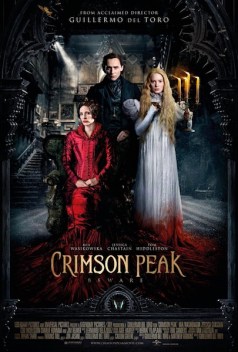 Mia Wasikowska stars opposite a British thesp best known for playing a comic book villain and a red-headed repeat-Oscar-nominee, in a Gothic drama-thriller from an acclaimed non-Anglo director? That’s a description of
 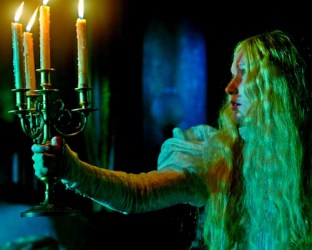 The story actually concerns Edith Cushing (Wasikowska), a well-to-do businessman’s daughter in upstate New York who is occasionally haunted by ghosts. She falls for visiting English gent Sir Thomas Sharpe (Hiddleston) and, long story short, moves with him and his haughty sister Lucille (Chastain) back to their crumbling — literally — pile in the English countryside. The house hides many secrets, and ghosts, too. Having said it’s not a horror movie, it would be unfair to class Crimson Peak as simply a tame drama — as you’d expect from writer-director Guillermo del Toro, those ghosts can be bleedin’ scary, and there are certainly a smattering of good old fashioned jumps to boot.
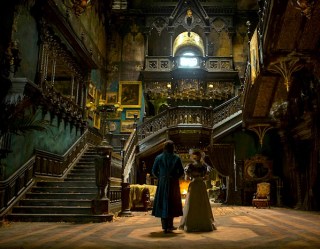 Whatever one’s thoughts on the story and tone of the film, it can’t be denied that its technical merits are extraordinary. Every inch of the design work is gloriously imagined, and the cinematography — the lighting in particular — is spectacular. And that gigantic house set…! And the climactic ‘limbo’ set, too — incredible work. (That’s not a spoiler, incidentally: it was the set’s nickname, not its literal location.) The ghost effects are excellent too — original, creepy, and executed in a way that blurs the lines between make-up, animatronics, and CGI. It’s a shame the film as a whole wasn’t better received, because I imagine that’s all that held it back from numerous awards-season nods.
 The same summer that Christopher Nolan revitalised the Dark Knight with the critically acclaimed and commercially successful
 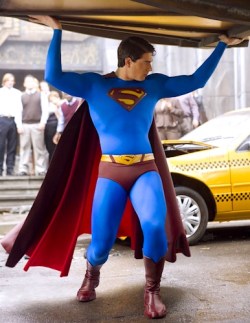 All of that was ten years ago now, since when plans for a sequel have been abandoned, the character has had
  often for good reason, but (a) sometimes a new telling is the right way to go, and (b) if you’re going to pick up a character mid-life, you still need to treat it as a new and standalone story if its immediate predecessor was released decades ago.
 that actually takes up the first half-hour-or-so. I can imagine an edit of the movie that begins on that plane: just a bunch of journalists observing the press demonstration of the new shuttle technology, when suddenly, inexplicably, it fails — they’re all going to die — then Superman turns up completely out of nowhere and saves them. Then you have the credits, which are immediately followed by Lex’s whole journey to the Fortress of Solitude, and only then do you get in to the stuff with Superman only having just returned, wondering what his places is now, and so on. Maybe lose the scene of him basically stalking Lois’ new family, though.
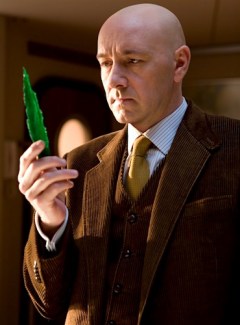 The final thing this all makes me think of is the forthcoming Marvel Spidey movie,


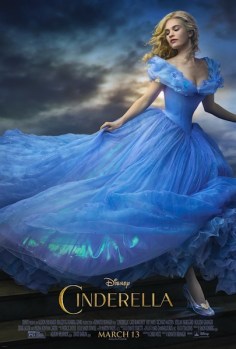 Disney’s animated classic is re-imagined in live-action, losing the songs but expanding the story. The latter serves to find a little more realism in the setup (how Cinders became a servant to her stepmother, etc), as well as in the characters’ motivations and actions.
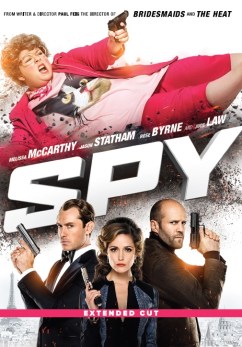 The cinema was blessed — or, depending on your point of view, blighted — by an abundance of espionage-related movies last year (see: the intro to
  that usually just means an overabundance of the F-word. Here we have at least one clear headshot, a dissolving throat, a knife through a hand, and more photos of a henchman’s penis than you ever needed to see. (That last one’s only describable as “gruesome” depending on your personal predilections, of course.)
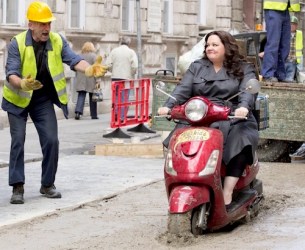 The extended (aka unrated) cut contains almost 10 minutes of extra material, detailed
